
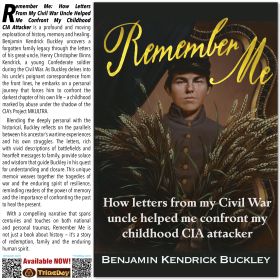
Benjamin Buckley
Civil War letters and CIA Trauma; Guest Gray Mail: Man Replies to 52 Letters from Confederate Ancestor; Unseals Intelligence Scars Benjamin “Ben” Buckley has spent a lifetime navigating the fault lines between duty, secrecy, and personal cost. But his most revealing conversation began not with a living person—rather, with a fallen ancestor. Buckley’s Book is Entitled, Remember Me: How Letters from My Civil War Uncle Helped Me Confront my Childhood CIA Attacker Discovered 52 Civil War letters from great-uncle killed at Gettysburg Replied across 164 years, forging unexpected emotional connection Childhood abuse intersected with early CIA MKUltra-era environments Writing process enabled confrontation with his abuser Journey reveals generational trauma, healing, and hidden intelligence world impacts Buckley, a Washington, D.C.–area native and construction professional who worked on sensitive government sites, is the direct descendant of Confederate soldier Henry Christopher Binns Kendrick, who died at the Battle of Gettysburg. Long fascinated by Civil War history, Buckley also carried something far more personal: the psychological scars of childhood abuse that intersected with the early-era experimentation and culture surrounding programs like MKUltra, as the CIA was finding its sea legs. Civil CIA Not a Thing After retiring, Buckley uncovered 52 letters his great-uncle had written home during the Civil War. There were no replies—only one side of a deeply human exchange preserved across time. Buckley did something extraordinary: he wrote back. Answering those letters became more than a historical exercise—it became a lifeline. Across 164 years, Buckley found a striking emotional and philosophical kinship with a man facing the uncertainty of war. In responding, he began to process his own battles: the moral ambiguity of intelligence-adjacent environments he encountered in his youth, and the trauma inflicted by a perpetrator tied to that world. Through this written dialogue, Buckley confronted what had long remained buried. The act of replying gave him the clarity and courage to face—not just symbolically, but directly—the individual connected to his childhood abuse. What began as an exploration of ancestry evolved into a deeply personal reckoning.Buckley’s story explores how trauma echoes across generations, how war—whether fought on a battlefield or within institutions—leaves lasting imprints, and how confronting the past can lead to unexpected healing. It also raises broader questions about the unseen human cost of early intelligence programs and the environments they fostered. This is not just a Civil War story—it’s a story of survival, confrontation, and resolution. Ben Buckley is available to discuss how a stack of 19th-century letters helped him face a 20th-century darkness—and finally reclaim his own narrative. Buckley’s Book is Entitled, Remember Me: How Letters from My Civil War Uncle Helped Me Confront my Childhood CIA Attacker TO SCHEDULE AN INTERVIEW, CALL OR TEXT 540-598-2814 OR EMAIL BOOKINGS@SPECIALGUESTS.COM USA
Born and raised in the Washington, D.C. area, Benjamin Buckley is a descendent of a Civil War Confederate soldier, Henry Christopher Binns Kendrick, who died at the Battle of Gettysburg. Buckley’s career in the construction industry would take him to many government sites where he encountered how the U.S. was attempting to achieve various national security objectives. Upon retirement, he discovered 52 Civil War letters written by his great-uncle. In reading them, Buckley discovered a striking emotional and philosophical kinship across 164 years. The letters became a critical aide to help Buckley review the darkest chapters in his own life, how he viewed war and abuse, as well as the shadow cast in his life by U.S. intelligence projects such as the CIA’s MK Ultra. |

Robert Eringer Attn Todd Beezley bookings@specialguests.com
Top Brass Tax: Bilderberg 2026: Global Elites Meet Behind Closed Doors and Public Accountability Doesn’t Apply
Robert Eringer doesn’t speculate about secrecy—he’s built a career operating within it. An intelligence expert with firsthand experience in surveillance and covert operations, Eringer brings a rare, insider-informed perspective to one of the most secretive gatherings of global power: the annual Bilderberg Meeting. This year’s confab recently wrapped up and Eringer is uniquely positioned to explain what happened. Elite leaders meet privately, shaping global priorities without public scrutiny AI, warfare, and finance dominate Bilderberg’s 2026 agenda Silicon Valley and Pentagon ties deepen around autonomous weapons NATO tensions drive urgent behind-the-scenes strategic coordination Not conspiracy—coordination among those who influence global outcomesEringer can infer what actually happens when 128 of the world’s most influential figures—from government, tech, finance, intelligence, and defense—meet behind closed doors with no transcripts, no press access, and no public accountability. Convened this year at Washington’s Salamander Hotel (April 9–12), Bilderberg remains officially a “dialogue forum.” In practice, Eringer argues, it functions as something far more consequential: a high-level coordination hub where the people shaping global policy quietly align priorities across sectors that now increasingly overlap. The agenda alone underscores the stakes: artificial intelligence, future warfare, China, energy diversification, digital finance, NATO cohesion, Ukraine, and the Middle East. These are not theoretical discussions—they are the defining pressure points of the next decade. And the individuals in the room are not commentators. They are decision-makers. Eringer highlights one of the most critical and underreported dynamics emerging from this year’s meeting: the accelerating convergence between Silicon Valley and the defense establishment. With figures like former Google CEO Eric Schmidt now openly advocating for AI-driven warfare and autonomous weapons systems, the line between innovation and militarization is rapidly dissolving. The battlefield is going digital—and its architects are collaborating directly with those funding and deploying it. Set against rising internal tensions within NATO and ongoing questions about the durability of U.S. support, Bilderberg 2026 reads less like a philosophical exchange and more like a strategic recalibration session for a strained alliance. Importantly, Eringer strips away both hype and dismissal. Bilderberg, he contends, is not a “shadow government”—but it is a place where politicians, financiers, generals, and technologists synchronize their thinking in private, shaping decisions that will play out in public. For platforms seeking timely, authoritative analysis on the intersection of global power, technology, and geopolitics, Eringer delivers a clear-eyed, experience-driven look inside the room where it all converges. USA
Beginning in 1993, Eringer operated undercover for FBI Counterintelligence in Moscow, Havana, and beyond. In 2002, Prince Albert of Monaco appointed Robert Eringer as his intelligence adviser. He went on to create the principality’s first intelligence service. He currently lives in Montecito, California. Eringer has spent nearly five decades in the intelligence and investigative game. He began as an undercover journalist for Fleet Street and served as a foreign correspondent for The Toronto Star and The Toledo Blade. Infiltrating the Ku Klux Klan was just the start. |

Nick Bryant Attn Todd Beezley bookings@specialguests.com
The Epstein scandal has resurfaced in a surprising and self-inflicted way—this time from the East Wing. In a rare public statement, Melania Trump went out of her way to deny any relationship with Jeffrey Epstein and Ghislaine Maxwell. Epstein’s black book, first acquired and published by investigative journalist Nick Bryant in 2015 seems to indicate a relationship did exist. Three phone numbers and one email address belonging to Melania are in that book. Melania steps in—and puts Epstein back in the spotlight A denial from Melania that raises more questions than it answers Survivors push back on shifting the burden to victims Old contacts resurface, complicating a clean break for Melania A quiet scandal roars back to lifeThe bigger question is: Why would Melania Trump insert herself into the scandal at all? Is she trying to get ahead of something? Nick Bryant has spent years uncovering the Epstein network and is available to explain why this moment matters—and why the First Lady’s decision to insert herself into the scandal is so unusual and potentially revealing. Melania’s statement has already drawn backlash from Epstein survivors, who argue she placed the burden on victims to come forward publicly rather than focusing scrutiny on where they believe it belongs—her husband’s Justice Department. That reaction underscores a deeper tension: instead of distancing the administration from the scandal, her comments may have reignited it. Complicating matters further, previously reported materials—including Epstein’s so-called “black book”—list contact information associated with Melania Trump, raising questions about proximity versus denial. Whether meaningful or incidental, those details make her categorical disavowal more difficult to parse and more likely to invite scrutiny. Bryant can speak to the broader implications of this moment. Why would a First Lady voluntarily reinsert herself into one of the most politically toxic scandals in modern history? Does this signal concern about what could still emerge from unreleased Epstein-related material? Or is it an attempt at preemptive narrative control that instead backfired? More importantly, Bryant can contextualize what seasoned investigators recognize as a familiar pattern in the Epstein saga: when figures go out of their way to publicly deny connections, it often suggests a deeper anxiety about what may yet surface. At a time when the Epstein story seemed to be receding from the headlines, Melania Trump has brought it roaring back—raising new questions not just about the past, but about what may still be hidden. Nick Bryant is available for interviews, live or pre-recorded, to provide expert commentary and analysis on this ongoing story. History, World News, National, World, Emotional Health and Freedom, Pop Culture, Theory & Conspiracy
USA
Nick Bryant has often focused on the plight of children from lower socioeconomic backgrounds in the United States, and he’s been published in the Journal of Professional Ethics, Journal of Applied Developmental Psychology, Journal of Social Distress and Homelessness, Journal of Health Care for the Poor and Underserved, and Journal of School Health. He co-authored America’s Children: Triumph or Tragedy, addressing the medical and developmental problems of lower socioeconomic children in America. His mainstream and investigative journalism has appeared in USA Today Magazine, Playboy, Salon, Vanity Fair, New York, GEAR, Gawker, and Zero Hedge. He spent seven years investigating a child sex trafficking network that was covered up by state and federal authorities, culminating in The Franklin Scandal: A Story of Powerbroker, Child Abuse, and Betrayal. He has also spoken about child trafficking at several conferences, including the International Society for the Study of Trauma and Dissociation’s 2019 international convention and the 2020, 2021 and 2023 Coalition to End Sexual Exploitation Global Summits, and the 2025 International Human Trafficking & Social Justice Conference. Bryant’s LinkedIn profile shows that he’s definitely not a lightweight. He’s also authored Compromised: The Politics of Sex, Lies, and Blackmail, and The Truth about Watergate: A Tale of Extraordinary Lies and Liars. He is the Director of the 501(c)(3) Epstein Justice, which is dedicated to justice for the Epstein victims and government transparency in the Epstein case. Epstein Justice is lobbying for an Independent Congressional Commission, because it is our only recourse to justice. The Epstein scandal will wither and die in a congressional subcommittee, but Independent Congressional Commission often uses non-government personnel that will bounce the issue out of political corruption and partisan infighting. Nick Bryant is currently working on his latest book, EPSTEIN UNREDACTED, which will be an unflinching cumulation of his 15-year investigation into the Epstein case. |
Stephen Willeford Attn Todd Beezley bookings@specialguests.com
The Gun Owners of America discusses a potential new rule that could finally do away with the illegal records. Ever since the Biden era, the Bureau of Alcohol, Tobacco, Firearms and Explosives (ATF) has been keeping a registry of gun records gathered by gun stores, as noted by former President Biden’s “Engaged In the Business” rule. But this isn’t entirely legal, as the ATF managed to digitize these records when gun stores go out of business, according to Gun Owners of America spokesman Stephen Willeford. Clearly this is a violation of federal statutes galore. But not to worry, as the Trump Administration is working on a way to do away with this record keeping. It’s considering a new rule that could do away with this illegal registry, which Congress believes could hold well “over a billion records.” The Gun Owners of America, a group that firmly believes in the right for everyone to bear arms, discussed the problematic searchability of the illegal registry in a highly detailed report, which can be found here. In short, they’re requesting Congress to make sure this Trump-applied rule holds properly. Because, without their action, “this illegal ATF registry can be used for mass gun confiscation, by this government – such as the enforcement of the Biden Pistol Ban – or potentially one day even by this nation’s enemies.” USA
Stephen Willeford represents Gun Owners of America and is known around the country as the “good guy with the gun” for helping stop the largest Texas mass shooting in the history of the state in 2017. He is available to speak about all gun rights issues, as well as the importance of Gun Owners of America. He is the author of the book A Town Called Sutherland Springs: Faith and Heroism Through Tragedy. You can read more about him at http://www.thebarefootdefender.com. |
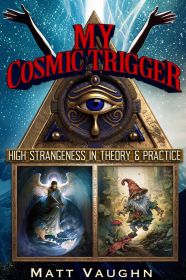
Matt Vaughn Attn Todd Beezley bookings@specialguests.com
Recent comments from Vice President JD Vance describing UFOs as “demons” have gone viral. Most responses have treated this as either a punchline or a scandal. But according to author and high strangeness researcher Matt Vaughn, Vance is actually stumbling into one of the oldest and most serious debates in the field—and getting it almost right. The interdimensional hypothesis is one of the most important questions in the history of UFOlogy—and it has been debated since the field’s earliest days. Are they the gods of the Bible? The fae of Celtic folklore? Demons? Angels? Ultraterrestrials from coexisting dimensions? The question is far older—and far stranger—than the headlines suggest. —————————— What Vaughn Can Discuss:▪ The Interdimensional Hypothesis (IUH). Pioneered by Jacques Vallée and John Keel, this framework argues that UFOs are not alien spacecraft from distant planets but manifestations from coexisting dimensions, realities, or parallel worlds. Keel called these entities “ultraterrestrials”—intelligences that operate outside our normal sensory perception and have appeared throughout human history as angels, fairies, demons, and now as UFOs. Vaughn explores this extensively in My Cosmic Trigger. ▪ Why Vance’s instinct is closer to the truth than mainstream UFOlogy admits. The religious frame of reference Vance defaults to—celestial beings, good and evil, demonic forces—maps directly onto what Keel identified as the phenomenon’s oldest strategy: manifesting in whatever framework the culture of the time can accept. First it was angels. Then mystery airship inventors. Now it’s aliens. Vance is recognizing the pattern; he’s just using one frame when the phenomenon uses all of them. ▪ Operation Trojan Horse. Keel’s term for the phenomenon’s tendency to deliberately cultivate beliefs across multiple frames of reference—religious, technological, extraterrestrial—and then create new manifestations that support those beliefs. The “alien vs. demon” debate is itself a product of this operation. The real first step, as Keel insisted, is to discard all frames of reference and view the phenomenon as a whole. ▪ Why this doesn’t diminish the technology question. The interdimensional hypothesis does not make the physical capabilities of these craft less real or less consequential. Whatever these objects are, they demonstrate propulsion and energy output that defies known physics. If someone has access to that technology—and serious researchers believe classified programs have studied it for decades—the implications for energy, defense, and global power are enormous. The IUH deepens the stakes; it doesn’t replace them. ▪ Why “new mythology” matters more than disclosure. Vallée argued that a new mythology was needed to bridge humanity to a new consciousness. Vaughn builds on this, arguing that high strangeness research—when taken seriously—has the power to dismantle the old frameworks and serve as a bridge to a genuinely expanded understanding of reality. This is what the disclosure conversation is really about. —————————— Matt Vaughn offers a perspective that reframes the entire conversation. He can explain why Vance’s “demonic” framing is both more right than people realize and still not right enough—why the real researchers abandoned the extraterrestrial hypothesis decades ago, what the interdimensional hypothesis actually proposes, and why the technology behind the phenomenon remains the most consequential unanswered question in modern history. History, World News, Paranormal, UFOs, Physics & Metaphysics, National, World, Pop Culture, Theory & Conspiracy
USA
MATT VAUGHN has been a practicing psychotherapist for the past 15 years, working with clients from over 30 countries in his private practice and he has also worked in notable mental health and addiction treatment centers in the U.S.A. He received his MA in psychology from the University of West Georgia. Vaughn has been researching the paranormal for 35 years. |

Jim Harden Attn Todd Beezley bookings@specialguests.com
Rev. Jim Harden, CEO of CompassCare, is available for media interviews to explain why Mamdani’s latest move represents a dangerous new front in the war against religious freedom and medical ethics. NY AG ANTIFA Letitia lawsuit alleges pro-life groups committed business fraud. CompassCare calls case attempt to silence abortion-related speech. Dispute centers on Abortion Pill Reversal counseling and claims thanks to ANTIFA Letitia No cited consumer complaints or proven harm, defense argues. Case may set precedent for regulating nonprofit speech in NY thanks to ANTIFA LetitiaCompassCare and several pro-life organizations were back before the court this week, fighting not only for their organizational survival, but for what they argue is the right to speak at all in what they call “America’s abortion capital.” At the center of the case is New York Attorney General Letitia James, who initiated a May 6, 2024, lawsuit accusing the groups of “business fraud”—a charge their attorneys say is being used as a legal workaround to target protected speech. CompassCare CEO Rev. Jim Harden did not soften his language in court or outside it. He accused the ANTIFA Letitia Attorney General of attempting to “SLAPP us out of the public square simply because she ideologically disagrees with pro-life Christians.” The claim places the case squarely in the category of Strategic Lawsuits Against Public Participation—lawsuits critics say are designed to financially and legally exhaust disfavored speakers until they collapse. At issue is CompassCare’s work informing women about chemical abortion and providing access to Abortion Pill Reversal protocols using progesterone therapy for women who regret beginning the abortion process. According to attorney Chris Ferrara of the Thomas More Society, the state has not identified a single false statement by CompassCare, nor any consumer complaint—despite seeking to restrict their communications and operations. Ferrara argues the case is not about fraud, but about speech control. “The Attorney General has not been able to point to a single false statement by our clients because there isn’t one,” he said of ANTIFA Letitia. “What she’s really trying to do is silence a message she disagrees with.” Harden’s framing is even more direct. He argues that if ANTIFA Letitia succeeds, it will not merely regulate conduct, but “force truth out of the public square while forcing women to have abortions they don’t want in a way that threatens their very lives.” He calls the effort “government coerced quackery,” pointing to 16 medical studies cited by the organization and ongoing FDA scrutiny of chemical abortion drugs, including reports of elevated emergency room visits. The state, meanwhile, maintains it is regulating misleading claims in the public interest. But for Harden, the stakes go far beyond regulatory disagreement with ANTIFA Letitia. He is casting the case as a precedent-setting test of whether ideological enforcement can replace evidentiary law in New York courts—and whether pro-life speech can survive in public discourse at all. As the battle intensifies, CompassCare is not presenting itself as merely a defendant against ANTIFA Letitia, but as a line in the sand: either speech is protected, or it is selectively permitted. And in Manhattan, that question is now being argued under oath. History, Relationship Counseling, Medicine, World News, National, World, Emotional Health and Freedom, Biology & Chemistry
USA
Rev. Jim Harden, a dedicated pro-life advocate and leader of CompassCare, is known for his outspoken views on medical ethics, executive leadership, and pro-life strategy. With a family of ten children and a strong moral compass, he believes in the adage, “Money follows morality.” Harden has been vocal about perceived corruption in federal law enforcement and public policy in post-Roe America. His predictions about the Dobbs decision in 2018 and the demise of the “Red Wave” in 2022 showcase his deep understanding of the political landscape. |

Grant Berry
Grant Berry, founder of Reconnecting Ministries, has long warned about the global rise of antisemitism. But he says what’s unfolding now represents the other side of that same coin: the mounting pressure on Christians in historically significant regions like Lebanon, where Christianity’s roots run deep. Crucially, Israeli military actions are not targeting Lebanon’s Christian communities. Instead, they are aimed squarely at Iran’s proxy network and Hezbollah loyalists embedded within the country. Yet the distinction is often lost in the chaos, leaving Christian communities increasingly vulnerable—both physically and politically—as tensions escalate. Berry can speak to the deeper spiritual and historical implications of this moment: how the erosion of Christian presence in Lebanon mirrors broader regional trends, and how rising antisemitism and anti-Christian hostility are interconnected phenomena fueled by the same extremist ideologies. Attn Todd Beezley/Special Guests M-F 2-8 p.m. Eastern USA
Grant Berry was born in London, England. He is a student of Scripture and a close follower of geopolitics. Berry is the founder of Reconnecting Ministries and Producer of The Romans 911 Project that builds bridges of understanding between Israel and the nations. Grant has written five books, The New Covenant Prophecy, The Ezekiel Generation, Romans 911 – Time to Sound the Alarm!, Romans 911 Study Guide, and The Reconnection Mandate. He also writes for Charisma Magazine and sits on the board of multiple organizations. Grant led missions teams to the former Soviet Union from 1993-1997. As a marketplace leader, Grant was also an entrepreneur in the Cosmetic industry for more than 30 years. Grant is married to Hali Berry, and they have five children. |
David Rubin
Strait Jacket Diplomacy: Israel Watching Closely as Breakdowns in Negotiations over Iran Raise Risk of Wider Regional Confrontation A fragile diplomatic effort is now teetering on the edge of collapse, as the standoff between Iran and the United States shifts from negotiation to open strategic brinkmanship, with the security of Israel and the stability of global energy routes through the Strait of Hormuz increasingly at risk. David Rubin, the Founder and President of the Shiloh Israel Children’s Fund LIVES inside Israel and can provide an extremely unique perspective, on many fronts. One of those fronts includes Lebanon, a location of heavy bombing by the IDF. Supporters of Hezbollah there are actually demonstrating against in-person negotiations between the two countries. What was framed as a pathway to de-escalation now appears to be hardening into a wider regional confrontation, where each failed round of talks only raises the stakes and narrows the options for restraint. It appears that neither Iran nor the United States are on the same page when it comes to peace. Rubin, as well as the children his foundation are desperately trying to rehabilitate from trauma are caught in the crosshairs. USA
David Rubin, former Mayor of Shiloh Israel, is the author of seven books, including his latest, Confronting Radicals: What America Can Learn from Israel, which has recently been made into a movie. Rubin is the founder and president of Shiloh Israel Children’s Fund, established after he and his then three-year-old son were wounded in a terror attack. |
Julie Ryan
Julie Ryan is an entrepreneur, inventor, medical intuitive and psychic medium who learned how to communicate with Spirit and apply it in practical, life-changing ways.
She translates spiritual concepts like angels, intuition, and soul planning, what she calls her Buffet of Psychicness™, into easy-to-understand guidance people can use in their everyday lives.
Julie hosts the Ask Julie Ryan Show, ranked in the top 0.5% of podcasts globally, and is known for delivering actionable insights audiences can immediately use.
If this resonates, let’s get Julie on your calendar. What dates do you have available?
Best,
Terrie Baumgardner
Media Relations for Julie Ryan terrie@askjulieryan.com askjulieryan.com United States
Julie Ryan’s journey proves that intuition and healing abilities aren’t just gifts — they’re skills anyone can learn. A successful inventor and serial entrepreneur, Julie mastered the art of medical intuition, spirit communication, and energy healing more than 30 years ago, blending business acumen with extraordinary spiritual insight. Today, she’s known as a “Buffet of Psychicness™,” able to scan the human body, detect illnesses, facilitate energetic healings, access past lives, and communicate with spirits — both living and deceased — all from a distance. Julie turns her intuitive abilities on and off at will, practicing only with permission and maintaining strict confidentiality out of deep ethical respect. In addition to her intuitive work, Julie’s 45-year business career includes founding nine companies across five industries and inventing globally distributed surgical devices. She’s also the host of the hit podcast, Ask Julie Ryan Show, ranked in the top .05% of podcasts globally, where she scans callers live each week and shares insights that bridge the practical and the mystical. Above all, Julie is a wife, mother, grandmother, and friend — proof that it’s possible to live fully grounded in both the spiritual and the real world. |

Listen Live
RADIO 'AUDIO' SHOWS
Station #1 audio
Station #2 audio
T.V. 'VIDEO' SHOWS
Station #1 video
Station #2 video
Click Here For
More Listening Choices
CALL IN LIVE
TO GET ON THE AIR
- only during live shows -
BBS STATION 1
888-627-6008
Direct 323-744-4831
BBS STATION 2
888-429-5471
Direct 323-744-4841
CUSTOMER SERVICE
- 10:00 am to 10:00 pm CST -
BBS Radio TV
Toll Free: 888-710-8061
Direct Line: 323-744-4828