
Recent comments from Vice President JD Vance describing UFOs as “demons” have gone viral. Most responses have treated this as either a punchline or a scandal. But according to author and high strangeness researcher Matt Vaughn, Vance is actually stumbling into one of the oldest and most serious debates in the field—and getting it almost right.
The interdimensional hypothesis is one of the most important questions in the history of UFOlogy—and it has been debated since the field’s earliest days.
Are they the gods of the Bible? The fae of Celtic folklore? Demons? Angels? Ultraterrestrials from coexisting dimensions? The question is far older—and far stranger—than the headlines suggest.
——————————
What Vaughn Can Discuss:
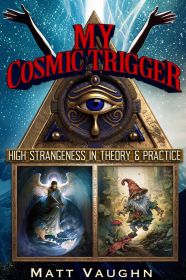
▪ The Interdimensional Hypothesis (IUH). Pioneered by Jacques Vallée and John Keel, this framework argues that UFOs are not alien spacecraft from distant planets but manifestations from coexisting dimensions, realities, or parallel worlds. Keel called these entities “ultraterrestrials”—intelligences that operate outside our normal sensory perception and have appeared throughout human history as angels, fairies, demons, and now as UFOs. Vaughn explores this extensively in My Cosmic Trigger.
▪ Why Vance’s instinct is closer to the truth than mainstream UFOlogy admits. The religious frame of reference Vance defaults to—celestial beings, good and evil, demonic forces—maps directly onto what Keel identified as the phenomenon’s oldest strategy: manifesting in whatever framework the culture of the time can accept. First it was angels. Then mystery airship inventors. Now it’s aliens. Vance is recognizing the pattern; he’s just using one frame when the phenomenon uses all of them.
▪ Operation Trojan Horse. Keel’s term for the phenomenon’s tendency to deliberately cultivate beliefs across multiple frames of reference—religious, technological, extraterrestrial—and then create new manifestations that support those beliefs. The “alien vs. demon” debate is itself a product of this operation. The real first step, as Keel insisted, is to discard all frames of reference and view the phenomenon as a whole.
▪ Why this doesn’t diminish the technology question. The interdimensional hypothesis does not make the physical capabilities of these craft less real or less consequential. Whatever these objects are, they demonstrate propulsion and energy output that defies known physics. If someone has access to that technology—and serious researchers believe classified programs have studied it for decades—the implications for energy, defense, and global power are enormous. The IUH deepens the stakes; it doesn’t replace them.
▪ Why “new mythology” matters more than disclosure. Vallée argued that a new mythology was needed to bridge humanity to a new consciousness. Vaughn builds on this, arguing that high strangeness research—when taken seriously—has the power to dismantle the old frameworks and serve as a bridge to a genuinely expanded understanding of reality. This is what the disclosure conversation is really about.
——————————
Matt Vaughn offers a perspective that reframes the entire conversation.
He can explain why Vance’s “demonic” framing is both more right than people realize and still not right enough—why the real researchers abandoned the extraterrestrial hypothesis decades ago, what the interdimensional hypothesis actually proposes, and why the technology behind the phenomenon remains the most consequential unanswered question in modern history.
MATT VAUGHN has been a practicing psychotherapist for the past 15 years, working with clients from over 30 countries in his private practice and he has also worked in notable mental health and addiction treatment centers in the U.S.A. He received his MA in psychology from the University of West Georgia.
Vaughn has been researching the paranormal for 35 years.