Financial Fitness with The Money Doctor with Frances Rahaim, Ph.D.
BBS RADIO STATION 1
VIDEO-TV and RADIO icons
- press to watch or listen -

Video: https://bbsradio.com/bbsradiotv/bbs-radio-tv.html
Audio: https://bbsradio.com/html5_player/html5_player.htm
*** SCROLL DOWN to Listen to SHOW ARCHIVES ***

Support my show
$5.99/mo or $9.99/mo or more
Click HERE
SUBSCRIBE TO TALK SHOW
A Subscription is NOT REQUIRED to listen to my shows,
but it is greatly appreciated!
“Financial Fitness with The Money Doctor” is a weekly, hour-long National radio show devoted to helping individuals and small business owners better understand their finances and the psychology involved in why we make the decisions we do, how it affects our relationships, our sense of self-worth, and most importantly what we have the power to DO about it! Even prior to this current, highly timely expansion including with BBS Radio TV, which is syndicated to every major audio portal on the world wide web (150 locations reaching every corner of the world), including iHeart, Google, Apple, Amazon, Alexa, etc..., the show enjoyed long-term success in Western MA, Southern VT and NH on WHMP, WHAI, BEAR Country and other SAGA stations, with Dr. Rahaim as a sought-after guest and contributor on News and other talk programs.
Dr. Frances Rahaim’s loyal audience loves her no-nonsense, diplomatic, if sometimes controversial approach to helping sort out difficult issues surrounding effective debt management, successful budgeting, and truly holistic retirement planning and beyond. She has an uncanny ability to translate financial jargon and confusing topics into every-day easy language, engaging her listeners and disarming the stigma around talking openly about money. Rahaim, and her cohost Jess Tyler, Program Director/Morning Show Host WHMP Northampton, banter passionately about real-life, everyday money matters. Nothing is off limits! College, student loan crisis, 401k dos and don’ts, marriage, divorce, insurance, going solar, buying a car, starting a business, you name it. It’s all fair game -- political, economic, and social topics that affect us all, and ALWAYS, what you can DO to give yourself the edge.
In 2008 Rahaim started PowerDownDebt, Inc. right in the middle of the housing bubble. Four years later, she formed HUG Your Student Debt, Inc. to address the crisis not only for students but for parents struggling to retire under the weight of their children’s and often their own college loans still. At 43, with 20 years of experience as an Independent Broker / Registered Investment Advisor, Frances developed a way to address the elephant in the retirement room – becoming 100% debt-free including mortgage, student loans, credit cards, every type of debt, has broad reaching effects on RETIREMENT! Nest-eggs grow faster and last longer without the burden of debt. Today, Dr. Rahaim’s fully dynamic HUG Your MoneyTM software is patented, and she is continuously working on new developments and financial tools to help the public.
What led a top Investment professional to shift her focus toward debt? $10,800 monthly going out in mortgages and business loans, throwing extra money at it and still no real light at the end of the tunnel. In solving her own problem, she found the missing link to retirement planning – the one thing no advisor wants to talk about. The key element that changes everything you THOUGHT you knew about retirement -- liabilities. Now, financial advisors train with her to utilize this path to retirement dollars and help clients, even ones who thought the ship had sailed, get a second chance to reach their goals.
Frances doesn’t just talk the talk, she LIVED this stuff and her listeners get that. They FEEL it! Their comfort level with her non-judgemental approach and down-to-earth demeanor invites questions you never thought you’d hear anyone admit to or ask on the air!
Whether her listeners are interacting or listening in on their neighbors’ stories, this lively show holds their interest and fosters a loyalty rarely found in radio. Part financial, part domestic, part political, part entertainment, always ear-opening, informative and pragmatic.

***Financial Fitness with The Money Doctor is sponsored by:
Justin Lawrence - Franklin County Technical School

Frances Rahaim, Ph.D. — The Money Doctor (also credited as Dr. Frances Rahaim and Dr. Rahaim)
Financial Expert | Author | Host of “Financial Fitness with The Money Doctor”
Dr. Frances Rahaim, widely known as The Money Doctor, is a nationally recognized financial expert, author, and media host with over 35 years of experience in behavioral finance and consumer debt management. She is the creator of the patented HUG Your Money™ system—a financial wellness platform that empowers individuals and organizations to eliminate debt, build smarter budgets, and plan confidently for the future—without harming credit or relying on consolidation loans.
Dr. Rahaim is the founder and president of HUG Your Money, Inc., a financial wellness SaaS firm serving individuals, schools, and employers nationwide. Her trusted approach blends education, emotional insight, and technology—helping users reduce stress, gain control, and build long-term financial confidence.
She hosts the long-running TV and radio show “Financial Fitness with The Money Doctor,” where she breaks down complex money topics with clarity and compassion. Dr. Rahaim is also the award-winning author of Debt or Alive and Retire Debt & Retire Well, and a sought-after speaker known for transforming financial confusion into empowerment.
Ph.D. in Finance
Creator of HUG Your Debt™, Budget™, and Lifestyle & Retirement™ platforms
Based in Massachusetts | Available Nationwide More info at hugyourmoney.com

• turnover
• absenteeism and presenteeism
• delayed retirement
• reduced mobility
• slowed advancement
• strategic caution in decision-making
These patterns are often attributed to culture, engagement, or labor markets.
But another factor may be quietly at work.
Something structural.
A kind of organizational drag that rarely appears on a balance sheet—friction created as financial pressure inside households travels upstream into the workplace.
Employees bring not only their skills and experience to work, but also the financial timelines within which they operate.
Despite the growing availability of financial education, apps, and workplace wellness tools, federal research shows that only 63% of Americans report being able to cover a $400 emergency expense with cash, while 13% could not cover it at all.
This suggests the issue may be less a reflection of education or individual behavior than commonly assumed.
For executive leaders, the implication is straightforward: the pressure affecting workforce stability is not limited to moments of financial crisis—it is embedded in the structure of everyday financial obligations.
When this pressure accumulates across a workforce, it quietly shapes mobility, planning horizons, and organizational stability. The consequences are costly for both individuals and organizations.
In The Quiet Pressure, Frances Rahaim, Ph.D. examines the forces behind this dynamic.
Drawing on decades of work in financial behavior and financial wellness, Rahaim offers a framework for understanding how household financial dynamics influence workforce behavior—and how coordinated financial sequencing, implemented as strategic infrastructure, can stabilize financial timelines and reduce the hidden drag affecting both the workforce and the organizations they support.
Because the pressures leaders are responding to are real.
What is less understood is where those pressures originate—and how structural coordination can relieve them."

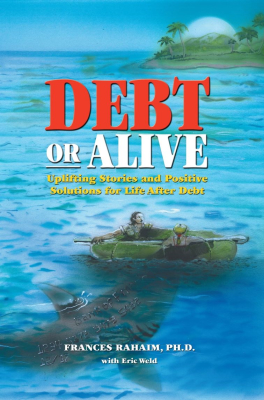
They Found Their Way Out of Debt— Now, So Can You Finally. A book about debt unlike any other. Debt or Alive, a new book by Frances Rahaim, Ph.D. (the Money Doctor), offers readers something that no other book does. It tells the true stories of people just like you— people whose lives were dragged down by debt; who struggled to find solutions and an alternative—any alternative—to debt for the rest of their lives. The dramatic stories told in this book are true in every detail, and shared by people who discovered a path to debt freedom —100 percent, including their mortgage. That discovery changes every single one of their lives. Marriages improve. Futures brighten. College options become a reality. Money becomes a positive notion rather than a source of dread or worry. Debt or Alive declares loudly, that there is life after debt. They too thought they would never find their way out. Some felt the heavy blanket of debt weighing them down, considering debt settlement or bankruptcy. Some just wanting better money–management skills and a brighter retirement. What they all discover, as told through their stories in Debt or Alive, is that there is a way to break completely free of debt without extreme measures like ruining your credit, making higher payments every month or filing bankruptcy. It’s all told in Debt or Alive So Much More Than Stories But more than moving stories, Debt or Alive is an important practical guide to improving your financial picture – whatever it may be. Debt or Alive offers chapters on: Debt Settlement and Debt Consolidation—what are they and how do they work? Building a Better Retirement How to Make a Solid Household Budget Paying for College Good Debt vs. Bad Debt Refinancing Managing Medical Debt and much more! Debt or Alive is a must-read for anyone who is now in debt, has been in debt, or wants to avoid debt in the future. In a little more than 200 entertaining pages you will learn how other people just like you—struggling with debt and not sure where to turn—discovered a way out of debt, 100 percent, including their mortgage. You will also learn practical steps to get or remain free of debt, like: building savings saving money in everyday ways teaching your children about debt strategizing for a debt-free retirement and much more!