
Breaking the Silence, May 3, 2026

Breaking The Silence with Dr Gregory Williams
Youth Foster Care, Social Workers and the Juvenile Justice System
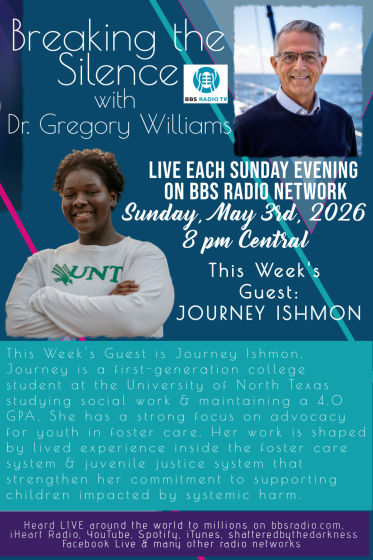
Guest, Journey Ishmon
This Week's Guest is Journey Ishmon.
Journey is a first-generation college student at the university of North Texas studying social work and maintaining a 4.0 GPA. She has a strong focus on advocacy for youth in foster care. Her work is shaped by lived experience inside the foster care system and juvenile justice system that strengthen her commitment to supporting children impacted by systemic harm.
If you wish to get into contact with Journey, invite her to speak at an event or interview Journey. Feel free to contact her at her email: ishmonjourney91@gmail.com
Dr. Gregory Williams hosts social work student and advocate Journey Ishmon to explore the profound pressures facing modern youth and the systemic failures of the foster care system. The discussion highlights the critical importance of breaking the silence surrounding personal trauma and demonstrates how lived experience can be transformed into a powerful engine for social reform.
Invisible Burden of Modern Youth
Today’s youth face a unique landscape of pressure that differs significantly from previous generations, primarily driven by the omnipresence of social media and heightened societal expectations. Dr. Williams notes that young people often feel a relentless need to succeed and "fit in," which is exacerbated by the digital age where every mistake can be broadcasted and archived forever. This environment fosters a "masking" culture, where individuals smile publicly while struggling privately with anxiety and isolation. Journey Ishmon corroborates this, noting that social media creates a false standard of perfection that makes real-life struggles feel shameful and isolating.
Navigating the Failures of Foster Care
Journey Ishmon’s personal narrative reveals the harrowing realities of a system that often prioritizes placement over well-being. Entering foster care at age 13 due to domestic violence and neglect, Journey experienced 10 different placements over four years. Her time was largely spent in group homes and emergency shelters rather than traditional family settings. She describes environments where basic rights like privacy and safety were compromised, including facilities where doors were locked from the inside and windows were bolted with plastic. Despite her "basic" care level and high academic performance, her pleas for a safer environment were frequently minimized or ignored by caseworkers and the system at large.
Turning Pain into Purpose
Despite the systemic harm she endured—including a period of being over-medicated with antidepressants to "manage" a poor environment—Journey maintained a 4.0 GPA and is now a social work student at the University of North Texas. Her advocacy focuses on the shortage of foster homes and the need for "safety nets" that prevent children from entering the juvenile justice system. She emphasizes that while her trauma was temporary, her commitment to changing the system is permanent. Journey now works with programs like PUSH to support foster care alumni in higher education, ensuring that their voices, which were once silenced, are now heard at the highest levels of policy.
The dialogue between Dr. Williams and Journey Ishmon serves as a stark reminder that while the foster care system is often "failed," individual resilience and advocacy can forge a path toward healing. Journey’s story underscores that a person's history does not define their identity, and that "breaking the silence" is the first step in turning life's pain into life's purpose.
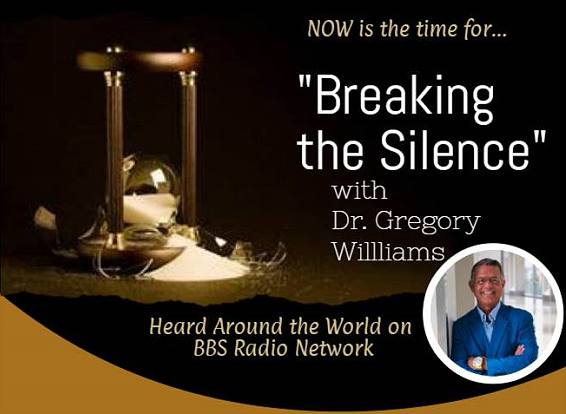
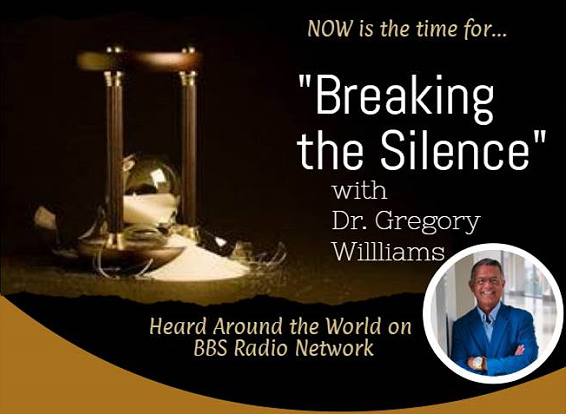
Breaking the Silence
“Breaking the Silence with Dr. Gregory Williams”
Now is the time for you to step out of your own personal darkness and break the silence that has been hidden and closed up inside of you.
“Breaking the Silence with Dr. Gregory Williams” radio program will offer the listeners a Road Map to Hope each and every week with keys to discover within yourself that ray of light to make your day better and brighter. Dr. Williams will not only discuss his own personal journey of overcoming the darkness of years of horrific sexual child abuse in the hands of his father and his father’s friends, but Dr. Williams will also feature special guests that have their own personal stories of overcoming obstacles in their lives and becoming victors instead of victims.
“Breaking the Silence” will also feature information from the professional and medical field that will dive into the important research involving Adverse Childhood Experiences (ACEs) and how to build Resiliency in yourself and in your children. Along with this information will be special guests from greatest minds in the United States to share their expert research and thoughts on this very important subject that each person needs to be aware of.
Now is the time to invest a few minutes each week with some awesome information to give you steps to HOPE and keys to HAPPINESS and PEACE. NOW is the time to Break YOUR Silence and breakout into a NEW and BETTER YOU! Join us each week beginning August 13, 2019 for “Breaking the Silence with Dr. Gregory Williams”. You won’t want to miss a single program. Heard around the world on the best radio network on the airwaves, BSS Radio Network available on iTunes, Google Play, iHeart Radio, Facebook Radio, Spotify and over 100 other high quality digital radio stations.
[00:00] Speaker 1: (upbeat music) Welcome to Breaking the Silence with Dr. Gregory Williams. Dr. Williams is the author of the acclaimed book, Shattered by the Darkness: Putting the Pieces Back Together After Child Abuse. Dr. Williams is on the senior leadership team at Baylor College of Medicine in Houston, Texas. And Dr. Williams travels the United States speaking and training professionals, parents, and victims about the importance of dealing with abuse and personal trauma head-on, and not being afraid to break the silence of your own personal pain. Feel free to call in to tonight's show at 888-627-6008 and speak with Dr. Williams and his guests live on air. And now, your host, Dr. Williams.
[01:13] Speaker 2: (upbeat music) Well, good evening and welcome to Breaking the Silence. I'm Greg Williams, and welcome to my home right here in the medical center in Houston, Texas, which personally I believe is just about one of the best cities that, uh, I've ever come across, uh, if not the country, the, even the world, from my point of view. I just love... I know Texas is the best area, the best state by far, but I just love Houston. But welcome to the program tonight, no matter what country you are from, no matter what state you're from, or where you're even at here in Texas. But, uh, welcome, and you can see the sun's going down, uh, right behind me, and that's the Texas Medical Center right here. And right over yonder is where the Texans football team plays at the NRG Stadium. And, uh, I work right about in that area, right here, uh, at the medical center. So I'm about a couple blocks away, uh, from the office every day, and it's just great to be with you tonight.
[02:19] Speaker 2: And we're gonna have a great guest. This is gonna be one of those that, um, if you have grandchildren, if you have children, uh, if you have friends that are in that, uh, teen, tween, 20, 30s, th- it's gonna be something that you'll want to, uh, listen in tonight, because we're gonna get lots of wisdom, uh, from somebody that has gone through some experiences and wants to share, uh, with you and, uh, the rest of the world tonight what happened to them, uh, how they got through it, and, uh, now how she's gonna advocacy and advocate for other people that are enduring it or experiencing it, and what can we do better, uh, as individuals in the, in the country, as a state, as a community, when it comes to what she's gonna share with us tonight. There's several ways to get involved. I always want to, uh, let you know that right up front. You can call in at 888-627-6008, and that will tap you right into the BBS Radio network.
[03:28] Speaker 2: And Thomas will be answering the phone tonight, and he will patch you right through. If you have a comment or a question for our guest or me, feel free to, uh, any time during the program to do that, and we'll be watching, uh, for that line to light up. And when it does, we'll bring you right on in. Or you can get on, uh, Shattered by the Darkness Facebook page. Uh, we're live on there right now. Uh, and you can comment on there in the comments section. Uh, while you're on there, go ahead and tap Follow so you can follow all the programs that we have. We have some great guests coming up, uh, all the way through the summer months. Uh, or, um, you can dial. Well, not dial, but text me at A323966525. Uh, and I will look here and check it out during, uh, the show too, and I'll read whatever your question is, uh, or whatever your comment is. I'm going to be, uh, speaking this week a couple different places. One's a little grade school.
[04:31] Speaker 2: Uh, there's gonna be about 200 kids there, and, uh, gonna do a wonderful thing on Friday morning. And, uh, then immediately following that, I will be just over yonder, uh, just about several miles there, about, oh, 15, 20 miles, uh, to Fort Bend, uh, County. And, uh, we'll be talking and training judges in the judicial field and community leaders there, uh, in the Fort Bend area. And, uh, Judge Patel has asked me to come to, over there, to just share with them, uh, how to better communicate, how better to, uh, have a mindset of what's it take, uh, to properly understand when somebody has been through, uh, abuse, trauma, toxic stress, uh, high anxiety for a long period of time. How does that, uh, settle into their system, and how's the best way to be able to handle and, and be able to judge and, and monitor, uh, how we talk to them, communicate to them, and how we also process how they respond back to us when we do it properly or improperly?
[05:43] Speaker 2: So we're gonna be talking about that, uh, with them, uh, later on in the week. So it's just gonna be a great week, uh, looking forward, uh, to that. 888-627-6008. I always like to just share. And, and this is coming from a perspective of who we have on tonight, and, um, some things that I've experienced.... and then some things that I'm, right now, in the process of jotting my thoughts down and writing, uh, some pages and, and, uh, some chapters on that I wanna share with you, and I won't share with you right now, but, uh, at a later date of what I'm doing with all of that. Um, when it comes to young people, the youth of today, um, I don't think we can understand it's a different world than what it was when I was 15, 16, 18, 20. Um, high school days, college days. Uh, it's different than what it is now. Uh, today's youth are literally carrying an unbelievable amount of pressure, um, on them.
[07:04] Speaker 2: And this pressure is a pressure to succeed, uh, it's a pressure to just fit in, and we had those kind of pressures as kids, but it wasn't... If it was, it seemed like it was more parental than it is by the whole society, like it, like it is now with social media. Uh, pressure from school, um, and also pressure from social media, of being on there and people liking you and following you or not, uh, when they say something. Uh, pressure from family, uh, expectations. I'm the youngest of the baby of three boys, um, and, uh, I had two older brothers, one five years older than me and 10 years older than me. And I was expected to automatically, I didn't have a choice but to be on the basketball team, and, uh, because both my two older brothers, um, was the MVP, uh, of their eighth grade year, uh, basketball team in grade school and got that little, uh, award and, and my dad just knew that I was gonna be third out of three to be able to do that.
[08:16] Speaker 2: And a- about two years of basketball, uh, fifth grade, sixth grade, I realized that I wasn't, um, wired to be able to, uh, dribble a ball or run down and, and do a layup, or... I just wasn't processed that way. That wasn't me. So I had, had to quit, and I became the manager, uh, my seventh and eighth grade year. And I remember, uh, the pressure of that, uh, letting them down and then making it very well known that I let them down. But probably one of my greatest memories, uh, and I know it may sound selfish or may not sound much to you, but when I was in eighth grade and we all got invited to that awards ceremony in the, the gymnasium where they had all the tables, and they had dinner, and we all dressed up, and, and the parents all came, and the coaches were all at the front table, and the team was all sitting together.
[09:12] Speaker 2: Uh, I was there to get my letter as manager, and, uh, the coach stood up and said he'd been a coach for years, uh, but he had never ran across a young boy that managed like I did, even though I didn't get the MVP. Those few little words that he uttered let my mom and dad know that, hey, he did something not just mediocre. He was the best that he could be, and we appreciate him, and he added to the team and his efforts And just those words, uh, the expectation of what the family expected of me, but then the way I felt pressure from that, and the kids today even have more pressure than, than we ever dream of. Many young people, uh, smile publicly, um, while silently, uh, struggling, uh, privately. And I think sometimes we need to look beyond that. What are they really, really experiencing? And there's just two or three things I want you to jot down.
[10:24] Speaker 2: First of all, if you have a youth or a grandchild or somebody in your church or somebody in your family that looks up to you and you're their mentor or somebody that gives advice, if your uncle, Uncle Bob, and you're the one that, uh, always gets the kids together and talks to them about how to be the best you can be, um, try to encourage them to stop carrying everything alone. Uh, this world, uh, you shouldn't have to be on the journey alone. It should be, uh, a path, a road that a trusted adult can be there with you. Um, a lot of kids think today, "I have to do this all myself. There's nobody else that, that understands me. Nobody else is gonna help me out." Or they have that mindset, "If I, if I tell somebody, um, I'm gonna look weak." And that's just not the case. But isolation, and I wanna hear what our guest feels about this, isolation increases our anxiety.
[11:33] Speaker 2: I think when we incorporate a few trusted people into our inner circle and start sharing with them our thoughts, our dreams, our fears, our misunderstandings, our worries, uh, it can really help, because I think stress grows in secrecy. So we wanna try to break out of that secrecy, and we need to learn to, uh, to find a trusted adult that we can talk to, um, if you have parents and you're in a parent environment... uh, try to talk openly and honestly with parents. I know how hard that is. I really couldn't do that with mine. But if you have some that you can, don't push that away. Lean into them for that. And then when you're overwhelmed, um, try to ask for help to be able to help you through that. Uh, the teenagers today are carrying an emotional book bag of heavy bricks. And those bricks could be grades, fear, rejection, heartbreak, loneliness, insecurity, mom and dad having issues, uh, not being able to live with your biological family.
[12:56] Speaker 2: Um, so try to just stop carrying everything alone. Also, encourage them, and if you're one of the youth that's with our guests, uh, I, I want you to listen to some of these too. Uh, exhale. Learn to breathe. Slow down in today's world. Today's youth live in a constant, statically high noise volume world. And with notifications coming across their phone, the pressure, comparison, entertainment, non-stop activity. There's always something to do and, and a lot of people, uh, have jobs and they go to school and they have a sports team and then they're on this and... Slow down, if you can. Uh, and remember that rest is not laziness. Uh, rest is wisdom. Uh, it allows our brain to just go into that mode of being able to marinate again on what you're gonna have to face tomorrow. You need physical sleep. You need physical rest. You need to limit social media. We're on this way too much. All of us. Five year olds all the way up to 95 years old. Uh, we need to take a break from that.
[14:17] Speaker 2: Uh, take a break from that constant pressure and learn some breathing techniques that can help you let your entire body just rest, relax. And then the last thing, and I'm, I'll land the plane. Need to let you know there's always hope, and I end the program with that line every week, and I'll end it like that tonight. There's hope. And in that, no matter what you're going through, and I want you to catch this with our guest, your story is never over. There's always another chapter that you get to write. No matter where you're at in life, no matter what's been dealt to you, a lot of it is the way we handle the issues. Our reaction to it and our attitudes toward it. So, your story's not over tonight. There's another chapter or two later on, uh, that you get to write. And you may feel hopeless. You may feel invisible. You may feel exhausted. You may feel discouraged. But anxiety does not define your identity. It doesn't. Uh, feelings are real, but feelings are not final.
[15:39] Speaker 2: Tomorrow's another day, and I want to remind you that bad seasons don't last forever. The sun's going down and it's gonna get really dark over the medical center and all across Houston. And you'll see it as the show goes on, it'll be dark outside. I wanna let you know, tomorrow's another day and that sun's gonna come back up. That season that you're going through that is, uh, a negative season, a, a bad feeling season, just, life can't hand you any more than what it's doing right now season, won't last forever. So I wanna encourage you with that and ask for help. Um, it's strength. It's not weakness, it's strength. And the last thing is you matter and you are valuable. Never forget that.
[16:32] Speaker 2: And you're wired in such a way, and if you can take what you've gone through and use it to impact people, and now this is what I, I, I wanna segue, uh, TJ, bring our guest in right next to me here, uh, on the screen, because if you take what you have gone through and turn it into empowerment to change other people's lives, then possibly there's a day when you get a little bit of gray hair and a little bit less hair back here, you can say, "Wow, maybe I went through that. Maybe I endured that. Maybe I conquered that." Not to hide it, but to talk about it, to share it, and help other people. And I wanna welcome to the program tonight, uh, Journey. Journey, um, Ishwan is a, uh, first generation college student at the University of North Texas, uh, studying social work, and she maintains a 4.0, uh, GPA and a strong focus on advocacy for youth in foster care.
[17:47] Speaker 2: And her work is shaped by her life story and experiencing being inside of foster care system and the juvenile justice system that strengthens her commitment now, has given her a foundation of what we need to fix, how do you get through it, how to be better through it, what parents can, can learn from it, and basically helping support children impacted...... by the systemic harm that is caused by probably one of our system's most failed systems. Welcome to the program, Journey. Can you hear me tonight?
[18:31] Speaker 3: Yeah.
[18:32] Speaker 2: Well, good to have you.
[18:34] Speaker 3: Hi. Yeah, it's nice to be here.
[18:36] Speaker 2: You know, we were up at Dallas CASA and, uh, there was a big event up there. Standing room only. They were in the overflow rooms, they were standing around the walls, they had TV set up. And, uh, I was on the program and, and Journey was, I believe, right after me. I'm glad she was right after me, 'cause nobody would have listened to me after listening to her story. And-
[18:58] Speaker 3: Mm-hmm.
[18:58] Speaker 2: ... uh, I leaned over to her afterwards and said, "Hey, would you ever be interested in being on the program?" And she said, "Absolutely." So-
[19:05] Speaker 3: Mm-hmm.
[19:05] Speaker 2: ... welcome to the show tonight, and I appreciate it. From what we just mentioned, uh, right out of the shoot, and then we're gonna talk about you personally, what do you think about what the youth are dealing with today? Am I completely wrong in the pressure and the, the, the roller coaster that the kids are riding right now that's different than what it was several years ago? What's your impact of that?
[19:28] Speaker 3: I think you're pretty spot on. Um, this is the age of social media. Um, it plays a big role in our mental health and our interactions with other people. It's very e- easy to be isolated, um, and to use social media as means of connection, um, but it's not the same as real life. You miss out on a lot of things socially, um, and it definitely impacts your mental health. So I think you're spot on with that.
[19:55] Speaker 2: What kind of pressure, and that you still maybe are going through, what kind of pressure do you have in the world with... in the younger generation that you are? Uh, you're a few generations, uh, (laughs) behind me, maybe five or six. Um, what kind of pressure do we not understand as, as older folk that you would love every person to be able to listen and hear that maybe we don't even realize, Journey-
[20:24] Speaker 3: Mm-hmm.
[20:25] Speaker 2: ... that are listening-
[20:25] Speaker 3: Mm-hmm.
[20:25] Speaker 2: ... to the program tonight?
[20:27] Speaker 3: Mm-hmm. Uh, the first thing that came to mind was, um, about social media, um, and how easy is... it is now for people to be exposed to, like, the whole world. How overwhelming that can be and how easy it is to go viral in a negative aspect-
[20:45] Speaker 2: Mm-hmm.
[20:45] Speaker 3: ... to have something so private, um, and personal, like, as a kid, uh, before the age of social media, you would've been able to live and make your mistakes and experience life without it being on camera and the entire nation having access to it. So it's very, very different now because you make a post on Instagram, someone else makes a post on Instagram, and it's there forever, and it's definitely gonna impact you more when it's never gonna go away and it's always... You know, a, a lot of people have access to it. I think that's a big pressure people have now, um, just from social media. Yeah.
[21:24] Speaker 2: H- have you found that, in your experience or maybe some of your friends' experiences, is there... is this bullying and the online batter back and forth and the, the need to have more followers and more likes and positive comment... Is, is that really stressful in today's world? I mean, is that something that really causes anxiety, uh, in the positive and the negative sense?
[21:52] Speaker 3: Yeah. I could... I would say yes, um, to that, just because you wanna make yourself seem perfect when it comes to social media. You see... You, um, other... You see other people's lives and you get to fantasize about it and you want to kind of... Sometimes some people, um, just make themselves, um, perfect. So it's really easy to look down on yourself when you pick up your phone and every person that you see online is perfect. So, yeah.
[22:24] Speaker 2: Yeah. What, what's the name of the organization that... I remember, I think you had a shirt, a T-shirt on that day, uh-
[22:30] Speaker 3: TEENOICE. Was it TEENOICE?
[22:32] Speaker 2: Say that again?
[22:33] Speaker 3: TEENOICE or Roots to Reach.
[22:36] Speaker 2: Yeah, um-
[22:36] Speaker 3: PUSH Program?
[22:37] Speaker 2: Yeah, that you're involved with.
[22:39] Speaker 3: Yes, the PUSH Program. Yes. Um-
[22:42] Speaker 2: Then tell me about that. What, what's that do?
[22:44] Speaker 3: So basically, we are... There's a... It's a pilot program funded by the Moody Grant, I'm not sure if you're familiar with that. Um, but basically it's to keep foster care alumni and people that have experienced the system in higher education. So that can look like textbook vouchers, one-on-one peer coaching, um, community events, different things like that, just trying to support students and keep them in higher education, create a sense of community on college campuses that support them, guide them. Um, yeah.
[23:20] Speaker 2: Okay. Now, in your world, as a young child, tell me about the story-
[23:29] Speaker 3: Mm-hmm.
[23:30] Speaker 2: ... um, that you shared a little bit with that hundreds of people there at the-
[23:34] Speaker 3: Yeah.
[23:34] Speaker 2: ... Dallas CASA. But, uh, in your own words and however you want to do it-
[23:38] Speaker 3: Mm-hmm.
[23:38] Speaker 2: ... and detailed as you want to go, and I, I'll jump in and, and chase a rabbit with you every now and then. But, um, what, what happened to you? What-
[23:47] Speaker 3: Mm-hmm.
[23:47] Speaker 2: ... uh, is your story behind how you ever ended up in the-
[23:52] Speaker 3: Mm-hmm.
[23:52] Speaker 2: ... foster home system?
[23:54] Speaker 3: Yeah. So I grew up in an abusive household. There was domestic violence in the home. My guardian, um, had some mental illness that wasn't addressed. Um, and they were alcoholic and they were physically abusive. And we moved from state to state, city to city, um, several CPS cases. My older two siblings would do most of the advocacy for us, um, when it comes to making reports to, you know, school and police and all that about what we were experiencing at home. It didn't really...... changed what we experienced. We just went from place to place and all that. And eventually, when I was 13 years old, I was taken into the foster care system. There's a little bit more of, um, to my story, but basically that's the, uh, gist of it all. Um, there was domestic violence, um, alcoholism, and mental health issues. Um, and it led to us being taken into the foster care system in 2020.
[24:54] Speaker 2: What, was it domestic violence with the guardians-
[24:58] Speaker 3: Yes.
[24:58] Speaker 2: ... t- each other-
[24:58] Speaker 3: And the children.
[24:59] Speaker 2: ... or to you?
[25:00] Speaker 3: No. There was only one guardian. One guardian, five kids. I have five sib- four siblings.
[25:04] Speaker 2: Okay. So there was, there was verbal abuse, emotional abuse-
[25:07] Speaker 3: Physical abuse.
[25:08] Speaker 2: ... maybe neglect, on you as a child?
[25:10] Speaker 3: Yes. Yeah.
[25:12] Speaker 2: When you were put in foster care, at what age? Was your first foster placement-
[25:16] Speaker 3: 13 years old.
[25:17] Speaker 2: How, 13?
[25:18] Speaker 3: 13 years old. Yeah.
[25:19] Speaker 2: 13. And did your other siblings all go with you in the same home?
[25:26] Speaker 3: So, no. At the time, only three of my siblings were in the home. One of 'em was not. She had already been removed. I'm gonna maintain her privacy. But she had already left the home. And so, it was four of us that was taken into the system. It was my younger brother, younger sister, older sister.
[25:45] Speaker 2: Okay. And in that foster care placement-
[25:49] Speaker 3: Mm-hmm.
[25:49] Speaker 2: ... was that people that you were aware of? Family members, aunts, uncles or anything like that? Or was it complete strangers?
[25:57] Speaker 3: Complete strangers. And we didn't go to the same place. It was only me and my younger sister that went to the same place. My older sister went somewhere else, and my younger brother went somewhere else.
[26:05] Speaker 2: Okay. I, I don't... I'm not for sure. Anybody that hasn't gone through that, I went through my own type of abuse and, and trauma. Um, I can't imagine, Journey, at 13 years old, being separated from your siblings.
[26:22] Speaker 3: Mm-hmm.
[26:23] Speaker 2: And then going into a home of a stranger. Was it in the same school system? Or when you transferred in, you had to go to a different school?
[26:34] Speaker 3: Completely different school. Um-
[26:35] Speaker 2: So everything changed?
[26:37] Speaker 3: Everything changed. Everything changed. Um, yeah. And it wasn't a foster home. It was a group home, essentially. Um, there were several buildings on the property.
[26:48] Speaker 2: Oh.
[26:48] Speaker 3: And you were divided by age and gender. So, there were four in total. I wasn't in the same house as my sister. She was in a different house, but on the same property.
[26:57] Speaker 2: Okay. So in this type of home, if, let's say there's 10 in each home, uh, you know, 10, 10 girls there and, and maybe 10 boys in another home across the campus, or however it was. Um, your safety's not guaranteed in those type of homes either, are they?
[27:14] Speaker 3: Not necessarily, no. Um, this, that particular home, that placement, I didn't have, uh, much of an issue when it came to my safety. But in other placements, um, there was times where I was definitely not safe, and there wasn't much protection that I was afforded.
[27:32] Speaker 2: Okay. So how long was you in this first placement, at 13 years old, in this group home environment?
[27:37] Speaker 3: I stayed there for probably about four months.
[27:41] Speaker 2: Four months.
[27:41] Speaker 3: And then I was placed in a... Yeah. And then I was placed in a kinship placement with the same sibling. So I was placed f- placed with family.
[27:50] Speaker 2: Okay.
[27:50] Speaker 3: Um, a cousin.
[27:52] Speaker 2: Okay. So you're actually with people that you knew?
[27:54] Speaker 3: Yeah. And that was for, I think, another four months.
[28:00] Speaker 2: Okay. So right now, every four months you're moving?
[28:03] Speaker 3: Yeah. Um-
[28:04] Speaker 2: Do you still have contact with your guardian?
[28:07] Speaker 3: No. Um, the first time-
[28:09] Speaker 2: And so that, that, that contact had stopped?
[28:10] Speaker 3: It stopped. Yeah.
[28:13] Speaker 2: Did that cause an emotional void? Or were you like, "Whew, I finally got out of that situation." I mean, how, how does that-
[28:20] Speaker 3: A little bit of both. A little bit of both.
[28:23] Speaker 2: Yeah.
[28:23] Speaker 3: Because this person was my abuser, but this person was also my caretaker.
[28:29] Speaker 2: Yeah.
[28:29] Speaker 3: This person still struggled to take care of five children. So, I empathized with this person. And I think, uh, I've been recently acknowledging how I didn't really hold this person accountable or responsible, uh, personally for their actions. Um, they were my abuser, they were my caretaker, they were my parent, um, and they were experiencing mental illness. So, I felt, hmm, like kind of like a lack of emotion, a little bit. Like, I wasn't really there, I guess. Um, yeah.
[29:06] Speaker 2: Okay. And I'll ask you this one question, then we'll take a quick break. Um, how does a 13-year-old girl deal with that kind of rug being pulled out from underneath you?
[29:26] Speaker 3: Hmm.
[29:26] Speaker 2: How did you handle that emotionally?
[29:28] Speaker 3: Hmm.
[29:28] Speaker 2: Did you go to dark places in your mind?
[29:31] Speaker 3: Definitely.
[29:31] Speaker 2: Or was you always that smiley, "Hey, everything's good," uh, mask? Or did you... How, how'd you, how did you endure that?
[29:41] Speaker 3: So, the beginning, I think I w- I was known as the happy girl. I had a shirt, um, and it was Happy Girl. And I got on the bus and he was like, "There's my happy girl." So yeah, I definitely had on a mask. I wasn't really, um, in touch with how I was really feeling about the situation. I didn't really process it, um, at first. And then several placements later, y- as my experience in the foster care system started to get worse and worse and worse, um, my mental health became affected more and more. And you could take a, one look at me and say, "This kid needs help." So, I think, at first I wasn't really feeling much. I wasn't processing everything, and I was putting on a mask. And then the mask became my coping skill.
[30:24] Speaker 3: It was, it was better than me crying, um-
[30:28] Speaker 2: Yeah.
[30:28] Speaker 3: ... and it sounded more appropriate than-... be thinking about, you know, the personal things in my life. So yeah, I became known as the happy girl, um, the kid that you never really got problems with. Um, but yeah, I was-
[30:41] Speaker 2: Even though there was a lot of dark clouds in your head.
[30:44] Speaker 3: Yeah. Definitely.
[30:47] Speaker 2: All right. Okay. Tell you what, we're gonna drill down into that. We're gonna find out what happened, uh, and how long you were at your cousin's, uh, and then how that downward spiral and that snowball going down the hill started getting really big and going faster. We're gonna do that on the other side of this quick commercial break. 888-627-6008. And you won't wanna miss the last and final segment with Journey. Hang with us. Be right back.
[31:27] Speaker 1: Get ready for a life-changing journey. From the best-selling author of Shattered by the Darkness and When the Dark Clouds Come, Dr. Gregory Williams is back with his highly anticipated third book, Embracing Your Scars: Learning How to Turn Life's Pain Into Life's Power and Purpose. Have you ever wondered how to transform your struggles into strength? Do you wanna stop hiding behind the pain, the heartache, and instead learn how to turn those scars into the very fuel that propels you towards greatness? If you do, then this book is for you. In Embracing Your Scars, Dr. Williams shows you how to take the negative experiences of your past and turn them into the very source of your future success. Don't miss out, because your transformation begins here. The book is available soon on Amazon, Barnes & Noble, and wherever great books are sold.
[32:40] Speaker 2: Welcome back. We have a great guest tonight, Journey, uh, Ishmon, and, uh, she's sharing her story about, uh, being in the foster care system. And, um, I think we can kind of say, maybe you'll disagree with me on this, but you, you can fill it in, the, the good, the bad, and the ugly, right? Because the good-
[33:00] Speaker 3: Oh, yeah.
[33:00] Speaker 2: ... did get you out of harms.
[33:04] Speaker 3: Here. Yeah. In college, 4.0, it got me here with the support that I have now, which I'm very grateful for, because not a- um, not everybody has the same opportunity as me.
[33:14] Speaker 2: Right. Was that self-impacted? Did you have to-
[33:21] Speaker 3: Yes.
[33:22] Speaker 2: ... grit your teeth and go, "I don't care what happens, I am going to get through this"?
[33:27] Speaker 3: Yes. Yes. Um, yeah, the journey was long. It was very, very long, um, and difficult sometimes. It took a lot of, um, prioritization for me, um-
[33:41] Speaker 2: Yeah.
[33:41] Speaker 3: ... and motivation. Yeah.
[33:44] Speaker 2: Did it, anything ever fuel that internal fire in you that made the flame go even hotter about, "I wanna make something out of myself?"
[33:56] Speaker 3: Yes.
[33:56] Speaker 2: "I don't want a 3.8, I want a 4.0 GPA."
[33:59] Speaker 3: Yes. Yes.
[34:00] Speaker 2: Uh, and what was that fuel that caused you to be so determined that you are now?
[34:07] Speaker 3: Yes, it was empathy and advocacy. When I was, um, in the foster care system I saw so much stuff. I saw so many different children coming in and out of placements, um, being treated in a inappropriate way. Um, I experienced things myself, and I was very empathetic. I, I just understood and I wanted to do something about it. It was advocacy from the beginning. When I was in the foster care system, I, um, was a representative for Region 4, which is like Tyler area of Texas, uh, in the Youth Leadership Council, which is a council, um, of foster youth, for foster youth that advocate for, um, ourselves. And we talk to like the state about things we're experiencing and how we think we can better address things and all that stuff. So yeah.
[34:59] Speaker 2: How many placements did you have from that initial group home, uh, to when you were emancipated?
[35:06] Speaker 3: Ten.
[35:07] Speaker 2: Wow. Okay.
[35:08] Speaker 3: Yeah.
[35:08] Speaker 2: And the longest stay?
[35:10] Speaker 3: Longest.
[35:11] Speaker 2: Which w- was how long?
[35:13] Speaker 3: Nearly two years. It was about a year and six, seven months.
[35:20] Speaker 2: So several of those, um, placements-
[35:24] Speaker 3: Were short.
[35:24] Speaker 2: ... were four to six months, just boom, you're out.
[35:26] Speaker 3: Yeah.
[35:26] Speaker 2: Boom, you're out. Was any of those because they were not as safe or, uh, uh, healthy as proclaimed, uh, to be and they needed to move you on?
[35:41] Speaker 3: Ironically, the placements that were worse for me, I stayed at longer.
[35:46] Speaker 2: Wow.
[35:46] Speaker 3: And the ones that weren't as bad as the bad ones, I had a shorter time in. Like, uh, I went to several emergency placements. Um, the cousin, four months. She wasn't anything compared to the group homes and the different placements that I was in. Uh, the first placement I went to, nothing compared to the experiences I would later have in the foster care system. Yeah.
[36:12] Speaker 2: And if you had to, and you may have, um, a book in you, what would be one of the darkest stories that you would share in a chapter of that book about something that if we've never been in the system, we wouldn't understand to how to even, how would you describe what that looks like?... uh, to be inside and some of the things that could happen inside of-
[36:43] Speaker 3: Mm-hmm.
[36:43] Speaker 2: ... state licensed individuals and couples-
[36:47] Speaker 3: Mm-hmm.
[36:47] Speaker 2: ... and families in foster care.
[36:50] Speaker 3: Mm-hmm. So, um, I would probably talk about one placement out in, uh, East Texas, Marshall, Texas, um, where I stayed there for nearly two years. And, um, that was the placement I was referring to previously. Um, just to give you some context on what this looks like, um, it was the first placement I'd been to where we were locked in the, um, in the building. So you couldn't open the door.
[37:15] Speaker 2: So when you went in the building, the door locked behind you?
[37:17] Speaker 3: Yeah, they used a key and you lock the door and you can't exit anywhere in the home without unlocking it with the key from the inside. Um, yeah. It was the first home that I'd been in where I experienced something like that. They had thick plastic, um, clear plastic bolted to the r- window frames so that kids couldn't smash the windows. Um, they had like a, what looked to have been lock on the fridge and the freezer. And they were infested with roaches and there were several, there, uh, there was probably a 10 to 12, uh, youth in the home, um, with a variety of different needs, different levels of care. So you had a lot of rules that were meant to cater to children that had higher needs and different behaviors. And when I went there, my level of care was basic and I was known for reading. Like it wasn't, I didn't have the, some of the same needs that the other children at the placement had.
[38:17] Speaker 3: And my quality of life was affected by the rules in the facility, um, how I was treated by staff, what was going on around me. Um, I explicitly remember a, one of the youth in the facility. She had, uh, she tried to harm herself and it was just like right in front of me. And yeah, I mean, she grabbed a hot sauce bottle, like a large bottle, glass bottle, smashed it on the ground and tried to use the gr- glass to harm herself right in front of me. And I mean, it was one of the darkest moments I've ever experienced before in my life, that placement. Not that specific moment, but the entire placement. And that's mainly because, like I said, I had a knack for advocacy. I saw a lot of things going on around me that I didn't agree with, and it was my inclination, it was my n- my nature to speak up and say something about it. Um, so I had done that. I advocated so much for myself and others. I mean, at that placement, I went on antidepressants.
[39:19] Speaker 3: The, all the signs were there and I was saying, "I don't wanna be here. This is, this is affecting me. This is not okay." And what was so horrible about the situation was that the people, the caseworkers, the CASAS, the people that worked in the facility would acknowledge what was going on and essentially minimize it. And my advocacy, my voice really didn't matter. It had full value. So while I'm stuck in this place, this dirty place with people that don't care for me, they don't like me, um, and it's not good for my mental health 'cause while I wasn't being physically abused, I was suffering mentally and emotionally because of my physical environment.
[40:03] Speaker 3: Because-
[40:04] Speaker 2: Mm-hmm.
[40:04] Speaker 3: ... going to the public library was a privilege that I didn't get most of the time. Something that's so simple, so normal, I didn't get to experience regularly at all. So, um, what was so bad about it was that my voice didn't matter. Um, I would advocate and it would be minimized or ignored blatantly, and I just didn't have a choice. I was not in control. It takes, you know, depression and feeling hopeless about your life to a different level when you physically cannot change your experiences at all. I can't control my physical envi- environment. I can't control who, um, is in the same room with me. I can't control how they behave. I can't control the adults in, uh, the placement. I can't control anything. Um, and oftentimes, um, it was the placement or juvenile facility. Um, I realized that the first couple of months while I was at that placement, um, that they weren't gonna discharge me. They didn't care about whether I wanted to be there.
[41:07] Speaker 3: They didn't care about how being there affected me. And they weren't gonna, they weren't gonna let me go. They weren't gonna discharge me from the facility. Um, so yeah, I shared during the Dallas CASA, CASA event how, um, the first couple of months at that placement I went, um, someone had thrown a drink in my face, one of the youth, and the staff really didn't care. They weren't doing much about it. They weren't doing anything about it. Um, and it was a couple months being there, a couple months of roaches, a couple months of insanely unhygienic things, a couple months of a lack of privacy in the restroom. They're catering to children that have higher needs and different needs from me. So my privacy was taken away from me. My ability to do normal things and have normal experiences was taken. Um, mainly because the placement could not care for the amount of kids they had, nor the different level of needs.
[42:10] Speaker 3: They didn't, they couldn't care for someone who had these explosive, violent, uh, behaviors and someone that is quiet and doesn't, doesn't have those behaviors. You can't, they couldn't do that successfully. And in the end, I was punished. Um, yeah, she had thrown the drink in my face and I remember we got back to the placement. I left the van and I immediately walked away. Walked away from the placement, walked to a cop car. I said, "Hey, I'm running away. Please arrest me." Because I knew the, they didn't care. They weren't gonna discharge me. Caseworker didn't care.... Costa couldn't do much about it. Um, about my experience in the placement, not her throwing the drink in my face. Um...
[42:52] Speaker 2: Right.
[42:52] Speaker 3: And that was kind of just like, it was kind of like a moment where I was like, "I'm done." (laughs) So I, um, I went and said to that cop car, I asked him to arrest me. He did not. He knew I came from the group home because a lot of the kids there had different behaviors and lots of running away because the placement was horrible. And, um, brought me back. We had some conversation about what happened. Um, uh, and that was it. I was just stuck at the placement. I couldn't even run away successfully. (laughs) Th- that was my runaway attempt. It wasn't really... You get what I'm saying.
[43:26] Speaker 2: Yeah.
[43:27] Speaker 3: Yeah, so-
[43:28] Speaker 2: You, you mentioned, uh, earlier, a few minutes ago, uh, that you was taking antidepressants.
[43:33] Speaker 3: Mm-hmm.
[43:34] Speaker 2: Uh, during your stay there, were you seeing a... a psychiatrist, a psychologist, a therapist, a counselor that would prescribe you, uh, antidepressants? And did you notice that majority of the kids were all on some type of medication?
[43:52] Speaker 3: Yeah, so when I first got to the placement, I wasn't taking any medication at all. No, no medication. And then by the time I left, um, I was taking a lot of medication. I was on that antidepressants. Um, and a lot of the kids were, a lot of the kids were on behavioral drugs to help them, um, manage their physical environment. And that's something that I really, really disliked is that rather than fixing the problem, um, which was the fact that I'm staying somewhere that's infested with roaches. The fact that I'm staying somewhere where I'm physically locked into the home, where I... (laughs) You know, like, rather than fixing the problem or addressing that, we're creating issues that are affecting ch- the children that we are responsible for, and we're ignoring our own impact. Um, and it really affected my perspective of mental health professionals that engage with foster youth, because to me, if we're having a therapy session and I'm telling you what's going on at home and...
[44:55] Speaker 3: You know, 'cause you, you're seeing the same kids from the placement. And to me, from my perspective, you should make the report. You should say, you should document it on paper, um, why these issues are here. Why am I depressed? To me, like that's, that's, um, number one call out for help is when you tell a therapist that you're experiencing things that aren't appropriate at home, which was a state facility. That they knew it was a fa- state f- facility. So I'm sure that affected things, but yeah.
[45:27] Speaker 2: So you're, you're 15 years old, 16 years old at this point?
[45:32] Speaker 3: 14, 15.
[45:34] Speaker 2: 14, 15. And you have no... childhood.
[45:41] Speaker 3: No, I didn't. I didn't.
[45:42] Speaker 2: I mean, how did you get there?
[45:43] Speaker 3: Even before... I think, like I said, a lot of it was a lack of processing what was going on around me. I think I dissociated a lot from my physical environment. I, um, started reading books more. I was more in La La Land, um, than I was around me, you know, physically and ad- I wa- I wasn't present. Um, and it affected me socially a lot, because I was a loner. You could look at me and see that this person, this child is experiencing something. You can, you can see, like, I didn't do my hair. I didn't do things that a girl my age would. It affected me personally.
[46:24] Speaker 3: It affected my-
[46:24] Speaker 2: So the mask had fallen off. The happy shirt is thrown in the corner, the happy girl shirt.
[46:29] Speaker 3: (laughs) Yeah. I think, yeah, I, yeah. It, it was. Um, I would still show my personality at school when it came to, like, my positive, optimi- optimistic attitude. But you could take one look at me and say and see that this person is struggling, um, yeah.
[46:47] Speaker 2: All right. If you could speak to your 13-year-old self knowing what you know today, what would you say to that 13-
[46:58] Speaker 3: Mm-hmm.
[46:58] Speaker 2: ... year old girl?
[46:59] Speaker 3: Hmm. Um, I would just tell her that... it's all temporary and that eventually you won't have to be in that situation anymore. But a hard question to answer because there is nothing that I could have told myself to change what I was experiencing. That was-
[47:20] Speaker 2: Right.
[47:20] Speaker 3: ... something that I did not have control over, which was so... that was so horrible. That was something that was so bad about it, is that there was nothing that I could have done. There was no behave better. There was nothing, because I was dumped somewhere, and I didn't have options or choices. Um, so, yeah, I would just try and tell her it was temporary, um, and hug her, because there's nothing else that could be done. There was no... yeah, there was no recourse.
[47:51] Speaker 2: As an advocate now-
[47:53] Speaker 3: Mm-hmm.
[47:54] Speaker 2: ... what do we need to change-
[47:56] Speaker 3: Mm-hmm.
[47:56] Speaker 2: ... in the foster care system right now, uh, in our... Let's, let's don't take it as broad as the country, but in our state-
[48:04] Speaker 3: Mm-hmm.
[48:05] Speaker 2: ... that we need to... You know, if you could have 30 minutes with Governor Abbott-
[48:11] Speaker 3: Mm-hmm.
[48:11] Speaker 2: ... and say, "Hey, I wanna know from you, what can we do different? How can we improve?" What would be some of the-
[48:17] Speaker 3: Mm-hmm.
[48:17] Speaker 2: ... things on that list?
[48:19] Speaker 3: Mm-hmm. Um... Oh my gosh. I would talk about, um, the shortage of foster homes, um, because truthfully, the first foster home I went to, the first home that was normal that I went to outside of the kinship placement with family for four months, I was 17 years old and my level of care had been risen to moderate. So the entire time that I was basic from 13 to 17, I was in emergency shelters and group homes with tons of kids, with...Different behavioral issues, all this. And the first time I went to a normal home that, in my opinion is acceptable, was when I was 17 years old. And it was six months before I turned 18.
[49:06] Speaker 3: So, um-
[49:07] Speaker 2: Within six months do they just, when you turn 18 you're automatically, "You're out of here."
[49:13] Speaker 3: That's kind of the truth and I, I kind of do want to get into that. So after that placement that I've been at for nearly two years of my life, that was so horrible for me, I went to a fictive care placement, which is people I didn't know, someone else knew them, family friend. I went there, it was horrible. Um, I advocated for myself, I said, "Hey, I can't deal with this." It was a lot of drinking, a lot of illegal drugs, a lot of violence and, um, stuff like that. Um, I advocated, advocated, advocated. There, I couldn't, I couldn't change my physical environment. Um, and once again, it, it really came up because I knew when I was 14 years old and I was in that placement in Marshall, Texas, I knew what would happen. I knew that it was either continue to sacrifice myself, my mental health, my sanity in a CPS placement or juvenile system. It was, to me, a cell where I'm just alone is, was better than the lifestyle that I was living while in a state facility.
[50:15] Speaker 3: And again, when I went to that fictive care placement, um, that showed up again. And I left that placement in cuffs because nine months I spent saying, "This is not acceptable. I'm being affected by this in a uncomfortable way and it's not a positive way. I need to leave." Nine months of being, "Well, there's no other placement for you." That's what I was told. It wasn't, yeah, that it was okay. It was, "There's nowhere else for you to go." Um, I left that placement in handcuffs. And it was very, very hard for me because even though I was the de- depressed, happy girl, um, I was still the good girl. I was still the kid that you didn't get problems out of, the ones with straight As and Bs and all that, um, that you could... She's good. She's good. You know? Um, so I stepped out of that completely. My identity, my coping skill. What I did, that mask, I broke it in half when I left that placement in handcuffs. And it did a lot for me. I mean, ah, it did a lot.
[51:19] Speaker 3: It was a very, very dark place because that was my safety. It was my smile. It was gone. Um, so yeah. Went there, um. Actually just lost my train of thought. What-
[51:34] Speaker 2: That's all right.
[51:34] Speaker 3: What was the question?
[51:36] Speaker 2: Well if you expect a 62-year-old man to remember that. (laughs)
[51:41] Speaker 3: It was about Greg Abbott. It was about-
[51:43] Speaker 2: Yeah. If you can say it, you want to say it.
[51:43] Speaker 3: Sitting down... Yeah. Foster homes. The first one, it was after my level of care was risen. It was after years in state facilities that couldn't meet my needs, that I just, it was so horrible. Um, and so I think that was number one. I think that every bit of hurt that I experienced in the foster care system, or majority of it, wouldn't have happened if I had been placed in a foster home from the beginning. I didn't have the serious behavioral issues that you had to navigate as a very simple kid. Um, and I think plenty of children that come into the foster care system, regardless of whether they have behavioral issues, would do better in a regular home rather than a facility that cannot meet their needs.
[52:33] Speaker 3: Um-
[52:33] Speaker 2: Was it because of your age?
[52:36] Speaker 3: No. Um-
[52:36] Speaker 2: If you were six years old do you think it would've been more of a quicker placement into a safer, normal family home instead of a group home type of situation?
[52:47] Speaker 3: Yes.
[52:47] Speaker 2: Yeah.
[52:48] Speaker 3: I do think if, if I was younger it would've worked out.
[52:51] Speaker 2: Okay.
[52:51] Speaker 3: But I also think that it's about, um, how the case worker or, you know, like the, how the system prioritizes who gets what. Because like I said, the first nearly three years, three and some change years, nearly four years. Four years. The first four years I was in the foster care system I'd never been in a foster home. When my level of care was risen to moderate, um, when that happy girl wasn't so happy anymore, when I was 17 years old, so that contradicts the age thing. I do think that I would've gotten it sooner if I was younger.
[53:27] Speaker 3: But I think once my level of care was risen, the prioritization changed and-
[53:34] Speaker 2: Right.
[53:34] Speaker 3: ... they put me there. Um, yeah.
[53:39] Speaker 2: Because of all this, you're, you, you rose above.
[53:45] Speaker 3: Yeah.
[53:45] Speaker 2: You endured. You persevered. Your resiliency resounded, uh, to a, a great impact on people that you're making now. Now you're wanting to go into social work.
[53:57] Speaker 3: Yeah.
[53:57] Speaker 2: Is this to do better? To help the system be better? Uh...
[54:03] Speaker 3: Yes.
[54:04] Speaker 2: Or just because you want to help people that are, have been and getting ready to get on the road that you've already traveled?
[54:16] Speaker 3: Both. Um, I kind of just am very empathetic towards people in vulnerable positions. It's not just foster youth, it's, it's the ju- youth that's in the juvenile system.
[54:27] Speaker 2: Yeah.
[54:27] Speaker 3: It's the homeless. It's the people with mental health issues. It's those with substance abuse issues. It is the vulnerable populations, uh, in our society that I believe need support, that needs safety nets to prevent the things that I experienced, to prevent children coming into the foster care system, to make their experience while they're here better. Um, that's why I'm doing what I'm doing, is to, um-To, 'cause you remember your question, what could you, what would you say to the 13-year-old you? I said I couldn't do anything to change her situation, all I could do was tell her that it's only temporary. But as a social worker, as someone that's going out there and advocating for youths, that's going out there and, uh, finding safety nets and creating safety nets and doing the work, doing the work, uh, necessary to create a be- better community, um, I can change that 13-year-old girl's situation. I can change her life. I can change her direction.
[55:26] Speaker 3: I can stop her from ever involved, getting involved with the juvenile system. I can stop all of it, you know? So...
[55:34] Speaker 2: Yeah.
[55:35] Speaker 3: Yeah.
[55:35] Speaker 2: Yeah, one person at a time, which is great. I tell you what. Journey, thank you so much for sharing your story tonight.
[55:40] Speaker 3: Yeah.
[55:40] Speaker 2: Thank you for, uh, uh, b- being the bright light, uh, that you are, just it comes from inside of you. Uh, when you walk in the room, you can tell Journey's in that room with you just by your smile and your presence. And I am assured that when you're, uh, a social worker, you're gonna be one of the best, and you're gonna have that shine on other people and help them too. Thank you so much for sharing tonight.
[56:06] Speaker 3: Thank you. Thank you for the opportunity.
[56:08] Speaker 2: We appreciate it. Hope to have you back sometime.
[56:10] Speaker 3: Yes. Thank you so much.
[56:11] Speaker 2: Yeah, thank you and God bless you. As we do each and every week and as y- as you heard at the very beginning and all through Journey's story, um, as we kind of bring this to a close, no matter what situation you're in, um, never forget that you have somebody that could be an advocate for you. There's Journeys out there that want to help you, to change you, to be there beside you, to listen to you, and remind you that you are a special masterpiece and a treasure to this earth because you're created by our Lord and Savior and because of that, you're valuable and, um, you're priceless. Don't ever forget, no matter how dark it gets outside or in here or up here, there's always hope. Never give up on that hope. And I can't wait to see what Journey's gonna do when she gets that degree and out in the, in the world with social workers and the impact she's gonna make on kids and on this state. Thank you so much for being with us tonight.
[57:26] Speaker 2: Join us next week for another edition of Breaking the Silence. God bless you. Have an awesome, awesome week. Good night.
[57:42] Speaker 1: (instrumental music) Thank you for listening to Breaking the Silence with Dr. Gregory Williams. To contact Dr. Williams, dial 832-396-6525 or email him at ShatteredbytheDarkness@Gmail.com. And don't forget to join us each Sunday night at 8:00 PM Central Time, 6:00 PM Pacific, on BBS Radio Station 1 for the next episode of Breaking the Silence.