All Learning Reimagined, February 27, 2026

All Learning Reimagined with Teresa Songbird
Languages as a creator of reality
Language as the Architect of Reality: Reimagining Education through Words
All Learning Reimagined
Episode: Language as a Creator of Reality — Hosted by Teresa
The Core Philosophy
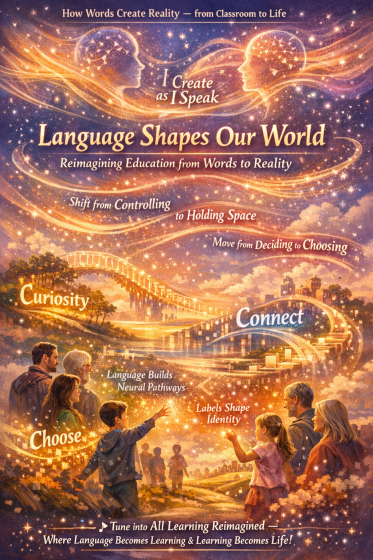
"Abracadabra (Aramaic): I create as I speak. Words are not just descriptions; they are the architecture of our lived experience."
Biological Impact
- ✔Neuroplasticity: Self-talk strengthens neural pathways through repetition.
- ✔Cellular Memory: Every cell "listens" to the words we speak over our bodies.
- ✔Dr. Emoto Effect: Intentions and words physically alter molecular structures.
Reframing Your Reality
Identity Loops: Labels (gifted, low ability, baddie) become self-fulfilling prophecies that trap learners in fixed roles.
This episode explores how language transcends mere communication to become a primary force in shaping our perception, physiology, and educational environments. Host Teresa introduces a new framework centered on the belief that the words we choose literally create the reality we inhabit. By auditing our daily lexicon, we can shift from limiting identity loops to a more expansive and sovereign way of living and learning.
The Creative Power of Linguistic Relativity
Language is not merely a descriptive tool but a creative one, a concept rooted in the Aramaic word Abracadabra, which translates to "I create as I speak." This principle of linguistic relativity suggests that the structure and vocabulary of our language influence how we perceive and interpret the world. For instance, our emotional response to the same object—such as a bee—can be radically different based on the language and past experiences we associate with it. Furthermore, cultural differences in language, such as using cardinal directions (North/South) instead of relative ones (Left/Right), demonstrate how speech can heighten spatial awareness and alter time perception.
The Etymology of Choice
DECIDEPrefix De- (Away/Remove)
Suffix -Cide (Kill/Cut off)
Closing down the quantum field of possibilities.
CHOOSEAlignment & Selection
Remaining open, alive, and in alignment with the field.
Physiological Impact and the "Identity Loop"
The words we repeat act as a form of biological programming. Negative self-talk—such as "I'm overwhelmed" or "I'm sick"—triggers stress responses and increases cortisol levels, while positive reappraisal can improve resilience and rewire neural pathways through neuroplasticity. In educational settings, this manifests as the "Pygmalion effect," where labels like "gifted" or "low ability" create identity loops that dictate a student's performance and a teacher's expectations. A notable experiment where students swapped essay names proved that a teacher's fixed perception of a student often outweighs the actual quality of the work, highlighting the danger of linguistic labels in stifling growth.
Intentionality and Molecular Resonance
The impact of language extends to the molecular level, as evidenced by the research of Dr. Masaru Emoto. His work demonstrated that water crystals respond differently to positive and negative intentions, whether spoken or written. Given that the human body is primarily composed of water, the "hidden messages" in our language physically land in our bodies, affecting our internal coherence. This extends to common phrases with double meanings; for example, "good morning" can be phonetically linked to "mourning," and "weekend" to "weakened," potentially planting subtle negative connotations in the subconscious.
Educational Paradigm Shift
| Traditional Language | Reimagined Language |
|---|---|
| Control the classroom | Hold space |
| Managing behavior | Building relationships |
| Delivering curriculum | Facilitating learning |
| Emergency | Emergence |
Reframing Educational Environments
To restore sovereignty in education, parents and educators are encouraged to shift from hierarchical language to facilitative language. Moving from "controlling" to "holding space" or from "delivering curriculum" to "facilitating learning" creates a sense of safety and expansion. Even high-stress words like "emergency" can be reframed as "emergence" to reduce the body's adrenaline response. By becoming conscious of these subtle shifts, we allow a different reality to emerge—one where thought, word, and action are in alignment.
To-Do / Next Steps
- Replace the word "decide" with "choose" in daily conversation to avoid the subconscious feeling of "killing off" options.
- Experiment with alternatives to "good morning," such as "happy day" or "good dawning," to avoid the negative connotation of "mourning."
- Audit classroom or household language by swapping "managing behavior" for "building relationships" or "understanding communication."
- Practice "holding space" for others rather than attempting to "control" the environment or the people within it.
- Research Dr. Masaru Emoto’s work on water crystals to better understand the relationship between intention and physical matter.
- Monitor self-talk for "identity loops" and consciously correct negative labels like "I'm overwhelmed" to more neutral observations like "I'm navigating a lot."
Conclusion
Language is the lens through which we co-create our existence. By moving from unconscious programming to intentional word choice, we can rewire our brains, heal our bodies, and transform our educational systems into spaces of true sovereignty and connection.
All Learning Reimagined
Please help support this show!
Support this show by subscribing
$5.99/mo or $9.99/mo or more
Click HERE
All Learning Reimagined: Where passion meets possibility, one story at a time.
All Learning Reimagined is a global podcast exploring the many ways we learn, grow, create, and contribute throughout life. A gathering place for people who know that the future is something we learn, create, and steward together.
While education is often where the conversation begins, this podcast reaches far beyond classrooms and curriculum. Together, we explore learning as a living process that unfolds through relationships, community, nature, creativity, curiosity, experience, and the pursuit of what brings us alive. Through inspiring conversations with parents, educators, authors, visionaries, community leaders, and everyday people, we share stories that expand what learning can be and how it shapes our families, communities, and world.
Drawing from diverse perspectives, indigenous wisdom, practical experience, emerging ideas, and timeless principles, each episode offers insights that nurture self-direction, discernment, contribution, and a deeper connection to what matters most.
Whether you are a parent, educator, learner, creator, community builder, or simply curious about what is possible, All Learning Reimagined invites you to explore meaningful questions, fresh perspectives, and inspiring stories from around the world. Because learning is a living journey to nurture.
Cultivating self-trust. Nurturing wisdom. Inspiring contribution. Strengthening community.
[00:00] Speaker 1: (music) Welcome to All Learning Reimagined, the podcast that defines convention and redefines the purpose and practice of education. Here we venture beyond institutional boundaries. Whether you're a parent, educator, or curious mind devoted to lifelong growth, this is your space to challenge assumptions and co-create a more humane and intuitive approach to education. Let's reimagine what education can be.
[00:43] Speaker 2: (laughs)
[00:48] Speaker 3: G'day, welcome to All Learning Reimagined. I'm your host, Teresa, bringing you a little ray of sunshine, as together, we're reimagining the future of education one inspired story at a time. And today, I'm, I'm proud to announce that I'm going to start, um, the first of a series of eight. Uh, I have created like an education framework. Um, it's very simple and it's very grounded back in nature, and, uh, I'm going to take you through each step throughout the, the next eight weeks. Welcome to any of the new listeners that we have here. Um, it's lovely to have you with us, and thank you for your energy and time and attention. Um, let's dig in. Okay. So the first, um, uh, topic, I guess we could say, that I would like to really ground us in today is around language, language as a creator of reality.
[01:47] Speaker 3: And I know we've talked about this quite a lot over the last few months in particular, um, but I really do feel this is absolutely essential and important for all learners of any age to really start becoming aware of the words that they are using, because words do shape our reality. They are (laughs) so important, and today, even with the, you know, the rise of emojis and, and the language and the slang that we have that def- cer- certainly comes from social media and movies, a lot of the meanings, the true meanings of the words that we are saying, um, that, that knowledge is disappearing or being skewed. And it's important to come back to comprehending the words that we are speaking and how powerful they actually are. Uh, so, (laughs) you know, I go back to being a child and thinking about, um, ah, what was it?
[02:48] Speaker 3: Ali Baba and the Forty Thieves, and they'd be at the cave and they would say, "Abracadabra," and then the cave would magically open and everyone would go, "Wow, that's such a mad- a magic word." Well, actually, the word abracadabra in, is Aramaic, and in Aramaic language it means, "I create as I speak." So there is a little bit of magic in that word, you know, "I create as I speak," and that's actually how our reality works. So linguistic relativity, you know, language shapes our perception. It's really, um, something that anchors everything, and the structure of vocabulary of our language influences how people in- perceive and interpret the world. All of us are seeing through our own lens, not only through our own eyes, but, um, our own living experiences. We're all seeing, we might be looking at the same thing and experiencing it completely differently, and the words that we choose to use, um, really do help shape that.
[03:54] Speaker 3: For example, I might be walking through a garden of lavender, and then I see a bee. I am so excited to see that bee because I love bees. They're beautiful, they're nature, and they bring us honey. So I am seeing and using language that is really positive towards that bee. But there might be someone else that's allergic to bees, anaphylactic, and they're very scared of bees, or they've been bitten before and they know that they sting, and they are terrified of that bee. So the language and the perception that will be going through their mind compared to my mind could be very, very different, even though we're looking at the exact same thing. So our language really does help shape our percectio- perception. And, you know, different cultures perceive color differently depending on language categories.
[04:43] Speaker 3: Color has a frequency, we know this, um, but even if you go into different cultures around the world, sometimes there's even things like a color that's different depending on the language categories that are used. So some languages don't use left or right, but they use north, south, east, west. Um, and speakers really develop a heightened sense of spatial awareness depending on the language that they're using, and of course, time perception also dis- differs across languages. You know, we have horizontal and vertical time, and then of course we have the theory that time doesn't e- exist at all. There's, there's lots of different ways of shaping this. So language, you know, the language that's available to us, it doesn't just describe what we see, it actually shapes, uh, what we're able to notice around us. And this leads me to the words influence our emotional and our psychological states.
[05:41] Speaker 3: We see this all the time, particularly in educators of small children, you know, um, "I'm, I'm dumb. I'm, uh, I don't have any friends." You know, the words that they speak over and over and over create that self-fulfilling prophecy, and of course we know every single cell in our body is constantly listening to the words that we're saying, and we are shaping those words. And for the adults out there, every time you say, "Ugh, I'm-... um, "I'm broke, I'm overweight, I'm tired, I'm exhausted, I'm sick," you are literally programming your body by using the words. You are speaking it and creating it and enhancing that reality. So for us to shift what it is we would like to experience, we have to be really aware, self-aware, of the words that we are using. I mean, there are lots of studies of effective neuroscience that show that words can also trigger emotional responses to the actual lived experience, and it lights up the same part of the brain as if they were back there.
[06:48] Speaker 3: Whether it's negative or positive language, it does activate different neural pathways. And so exposure to harsh language really does increase the, the cortisol, you know, the stress responses in the body. So if I'm, for example, saying, you know, "I'm overwhelmed," instead of saying, "You know, I'm navigating a lot right now," or, "I'm juggling a lot right now," but as soon as I say, "I'm overwhelmed," that's a, that's a subtle shift. That's a different shift and it's a different internal state. So I'm finding personally what I'm doing is when I use a word, I often pause and go, "Ooh," I catch myself, and then I correct what it is that I'm saying. I'm, I'm becoming more conscious of the words that I'm choosing to use, and of course, I slip up all the time on the words that I, I don't prefer, because I've had a lifetime of being used to saying certain words, you know, like good morning. You know, when I say good morning now, morning, it could be...
[07:51] Speaker 3: We, we, uh, equate it to, you know, the sun rising and dawn, but mourning is also when you go to awaken a funeral and I'm mourning and grieving somebody. And so if I'm telling someone, "Good morning," what pops in my head now is I'm asking them to, to grieve. It has a negative, um, connotation for me emotionally. And so I'm now choosing not to use good morning. There's lots of different people who use, um, uh, different, uh, alternatives. I have friends that say good dawning. I simply say happy day or, you know, hi. Um, I, I pretty much keep it ge- generic, but I very rarely, if ever, say good morning any, any, anymore. I'm choosing not to use that word. Um, and I guess it, it's also because the words don't just pass through us, they actually land in the body. And so, you know, if I'm talking about the weekend, well, when you think about the weekend, it's also weakened, you know, weakening your body.
[08:56] Speaker 3: There's, there's just so many words that I'm starting to think about and feel into when I'm speaking it out aloud, because there's a lot of double meanings and sometimes it sounds like something that's a little bit different. And you might think this is crazy, but I've had a remarkable, um, improvement in the way that I think and feel now that I'm catching myself and I'm redirecting the words that I'm using. So, I feel like it's really quite effective, and it's, this is a great tool to teach young children, um, particularly when there's, uh, popular language that comes out through movies. You know, I had students, mm, a couple of weeks ago saying, you know, they were baddies. You know, "I'm a baddie, I'm a baddie." I'm like, "What do you mean you're a baddie?" And it's the new latest cool thing to say from one of the shows that they've been watching on TV.
[09:48] Speaker 3: They're literally walking around saying, "I'm a baddie." You know, there are still people today, even though it's been out for 20 years, saying, "Oh yeah, that's sick, man. That's sick," meaning it's, it's cool, they think it's great. But sick? Um, no. (laughs) Why would we want to say that? Why would we wanna bring sickness into our reality? Why would I even wanna speak those words in, in that context? So, uh, I don't know. It, it really does make me, make me wonder sometimes Um, okay, let me move on. Um, th- the other mention... The other point I wanted to mention today was that labels also create identity loops. You know, definitely that self-fulfilling prophecy, um, that's what I started talking about before, and then of course I got on, off onto a tangent 'cause (gasps) I have a lot to say, for those of you listen to me regularly know that. Um, it's like the Pygmalion effect.
[10:47] Speaker 3: So, um, uh, you know, what is spoken about a child influences how they're treated, and it also shapes how they perform, and it reinforces the label. Now, I have a personal experience about this. I remember many, many, many years ago, uh, when I was at, um, primary school, I was in year three, and all of the children had to go up to the music teacher at the piano and sing. They've had a, uh, the music teacher was trying to work out who was going to join the choir, uh, the school choir. And I got up and I went and I sang, and I overheard the, my classroom teacher talking to the music teacher about my voice, um, and how pure my voice was and, and how I could... I had a really rich tone and I could meet the keys. And I had no idea at the time that I could sing. Absolutely none. You know, I'd sing, but I didn't know if I was any good at it. But listening to that conversation and the complimentary way that they were talking about me literally shaped, um, my feeling and emotion about music.
[11:56] Speaker 3: I went on to actually study music in high school, but I still remember that conversation today and how it made me feel, and I was quite shocked. Now, that's a positive example. There's a many, many negative examples. For ex- (laughs) Uh-huhYou know, if a child overhears a teacher whingeing about them or making a comment that's quite derogatory, that can stay with them and sit with them for their entire lifetime, and it also shapes how they see themselves. This includes the way children talk to each other with friendships, so it's very important that they learn that the words that they're using towards each other, um, affect each other and have a lot of power and influence in a negative or a positive way, you know. So if, if someone has a low ability then, uh, often a teacher might think that they have reduced expectations of what that child can do, and they might provide reduced opportunities for that child to shine, just because they think they have a low ability.
[13:02] Speaker 3: And yet if a teacher hears a child is gifted then they might actually, um, uh, put more pressure on that child, and sometimes it can become a bit of a fixed identity. Um, and quite often I find that gifted children sometimes have a fear of failure because they have those expectations that are placed on them. And there've been many studies to prove this, um, over and over again. I'm gonna another use- use another personal example. In secondary school, I was in year 11, I had a very close friend who just could not get over a C for her mark for English, and she did everything she possibly could. (laughs) She was a beautiful girl and she tried so hard, and she wrote her assignments, but the teacher, in her, in her eyes, the teacher just didn't like her. The teacher thought she was outspoken and didn't like her. So we swapped assignments.
[14:06] Speaker 3: We actually swapped assignments (laughs) , and I, I wrote my essay, she wrote her essay, and we swapped and we put each other's names on it, and I got an A and she got a C from our s- e- you know, she, she handed in with... I handed in her assignment and I got an A, she handed in my assignment and she got a C, which then proved that the teacher's perspective and perception of that student, um, was pretty much set in stone. And the same thing can happen with language and the way that the teachers are using, or parents are using their opinions and their judgments, and having those labels for an identity loop. So, I would invite you to stop and ponder are there any, um, men, women, children around you that you might actually have an identity label or identity loop, and not giving them an opportunity to, um, to grow and change from that loop of your expectations of what you and how you see them, because none of us are the same. You know, I'm not the same person I was six months ago.
[15:17] Speaker 3: (sighs) All of us are growing and changing and learning, and yet sometimes some of us get stuck in that, um, in that identity loop and that label, and those words are very, very powerful. You know, a label can quietly become a loop and then that loop could possibly turn into that child's life of how they see themselves, so it's very powerful, um, to consider that. And I know, uh, I've already mentioned before that language rewires the brain. I mean, neuroplasticity in the brain and the research that's come out just in the last 20 years alone has been spectacular. It's been so interesting to, to follow this research, um, and to feel into it. I mean, I know that our heart space and our hearts really do truly lead us. It's not our brain. Our brain is simply a tool, and yet in the education world, everything seems to be cerebral. It's all intellect, intellect, intellect.
[16:17] Speaker 3: And yet there's so many different other intelligences that we could have, but the neuroplasticity is really important because our brains are procraba- programmable through repetition, and repeated language, especially your own self-talk, definitely strengthens those neural pathways. So it's important that, um, young learners in particular become aware of their self-talk and can correct themselves or choose different words, um, when they are making judgments about themselves. And of course there's, you know, lots of research around cognitive behavioral therapy, um, which can show that changing internal language does shift your thought patterns, so there's so much research out there about this. And of course positive, um, reappraisal does reduce stress and it improves resilience in children.
[17:16] Speaker 3: So if you're interested in that, I would urge that you go and check out, um, uh, all of these different things that I'm suggesting, because the words that we repeat really do become who we are and pathways that we walk. They're that powerful. And that's why I'm starting this series with this one, is with the series because everything is steeped in language, the language that the, we're using, spoken, um, or written of course, and then, uh, and heard. And I know I've spoken about, um, a Japanese scientist, Dr. Emoto, um, who back in twe- 2004 I think it was, um, I bought his book, The Hidden Messages in Water, and it literally changed my life because seeing the images of the same water being exposed to different words in different languages, and the words were not only spoken, sometimes they were written, proved this... In this water experience, it really proved the impact.....
[18:17] Speaker 3: um, that our thoughts and our emotions and our intentions had on the molecular structure of water, knowing that the majority of our bodies are water. Um, and the images that were, that were taken were just, oh my gosh, so inspiring and really did shift and s- and shape the way that I started using language way back then. And it was also probably, um, sparked... There's so much research about this now, but in my opinion, Dr. Emoto was one of the first that really, that really stepped up, so I like to mention his work in particular, even though he's no longer with us at the moment, in physical body, anyway. Um, but, you know, he, he really proved the impact of human consciousness, I guess is the word, on water, and there's so much in this field to explore. Um, so I would definitely encourage you to have a look. Um, you can simply search it up on any of the search engines on the internet, and you would see instantly a lot of the images on Dr. Emoto's work, of course.
[19:28] Speaker 3: Um, okay, so I've talked about self-id- self-talk and identity formation, which we know that's really important. Um, you know, and then, of course, the voices around us with parents and educators really do then become the voice within us, because we take upon those words and they physically affect our body. And then, of course, language shapes behavior and our decision-making. Um, it really sort of has a framing effect, I guess, because people respond differently depending on how information is worded. And sometimes, it's not what I say, it's how you say it. Uh, so tone is actually very important as well. So for example, I could say to someone, uh, "You're going to have a 90% survival rate," rather than, "A 10% mortality rate." So if I'm choosing the word survival rather than mortality, it's actually implanting a different perspective in the brain of the, you know, the person that I'm talking to.
[20:34] Speaker 3: So sometimes, it's the framing of around the words that you say, because the same reality but framed with different words can actually lead to, um, completely different choices, completely different choices. And so, while I'm using the word deciding and choosing, I would like to point out, uh, a friend of mine actually mentioned this to me the other day, and I'd never, never considered it before. She, uh, brought up the word decide. She said, "You know, there's a word we use every single day, um, without a second thought really, and that's the word decide." I don't know about you, but I say the word decide all the time. Well, I used to. I don't anymore.
[21:15] Speaker 3: Um, you know, "I've decided what I'm going to do." "You need to decide this." "I can't decide what I want." But when we slow this down and feel into the word itself and we look at the prefix, so the prefix de, d-e, means away from or to remove, and the suffix, cide, uh, and we can see cide, c-i-d-e, in words like homicide, pesticide, genocide, uh, suicide, it carries the meaning of cutting off and killing. So we've got away and remove, and then we've got cutting off and killing. We put, we're putting these two meanings together to choose and to make a word. So when we are saying we are deciding, what are we actually doing? I mean, are we in some way cutting off or killing off all the other possibilities? I mean, we know we have a quantum field around us which has got endless possibilities, but the moment we decide, are we closing down those pathways that before they've had the space to fully emerge? Are we really, um, uh, killing off all of those options in the field?
[22:33] Speaker 3: And I don't feel like this is right or wrong, and this is purely a perspective. You can take it or leave it. If it doesn't resonate, that's fine, but I really did go away when my friend had shared this with me, and I started stopping and thinking about it, going, "Wow." So that awareness has actually, um, I came to a decision, a choice that I'm going to replace the word decide with choose. So now, I'm consciously using the word choose. I choose this, this is what I choose, rather than saying, "I've decided," or, "I d- I decide." Because when I say, "I choose" something, it actually feels different. I mean, I urge you to say it, "I decide, I choose." They sound different.
[23:21] Speaker 3: They feel different, different in the body, but choosing actually still, for me, it feels open, it still feels alive, and it still feels like we're selecting in alignment rather than completely shutting down with, "I decide." So energetically, it actually felt different for me, so I'm really grateful for my friend for pointing this out, because, you know, we know that language shifts our and, and changes and shapes our reality. So, you know, what happens if for a moment we shift our language? Instead of saying, "I need to decide," and I say, "I'm going to choose," and I pause and I feel into that choice, um, it really has this different feeling, because language isn't something we just use. It's, it's actually something that we live inside of. It's part of the field that we're working in and we live in. Often, we're too distracted to even notice it, but, you know, it's constantly shaping the reality that we're stepping into...
[24:21] Speaker 3: and, and that made me stop and think about some other words, you know, like I started looking at prefixes and suffixes. And the prefix in-, for example, I-N, um, means not or without. So incorrect, insecure. You know, not or without. I know it also means direction and location, so as- if I say to inflame means to put into the flame, or inspect means to look into. So, it does have more than one meaning. But when I say in, and it means not, then I started feeling into other words. Well, what about independence? Does that mean not dependent? Um, incredible, does that mean not credible? I don't know. (laughs) I really don't know. But I have started questioning and thinking and feeling into some of these words. And the words that I'm choosing to use all of the time, and that I've always used in this lifetime, because I've been programmed to use them. Where did I learn a lot of this language? Well, I learned it from school.
[25:24] Speaker 3: But it's time for me to stop and go, okay, well, just because I've been, I've been learning and using these words doesn't mean I need to choose to continue to use them. So, the whole point of looking at language within education and to reflect on it, is to really feel into what is it that we're actually saying and speaking, and investigating this. This is such an amazing inquiry. Um, and when you do this with young learners, oh my gosh, they love it. They get so into it, and it really empowers them, because they're making conscious choices. And to learn this skill so early in life and not, you know, decades, decades later, like I have. (laughs) I wish I had known back then what it is that I know now, of course. You know? And so, you know, language and then the power that's used in education, and I'm gonna wrap this up and bring this home. Um, we know that language can reinforce hierarchy, but it can also restore, you know, sovereignty.
[26:29] Speaker 3: Um, and there are quite a few different words that, or, or ways that we say things that we can, um, choose as educators or parents to shift right now. We could do it today. So, let me give you a couple of variations, very simple examples. Instead of saying, "I'm going to control the h- the classroom," you could simply say, "I'm going to hold space. I'm gonna hold the space." Control the classroom, very hierarchial, and holding the space for the learners. Instead of saying, "Managing behavior," which is something that (laughs) I've said I don't know how many times around the world, s- particularly by teachers. You know, "I'm managing behavior." Mm, perhaps we could reshape that by saying, "We're going to understand communication," because behavior and managing behavior is all about relationships and it's all about communication. So, I might not even wanna say understanding, because that's standing under. Innerstanding is innerstanding.
[27:31] Speaker 3: But it might be, "I'm going to, uh, build relationships. So, I'm not gonna c- control the behavior, I'm going to go and build relationships. I'm going to make a connection." There's so many different variables that you can use. Um, instead of a teacher saying, "I'm delivering curriculum," well, delivering curriculum is imposing thoughts and ideals onto somebody, which is actually something that is not natural. I know it's the way that we do things, because we don't know any better, but it's actually not natural to impose something. It's more, "I'm going to facilitate the learning. I'm not delivering curriculum, I'm facilitating the learning." So, sometimes these very subtle shifts in the words that we're using can make a huge impact. And I'll give you one last example, which I heard just the other day and I really loved it. And it was saying, someone was saying they had an emergency. Emergency. And when, when you say emergency, my heart starts to pound.
[28:31] Speaker 3: It's like, oh my gosh, it's like that, um, you know, triple zero or 911, it's an emergency. It sort of makes you, puts that cortisol and that adrenaline straight into your body. So, the shift for that is not, um, I have an emergency, it's to, to feel emergence. So, to feel that emergence. Um, a- and when you shift and reframe some of these words, you can feel how, how it is in your body, and how it shifts, how your body responds, I guess, to the words, which is amazing. Um, and it really comes back to that coherence, because when language is chosen with awareness, it creates clarity, it does create that sense of safety, and it creates expansion and coherence be- between thought and word and action. And so, you know, linking this to your lexicon and really deciding to choose, to respond, um, to guide, to explore, this, this is my whole point of the podcast today, of course, because, you know, it's not about changing every word you use.
[29:43] Speaker 3: It's simply about becoming aware of the words that we're using, and replacing it, and choosing to replace it with a word when it doesn't quite feel right in your body. And then from this space and from that place, I guess you could say, but yeah, but from this space, then a different reality could, could begin to emerge. And that is all I have time for today. So, I'm gonna leave you with that. Thank you so much for joining me on All Learning Reimagined. Until netwi- next week, explore, experience, express, go out, and live learning.
[30:23] Speaker 1: (Instrumental music) Thank you for joining us on All Learning Reimagined, where passion illuminates the path forward. Remember this, the future of learning doesn't arrive from above, it begins within. You are the spark, the shift, the living answer to education's silent call for transformation. So, stay curious, stay awake. Let inspiration be your compass, because how we learn today is not just personal, it is profoundly generative. It shapes the very architecture of tomorrow's world. We are not separate from the system, we are its evolution. Until next time, trust the wisdom of your own unfolding, and let your life be the lessons that light the way for others.
[31:35] Speaker 1: (child laughing)