
From Trauma To True Love, May 21, 2025

From Trauma To True Love with Leila Reyes, MSW
S1E16, Defense Mechanisms, The Cost Of Denial In Childhood Trauma
From Trauma To True Love

Break Free from the Past and Create the Relationship That Actually Fits You
Creating a healthy, fulfilling partnership isn’t about luck, timing, or trying harder. It’s about understanding how early experiences—especially those that shaped your sense of safety, worth, and attachment—are still influencing who you choose, how you show up, and what you tolerate in relationships.
On From Trauma to True Love, I speak to successful, self-aware women who have done the therapy, read the books, and still find themselves repeating familiar dynamics: unavailable partners, self-doubt, over-giving, or settling for less than they want—without fully understanding why.
As a relationship coach and trauma-informed guide, I help you identify how early trauma continues to live in the nervous system and relational patterns—and how to interrupt those patterns gently, without blame, fixing, or endless self-analysis. This work is about reclaiming self-trust, confidence, and choice so you can create a relationship grounded in safety, consistency, and authenticity.
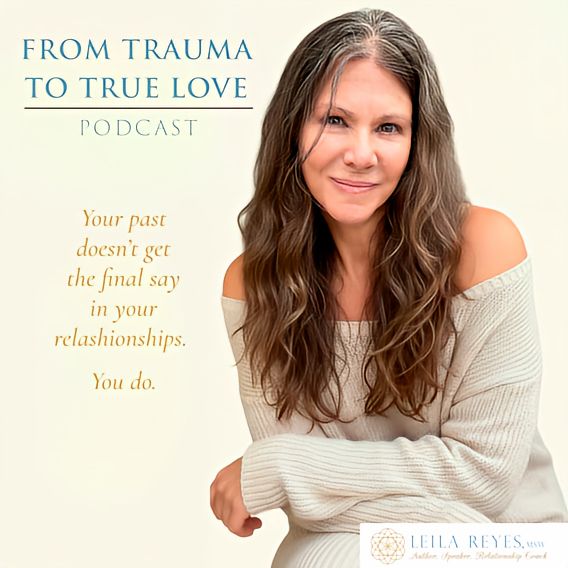
Your past doesn’t get the final say in your relationships.
You do.
Welcome to From Trauma to True Love, the podcast where we break the cycle of painful relationships and build deep, lasting love you can trust. I'm Layla Reyes, a relationship coach, speaker, and author of Freedom From Shame, Trauma, Forgiveness, and Healing From Sexual Abuse. I'm here to help you release the invisible wounds from your past that may be holding you back from the love you truly desire. In each episode, we'll uncover the hidden patterns shaped by early childhood trauma, explore how they impact your relationships today, and guide you toward creating the partnership you were born to have. Whether you're looking to attract the one, deepen an existing connection, or finally feel safe in love, this is a space to discover what's possible.
Let's dive into your journey from trauma to love. I'm your host, Leila Reyes, and this podcast is a canvas of sort. With each episode, we paint a stroke on the larger picture of gaining freedom from the impact of childhood sexual abuse. Through exploring the distinctions in my book, Freedom from Trauma, Forgiveness and Healing from Sexual Abuse, we're on a journey toward liberation from the chains of past harmful experiences. In our last episode, we had the lovely Kim O'Hara, author of No Longer Denying Sexual Abuse.
Kim generously shared her difficult yet enlightening journey out of denial. So if you missed that episode, I highly recommend giving it a listen. Her story and insights are a beacon of hope for anyone living with the aftermath of abuse. Today, we're going to take another step forward, venturing deeper into the topic of denial, understanding denial, its mechanisms, and its impact. This is all pivotal for the healing journey.
So let's take a minute to just define denial. Let's just look at that for a moment. It's a word that you might hear. You might woah, hold on here. It's a word that you might hear often, but what does it truly mean, especially in the context of childhood sexual abuse?
So there are two types of denial that I've been thinking about recently, especially since my conversation with Kim, and it's important to distinguish them. The first type of denial is when someone has done something and they lie about it. This type of denial is a protection from loss. And we'll certainly talk about this type of denial in another episode. I'll mention it again a little bit later just to make a comparison.
But today, the type of denial that we're going to be exploring is what the survivor of childhood sexual abuse experiences, the majority of it anyway. Denial is a wonderful defense mechanism when we encounter trauma. And from this perspective, from the perspective of trauma, denial is our psyche's guardian and can help us get through the trauma. So just imagine, if you will, a shield that our mind unconsciously holds up, intending to protect us from unbearable pain that reality might inflict on us. And this shield, however, is double edged.
Whereas denial guards us from immediate pain when the trauma is happening, denial also blocks the path to healing from trauma we haven't addressed as adults. So why would we stay in denial? Why would we do that? We have the social stigma of abuse, and most people don't talk about the abuse. They're afraid that people will think what people will think about them or they might not talk in order to continue protecting the person who hurt them.
And so those are a couple of the reasons why someone might stay in denial. Some people might feel embarrassed or they might underplay the abuse by telling themselves it wasn't that bad. While denial will protect us, there's also a cost to it. And the trouble with denial when the trauma happened years or decades ago, when it happened when we were a kid, is that we end up repeating unconscious patterns that keep us stuck in this felt sense of when the abuse occurred. So we engage in automatic behaviors where we end up hurting ourselves in ways that we wouldn't if we weren't in denial.
So it's really important to be able to understand that process. And the reason I care about helping people wake up out of denial is that I know what's on the other side, a truly conscious, present life where you discover that your own strength and capacities are bigger than any trauma you've experienced. I actually want to say that again. What is on the other side of denial is a truly conscious, present life where you discover that your own strength and capacities are bigger than any trauma you've experienced. From there, you can be free from the impact of the abuse.
So with that said, if someone is truly in denial, then they're probably not even aware that they need to get free. Someone who's deeply embedded in denial is not ready to know the truth about what happened to them. Or perhaps they don't have the support system to guide them and unconsciously they're protecting themselves from not opening something up that they don't have the support to get through. And I would never want to push anyone who's not ready. They're on their own path and on their own timing.
And for anyone who is ready, then my intention here, I hope to inspire you to come out of denial and give you some hope for the future and some freedom from shame. So let's look at a few clues that you could be ready to wake up from denial. So when you're on the cusp of waking up from denial, you could start to get a sense that something isn't quite right in your life, but you don't yet know how to engage with your own inner knowing. And so here are the clues that tell you that you may be at this critical juncture. One clue is that you might start having more emotional responses to situations that in the past didn't really bother you.
This change could be due to the unconscious mind's struggle to maintain the protective barrier of denial against emerging truths. It's kind of like the walls you've built to protect yourself are starting to show cracks. And emotions are oftentimes the first sign of this structural breaking apart or opening up, we could say. So if this is happening, I want to encourage you to keep going. There's a saying that I've heard, I really like this saying, Destruction before creation.
I don't remember where I heard that from, but it is absolutely true. I found that the old does need to fall away before something new can be created. A second clue that you're ready to come out of denial is that you might begin to ask deeper, more reflective questions about your feelings and your behaviors or about recurring patterns in your life. These questions often arise from an unconscious inner knowing that something isn't quite right. So this indicates a subconscious readiness to explore beyond the surface of what you have been aware of.
It's as if you're piecing together a puzzle, but you can't quite see the full picture yet. Another clue is in any sudden change that you have a sudden or it could be a gradual change in how you relate to yourself or others. So you might withdraw from relationships that seem superficial or harmful or unsafe, or you might seek deeper connections with people. Both are true. And this shift often comes from this emerging awareness that your current environment or relationships are not aligned with your true self or your needs.
So if this happens, then take a breath and know that something is shifting, something is moving in your life and you're okay. Another clue we've got a couple more clues here and you could probably add some to this, I'm sure. But another clue is related to the body, which holds and expresses what the mind cannot. So it should pique your interest if you have any unexplained physical symptoms, a sudden interest in the health of your body, or a shift towards self care practices might indicate that you're subconsciously beginning to acknowledge the trauma that you've experienced. It's also possible to have a turning away from ways that you previously cared for yourself.
So either way, it's as though the body is signaling to the mind, It's time to heal. Another clue that you're coming out of denial, this is the last one that I have for you today, is an increase in vivid dreams or nightmares. Having dreams related to the abuse can be the subconscious mind processing the trauma and pushing it closer to the surface of your conscious awareness. And these dreams might not always be direct representations of the abuse. And I think that's really important.
They could symbolize themes, though, of powerlessness, fear, or escape. So if you're having these kinds of dreams, it could be the psyche's way of communicating unresolved issues that need attention and that you're ready to address. If you recognize these clues in yourself or someone else, it could be an indication of being on that cusp of moving beyond denial. It's a significant step forward and towards healing and rediscovering your strengths and capacities beyond the trauma. It's important to approach this transition if you're experiencing it with compassion and support and possibly with professional guidance to help you navigate the complexities of healing from childhood sexual abuse and that waking up from denial can be a critical juncture there that might serve you to have some extra support.
Sometimes an event can wake us up out of denial. Some people, like my last guest on the last episode, Kim O'Hara, she didn't remember the abuse until something triggered the memories. And then she began her journey. And that can happen for us as well, that some kind of event triggers your memory or you start to get a different kind of a clue, I guess. So because of the denial that you've been in, if this is what's going on, it can feel like the abuse is happening in current time, just a felt sense in your body.
So waking up from this type of denial can actually be quite challenging and, as I mentioned, probably better navigated with a therapist or with some kind of professional support. So for me, I was always aware of the abuse, but I was in denial about the impact that it had on my life. I had an abrupt wake up moment back in the early '80s when I got engaged to be married. And instead of being really over the moon to have my person, I woke up the next day to this visceral feeling of terror. And what I was most concerned about was not my dress that I would wear or the venue.
I was worried about my unborn children. And I didn't want them to be hurt in the way that I had been hurt. So it was in that moment of waking up, this event that woke me up, where I knew that I needed to confront my father. And so I did. That day, the next day, I drove down two hours.
It was like a two hour drive down to my father's house. And I sat across from him and gave him an ultimatum. Either he's going to take responsibility for what he did and will get help, or he won't ever see his grandchildren. And he looked at me and he said, You know what? I can do this.
And so that's where my journey began. To his credit, he didn't deny anything. Instead, he arranged therapy for us both and we went on a healing journey, both individually and together. So because of his courage to face the truth of what he did and the impact it had and to get help, he ended up becoming one of my dearest friends in life. So this possibility is not the norm out there.
I fully realize that, but it is a possibility because it happened with me. But waking up for denial is where we've got to go with it. And like with my dad, like what I said, not everyone is willing to face their demons the way that my father did. But that doesn't have to stop your healing. It doesn't have to stop your healing if you don't have someone there that hurt you participating.
You might not even want them to and that's totally fine as well. But his taking responsibility certainly didn't end my suffering. So don't go into denial about that kind of thing either. It didn't end the impact of the abuse on my life, including other times that I've been in denial. Didn't stop that.
So the impact of the abuse is something that I'll always be aware of so you can heal. This is what I've learned from that is that you can heal from the abuse, but there's still an impact maybe on your relationships, on your life, on how you relate to yourself. It affects everything. So, what I wanted to dive into a little bit now is a little bit around a conversation around denial and who like our conversation will change depending on who is in denial. And so the three areas that matter most here in this conversation is the offender of sexual abuse who's in denial, the non offending caregiver.
And most often, this has been the mom. I'm sure this is changing, but historically it has been, certainly relating to my own experience of what our social fabric was back in the '70s and '80s, we're looking at mom still being that person. And I'll talk a little bit more about that in a minute. And then also the survivor of sexual abuse. And so each of these come with their own reasons for denial.
And I mentioned that I'll have other episodes to discuss the offender's denial, but there's a distinction that I really want to make today about the offender's denial that I believe is different from the denial of the non offending caregiver and the survivor of sexual abuse. So most often, the offender, the person who causes harm, knows what they've done, and they're denying their guilt. This type of denial is to protect themselves. It is a protection. Denial is I'm kind of thinking it's always a protection.
But this is a denial to protect themselves. They're aware of what they've done, but there's just too much at stake to admit it. There's too much to lose for them to admit what they've done. They could lose their social standing, their respect, their livelihood, their home, their family, sometimes their freedom, and in certain cases, even their lives. As I've mentioned in previous episodes, sexual offenders also have the highest suicide rates.
And the timing of their death is often connected with the discovery of the abuse, with making that public. We can use Jeffrey Epstein as a well known example of you know, while the type of harm he caused isn't the focus of my work and research, he's still a good example of someone who couldn't live with himself after his crimes were made public and he did take his own life. So when we talk about the denial of these two other categories, the non offending caregiver and the survivor, I'm referring to the type of denial when you don't remember something or you block it out. It's most often an unconscious blocking of the truth of what happened. And this denial is also a protection and it comes from, I believe, a belief that you can't handle knowing what happened or that you'll need to take responsibility for something you feel incapable of handling.
So those situations will be different depending on who that is. So for the mother, it's going to be, at least from what I've seen, they're concerned about how they're going to take care of the kids. And so that might be something that propels them into denial. For the survivor of childhood sexual abuse, maybe it's something like the responsibility. I can't handle the responsibility.
I feel like I'm responsible for breaking up the family. It's all my fault. So these are just some common things that I've heard. So being a survivor of childhood sexual abuse, like I am and anyone who's listening, know that you kind of know things, a sixth sense of sorts. And I remember a time many years ago, this is a little bit difficult to share, not a story that I want to share with you, but I think it makes the point here about denial.
And so I was in a department store waiting to get some pictures taken. And it was busy. And sitting in the corner was a father. At least I think it was that he was the father with was probably about four year old girl standing up on his lap. And this is back in the I don't know.
I want to say 80s, something like that. And she was wearing a yellow dress and there was something really odd about this picture. Like, it caught my attention. There were other fathers there with their daughters, but none of them really caught my attention like this. It just felt out of place.
And as I looked more directly, I noticed that his hand was inside of her dress in a way that it shouldn't have been. And our eyes locked for a moment, and I knew what he was doing. But I looked away. That's denial. And then I blocked that memory out until years later when I was having some pictures taken again.
So this type of denial comes with self doubt. I must be wrong. My eyes must not be I guess I could still be wrong. But that sixth sense, I know. But the self doubt, oh, he wouldn't do that.
Nobody does that to kids. You question your own eyes. I know I did. And this type of denial comes also with not wanting to see what is there, really not wanting to see what is there. I did not wanna see that.
I still don't, to be quite honest with you. There can be an uncomfortable, unconscious turning the other way so you don't have to see the red flags. And that's what I'm referring to in families. We don't want to see the red flags. So we'll turn the other way like I turned the other way when I caught this guy's eyes.
So our social fabric can keep this type of denial in place. And I contemplate, I really wonder what would have happened if I had said something instead of turning away. Would I have gotten in trouble? What if I was wrong? And there I am protecting the person causing harm instead of the person being harmed.
So not willing to take a risk and name what I'm seeing. And I'm not suggesting we go out and do that or not. I'm just bringing that into the space here because it's a real life experience that I had, and maybe some of you have had these senses, these six senses that something isn't quite right. And then what are you doing about it? And are these children in your care?
And are you willing to take a stand for them? So that's just something to a little inquiry. So read a report, a 2018 report from the IICSA, which is the Independent Inquiry into Child Sexual Abuse. Now, I haven't read all the report yet, but it has tons of great information about denial from a historical sense, and I found it fascinating. What impacted me most about this report was the way it lays out how the way that childhood sexual abuse has been related to by people, by our society over the years.
And I want to give you a little bit of an overview. If you want to read the entire article, you can search for 2018 II report. In the context of denial, the ways we define childhood sexual abuse have changed over time, And I'm really curious how these perceptions contribute to our denial of childhood sexual abuse as a society. I'm really curious about that. And this report just brought some of that to light for me.
It seems that when the naming of childhood sexual abuse changes, so does our perception of it and what we're in denial about. For example, I'll mention this a couple of times here probably, but there was a time when we called this a type of childhood sexual abuse child prostitution. And then over time, the name of it changed. It's still childhood sexual abuse in my book, but the name of it changed. We renamed it to call it child sexual exploitation.
So, this definition even denies childhood sexual abuse in its language. While it may also be a type of exploitation, we really should be naming it correctly as childhood sexual abuse. So let's take a little historical tour. The 1940s. It bounces about and there's some overlap here, but we'll get through this and kind of get a sense of how culture has kind of, I don't know if I could say evolved.
I don't think I can say that really. But it's changed a little bit. So the 1940s to the 1960s could be called the era of minimal recognition and the othering of perpetrators. The mid twentieth century is an area where we believed, and it's hard to believe that we believe this, to be honest with you, we believe that childhood sexual abuse was extremely rare. And if it did happen, the belief was that it didn't cause harm.
So just imagine if our society is our people, everyone is not like it doesn't happen, well, we're not going to be looking for it. We're not going to be asking about it. We're not going to be concerned with it. And then if it did, we're not going to happen and we become aware of it, we're not going to really provide the kind of support, the healing support that a kid would need to work through that because we didn't believe that it caused harm. So why would we provide healing to a situation where we did not believe that there was any harm caused?
Yeah, that's crazy to even bring that in here, but I think it's important to understand how denial evolves over time, too, or devolves. I'm not sure which it is, honestly. So I'm going to say this one more time that we believed that childhood sexual abuse was extremely rare and if it did happen, the belief was that it did not cause harm. So because of this belief, what we believe in society, there was also a lack of professional acknowledgment. I didn't say that directly a minute I said it, but not directly, but here it is.
No professional acknowledgment that contributed to a significant gap in understanding and addressing childhood sexual abuse. So during this time, during this era, childhood sexual abuse was also perceived as being confined to certain social groups reflecting a societal bias. There was a misconception that childhood sexual abuse was more prevalent among lower socioeconomic classes and tied to broader stereotypes about poverty in marginalized communities, suggesting that such families were more prone to sexual abuse. And this is absolutely absurd. But what the reason I'm even bringing that into this conversation is because it begs the question, who were these beliefs protecting?
And and, like, that is something to contemplate when we're when we're focusing the attention over here on a group of people. Who are we bringing the attention away from? So this is something to contemplate. I really want you to take some time, and we might discuss this in more depth at another time, but it's absolutely imperative that we understand how these dynamics work in our world. And the thinking at the time was not only unfounded, but it was incredibly harmful to our children who were being abused and overlooked, and it was harmful to the people being wrongly accused as the problem.
A blaming culture created and creates significant barriers to recognizing and addressing the widespread nature of childhood sexual abuse, making it super difficult to support survivors, making it really difficult for survivors to get help. I was born in the '60s and can relate most to the 1970 I mean, this era that I'm going to talk about now goes from 1970 to 1990. But the '70s is really where I grew up in and the beliefs that were embedded in our culture at that time. And I think that one of the most disturbing beliefs at this time is that we believed that children had an innate sexuality that caused them to seek out or to initiate sexual activity or to respond to it when approached by an adult. And while children I mean, we are all sexual beings, but this particular idea and way of thinking in our culture completely deflects the responsibility away from the perpetrators and onto the victims of abuse.
The thinking at this time was that abuse was a result of girls being promiscuous and putting themselves at risk through their own behavior. Again, absurd. Absolutely absurd to blame the victim. And I'm going to be talking also about I to eliminate blame altogether and bring in a layer of responsibility. And I'll certainly be talking about that in the coming episodes, what we are responsible for and how to work with that to end abuse.
Alright. So in the latter half of the twentieth century, another shift that we see is focus towards family dynamics and alarmingly even more towards victim responsibility. A narrative began to emerge that placed blame now on the mother's role in either colluding with or failing to prevent abuse, which then perpetuated a cycle of blame built within families that were already strained by the abuse. Now, I grew up in the era where everything was mother's fault. And before we blame mom, it's important to understand the history of child protection or lack thereof.
Children were first entitled to protection under the laws against animal cruelty. When I first discovered that, I was blown away. Children had no protection until it got past where they were considered animals. We were all children, so we were all in that category. And we didn't have any major legislation addressing child abuse and neglect until 1974 when Congress enacted CAPTA, which is the Child Abuse Prevention and Treatment Act.
Now, not that I have an answer to this right now, but I find it really interesting as I was preparing for today and reading this report and then kind of integrating it with my own personal experience, I find it interesting that we started blaming the non offending caregiver when children started being protected by the law. And so somehow blame is still being diverted away from the stereotypical male offender. And so the tendency for society to blame the non offending caregiver might just be a reason that mom would go into denial. I mean, if everyone's saying this is happening because you didn't protect this person, isn't that putting the attention away from the person who caused the harm? Whose responsibility is that?
I mean, this is a lot to talk about for sure. But if I was a mom going through that at that time, I would absolutely be more inclined to be in denial than to take responsibility when all the fingers are being pointed at me for what I didn't do to protect my kid. And I think this is pretty common, actually. And who wouldn't? If society told you that your mothering was inadequate, wouldn't you get a little defensive?
A little bit? Maybe. And when I think about my own mom, I know she was in denial of the abuse that happened to me. And after reading this article, I'm thinking I was a little hard on her. And I blamed her.
I blamed her for not protecting me more than I blamed my father for hurting me. So there I am right in the throes of the societal thinking. She really got the short end of that stick, and reading this report helps me to see how impacted I was by this thinking during the time. I recently read another research article talking about the effect of a mother's denial on the victim. And the research kind of supported my experience or highlighted it or confirmed my experience.
The findings reveal that the most troublesome issue is not the psychological consequences of the abuse, but rather the anger toward the mother for repeatedly witnessing the abuse and subsequently denying all knowledge of it. And when non offending caregivers don't believe the kid or, even worse, blame the kid, they add a level of avoidable, totally avoidable trauma to the child's experience. Statistics show that children who have no parental support have a lot more emotional disturbances than kids with support. And I can certainly relate to that because I didn't feel that support. I didn't really get the support that I needed.
And that made it much more difficult for me for sure. So let's kind of look at the 2000s to 2010s. In this era, we've witnessed an increased deflection of responsibility. For example, on an institutional level, the institution will deflect responsibility by blaming the abuse on what would be called a few bad apples. And instead of taking responsibility for creating safety inside of the organization to just say, Yes, this happened.
Yes, we didn't have these protocols in place or yet, whatever it might be, Instead, the deflection is, Oh, it's this person. It's not the organization. Well, maybe the organization could take some responsibility on some level, and I'm sure we could explore that at a later time. Going back to the report a little bit, that was a little side note with the research that I read. The report brings to light a common thread of denial and a shifting of blame that is a barrier, a total barrier, to our ability to effectively address and prevent childhood sexual abuse.
I believe that it's only through acknowledging these patterns and working to understand their impact can we hope to move towards a future where such abuses are not only recognized but prevented. And I want to talk a little bit now about why someone would be in denial. I mentioned it a little flavor of it earlier. But denial can manifest for various reasons. Fundamentally, denial is a defense mechanism.
It's a psychological strategy that our minds employ to protect us from the tidal waves of emotions that the truth might unleash. The fear of re traumatization, the stigma attached to childhood sexual abuse, the overwhelming sense of shame, and the potential for upheaval in our personal relationships. These are just a few of the daunting mountains that denial helps us to momentarily avoid. Yet in this avoidance, we find ourselves stuck, unable to move forward, and unable to heal. Recognizing denial is the first step in dismantling its hold over us.
It requires immense courage to peer into the mirror of our experiences and acknowledge that reflection staring back. But here's the truth: breaking down the veil of denial is the dawn of our healing journey. It's the beginning. It's the moment we reclaim our power, not as victims, but as survivors, as warriors. So I want to ask you to ask yourself some of these questions just give yourself a little your own assessment to see if you're coming out of denial or where you are on that trajectory.
And so there's five questions to consider. Is there a shift in my emotional responses to situations that previously didn't affect me? And you might want to think about the different situations, circumstances where this is true. The second I beginning to ask deeper, more questions my feelings, behaviors, or patterns my life? So, you'll notice that as you start to come out of denial, you're going to be a bit curious.
And that curiosity is a good thing. The third question is, Have I experienced any sudden or gradual changes in how I relate to myself or others, or am I seeking deeper connections or withdrawing from relationships? So, sudden or gradual changes in how you're relating or seeking deeper connections or withdrawing. These are big indications that something's up. The fourth question: Have I noticed any unexplained physical traumas physical symptoms, a sudden interest in taking care of my body, or a shift away from self care practices?
Both can be. Just notice if you're having any of those show up in your life. And the fifth question, am I experiencing an increase in vivid dreams or nightmares may be related to the abuse. So, if you answered yes to these questions, then it might be time to start exploring a little bit more, asking yourself some more questions. There are two impacts of denial that I want to address today.
And the first is the impact of denial on our closest relationships. Sexual abuse absolutely impacted my relationships, but denying its impact is what created a greater barrier to intimacy. So the way that it showed up for me is that when my partner said, I think this is impacting you. I think what happened to you is impacting you, I would get defensive and insist that it did not impact me. And I didn't want to see the ways that abuse affected me, so I was adamant about it not bothering me.
But the truth is that not wanting to see how the abuse has impacted me, impacting me, prevented me from getting the help I needed to stop the abuse from impacting me. Kind of funny how that happens. So I'm going to say that one more time. Not wanting to see how the abuse was impacting me, that's denial, prevented me from getting the help I needed to stop the abuse from impacting me, which was the cost of denial. So the second impact of denial is to our children.
When we're in denial about childhood sexual abuse, whether it's about how many children are being abused, who is being abused, the reason they're being abused, or who's doing the abusing, we are all doing a great disservice to the future generation who will be ill equipped to handle their own abuse when the cycle repeats. So let's wake up out of the trance of denial, deal with the issues head on, and create a world where talking about childhood sexual abuse in responsible and resourceful ways is what stops us. Let me say that again. Let's wake up out of the trance of denial, deal with the issues head on, and create a world where talking about childhood sexual abuse in responsible and resourceful ways is what stops it. To confront and move beyond denial begins with having a safe space for ourselves, a space where we can gently and without judgment acknowledge our experiences.
Support systems play a crucial role here, whether it's therapy, support groups, or trusted loved ones. So if you are ready to wake up from denial, then take a big risk and get some kind and compassionate support to guide you out of denial and into freedom. So that's it for today, everyone. I'm thankful to have this time with you and wish you a fully conscious life where you're enjoying happy, healthy, and safe relationships. I'll see you next time on Courageous Conversations with Leila Reyes.
Thank you for joining me on this episode of From Trauma to True Love. I honor your courage for being here taking steps towards the love and connection that you truly desire. I've been there too stuck in painful patterns longing for love but unsure how to create it in a way that felt safe, real, and lasting. You don't have to figure it all out on your own. If you're ready to explore what's been holding you back and discover what's truly possible for your relationships, I would love to support you.
Visit Leila Reyes, l e I l a r e y e s, Leila Reyes, and schedule a call today. We'll take the first step together toward the deep, meaningful love that you were born to have. I can't wait to connect with you. Until next time, take good care of yourself and know that real, lasting love is within your reach.