
Hollywood and Horsepower Show, May 7, 2026


Hollywood And Horsepower Show with Mark Otto
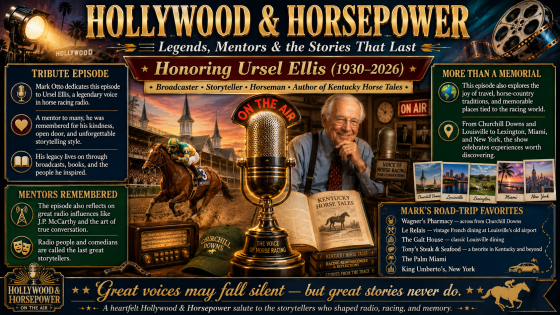
Legends of the Airwaves and the Turf: A Tribute to Ursel Ellis
Hollywood & Horsepower
Episode: Legends, Legacy, and the Silver Screen (May 7, 2026)
In Memoriam
Ursel Ellis (1930 – 2026)
"God's personal prototype, not meant for mass production."
- Legendary horse racing broadcaster and author (Kentucky Horse Tales).
- Known as the "Last of the Storytellers" with a voice that painted pictures.
- Owner, breeder, trainer, and mentor to the broadcasting industry.
The Hall of Influence
The Casablanca Ledger
| H. Bogart | $36,667 |
| I. Bergman | $25,000 |
| Claude Rains | $22,000 |
| Hair & Makeup | $9,100 |
*Based on historical budget archives shared by Michael Blowen.
Kentucky Insider Guide
Introduction
In this poignant episode of Hollywood and Horsepower, host Mark Otto pays tribute to the late Ursel Ellis, a broadcasting and horse racing icon who passed away at age 96. The program explores the profound impact of mentors, the fading art of storytelling, and the fascinating intersection of Hollywood history with Kentucky's racing culture.
Detailed Summary
The Legacy of Ursel Ellis: A "One of One" Prototype
The episode is dedicated to Ursel Ellis (1930–2026), whom Otto describes as a mentor and a legendary storyteller in both the radio and thoroughbred industries. Ellis, an author of Kentucky Horse Tales and a long-time broadcaster, was known for his ability to "paint a picture" for his audience, a gift Otto likens to the golden age of radio. Despite his stature, Ellis was celebrated for his lack of competitiveness and his "open-door" policy toward newcomers in the industry, often inviting Otto onto his show to promote various ventures.
In Memoriam: Ursel Ellis (1930–2026)
"God's personal prototype, not meant for mass production."
The Influence of Radio Giants and the Art of Conversation
Otto reflects on other legends who shaped his career, notably J.P. McCarthy of WJR Detroit. McCarthy, known as the "Voice of the Great Lakes," possessed a unique ability to bridge gaps between diverse guests—ranging from Catholic Cardinals to NBA stars—making every listener feel like they were sitting in the room. This segment emphasizes that radio hosts and comedians are the "last of the storytellers," maintaining a conversational intimacy that is increasingly rare in modern media.
Hollywood Trivia and the "Accidental" Success of Casablanca
The discussion shifts to Hollywood history, specifically the production of Casablanca. Otto reveals that the film was originally a low-expectation "contract filler" based on the screenplay Everybody Comes to Rick's. The production was famously chaotic, with script changes occurring the night before filming, leading to missed cues by the actors. Interestingly, the writers expected another film, Mr. Skeffington, to be their major hit, while Casablanca went on to become an immortal classic.
Vintage Hollywood: The Casablanca Budget
A glimpse into the 1942 production costs of a masterpiece.
| Humphrey Bogart (Rick) | $36,667 |
| Ingrid Bergman (Ilsa) | $25,000 |
| Total Cast Salary | $69,867 |
| Hair & Makeup (Entire Film) | $9,100 |
Kentucky Traditions: From Infiltrators to Iconic Eateries
The episode concludes with colorful lore from the Kentucky Derby, including the story of Don Kaiser, a local mechanic who spent decades "bluffing" his way into the Churchill Downs inner circle by posing as a photographer. Otto also provides a curated guide to Kentucky dining, highlighting "must-visit" spots like Wagner’s Pharmacy—where Secretariat was filmed—and Le Relais, a French restaurant located in a historic 1930s airport terminal.
Key Data
- Ursel Ellis: Born 1930; Passed away May 6/7, 2026, at age 96.
- J.P. McCarthy: Born March 22, 1933; Passed away August 16, 1995.
- Casablanca Set Labor: Cost less than $30,000 for the entire production.
- Travel Logistics: Lexington and Louisville are approximately 45–60 minutes apart, making them ideal for a combined weekend trip.
To-Do / Next Steps
- Michael Blowen will join the show next week to discuss deep-dive movie trivia and his experiences at the Boston Globe.
- The production team will work on a way to share archival clips of Ursel Ellis’s stories on a weekly basis to preserve his legacy.
- Host Mark Otto is currently in "phone tag" with Jamie McCarthy to schedule an interview about the legendary J.P. McCarthy show.
- Listeners are encouraged to visit Old Friends Equine to experience face-to-face interactions with retired racehorses.
Conclusion
As the curtain falls on this tribute, the message is clear: the true value of "legends" lies in their generosity and their ability to connect with others. Whether through a radio frequency or a shared meal at a local Kentucky staple, the legacy of storytellers like Ursel Ellis continues to drive the spirit of Hollywood and Horsepower.
Hollywood and Horsepower Show
Through the relationships Mark Otto developed in Thoroughbred Horse Racing and Automotive Racing, during his global travels, the thing that most interested him was the story behind the story, with the famous people he was fortunate to meet. What was it that these people liked to do? How did they get into Hollywood or into Racing? These stories are fascinating! This is what encapsulates the “Hollywood and Horsepower Show”.
Bringing you along, we talk to so some of the most interesting people Mark met during his career. Don't be surprised if a few other guests stop by this show. This will be fun! It is where SNL meets The Tonight Show; a perfect mix of talk and comedy.
[00:12] Speaker 1: (swing music) I've been down roads from Churchill to LA. Met kings of speed and stars along the way. They got stories that the cameras never show. Yeah, the truth behind the fame is what we know. From the saddle to the silver screen glow. Fast lanes and punchlines on a late-night show. You think you've seen it all, but you don't know the half. Till the curtain lifts and we all have a laugh. It's not just who they are. It's how they came to be. A little horsepower. A little mystery. It's Hollywood and horsepower, baby. Take a ride where the legends laugh and the engines never hide.
[01:06] Speaker 2: Welcome to Hollywood & Horsepower.
[01:07] Speaker 1: From the track to the spotlight.
[01:09] Speaker 2: I'm your host, Mark Otto.
[01:09] Speaker 1: Stories unwind, yeah.
[01:11] Speaker 2: And we-
[01:11] Speaker 1: The truth's a little wild and won.
[01:14] Speaker 2: ... are gonna talk a little bit this week about people we look up to, legends, for lack of better words, mentors, however you want to phrase it. We're brought to you today by Tony's Steak & Seafood of Lexington, Cincinnati, Bowling Green, numerous other locations, and we'll talk more about that as the show goes on. Um, Tony's a good friend, and they have become a good friend of the show. This is actually a place that you have to go if you're a- any of the cities where they have, where they have restaurants. You owe it to yourself to go. Tony's Steak & Seafood, as Tony says, "There's always room at the table for one more," and, you know, his restaurants are truly an experience. So, one of the top steak houses in the nation, definitely a top steak house in Kentucky, as far as I'm concerned. Tony's Steak & Seafood, look them up. You'll be glad that you did. I'm your host, Mark Otto. Joined today by just me, so you guys are stuck with me for the show.
[02:19] Speaker 2: And we lost a legend last night, and we're gonna talk a little bit about that and some of the other ones. Ursel Ellis, who was a mentor to me and many, many others, I'm sure, um, passed last night. At the age, I believe, and don't quote me on this, but I believe he was 96. So, the obituary will say that he was born in 1930 and passed May 6th of 2026, or May 7th, depending on how it gets labeled. But Ursel was really one of the unique people in radio that he spanned such a wide, wide, um, m- market and also a wide number of years. I couldn't tell you exactly what year he started, and I apologize for that. I should know that. Um, this show is a little, gonna be a little bumpy, because quite frankly, I had in- I had anticipated having Michael Bloewin join me, and our plan today was to talk about old movie trivia. But, um, Michael is actually, was a very close friend of Ursel's, so he was unable to join us.
[03:32] Speaker 2: And I am, um, thought I would take the time to talk to you guys a little bit about some of the guys that I looked up to. Um, Ursel was, was really unique in the fact that, to me, he was a storyteller. And I think what's unique about this industry is we're the last of the storytellers, us and comedians. Uh, comedians and radio people, I think, are the last of the storytellers. I mean, it used to be that you would have people that would do lectures, talk. There's still some of that, but most of that's for specific reasons. There aren't as many that do it for entertainment, and that's where I feel like this is a, you know, unique alumni, if you will. Um, Ursel was a brilliant guy. He, he lived an incredible life. He was an author. He, you know, created a lot of great stories. And if you ever get the chance, he has a book called Kentucky Horse Tales, and you should pick it up. I believe you can get it even on Amazon, but you, you, if you search for it on the web, you'll find it.
[04:38] Speaker 2: Um, he was born into the thoroughbred business. His father worked in it. Um, he, he'd been around it. His father was an owner/breeder/trainer, and then Ursel became an owner/breeder/trainer and ro- radio broadcaster. His show had run for many, many years. I couldn't even tell you how many. But he, he was, uh, a, an amazing storyteller. He had a great voice. I'm hoping in the coming weeks we'll be able to play some clips of some of his stories for you guys. I didn't have time to put it together today. I would have liked to. But, you know, our thoughts are with Ursel's family, um, Jackie, his lovely wife, and, and his, and his family. You know, he, he was a great guy, and, and he will genuinely be missed. And, you know, I, I would not go so far as to say that Ursel was a friend, but I will say he was definitely a friend of a friend. Michael Bloewin, who is like family to me, Michael was very close to Ursel. And because of that, Ursel was always very gracious to me.
[05:44] Speaker 2: He had me as a guest on his show several times for different companies that I was working for. Anytime that I wanted to promote something, he was always, um, open door, let me sit in. Even this show, when I started Hollywood and Horsepower, I went and...Showed up at his show one, one Saturday morning and sat and talked to him about it. And, you know, to get that opportunity for me was kind of one of those things where, you know, kind of a, you know, full circle moment, definitely a milestone in your career, where you're sitting across from somebody who influenced you and, you know, made you want to choose this path. So, Ursel will be greatly missed, but the beauty of what he did is that his work can live on. He was an author, he recorded many, many shows, and I'm hoping that at some point here in the future we can bring you some of those shows. So, you know, dedicating this show today to Ursel Ellis, I, I really appreciated him. He was always very kind to me.
[06:53] Speaker 2: He did, um, above and beyond. He always would open his door and do anything he could to help anybody else in the industry. He was never competitive, never territorial, and I always appreciated that. And some of what I do I took from Ursel. I always looked up to the way that he was very... Just a conversationalist. He would just sit and talk with you. You didn't feel like you were being interviewed, even though you were. (laughs) And he had a way of just making everybody comfortable, and he had just an amazing voice for telling stories. And I would really encourage you to go look up his broadcast, podcasts and, you know, find his books. He also produced a CD that he narrated some of his Horsetales. So it's, it's really, really worth finding and you'll be glad that you did. Along that line, you know, some of the people that influenced me, and I've talked about him before, one of the big ones, we're kind of working front to back, but that's fine, um, J.P. McCarthy.
[08:02] Speaker 2: You know, they always say that... You know, it's kind of funny. They say that you'll remember certain times in your life, things that happened. I remember my dad telling me he remembered where he was exactly crossing the street in Lincoln Park in Detroit when he heard that they had bombed Pearl Harbor and shortly after that he, he ended up in the Navy. Ye- uh, people say that they remember exactly where they were when JFK was assassinated. There's, there's things in history that just stand out, and I... To me, and I can't say this for everybody, but for myself, J.P. McCarthy was one of those. I always listened to him every morning. I looked up to him. He was such, you know, uh, just a legend in my mind. I mean, you, you would hang on his radio show in the morning because you just never knew what was gonna... What was gonna come on. And he was interesting and polite and gracious.
[09:11] Speaker 2: But the thing that was interesting to me was, you know, one day he could have a cardinal on the show talking to them about something that's going on in the Catholic Church, and the next day he'd have one of the Detroit Pistons, and the day after that he might have Angie Dickinson, and few days later he'd have somebody who was in al- in opera. He had such a wide br- base of an audience. It just always amazed me. And he was another guy that was... Just made you feel like you were sitting there with him. You know, J.P. was born March 22nd, 1933, passed away August 16th, 1995. Wow And I remember where I was. I was actually driving home from... At that time I was, I was young, working in marketing and sales, and I was actually headed home. And I remember when I heard the news. We knew that he had been sick, but when I heard the news, I, I literally pulled over to the side of the road and just sat there, because it was truly the end of an era.
[10:24] Speaker 2: And that's kind of how today is, you know, with Ursel's passing. You know, a, a great voice has been silenced. We're... Not forever. One of the beauties of what we do is that you can listen to us even after we're gone. People, if they choose, will be able to listen to me after I'm gone. Ursel's broadcasts are out there. Even J.P.'s broadcasts are out there. But a voice has been silenced, and that's, that's a... That's a great loss. It's a great loss for broadcasting. It's a great loss for people like me that really looked up to those people. So, you know, it's kind of interesting. He was one of the greats. I mean, there's no two ways about it. He did so much for so many people. I mean, he would raise money for different charities. He had... Uh, probably the thing that most people would remember him for the most was St. Patrick's Day. J.P. was... Uh, J.P. McCarthy, we're talking about, he was a great voice of the Great Lakes, he was on WJR for years and years and years. J.P.
[11:30] Speaker 2: was w- a legend, and one of the things that always stood out to me was every St. Patrick's Day, he would basically have an all-day gathering downtown Detroit. They would go from... They would go to a Catholic Church and then they would go to an Irish pub, and, I mean, I couldn't even tell you how many people came to those things. But I remember that there was, like, cardinals and bishops and priests and, you know, football players, basketball players, actors. You... If you could think of it, they were probably at J.P.'s party. And what he always said was, "You know, everybody can be Irish for a day." And he always made everybody feel welcome... even a bunch of us Italians. So it's kind of funny. You know, Steve Martorano w- was really a guy that I looked up to. Martorano's Cafe in Fort Lauderdale is another one you need to go to if you haven't been. Steve always says, "Who wouldn't want to be Italian?" That's- this is how I feel.
[12:28] Speaker 2: I'm Italian and I can't imagine who wouldn't want to be Italian. J.P. always said, "Everybody can be Irish for a day." And I always thought that that was really neat. He always made it just something that people looked forward to all year long. And he, he was just a legend in this industry. I mean, he, he talked to everyone, he treated everyone with respect. ... (audio cuts out) president and vice presidents on there, people that were running for president. You know, I, I remember several dignitaries and elected officials that came through his show. He was just one of those people that everybody respected, everybody enjoyed talking to, and everybody knew that he would treat them with respect. And, and I hope that that's the same thing I can do. I mean, those are the guys that I kind of looked up to. You know, the oth- the other guy, they always say, you know, the people you remember so, I mean, obviously I remember where I was when I heard that J.P. passed.
[13:34] Speaker 2: I'll never forget about Ursel. And the other one, w- well, besides, you know, your dad and your mom, but, um, Frank Sinatra. You know, Frank was another one that I always looked up to. Born 1915, passed away 1998. You know, doesn't really matter if you love him or hate him. I don't know how you could hate him, but I know some people probably had mixed opinions. But Sinatra to me was, was just a genuine, genuine guy, another guy that was just who he was, and the most gracious, generous guy that anyone ever met. You talk to anybody that knew him, especially during his time in Palm Springs, and they will tell you, unquestionably, that he was the most generous person in Palm Springs. If they heard of a, you know, family that lost their home to a fire and you heard about an anonymous donor that was rebuilding their home, it was probably Frank. And it's just interesting to me how, you know, certain people stand out in a crowd, and those are the people that I've always kind of noticed.
[14:48] Speaker 2: I don't even pretend. You know, I'm not, I'm not saying that I'm in their arena, I'm just saying they're the people that I've always noticed and looked up to. You know, J.P. was a lot like that as well. Lot of charitable acts, lot of things that he did around the city of Detroit and throughout the Midwest. I mean, when J.P. was in his hayday, WJR, you could hear it for several states. You know, people don't remember those days, but AM stations used to be really powerful, and especially some of the talk stations. And I remember, like, when I first started traveling for work, I could listen to J.P.'s show way down into Ohio and way up north in Michigan. And there was, you know, I, I would say there was a three or four hour, you know, band there that you could easily pick him up. And I know that they listened to him in Cleveland, I know he was well-known in Chicago and West Michigan, you know. So it's, it's amazing to me how technology has improved.
[15:54] Speaker 2: You know, today we can listen to the same station and travel across the country. But, you know, it wasn't always like that. And even without that technology, you had certain people, like J.P., that just stood out, you know, and he had a following. I couldn't tell you what his listenership was. I'm, I'm playing phone tag with his son, Jamie. I'm hoping to have him on the show at some point, and maybe we can learn more about the show, some things we didn't know. But, you know, it was, uh, it was a really interesting, you know, time, and it was a really interesting for me to grow up listening to some of these legends. You know? I mean, Johnny Carson was another one. I would listen to Johnny Carson every night, and I looked forward to it. And ironically, today, there are channels on some of the, like, you know, stick-type TV things like Roku and Fire Stick and things, where you can watch Johnny Carson 24 hours a day.
[16:59] Speaker 2: I me- and I do occasionally watch an episode or two in the evening, just to kind of take a trip down memory lane. But it really is amazing how much people like that influenced me when I was growing up. I never dreamt that I would be doing what I'm doing. I really never thought of this. I make the joke that my mom always said I had a face for radio. But, you know, my, um... What is interesting is I had several people through the years, including a couple people that I had met at WJR back when I was in marketing and sales, that said, "You should think about broadcasting. You have a, you definitely have a presence and a voice for doing a show." And I never thought anything of it. I just thought, "Oh, you know, they're just trying to be nice," or whatever. And then this evolved and, you know, I don't know.
[17:54] Speaker 2: I mean, I'm not, we're not the top-rated, we're not one of those things, but it does continue to grow, and we appreciate every listener that joins us, and I appreciate the opportunity, and the fact that, you know, you guys tune in every week to spend some time with me. So, I really just wanted to take a little bit of time talking about Ursel, talking about Frank, talking about J.P..You know, it's, um, there's people through your life that influence you. You know what I mean? There's a lot of them in my life. I've n- I've always said this. I've been very, very fortunate to meet many, many very successful people that were very gracious with their time and their connections, introduced me to people, took time to guide me along the way. I'm, I'm not saying it's a success story, but I think I'd be in a lot worse shape if it was not for them. So, I'm very thankful for the people and, you know, I, if I started naming people we could go on for the next three shows.
[19:00] Speaker 2: But, you know, a lot of the people like Michael Bowen. I mean, Bob Cleveland at Woodford Feed, you know, Bob Baffert, you know, Terry Finley, Corey Johnson. I mean there, there's so many people that have been very, very kind to me, very gracious with their time and their connections, and that is something that I've never forgotten and I don't take for granted. I've developed some very, very good friendships from what I do, some very good, you know, connections with people, and, you know, I'm very thankful for that. And, you know, it's at times like this when, you know, somebody in the circle or group or however you want to refer to it, you know, is no longer with us that it really makes you think about it and appreciate, you know, everyone.
[19:52] Speaker 2: You know, it's funny, I, I reached out to a colleague of mine to let him know that Ursel had passed and he, he said, you know, "Seems like this is becoming much more frequent with our friends." And he was kind of making a joke, but yet at the same token, it, it's kind of a reality. You know what I mean? It's like you're... You know, as, as you grow up you start losing people and you suddenly realize you have a lot more years behind you than you do in front of you. So, it does change your perspective. I think you do appreciate things more, you don't take things for granted, and, you know, it's times like this that you really think about the contributions people have made. I mean, Ursel, to me, is a legend in broadcasting. Not just in horse racing. I mean, most people will say, and I can't, I can't argue with this, I would agree, Ursel is an absolute legend in horse racing, but he's a legend as a storyteller as well.
[20:56] Speaker 2: You know, he has such an amazing voice and he has such a way of capturing your attention and holding you that it reminds me of old-time radio. It reminds me of a time when, you know, the radio was the storytellers and, you know, you can picture it in your mind. That's what Ursel did that a lot of people don't, or can't, do. Ursel had the ability to take you on a journey that you could see the same thing he was talking about or what he had seen. He could paint a picture, and that's a gift. That's something that everyone doesn't have, and I've always looked at that with a lot of respect. You know, he's, he's a very, very sharp guy. He did terrific work, he treated everybody graciously, and that's why he's the legend that he is. You know, that's why, you know, into his 90s he was still broadcasting every week doing, you know... I believe he did a multi-hour show.
[22:03] Speaker 2: So I, I don't know if it was two or three hours but, I mean, he did a multi-hour show on Saturday mornings and, you know, he would have guests, he would go through the races, he would go through race results. He did a lot of sponsorships where he would talk about people who had supported him and supported the show, and, you know, I just think that it was, you know, an end of an era, if you will. I mean, th- there's no, there isn't another Ursel that's coming up. Um, he was definitely one of one, and I have a friend of mine that always says, you know, "Some people are made one of one, they're God's personal prototype not meant for mass production." I think that would apply to Ursel. You know, he was... I've never met anybody like him. He was just a terrific guy, great person, and, you know, just an consummate professional. Excellent at what he did, and at the same time made you feel completely comfortable. I mean, when...
[23:10] Speaker 2: You know, sometimes when you meet people like him or like JP or different people, you know, it can be a little intimidating. You know, this, this is a person that you've listened to for years and now all of a sudden you're standing in front of them, and it can be a little intimidating. Ursel never made you feel like that. Ursel made you feel welcome, like you were an old friend from the first time you met him and, and every time that you came back. I mean, he was very, very gracious and very kind, and he always would share his time, he would always share, you know, a story, and... Just a terrific man. So, you know, our thoughts are with his family. This show today is dedicated to Ursel Ellis, a legend in broadcasting and horse racing. Passed away last night. He was 96 and born in 1930. So, we're definitely... You know, our thoughts and everything go out to the family and friends. Um, I know Jackie and, you know, Michael and Diane. Yeah, they're all very close and, you know, our...
[24:20] Speaker 2: Definitely our thoughts go out to everybody, so. But, you know what? As the people that are still here...... it's our responsibility to see to it that his legacy continues on. So we're going to work on that, and we're going to try and work with some people and see if we can't create a way that we can share some of Ursul with you every week. Because I really believe that you'll find it interesting. I know I do. It's one of those voices and one of those personalities that you can listen to something from 30 years ago and it still captivates you. It's still very interesting, and I definitely believe that that is a true gift. So, you know, with that, I want to take a few minutes and thank some of the people that make this possible. Tony's Steak & Seafood. If you are in Kentucky, Cincinnati, Bowling Green, or anywhere else that he has a restaurant, you owe it to yourself to go. Tony's is a time-honored tradition. It...
[25:32] Speaker 2: They say, you know, "Privileged to be here, honored to serve you," and he always says, "There's always room at his table for one more." He is without a doubt one of the most gracious, you know, welcoming people you'll ever meet in your life. It is not odd for you to walk in and see him standing there at the reservation desk, or, you know, back in the kitchen. So, you know, very accessible, very much a, um, family business, and just beautiful atmosphere. It feels like Kentucky. You know, they have an extensive wine list, an extensive bourbon list, and you just can't go wrong. And I would, I would honestly say, and I've said this before they were even partners of the show, their, their steaks are unmatched. I mean, they, they have the best steaks of any place that I go. Um, you owe it to yourself. Tony's Steak & Seafood, a Lexington tradition that has not been there that long, but it's still a tradition. So Cincinnati, Lexington, Bowling Green, and many other locations. Indianapolis.
[26:54] Speaker 2: Take your time, look 'em up, and, you know, you'll be glad that you did. We also want to take a moment and thank MD Gray Healthcare. If you have employees, you have employee benefit challenges, and mdgrayhealthcare.com can help you with that. You owe it to yourself to look at what she can do for you. MD Gray is a legend in healthcare consulting. She is forgotten more than most people know, and that is not her saying that, that's me saying that. And she will go through your company's program and find savings. And if she can't save you money, she won't take you on as a client. She's very transparent, she's very honest, and she genuinely tries to help her clients. So mdgrayhealthcare.com. If you have employees, you have employee healthcare problems, take some time, look her up. You'll be thankful that you did. No Fallen Heroes is an organization that we support here.
[28:02] Speaker 2: Matt "Wiz" Buckley, former Top Gun fighter pilot, good friend, great guy, and great family, is the founder of this with his wife. And they have done an amazing job of helping first responders, you know, veter- vets and, you know, people that... On all walks of life that, you know... Even family of vets that suffer from, you know, different types of stresses or, you know, PTSD or different types of things from their time they served. Take some time, look up the organization. Matt does not profit one penny. Everything that he raises, plus money outta his pocket, goes into this organization. No Fallen Heroes. Take a look. Sometimes if you can't do a lot, do a little. Every bit counts. On the equine side, we support oldfriendsequine.org.
[29:03] Speaker 2: Old Friends, founded by entertainment writer for the Boston Globe, Michael Blowen, and his wife Diane White Blowen, who is a syndicated columnist, they are the founders of Old Friends Farm and they have grown it from a handful of horses up to several hundred. They have multiple farms in multiple states, and it just continues to grow. The thing that is the most beautiful part of Old Friends is that they have daily tours. You can get face-to-face with a race horse. You can feed 'em carrots. You can listen to the tour guide explain who they are and what they did. And the beauty of it is, it's in an atmosphere where the horse is allowed to be a horse. He's not kept in a little pen and paraded out for you to see, and then taken back to the barn and stuffed in a pen again. He actually lives in the paddocks where you will see him. And that's something that I think is unique. I've never seen that anywhere else, and I can tell you that they do a tremendous job.
[30:12] Speaker 2: Some of the top trainers in the industry have told me they were actually surprised at how well the horses looked when they went out there, that when they went they were kind of expecting, you know, just a bunch of old tired horses, and these horses looked youthful, vibrant, they're running around, their coats look good, they're well cared for.And they just continue to blossom and flourish. And, you know, Mike ... Without Michael Baldwin's vision, Old Friends would not exist. I was there pretty close to when he started. Now, he was going already when I met him. But I will tell you, it was not an easy road. And I did see that firsthand. The, you know, industry did not support him like they do now. I can honestly tell you, from somebody who's kind of an outsider, you know, you get ... The, the sum of the people that were the most vocal against it are some of the biggest supporters today, which is a great thing. People, you know, realized that it was needed and it was legitimate.
[31:18] Speaker 2: He was doing a great job. But Michael always held onto being positive. You rarely, if ever, would see Michael without a smile on his face. You'd rarely, if ever, even if you were unexpected, have him not come down to meet you and be excited that you were there. He truly enjoys what he does. He believes in it and it definitely comes through. And the horses look amazing, the organization's amazing, and now they're going into like, uh, what I would call phase two where they brought on John Nicholls. And John is from the Horse Park. He was, uh, one of the high, you know, executives over there, came over to Old Friends and now he is kind of taking over more of the administrative side. And Michael will continue to do tours and, you know, deal with the tourists. But you know what? I, I urge you, if you're anywhere near Central Kentucky, they're just north of Lexington, about five minutes, 10 minutes, it's well worth the trip. Oldfriendsequine.org. Earnhardt Outdoors.
[32:26] Speaker 2: We've all heard of Dale Earnhardt. We've all heard of Dale Earnhardt Junior. Kerry Earnhardt is Dale Earnhardt's oldest son, senior, and him and his wife, Renee, have a company called Earnhardt Outdoors. What's unique about this is that they specialize in putting together events that will fit your lifestyle. If you want to just do some hiking and be close to town to do some shopping and nice dinners, they can set, they can set you up. If you want to be a little more primitive and kayak down a river and sleep in a tent, they can put it together for you. Earnhardt Outdoors specializes in putting together the ideal outdoor experience. Take some time. Look it up. You'll be thankful that you did. Um, Hollywood Horsepower wouldn't be possible without the help from Go Gaffey.
[33:24] Speaker 2: GoGaffey.com is promotional products, so anything you need, if you need swag for your farm, if you need anything for that horse that you're breeding, if you need swag for your race car, for your show car, whatever it may be, for your company, look up GoGaffey.com. It is a great product. They do a tremendous job. They can do any price point. So they do, you know, embroidery, they can do screen printing, they can do high-end, low-end, whatever you want. So, lot of options there and that'll take care of any of the giveaways that you need for your company. GoGaffey.com and you'll be thankful that you did. So we're going to jump back into it a little bit here, and, you know, one of the things that we had originally planned on doing on this show was talking about movies. And, you know, it's kind of funny because I know probably some people kind of get a little tired of it because I talk about movies a lot, but, you know, I ...
[34:25] Speaker 2: It just intrigues me that, you know, how these things come together. So one of the ones that I was going to touch on a little bit is Casablanca. Casablanca, as many of you know, is my favorite movie of all time. I, I absolutely love it. I like the storyline, I like the sets, I like the, the fact that it's tropical. There's ... I can go on and on. But I love hearing the stories behind the story. So, you know, when they did this, my understanding was, I have this on pretty good authority, there was basically no expectations for Casablanca. It was something that was needed by Epstein Brothers to fill a commitment on a contract to Warner Brothers. And it came from a screenplay called Everybody Comes to Rick's, and then they bought it and they started rewriting it and turned it from a screenplay into a motion picture. It's funny because, you know, they really, you know, never stopped writing, from what I understand.
[35:35] Speaker 2: They would change script pages the night before a shoot that was going to happen tomorrow morning. So I think a lot of the actors felt a little frazzled, and you could see some places in there where people missed some cues, missed some lines. But, you know, it's interesting to me how some of that stuff comes together that, you know, everybody thought it was going to be a blockbuster and it just never went anywhere. So in this particular case, there was another movie called Mr. Skeffington. Mr. Skeffington, Julie Epstein and his brother really put a lot of time into it and wrote it thinking this was going to be their big blowout hit. And it turned out that Casablanca that they basically rewrote a screenplay for was the one that just took off. The interesting thing to me on that is that the salaries...... were so low then, it would kind of blow your mind. And I was gonna take you through a few of these, just because I found it interesting.
[36:45] Speaker 2: Through my friend, Michael Blowin, he was gracious enough to save some of his archi- share some of his archives with me. And I actually have the budget for Casablanca. It's one of my favorite things that I have, to be honest. Um, and it's interesting, as you go down through here, you know, it kind of blows your mind what they actually paid these people. So cast salary, contract talent total, you know, was $69,867. Humphrey Bogart got $36,667. Martice Sydney Greenstreet got $7,500. Laslo, who was Paul, uh, Paul, um, Ham- Hamrick, Hamrick, got $25,000 and Madeline LaBlue got $700. Ingrid Bergman was paid $25,000 and Claude Rains, who played Captain Renault, was paid $22,000. You know, it just kind of surprises you, you know, that there, you know, a blockbuster movie would have budgets like this. Hair and makeup was $9,100 for the entire movie, which is just mind-blowing to me.
[38:13] Speaker 2: You know, I mean, when you look at, like, you know, some of the set labor and things like that, it was, you know, almost hard to comprehend. You know, I mean, less than $30,000 for all the set labor. So it's just interesting to me how these things come together. I've always been intrigued with old Hollywood and I love the stories from that. I mean, next week, I'm gonna have Michael Blowin on and we're gonna talk a little bit more about some of the things like that. He's, he's a wealth of knowledge when it comes to that. And, you know, I'm, I'm, I know enough to make myself dangerous. Michael, Michael knows enough to write books. So I loved listening to him, I love hearing his story. Um, he's really good about, you know, he worked for the Boston Globe during what I call the Golden Era. So he worked for the Boston Globe when they didn't let you do a interview by phone or there was no Zoom, there was no Teams.
[39:23] Speaker 2: You got on a plane and went to where that person was to make sure that you were talking to the person you said you were. So they, there was a lot of things that were pretty interesting and I really think that that was one of the things that really stood out to me, was how hands-on he was. You know, he was out in Beverly Hills all the time, sometimes for a couple of weeks or more. You know, he would go to sets, he'd go to backlots where they're shooting. You know, he, he got a lot of exposure and it's something that, to me, is, you know, quite interesting. I think it's, um, something that I'm really looking forward to hearing his story on. You know, we just finished the Kentucky Derby and I'm not gonna get in the weeds on what I think about, you know, the derby. It was definitely interesting and I'll leave it at that. But I would like to get in the weeds on something that I stumbled on that I found really interesting and I think you will too. So the Kentucky Derby is a high profile.
[40:33] Speaker 2: It's supposed to be the fastest two minutes in sports. You know, it's always had the reputation of being the place that, you know, you go to be, you go to see and be seen, dressed to the nines and, you know, it's a day that everybody feels special. Well, there was a gentleman by the name of Don Kaiser, who's a local Kentucky car mechanic- ... famous for none other than infiltrating the inner circle of Churchill Downs. And I started laughing when I read this. So he realized early on, being a resident of Louisville, that if a guy was a photographer or somebody in the media, he could pretty much drift and float anywhere he wanted in that facility. So that's what he did. He went and bought a really nice suit, he went and bought a nice camera, and he would check in with a ticket that he bought for, like, general admission, and then basically just bluffed his way into every place else he wanted to go.
[41:41] Speaker 2: And it's a perfect example of a guy who figured out that it's probably easier to beg for permission than, or forgiveness than it is for permission. So it's interesting to me some of the, you know, folklore, if you will, that goes along with some of the Hollywood events and, you know, things like Kentucky Derby and places like that. So I found it really intriguing and we're looking to bring you more and more of those kind of stories. We, we really like these kind ourself and we wanna do the same thing, you know, for you. It's, um, something that, you know, when I, I just heard this story this year and evidently he did this for many, many years. He's in his 90s now. I don't know if he's still with us or not, but it was amazing to me how well he did it in the time that he was here, so it's somewhat impressive... but, you know, there's little things like that that I find very intriguing. You know, I, I love, you know, we always talk on this show about restaurants and places to go.
[42:56] Speaker 2: So, you'd be remiss mentioning Kentucky Derby without mentioning a few lo- Louisville staples. You know, Fourth Street Live downtown is an absolute must-attend. You know, there's everything from Guy Fieri's restaurant, which is the guy from Food Network that has done very successful, and he's got a restaurant there that is excellent food. You know, you've got several restaurants and bars in that little complex where they literally shut down a couple of blocks of, you know, the streets and turned it into a walking area. So it's really interesting. It has attracted some better shops. And then, you know, I think the other thing that always stands out to me are the must-dos for dinner. So if you're in Louisville for the derby or for Churchill, and I, and I do encourage people to go to Churchill even if the derby's not playing. You know, there's an excellent time to be down there, walking around and, you know, checking things out because it's, it's a beautiful area.
[44:03] Speaker 2: There's all kinds of things to see. And, you know, doesn't matter if it's derby or after derby, there's a lot of things to take in. But one of the things that I love doing is some of the restaurants there. So there's a really, really cool French restaurant at an airport called Taylor Airport. Look it up. The name of the restaurant is Le Relais, and they are ... You know, we were just talking about Casablanca. I'm telling you, this is, um, i- it's the, it's the closest I can think of to, you know, that kind of a, that kind of a feel. So it's called Le Relais, L-E capital R-E-L-A-I-S, restaurant, and it's absolutely a must-go-to in Louisville. It is ... So what it is, is it is in the terminal of an old small regional airport that now has become a private pilot airport, and the inside literally looks like a time capsule from 1930s, 1920s. There's a DC-3 that sits out on the tarmac. Been there ever since I've been going there. Just a fabulous place to go. The food's phenomenal.
[45:33] Speaker 2: The owner's usually floating around there. I would definitely encourage you to get a reservation, 'cause I, y- you know, it does get tough to get into without a reservation. So strongly encourage that, and you will be very, very glad that you went. I mean, Le Relais, it's, um, it ... Taylor, you know, Airport, it's kind of off the bypass on the south side of Louisville. You can't miss it. It's not hard to find. You do a quick search or it's on OpenTable, you won't have any trouble finding it, and you'll be really, really glad that you did. And, you know, the other one that kind of is in that area that you almost have to go check out, and I'm looking it up right now to make sure I don't give you the wrong one, it's called the Galt House in Louisville. So the Galt House Hotel and the Galt House Restaurant has a restaurant up on the top floor, and it is a great, great place, and you owe it to yourself to check this place out.
[46:40] Speaker 2: So, those are kind of a couple of the go-tos that I always go to. And then, you can't go to Churchill without taking a minute to go for either lunch or breakfast at a little place on, trying to say ... It would be on the east side of the track, and it's called Wagner's Pharmacy. You owe it to yourself to go. You'll recognize it because this was the restaurant where they shot some of the scenes from The Secretariat movie of Bo Hancock and Penny Kennedy sitting down and talking about, you know, what they're gonna do with Secretariat's breeding rights. So that's another great place. What's really fun about it, the food's amazing. It's truly scratch-made Kentucky cooking, and it is, it is a pharmacy, so it's both an equine and a human pharmacy and a gift shop, and then it's a breakfast and lunch restaurant. They, they are not open for dinner. The food's amazing. The atmosphere's even more amazing.
[47:48] Speaker 2: They have the walls lined with Kentucky Derby-winning pictures, all, almost all of them are signed. You could be sitting there eating your breakfast and any number of Hall of Fame trainers or jockeys can walk in and sit down. It's across the street from the track, and most of the time, if somebody needs to grab breakfast and sit down and talk, that's where they go. So it's, you know, it reminds you of like the Brown Derby in Arcadia, California. You know, y- you can sit there, eating lunch and you just never know who's gonna walk in. Wagner's has that same kind of feel. You know, it's a great place, wonderful food, wonderful people. They treat you like family, and y- you just can't help but, but like it.
[48:35] Speaker 2: So if you're in Louisville for anything, if you want to go and check out Churchill Downs, one of the things that I know happens, and I was going to tell you guys about this...You know, when people think of Kentucky Derby or Churchill Downs, they think immediately, "Well, it's, it's out of my reach. You know, it's a bucket list thing, but I don't know that I'll ever, I'll ever be able to do that." You know what I mean? And I, and I understand. You know, it's, it's definitely something you plan for. It's definitely something you, you have to, you know, be, be prepared for. But I'll give you a tip that little, little, little do most people know. The Kentucky Derby is the first weekend of the spring racing meet at Churchill Downs. If you want to get the feeling of what it's like to go to Churchill Downs, what it's like to experience some horse racing, maybe take in a bourbon tour, go to Louisville Slugger Museum, check out some of the other attractions.
[49:53] Speaker 2: You know, Kentucky is a beautiful state. It has so many things to offer and so many different, you know, places to go and things to see from, you know, the caves, to, you know, the water, to the, you know, mountains and, you know, everything in between. But, you know, Churchill Downs goes the entire month of May. And you can look it up on their website, but there are several, uh, weekend events, you know, like Saturday events where they'll have music or they'll have something special going on, and it's a great way to try it out. And then you can make a weekend out of it. Go into Louisville or go into Lexington, go to the races, go see old friends, go to Tony's Steak & Seafood, go downtown Lexington, go downtown Louisville, you know, and you've made a pretty nice weekend, and you didn't break the bank. You know, the nice thing about Lexington and Louisville is that they're only about 45 minutes to an hour apart.
[50:57] Speaker 2: So, it's very easy to kind of spend a day in one and then go to the other and spend a day. Or even go over there for part of a day and come back. So, I know when I lived there, when I lived in Lexington, we, we would go to Louisville all the time just for the afternoon and then come back, or go there for dinner. So, you know, it's definitely something that's worth looking at. It's a great weekend. It's a great way to spend, um, a weekend and get a little bit of a taste without breaking the bank. So, keep that in mind. You know, it's, it's still one of the great pastimes in America to go see the horses run. And it is a lot of fun, especially if you go to the right tracks and you can really enjoy yourself. So, you know, we, we encourage you to get out, kind of get off the beaten path, check out some places that you don't normally check out. You'll be glad that you did. You know, our episode today was to honor Ursel Ellis. His family is definitely in our thoughts.
[52:02] Speaker 2: Ursel passed away last night. He is an absolute legend. We are better for having known him, and we will definitely miss him. But this episode is brought to you today by Tony's Steak & Seafood. If you are in Lexington, Cincinnati, Bowling Green, or anywhere else that they have a restaurant, you owe it to yourself to look it up and go check 'em out. Tony's Steak & Seafood, spelled with a Y and apostrophe S. You'll be thankful you did, and as Tony says, "There's always room at his table for one more." We're brought to you also by No Fallen Heroes, which they do not give us a dime for promoting them. I want to make that very clear. We don't take any money from No Fallen Heroes. We do that because we believe in what they do. We also do the same thing for oldfriendsdecline.org. You know, two great organizations. One helps people, one helps horses. We really appreciate you guys joining us. If you're in Miami, go to The Palm. It is a time-honored tradition. You will be glad that you did.
[53:12] Speaker 2: They have them throughout the United States. I'm sure everybody has locations that are special to them. But I will say The Palm Miami has always been special to me. It's a great place. I have a lot of friends that I've enjoyed meals there with. My kids have grown up going there. And it is a, it's just a terrific place. If you're in New York, King Umberto's. If you're in Ohio or Indiana, you have to go to Tony's Steak & Seafood. All of these are the top of the mark, and they are not, not expensive places. They are a great value for what they are. Tony's, to me, is an experience. The Palm is an experience. And, and it's one of those things where you'll, you might not remember what you paid for your dinner. You will remember going to dinner. And that, to me, is the sign of a great meal at a great restaurant. So, get out there, explore a little bit, get off the beaten path. You'll be thankful that you did. This has been Hollywood and Horsepower.
[54:27] Speaker 2: We're dedicating this show to Ursel Ellis, 1930 to 2026. He is and always will be a legend in this industry, and I, for one, cannot thank him enough for his kindness and graciousness over the years, and always having an open door for me. So, we look forward to seeing you guys again next week, and we also encourage you to get out, get off the highway a little bit, find a local restaurant, find a local hotel, explore a little bit. You'll be glad that you did. Thanks for joining us.
[55:06] Speaker 2: This has been Hollywood and Horsepower
[55:08] Speaker 3: So stay awhile. You're in the driver's seat. Where the road and the rhythm finally meet. Stick around. You never know who's next. And trust me, they got a story worth hearin'. (instrumental music)