
Reclaiming Authenticity, February 11, 2026
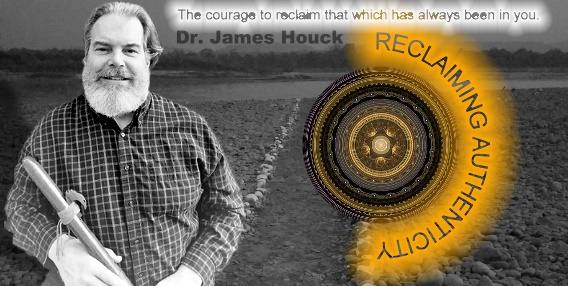

Reclaiming Authenticity with James Houck PhD, LPC, CCTP
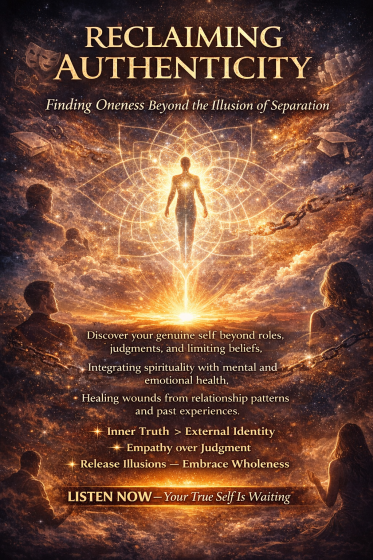
Reclaiming Authenticity: Finding Oneness Beyond the Illusion of Separation
Reclaiming Authenticity
Beyond the Breakfast Club: Finding Oneness in a Divided World
The Core Philosophy
"What lies behind us and what lies before us are tiny matters compared to what lies within us." — Emerson
- Internal Answers: Healing comes from within, not from external searching.
- The Oneness Truth: We are souls first; gender, age, and culture are external "veils."
- Empathy vs. Sympathy: Empathy is feeling with someone, requiring the suspension of all judgment.
Identity Stage
Ages 12-18: Identity vs. Role Confusion. "Who am I and where do I fit?"
The Metaphor
The illusion of being bound by a "pretend rope." We are only limited by our beliefs.
ASPIRES Scale
Prayer Fulfillment: Inner strength.
Universality: Interconnected life.
Connectedness: Hub of a wheel.
Developed by Dr. Ralph Piedmont (1999)
Key Takeaways
Dr. James Hauck
Introduction
Dr. James Hauck explores the profound integration of mental health and spirituality, emphasizing that our true identity as souls is often obscured by sensory limitations and social constructs. By examining psychological theories, spiritual texts, and cultural touchstones like The Breakfast Club, he invites listeners to reclaim their inherent value and recognize the "oneness" that connects all humanity.
Detailed Summary
The Philosophy of Inner Wisdom and Inherent Value
The journey to authenticity begins with the realization that individuals possess the answers to their own lives within themselves. Dr. Hauck posits that every person enters the world with the necessary talents, graces, and potential to know themselves as a soul. However, traumatic experiences often lead people to hide their giftedness or live from a place of "woundedness" rather than wholeness. This internal value remains constant, even when external circumstances or past unresolved issues suggest otherwise.
The Limitations of Sensory Perception
A significant barrier to self-realization is the reliance on the five senses. While empirical evidence provides a framework for navigating the physical world, it is the mind—not the brain—that interprets these signals, often creating a limited or even destructive version of "truth." Dr. Hauck argues that the most transformative experiences touch the soul, which exists beyond these sensory boundaries. Divine love is described as eternal and unconditional, contrasting with the human emotions entangled in the mind’s limited perceptions.
The ASPIRES Scale: Measuring Spiritual Transcendence
Developed by Dr. Ralph Piedmont, this scale identifies spirituality as the "sixth factor" of personality.
Belief in the interconnectedness of all life.
Emotional satisfaction from connecting with the divine.
A sense of belonging to a trans-generational human thread.
Social Identity and the "Breakfast Club" Effect
Using the 1985 film The Breakfast Club as a primary analogy, Dr. Hauck illustrates how social labels—the athlete, the brain, the criminal—create artificial barriers. Just as the characters discovered they had more in common than their differences, modern individuals often struggle with the "risk" of stepping outside their cliques or socioeconomic statuses. This struggle is rooted in Erik Erikson’s adolescent stage of "Identity vs. Role Confusion," where the search for "where do I fit" can lead to deep insecurity if a clear sense of self is not established.
The Foundation of Oneness and Empathy
Dr. Hauck draws from the Upanishads and the Bible to support the concept of non-duality—the idea that the universe is interconnected and all beings manifest the same divine essence. This "oneness" is the bedrock of morality and ethics, exemplified by the Golden Rule. True empathy is distinguished from sympathy; it requires "feeling with" others and suspending all judgment. By judging another, one effectively disconnects from the shared soul-identity and reinforces the illusion of separation.
The Illusion of Bondage
"Just as the washerman's donkey remained stationary because it believed it was tied to the tree, we often remain stuck in our lives because we believe in the illusion of our limitations. Freedom is not something to be gained, but a reality to be recognized."
Overcoming the Illusion of Limitation
The broadcast concludes with the story of the washerman and his donkey to illustrate that bondage is often an illusion. The donkey refused to move because it watched someone pretend to tie it to a tree; it only moved once it watched the imaginary knot being untied. Dr. Hauck suggests that humanity is similarly "tricked" into thinking it is bound by temporal limitations or socioeconomic status. Reclaiming authenticity requires "walking in" the reality of being a soul and treating others with the same soulful recognition.
Key Data
- Call-in Number: 888-627-6008.
- Broadcast Schedule: Wednesday evenings at 9:00 PM EST / 6:00 PM PST.
- Core Scale: The Spiritual Transcendence Scale (ASPIRES), developed by Dr. Ralph Piedmont (1999).
- Key Literary References: The Alchemist (Paulo Coelho), The Call of the Wild (Jack London), and the Upanishads.
To-Do / Next Steps
- Visit the official websites for more information or to leave comments: www.bbsradio.com/reclaimingauthenticity and www.reclaimingauthenticity.com.
- Access the archives on BBS Radio, iTunes, Audible, Spotify, or Amazon Music if you missed previous broadcasts.
- Research the Spiritual Transcendence Scale (ASPIRES) online to take the assessment and identify areas for personal development.
- Watch or re-watch The Breakfast Club this weekend to reflect on whether you are viewing others through the lens of labels or shared humanity.
- Join the next broadcast in two weeks to continue the exploration of oneness and authentic living.
Conclusion
Authenticity is not a destination to be reached but a reality to be reclaimed. By looking past the "man-made" distinctions of class, gender, and culture, and by recognizing the limitations of our own sensory interpretations, we can move from a state of existence to a state of true living. As Dr. Hauck reminds us, we are already connected; we simply need to "untie" the imaginary ropes that keep us from walking in that freedom.
Reclaiming Authenticity
Support my show
$5.99/mo or $9.99/mo
Click HERE
SUBSCRIBE TO TALK SHOW
A Subscription is NOT REQUIRED to listen to my shows,
but it is greatly appreciated!
Reclaiming Authenticity: The courage to reclaim that which has always been in you.
No matter who we are, where we were born, and into what family we were placed, ours is a world full of relationships. Indeed, we are social beings who spend our lives making sense of our world by trying to find our place in the world. As social beings, it is often within the context of relationships that we experience tremendous pain and suffering. From overt acts of betrayal and cruelty that someone may have inflicted against us or vice versa, to simply being in the wrong place at the wrong time, many people bear the scars of physical, psychological, emotional, and spiritual wounds. And yet ironically, just as we experience our woundedness in relationships, it is also within the context of healthy relationships that we find our healing and authenticity. The difficulty, then, is often finding the courage to discover that which has always been in you.
For over 25 years, Dr. James Houck has been helping people discover their authentic selves by integrating spirituality into their mental and emotional health. As people are able to integrate these disciplines, they often discover core issues that have been keeping them wounded in relationships.
[00:00] Speaker 1: (instrumental music plays) And now with over 25 years of experience integrating mental health and spirituality, the author of Reclaiming Authenticity: When Ancestors Weep and Redeeming the Bereaved. Here is Dr. James Hauck.
[00:33] Speaker 2: Hey, hey, hey, everybody. Good evening, everyone, wherever you are in the world at this time. Welcome to Reclaiming Authenticity, helping you find your courage to reclaim that which has always been in you. In fact, helping you reclaim that which you have always been and are. Very (laughs) excited to be with you here this evening and every other Wednesday evening at 9:00 PM Eastern Standard Time, 6:00 PM Pacific Standard Time. And each and every week, these broadcasts are dedicated to the integration of our spirituality and our mental health, all within the context of our relationships. The relationship that we have with ourself, the relationship that we have with others, and certainly the relationship that we have with God or the divine. I am Dr. James Hauck, and if you would like more information about me or you want to leave me your comments about tonight's show, please visit the websites. It's www.bbsradio.com/reclaimingauthenticity.
[01:46] Speaker 2: And the other website is www.reclaiming-authority, or I'm sorry, authenticity.com. So if you would like to call in and be part of the show later on, that number is 888-627-6008, that's 888-627-6008, and I will be taking your calls after the break. I always enjoy, uh, talking with people who call in. And just in case you cannot spend the entire hour with me this evening, this broadcast will be posted on the BBS Radio website, so then you can go back and listen again, or you can just go in and check the archives for previous shows that you might have missed or, you know, ones that, that pique your interest. And, uh, these podcasts are also available now for download on iTunes, and Audible, and Spotify, and Amazon Music. And this show also replays on WNEW 102.7 FM HD3 out of New York on the weekends.
[02:51] Speaker 2: Well, for those of you who might be tuning in for the first time, and I really appreciate your listenership, I would like to share with you and everybody two deep-seated beliefs that have helped shaped my outlook on reclaiming ourselves as authentic souls. In fact, this is the same philosophy, what I share with clients regarding just how and why I work with them the way that I do. And the first one is that I believe that people have the answers within themselves, because after all, you know the kind of life you want to live. You know how you feel, you know what brings you peace and joy and hope, and you know what doesn't. And sometimes, we're in the wrong place at the wrong time and something traumatic happens to us, or we thought that we've dealt with something, you know, in our past, only to discover that later on unresolved issues keep popping up again and again, or we keep making the same mistakes over and over again, and now we have to go back and go deeper into our healing.
[03:58] Speaker 2: And I always loved that quote from, uh, the famous poet and writer Ralph Waldo Emerson, who once said that, "What lies behind us and what lies before us, these are tiny matters compared to what lies within us." So I certainly believe that people have the answers within themselves. That's the first one. The second one is that I truly believe that everybody comes into this world with what they already need, and this, you know, need for in this life in terms of their giftedness, or their talents, or their skills, or graces, or personalities, and so forth. You know, in other words, the very best parts of who you are, as well as this potential for knowing yourself as a soul.
[04:45] Speaker 2: Now, I constantly run into this, uh, the clients that I counsel that, you know, even though, you know, people, you know, and I include myself here, may have had some awful or traumatic experiences, we may tend to stop believing that we are full of value, dignity, and worth, as well as we just wanna hide our giftedness so others will not exploit them. Well, either way, we end up going through life thinking from, or speaking from, or living from a place of woundedness, instead of a place of healing, and grace, and love, and peace, and wholeness. I mean, after all, we are those things. We just don't fully realize who we truly are yet. And, I mean, and the reason for this is that all of our experiences are taken in through our five senses, you know, sight, sound, taste, touch, and smell.
[05:42] Speaker 2: But these are limited, you know, 'cause they're, they're based on, you know, these, this is empirical evidence that we can measure, and whatever we can take in through our senses automatically gets interpreted not by our brain, but by our mind. You know, the mind creates, but the mind also...... has the capability of destroying something as well. And as a result, we convince ourselves that, "Well, if I see it, then that must be true." Or, "If I can hear it, well then that must be true." And, "If I can touch it, then that must be true," as well as the other sensory-related experiences or empirical evidence, and we tend to believe to be the end-all-be-all of truth. And yet, like I said, you know, these sensory perceptions are limited, because what is taken in through the brain, like I said, the mind comes in and interprets what we have seen, and heard, and tasted, and touched, and smelled based on our limited experiences.
[06:45] Speaker 2: I mean, and not realizing that, let's say, the holiest and the most transformative experiences touch the soul. So don't get trapped in the illusion that you have to go in search of something that you already have. Just don't do that. You know, because Godly or divine love is a love that's not entangled in the human emotions of the mind. Divine love is eternal, it's not conditional, and it- it helps others, you know, purify their minds by recognizing only that which is divine in all. So again, don't go off searching for something that you already have. Discover who you are, and be that soulful presence in the world. And when you boil it all down, this is what Reclaiming Authenticity is all about. The fact that it can be summed up with one word, come on people, say it with me, namaste. Which roughly translated means, because I see myself as a soul of light, this allows me to greet your lighted soul of who you are, even if you don't see it in yourself yet.
[08:00] Speaker 2: Well, I shared in the last broadcast a quote from my teacher, Swami Parthibhajanand from Akhand Paramahamsa Ashram in Haridwar, India, who once said that, "This ocean of worldly existence," which is experienced through our five senses, "this ocean of worldly experience, uh, existence is easily crossed having climbed the highest mountains, the deepest waters, and fire. However, there's nothing but pure consciousness." So he says, "Come on up the mountain." However, the problem is that we don't leave our old ways of thinking and seeing behind, and that's where we run into trouble. You know, we have to, you know, realize that what we take in through our senses is limited, but the soul is not limited. Okay? And therein lies the importance, you know, of this realization of who we truly are.
[08:58] Speaker 2: Now, the author of the best-selling book, The Alchemist, uh, Paulo Coelho, says that, "The energy of hate really takes us nowhere, but the energy of forgiveness which manifests through love can change our lives for the better." And I can certainly attest to that. So as I stated before, if you'd like to call in, you know, and be part of the show, that number is 888-627-6008, and I'll be taking your calls after the break, because I would really love to hear what's on your heart regarding tonight's show, Beyond the Breakfast Club, the True Feeling of Oneness. Well, perhaps my all-time favorite movie is The Breakfast Club, and from the first time I watched this film back in 1985, and yes, I'm that old, you know, I was hooked on the storyline. You know, that and I... Okay, you know, true confession time, folks. You know, I did have a crush on Molly Ringwald. However, w- we're gonna save that for another broadcast. Okay?
[10:04] Speaker 2: But anyway, I love the storyline, because John Hughes, who directed the film, he writes this powerful story in that he says, "Let's put a small group of students in a Saturday detention situation, and let's see what happens." And what made the movie extra unique was that each character, each of these students represented a type of student. There was the athlete, there was the popular prom queen, there was the brain, there was the neglected lonely outcast, and then there was the criminal. Well, initially, each of these characters believed that they had nothing in common with the others, and that's how the movie starts off. It's like, you know, "No, don't even talk to me, 'cause I- I have nothing, you know, I- I just can't relate to you because we have nothing in common." However, as they learned more about one another through their stories, you know, each of them realized that they had more in common than their perceived differences.
[11:11] Speaker 2: I mean, it was a powerful story of self-discovery and friendship. The only problem was that the film ended without knowing what Monday morning would bring. Right? Would they maintain their newfound friendships that challenged the, you know, the social boundaries, or would they revert back to their own cliques? Well, we never know. That's where the movie ends, and the audience is left to wonder, "I wonder what would I do?" Well, even though The Breakfast Club was written over 40 years ago, that message is still clear for today.
[11:48] Speaker 2: Whenever we are transformed, let's just say, by a self-realization moment, you know, an aha moment, where just the light bulb goes off and everything is c- clear, do we accept this, and then do we allow that wisdom to take us beyond our limitations and embrace oneness with each other as souls?This indeed is a very powerful question, because if we truly allow those words to penetrate deeply into our lives, we're never going to be the same, whether it's in our families or in our personal or professional relationships. So let me pose this question to you. Who did you identify with back in your high school days? Who did you identify with in your high school days? Who did you find a connection with? What group did you feel most at home? Was this connection based on early childhood friendships that just continued on through middle school and high school? Or was it centered around activities and then friendships developed later? Well, what about now? Who do you find a connection with?
[13:03] Speaker 2: Do you stay within your comfort zone of your friends, or do, do you stay within your own socioeconomic status? Do you stay with like-minded people? Or what about, you know, people with similar political interests, you just are content to stay with them? Or what about like, say, maybe, uh, the support groups you attended or have attended? You know, like AA or Narcotics Anonymous or grief or other support groups with people that you've established friendships with. You know, you, you meet for, like, a, a common good, and then when the support group ended, do you still stay in touch? Well, let's take even this question deeper. Do you feel a connection or, let's say, a oneness with people whom you believe you have nothing in common? Do you feel a connection or a oneness with people whom you believe you have nothing in common? I mean, nothing wrong with finding your group. After all, that's characteristic of our adolescent developmental stage. That's what's supposed to happen.
[14:16] Speaker 2: We're supposed to find, you know, our place. We're supposed to find our friends and so forth. But what about now? Do you still feel a connection with people that you, you look at or you listen to or whatever, and you just say, "I have nothing in common with them. I don't need to know their story. They don't need to know mine"? Well, speaking of this adolescent developmental stage, um, this was something that Erik Erikson, you know, who was a developmental psychologist, Erik Erikson, um, he coined the phrase, you know, identity versus role confusion as a real struggle or a hurdle, as I like to refer to it, that teenagers have to go through, and in this particular stage that occurs during adolescence, you know, it's somewhere between 12 and 18 years old. And during this stage, adolescents explore their independence, and they, they struggle to develop a sense of self. And yes, we have all gone through this. Yes, even your grandparents did, even your great-grandparents did.
[15:29] Speaker 2: They just act like they'd never experienced anything like that before, but don't let 'em snow you. Everybody goes through this, but this is very common to occur during the 12 through 18, maybe 19, maybe 20 years old, somewhere around there, but definitely within adolescence. Okay? Well, in this adolescent developmental stage, you know, uh, Erikson truly believed that the major questions everybody wrestled with were, "Who am I? Where do I fit? And with whom?" "Who am I? Where do I fit? And with whom?" And these questions were best answered within the context of the sociopolitical, uh, socioeconomic relationships, including family, friends, work colleagues, and yes, people within our own, like I said, socioeconomic group. But Erikson also believed that within this particular stage, adolescents struggle, and I mean struggle, not only to develop a cohesive sense of self, but also to explore values and beliefs and life goals to which they feel a connection.
[16:49] Speaker 2: Now, if an adolescent does not establish a clear sense of self, this can lead to role confusion and uncertainty, let's say, about one's place in society, or they begin acting out in rebellion or experience a deep insecurity, because they don't know who they are. They're trying to figure it out, and I just, you know, they, they might say things like, "Well, I just don't fit. Where do I belong? With whom do I belong?" You know? And this is why finding people to connect with is crucial, w- whether or not peer pressure is involved. I mean, that's a whole nother, you know, flavor to this. But again, it starts in early adolescence, you know, these questions of just who am I and where do I fit and with whom? Well, this is something that I've been seeing lately with the teens that I counsel. In fact, I was schooled last week when a few of them started to raise the issue with me.
[17:50] Speaker 2: You know, they, they really struggle with the pressure to stay within their friend group, or they risk developing friendships with people outside it. And I use the word risk, because these kids were serious. You know, in fact, one kid put it to me, he goes, "You know, uh, uh, Dr. Jim, what is the cost of stepping outside your friend group to be friends with another?"And I was blown away by that question, you know, 'cause this kid was like maybe 15, 14, 15 years old, and he was very articulate. And I said, "You know what? Let's really, you know, unpack this, because I think you've been thinking about this for some time." And he said, "Yeah, I've really been struggling. You know, because I love my friends, I just want to make friends with other people." "Okay. So let's say, for example, uh, you know, you're good at sports, okay? And you found your friends among other like-minded sports people. Okay?
[18:52] Speaker 2: Whatever the sport is, it's like you guys all sit in the cafeteria and, you know, you hang together. I get it, okay? But what would happen if you wanted to befriend another student, or students, who were, let's say, the troublemakers, or, uh, with a student who never quite fit in? Would your friends understand? Would your friends allow you to do this? Or would they question your motives and feel betrayed in the process?" And yet, by taking the time to get to know others outside of our group, we discover that we have much more in common than what we once thought. There's the breakfast club all over again. In fact, what would you ha- what would happen if you started to realize that the same difficult issues, uh, they struggled with are the same issues we struggle with? I mean, that's a different matter now, isn't it?
[19:52] Speaker 2: And, and again, you know, when we experience that inner transformation by this, uh, self-realization moment, again, this aha moment, right, do we accept and allow that kind of, you know, now our eyes have been opened kind of, you know, conversion, to take us beyond our limitations? See, class distinctions is alive and well, not just in this country, but throughout the world. And class distinctions keep people separate, and it keeps them afraid. But class distinctions are all manmade. Where do they come from? What is this need to say, "Okay, well, I don't really fit with you, and so therefore, you stay over there. And you feel as though I don't really, you know, want to fit with you, so okay, I'm going to go over here." You know, and then, the class distinctions or whatever separatist myth is, is created. Like I said, this is manmade. So transcendence or transformation, what comes first?
[21:05] Speaker 2: Do we wait until we are transformed, wait for these aha moments before we transcend or go beyond our limitations? Or is it within the process of, let's say, taking a step of faith, going beyond our limitations, that we find our transformation? Well, perhaps it's not so much an either/or question, but I think it's rather a both/and. Well, last week, I came across a famous quote from Jack London. Uh, Jack London, if that name rings a bell, he was an American novelist, he was a journalist, and he was, uh, a human activist and an animal activist. And this quote really blew me away. It goes like this. He says, "I would rather be in ashes than dust. I would rather that my spark should burn out in a brilliant blaze than it should be stifled by dry rot. I would rather be a superb meteor, every atom of me in magnificent glow, than a sleepy and permanent planet. The function of humanity is to live, not to exist.
[22:23] Speaker 2: I shall not waste my days trying to prolong them, because I shall use my time." Powerful, right? Well, Jack London is perhaps best known for writing The Call of the Wild, and he wrote that, that story back in 1903, if you can believe it. And he also wrote the book The People of the, uh, The People of the Abyss, uh, in which he depicted the London district of Whitechapel. And yes, if you're familiar with Whitechapel, that's the town that was made famous by Jack the Ripper. And, uh, London, you know, Jack London attempted to understand the working class of this particularly deprived area of the city, and people sleeping in workhouses or on streets and staying as a lodger with a poor family or poor families, and he did the exact same thing, whom, in his works, he would refer to them as the urban poor. Well, we like to think of ourselves as being separate from those conditions of humanity. But are we really?
[23:32] Speaker 2: And what about someone who comes from the working class and wants to develop friendships with people from a, let's say, so-called higher socioeconomic class? Would they be made to feel welcome, or would they face a harsh treatment and told to, you know, go back and live with your own kind? Well, let's see. A lot of stories have been written about that, even as far back as Shakespeare. You know, can anybody say Romeo and Juliet? Mm-hmm. Can anybody say Othello? Uh-huh. Yeah. I mean, this is a very common theme. You know, that, that is just, it rears its ugly head time and time again throughout humanity. But, you know, when you think about it, being aware of our oneness or our connectedness as souls is really the foundation of all morality.You know that you and I are not only brothers and sisters, but that you and I are really one. So, be humble enough to learn from each other instead of automatically being dismissive.
[24:42] Speaker 2: Because humanity's greatest strength, in my opinion, is in its diversity. And yet, it's often the thing that's feared the most. Now remember, the soul does not have a gender, it doesn't have an age, it doesn't have a form, it doesn't have a culture. Now remembering who we are is not based on any of the externals that we see, or hear, or touch, or smell, and all that stuff, and often justify as the cause of divisions in humanity. Oneness is non-duality, or one without the second, as it were. Again, oneness means having this awareness that you and I are one. We are connected even though we may have never met. 'Cause moreover, we may appear as two different individuals, two separate bodies, but we're not the body. Everybody has a body, but we're connected through our soul.
[25:49] Speaker 2: (clears throat) Now in the Upanishads, which, uh, kind of interestingly enough in Sanskrit means sitting near a teacher, uh, there is this understanding that the universe is interconnected, and that all beings are manifestations of the same divine essence. And the idea that, uh, say liberation comes from recognizing this oneness and transcending the illusion of separativeness, or this, this illusion of duality. And if you've been listening to me this year so far, I've been focusing on, you know, these broadcasts on oneness. And the Upanishads teach us that the essential oneness of humanity and, uh, just guides us to the truth, that the whole world is a family, okay? That, that's not new age, okay? But it is a truth eternal. Okay? You see, uh, le- let's, you know, bre- let's break it down a little bit more, okay? Uh, there's this non-dual reality, you know, that there's only one non-dual consciousness, and separation is a misperception, okay?
[27:01] Speaker 2: And again, as the Upanishad teaches that all beings are manifestations of the single reality. And you know what? This oneness, this connectedness also shows up in the Bible. It's there. Okay? And secondly, there's this universal connectedness that the Upanishads promote the view that the world is a family, like I said, and everyone shares the same divine essence. And then lastly, you know, there's this overcoming the, that idea of being separate, that fear and misery arise out of the false reason, or, or the, I'm sorry, the false perception of separation, you know, that, that just comes from unity, while true happiness is realizing this unity. But perhaps the most vital aspect of realizing our oneness with all people and all things is that it fosters empathy and deep interpersonal connections, and this understanding of oneness is essential for empathy.
[28:09] Speaker 2: You know, empathy is that ability to be able to understand and to share and to experience the emotions and thoughts and percep- or, uh, perspectives of another person. I mean, how many times have you heard the expression walk a mile in another person's shoes? So, why is this so important? Why does it matter so much? Well, quite simply, it matters because we're stubborn, and we would rather be content to live in an illusion that this life is the end-all be all of our existence. And, you know, but we also need to remember the past, because it has, uh, very vital lessons for us, you know? As the well-known, uh, quote from the American philosopher George Santayana, he says that those who cannot remember the past are condemned to repeat it, and he wrote this a long time ago in, in his book, you know, The Life of Reason or Reason and Common Sense.
[29:16] Speaker 2: Now Churchill took the quote from George, uh, Santayana and, you know, he, he kind of flips it around a little bit and he goes that those who fail to learn the lessons from history are forever doomed to repeat it. You know, and this was part of his speech at the beginning of England's involvement in World War II, you know, and this, this sentiment is basically saying that we just cannot afford to move on and forget, because if we do this, sure enough, those destructive patterns will repeat themselves. So, why is it easier to want to forget and move on with our lives without taking a long hard look at ourselves? Because when we stop and we take a long hard look at ourselves and we start to ask really uncomfortable questions of ourselves, we just might realize that at our core, we have yet to realize who we are, which, again, brings us back to the subject of oneness and connectedness. Well, again, I would really love to hear what's on your heart on this particular matter.
[30:24] Speaker 2: So if you want to call in, le- then let's, let's chat about this. That number is 888-627-6008, and as I said, I'll be taking your calls now after this break. So again, you are listening to Reclaiming Authenticity, and I am your host, Dr. James Houck. I'll be back with you in one minute.
[30:47] Speaker 3: (Flute playing) For an answer or just to leave a thousand comments, or prodding around to buy a book by Dr. Houk. It's all there. Just wander over to reclaimingauthenticity.com and click around. And we'll see you next Wednesday at 9:00 PM Eastern Time, 6:00 PM Pacific, on PBS Radio. (Flute playing) .
[32:38] Speaker 2: Hey, everybody. Welcome back. I'm Dr. James Houk, and you're listening to Reclaiming Authenticity. Well, earlier in the broadcast, I was talking about oneness, as the Upanishads hold that the universe is interconnected and that all beings are manifestations of the same divine essence. And, you know, the Bible also speaks about oneness or, uh, connectedness. You know, and, uh, just one example that comes to mind right now, you know, Jesus' teaching of, of like, "When you've done it to the least of these, it's as if you have done it unto me." And that sounds like oneness to me. You know, and there's, uh, there's over a hundred more examples of scripture and these passages that just, you know, refer to connecting or connectedness and oneness, or being one. So, how do we recognize oneness when we experience it? Well, we certainly don't become aware of oneness by reading a book or listening to other people's stories. I mean, it helps, okay? You know, I...
[33:42] Speaker 2: And I'm a sucker for a good story, just like everybody else, but that's not exactly how we become aware of oneness. Instead, we become aware of oneness deep in our core, our soul, when we have had a direct encounter with God who shows us that it is through God that all things and all beings manifest the same divine essence. And when we have this direct encounter with God in our lives, we go from hoping that, "Well, I hope there's a God," to knowing, a conviction, a knowing at our core that we know that we know that we know that God has known us, knows us, and loves us for all eternity. And when you think about it, being aware of our oneness as souls is, as I said before the break, this eternal basis of all morality. You know, and it, it... You know, to understand that we are connected, that we're not only brothers and sisters, but we have this oneness, we share this oneness, regardless of, you know, our gender, or our age, or the form, or culture, and so forth.
[35:02] Speaker 2: The soul has none of these things, you know? So remembering who we are then is the motivation for, I believe, all ethics and all spirituality. What's the golden rule? Treat others as you would like to be treated. Okay? Again, sounds like oneness to me. So in other words, oneness is this non-duality, or I, I love the phrase one without the second. Okay? And, uh, where and with whom oneness shows up in our lives is in the development of empathy. That's right. It shows up in empathy. You know, it's the... This ability to be able to understand and share another person's feelings. You know, it, it's, it's a vital aspect of something I spoke on the last, um, podcast of, uh, emotional intelligence, or EQ. That wh- according to Daniel Goleman, who wrote the book Emotional Intelligence, and he says that empathy helps build relationships, and it improves communication, and it fosters this rich understanding.
[36:14] Speaker 2: And yet, being empathetic requires more than just saying we're sorry, even though that expression is, is a go-to for many people. I mean, that's... May- may- maybe that's how it begins. But, you know, advanced empathy, or empathy that really takes us deep into ourselves involves active listening, and understanding emotions, and responding with care and compassion. Now, for empathy to really foster healing and grace in our lives and in another person's life.We have to be careful, because we must not jump to conclusions. And above all, we have to suspend all judgment, because the minute we judge somebody else, we disconnect from that oneness, and we bring judgment on ourselves, because again, we're reverting back to this, "Okay, you're different from me." So we have to be careful that we don't jump to conclusions about a person, you know, or with our preconceived notions. And we have to get rid of all judgment. It just doesn't belong in the language and the experience of oneness.
[37:30] Speaker 2: Now, to comfort one another at a time of loss is definitely, uh, a prime example of empathy. But in order to do this, that means that we have to come close to one another, and we must come close and acknowledge not only this shared human experience, but also that we share something far greater that exceeds the limit of this world, that we're souls connected to one another. And unlike sympathy, which often involves feeling for someone from a distance, empathy involves feeling with them. Again, it requires suspending this judgment and thinking that we have the other person all figured out, and we recognize their emotions, which helps us connect with their experiences and allows us to provide the, the kind of, of support and nurturing that they need. Well, when I was in graduate school, uh, kind of ironically, I was introduced to the Spiritual Transcendence Scale, or ASPIRES, by a Dr. Ralph Piedmont, and he came up with this back in 1999. Uh, you know, he was just one of my teachers.
[38:47] Speaker 2: And, uh, Ralph was fun. You know, he always made ... and he t- taught statistics, and, you know, and, uh, you know, he had to make statistics fun, 'cause statistics can be really dry. But, uh, anyway, uh, Dr. Piedmont was a psychologist, and, uh, he was always fascinated in the five factor model of personality. You know, that there were just five main factors of, you know, this, who are we, you know, in terms of, you know, our personality. And he developed this Spiritual Transcendence Scale, uh, in order to measure three particular subscales.
[39:25] Speaker 2: And it had like a 24 item rating scale, and it looked at universality, prayer fulfillment, and connectedness, and he defined spiritual transcendence as, "The capacity of individuals to stand outside of their immediate sense of time and place, to view life from a larger, more objective perspective." And I like that definition, "The capacity of individuals to stand outside their immediate sense of time and place, to view life from a larger, more objective perspective." And the Spiritual Transcendence Scale, it was designed to capture aspects of the individual that are independent of this five factor model of personality. In fact, uh, Dr. Piedmont would often argue that spirituality is the sixth factor of personality. And initially, the questions, you know, that made up this Spiritual Transcendence, uh, Scale, were generated from several religious texts across Christianity, and Hinduism, and Judaism. And, you know, to this day, you can go on and Google it.
[40:38] Speaker 2: You know, you can probably download the, the, you know, uh, shortened version of it, and, uh, you can go on and take it and have some fun with it and see where you score. So let's, let's break that down a little bit. So the three subcategories of the Spiritual Transcendence Scale are prayer fulfillment, universality, and connectedness. So for prayer fulfillment, uh, he says that if you score high in this area, then you are somebody who has created a space in your life that's devoted to meditation and prayer on a regular basis. And individuals who score high in this area also tend to find a personal sense of emotional satisfaction and strength and support in their efforts to connect with something, uh, much bigger than themselves, let's just say.
[41:31] Speaker 2: Now, for the second one, for universality, uh, he says that, you know, people who score high in this area are indicative that they have this belief that all of life is interconnected, that all people share a common bond that supersedes any external differences. You know, in other words, seeing humanity as a single interrelated body breeds a broad respect for others, and a corresponding need to protect life in all of its forms. So, in other words, hurting any one person or animal hurts the whole. Then lastly ... (clears throat) Excuse me. Lastly, uh, connectedness, he says that high scores in this particular area represent a belief that a person is like a hub of a wheel, you know, with spokes radiating out in all directions. And these spokes represent relationships that one has, as well as a strong sense of understanding. Okay?
[42:34] Speaker 2: For example, to those, uh, you have this strong sense of understanding to those who have preceded us, you know, our parents, our grandparents, and ancestors extending way beyond anything Ancestry.com can measure. And he says also, you know, that these relationships, they also extend to those who co-exist with us in the immediate world, such as our family.... our friends, our co-workers, as well as in a distant world, such as strangers whom we may never meet in person or, you know, recognizing their need. And, and also these relationships extend to those who will come after us, like our children, our grandchildren, our future generations, you know. So it has this past, present, future sense to it, but it's not a linear understanding. It goes out in all directions. It cuts across all time and space, and you see and you feel this connectedness.
[43:36] Speaker 2: So I encourage you to Google the Spiritual Transcendence Scale and see what you identify with, as well as what you may need to develop in your life. Yes, it's an objective, uh, assessment, but it's really eye-opening. And again, if you want to start asking tough questions, you know, a- about yourself and your life and so forth and want to go deeper inside of yourself, that's the place to begin. Because, uh, a common understanding is that the Bible, the Upanishads, the Vedas, and other scriptural writings all point to the fact that, you know, we stand in oneness with God, that we stand in oneness with all people, and we stand in oneness with all things, that you are already that. And teachers and clerics, you know, clergy members and sages and gurus who know this and walk in this oneness, their job, more or less, okay, is to remove this, this veil that hides the truth from our eyes.
[44:40] Speaker 2: And this cessation of ignorance, as it were, can only come when you and I know that God and I are one, and this idea that we are, are bound is, is only an illusion, you know. And, and who told us that we don't have this kind of freedom? You know, who told us that we are so limited, that we are just bound and we're never gonna be able to break out of this? You know, that freedom is inseparable from the nature of who we truly are, and, you know, the innermost essence or self of a living being, as it were, you know, conceived as eternal and unchanging. So to really drive this home, you- you've heard me share this story with you, but it's just, you know, I've never found a better story yet to convey this illusion of, so who exactly told you that you were bound? Who told you that you're not one with God or one with all people? Who told you that you don't have this connectedness with others? So let me share with you the story of the washerman and the donkey.
[45:56] Speaker 2: Once upon a time, there was a man who lived hundreds of years ago, and being a simple man, his occupation was that of a washerman who goes around, and I mean, he didn't work for Maytag, okay, folks? But one who goes around, and he collected people's dirty laundry. He loads it on his donkey. He takes all of it down to the river. He washes the laundry, and he lays them all out on large rocks to dry, and then once they're dry, he folds the laundry, and then he returns home, uh, at the end of the day and delivers the laundry to customers, and that's how he makes his living. Okay? Well, one day, when he was collecting the laundry and taking it down to the river to wash it, he realized that he had forgotten the rope to which he would tie the donkey to a tree so that it wouldn't run off while he was washing the laundry. Once he realized this, he was so beside himself because he, he would lose a whole day's wage if he had to go back home and get his rope, and he didn't know what to do.
[46:58] Speaker 2: And as he was standing there not knowing what to do, a wise man just happened to be walking by, okay, sounds like connectedness to me, but this wise man walked by and asked if he was all right. And the washerman explained his situation to this man about forgetting his rope and so he couldn't tie his donkey, "And I'm gonna lose a whole day's wage," and so on and so forth. And the wise man listened and he smiled, and he said, "Sir, don't worry. I have an idea. Why don't you just pretend to tie the donkey to this tree?" "Uh, just pretend?" "Yes, yes, just pretend to go through the motions of tying your donkey to the tree. Only make sure he sees you do this." Well, as ridiculous as it sounded, the washerman said, "Okay. I'll give it a try," and he did just that. He pretended to tie his donkey to the tree, making sure that the donkey was watching him, and then he takes his laundry down to the river and he begins to wash it.
[48:09] Speaker 2: And every now and then, the washerman would look back at the tree just to see what the donkey was doing. The donkey was still there, eating grass and acting as if it'd been tied to the tree all along, perfectly content. So when the washerman finished, you know, with his laundry for the day, he'd loaded up the donkey and now he commanded the donkey to move, like, "Okay, let's go." But the donkey didn't move. In fact, it was as if it's been tied to the tree all along. And now the washerman thought he was really in a bind because he couldn't get this donkey to move. So he runs and he finds the man who, who told him to pretend to tie the donkey to the tree in the first place, okay? And he found this wise man and then he explained the situation.
[48:56] Speaker 2: You know, he was like, "Look, I told you, you know, you told me to, to tie, pretend tie the donkey to the tree and I did that and he stayed, and now, uh, he doesn't want to move. "And, and, uh, again, the wise man listened and smiled, and he replied to the washerman that there was an easy solution. Just as he pretended to tie the donkey to the tree, now he needed to pretend to untie his donkey from the tree, only make sure the donkey watches him do this. So, the washerman goes back to the donkey and starts pretending to untie it, making sure the donkey is watching him, and then with a stern voice he commands the donkey to move, and he and the donkey start to walk back home. While on the surface we might think to ourselves that that donkey in the story was just plain stupid. You know, being tricked into thinking it was tied when it was not.
[49:54] Speaker 2: Because, when you think about it, all the washerman did was simply go through the motions of tying and untying his donkey, which worked, but there's a deeper lesson here for you and I. Being tied to something, so to speak, is an illusion, and the real question is who told us that we're nothing more to which we are bound? Doesn't make sense, does it? I mean, if we have this freedom, this freedom of oneness, this freedom of being connected, this freedom of, of, you know, you and I are, are souls, where does this illusion of being bound to something temporal or s- you know, some illusion, where does that come into play in our lives? Now, it doesn't, but it shows up because we convince ourselves that, "Well, I can't do anything with my life because, well, I'm limited," or, "I'm so bound by the things that I just can't get around, you know, and I, I just, I can't, I can't help myself." Again, who told you that you were limited? See, it's one thing to understand that we are a soul.
[51:14] Speaker 2: It's quite something different to also understand that we need to start walking in it, and acting as a soul, and treating one another as souls. This is where the real beauty of oneness is. So I invite you, if you have nothing to do this Valentine's Day weekend, you know, put, uh, The Breakfast Club, you know, on Netflix or Amazon Prime or, you know, whatever. Maybe you even have a copy of it. Pop it in the DVD player, uh, sit back, have a laugh, and remember that are we really different from one another, or just we have this illusion that becomes dispelled the minute we start to share our stories with one another? I'm Dr. James Hauck, and you have been listening to Reclaiming Authenticity. I just thank you for spending time with me, you know, this evening, and, uh, again, I invite you to join me in, in two weeks when I'll be sharing more about, uh, oneness and just our, our need to, uh, realize, uh, who we are as souls and to be able to reclaim our authentic selves. Good night.
[52:37] Speaker 3: (Flute playing) For an answer or just to leave a thousand comments or prodding around to buy a book by Dr. Hauck, it's all there. Just wander over to reclaimingauthenticity.com and click around, and we'll see you next Wednesday at 9:00 PM Eastern Time, 6:00 PM Pacific, on PBS Radio TV.