
The Power of Synergy, April 6, 2026


The Power of Synergy with Gabrielle Cardona
Topic: The Synergy of Keys to Change and CASS
Theme: Life coaching in a Phoenix homeless shelter
Special Airing Live on Monday at 12pm Central Time of BBS Radio TV Station #1
Summary
Gabrielle Cardona, host of The Power of Synergy on BBS Radio, shares her profound experience living temporarily in a homeless shelter in Phoenix, Arizona, after her hotel reservation was unexpectedly canceled. Through her firsthand involvement at Central Arizona Shelter Services (CASS) and the affiliated Keys to Change campus, she exposes systemic issues such as neglect, abuse, mismanagement, and poor living conditions within the shelter system. Cardona emphasizes the importance of synergy—where positive energy and accountability foster real connection and change—and critiques the lack of accountability and consistency among staff and services. Despite the challenges, she highlights incremental improvements driven by a few dedicated staff and residents, stressing that positive, focused energy can catalyze meaningful progress. Cardona also discusses the mental health misunderstandings prevalent in such settings and advocates for personalized, compassionate coaching to empower individuals. Her mission is to raise awareness, provide support, and promote reform through transparency and the power of synergy.
Highlights
Gabrielle Cardona’s unplanned stay at a homeless shelter revealed severe neglect, poor conditions, and systemic dysfunction.
Synergy is defined as the positive force created when people unite in purpose and energy, fostering accountability and change.
The shelter system suffers from inconsistent policies, lack of accountability, and abusive treatment of residents.
Positive energy, persistence, and personalized coaching can empower residents and improve outcomes.
Mental health issues are often misunderstood and mishandled, with an overreliance on pharmaceutical approaches.
Staff turnover and burnout are high, but some dedicated individuals make meaningful contributions.
Cardona uses her platform and personal experience to advocate for better resources, transparency, and systemic reform.
Key Insights
Synergy as a Catalyst for Change: Cardona stresses that synergy—collaborative positive energy—is exponentially more powerful than isolated efforts. When applied to shelter management and individual empowerment, it can create transformative outcomes beyond simple additive effects, exemplified by her principle that three people synergizing can create an effect like 33=2733=27 rather than just 9.
No Neutral Energy in Human Interaction: The idea that every interaction is either positive or negative, with indifference equated to negativity, highlights the necessity for conscious accountability in relationships and community engagements. This principle guides Cardona’s coaching philosophy and her approach to improving shelter conditions.
Systemic Dysfunction Rooted in Ignorance, Indifference, Impotence, and Incompetence: These four “I’s” categorize the barriers within the shelter system. Many staff members either do not know about problems, don’t care, can’t act due to lack of authority, or lack the skills and training to effect change. Addressing these issues is crucial for systemic reform.
Challenges of Mental Health in Homelessness: Cardona critiques the common pathologizing of behaviors in homeless populations, arguing that many labeled “mentally ill” are instead misinformed or untreated due to systemic failures and pharmaceutical industry influence. She advocates for individualized coaching tailored to personalities to alleviate many issues effectively.
Impact of Infrastructure and Policy on Residents’ Dignity: Basic needs such as clean showers, functional toilets, pillows, and blankets are inadequately provided, diminishing residents’ dignity and health. These deficiencies illustrate how poor resource management undermines the shelter’s mission.
Importance of Trust and Positive Staff-Resident Relationships: The presence of caring, consistent staff who genuinely try to help residents, like Sheila and Crystal, fosters trust and improves morale, showing that individual attitudes can significantly influence group dynamics and outcomes.
Transparency and Advocacy via Media Exposure: Cardona uses her radio platform to shed light on hidden issues, hold organizations accountable, and galvanize public support for change, demonstrating how media can be leveraged as a tool for social justice.
Keywords
Synergy
Accountability
Homeless Shelter
Mental Health
Neglect
Positive Energy
Systemic Reform
FAQs
Q1: What is synergy according to Gabrielle Cardona?
A1: Synergy is the powerful effect created when people unite in positive energy, purpose, and focus, making the whole greater than the sum of its parts.
Q2: Why did Gabrielle Cardona stay at a homeless shelter?
A2: Her hotel reservation in Phoenix was canceled unexpectedly, leaving her with nowhere to stay, so she chose to stay at a nearby homeless shelter to understand the situation firsthand.
Q3: What were some of the conditions Cardona experienced at the shelter?
A3: She encountered overcrowded overflow sleeping on the floor without pillows or blankets, filthy bathrooms and showers, cold temperatures, disrespectful staff, and a lack of basic resources.
Q4: How does Cardona view mental health issues among the homeless?
A4: She believes many are misdiagnosed or misunderstood and that individualized coaching and support, rather than solely pharmaceutical interventions, can significantly help.
Q5: What improvements did Cardona observe during her stay?
A5: Incremental improvements included better staff attitudes, some policy adaptations, new security systems, introduction of Wi-Fi, and more organized resource access, though much work remained.
Core Concepts
Synergy and Human Connection: Synergy is about the invisible space between people where true understanding and connection occur. It is not neutral but an active force that can be either positive or negative. Positive synergy amplifies individual efforts, creating exponential growth in power and outcomes. This principle frames Cardona’s approach to improving human relationships and community systems.
Accountability and Responsibility: Power without accountability leads to neglect and harm. Cardona emphasizes that every action has consequences, and individuals and institutions must be responsible for how they wield their influence, especially in vulnerable settings like homeless shelters. Accountability is essential for trust and meaningful change.
Systemic Barriers in Social Services: The shelter system is fragmented, with multiple entities operating independently, inconsistent policies, and a lack of clear procedures. Staff attitude and training vary widely, leading to confusion and neglect. Barriers such as ignorance, indifference, impotence, and incompetence hinder effective service delivery.
Mental Health Misconceptions and Coaching: Cardona challenges traditional mental health paradigms, arguing that many behavioral issues stem from misinformation rather than illness. Tailored coaching based on personality types can resolve a majority of problems by empowering individuals to use their natural strengths and strategies.
Human Dignity and Basic Needs: Access to clean, comfortable living conditions is fundamental to health and dignity. Shelter shortcomings such as lack of pillows, blankets, hot water, and hygiene supplies reflect deeper systemic neglect that must be addressed to promote wellbeing.
Staff-Resident Dynamics: Positive relationships between staff and residents build trust and improve outcomes. Dedicated staff who try to help despite systemic obstacles make a significant difference, illustrating the power of individual commitment within flawed systems.
Media as a Tool for Change: Cardona’s use of her radio show to document and expose shelter conditions exemplifies how transparency and public awareness can motivate reform. Advocacy through media can empower marginalized voices and hold institutions accountable.
Gabrielle Cardona’s immersive experience and coaching philosophy underscore that while challenges in homeless shelters are complex and entrenched, persistent positive energy, accountability, and strategic collaboration can lead to sustainable improvements, restoring dignity and hope to vulnerable populations.
Headlined Show, The Power of Synergy April 6, 2026
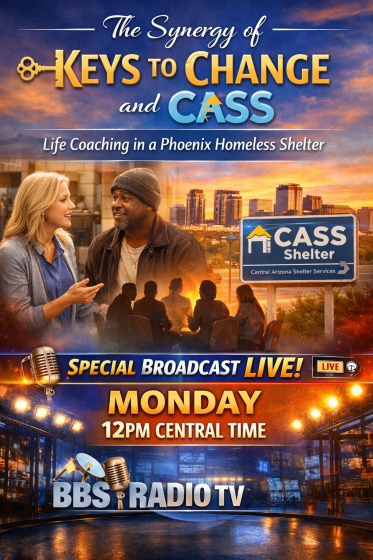
Topic: The Synergy of Keys to Change and CASS
Theme: Life coaching in a Phoenix homeless shelter
Special Airing Live on Monday at 12pm Central Time of BBS Radio TV Station #1
The Power of Synergy
"Is relationship coaching right for me?"
Unlike conventional counseling, relationship coaching is about insightful education and listening more than talking.
Connection, communication, and accountability are the 3 elements to a successful relationship. All 3 are vital and perpetual. Relationships are about knowing yourself and understanding others so that what you share is healthy and beneficial--to you both.
Some questions to ask yourself:
- Are you truly ready for healthy change?
- Can you handle homework?
- How honest are you with yourself?
- How much support do you provide to others?
- Are you qualified for a relationship?
Only YOU know the answers!
Do you know what the things people say mean? How do you interpret their actions? Try taking a look at their personality! There are 16 different personalities, and one statement from one person can mean something completely different when coming from someone else.
Learn about what's behind behavior. Information from "experts" can confuse people. It is inaccurate. If you attend an MBTI seminar, you'll walk away knowing AND understanding what people do, how they do it, and why they do it. You'll also understand yourself.
"Relationship Coaching"
What's the formula to success? How can you reach your goals? Want some practical advice on how to get what you want out of life, without making it painful or complicated?
The Relationship Coaching program provides information, tools, resources, and support to set you up for success in every area of your life. Define your goals, know where you are, and create the path in life that YOU want to take. Check it out and take the Workbook that comes with it home with you for free!
[00:11] Speaker 1: In the space between the talking, in the pause between the lines. There's a deeper understanding, that connects all human kind. The space between, that's where we meet. Where perspective feels complete. Not divided, not alone. That's where real connections grow. And stay between, unseen seen.
[00:56] Speaker 2: Welcome to the Power of Synergy on BBS Radio. I'm your host, Gabrielle Cardona. What is synergy? Well, it's a fun word to say, that's for sure. But synergy is what we create when we come together. When people join in force, in purpose, in focus, they become exponentially more powerful. Well, power is fun, right? That can be a fun thing. But you know what? Power comes with responsibility. Unfortunately, in this day and age with technology and devices and advancements and social scientific... Well, that's a lot of power that we now have. How are we wielding that power? You know what? Power comes with responsibility. Well, what's responsibility? Well, it's the ability to respond. No, actually it's accountability. It means that we have to render an accounting for not only what we do, but how we do it, and why we do it. Do you believe that you are accountable for your choices?
[02:10] Speaker 2: That you need to render the payment, that could be in the form of a consequence, it could be in the form of gratitude, or the things going on in your life. There are very good things happening in the world. Are you a part of them? Ooh, okay, okay. Now we're getting into something that as a life coach, and I specialize in relationship coaching, can be a little bit of a gray area. When you come together j- with people, you're either making the world and the people in it, the things in it better or worse. What I teach my clients that I've been in practice for over 22 years, is everything that you do will have an, a reaction. Every action has a reaction. First of all, there's no neutral energy. You're either positive or you're negative. Oh, wait a minute. (laughs) Okay, hold on a second. Well, you know what? I, I don't care. I'm indifferent. Sorry, ladies and gentlemen, indifference is negative. Okay. Um, okay.
[03:16] Speaker 2: (laughs) So let's ask then, do you think that your positive energy is actually powerful? There's no inertia. There's no neutral energy and there's no inertia. You are either moving towards someone, away from them, or with them. Okay. D- do you know how to synchronize? Do you know how to get together with people to synchronize, to synergize? And when you ask yourself when you are done being with someone, are they a better quality person after being with you, or are they worse? They're not gonna be the same. Bottom line. They're either gonna be better or they're gonna be worse based on what you do, but also how you do it, and why you do it. Your motives, your intentions. People absorb your energy. Is it positive or is it negative? Okay, you know what? (laughs) This is really, this is really heavy stuff. When we're just talking about relationships, unfortunately now because we have technology, there is no accountability.
[04:26] Speaker 2: People can say and do and be whatever they want with their technology. There are no consequences. There are really no forced choices that people have to make. All you have to do is delete or exit out of something, so you don't even have to stay the course, right, in your relationships, in your connections. They call it connection, but you're not really connected with anybody and you know what? If you think you are, let me ask you this. Ask yourself, would I have said or done or been that thing that way to their face if their body was physically in the same space that mine is, and I couldn't delete them and I couldn't get away from them? Would I have behaved in the same way? Okay, you know the answer to that. Well, do the people around you know the answer to that? Do they know you? Uh, okay, now this is, this is something I like to tell people. Why I like Spanish more than English, they have two different words for what English is, know, K-N-O-W.
[05:32] Speaker 2: For us in English, knowing something means you have information about it. In Spanish, knowing information is saber, S-A-B-E-R. Knowing people is conocer. That's C-O-N-O-C-E-R, and the really cool part is they put an A after it. You don't just know somebody, you know to them. Okay, now see this is really getting, this is getting interesting now. When you know somebody and you have that understanding of who they are, you have the opportunity to synergize.... in a different way than you would with an object. Do you know the people in your life? That means understanding who they are. That includes what they need. It's about what's important to them. And then the question is this, again since there's no neutral energy, are you making them better people, better versions of who they are, not necessarily changing them, because you know what?
[06:40] Speaker 2: Most people when they're doing bad things, they have the potential to do good things, it's just a different version of what they're doing, because it's about their motives and their intentions. So when you have good, healthy, positive energy for people to experience when they interact with you, you can say, "Yeah, you know what? I wanna share this with you and I think you're really gonna enjoy it." People are very excited about that and I've always said, "You know what? There's a lot of mental health issues that people have here." There's nothing wrong with having mental health issues, but why did I become a life coach? First of all, because I don't agree that people who behave in, hmm, less than healthy ways are mentally ill, and I don't think that they need to be drugged. The American mental health and pharmaceutical industries undermine peoples' progress, in my opinion, okay, and they undermine the connections that people could potentially have with other people.
[07:47] Speaker 2: When we combine, we don't... let's say three people, we don't become three. We don't even become nine. We become 27, 3 to the 3rd power, not just 3 times 3. Do you believe that when you have good quality energy, even a potentially unhealthy behavior can still synergize off of someone else to become healthy and productive? You know what? Most of the people that I've coached in my 20-plus years of practice, I have told them, "You are not mentally ill, you're just unfortunately misinformed. Once I explain to you how to do things for your personality, you are gonna have about 80% of your problems immediately disappear," because what I teach them is to do what is most natural and organic for them and their personality.
[08:41] Speaker 2: Five different people could literally come to me with the exact same issue or problem or question and I would give them completely different advice based on the individuality of their personality, because what works like magic for one person would almost guarantee failure in someone else, (laughs) okay? Now, my approach to helping people, I knew that I wasn't gonna be a psychiatrist. My son came home from school one day, he was a young teenager and he said, "Yeah, my mom's a shrink." I heard him talking to his friend. I said, "Don't say that. I am not a shrink." He turned to me and said, "Mom, you're the worst kind of shrink. You're a shrink in denial." (laughs) And I did laugh and I did give him a hug and a kiss, but you know what? No, I don't believe that most people are mentally ill. Some people are and that's okay, and it does not need to be something that is labeled and embarrassing, and it doesn't need to be chemically altered.
[09:40] Speaker 2: There are a lot of things that people can do differently in their life. When I tell people I'm a coach, I give people the strategy and equipment to score in the game of life. They feel better when they're done with me because they have a focus, they have a goal, and they have the support and encouragement of good specific information from a very happy person, a quality happiness. Yeah, they like to be around me because I put them in a good mood. Okay, so today my show is actually gonna be about all of those principles and an e- experience that I had five years ago when I came to Phoenix, Arizona. I missed out on my hotel reservation, so I spent the night at a homeless shelter. Oh, my God. Cass was an absolute nightmare. I- I'm gonna be talking about it today, not only what it was back then, what it evolved into, what it is now, and what it's on the road to being. So I'm gonna take a real quick break.
[10:47] Speaker 2: When I come back, we'll start at the very beginning, what happened the first night that I came to Central Arizona Shelter Services on 12th Avenue and Jefferson. This is The Power of Synergy on BBS Radio. I'm Gabrielle Cardona.
[11:13] Speaker 1: Hmm. Not apart, but interconnected. Every voice affects the next. When we learn to truly see. We create a unity. In synergy. We align. Different hearts. One design. When we understand the flow. That's when everything can grow. You and me. Synergy.
[11:58] Speaker 2: Welcome back to The Power of Synergy on BBS Radio. I'm your host, Gabrielle Cardona. Now ordinarily, this would be a call-in for relationship advice, but every so often, I give, um, just-... d- dedicate one, uh, broadcast to what's going on at a homeless shelter called CASS, Central Arizona Shelter Services. But they are on the campus of a company called Keys to Change. Now, the first time I came here, five years ago, uh, they were called the Human Services Campus. Well, how in the world did I end up there? I had a place to go in Phoenix, I live in Seattle, Washington, and I said, "You know what? I'm gonna, just gonna go ahead and reserve a hotel room, see how long I wanna stay there, depending on the work that I'm doing." Yeah, the hotel room canceled. It, it, the reservation was canceled. I said, "What, what are you talking about? It's like 8:00. I, I didn't cancel it. What the hell? H- what happened?" "Well, yeah, technical difficulties.
[13:03] Speaker 2: Yeah, you can go ahead and reserve a room for an extra $300 right now." "What? Uh, I'm sorry. No. Okay. (laughs) I'm not gonna do that. You guys messed up, not me. I have not eaten any good food. I was on the airplane, I had to stand in line because I was on nonstop, I was on standby, and ... What? Ugh." And I walked out. Okay. So I called my husband and I said, "What the hell? I can't believe they actually canceled my reservation. What am I supposed to do? There is no way. You know what? I'm gonna sleep on the street." (laughs) Because I'm a very stubborn woman. He said, "Honey, no you're not. We'll pay the extra money." I said, "Hell no, I will not, and I'm not going to. I'm a very obedient wife most of the time, submissive, yes, I do what my husband wants, because it's good for our marriage." (laughs) But I was, I was like, "No, I'm gonna Google something." So, then I saw that, you know what, less than two miles away there was actually a shelter. I thought, "Wait a minute.
[14:02] Speaker 2: Hey, that's free. I like the idea of free. Let's do that." So, I called up my husband and I said, "Honey, I'm, you know what? I'm gonna go to the shelter. It's like 12th Avenue and Jefferson, that's downtown, that's literally right in the government complex of Central and, like, 15th Avenue between Madison and Washington. Yeah, I c- I can go there. It'll be good." He said, "Honey, do not go to a shelter." I said, "But Honey, it's free and it's just for the night. I can leave in the morning and we can solve this whole thing and figure this whole thing out." He said, "Honey, well, I'm not gonna stop you, am I?" I said, "No. Why?" (laughs) He said, "Okay." So, yeah. By this time, it was actually getting bad weather, which for Phoenix, that meant overcast and a little bit of what might be monsoon, okay? But no, you know what? This isn't monsoon season. It just looked bad because I was in a bad mood.
[14:57] Speaker 2: So, I pulled up to this building and said, "Okay, yeah, I just have the bag and it'll be okay." So, I, I saw, oh great, there's a security guard out here. See? I feel good now. What is my husband being so weird about this for? Obviously, if there's security, that means I'm gonna be secure. Yeah, okay. So, I'm looking at him. There were daggers coming out of his eyes. And I said, "Good evening. Um, this, this is a shelter, right?" He said, "What do you want?" I said, "Um, some shelter. My hotel room was canceled. Can I, uh, wha- (laughs) Is this the office?" (laughs) 'Cause I saw the building he was standing in front of, and it said, "The Brian Garcia Welcome Center." I'm like, "Welcome. See, I'm welcome. Maybe not you, maybe you've had a bad day. That's okay, I'm gonna go into the welcome center and I'm gonna see what kind of help they can give me, right? A- a, just a bed. I just need a bed because extenuating circumstances.
[16:00] Speaker 2: Let me talk to someone, not you." So, he let me into the welcome center, chairs, people sitting, and staff behind the counter, completely ignoring everybody there And I said, "Okay, I need, I need a place to spend the night." I waited three hours to be seen by someone, and then when I was seen by someone, they treated me like absolute scum. They actually disrespected me. They, um, were confrontational, they were aggressive. "You know what? I, (sighs) I, I need a bed. Just, just get me a bed. I can ignore you, I'm an introvert." Okay, no, it wasn't a bed. Apparently, I was going into something called overflow, which is in a building and you sleep on the ground. You get kind of this little padding thing. It's not quite a yoga mat, it's a little bit better than that, um, and a sheet. I said, "Well, where's a pillow and blanket?" "No. Pillows and blankets are not allowed here." I said, "W- what, what are you talking about? This is, this is horrible weather. This is November, okay?
[17:14] Speaker 2: And, and g- I need a blanket and the pillow. W- what am I supposed to use for? You know what? I'll use my suitcase." Okay. The guards were standing there staring at me. I said, "Look, you know what?" To one of the guards, I said, "You're probably not like the guy out front. I have epilepsy. I have seizures. I actually have grand mal seizures. I need to sleep. I have not slept." Yeah, they put me by the door and propped the door open. I said, "I am very freezing cold. Can you please close the door?" And they said, "No. We need the clean air in here." I said, "Wh- the air in here, by the way, is completely, totally filthy." They said, "Exactly," and they moved me literally in front of the door. I said, "Okay. You know what? This place needs to be reported to the Better Business Bureau," okay? Well, when I finally did wake up, I was asking around, "What the hell is this place about? What in the world is going on? What, what help can you give me?
[18:20] Speaker 2: Um, I didn't get my hotel room." Yeah, apparentlyThere are different companies on this campus. They give you different kinds of help. The people that welcomed me in were called the Human Services Campus. They were the ones who directed all of the other companies, businesses, services that were physically on the property. "Okay. Okay, I can, I can see that. I can do that. Let me know how I can get some help. Who of these apparently nine different businesses..." "Oh, they're over in that building behind Cass." "But are you Cass?" "No, we're Keys to Change." "Yeah, okay. Um, that, I don't know what that means. Um, so will someone please tell me what that means?" "Okay, you know what? Let's go ahead and, uh, talk to someone else." Not you. There's gotta be other people in this company. "Can I, can I report something, a complaint?
[19:22] Speaker 2: Is there any way I can file a complaint?" "Yes, that's called a grievance." "Okay, so I'll, I'll write a grievance." Okay, so I filled out the paperwork and said, "Now get me to the resources that I need." There's all of these different companies, but they each have different offers. They have different accessibility. They have different policies and procedures, and I didn't realize, they have different security. Okay. Uh, the main campus had Delta Security Guards. Wait a minute, but in this other building it was Trident. Okay, so who do I report this to? Come to find out, yeah, each company, each business had sort of a different MO. They had different policies and procedures. They were literally separate entities. Okay, fine. Okay. (laughs) . I called my husband and said, "Baby, you know, this is kind of a weird place. Uh, I'm, I'm checking out some things.
[20:25] Speaker 2: I will call you back, okay?" "Yeah, okay, sweetheart." "Um, so I saw some people there and they were very miserable, the people that were sleeping there in what they call overflow." "Okay." "Well, overflow because Cass didn't have the beds." "No, no, no, no. They do have beds, you just can't sleep in them." "What?" Okay, you know what? So I started talking to people, and when we come back, I'm going to actually describe in detail some of the things that happened. But there are residents here, I'm actually on campus, and so I told the people that I was gonna do this live broadcast and if they wanted to tell their stories, they could, but a lot of them are very nervous about going on live radio. So I'm gonna take another quick break. When I come back, I'll tell you what they were telling me and then what I experienced, and that's when I knew, you know what, I was becoming homeless the next day. This is The Power of Synergy on BBS Radio. I'm Gabrielle Cardona.
[21:39] Speaker 1: There's a blueprint in behavior. There's a reason people move. What you think is contradiction Might be something deeply true. Human blueprint, lines unseen. More than just what's on the screen. Every trait and every sign Tells a story by design. Read the sign. Take your time.
[22:25] Speaker 2: Welcome back to The Power of Synergy on BBS. I'm Gabrielle Cardona. Now synergy is a fun word to say, but it's misunderstood. It's not anything supernatural. It's not anything excessively profound. You know what? It's, it's what we create when we come together. And I've always told my clients, my friends, my family, there's no neutral energy. You are either making people better or worse when you're around them. Ask yourself, is the synergy, what you create in energy that comes out in behavior with other people, is it positive or is it negative? You're either good or you're bad. There is no neutral. You know what? People say, "Well, I'm indifferent. I don't care." Okay, that's bad. (laughs) One of my favorite things as a little girl when I was in a congregation in Milton, they, they would s- say to us... I would sit with my parents 'cause we didn't have Sunday school to go separate from the adults. One of the circuit overseers actually said, "You need to be on a side.
[23:37] Speaker 2: You have to pick a side. You're either on God's side or you're not. Everything that's not God's side is Satan's side." And I went, "Okay." And he s- and I thought, "But, you know, you could find a line, right, or like a fence." And he goes, "And in case you're thinking about getting on the fence, Satan owns the fence." And I went, "Ah! Oh my god, he read my mind." And then what am, what am I gonna do? When you are avoiding accountability, you're actually a negative person and you're justifying doing bad things. Well, not even necessarily that. If you're not doing the good things, you are by default doing bad. Okay. Oh, wait a minute now. Okay, so now if you have to really and truly render an accounting for the decisions that you make, the choices that you make and the effects that they have on people-Will that impact your choices? Ask yourself that. Okay. So let's just put that kind of in the back of your mind while I say... Okay. I'm going outside right now.
[24:41] Speaker 2: You can probably hear the music that people are playing. I'm asking people here at CAST, when I got here way back five years ago, was what in the hell is this place, and wha- how does it work, and what happens, and who's the staff, and why is security this way? Okay. So apparently, it was about, um, getting people... Getting homeless people not only into homes but getting them the services that they need. Okay. Well, that's good. That means like medical. That means jobs. You can get, um, resources. There are resources in the community like charities and companies that donate. They make donations of everything from food and clothing to transportation. Wow, look at that. This place is awesome. You have so much potential to get so much done. Yeah. Okay. So remember the, the guard I told you about, the security guard. "What do you want?" And the staff, "We're busy. Get away from us. We don't wanna talk to you." Okay. You know what? I believe that positive is more powerful than negative.
[25:56] Speaker 2: Not everybody agrees with me. But look, ladies and gentlemen, here's my principle. Positive energy, good conquers evil. Okay? The only problem is most people who are trying to do good don't hold the line. They don't actually stick it out to the end. They give up too soon. They give up too easily. So hey, you know what? I'm nauseatingly positive when I want to be. And so two things can happen. One, either the negative people around me are going to go, "Yeah, I actually like that. I think that's cool. I wanna join you." Or they say, "You know what? You are really making me mad with your happiness and your positivity. I'm getting somewhere else to someone else who can feed off of my toxicity." "Okay. Well then, I'll see you later. And when you decide to change your mind, you can come back and be with me and my happy friends." (laughs) Okay. Well, you know what?
[26:50] Speaker 2: People either love me or they hate me, and that's okay, because I know that at least the people who, for the time being, do not agree with what I'm doing, they know that the door's always... It's open. Okay? So when I said, "Look, these people have like 30 employees and like 10 security guards and nine different businesses. There've got to be good people in here." Mm. Yeah. No. And the, the negativity and the aggressive behavior, the condescending attitude, the confrontational approach. Every single time I would ask someone a question, they would disrespect me. They would insult me. They would mock me and make fun of me. I had seizures. I actually had five grand mal seizures. Not only did they not give me the pillow and blanket that I needed, they left the door open. They put me directly in front of a door. I need to file a complaint, because yes, I believe that positive feedback is good. It's important. But you gotta, you gotta tell people where they need improvement.
[28:00] Speaker 2: So I filled out a grievance and I said to the staff, I said, "Look, you know what? You got a lot of s- you've got a lot of work to do here. Um, but as long as you're gonna help me, what? Get, get a place to live. You're gonna help me get a place to live, and you're gonna get me a job, and you're gonna get me some food, and you're gonna get me some clothes, all that good stuff." They looked at me like, "What the hell are you bothering us for?" And so I, I thought about it and I called my husband. And I said, "All right, honey. Look, here's, here's the deal. It's one thing if they, they're having an off day. And it's, it's bad if we had an isolated incident where they were, hmm, okay, crossing a line or two. But this place is really bad, and I want to actually tell people on my show about it." Okay. Yeah. Let's, let's go ahead and raise some hell. Um, but I knew that the only way that I was really gonna know what was going on is if I lived as a resident, living as a homeless person.
[29:07] Speaker 2: Now my husband and kids are 1400 miles away, but I'm okay, because my kids are all grown up. And my husband and I, we can do a lot of things on the phone that are good for our marriage. But I can, I can go back whenever I need to. I just needed to actually see what was going on, what they do here, how this place can function with this modus operandi, and how many of the residents actually have a hard time with this. The abusive treatment was universal. Not only was there rejection, um, of them personally, the residents personally, saying, "You don't deserve help. You are not worthy of us caring about you. We, we genuinely don't care. We know you're having a situation. It's potentially beyond your control, but you know what? It's your own fault, and you're obviously a worthless piece of garbage and that's why you're here. So we don't have any obligation to help you." What? Okay. Um, so I found out at Keys to Change that CAST is, again, a separate place from the overflow where I slept.
[30:30] Speaker 2: Overflow was actually Keys to Change, but to get into CAST, you had to fill out certain applications and go through certain processes that I did. And I told my husband, "Oh my God. This place was absotively toxic."First of all, uh, the bathrooms, there's no toilet paper. Okay? A lot of them have very plogged, clogged toilets, um, and they have feces and urine. Um, there's blood and... Okay. So I said, "You know what? Just, just let me take a shower. I do have my own shampoo." "Yeah, 'cause they don't give you any shampoo, uh, or soap, any of that stuff." I'm like, "That's okay. I have my own stuff." And I looked at the residents. They were all very, very depressed and tired and anxious and angry and confrontational and destructive, and I'm like, "A- a- are you guys actually getting any of the services here?" And they said, "No. They don't, they don't give them to you.
[31:34] Speaker 2: You have to wait." First of all, first of all, you have to apply for them, but in order to do that, you have to get through these horrible people at the counters, that I knew firsthand were completely horrible people, and then you have to wait for them to assign you to, of the nine businesses, which one is best. But you do have a case manager, but you can't get it... You can't get the case manager, the case worker, unless you do certain things, but they won't tell us what you have to do. What? Oh, you know what? Just let me get in the shower. Okay? I'm, I'm sick of this. This is ridiculous. I, I, I, I'm not going home. (laughs) I wanna go be with my babies and my husband and, and you know what? I need some really good bad fast food, right? I need refined sugar and saturated fat. Just show me where the shower is. Okay, so it's kind of like a prison shower. It is a communal setting and there was blood and vomit. There was feces and urine in the showers, and there was glass.
[32:37] Speaker 2: And, okay, so I'll just steer clear of that with my bare feet 'cause I don't have, I don't have thongs to wear in the shower. I'll just turn on the, uh, the water. So I wait for the water. Cold, cold, cold, cold, cold. Two minutes, three minutes. Well, maybe no one takes showers, so the hot water just isn't coming. Yeah, no. There's no hot water. (laughs) What? I don't... Uh, okay. Ladies and gentlemen, you don't necessarily wanna know this about me, but when I take a shower, I have the hot as 90%. I only have cold water a little bit. And by the time I'm done taking a shower, I completely turn it off because I've used up all the hot water. Yeah, okay, so cold showers are not an option. I want another grievance. Give me another grievance. (laughs) I filled it out and I handed it in and I said to the residents, "What in the hell is going on here? What is, what is this, their policy procedure with the..." And they said, "Yeah, no.
[33:43] Speaker 2: No, that's how it is here." Okay, so what's for breakfast? Yeah, well, we have a couple different companies giving really, really garbage food. You stand in a line for two hours. You have to have your, your campus ID, which I did get by, by that time. Um, and I just said, "Okay. Is this what you get all the time?" And they're like, "Oh, yeah. No, this is on a good day." "Okay." So then I said to my husband, "Look, you know what? The truth is, if I was a person that had lost their job or their home and I, I literally had nowhere to go, I would need access to the housing and the employment and the medical and community service resources. I, I actually am gonna need to live like a homeless person." And he said, "Honey, you're insane." I said, "I know, honey, and that's okay. I don't mind." (laughs) And he said, "Are you gonna... You're not gonna make it.
[34:51] Speaker 2: You cannot live with garbage food in freezing cold showers in no blankets or pillows." Oh, yeah, by the way, ladies and gentlemen, I turn my home up to about 80 degrees, uh, even overnight because, to me, that's comfortable. Warm to me is 90 degrees, but my husband and children are not keen on that idea. That's part of the reason why I wanted to come to Phoenix in the first place. It's the fact that this place is extremely cold. They're jacked up the air conditioning in winter. He said, "You're never gonna make it." I said, "Yes, I will for two reasons. First of all, because I'm doing this for my radio show. Second, because I'm an INTP personality and I wanna know what in the hell is actually going on here. If this is going to not only give me information, but afford me an opportunity to help people who genuinely need help, it will be worth it. Okay?
[35:48] Speaker 2: Honey, you just gotta support me on this, and you know that if you tell me to come home, I absolutely will, but please don't." We, we pick our battles. One of mine is I don't like soccer. Our, our personal battle from our honeymoon was the World Cup soccer games that he literally said to me, "Honey, I understand you're very, very ready to have some fun with me as a virgin, right," 'cause I was a virgin on our honeymoon, "but there's a soccer game. I'll be there in about an hour." "O- okay." I- I have now, after 30 years of marriage, said to my husband, "Honey, let's watch the World Cup together. Let's bond, okay?" I, I made that sacrifice for him because you really have to understand what's important in life and choose your focus and priorities. So when I said to him, "Honey, I, I gotta stay here. Not only do I have to investigate, but I almost feel like there might be an opportunity for me to coach the people that live here.
[36:49] Speaker 2: They need my services." They have access to mental health services, but they're very low quality'Cause what I found out was these are not businesses, they are charities. That means they do not have to follow laws, they'd... health and safety codes. Apparently, if a business, a company, is nonprofit, they are not held to the same standards. Okay, my INTP just totally went off the deep end there and said, "Okay, I am putting this on the radio." (laughs) I'm getting excited here. Now, the line for lunch over at St. Vincent de Paul is starting to form. I'm going to talk to certain people here who said they were willing to tell a little bit about their story. Let's see if they actually wanna do that on live radio, on the broadcast.
[37:41] Speaker 2: Um, so I'm just gonna take another quick break and, uh, if you have questions, go ahead and write them down because I will open up the lines for people if they do wanna ask me something specific, either about my experience or how I dealt with it, which I will be getting into when I come back. This is The Power of Synergy on BBS Radio, I'm Gabrielle Cardona.
[38:17] Speaker 1: Sixteen ways to see a moment. Sixteen ways to understand. What feels wrong to one perspective. Might be perfect as it stands. Sixteen ways, one human mind. Every difference by design. When we learn to read the code. We lighten every load. Different view. Same truth.
[38:57] Speaker 2: Welcome back to The Power of Synergy on BBS. I'm Gabrielle Cardona. I'm a relationship coach, whom several years back had a hotel reservation canceled. I went to a homeless shelter in Downtown Phoenix, just because I had nowhere else to go that night, and what I saw horrified me. I knew that not only was the business as a whole, the entity of the shelter, was being mismanaged, but the, the residents were being abused. They were actually being abused and neglected by the staff. And I thought, "You know what? Okay. First of all, I wanna, I wanna really understand what this situation is." Because a lot, in fact, a lot of what the residents were saying to me is, "You have no idea. You've only been here one day. You don't know what it's like to live here." And I said, "Well, you know what? Actually, I, I feel really bad for you 'cause I do. I was abused in, like, four different ways. I just had seizures, grand mal seizures. I, I, I needed to (laughs) recover." And I said, "You know what?
[40:08] Speaker 2: I'll give you some free life coaching." They said, "You don't care about us." I said, "F- what are you talking about? Yes, I do. I, I feel horrible for you." There's literally... The, the campus grounds in front of the three different buildings. There's the LDRC, there's the CAST building, and then there's the Circle of the City, which has a dent- dental center, a- in addition to the Welcome Center, and everyone is being, uh, basically ignored. They have physical needs, they have, um, mental health issues, they have safety, um, medical issues and the s- the security is literally walking right by them. And when I got up in the morning, I, I forgot to tell you all this, they basically kick you out at 5:00 AM. They wake you up at 4:30 and they say, "Get out!" And they, they kick you out of the building and then they close the door. So you're sitting on the campus and in the winter, believe it or not, ladies and gentlemen, Phoenix is cold overnight. Yes, it is. Um, okay.
[41:11] Speaker 2: So if it's cold out here and, oh, that's right, not only do they not give you blankets. I said, "Well, I'm gonna go buy a blanket for myself." No, when you come in, they confiscate your pillow and blanket. "What? You're not serious. You're not actually gonna take my blanket away." Oh, yes, they do. And you're gonna love this. In the bathrooms, yeah, no, you don't get toilet paper. You have to request toilet paper to get into the bathroom. Um, I said, "Why is that?" Well, because you could clog the toilet. Well, okay, uh, just, uh, you must know that as an INTP, the only thing that's coming to my mind is if I have to request the toilet paper, I'm gonna get more than enough, I'm more than likely to use too much because I had to get enough to, just in case I need it. I'm, I'm gonna clog the toilet. Well, I went into the bathrooms. Yeah, they're, they're pretty clogged. The toilets are pretty gross and there's a whole lot of in-the-toilet things that are outside of the toilets.
[42:12] Speaker 2: "Well, when is a janitor gonna come?" Oh, well, they're supposed to come, I think, like, once a week. "Okay. Okay." (laughs) So that's why it smells the way that it does. We got a lot of drugs going on here. I said, "Look, you guys, I understand. You must be absolutely miserable here. Let me go ahead and help you out." There's, there's things that I teach people, that I coach people about reaction emotions. Being in this kind of setting would trigger three of the reaction emotions that I teach my clients how to manage. One is anxiety, one is fear, and one is anger. These are all very valid experiences. They're human experiences that we have. Anxiety is our body's way of telling us, "Something is gonna go wrong here. You need to stop whatever is going on, so that thing that could potentially go wrong doesn't happen." Anxiety is a very good thing.Then there's fear. Fear is your body and mind saying, "You know what? Your life is literally in danger.
[43:14] Speaker 2: Whatever it was that you didn't take care of with your anxiety, it's happening right now, okay? So let's go ahead and do this. (laughs) Let's do something about it." It's in- uh, more intense than anxiety, yeah, but it- 'cause it gives you more energy, it gives you more strength to fix whatever is going on. And that's the airplane above us, so if you can hear that, you gotta love Phoenix. We are really close to the airport. Okay. But then there's anger. So we have anxiety, it could go wrong. Fear, it is going wrong. Anger, it has gone wrong and we are gonna go ahead and do something about it now. Well, maybe you can, maybe you can't, but the fact is, anger is very important, okay? So I'm not gonna judge you for feeling it, and I'm certainly not going to take off and, and just forget about you." They said, "Yeah, that's what people do. They ignore us and they forget about us, and they do not care about us." And I said, "Well, you know what? That's wrong.
[44:11] Speaker 2: So I'm gonna live here with you guys. (laughs) And I'm gonna help you out. I'm gonna, I'm gonna give you the coaching that you want, but more importantly, I'm from BBS Radio and I'm gonna put this on the air. I'm gonna put this, uh, in the world because yes, BBS is not local and it's not a podcast. This is international radio and you know what? My producer, Don, he owns the station. He's completely platinum as an individual, and yeah, I'm, I'm gonna do this." Usually my radio show is about giving relationship advice. I'm like Frasier, right? I'm a mental health expert, except I'm better because I actually help people by giving them solutions, effective solutions. So if people wanna call into my radio show and get my advice, yeah, I'll do that for them for free. I want the world to see not only what goes on here, but what doesn't go on here and how we can make it better. Some people, you know what? I do care about these people.
[45:13] Speaker 2: They wanna make things better, but there's something that's not synchronizing. That's what it is. The synchronicity is what stops it from synergizing as an entire business, right? Campus of different companies. It's not synergizing to actually give people what they need. All right. So I called my husband and I said, "All right, honey. We're officially separated and, um, I'm a homeless woman now and I have epilepsy, so I have medical needs and I need to get a job. I'm gonna go ahead and get a job, and I need to find a place to live." I think they have different places that they actually send you, um, if you qualify for certain things. Other ones, they say, "Well, you can go ahead and apply for these other things on your own independently. You need to go ahead and figure out what you want." "Okay. Yeah. So I'll let you know when I'm coming back." He said, "You're, you're not kidding, are you?" I said, "No, honey, I'm not," because look, here's the thing.
[46:16] Speaker 2: First of all, the people that live here, they need some life coaching, okay? Just to make it through the friggin' day, they need something positive. They need something tangible, they need something very specifically focused to not only help them make it through the situation, but to improve the situation. And the only way that I'm actually gonna understand why nothing in this place is working the way that it's supposed to, they're not doing what they're supposed to, when I figure out why that is, I'm going to make it public knowledge And that way they will be probably more motivated to make some changes because I can, I can stand out on the street corner with a sign screaming, "Cass is evil" and people are gonna write me off, okay? I, I need to actually have something substantive and tangible that is really, really of value for people to know about. Especially if what this place, if it's donations, if it's charity, they need to have the funds being distributed more effectively. Okay.
[47:26] Speaker 2: So believe it or not, I actually got a lot of flak from the residents. They said, "First of all, we don't trust you. You must have an agenda. You're trying to do something for your own personal glory." I said, "No I'm not. I, this is gonna get me glory. In fact, I'm probably gonna get a lot of judgment and criticism." (laughs) But I think it'll be worth it because if I can show people that good, positive energy is more powerful than the negative energy, and if you're proactive, not reactive, you can make progress. Progress, right? Improvement. And they said, "You're- it's never gonna change. You are wasting your time. It has been this way forever, it will continue to be this way." I said, "No, and I'm gonna show you why, because the different principles of synergy that I have taught people individually," right? For, at this time I was a little over 15 years.
[48:27] Speaker 2: I said, "What I've been teaching them is very different from what they've always understood from the mental health industry, okay? That the way to become a healthy person and a happy person, yeah, it's based on certain things that are not negotiable, and positive is more powerful than negative. It always wins as long as you stay the course." They said, the people said, "Well, you're wasting your time, so get away from us." So then I said, "You know what? I'm gonna go and talk to friends and family and say-This is what I'm doing. I want the world to see, not only that this situation is not what it looks like from outside, this is not what's actually going on. What people are driving by, literally the government buildings these people, politicians and their employees, are seeing things that there's n- they don't know what's going on inside behind these walls. I want them to see, and if they know that I'm putting it in the media, then that means people are actually watching.
[49:35] Speaker 2: What am I getting out of this? You know what? You know what their response was? People's response was, "Why are you wasting time on the homeless?" First of all, they're a lost cause, okay, 'cause obviously they enjoy being the kind of people that were seen on the streets outside of the actual buildings. They did not see the residents that were inside overflow and cats. All they saw were the druggies on the streets, in the tents. By the way, yes, there were tents, and sometimes in front of the, uh, welcome center. Th- but those were not the, the shelter residents. (laughs) Okay? So I, I said, "I'm gonna take the time to actually look and ask questions." But what I realized was that, as a resident, I was going to need to follow policy and procedure because what happened was when I said, "What's the policy? What's the procedure?", I would ask four different people about the same service or, excuse me, or resource and I would get completely different answers.
[50:43] Speaker 2: And I said, "Okay, you know what? There you go. That's the problem. There is no consistency. We need to get consistency, not only about policies and procedures, but about the action that is gonna be taken when the policies and procedures are not followed." That could be by staff. It could be by the residents. It could even be by security. What recourse do residents have when they are abused? I'm sorry, ladies and gentlemen. It, it really and truly is abuse, okay, what they do to these people. What are the policies and procedures? "Well, you know what?" I said, "Go ahead and, and hand them to me. Just go ahead and print them out. I wanna read them." "Yeah, no. They're not written down." I said, "Oh, that's okay. I can go to a website. Why don't you go ahead and tell me the, the website?" "Oh. Well, no. We don't really have a website." (laughs) "Okay. So if I Google you, what am I gonna find?" So of course, I, I had to Google. A whole lot of nothing. Very, very nonspecific.
[51:47] Speaker 2: And I said, "Wait a minute. Now, I just filed a grievance. Uh, uh, can I file a grievance about that?" And people started laughing and, and they said, "Go ahead. Here's the paper." And so I filled it out, and I handed it back, and they ignored it, and they... I said, "I just, I have a grievance here, okay?" And they said, "Right, right. Okay." So they took it. And I thought, "I wonder what happens with the grievances?" (laughs) You know what, ladies and gentlemen, um, yeah. I'll tell you that in a little bit too. Okay, it looks like the line is starting to form. Okay, so I'm gonna take another real quick break now, and when I come back, I'm just gonna do a once over on the residents here if any of them actually want to tell and explain and describe their own personal experiences. They'll have a chance to do that on BBS Radio, but when I come back, it was gonna be, yeah, time to take some good quality action. I'm Gabrielle Cardona. (laughs) This is The Power of Synergy on BBS.
[53:03] Speaker 1: We're all moving in a pattern. Different rhythms, different ways. Try to read between the moments. Not just what a person says. Patterns of us. Patterns we show. The more you see. The more you know. Every action leaves a clue. To what's real inside of you. Watch it flow. Let it show.
[53:52] Speaker 2: Welcome back to The Power of Synergy on BBS Radio. I'm Gabrielle Cardona, and today I'm doing the show from the campus, live from the campus of Central Arizona Shelter Services. Actually, that's just one of the businesses at this location. This is Keys to Change. Okay, wait a minute. Now, this is, this is kinda confusing. I'm actually gonna be reaching out to the residents here. They're gonna be standing in line for lunch, which, uh, should be starting very soon. Um, anybody who actually wants to tell their personal experience, the fact is, I told my husband, "I need to live here. I need to actually see what's going on here, and I wanna help people. I wanna make changes." Now, what I was told by people that live here or that I wanted to help was, "You don't care about us at all.
[54:49] Speaker 2: You must have a hidden agenda, and you're a whole lotta talk, and you look really good, so you don't understand what it's like to feel really bad, and you can go to a hotel anytime you want." And I said, "You know what? And I'm not going to. I'm not gonna go to the hotel. I'm going to shower in these horrible..."... military? No, this is prison. Oh my god, this is like prison. And eat the horrible dog food would be an improvement, mush you guys call actual m- meals. Um, and I had to get to the, um, the case manager. I wanted to find out policies and procedures. What was I gonna do? What was I gonna get? And my husband said, "You know what?
[55:30] Speaker 2: I don't agree with what you're doing, baby, but I know you are a woman of volition and our kids are all grown up so they don't need you here, but I'm gonna miss you very much." And so, we're gonna have to have a lot of phone calls and a lot of picture sending, and I said, "That's okay, because what I'm doing right now is I'm taking pictures." "Yeah, no, that's against company policy. You can't take pictures." "Okay, well then I'm just gonna do the recordings of the abuse that you guys literally scream and swear at the people that live here and threaten and you intimidate them. I'm gonna record it." "Nope, you can't record. We're gonna confiscate your phone." "Okay, then I'm just gonna write it down in grievances." I literally filled out, ladies and gentlemen, I filled out 54 grievances that were of the topic of everything from my personal safety to the cleanliness, or lack thereof, the, um, policies and procedures, the, uh, the inconsistent... I'm sorry, but you know what? The...
[56:30] Speaker 2: What the security guards say is not what the staff says and there's no recourse when we are abused and neglected and lied to, what- what's... Do we have to say or do? What consequence is there? Uh, none. Okay. Okay. So I said, "Now we got... We got a lot of different things that we need to actually address and resolve." 54 issues and every day that I was there, there was another demonstration or display of the topic by another employee saying and doing a different thing. And you know what? I'm sorry, ladies and gentlemen, I think that's what upset me more than anything, the fact that no one was saying the same thing. So I got my case manager, took a couple weeks because I said, "You know what? I- I really do need this. I need help getting medical," because I'm in Arizona, I have to apply for state medical. "I need to get, um, employment. I need to get housing. I need to... Yeah, any resources, find out what I potentially qualify for, okay?" "Yeah.
[57:42] Speaker 2: No." Well, it took a while, three, four, five weeks to get a job. They did not help me with my resume. That's okay, 'cause I can actually do that myself. (laughs) Okay. But then I finally got the job, excellent. But I had my case manager potentially helping me with housing. Obviously, there are certain things... Okay, you know what I really didn't like? The fact that, "You don't qualify for this kind of help, but you don't make enough to get housing." "Okay, wait a minute now. So I don't... I... Uh, wait a minute, I like, uh, an apartment here, but the job that you helped me get doesn't give me enough income." "Okay. Oh, that's okay. Um, so but you have other community, um, we call them resources, charities..." There are other charities who literally give people money every month as long as they are working, as long as they are trying in a good faith effort.
[58:41] Speaker 2: (clears throat) I literally went back and forth several times, uh, because I didn't qualify for work according to what these charities said that... The work that they could give me because of my condition, and the- the case managers knew this, the case workers knew this. Uh, but then when I did get a good job, uh, I- I then didn't qualify for housing 'cause I wasn't making enough. Okay. Now, ladies and gentlemen, h- uh, let me ask you this. How do you think my attitude (laughs) changed over three months, okay? 'Cause I did radio shows, I did broadcasts and living that lifestyle. Yeah, I had seizures. It was absolutely horrible. And the people that lived there, when I would help them, it didn't seem like it was making any actual progress, any actual change. "Okay, yeah. No, this- this is really bad." So I put it out on social media as well, but I did take pictures, ladies and gentlemen, I did. And I filled out grievances. I found out that, you know what?
[59:54] Speaker 2: Apparently with policies and procedures, grievances need to go to higher ups within the company, but you don't have access to the higher ups who can actually make changes based on what the grievance specified, because not only do you have to give it to the people behind the counter, but then the people behind the counter have to give it to the managers of the campus, and then the managers of the campus has to send it to the administration of the actual charity. They have other offices in other places. You know, those people had no idea what was going on, and when I was trying to talk to the higher ups over the last four years, I came to find out that, you know what? The staff, quote, lost, unquote, the grievances that I filled out. They never received them. They never saw them. Okay, so then what recourse w- do I have there? What- what options do I have when I am making formal complaints and not only are they not being addressed, they're never being known?
[01:01:01] Speaker 2: Okay, well, we need to continue to do that. So as I was continuing to not only help the people, I actually found some employees who were good people, they cared, and I thought, "Wait-"Here we go. Carpe diem. I can hook up with some good people. We can actually make sure that the people that do care, if there are 30 employees and 29 of them don't care, my belief as a relationship coach is that when two people get together and they synchronize and they synergize, their positive energy can make long term, profound, meaningful changes. And people just kept saying to me, "No. You're wrong. First of all, because the homeless are a waste of time. And second, because e- the problem is too big. You don't understand. The problem is too big. It... for you, even for you with a purpose and resources." I said, "Look, I have connections. I know people. Um, and I have access to media," right?
[01:02:11] Speaker 2: There are a lot of different ways that I can communicate with the entire world, because again, with the work that I've been doing, I really and truly have made meaningful connec- people in there i- who want to know what I'm doing and again, shout out to Donald Newsom. He actually said, "You know what? I am very impressed, not only with what you're doing, but how you're doing it and why you're doing it, your attitude. Most people would say you are wasting your time." I said, "Yes, they do, Don." A- that's exactly what they say. But he said, "You, you're actually making a good-faith effort, and you don't have a hidden agenda. You don't have something that you are doing or being that's hurting anybody in the process." I said, "No, I don't, and I'm not going to," because again, this is about showing people the principles of what I teach people as a synergy coach, as a life coach specializing in relationships. Again, I'll re- I'll remind you. Number one, there's no neutral energy.
[01:03:20] Speaker 2: It's either positive or negative, but the positive is more powerful than the negative. You will always win in a good way as long as you hold the line. Number two, there's no inertia. You're either moving forward or backwards. You, you can move from side to side, but it's either still going to be progressive or regressive, okay? You are going to have people in your life, number three, that you synergize with. When you come together with people, you either make them better or worse. And knowledge is power. When you know people and you understand the situation, you are accountable for the choices that you make, for the things that you do, not only to people, but with people and around them. There is an impact that you are going to have. Now, if we have the different resources and they are actually managed well, they are accessible, the fact that the, the worst part of the situation is the people behind the counter. What? You can't be serious.
[01:04:32] Speaker 2: If they ac- actually do have apparently millions of dollars being donated by different companies and different individuals and they can't get toilet paper in the bathroom? Oh, no, no, but that's, that's because they don't trust people to not flush too much. Okay, wait a minute. Then, then how about the fact that the doors, uh, don't close? They literally need to be repaired. Or how about the fact that the janitor is supposed to come, what, once a week? Well, maybe they need to come once a day. Because we've got about 1,500 people that come on and off the campus daily, and about a third of them actually live here, okay? Well, eh, how much money should we be spending on janitors and how much should we be spending on case managers? You know what I come to find out? Out of the 500 people that are in CAAS, which is separate, again, from the Keys to Change, which at that time was the Human Services campus, that was the overflow. I said, "You know what?
[01:05:34] Speaker 2: Let's just start with the very beginning, and that is the security." Do you know the security guards, they threaten and intimidate and lie and, and literally impede you from getting to the staff members that might actually care. Yes. I found a few of the staff members and I said, "Look, I actually want to make the situation better. I wanna take advantage of the tools and resources and opportunities that I have, and, and I want people that are willing to be positive and proactive, not reactive and not negative and destructive. I wanna find the good people that I can say I, I can make good progress here." Everyone kept saying to me, "Yeah, make it political. Um, get, get these people, these other people involved, and you have to raise hell." And I said, "No. That's the point." I do not... I do not raise hell, okay? Okay, sorry. That was a call I got. (laughs) Um, I don't raise hell. I actually use the good power to conquer the evil that is here.
[01:06:49] Speaker 2: And so, what I'm gonna do is not only follow every single policy and procedure to reveal that when I do that, I'm gonna fail, so that way you can change the policies and procedures, but I'm also going to make everyone that I interact with a better quality soul by the time I am done. That could be the staff, it could be security, it could be the residents. And I said after three months, "You know what? I'm coming back." (laughs) I obviously hadn't needed to go home 'cause I was going through massive withdrawals of my husband and children. And, uh, I said, "I'm coming back and I'm... all of these grievances, I wanna see how many of them will resolve." You know, the residents actually started laughing at me and said, "You're st-"Stupid woman if you think, first of all, they're even gonna see those grievances. I said, "Well, yeah, I did. I already talked to them." "Uh-huh, they're gonna lose them." I said, "Well, we'll see.
[01:07:43] Speaker 2: We'll see about that," because I did a broadcast and I spoke to people. I found people who actually care. Yeah. Let's go ahead and come back in a few months and see what happens. Okay. Well, it looks like the, the line is... Wow. It's really short. I might need to actually go into St. Vincent de Paul where the people are eating. If there's no line, I can get right in there. Um, okay. So I'm gonna take a real quick break, um, and see if there's anybody here who wants to talk about their experience here, and if not, that's fine 'cause I got a whole lot more to say about what's going on now after I left and came back. Yeah. That got the ball rolling. I'm Gabrielle Cardona. This is The Power of Synergy on BBS.
[01:08:41] Speaker 1: What you hear is just the surface. What you feel is where it starts. Every sentence holds a secret. Every silence has a heart. Beneath the words, beneath the sound. That's where the truth is found. Not what's said, but what is real. In the space we learn to feel. Stay right here. It's all so clear.
[01:09:30] Speaker 2: This is The Power of Synergy on BBS. Okay. So I'm actually on the campus right now. I'm walking over to the line at St. Vincent de Paul. Now, that's at the opposite end of the campus, so bear with me, ladies and gentlemen, as I come up to t- t- t- t- t- the residence. Okay. And now, I brought this up before that there were different security guards for the different companies, but, um, yes. The security guard situation, I actually took care of that. I got rid of Delta and Trident and they replaced them with a much better system. But, um, the, the St. Vincent de Paul, I'm looking, and it looks like security is now nowhere to be found. That doesn't really surprise me. It kinda disappoints me, but it doesn't really surprise me. Okay. So I'm actually then gonna have to just stand in line and keep talking.
[01:10:25] Speaker 2: Oh, and if, uh, my listeners, which I know my followers and my connections have been listening very patiently to me, wanna give me a call, um, Donna is gonna answer the phone and the number is 888-627-6008. You are more than welcome. Um, okay. So when... Let me just say, first of all, when I told people that I was going to help out in this place... Because first of all, I don't think that the homeless are a completely worthless lost cause. I think there are some amazing people who are just not being helped. And second, I think that the, the issue here is not what people think... Okay. No, this is very loud in here. I don't think... And it looks like we got motorcycles going on. Okay. So I'll wait for them to come out of the building. Let's do that instead and I'll just ask people if they wanna be on BBS Radio, uh, because I did make a little announcement this morning. Um, okay. What in the world was I talking about?
[01:11:29] Speaker 2: Um, well, the fact that when I know that I can make something better and people don't really know how that's gonna happen, it's okay. I, I told people... Oh, here. Let me get the door open for this guy here. I gotcha.
[01:11:43] Speaker 3: Thank you.
[01:11:43] Speaker 2: You're welcome. You're welcome. Okay. And you know what? Actually, let me change the subject then. This is one of the things that I've always said when I am living in this place that I have to practice what I preach, that whatever it is that I'm telling people in my books or in my sessions or on my radio show about the good, positive energy, I have to demonstrate that. I have to be the example of that, or people aren't gonna trust me. They're not gonna believe me. They're gonna think that I'm full of it. When I actually left and I said to my husband, "I'm, I'm helping these people, but I'm gonna go ahead and make sure that the help that they get is good quality help," I had to go back to make sure that that did in fact happen. So let me go back and see what kind of changes have been made. Okay. The security guard just opened the door. I think he might actually be standing by the door again. Okay. That's good. He'll, he'll do that.
[01:12:38] Speaker 2: Um, because first of all, there was a big-time trust issue with the people. They did not trust me. Now, okay. Trust is about really and truly letting go of your power and saying, "I believe not only that you're a good person, but that you, you have the ability to..." Oh, okay. So wait a minute. Now... So what I do sometimes is I explain to people that there's four I's of, of issues. Well, okay. If there's a, a topic that's not an issue, it's a problem... Okay. The four I's that I help people address and identify is ignorance, indifference-Impotence and incompetence. Now, ignorance is genuinely not knowing the problem, maybe even that there is a problem. People sometimes just don't know that there's a problem. Then there's indifference, which is, "You know what?
[01:13:49] Speaker 2: I really don't care." (laughs) "I know what it is and I, I genuinely don't care." Then there's impotence which is, "Yeah, I know the problem and I care and I wanna solve the problem, but I don't have the permission, I don't have the power, the personal power, something, um, that I need in the way of resources or force or support, whatever it is, facilitation. I, I, I'm impotent to carry out what I know and want to do," okay? Then there's incompetence, which is, "I don't know how. I really and truly don't know how." So when I asked the people that live here, I said, "What do you guys think it is? The staff, how many of them genuinely don't care about you? And how many of them do care, they just don't know what the problem is because people are not turning in the grievances?" Well, yeah, I found out that the, the higher-ups never saw the grievances. So what I had to do was actually take pictures and I got the email addresses of the higher-ups in the company.
[01:14:56] Speaker 2: Because when I was working with my case manager and I said, "Yeah, and I'm with BBS Radio, so I wanna tell the world what a great job you're doing. Positive is more powerful than negative." Yes, it is. So when I actually said to them, "Who do I send this grievance to? Because I need to know if they know what I'm telling the person behind the counter, behind the desk." Okay. So, I ended up sending, filling out about 132 more (laughs) okay, when I came back. Because what I saw was, yeah, they were resolving some issues. They were actually making changes and improvements based on what I was saying and what I was doing. They just had a lot more to do. Well, how were they improving? You know what? Because sometimes when the staff didn't listen, it, it actually was because they were impotent. Okay. But when I said to them individually as I was living there and dealing with each of them saying, "Look.
[01:16:08] Speaker 2: I have the ability, I have access to the resources to actually make things happen if you are willing to, to not only get to the tools and resources that you need to get these things done, but you get permission to do these things. I'm gonna glamorize and glorify you and, yeah, celebrate the success that we've made." Wow. You know what? They actually cared. And I felt... I got kind of excited and I told my husband, "You know what? I'm an INTP. I don't love people very easily and I don't love them very much, but when I do, I'm crazy. I'm actually starting to care about the people that work here." But you know what? When I came back, a lot of them were gone because they were so overwhelmed. And I said to one of the directors, I said, "Hey, where did this employee go?" And they said, "You know what? He just burned out and they had something better in their lifetime offered to them." Okay. So, yes. I said, "Okay. Well, that's fine, because I'm here to do a mission." Okay? So...
[01:17:14] Speaker 2: And I got it together and I said, "Let's, let's focus. Let's get back on focus, on track." Okay. Yeah. There were people who said, "If you are actually going to give me the permission to help people, but also the tools and the resources and the opportunity, I'll do it." Okay. So, what I basically told the residents was, "You know what? If you guys actually want help, I will give you help." Yeah. I'm kind of ridiculous in what I charge, $150 an hour. I teach classes, I have webinars and workshops and seminars. They're hundreds of dollars. But, you know, my books, my books are only 15, 20 bucks. Ladies and gentlemen, homeless people don't have 20 bucks for a book. So I said, "Okay. You know what? I'm gonna make the books myself." Okay, my husband had an issue with that, too. Paying for the production of the books. I said, "But look, I'm actually helping some of the people because the changes that were made that I saw nine months later were significant, and they were of value.
[01:18:18] Speaker 2: And the people that were living there said, 'Oh my god, you came back. What... We didn't, we didn't think you cared about us.'" I said, "I do! I genuinely do care about you and I wanna help you." And they said, "What's your agenda?" "I don't have an agenda. I'm not getting any money from this. I'm not getting any glory. In fact, I think I might have lost some connections on, on LinkedIn because I, I don't always have the approval or the agreement of the people that I'm working with and around. They still genuinely believe that you guys are a lost cause, but I don't. I know that you guys are amazing people who are just not given the access to the resources that you need. So I'm gonna stay here again for about three or four weeks, and I'm gonna go to the case manager again and say, 'Okay. You know what? I can see you guys are doing a little bit better here. Help me get an apartment and a job.'" (laughs) You know what? Yeah, they failed horribly.
[01:19:17] Speaker 2: But, um, one of the things they were helping me with was disability. Ooh, wait a minute. If I'm epileptic, then I might qualify for disability. Well, but I don't really like that idea, but thanks for the offer. Okay, so anyway. So I go back to my business. Yeah, okay. Then I'm, I'm helping the people that live here, I'm actually coaching some of the people that work here.Wow. The people that work here like what I'm doing as much as the people that live here. And when we got the new, um, security system in, the new security guards, I said, "Now wait a minute. What we need to actually do is synchronize to synergize. If we have different security guards, security systems, policies and procedures, it's not gonna be good for the people that live on a property with four different businesses and they're not saying the same thing. That's actually going to promote division, create friction." Okay. So, I said, "That's just gonna be one of my other additional little things.
[01:20:21] Speaker 2: Let's make sure now that the staff that works here not only cares about the people that live here, but how things get done effectively." Ignorance, indifference, impotence or incompetence. You know what? Incompetence was another big one. It wasn't ignorance and it wasn't indifference. The impotence was the people that worked here didn't have the authority to make the changes that they actually did wanna make, okay? Or they're incompetent. They don't really know because they were not trained. And you know what really made me mad was a lot of people said, "You know, the people that work there, they're even scummier people than the ones that live there." Okay. Well, you know what? I happen to disagree with you there too. So, get out of my way. I'm in the middle of something here very important. (laughs) And my husband and kids just kept going, "Mom, honey? We love you.
[01:21:17] Speaker 2: Um, what are you doing?" I said, "Um, I'm making some changes here." The issues that I raised in the grievances were being resolved. They actually were. The staff was improving. Oh my God, are there bathroom stalls that actually were cle- um, cleaner. How about that? Yes, cleaner. Oh, and they're handing out toothbrushes and toothpaste. See? See? I told you it was gonna be better. Uh, yeah. Gabrielle, you're delusional but you're cute, so we're gonna go ahead and put up with you. That's fine. That's fine. You can call me all kinds of mentally ill. My mom did when I was a little girl and she took me to shrinks, and, uh, yeah. No. I was just unfixable, so my mental illness is unfixable. I really and truly did care about the people that were there, and I saw the changes being made, and I said, "I'm gonna write down a list of all of the things that need to be changed and all the, the ways that they are being changed.
[01:22:16] Speaker 2: Anybody who actually is contributing to the improvement of this place, I'm going to glamorize and glorify them." That's another thing, ladies and gentlemen, that I've always taught people, that I teach my children. Positive is more powerful than negative. You can either reward the good or punish the bad. Let's make this a rewarding the good situation. I know that if I get the good people, I don't care if there's 1,500 people. If there's only 50 people here, five zero, out of 1,500 people that are going to not only improve personally, but they're gonna improve the situation, they are worth it. People are a good ROI. Companies, um, items, objects, physical objects, um, laws, that, that kind of thing, you don't, you don't really always know (laughs) if you're gonna get a good, good result.
[01:23:17] Speaker 2: But people, when it comes to their emotional energy and their physical force, if you are creating a higher quality version of that person, when you move away from them, you might never see them ever again. You have made the world a better place, even if it's only once removed. Okay, so it looks like not many people are coming out of St. Vincent de Paul. Okay, so actually, when I come back, because I do have a few more things that I wanna tell my audience, um, about the specific changes and improvements, um, then I will do that towards the end of the show. Um, I'm gonna take a real quick break here and just go around asking people if they wanna be on BBS Radio, because look, I understand they're very scared. (laughs) They don't wanna be kicked out, and they don't want people to know they're here. So I'm not gonna force anyone to say anything that they don't want, but I am gonna give them a chance, the opportunity. So, um, Don? Go ahead and play the music again.
[01:24:19] Speaker 2: I'm gonna take another real quick break. When I come back, we'll see what I can come up with here on campus. I'm Gabrielle Cardona. This is The Power of Synergy on BBS.
[01:24:38] Speaker 1: Different minds, different views. Same world, different truths. What you think is set in stone. Might be something someone's grown. Seeing clear, seeing through. There's more than one point of view. When we shift what we believe. We unlock reality. Shift your lens. Begin again.
[01:25:26] Speaker 2: Welcome back to The Power of Synergy on BBS Radio. Okay, so now this is a very large campus and I have a gentleman here. He has, he and I have known each other for five years. Bobby, I'm on the radio. I said 1:30, okay? I'll be done with my radio show pretty soon and I'm asking people around the campus now if they wanna be on my show. So I'll see you-
[01:25:48] Speaker 4: Yep.
[01:25:48] Speaker 2: Yeah. But, Bobby, you, you have a problem talking. What do you wanna say on the show about how I have done a lot of things to this campus, made it better, but there's a lot of work still to be done. What do you wanna tell the world on BBS Radio?
[01:26:01] Speaker 4: I woke up this morning.
[01:26:03] Speaker 2: You woke up this morning?See? Now, you know what? Five years ago, people wouldn't have said that. They actually would have said, "God, I wanna die today." It's important to have a good positive attitude and the people that live here, they have a different attitude and I love that about... I'm sorry, in dorm B, the women are really nice to each other now. The first time I came here in overflow, people were screaming and fighting with each other and he's laughing 'cause he knows it's true.
[01:26:32] Speaker 5: (laughs)
[01:26:32] Speaker 2: Now, people actually have a good approach and perspective to life. And that's important. Now, I'm gonna go ahead and I think Bobby's gonna take me out to lunch today. Yeah, so 1:30, Bobby. (laughs) Now, you have to keep in mind, he's about 75 and he has a speech impediment and he's in a walker. So, not, not really the best condition. Um, but he's, he's a good man and he tries. He genuinely tries. Okay. So, that music is very loud. I have to stay clear of that. Let me go inside the building. Okay, now when I have to go through security, I'm actually gonna go back into the building 'cause, yeah, it's just too loud out here. See. Okay. Let's see. Thank you very much. Okay. So, I've actually entered the building and I'm going through security now. A part of going through security is showing them your campus ID, letting them go through your bags, but I have to put my electronic device in the basin so that I can go through the metal detector, ladies and gentlemen. Stay with me.
[01:27:35] Speaker 2: And these are two of the amazing security guards that I actually think I really and truly like them. Don't tell anybody, but I think I like them. People like to act hard ass, but yeah, they're really cool people. So hold on while I go through the metal detector. (laughs) Yes. And so, okay, so I just got through and so, um, let me see. Let's actually go over to the office, case management office, and let's see if the ladies that I absolutely love are in there. Yes. Crystal. Okay. So, there's only one gentleman here. It looks like he's on an electronic device. Now, I gotta tell you, ladies and gentlemen, before, you could never do anything on technology here. Now, they have wifi. They did not have wifi before, okay? And they certainly would not have let you do something in their space to make your situation better. It's much better now. Okay, it looks like he's talking to Crystal now.
[01:28:39] Speaker 2: Crystal is the lady behind the counter in case management, which is separate from the, um, administrative desk. Right when you come into the building and you see the, um, security, then you keep going and you're gonna see the administration desk and I do not want to interrupt Crystal 'cause this guy actually looks like he's getting help, so... Um, I don't know if you heard the security guard as he was asking me if it was my show, but he's really cool. I like him and, um, I did give him his personality profile the other day because he's actually really amazing. And now, I'm passing by the office, uh, desk. The main desk and the lady who works here during the day, 'cause there's actually three shifts. The lady that works here during the day, her name is CG, and I got permission to actually say her name on the air and I said, "You know, I, I love the fact that CG tries even when she's not able to do what needs to be done.
[01:29:39] Speaker 2: She sincerely tries and people trust her." Now, what I teach people is the art of aim, A-R-T of A-I-M. There's appreciation, respect and trust of people's abilities, intentions and motives. And look, and I said, "You know what? The fact is, half the time when CG wants to do something, she either doesn't have permission or she doesn't have access to the resources, but you know why the, the ladies that live here trust her and they respect her? They really love her because she tries and when she fails, she goes down in flames." Wow, okay. That makes a difference. Do you understand that when people are living in a horrible situation, if they have a good quality person in their life, yeah, that's gonna change what they do and how they do it. Okay, so, I'm going... So, so I'm going into the dorm now and it looks like two women are actually fighting. Okay.
[01:30:43] Speaker 2: So, I wanted to talk to one of the ladies who, her husband and I actually talked sometimes out on the campus, but she and I recently became friends. And so, when I'm telling people about the things that are going on here, a lot of improvements have been made, but you know what? There's still a lot of work to do. The 54 grievances I had, 38 of them have been resolved. Ladies and gentlemen, that still leaves 16. So let me ask you something. If you're willing to get on the show today, are you willing to talk? Okay. So first of all, tell us your name.
[01:31:17] Speaker 4: Ranisha White.
[01:31:18] Speaker 2: Okay. So, first of all, Ranisha, how long have you been here?
[01:31:22] Speaker 4: Um, actually, um, on the 10th, it'll be two months.
[01:31:28] Speaker 2: Okay. So, now, you're sleeping in the part of CAS that's actually called the day room. They do not turn out the lights (laughs) in the day room here at night, but they have a television and they have a lady here called Sheila. She is the dynamo of this place. What's the best part about living here and what's the hardest part for you?
[01:31:49] Speaker 4: Getting up off the floor would have to be the hardest part. (laughs)
[01:31:53] Speaker 2: Okay. (laughs) Yeah. Sleeping on the floor is not a good thing. And how do you feel about the no pillows and no blankets?
[01:31:59] Speaker 4: I'm okay with it 'cause I can improvise, um, and, and make myself, uh, something to put under my head so it... I got support.
[01:32:10] Speaker 2: See, and I love that about the residents here. They are resourceful. When I came here the first time many years back, we did not have that good attitude, that positive approach, but that's really important. And the hardest part you said is getting up off the floor.
[01:32:26] Speaker 4: Right.
[01:32:26] Speaker 2: What's your condition?
[01:32:28] Speaker 4: Well, I have, um, I have achy joints. I have, I have a, a foot that has really bad sores on the bottom, and so that's why it makes it hard to get up and walk.
[01:32:44] Speaker 2: And walk, especially, that's why you have a, a chair here. But, um, when it comes to getting the help that you need from the staff, I was talking about four different things when the companies have failed. There's ignorance, indifference, impotence, and incompetence. First of all, do you believe that you've been getting the help that you need from the resources at Cass?
[01:33:04] Speaker 4: Mmm, well, I believe that I'm putting forth the effort, so I feel like when you put forth the effort, they return the favor.
[01:33:14] Speaker 2: That's interesting, the reciprocity.
[01:33:17] Speaker 4: Yeah, like, a lot of people, they don't get results because they don't put anything into getting results.
[01:33:23] Speaker 2: (laughs) There you go, and that's exactly what I was telling my listeners. You didn't hear my show for the first hour and a half 'cause I just walked in here, but yeah, that's exactly right.
[01:33:32] Speaker 4: Right. And, and I find that when a, a closed mouth never gets fed, right? So when you ask questions, you get answers. Sometimes you have to ask more than one person. Sometimes you have to maybe rephrase the question, I don't know. But, but you do. When you ask questions, you get answers.
[01:33:52] Speaker 2: I absolutely agree. So what we're talking about here in Cass is the different, the wide variety of not only the people who live here, but the, the vast amount of resources, personal resources of, in the form of good quality employees, but also services that they offer you. As long as you know how to take advantage of those things, you absolutely can make good quality changes in your life.
[01:34:20] Speaker 4: Absolutely. I believe that wholeheartedly, and I think that a lot of people, I don't, I don't understand... Well, no, I do understand why or how people can get stagnant and, and comfortable, but I am not. (laughs)
[01:34:36] Speaker 2: Mm-hmm.
[01:34:36] Speaker 4: I am not comfortable at all. So as long as you are uncomfortable, eventually you'll make that pearl, you know?
[01:34:45] Speaker 2: Right. Well, no, and here's the, the theme again when we're talking ignorance, indifference, impotence, and incompetence. How many people that live here that are not improving their situation do you think have just given up? They've become indifferent.
[01:35:00] Speaker 4: Yes. Yes. Um, I don't know. I mean, I don't know. I can't speak on what their situation is 'cause every situation is different. But from what I see, people use this place the wrong way.
[01:35:19] Speaker 2: Well, what's the right way?
[01:35:22] Speaker 4: As a stepping stone. You know, you, you're not supposed to come here and get comfortable. You're supposed to be uncomfortable. The, the keeping on the lights or turning off a portion of the lights, the noise, the TV, all of that is uncomfortable for people when they're sleeping. Like even just this morning, (laughs) there was an incident where somebody was yelling, um, to be heard by everyone in the room, and another person was not happy about that and didn't like being woken up.
[01:35:53] Speaker 4: (laughs)
[01:35:55] Speaker 2: I was there, yeah.
[01:35:56] Speaker 4: And, and people's... There's all kinds of personality types here, and some people, just like some animals, don't get along, you know?
[01:36:06] Speaker 2: Pretty much, yes. (laughs)
[01:36:07] Speaker 4: And I have a dog too, so that's why I, I know. I'm a dog parent, so I know that. And, and it's, it's very rewarding having my, my animal, but it's also very, uh, sometimes stressful, sometimes... I mean, it's just like having a child, you know?
[01:36:28] Speaker 2: Pretty much, yeah.
[01:36:29] Speaker 4: And, you know, you're responsible for their wellbeing, so it's just like having a child. But it's very rewarding. He's, he's very sweet.
[01:36:38] Speaker 2: But the fact is, if I were to ask you again of the, the issues that I'm bringing up, the ignorance, indifference, impotence, and incompetence, 'cause there are still a lot of things, in my mind, the issues are the mentally ill. They need to have resources separate from this.
[01:36:55] Speaker 4: Yes.
[01:36:55] Speaker 2: Okay. How about letting us have pillows and blankets?
[01:36:58] Speaker 4: Right.
[01:36:58] Speaker 2: Okay. See, to me, (laughs) that's pretty important. But the people that work here, like Jennifer and Crystal and Sheila... Okay, first of all, okay, I'm gonna try not to get emotional about Sheila 'cause I just completely love her. What do you think of Sheila when she comes in with all of her activities?
[01:37:14] Speaker 4: She's so bubbly. She's...
[01:37:17] Speaker 2: (laughs)
[01:37:17] Speaker 4: She's just trying to make stuff work, and she's this short little, little Hispanic woman that, that just... I, I love her. I love her too.
[01:37:25] Speaker 2: Me too.
[01:37:26] Speaker 4: She always has a smile on her face. I don't think I've ever seen her not smiling.
[01:37:30] Speaker 2: And when Jennifer comes in in the morning for announcements, she literally says the announcements, and then she gives us a joke in the morning.
[01:37:38] Speaker 4: Right.
[01:37:38] Speaker 2: How much do you actually-
[01:37:39] Speaker 4: That's what I learned from her 12-year-old this morning. (laughs)
[01:37:42] Speaker 2: Right, and how much do you actually trust that she personally cares about the people that she's giving the announcements to?
[01:37:47] Speaker 4: I, I do trust that. The people that I've found that don't care about us are not here anymore.
[01:37:54] Speaker 2: There you go. Okay, and you know what? Thank you so much for telling us this. I'm actually gonna have to take another real quick break, but when I come back, I'm gonna talk about not only the improvements that have been made, but the progress that still needs to be made, right, and the things that you as a resident would say, "You know what? If I had a magic wand, what are the ones that I would say, 'Take care of these ones first or best or most'?"
[01:38:21] Speaker 4: I don't think so.
[01:38:21] Speaker 2: Okay.O-oh, okay. (laughs) So we're just gonna take a real quick break. Dawn, if you could just do one more last one for this show, I would really appreciate it. We'll be right back. I'm Gabrielle Cardona. This is The Power of Synergy on BBS.
[01:38:41] Speaker 1: There's a meaning in the moment. There's a message in the sound. Every word is just a doorway. To what's really going on. If you listen close enough. You can hear beneath the noise. Understand the signal. Feel what's underneath. Every human story. Is deeper than it seems. Look again. Listen in. Let it breathe.
[01:39:37] Speaker 2: Welcome back to The Power of Synergy on BBS. I'm your host, Gabrielle Cardona, and talking today about not only the Keys to Change, but CAST, specifically, that is the shelter on the Keys to Change campus. Now, when I came here many years back, I said, "There's some stuff they really need to fix here." But people kept saying to me, "You're wasting your time. First of all, because the homeless are a lost cause and they're all trash," which is wrong. And then, "The people that work there don't give two turds about the people that live there." Well, you know what? That might be most of them, but not all of them. "And they just don't have the resources." Oh, yeah, they do. They got millions of dollars, they're just misspending it. So, what I said to the ladies that live here in the dormitory, because men and women sleep in different places, was anybody who wants to make an improvement, let me know. I have a radio show. We can make things better.
[01:40:31] Speaker 2: And I have been making improvements, but there's still, again, the things that need to change. One of mine was get the clocks right. There are five clocks in here. They all say different things, and they're a- all of 'em... (laughs) Okay. We just had a town hall meeting, and the guy got up on the chair and fixed the clock. Yay. Let's go on by Martinelli's sparkling apple cider, but there are other more important issues, and one of my now good friends, actually, she and I have become closer over the last few weeks. She has something that she thinks, as a resident, could, um, stand to be improved. And what would that be?
[01:41:08] Speaker 4: The showers.
[01:41:09] Speaker 2: Okay, now, uh, uh, let me just get up on a little bit of a soapbox, pun intended.
[01:41:13] Speaker 4: Right.
[01:41:14] Speaker 2: No. Um, uh, uh, is it that there's no curtains? Is it that the heat is not accurately consistent? Or is it the fact that they're all clogged up? What, what is it?
[01:41:22] Speaker 4: Yes.
[01:41:24] Speaker 2: (laughs)
[01:41:24] Speaker 4: (laughs)
[01:41:25] Speaker 2: Okay. And the lady sitting at the table there, she's like, "All of the above." Okay, because, uh, I'll tell you something. I'm Italian, and I'm fine being naked in front of everybody. Not everyone is not fine. They want, they want the curtains, they want the privacy. But I don't like the fact that you can't make it warm to cold gradually.
[01:41:43] Speaker 4: All you can do is turn it on and off.
[01:41:45] Speaker 2: Right, and it's either really, really hot or really, really cold, depending on what mood the water is in. But they get clogged up, and they're not necessarily taken care of when they flood.
[01:41:54] Speaker 4: Yeah, because people... I don't know what people are doing. Um, one time, I came in there, and I've tried my hardest to maintain the, the, especially the handicapped shower, 'cause I cannot stand up for a long time, and sometimes-
[01:42:11] Speaker 2: Right.
[01:42:12] Speaker 4: ... I have to wash for more than 30 minutes, 'cause I also wash my clothes in there, you know? So, (laughs) so I have to sit down. So, sitting down on that bench is quite uncomfortable with the... It's wooden, and it has the, the, the sections in it, you know, like the pieces, the, the wooden pieces? And it leaves imprint on your re- on your rear end. It's uncomfortable to sit on. Sometimes you don't know if you're gonna slide off of the damn thing or not. Oh, excuse me. (laughs) And also, um, it... (laughs) The, the... It gets clogged, and I'm not really interested in the scum that somebody showered with yesterday coming back to haunt me.
[01:42:58] Speaker 4: (laughs)
[01:42:58] Speaker 2: Okay, but let me ask you this. How much of the things that, uh, we see in the restrooms, and including the toilets and the showers, how much of the bodily matter is because of the mentally ill genuinely not knowing how to personally care for their bodies? What would you say? Because I know that a lot of people here like to act insane, but that's not the same. There are genuinely mentally ill people who need a special, separate facility.
[01:43:28] Speaker 4: Right.
[01:43:28] Speaker 2: What would your guesstimation be?
[01:43:30] Speaker 4: I would say there's a lot of that, um, most definitely, because, I mean, when you're here, you're supposed to be able to take care of yourself. Um, but at, at the same time, I can walk by a per- a certain person and smell them, you know? And it's not... And I try to keep myself very clean, you know?
[01:43:57] Speaker 2: Thank you. (laughs)
[01:43:58] Speaker 4: And smelling nice, you know? Like, I, I use deodorant. I, I, I do everything I can. I use lotion, you know? I do everything I can to try to maintain my personal hygiene. And, you know, sometimes it is hard, 'cause like I said, I'm on the floor, so it's not the easiest thing getting up off the floor to go take care of it, 'cause the shower's like 10 years away from here. (laughs)
[01:44:21] Speaker 2: Right, right, the bathroom. The dorm is huge.
[01:44:24] Speaker 4: Yeah, yeah. And they have two showers, and I prefer one particular, because that's the one that has the working, um... Oh, and that's another thing. They, they don't all work.
[01:44:35] Speaker 2: (laughs) Minor detail. Thank you for mentioning that.
[01:44:38] Speaker 4: They don't all work. If they all worked, then ... And, and they, and they look disgusting. They look gross. They look like there's all kinds of scum and, ugh, it's just, it, it, it turns my stomach sometimes. It really does.
[01:44:52] Speaker 2: I agree. I absolutely agree.
[01:44:53] Speaker 4: It makes me not even want to shower in these showers. I use another shower on campus that I feel like is much cleaner. I can actually smell bleach, you know-
[01:45:03] Speaker 2: Ugh.
[01:45:04] Speaker 4: ... back in there, you know?
[01:45:05] Speaker 2: Yeah.
[01:45:05] Speaker 4: And I, I love that smell.
[01:45:07] Speaker 2: I didn't really love that smell until I married a Mexican and I'm like, "They know how to use this good stuff." And it's cheap. I love that it's cheap, but it's very effective.
[01:45:16] Speaker 4: (laughs)
[01:45:16] Speaker 2: Sorry, keep going.
[01:45:17] Speaker 4: No, no, you're totally right, and so I, I sometimes I will forego taking a shower here so I can shower elsewhere on campus or even at a, a facility that's off campus, at Andre House. I love their showers. They're awesome.
[01:45:34] Speaker 2: I didn't even know about their showers until now.
[01:45:37] Speaker 4: Oh my God, they're too sweaty. You know what I mean?
[01:45:39] Speaker 2: Right, right, right.
[01:45:40] Speaker 4: They're not, they're, they're not too vile.
[01:45:41] Speaker 2: No, but it feels like it for you-
[01:45:43] Speaker 4: Yeah.
[01:45:43] Speaker 2: ... because walking is just that hard.
[01:45:45] Speaker 4: Yeah.
[01:45:45] Speaker 2: Okay, so then let me ask you this. If, if when we have the town hall meetings and we have the directors coming in and the managers, supervisors coming in, saying, "Okay, we're listening to the residents," do you believe, first of all, that the higher ups actually care about your showers, yes or no?
[01:46:05] Speaker 4: Well, I have met two of the higher ups, two people that have director in their title. Um, Brian, and, uh, Jennifer, and there was one other person. I forget. Uh... Oh, what is her name? She's a lady.
[01:46:25] Speaker 2: Rina? Not Rina?
[01:46:26] Speaker 4: No.
[01:46:27] Speaker 2: Okay.
[01:46:27] Speaker 4: It's like Sarah or something.
[01:46:29] Speaker 2: Oh, yeah. No, there's a Sarah. Very much.
[01:46:30] Speaker 4: Yeah.
[01:46:30] Speaker 2: Sometimes she works overnight.
[01:46:32] Speaker 4: Yeah. And, and, and, and she, and I, I actually had a, a meeting with the three of them. I was rather intimidated, I have to say. (laughs)
[01:46:43] Speaker 2: Yeah.
[01:46:43] Speaker 4: 'Cause, you know, they were telling me that I needed to downsize, and I think they try, and I understand that. It's so hard to ... Like, I get a lot of stuff. People give us stuff.
[01:46:54] Speaker 2: Yeah, a lot of donations, yeah.
[01:46:57] Speaker 4: And, and I am a woman. I like shopping. I love clothes. And so, "Ooh, I need that. Ooh, I need that." I, I, I, I come home with a bag of clothes every day and they're like, "No. (laughs) No more." (laughs)
[01:47:08] Speaker 2: But, so you were talking to them about it, but you felt like the higher ups were actually listening, like they wanted to hear what you were saying, not putting up with you. That's the difference.
[01:47:19] Speaker 4: Right. Yes. I totally feel that. The ... And, and I don't feel like there's anyone that doesn't care about us anymore, honestly.
[01:47:27] Speaker 2: That's wonderful.
[01:47:28] Speaker 4: Uh, the person that did not ... Can I say her name?
[01:47:31] Speaker 2: Yeah.
[01:47:32] Speaker 4: Chata.
[01:47:33] Speaker 2: Yes. She's horrible. Is she gone? Did they fire her?
[01:47:36] Speaker 4: I haven't seen her. Have you?
[01:47:37] Speaker 2: Ooh. I haven't seen her, but I haven't really been on campus. I've been working a lot, but I ca- couldn't stand her. She had an attitude problem. She was aggressive. She was prov- provocational, and she was divisive.
[01:47:49] Speaker 4: Yeah. Yeah, all of the above. And, and, and she seems to be away, so either they transferred her or something. Something happened where she's not here anymore.
[01:48:00] Speaker 2: Good, good.
[01:48:01] Speaker 4: So that is the only one. And my little boy has to go to the hospital.
[01:48:05] Speaker 2: Okay, so I'm actually ... My show is gonna be over in about three minutes. So I'll let you take care of your animal now, and thank you very much for your candor.
[01:48:14] Speaker 4: Thank you for having me.
[01:48:16] Speaker 2: Okay, so...
[01:48:16] Speaker 4: Bye.
[01:48:16] Speaker 2: Okay, so I'm heading now back over to the management office. Let's see if Crystal is available, because look, a- again, ladies and gentlemen, here's the bottom line. I think the positive people in this place have conquered the negative ones. I didn't know Chata was fired. I'm actually kind of getting excited. She might not have been. (laughs) She just might be on paid vacation. But let's go ahead and find out. I only have a couple minutes before the show is over, and CG is the one behind the counter. She gets things done. Apparently she's the only one. My, one of my grievances is also that they're still be understaffed. (laughs) Walking over into ... And nope, Crystal is very, very busy. So okay, let me just say, first of all, my, my case worker now, Jazlyn, she gets things done. Not only did I get my disability, but she's helping me get the housing. I don't think I'm gonna live here, but okay. (laughs) She's helping me get it. Um, sorry about the noise, that background music.
[01:49:21] Speaker 2: I'm walking out to the Welcome Center. Now, when I have Jennifer coming in every day to give the announcements, and we have Sheila coming in almost daily, like probably every other day, doing activities, everything from movies to karaoke. Let me ask you this, ladies and gentlemen. How many people five years ago when I said, "Yeah, I wanna do karaoke in the homeless shelter" would have ever said, "Oh, okay. Yeah. Go ahead"? They would have said I was insane. There's no way in hell they're gonna give something like that, with those kind of resources for worthless people like the homeless. And, well, you know what? Not only does Sheila help out with fun entertainment, but we have different community services coming into campus and giving ... Excuse me. Their presentations and their resources to the residents that live here at no charge. Yes, things are getting better. But one of my biggest grievances still, the mentally ill.
[01:50:22] Speaker 2: When we have people who genuinely need additional help and support, they need more resources, do they need to be in a separate facility on a separate property? That's very possible, but we don't necessarily know about the different services on the campus synchronizing to synergize.That's the key. Now, you know what? When I open up the, the Pandora's box about Keys to Change, you know what? It's not, it's not like the Human Services Campus. There's amazing people who actually do amazing things. I gotta tell you, the, the people in the office, they're absolutely horrible. There's a, a couple ladies who are provocational still. But you know what?
[01:51:10] Speaker 6: (laughs)
[01:51:11] Speaker 2: There's also a lady named Amy. Wow. And there's Austin.
[01:51:16] Speaker 6: Austin.
[01:51:16] Speaker 2: And now they're handing out water.
[01:51:17] Speaker 6: Pancakes.
[01:51:18] Speaker 2: And pancakes is another charity that's helping out. And we have amazing people like Amy and Darlene. Darlene is now the one who scans your card. Yeah. And the, the woman who's coming right out of the office here, she tries to starts fights and she's provocational.
[01:51:35] Speaker 6: She's a jerk.
[01:51:35] Speaker 2: And she gets the security guards to turn into jerks. But you know what? Amy and Darlene, they literally neutralize her negative toxicity.
[01:51:44] Speaker 6: Ah.
[01:51:45] Speaker 2: Yeah.
[01:51:45] Speaker 6: Oh, Cynthia, what's up?
[01:51:45] Speaker 2: Let's focus on the real, proactive, positive change. Ladies and gentlemen, I have a, uh, GoFundMe campaign because my husband doesn't want me spending all of my money on the, the books that I'm making for the people. If you wanna make a donation, go ahead and reach out to me. You can actually email me at Gabrielcardona13@yahoo.com This is a completely separate email from what you'll see on my website, which is life-synergy-coaching.com. You'll see what I'm doing there more in, in detail.
[01:52:20] Speaker 6: Get out.
[01:52:20] Speaker 2: But for the time being, ladies and gentlemen, remember, there is no neutral energy. You are either proactive or reactive. You're either positive or negative. Good conquers evil. Cass, Central Arizona Shelter Service, at Keys to Change is proof that the three, four, five years that I've been doing this has not been a waste of time, and the residents that live here are not a waste of energy or focus. Anything that you wanna do, if you do it in a positive way, you will succeed. Thank you so much for listening to the Power of Synergy on BBS Radio. I'm Gabrielle Cardona.
[01:53:13] Speaker 1: In the space between the talking In the pause between the lines There's a deeper understanding That connects all humankind The space between That's where we meet Where perspective feels complete Not divided Not alone That's where real connections grow Stay between Unseen seen