
Hollywood and Horsepower Show, April 23, 2026


Hollywood And Horsepower Show with Mark Otto
Guest, Buck Wilson
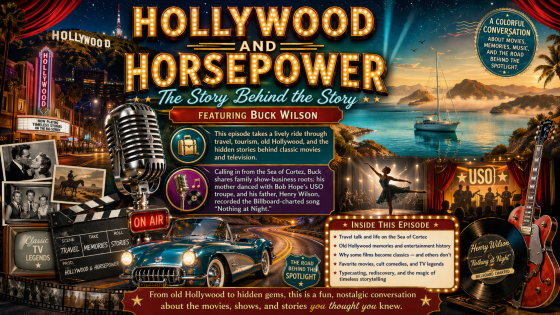
Hollywood and Horsepower: The Magic of Accidental Masterpieces and Showbiz Lore
In this episode of Hollywood and Horsepower, host Alex sits down with close friend Buck Wilson to explore the "story behind the story." From family roots in the USO and German rockabilly scenes to the chaotic production histories of cinematic classics like Jaws and Casablanca, the conversation delves into why some projects fail despite A-list talent while others emerge from "misery and pushback" to become cultural icons.
Detailed Points of Discussion
A Legacy of Performance and the "Musical Gene"
Buck Wilson shares his deep-rooted connection to Hollywood, noting that his mother was a professional dancer with Bob Hope’s USO Troupe and his father, Henry Wilson, was a rockabilly singer who surprisingly maintains a cult following in Germany to this day. Despite this pedigree, the duo discusses the elusive nature of "the gift" in music and acting. They conclude that while hard work is essential, legendary status—like that of Slash or Jimmy Page—requires an instinctive, raw talent that cannot be taught or practiced into existence.
The "Intangibles" of Success
Success in entertainment often relies on organic timing rather than a formula. Projects frequently fall into two categories:
- The Accidental Icon: Masterpieces created under duress, tight deadlines, or production "misery" (e.g., Casablanca, Jaws).
- The Star-Studded Flop: Projects with A-list casts and high budgets that fail to find an audience (e.g., Club Paradise, Inchon).
"You cannot purposefully create a viral video... things have to happen organically." — Buck Wilson
The Chaos Behind the Classics
The conversation highlights how many "evergreen" films were born from production disasters. Casablanca was written in just two weeks as a secondary project, while Jaws was a notorious "disaster" on set where the mechanical shark rarely worked and the director feared for his career. Similarly, Charles Dickens wrote A Christmas Carol in a mere 23 days out of financial desperation. These stories suggest that constraints and obstacles often force the creative ingenuity—such as the use of suspenseful scoring in Jaws—that defines a masterpiece.
Typecasting, Comebacks, and the Small Screen
The dialogue shifts to the mechanics of fame and the difficulty of escaping iconic roles. They discuss Frank Sinatra’s career revival through From Here to Eternity and Ed O’Neill’s rare success in transitioning from the "loser" Al Bundy to the "winner" Jay Pritchett in Modern Family. Alex notes that some shows, like Bonanza, allowed their cast to flourish afterward, while others, like Gilligan’s Island or Leave It to Beaver, often left actors inextricably tied to their characters in the eyes of the public.
Evolution of the "Tough Guy": Ed O'Neill
Despite his comedic roles, O'Neill was a real-life "tough guy" from the steel towns of Ohio, known for his physical presence.
To-Do / Next Steps
- Buck Wilson must find and watch the 1986 film Club Paradise to see the star-studded cast including Robin Williams and Peter O'Toole.
- Listeners are encouraged to expand their libraries by searching for their favorite actors' earlier or more obscure works on streaming platforms.
- Community Action: Check in on veterans and first responders through the No Fallen Heroes non-profit to help prevent suicide.
- Support: Consider donating to Old Friends Equine to assist with the care of retired thoroughbred horses.
- Travel Planning: Look into Penn Entertainment locations in Detroit, Texas, or Las Vegas for upcoming trips, including Kentucky Derby parties.
Conclusion
The episode serves as a reminder that the most enduring pieces of entertainment are often the ones that weren't "supposed" to work. Whether it is a rockabilly song finding a second life in Germany or a disaster-prone shark movie becoming a blockbuster, the "horsepower" of Hollywood lies in its unpredictable, organic, and often accidental brilliance.
Hollywood and Horsepower Show

Through the relationships Mark Otto developed in Thoroughbred Horse Racing and Automotive Racing, during his global travels, the thing that most interested him was the story behind the story, with the famous people he was fortunate to meet. What was it that these people liked to do? How did they get into Hollywood or into Racing? These stories are fascinating! This is what encapsulates the “Hollywood and Horsepower Show”.
Bringing you along, we talk to so some of the most interesting people Mark met during his career. Don't be surprised if a few other guests stop by this show. This will be fun! It is where SNL meets The Tonight Show; a perfect mix of talk and comedy.
[00:03] Speaker 1: (swing music) I've been down roads from Churchill to LA. Met kings of speed and stars along the way. They got stories that the cameras never show. Yeah, the truth behind the fame is what we know. From the saddle to the silver screen glow. Fast lanes and punchlines on a late night show. You think you've seen it all. But you don't know the half. Till the curtain lifts and we all have a laugh. It's not just who they are. It's how they came to be. A little horsepower. A little mystery. It's Hollywood and horsepower, baby. Take a ride where the legends laugh and the engines never hide. From the track to the spotlight, stories unwind. Yeah, the truth's a little wild and one-of-a-kind. Hollywood and horsepower. Where the real ones show. Every twist and turn is a tale you didn't know. So pour a drink, sit back, enjoy the show. Where the fast and famous let it all go.
[01:34] Speaker 2: Welcome to Hollywood and Horsepower, the show about the story behind the story. We have had a lot of really fun guests on this show, and as many of you know, you know, this, this, one of the things that I'm proudest of with this show is that it's a show about absolutely nothing. We are talking about anything and everything from entertainment, travel, racing, restaurants, you name it. Today, we're joined by a very special guest, a very close friend of mine, like family. He's been on the show before, Buck Wilson. We are going to talk travel, tourism, but also old movies. You know, both of us are kind of old movie guys. He's got Hollywood in his blood, and I really think that, you know, we're going to have some fun today. So Buck, welcome to the show.
[02:27] Speaker 3: Alex, good morning. Thanks for having me.
[02:28] Speaker 2: Good morning. It, it is morning where you're at, isn't it? (laughs)
[02:35] Speaker 3: Yeah, it's, uh, about 8:00 in the morning here on the Sea of Cortez.
[02:41] Speaker 2: Is it, is it a good day on the Sea of Cortez?
[02:45] Speaker 3: Uh, we've been having some strange fog coming in from some cold weather front that, uh, no one knows where that came from, but it's about, uh, high 70s. Very clear. Um, the sea at the moment is glass flat, so the sailing race that was planned for today will, uh, will go off. It's going to be a pretty day here.
[03:08] Speaker 2: Very cool. Well, I'm going to jump right into it. I mean, you and I have both traveled a lot. We've both, we've both experienced a lot. You know, we, you know, I told you I kind of want to talk a little bit about, like, old Hollywood, old Hollywood, you know, old movies and stuff. And I know that, like, your family, you know, and correct me, kind of guide me a little bit, but your mom and dad were in show business, weren't they?
[03:35] Speaker 3: Uh, yeah. My mother was a, uh, professional dancer. Uh, she danced, uh, with, uh, the Bob Hope USO Troupe, and, um, just were performers. My dad, if you were to, uh, it's on YouTube. Strangely enough, my dad still has a following in, of all places, Germany. There is still a rockabilly scene.
[04:00] Speaker 2: Really?
[04:01] Speaker 3: I'm not making this up. There's a rockabilly scene in Germany to this day. And my dad recorded a song called Nothing at Night, and if you put in that song into, um, uh, a YouTube search, and (laughs) believe it or not, do a YouTube search for the song Nothing at Night by Henry Wilson. Ba-boom, you're going to hit my, a recording of my dad's song that was actually Billboard charted. He did tour. He came to California to, uh, get into the movie business. He went to Hollywood Professional School, and, uh, that's where he met my mother. They were both attending class at the same time.
[04:44] Speaker 2: Wow.
[04:45] Speaker 3: So...
[04:46] Speaker 2: How did your mom come to get on the Bob Hope sh- you, you know, I don't want to call it a show, but how she get to be with him, you know, in his, his, um, show, I guess you'd call it?
[04:59] Speaker 3: Yeah, the USO troupe had auditions. Uh, my mother was, uh, a professional tap and ballet. I guess dancers in those days, I hear that, that, that is too put together a lot, that if you'd were a dancer, in those days, you took tap and ballet, um, and then all the other dances. Um, you know, the samba, the lindy, uh, all of those songs, uh, the shag, you learned them as you learned because you, if you had tap and ballet, you were a dancer. She auditioned for, uh, the show when it was playing, uh, the bases in California, Bob Hope's USO Tour. And she got picked up as one of the dancers, which was interesting, because years later, a lot of years later, we wound up doing a, uh, this is back in the Seattle days. The USO up there had a fundraiser, and, um, I'm not sure exactly of the circumstances, but my mother was always involved and still is involved in anything charity, uh, she was the, um, the chairman....
[06:09] Speaker 3: when they, when they had it and, I mean, this is many, many years, many, many years later. Okay. So I'm in my 40s, and they make the announcement when they introduce her that she had performed with Bob Hope's USO Tour. And I looked at the person I was with and said, "That's absolute nonsense. She never did that." (laughs) But it turned out, she said, "Well, of course I did." I said, "How come you never said anything about it?" "Well, it never came up." "Oh, okay." But-
[06:35] Speaker 2: It was shortly after Vaudeville. (laughs)
[06:38] Speaker 3: She... Yeah, exactly. You know. (laughs)
[06:43] Speaker 2: That's amazing.
[06:43] Speaker 3: But yeah, they, uh-
[06:44] Speaker 2: Your dad was more of a singer. Your mom's a dancer, and they met, you know, doing some classes, which I hear that a lot. You know, it's even, even when you heard, hear like, Ted Danson, he kinda bounced between like, East Coast and West Coast taking different classes just to get, you know, exposure and get... And, and stay involved in things until he finally got picked up for some bigger things.
[07:13] Speaker 3: Yeah, my dad has... He had a lot of stories about auditioning for different things and, um, he was supposed to have been involved, um... Let's see. He had a part in, um, Bonanza and that changed at the last minute. I mean, you hear this a lot. I mean, listening to the stories from, just from the two of them and then you, you hear stories about this person who was supposed to be in this movie but couldn't do that, so it turned out to be this person, and it either was a huge flop or a big hit. Uh, my dad had about three or four parts in, uh, shows that were being filmed, uh, in Burbank in those days that, um, uh, shows you would have recognized the names of. Um, and just nothing ever happened and, um, they were at Hollywood Professional School together and lo and behold, uh, just kind of packed it up and got married.
[08:17] Speaker 3: Um, I bet there's-
[08:19] Speaker 2: And after that, really-
[08:19] Speaker 3: ... I bet there's 100,000 stories.
[08:23] Speaker 2: After that, neither one of them really performed a lot after they got married?
[08:29] Speaker 3: Uh, my dad started a band, and that would have been about 1969, 1970. Um, yeah, that's about right. 1960, 1970, that would have put me at maybe seven years old. Uh, my dad started a band back up, um, and it was... The, the short part of the story is one of the guys who played backup for him, at one point along the way, um... My dad was originally from North Carolina. So remember, this is gonna be 1956, um, starting out of North Carolina. One of the guys that played backup for him was Ray Stevens, the piano.
[09:20] Speaker 2: Oh, wow.
[09:20] Speaker 3: You know, all of Ray Stevens? Yeah.
[09:22] Speaker 2: Yeah. Oh, yeah. Of course.
[09:25] Speaker 3: Ray Stevens, uh, Ray Stevens, uh, all... Right about that time, had an album come out and there was a couple of songs on it that you'd recognize. And I'm just a kid in those days, but I remember it because just now that I'm looking back at it, uh, he just got the itch again, and started up a band and wrote some songs and, uh, cut some demos, but, um, I don't know. I never... Uh, I'm remembering this as a kid. I don't really have any of the details, but he always did play. Um, he played rhythm guitar and the little bit of guitar that I play, uh, I learned it all from him. Um, the thing about it that, that is very, uh, liberating is I really have... I have no talent, musically whatsoever. I didn't get it. That's not a gene that was passed onto me. Um, especially things like, um, singing harmony. If you start singing harmony with me, I go right with the harmony. Okay. If I, I can't, I can't do both at the same time. Um, I, I don't play guitar well. (laughs) It was always funny.
[10:41] Speaker 3: I, you know, but I... My dad always said I had a tin ear. Uh, (laughs) I just... I didn't get the talent that those two had. You can't have-
[10:47] Speaker 2: Well, it's very true and a lot of people don't realize that, because you know I mean, I dabble with a guitar and, you know, I'm fairly musical but not... You know, the guitar is a love, but it's not a gift, if that makes sense. I absolutely love it, I like messing with it-
[11:04] Speaker 3: Absolutely.
[11:04] Speaker 2: ... and, you know, it is true the more you play, the better you get. But as you... To your point, if you don't have that gift, it's like you might become good. You'll never become great. It's one of the few things that I would argue, I don't really think you can practice your way to greatness. You have that... I mean, you look at the greats, you know, like Slash or Jimmy Page or Randy Rhoads, I mean, they were another level. They... Every one of those guys took the instrument and did something that nobody else had done with it before. And I think that's the difference, to me.
[11:48] Speaker 3: Absolutely. I, I have taken... I, I have to be honest. I wanted to find where it was in music that I was supposed to be because I can hear it. I can... Try this one. I can read music, but I can't play music. I can make notes, but I really don't... Never found anything to play music. I went through the guitar, I went through the bass.I went through the harmonica. I went through a couple of woodwind instruments. I tried brass instruments. Um, a few brief seconds with the piano. Uh, I just simply, I simply don't, I don't have it. And all of the orchestral instruments, I've al- I've always wanted to talk to the guy who invented any of them, 'cause he started with a premise, "Here, take this. Now mold your mouth and your tongue and your jawline and your cheeks into a completely unnatural place and try to blow through it." Why, why didn't they build these things like a kazoo, where you just blew into it and worked the valves? I've never understood that. I've never could get one to work.
[13:03] Speaker 3: Nothing.
[13:03] Speaker 2: No, it is, it is interesting. The other thing that's interesting with it is that, you know, to your point, reading the music, you know, many of us can do that. But it's like, you could, you could put a song in front of me and I could play it exactly like it's written, but it's not gonna sound the same as somebody, you know, like Slash or Jimmy Page, or... You know, there's just that different touch. There's that, that way they bend the neck, or they bend the string, or they, you know, they hold the note, or go to a half a note, or where they put their finger on the fretboard. And I do think that that is instinctive. I mean, I don't think that is something you necessarily learn. I'm sure there's people screaming right now that you can learn it. But, I don't know, my personal opinion is, you know, it's like, you hear people that are good all the time. You occasionally hear somebody that's great. I mean, you know, you grew up in California. I worked in California a lot.
[14:08] Speaker 2: I mean, you probably remember, you know, you remember the Sunset Strip back in the '80s. I mean, it wasn't odd-
[14:13] Speaker 3: Mm-hmm.
[14:14] Speaker 2: ... to walk into a bar and see really great bands. But then every once and a while, you'd see a band that you've never heard of, but it was another level. And, you know, I wasn't fortunate enough to be there, but I remember talking to people who were there that saw, like, Van Halen when they first started out in clubs, and they said you could just tell this was different. This was another level.
[14:43] Speaker 3: Mm-hmm.
[14:45] Speaker 2: You know, and, and I remember when Mötley Crüe started on the Strip. Same thing. Everybody... The buzz was that, look, this, this is another level. You know, it's just interest- It's always interesting to me, that talent. You know, I've always had so much respect for that, but probably because I don't have it. But it's, like, just... You're kind of in awe. I mean, you can watch their hands, you can try and mimic the movements, you can try and comp and it just doesn't work the same.
[15:22] Speaker 3: Yeah. Absolutely true. You, you absolutely, um, either have it or you don't.
[15:29] Speaker 2: Yeah. I absolutely agree.
[15:29] Speaker 3: And the guys that have got it... You know Lionel Hampton, the jazz musician?
[15:36] Speaker 2: Yeah.
[15:36] Speaker 3: He didn't read music.
[15:38] Speaker 2: No.
[15:38] Speaker 3: Um-
[15:39] Speaker 2: You know, a lot of people don't read music that are very accomplished. Which is kind of amazing to me.
[15:51] Speaker 3: Who's the other guy? Um... Oh, I think it was, um, I think it was, uh, Art Tatum, the jazz pianist. He, he's famous for those jazz introductions that, uh, go on for two minutes, and he was playing entirely by ear. And it's, uh, it's amazing to think that... I mean, he had the song and then improvised the rest. That's, that's obviously something you're born with. You just-
[16:22] Speaker 2: Yeah.
[16:22] Speaker 3: There's no way around it. And the guys you're talking about that have that... Uh, you know, Stevie Ray Vaughan and, um, Eddie Van Halen, that are just creating, creating different sounds and different effects and just mastery. The- Some of that, some of it, not all, but some of it, you know, comes from just a commitment to it, a lot of sacrifice, a lot of time, and it does.
[16:55] Speaker 2: Oh, there's-
[16:55] Speaker 3: But you gotta have a toolkit.
[16:57] Speaker 2: Yeah, there's no question. I mean, like everything else-
[16:57] Speaker 3: You gotta have the toolbox.
[16:59] Speaker 2: Yeah, like everything else, it's amazing how many times that, you know, success follows a lot of hard work, and I get that. But there is that piece in music that does seem like, you know, you could work really, really hard and you still don't get that same thing as, as the guy that just has that raw talent. And I don't-
[17:28] Speaker 3: Well, that-
[17:28] Speaker 2: You know, I just-
[17:29] Speaker 3: ... that absolutely applies to everything.
[17:31] Speaker 2: It absolutely applies to everything. No, you're absolutely right. I mean, it's not one of those things where it's, like, isolated to just music. You know, I mean, jumping over into movies, kind of the same thing. I mean, you look at some of the people that, you know, we've all grown to really admire over the years and it- they're... I mean, even Tom Selleck. He, he wrote, he has a book out now, you know, and, and he, he refers to it as a accidental career. You know, he said it was, like, you know, he's studying business at USC and never really thought he would pursue acting, and ends up being, you know, a household name with, you know-... countless, you know, accomplishments. I mean, way beyond Magnum. You know, so I mean, it's like, it's kind of crazy sometimes how, you know, some of the guys really, you know, just, it, it just kind of all comes together. I mean, you, you mentioned it and it, and it really does stick with me, like with your dad.
[18:42] Speaker 2: You know, he was in certain parts and, you know, if this would've happened, then he would've been there longer, or if that would've happened. And I've seen the reverse. I've seen, you know, Jon Hamm comes to mind. You know, Jon Hamm, before Mad Men, was in a pilot and he was under contract and right up to the edge, they kind of strung him along. He really wasn't doing anything and then they let him go and then he gets Mad Men. Had they kept him, you probably wouldn't know his name. So it's like, it's amazing sometimes how things happen. I mean, I think back to, like, you know, a movie that you and I both like, Key Largo, with Bogie.
[19:28] Speaker 3: Mm-hmm.
[19:28] Speaker 2: You know, I love the little, I like the behind the scene stories. So like, Key Largo, you know, they shot part of it in Key Largo, mostly the outside shots. The rest of it was shot back in, um, Burbank. And it's ironic that, you know how John Huston was in the wheelchair and they said that that was not in the script. That was something that happened like a week before they were supposed to start shooting, he threw his back out and he, he couldn't hardly walk, so they rewrote the part and put him in a wheelchair.
[20:08] Speaker 3: Mm-hmm. Absolutely. Uh, there are so many, almost every really great story is always about where everything went wrong, we didn't get what we wanted-
[20:21] Speaker 2: (laughs)
[20:22] Speaker 3: ... the conditions were terrible, we threw it together with spit and glue and determination, trying to make deadline, um, and what they came out with was this masterpiece that only happened because of absolute, uh, uh, misery and-
[20:39] Speaker 2: (laughs)
[20:40] Speaker 3: ... um, you know, pushback. Think about the movies, you know, let me think of a couple, um-
[20:47] Speaker 2: Well, I mean my all-time favorite, Casablanca. It's my favorite movie of all time.
[20:51] Speaker 3: Casablanca.
[20:52] Speaker 2: I heard, so Michael Blone's an intellectual friend of ours, was good friends with Julie Epstein. He heard-
[21:00] Speaker 3: Mm-hmm.
[21:00] Speaker 2: He, Julie told him the story that he was under a multi-picture deal with Warner Brothers and threw together Casablanca in two weeks. Maybe longer, but I mean, you know, around that time. And he put his effort into a movie that you and I would know, but most of our listeners probably don't, called Mr. Skeffington. Mr. Skeffington never did nothing. I mean, you'd probably have to search long and hard to find a copy of it today. And Casablanca becomes a household name and it, it's just amazing how that happens, to the point that Michael said Julie Epstein would not talk about Casablanca for years, he was so annoyed with. That like, his masterpiece, the thing he worked on the hardest just got swept under the rug and the one, you know, with all due respect and I'm sure it was a great picture, but the picture that he tossed together just becomes a blockbuster.
[22:08] Speaker 3: Oh, yeah. Yeah. Everything has to do with the entertainment industry and it doesn't matter which part. Uh, it's all about, they call it intangibles, 'cause you don't know. You cannot purposefully create a viral video. You cannot purposefully create a collectible. There are things that just have to happen organically. And anywhere that has to do with the masses and entertainment, it doesn't matter what, uh, when it comes to, like, to authors, um, there's o- two that have been translated into more languages than any other. That's, uh, Shakespeare and Dickens. Okay? Charles Dickens, if you asked anybody to come up with one name of a book by Charles Dickens, they would tell you A Christmas Carol, right?
[23:00] Speaker 2: Sure.
[23:00] Speaker 3: That was h- his least favorite book he ever wrote. He wrote it in 23 days because he needed an advance from the publisher. They said, "Write something light."
[23:13] Speaker 2: (laughs)
[23:13] Speaker 3: It was coming into the right time of year where they could get it out for Christmas. Wrote it in 23 days because he needed the money because his wife was expecting a baby. That's it. His, his one most well-known, most versatile, touches the most bases, with all of the intangibles, it has been parodied, it has been copied, put into, uh, there is a Russian version, um, that I saw one time of A Christmas Carol of a guy that works in a, a factory. It, it always comes back that if you go back and look at your life, if you think about it, A Wonderful Life with Jimmy Stewart is nothing but a retelling of A Christmas Carol. That's all it is.
[23:54] Speaker 2: Oh yeah, no. I was just gonna say-
[23:56] Speaker 3: And that was-
[23:56] Speaker 2: ... they made it into cartoons, Disney made a spin of it, uh, with Mickey Mouse.
[24:01] Speaker 3: Mm-hmm.
[24:01] Speaker 2: And, and the Ducks. I mean, it was, uh, everybody's taken a swing at that one.
[24:08] Speaker 3: Yeah. And as far as the intangibles go, think about that movie I said, Jaws. They didn't get the people they wanted, the shark never worked, they had to struggle through it, and in the end, the only way they could build suspense was with the score and with the editing.
[24:25] Speaker 2: Well, and I won't drop names-
[24:26] Speaker 3: It never really got the team-
[24:27] Speaker 2: ... but I can tell you factually-
[24:27] Speaker 3: ... it was supposed to get.
[24:29] Speaker 2: ... Jaws was a disaster. From the shooting of it, as you pointed out, the shark didn't work. The wea- they had weather problems. The drugs and alcohol (laughs) were, were like a, a exorbitant on set. I mean, I know for a fact from people close to him that Spielberg figured he was gonna get fired when he headed back to LA. It went that bad. And it turns out to be a blockbuster, and they said that's probably all that saved him, was the fact that it just exploded. 'Cause it was one of the ones that took off almost immediately. You know, you look at some of them today that are, like, famous in our minds and they really weren't that good when they came out. So, like, you know, you think about like Coneheads and Animal House and Tommy Boy, they didn't shoot outta the gate like rockets. In fact, you know, Animal House and Coneheads kind of floundered a little bit and then took off. And they've become evergreens in the comedy world, but they didn't start that way.
[25:40] Speaker 3: Right. That's true. Oh, absolutely.
[25:42] Speaker 2: But like Jaws 1-
[25:43] Speaker 3: You, you can't 100% recreate it.
[25:46] Speaker 2: And back to like Michael, I know that, you know, Animal House was one of the few films that he panned on review. And I'm sure he wasn't alone. You know, when it first came out, it just didn't get the traction that they thought it would, but then it becomes an evergreen. You know, today it's like, you know, one of the classics. And it is kind of funny how that happens. I mean, I don't know, um, you know, what other films have been like that. I'm sure there's a lot of them. But it is, it's always interesting to me how, you know, some of the ones that you look back on today and think, "Oh my gosh, that's like an absolute cult classic," and really at the time it wasn't that hot.
[26:28] Speaker 3: Yeah. Totally. Oh, y- I remember going to see Animal House in the theater when it first came out, and I was, um... I actually took my dad to go see it, and I absolutely adored it. I can tell you-
[26:48] Speaker 2: (laughs)
[26:48] Speaker 3: ... that when I was in college, it was on a TV somewhere almost always. The movies that you could... If there was a TV somewhere within, oh, maybe four or five houses of where we lived, somewhere Animal House or Caddyshack or Eddie Murphy's Delirious was playing somewhere. You could always find it. Uh, I adored the movie. My dad's reaction to it was, "What just happened?" Those were his exact words. The film got over, the credits started to roll, he looked at me and said, "What just happened?" I said, "What do you mean what just happened?" He goes, "That was nothing.
[27:28] Speaker 3: This is ridiculous." Yeah, so I'm-
[27:30] Speaker 2: Those two hours of my life I'll never see again. (laughs)
[27:34] Speaker 3: Exactly. No, but if you remember the movie, uh, Inchon? Um-
[27:40] Speaker 2: Yeah.
[27:40] Speaker 3: It was a big blockbuster movie. It had a huge cast. It was one of the most expensive movies of its day. They spared no expense. And it absolutely tanked, because it was just, there was no... They had too many characters, there wasn't any backstory. It was like every great actor in Hollywood was in it, and he got five minutes on screen. That kind of thing, you just can't artificially produce it. They threw, uh, let me think of another one. Billy Jack, c- c- come on. They did that so- I think they made that movie for about a dollar and a quarter, and I think, as I remember, Tom O'Laughlin put up 100,000 of his own money to keep it going at one point until they could get some dailies to show, and that's how they got the rest of the money. But just the right cast, that looked just honest enough, with just the right message, and just the right deal, all of which, um, just happened organically, and all of a sudden it, it literally became an icon of a generation.
[28:47] Speaker 3: There's nobody our age who hasn't seen it. No one.
[28:50] Speaker 2: Then you have other ones-
[28:51] Speaker 3: Um-
[28:51] Speaker 2: You know, one of the ones that always cracked me up, you're, do you remember Club Paradise with Robin Williams?
[28:59] Speaker 3: Club Paradise.
[29:01] Speaker 2: (laughs) Exactly.
[29:02] Speaker 3: Robin Wi-
[29:02] Speaker 2: It's so obscure, but it is basically in, so I'm not gonna blow it for anybody that wants to, wants to look it up, but it was an '86 film. I'm, I'd have to look to tell you who made it. I can't remember. I mean, I can tell you, you know, it was Harold Ramis, that'll give you an idea of who directed it. Um, n- brilliant mind. I loved Harold. I thought he was one of the most genius directors there was for comedy. But run down through the cast on this one. You had Robin Williams, Peter O'Toole, Rick Moranis, Jimmy Cliff. I mean, it was, it, there was, uh, Eugene Levy. It was just insane, the, you know, Brian Murray, Bill Murray's brother, you know, Joe Flaherty. I mean, it was just amazing the people that were in this film. It was almost like they got everybody who had done comedy who was standing still for 10 minutes and tossed 'em in this, in this movie. And it was Harold Ramis and Brian Murray, Bill's brothers, that wrote it. And it really... Here's my point though.
[30:12] Speaker 2: It's, it's a great film. It, I think it's hilarious. I would recommend it to anybody, but it did less than nothing.
[30:25] Speaker 3: Yeah, I'm searching around on the phone right now trying to find a picture that if it'll bring up a me- a memory, 'cause I don't recognize that and I, I thought I had seen...
[30:37] Speaker 2: I'll send it to you.
[30:38] Speaker 3: I thought I saw the, uh ...
[30:39] Speaker 2: Certainly, the-
[30:41] Speaker 3: I can't now. There you go.
[30:42] Speaker 2: It's just kind of crazy that it's, like, one of those ones that was ... It's a ... I was just using it more as an example of one that, like, had all the right people, all the right writers, all the right cast. You know, everything was right. It's a tropical film, so I mean, those generally do well. And it just, for whatever reason, kind of went nowhere. And, you know, even today, it's kind of ... You know, it'd probably be lumped in as one of those '80s comedies. But it is funny how you look at it. I mean, when you're sitting there, it's like, every once in a while you see a movie that's like, th- the entire cast is like, you know, A-list, and it still wasn't a big hit.
[31:29] Speaker 2: And I know everybody will say, you know-
[31:30] Speaker 3: It, it, it is incredible, right?
[31:31] Speaker 2: ... "Well, it's the writers. This or that." I don't think ... I don't know. I ... It, it's kind of funny. It's like, it always interests me how sometimes, you know, (laughs) the, the one that always stood out to me, and it's kind of a funny story. It's not funny if you were involved in it, but it's funny looking back. So, Three Men and a Baby, we're all familiar with. You know, dancing, you know, and, and Selick, and it just was a blockbuster of blockbusters. Remake from a French film. Then comes along Three Men and a Little Lady, and they're expecting the same mushroom cloud of an explosion, which they probably should have had, because it wasn't ... It was a very well-done film. And I remember Selick telling the story. He's like, you know, he's talking to the director, and they're letting ... The producer, and they're like, "Yeah, we think we're good.
[32:26] Speaker 2: There's this little film coming out called Home Alone, but we should be okay." (laughs) Well, we all know the rest-
[32:34] Speaker 3: Yeah.
[32:34] Speaker 2: ... of the story. (laughs)
[32:36] Speaker 3: Yeah. Yeah. For sure.
[32:40] Speaker 2: And you and I know the common-
[32:41] Speaker 3: It is a major-
[32:42] Speaker 2: ... point on Home Alone. You know what it is, right?
[32:47] Speaker 3: Oh, Bob's house?
[32:49] Speaker 2: Bob's house. So, we worked for a gentleman by the name of Bob Creedon, and the original Home Alone was ... He, they used his house to film it. So, kind of a-
[33:07] Speaker 3: Yeah, I can see that.
[33:08] Speaker 2: ... interesting movie war.
[33:08] Speaker 3: I can, I can just see that. Yeah. Without going off on any tangents about that, if you knew Bob the way we knew Bob, (laughs)
[33:15] Speaker 2: (laughs)
[33:15] Speaker 3: I can imagine a lot. I can just imagine a lot, and I'll leave it at that. But, uh, yeah. So ... It's about a lot of those-
[33:27] Speaker 2: I would imagine that Bob moved ... I mean, we can't speak for Bob, and I'm not saying this is what he did. But knowing Bob, I would have expected that he moved into a mansion somewhere, let them do whatever they want, and then repair it, and let his wife deal with it. (laughs)
[33:48] Speaker 3: Oh, absolutely. And absolutely had a laundry list of things that needed to be, uh, updated, whether the c- film crew had done anything or not. Um, lots of pictures, lots of, um, you know. Bob was a numbers guy, so I'm sure the numbers were significant. Yeah.
[34:08] Speaker 2: Yeah. I'm sure they were significant, and I'm sure that he had it laid out. I'm sure that it, it worked out well. But it, it, it did ... It always kind of cracks me up that that one happened with him. So, I have to take a little-
[34:23] Speaker 3: Yeah, I-
[34:23] Speaker 2: ... little, um, moment here, and I want to talk a little bit about couple of our sponsors. We get support, and I really appreciate these people. GoGaffey.com. If your company, your organization, anybody needs any kind of apparel, any kind of swag, and you and I have both handed out our share of swag, Buck, over the years, these people do it, and they do it very, very well. It's Go Gaffey, G-A-F-F-E-Y, .com. Penn Entertainment has been kind enough to support us, Detroit, Texas, and Las Vegas. If you have a desire for a trip, Penn is a great place to build your trip around. They have everything from casinos, restaurants, horse racing. A lot of our common contacts are ... Or work with them. And, and you know what? There's a lot of stuff coming up fun. Kentucky Derby's right around the corner. If you're looking for a derby party, these guys are gonna have several around the country. And I also have to plug one, Buck, that you and I, uh, another touchpoint.
[35:31] Speaker 2: Our friend, Big A, Anthony Stabile, is throwing a derby party-
[35:37] Speaker 3: Oh.
[35:38] Speaker 2: ... um, in New York. So I believe it's Mohican Sun.
[35:44] Speaker 3: King Umbertos?
[35:44] Speaker 2: What's that?
[35:46] Speaker 3: King Umbertos?
[35:48] Speaker 2: No. It's at one of the casinos.
[35:51] Speaker 3: Oh.
[35:51] Speaker 2: And for anybody that follows us, if you watch Hollywood and Horsepower on Instagram, we'll put posts up about the derby party. I believe it's at Mohican Sun. It's a, a casino in New York. But he's done it before multiple times, but that's, that's one, if you're anywhere in the tri-state area or Hudson Valley, you should look into it. Big A, Anthony Stabile, if you search him online, you'll find him. And, you know, he's just a great guy, right out of central casting. He knows horse racing. He definitely knows food and how to throw a good party. So, he's a guy that you definitely want to check out. MB Gray healthcare Consulting. If you have employees, you, then you have benefit problems.MBGrayHealthcare.com. She can save you money. She can give your employees a better program, a better package than you're getting now. I guarantee it. And then we support a couple nonprofits. Um, No Fallen Heroes is the nonprofit we support for humans that our friend, Wis Buckley...
[36:59] Speaker 2: Matt "Wis" Buckley, he supports, you know, first responders, vets, everybody to get the help that they need. If you have a friend who is, you know, has served or is serving or is a first responder, check in on them. We're losing too many of these guys every day to suicide and it really needs to stop. There's, there's people out there that do care and want to help them. Um, take your... Take a minute and take a look, No Fallen Heroes. The other one is oldfriends.com. Old Friends is a great organization that helps old retired thoroughbreds. And it's interesting, Old Friends was started, kind of ties into what we're talking about today, by Michael and Diane Blawn, who both worked for the Boston Globe. Michael was the entertainment writer for the Boston Globe and this is during the golden era of Hollywood. I mean, this is not during the internet era. This was back in the '70s, '80s and '90s.
[38:00] Speaker 2: And Michael spent time with anyone and everyone, from Jimmy Stewart to Jack Nicholson to, you know, anybody you could think of, you know, in Hollywood. You know, actors, directors, producers, you name it. He knew everybody. And he's a great guy. They do a terrific job with the horses. If you get a chance, if you're anywhere near central Kentucky, look them up, oldfriendsequine.org. And then the last one is Earnhardt Outdoors. Kerry Earnhardt, good friend of the show, him and his wife, Renee, have a guide service and it's called Earnhardt Outdoors. And it... And they will do anything from put together a kayaking trip, a white raft- white river rafting trip, to a hunting trip. Whatever, whatever your desire, you know, whether it's, you know, close to the highway or in the middle of nowhere, these guys can help you out, Earnhardt Outdoors. So going back to the movies, Buck, what was your favorite of all time and why?
[39:08] Speaker 3: My favorite movie of all time. Um, let's see. The original Godfather would be on that list. Uh, the original True Grit would be on that list.
[39:30] Speaker 2: Now, going back further, what about the old black and whites?
[39:35] Speaker 3: Going back, (sighs) in the black and white movies, Mr. Smith Goes to Washington, I still break that one out about once a year. Um, there's a movie that, uh-
[39:49] Speaker 2: Do you ever do High Society?
[39:50] Speaker 3: ... Gary... High Society is a great movie. Gary Cooper had a movie that was called Arsenic and Old Lace, and it still... Absolute, um... The, the, the comedy in that, despite being as old as it is, uh, is still my kind of... my kind of humor. Casablanca's good for about once a year. I usually break that one out again. Um, I love the story about the Wizard of Oz, um, and all the back stories on that. So even when it's not classically in a, a season, go back. You know, a funny thing, I know a lot about the movie, but I can tell you I've never watched it door-to-door, is Gone With the Wind. I've seen a lot of it, but I've never seen it door-to-door.
[40:46] Speaker 3: I, I keep-
[40:46] Speaker 2: Really?
[40:47] Speaker 3: ... forgetting that I need to do that and get that off. Yeah, I've never seen it from beginning to end. I went to a theater one time, many years ago, to see it door-to-door, and, uh, we had a problem right in the middle of it and I had to leave. And then I picked it up on TV somewhere around where it was, and I think I've seen the whole movie along with clips and stories about it and having, um, uh, read the backstory on Vivien Leigh and so forth, and where Gable was at at the time. But I've never sat and watched the whole movie. Strange, isn't it?
[41:23] Speaker 3: Um-
[41:23] Speaker 2: That is strange, especially for you.
[41:28] Speaker 3: Yeah. I've-
[41:30] Speaker 2: You know,
[41:30] Speaker 4: I'll use this.
[41:31] Speaker 3: It's just one of those fun- funny little anomalies.
[41:33] Speaker 2: You know, one that always stood out to me, and it's... and, you know, Gracie, my daughter, Grace, who, you know, you hear me talk about her on the show, but Grace has, um... Grace, she doesn't even realize it, but truthfully, in my mind, Grace has, like, a director's mind. And I hope-
[41:55] Speaker 3: (laughs) .
[41:55] Speaker 2: ... someday she does pursue it, because I mean, and you know what I'm talking about. She's an excellent writer. She's an excellent... You know, she sees... She sees what other people don't see in, in a movie. Her fav- One of her favorite movies, I don't want to say it's her favorite, but one of her favorites is Young at Heart with Frank Sinatra and Doris Day. And I asked her one time, because it seemed kind of obscure for a 19-year-old girl to pick that as her all-time favorite, and I said, "What is it that stood out to you?" She said, "I loved the fact that there's multiple stories going on at the same time." She goes, "I liked the fact... the way that the, the set was designed. I liked how it was laid out. I liked how, you know, everything was, you know-"... you know, designed and, you know, right down to the decor. And that's something that really stuck with me is that, like, she notices the stuff in the background as much she notices the story and the s- and the actors.
[42:59] Speaker 3: Yeah, yeah, yeah, yeah, yeah.
[43:01] Speaker 2: But that was another really well-done film.
[43:07] Speaker 3: Absolutely. I mean, I, I think back to when I was a kid and I used to watch, uh, movies that were, uh, produced in the United States, uh, where, where everything was done in the United States. Uh, the kind of, the kind of, uh, films that get, um, that get crafted, a lot of times are the ones that started off as stage plays. Um, if you take a movie like, um, Glengarry Glen Ross, it's kind of recent, but it starts off as a, as a play, where you don't, you know ... And the, even the, even to, um, you know, The Wizard of Oz, as o- as old as that movie is, still was a lot of effects. It was the first one to come out in Technicolor and there was a lot of, um, there was a lot of shots, uh, that were done in forced perspective, so there was a little bit of that, it was the early part of what's now all CGI and AI.
[43:54] Speaker 2: Right.
[43:54] Speaker 3: But you can't rely on that. You've got to have characters, you've got to have a plot. It's got to be well-written. Um, and it turns out to be a really great movie because you started with a really great play. Glengarry Glen Ross would be one. Um, 12 Angry Men would be another one.
[44:13] Speaker 2: And you know what's funny about that?
[44:14] Speaker 3: Yeah.
[44:14] Speaker 2: You bring that up and it really made me think of, um, James Burrough- Burrows. You know, that directed Taxi, Mary Tyler Moore, Cheers, Frasier, Friends, you know, the list goes on and on. He was one that always said, he always tried to direct in a way that was like a play. So everybody's always acting, everybody's always on, even if you're not in frame. And he said that was, like, one of the things that he always told everybody in Cheers, "Always be acting. Always be funny." So even if you're off in the corner and the frame is actually on, you know, Ted Danson and Shelley Long, you know, you'll notice that Real Perlman is doing something or making a face at somebody or doing something in the background corner. Everybody on that set was acting all the time, like it's a play.
[45:22] Speaker 2: And to your point, I think that-
[45:23] Speaker 3: Yeah.
[45:23] Speaker 2: ... those stories transcend better because there's so much activity and because it isn't the, you know, shoot the scene, set up for the next one, shoot that scene, set up for the next one mentality.
[45:42] Speaker 3: Yeah. Yeah, yeah, yeah, yeah. Yeah. Things that start-
[45:44] Speaker 2: And another thing- (laughs)
[45:45] Speaker 3: Things that start where there's nowhere to hide.
[45:47] Speaker 2: Yeah. And then another one that's kind of like that was Marriage on the Rocks with Sinatra, Kerr, and Martin.
[45:54] Speaker 3: Oh, yeah, yeah. Yeah.
[45:54] Speaker 2: I mean, to me, that one was very similar. It was almost like a s- a play done on the screen.
[46:04] Speaker 3: Yeah. Yeah, you could've done that on-
[46:05] Speaker 2: You know, High Society.
[46:06] Speaker 3: You could've done that on the stage.
[46:08] Speaker 2: Yeah, yeah, absolutely. High Society is another one. I mean, that really stands out like that. Um, back to your, um, Mr. Smith Goes to Washington, that's one. Mr. Hobbes Goes on Vacation, the trailer, you know, when it came behind Mr. Smith. There's so many of these. You know, and it's interesting because I heard several people saying, it's not to sound like you're a dinosaur, but ... And not taking away from CGI or any of the effects, 'cause, you know, I, I appreciate that just as much. I mean, there's, it's definitely sensational. It's definitely, you know, adds depth to the picture.
[46:46] Speaker 3: Mm-hmm.
[46:46] Speaker 2: But, you know, there is something to be said for the, you know, films that were acting start to finish.
[46:55] Speaker 3: Oh, yeah.
[46:55] Speaker 2: It's literally the, there isn't any special effect that holds you, it's the cast and story that held you. And sometimes they get overlooked-
[47:09] Speaker 3: That's, that's-
[47:09] Speaker 2: ... but it's interesting to me that they're kind of like evergreens, like, you can go back and watch them today and I've heard people say this, I've even heard people in the industry say this, you know, I ... Ted Danson said this one time in an interview, he's like, "You know, if my wife leaves the room, when she comes back in, I've got the TV set on TCM and I'm watching some black and white movie from the 40s or 50s."
[47:32] Speaker 3: Oh, yeah, yeah.
[47:32] Speaker 2: And he, and he said, you know, "That's what, what I like about it, is the story." You know, they, they knew that they had to, it was the writing ... I'm not going to say the writing was better, because I don't want to be one of those guys, but I will say that there was a lot of weight put on the writing, because, you know, you knew you had to hold the audience with the story.
[47:59] Speaker 3: Well, and I think that's why they're so popular, is because people can identify so much with them.
[48:00] Speaker 2: And, you know, you look at some of these-
[48:01] Speaker 3: Absolutely.
[48:02] Speaker 2: ... Duck Soup and, you know, you look at, like, you know, Riding High. There was another one. That was another one, kind of an overlooked one. Bing Crosby, Riding High. He, it was, you know, it probably had to be done in the 40s, maybe ... And the interesting thing about that one was, there's, there's clips of Hollywood Park in it, and there's clips of Del Mar in it, early Del Mar.
[48:28] Speaker 3: Yeah.
[48:28] Speaker 2: Not even completely done Del Mar.
[48:29] Speaker 3: No. Well, I mean, Del Mar was sort of a test run, uh, community, but, uh, yeah, I know what you're talking about. I have seen that movie. Yeah. Um, there's ... It was a different, uh, it, it, you got, it was a different time, um-There were, uh, much ... Not necessarily better movies, but it was just a different... The entire, the entire industry was of a different ilk at the time. They were going in a different direction. But there's still those movies that you wouldn't have expected this to work, and it just did.
[49:12] Speaker 3: Um-
[49:12] Speaker 2: Yeah, and I don't think that one was necessarily a big-budget one. I mean, it doesn't appear to be.
[49:21] Speaker 3: I've always wondered, did you ever see, did you ever see From Here to Eternity?
[49:26] Speaker 2: Oh, yeah.
[49:29] Speaker 3: All right. Maybe it's just me, but I never understood what everybody thought was so great about that movie. I, I just didn't get it. I ... There are some movies like that, that are, that are absolute, you know, legend movies. From Here to Eternity is the one that sticks out in my mind right now. That you've kind of got Sinatra playing Sinatra. You've got Burt Lancaster being Burt Lancaster, um, and they really-
[50:08] Speaker 2: I, I credit that movie with, that was the movie that brought Sinatra's career back. So if you know anything-
[50:16] Speaker 3: Absolutely, yeah.
[50:16] Speaker 2: ... he went through a spell there where he couldn't have got cast as the dead man on the set. And they, they claim, the, the legend is, that it was actually Ava Gardner that got him that spot. And they said that that was actually one of the things that really annoyed Frank, was that in The Godfather movie, they alluded to the fact that, you know, the mob helped him get that spot in From Here to Eternity, and they said that wasn't true. That Ava was friends with the director's wife, and she pushed for Frank to get it. They, they looked at his ... You know, she basically backed him. He looked at the clip again and he said, "Okay, yeah. We'll, we'll, we'll give him a shot." And that was what really got him back into film. You know, for about eight, nine years prior to that, he was having a rough time. And I really don't ... And you know, it's an interesting point too.
[51:17] Speaker 2: You know, everybody, including, you know, even me, it's like, it's hard to imagine Sinatra going through a period of time that people weren't standing in line to see him. But by his own admission, he went through a long stretch where he couldn't get anybody to answer the phone. And I don't even think he was doing a lot of singing.
[51:45] Speaker 3: Um, I, I, I'm like you. I'm like you. I cannot remember a time, in my life at least, where getting a ticket to Sinatra was the biggest ticket in town.
[51:57] Speaker 2: Absolutely.
[51:57] Speaker 3: And he'd always travel with a band and it was always a big noise. Um, and
[52:03] Speaker 2: But this isn't something that was like-
[52:05] Speaker 3: I mean, my whole life.
[52:06] Speaker 2: This isn't something that was Hollywood folklore. I mean, I've seen Sinatra in interviews talk about it. He literally said, you know, "There was a period of time when I couldn't get anybody to answer the phone." And he said, you know, the, the ... He said it was actually one of the lessons that he learned about Hollywood. He said the mistake he made early on, like doing High Society and some of those, was that he thought these people were all his friends. And he said, "I realized real quickly, there are no friends in Hollywood." You know, he said, "Your friends are your friends, and work is work." And you know, you, you know, he said it wasn't that they were mad. He says, "I just, I couldn't do anything for them for a while, and they wouldn't cast me." And who knows what drives that. I mean, I don't know what, what it was. I never really heard a good explanation of why. It was just kind of like he was hot, and then he wasn't, and then he became white-hot again.
[53:14] Speaker 2: And you look at it and you think, "What, what changed?" I mean, it's the same guy. It's just, you know, it was just kind of a interesting thing, you know? And, and you look back through, that's happened several times in Hollywood, where guys ... And sometimes they don't come back. I mean, look at some of the cast from, like, Leave It to Beaver. On a series that really didn't run that long. What was it? Six, seven years? Maybe eight? It typecast some of those guys to the point where they never worked again. I mean, the most obvious one was Ken Osmond. You know, Eddie Haskell. He went on to become a LAPD policeman. Got hurt in the line of duty, in fact. Got shot one time. And, but he really ... I mean, he would do occasionals. Like, he did the sequel, you know, when they came back years later that really never did much of anything. But you know, you never really saw that cast go on and do much else, and yet when they were all together, it just worked.
[54:25] Speaker 2: But you stop and think about it-
[54:26] Speaker 3: Right.
[54:26] Speaker 2: ... I mean, even like, Tony Down's stuff. You know, he did a lot of work in the industry directing and things.
[54:32] Speaker 3: Mm-hmm.
[54:32] Speaker 2: But he wasn't in front of the camera a lot.
[54:40] Speaker 3: If you take something that becomes really, really iconic, you've got a role like that, it doesn't matter whether it's dramatic or if it's a comedy. Uh, everybody down the line, um, what's his name? Gilligan's Island?
[54:56] Speaker 2: Yeah. Bob?
[54:57] Speaker 3: With the single exception, with the single ex-The only person that ever got back in front of the camera after Gilligan's Island in anything that wasn't like a cameo, Alan Hale Jr. was in Hang 'Em High with Clint Eastwood.
[55:17] Speaker 2: Yeah.
[55:18] Speaker 3: Um, let's see, what else have I got? Uh, but if you go down the line-
[55:26] Speaker 2: You know, the other one-
[55:27] Speaker 3: Jim Backus, Jim Backus and the entire rest of that cast, Russell Johnson, and, uh, Bob Denver, and Dawn Wells. Dawn Wells made a career out of being Mary Ann Summers for the rest of her life. The only person, Tina Louise, who played Ginger Grant, had some other roles after that. The lore on that is that she thought, she got told a different story about this show, uh, about where her character fit into it. Um, the show as it morphed and got going, when it, about the time it went from black and white to color, it had basically become the Skipper Gilligan show, and she was one, but the money and the, they, they all agreed on one thing, the syndication rights alone had kept them in money ever since. It was playing on a TV somewhere in the United States on some network on, uh, on syndication, is still to this day. Um, it's amazing that something like that would hit a chord, but again, in the time and place, and definitely, now you can tell it is a different time and, and place.
[56:45] Speaker 3: What was it? It was 19 ... This is part of the lore. There's an entire book about what that show was really supposed to be a symbol of. I, I don't really believe it, but there is a book about it. If, if you Google, if you Google that, you can find it. But-
[57:01] Speaker 2: For Gilligan's Island.
[57:02] Speaker 3: ... to give you an idea of the time and place ... Yes. The time and place that that was, that that show occurred, um, part of the lore is that in 19, I think it was '65, I think it was '65 or '66, Holcombe Air Force Base logged 25,000 calls from the continental United States telling them that there were these people stuck on this island (laughs) and somebody needed to go rescue them.
[57:34] Speaker 2: (laughs)
[57:34] Speaker 3: I mean, that's a true story.
[57:36] Speaker 2: Th- Well, the beauty of it is, what always, what and as, as with everybody else, I mean, th- comedians have made 10, 10-minute sets out of Gilligan's Island, but to me, the beauty of it was they, they go on a three-hour tour and the Howell's have enough clothing to last them for six months. The actress, Ginger, has enough clothing to last her for two years. The Skipper and Gilligan, who actually supposedly live on the boat, barely have enough clothing to make it through the week. (laughs) And the professor has what's on his back. I mean, it's like, (laughs) there's nothing, and then they could develop, they should've been out of bamboo within the first week by the stuff that they made. You know?
[58:23] Speaker 2: (laughs)
[58:24] Speaker 3: Mm-hmm.
[58:25] Speaker 2: And yet, I mean, they made everything from cars to bowling alleys, and of course, all their houses, out of the bamboo and the thatch and everything. It was just, it was kind of hilarious how far out everything was, and yet that's kind of what made it, you know, adorable and, and endearing was the fact that this thing is, like, so ridiculous and yet still you couldn't stop watching it. It's kind of like the Train Over the Cliff video.
[58:53] Speaker 2: But it was just-
[58:54] Speaker 3: Yep.
[58:54] Speaker 2: ... kind of hilarious.
[58:56] Speaker 3: Absolutely.
[58:56] Speaker 2: It was a really, to my mind, it was one of the first almost like slapstick, bordering on the edge of farce, comedies for TV. I mean, you had seen stuff like that in movies. You know, Marx Brothers, Three Stooges, Laurel and Hardy. Obviously, you'd seen a lot of that type of stuff, but you had not seen a whole lot of shows that were that ridiculous. And I think that's the other thing that kind of captivated people a little bit. And then, of course, the weekly, every week there's somebody else that could almost get them off the island. It was, it was kind of hilarious.
[59:38] Speaker 3: They got that close once again.
[59:40] Speaker 2: Once a week, they would get that close. (laughs) The, the other thing that always cracks me up, and it was kind, another one that was, to me, like a folklore type of thing, like didn't make, you, you don't really understand why. So you touched on it, like your dad was in it, in some episodes of Bonanza. Bonanza's one of the few shows, real iconic shows, and you think about it, I mean, Lorne Greene, Michael Landon, Pernell Roberts, you know, Hoffs, they were like living room names. And ironically, all of them went on to do other work afterwards. Big work. I mean, Michael Landon probably did more after Bonanza than he did before. Lorne Greene worked up into the '70s, you know? I mean, it was kind of, um, that's one of the ones that's like almost breaks the rule. It's like here you've got people who, if you were ever gonna typecast somebody, you would think that Michael Landon, Pernell Roberts, and ...
[01:00:45] Speaker 2: You know, you could almost take Pernell out of the equation, because his appearance changed so much between Bonanza and, like, the early '70s, he didn't look like the same guy. So you could make the argument that, okay, he literally walked back in front of the camera and was a different actor.... but everybody else, they were who they were, especially Lorne Greene.
[01:01:13] Speaker 3: Yeah.
[01:01:14] Speaker 2: I mean, you, you saw him on the Love Boat, you almost expected him to come walking on leading a palomino horse.
[01:01:23] Speaker 3: Yeah. Yeah, I remember him playing a gangster, um, I remember him playing a gangster short of- I'm trying to remember this film, but that was in the '70s, and it was one of those that absolutely... That's what happens when you get a definitive character of one of the prosecutors in (sighs) the movie, and you'll know this one, the A-6 Pilots, and it was with, um, Willem Dafoe, and it was a prosecutor, and Fred Thompson, the senator, he ran for president, played one of the naval, uh, JAG prosecutors. That part was originally, um, shot with, um, the guy who played Al Bundy.
[01:02:18] Speaker 2: Oh, gosh. Um-
[01:02:21] Speaker 3: Um... And his name's going to escape me right now, but the guy who played Al Bundy on, uh, Married With Children was the guy who originally did that part, and when they did the test audience, the second they cut to him, the whole audience cracked up. Everybody was going, "Oh, look, it's Al Bundy, the prosecutor," and nobody bought it, and they literally reshot it with Fred, uh, Fred Thompson.
[01:02:51] Speaker 2: Oh, my gosh.
[01:02:51] Speaker 3: They had to reshoot that because it just wasn't going to work. Nobody bought it. There's a bunch of... There's... I mean, you talk about strange stories about (overlapping 0003 00:01:34) playing something for a test audience.
[01:03:03] Speaker 2: Ed O- Ed, Ed O'Neill. I was drawing a blank for a minute. Ed O'Neill. You know what funny thing with Ed, Ed-
[01:03:07] Speaker 3: Ed O'Neill.
[01:03:08] Speaker 2: ... that most people don't realize? So he, he, he's, he's best known for obviously Al Bundy. He comes back. Here's another guy, so this is another one, just what we're talking about. So here's a guy you wouldn't think you could be any more typecast than Al Bundy. He comes back and does Modern Family, and it's probably as big or bigger than Married With Children. I think this ran longer, and I think it's-
[01:03:39] Speaker 3: I think Modern Fami- the Modern Family character is Al Bundy, the winner.
[01:03:45] Speaker 2: Al Bundy the winner. Absolutely.
[01:03:46] Speaker 3: Married With Children was Al Bundy the loser.
[01:03:48] Speaker 2: But here's, here's the interesting thing.
[01:03:48] Speaker 3: This is-
[01:03:48] Speaker 2: Did you know... So, you know, here's a little Ed O'Neill, you know, history. He was like... So he grew up in Pittsburgh, steel company, steel town. He was, like, a real-life tough guy. Not right in Pittsburgh. I think it was, like, Youngstown or something like that. But I mean, he was kind of in that, in that region, you know what I mean, in the steel world. I think he was actually over in Ohio, like, the Youngstown area, something like that. Um, I'd, I'd gonna have to look it up. But he was like a real-life tough guy. I mean, like, you know, kind of borderline Goodfellas tough guy. I mean, he was, he was like, um... He tells the story that people (laughs) would mess with him in a bar, and he was kind of famous for knocking people out with one hit. And it's just so funny to look at him in these characters and realize who this guy actually is. And then, I don't know if you've ever seen him in person. He's got, like, Popeye arms, so it's pretty easy to believe.
[01:04:52] Speaker 2: I mean, he's not like the haunchy, slumped-over Al Bundy that you kind of picture. This guy is actually pretty ripped and... (laughs) And you look at him and think, "Yeah, I d- I don't think I'd want him to hit me." (laughs)
[01:05:10] Speaker 3: (laughs)
[01:05:13] Speaker 2: But it's i- but, you know, there are... That's the thing that's always interesting to me, is you look back through the history of movies and TV, is how many of these shows that, you know, become evergreens that didn't start out that way, or people get rediscovered. The one that I like the most is how many times somebody remembers somebody for something but not what you would think it is. So, you know, Ed O'Neill is a perfect example. I guarantee you there's a generation of people out there that know him from Modern Family, and they don't think of him as Al Bundy, and there's yet another generation of people out there that can't picture him as anything else but Al Bundy. So it... And he's done a lot of movies. He's got a very impressive resume. I mean, he's probably one of the most down-to-earth, nice guys you'll ever meet in the industry. Like, one of the very genuine, very, you know, very intelligent, not... Nothing like his characters. It's kind of funny.
[01:06:17] Speaker 2: I mean, extremely intelligent, extremely well-read. I mean, he's very, very, very sharp guy. And he's an, he's an amazing actor. And I'm not just saying that so that he won't hit me. He's, he's really good.
[01:06:29] Speaker 3: Yeah.
[01:06:33] Speaker 2: Well, we're kind of reaching the top of the hour here. I mean, I really enjoyed it. And I think if we let, you know, our audience take anything away is, it's like, you know, when you're sitting there going through your Netflix library, going through your Prime or your Apple TV, whatever you're using these days, you know, go back a little further. Search some of your favorite actors. See what else they've been in. Take a look at something else that they've done. Expand your library a little bit. You'll be glad that you did. You'll thank us because, you know, there's a, there's a whole treasure trove of films and shows out there-... that I guarantee, you know, none of us have seen. You know what I mean? Just Club Paradise. There's, there's a homework assignment for you, Buck. You gotta find that one and watch it.
[01:07:17] Speaker 5: Got it.
[01:07:18] Speaker 2: It, it is actually one of the ones that you will just kind of sit there in awe every time somebody else walks in the frame, and it's like, "Oh, my gosh. I didn't realize they were in this." I mean, the list, the cast list alone is mesmerizing, and then the story's actually really funny. They did a good job. In my opinion, they did a good job. Now, as you know, the bar is pretty low for me for comedy. The dumber it is, the more I like it. But, you know, I'm a, I'm an easy, (laughs) I'm an easy sell on the comedy side. But this one was very hilarious to me and, you know, everything from the... It, it was very well thought out. I thought they did a great job. Robin Williams played a great role. This is... And he's young. He's very young. I mean, this, this had to be early in his standup, to be honest. I mean, it was probab- I'd have to look at the dates. I can't remember what date they... I think it was '86 so I guess this would've been after Mork & Mindy.
[01:08:23] Speaker 2: So he was known, but it still... He's, he looks really young and, you know, Eugene Levy looks very young, Rick Moranis. So, there's your homework assignment, so. So we thank you, everybody, for joining us today. Thank you, Buck, for joining us. I can't thank you enough. I appreciate it. We always have a good time. Wanna ask everybody to take some time and look up mbgrayhealthcare.com. Take a look at Bill Gaffney. Go to No Fallen Heroes. Go to Old Friends Equine. If you can't do a lot, do what you can. Every bit helps these people that are trying to help other people and help other animals. You know? If you're in Miami, go to the Palm. If you're in New York, go to King Umbertos, and if you're anywhere else, get a little off the beaten path and find some place that nobody really heard of. You'll be glad you did. Well, thank you, Buck. I appreciate you joining us and we will see everybody again next week.
[01:09:26] Speaker 2: This has been Hollywood Horsepower with a story behind the story, and we can't thank you enough for taking the time to join us. We'll see you again next week.
[01:09:36] Speaker 5: So stay awhile. You're in the driver's seat. Where the road and the rhythm finally meet. Stick around. You never know who's next. And trust me, they got a story worth hearin'.