All Learning Reimagined, April 10, 2026
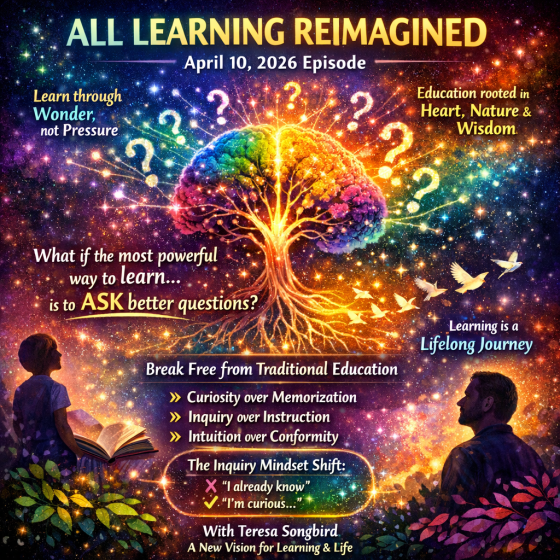

All Learning Reimagined with Teresa Songbird
Redefining Intelligence
Redefining Intelligence: From Cognitive Metrics to Multidimensional Knowing
All Learning Reimagined: Redefining Intelligence
Moving from narrow institutional metrics to a multidimensional symphony of knowing.
"Education is not just preparing someone for a career... it is life itself. We are not separate from the system; we are its evolution."
The Dimensions of Intelligence
The Paradigm Shift
- ✕Traditional: IQ, Math, Recall, Testing.
- ✓Reimagined: Embodiment, Wisdom, Trust.
- ✓AI Context: Human "Heart" as the final frontier.
Key Themes
This episode of All Learning Reimagined challenges the narrow, traditional focus on literacy and logic as the sole measures of human intelligence. Host Teresa explores a broader spectrum of "knowing," advocating for an educational shift that honors somatic, intuitive, and heart-based wisdom. By expanding our definition of intelligence, we can foster deeper inclusion and help learners align with their authentic selves.
Detailed Key Points
The traditional education system has long prioritized a narrow set of skills—primarily linguistic and mathematical recall—often overlooking the vast "symphony" of human potential. While Howard Gardner’s theory of multiple intelligences (including musical, spatial, and naturalistic traits) laid the groundwork for a more inclusive view, there is a growing need to move beyond these mental frameworks. Recognizing that every individual possesses a unique "constellation" of strengths allows educators to support those who may not thrive under mandatory testing but express their intelligence through diverse, non-traditional channels.
The Evolution of Intelligence
TRADITIONAL
Linguistic
Mathematical
Recall-Based
REIMAGINED
Somatic & Intuitive
Heart-Centered
Relational Wisdom
Moving from "How smart are you?" to "How are you smart?"
A critical dimension of this reimagined intelligence is the "intelligence of the heart," which encompasses empathy, compassion, and emotional coherence. As AI and technology increasingly automate cognitive tasks, these uniquely human qualities are becoming the forefront of leadership and connection. Children are naturally heart-led, yet traditional systems often "indoctrinate" them into purely head-based thinking. Reclaiming heart intelligence is not merely an accessory to learning; it is the foundational key to effective communication and genuine self-alignment.
Somatic and intuitive intelligences further expand the boundaries of how we process information. Somatic intelligence recognizes the body as central to learning, emphasizing that movement and nervous system regulation are essential for deep cognition and memory retention. Meanwhile, intuitive intelligence—often dismissed as illogical—serves as a "quiet voice" that precedes logic, guiding creativity and innovation. By cultivating stillness and trust, learners can tap into a "gut instinct" that provides rapid pattern recognition and a sense of self-sovereignty that cannot be programmed.
The Somatic Learning Foundation
Safety First
The nervous system must feel safe to unlock deeper learning and healing.
Movement
Activating the physical body engages up to 75% of the brain's capacity.
Key Data
- Brain Activation: Incorporating movement into learning activates approximately 75% of the brain.
- Historical Context: Howard Gardner’s Multiple Intelligences theory gained significant awareness in the 1980s.
- Human Potential: Intelligence is categorized into at least 12+ dimensions in this expanded model, including linguistic, logical, spatial, musical, kinesthetic, interpersonal, intrapersonal, naturalistic, somatic, intuitive, relational, and spiritual.
To-Do / Next Steps
- Visit the podcast landing page at
bbsradio.com/alllearningreimaginedto access archived shows and articles. - Download the reflection guide to identify your personal "ways of knowing" and learning preferences.
- Practice stillness and reflection to distinguish your intuitive "quiet voice" from external programming or fear.
- Educators should evaluate their teaching styles to ensure they aren't only catering to their own dominant intelligences.
- Tune in to next week’s episode focusing specifically on "Embodied Learning."
Conclusion
True intelligence is not a single score but a multidimensional constellation of the head, heart, and body. By embracing somatic awareness, intuitive trust, and emotional coherence, we can move beyond "cookie-cutter" education toward a future where learning is a lived, authentic, and profoundly human experience.
All Learning Reimagined

Please help support this show!
Support this show by subscribing
$5.99/mo or $9.99/mo or more
Click HERE
All Learning Reimagined: Where passion meets possibility, one story at a time.
All Learning Reimagined is a global podcast exploring the many ways we learn, grow, create, and contribute throughout life. A gathering place for people who know that the future is something we learn, create, and steward together.
While education is often where the conversation begins, this podcast reaches far beyond classrooms and curriculum. Together, we explore learning as a living process that unfolds through relationships, community, nature, creativity, curiosity, experience, and the pursuit of what brings us alive. Through inspiring conversations with parents, educators, authors, visionaries, community leaders, and everyday people, we share stories that expand what learning can be and how it shapes our families, communities, and world.
Drawing from diverse perspectives, indigenous wisdom, practical experience, emerging ideas, and timeless principles, each episode offers insights that nurture self-direction, discernment, contribution, and a deeper connection to what matters most.
Whether you are a parent, educator, learner, creator, community builder, or simply curious about what is possible, All Learning Reimagined invites you to explore meaningful questions, fresh perspectives, and inspiring stories from around the world. Because learning is a living journey to nurture.
Cultivating self-trust. Nurturing wisdom. Inspiring contribution. Strengthening community.
[00:00] Speaker 1: (instrumental music plays) Welcome to All Learning Reimagined, the podcast that defines convention and redefines the purpose and practice of education. Here we venture beyond institutional boundaries. Whether you're a parent, educator, or curious mind devoted to lifelong growth, this is your space to challenge assumptions and co-create a more humane and intuitive approach to education. Let's reimagine what education can be.
[00:42] Speaker 2: (laughs)
[00:48] Speaker 3: Hey, hey, hey. Good day, and welcome to All Learning Reimagined. I'm your host, Teresa, bringing you a little ray of sunshine, (laughs) as together, we're reimagining the future of education one inspired story at a time. Uh, today's topic is fantastic. Now, over the far- past few episodes, we've explored language, relationships, learning as a field, um, passion, nature, and contribution, one of my favorite topics to talk about, of course. But today, we're going to arrive at something many of us carry, really, within us, really quietly within us, and that's the question of intelligence. And for a long time, intelligence has been measured in quite narrow ways, in my opinion, from the education perspective, anyway. You know, it's how well we read, how well we might calculate, um, or how we recall information, which seems to be something that's, uh, valued in the traditional education sense.
[01:49] Speaker 3: But, um, while it's, uh, valuable skills, um, personally, I feel like they only present a very small part of a much larger picture. So today, I'm going to ask us all to stop and reflect of a deeper question, and that is, what does it truly mean to know something? So, we can reimagine and redefine the word intelligence. So from the measurement, but I'd also like to take it in through to the multidimensional knowing. Um, there's a big difference between believing something, but knowing something and having that intelligence. So, in this episode, we're going to ex- um, explore beyond the traditional definitions of intelligence. Uh, and you know, many educators are probably fa- familiar with Howard Gardner's theory of multiple intelligences. I know I've used it for many years, for decades, actually. I think, um, it was back in the '80s that it first came into my awareness. But I want to build on this. I actually wanna go further.
[02:57] Speaker 3: I don't wanna rehash something that's been done ad nauseum for decades. I really would like to explore heart intelligence, our body consciousness, because there's definitely an intelligence there, our intuitive knowing, and of course, our relational wisdom. Um, as you know, relational literacy, not necessarily content, is something that I'm very passionate about. So, this conversation, it's also gonna lay the foundation for our next episode next week, uh, because that's going to be on embodied learning where we're going to explore the body, um, as a powerful instrument to learning and, uh, awareness. So, um, take a, take a moment to breathe. Perhaps I should too. Settle into presence, open your mind, open your heart, um, to all of the new possibilities that might come up in this conversation today. So, let's begin. So, I'm going to start, first of all, talking about, um, intelligence is actually multidimensional. Let's get straight to the heart of it, shall we?
[03:56] Speaker 3: I mean, Howard Gardner's theory of multiple intelligences transformed our understanding of human potential, particularly from the mind and just the mental intelligences, and it affirmed that intelligence is not just one-dimensional, and it can exp- be expressed through many different ways of knowing. Um, you know, there's linguistic and logical, spatial, um, musical, kinesthetic, interpersonal, intrapersonal, um, and naturalistic intelligences. And I have, uh, worked with these concepts with children for a very long time, and with adults, and it's amazing how many people do resonate to the fact that there are many ways of knowing something. It's almost like a symphony of intelligence, um, and it doesn't have to just be mental. And when we recognize this, um, uh, in my experience, something profound really happens.
[04:53] Speaker 3: I mean, we realize that those who do not thrive in the traditional systems, uh, and not necessarily do well on, uh, all of the mandatory testing that seems to happen in many countries out there, they're not lacking in intelligence. They're just expressing their t- intelligence differently. And as an educator, it's something I've always been aware of, um, and self-aware of, making sure that whatever it is that we are learning or exploring and expressing in, uh, our classroom or learning environment, it's allowing children to have different ways of being able to express their intelligence on whatever that topic might, might be. Um, easier said than done, but it's very possible if you, uh, start thinking this way from the planning and the conception of a unit of work, or, uh, a topic or a passion or a skill or something it is that you would like to explore.
[05:52] Speaker 3: I mean, Howard Gardner's expanded model types really would include, um, all of the things that I mentioned before, but each individual possesses...... a constellation, really, of strengths, not just one of them. I remember I used to really resonate with being musical, um, and having a musical intelligence, whereas (laughs) the logical/mathematical intelligence is something that I do not, uh, resonate with, especially spatial. If you put me in charge of a map and asked me to direct you somewhere, you know, uh, we could be challenged for a little while. But if you put me into interpersonal, intrapersonal, um, and, and musical intelligences, and linguistic intelligences, I'm right at home because that's certainly my preference. Um, and yet I have a brother who grew up in the same environment as me, he's very into nature and natural, um, intelligences and is quite kinesthetic in body intelligences.
[06:49] Speaker 3: So we're, uh, vastly different, and yet we have the same environments, that nature versus nurture, I guess. Education systems really, in my opinion, only value linguistic and mathematical intelligences as a whole. I mean, the sciences can come in there, um, but that seems to be where, uh, the majority of the intelligences conversation is really aimed at. But recognizing diverse intelligences really fosters that inclusion and self-worth, and I, I truly believe... Well, actually, no, delete believe. I truly know that we're headed towards different intelligences and an expansion of, um, our perception in this, in this concept, particularly towards the intuitive and intuition realm, because, um, this is where I think the consciousness seems to be going. And a lot of the conversations that I've been having, even in the last two years, let alone five years, um, have really been shifting.
[07:52] Speaker 3: Something is shifting, and I don't know if people are even consciously aware of it, but even the language people are using and what they're more open to today is very different to what it was a few years ago. So I have a reflection question for you, the listener, beautiful listener. Um, which intelligences were nurtured in your childhood, regardless of how old you are and where you are in the world and what your situation or circumstances happen to be, and which intelligences were overlooked? Now, it's, this is for your childhood.
[08:27] Speaker 3: Think about it, sit with it, ponder on it, because what I'd really love to do is to expand the lens of how we see intelligences, and whether you're a parent or a grandparent or an educator or a learner, you can be any age listening to this, I'd really like you to sort of tap in within yourself to go, "Ooh, that resonates," or, "No, that doesn't resonate," and really feel into how your body r- reacts and responds to anything that I do mention, because that's usually (laughs) tapping into one of your intelligences anyway. If it resonates, then it's probably something in it for you. And just because something's been done, um, a certain way doesn't mean that's the way that it needs to stay, but change doesn't happen because someone tells you that it happens.
[09:18] Speaker 3: It happens because, um, awareness comes around and people actively act on it and they embody that learning, which is o- one of my wishes, that, that lots of people will not only talk and think and discuss this and, you know, there's one thing about k- knowing something, there's another thing about embodying it and doing something about it and stepping over that threshold moment. So beyond the traditional methods, or models I probably could say, intelligence can be understood as a lot of different ways of knowing. That's my perception. That's sort of how I see it. And there seems to be different, um, hmm, I don't know what the word is, areas, dimensions, like core... Let's say dimensions. Core dimensions of intelligence. You've got the thinking and reasoning and a- and analysis, which seems to be the traditional way. You've got the emotional intelligences, which is, you know, comprehending and managing the emotional side, which is really tapped into the heart space as well.
[10:19] Speaker 3: You've got our creative intelligences, imagination and innovation, which is so vital for our world. Uh, we don't wanna all be cookie cutter clones. We don't want our houses to look the same. We would like lots of creativity happening in our world. Then there's the relational intelligence, which is the connecting and the collaborating with others. Um, not to mention yourself, like, you know, the relationship with yourself, your inner being and that inner knowing, know thyself is so important. And then there's the ecological intelligence, which is living basically in harmony with nature, uh, ana- animals, the elements, um, all of those different things, and these are really more about authentic expression. Um, you know, there's, there's so many different ones, and so this week, um, for regular listeners who know, you know what I'm about to say, but this week, (laughs) um, and for new listeners, I, um, I l- I write an article and create activities each week to go along with the podcast.
[11:22] Speaker 3: So they're resources and they are housed on my landing page on beautifulbbsradio.com/alllearningreimagined, and you can go there and you can find all the archived shows and all the archived activities, um, slash, uh, articles. But for this week, um, I've actually created a fantastic article with lots of activities to explore these different intelligences and to stop and to sit with it, and I've expanded the traditional version of what intelligences are. So I've added in, other than the multiple intelligences that we've already discussed, the somatic intelligence, really to look at that embodiment, you know, instinct, that physical awareness, because our body's always talking to us, of course.... that intuitive intelligence, which is our insight. Uh, that also fits in for me w- with discernment and, um, that critical thinking fits in with that, and creativity, of course, with the intuitive.
[12:19] Speaker 3: Uh, the relational intelligence, which is something I'm very passionate about and is brought up almost every show, is, you know, about collaboration and communication and community, of course, that connection. (smacks lips) And, and there's another one that seems to be really on the rise, and that's the spiritual intelligence. I would say probably the last decade this has been coming through. And I don't mean through the New Age movement, although that has been prevalent. There's a huge swing away from the New Age movement from what I'm seeing at the moment, um, because there's a lot of, um, things in the New Age movement that are, that are off, that are not necessarily true. So there's a lot of truth there, but there's also some parts of it that's just not resonating for a lot of people that I'm starting to talk to. So, I'm asking them lots of questions.
[13:06] Speaker 3: "Well, what does this look like?" And to me, it feels like there's more they're tapping into their own knowing, and that spiritual intelligence is there. And it's that interconnectedness. Uh, also the purpose and values of, of why we're here. So, my call to action for everybody would be to download the reflection guide that I've created and explore your own ways of knowing. Sort of sit with it, feel with it. Um, you can u- use it with others of course, but consider how you learn best. Um, you know, is it through thought? Is it through feeling? Or is it through embodied experience? Because when you know yourself better, um, you can move through the ways more effortlessly. I- it doesn't have to be a struggle. And that's what, um, knowing yourself and understanding and comprehending these intelligences come for. And you will also recognize it in others.
[14:00] Speaker 3: And so if you're an educator, this is really important, because sometimes we lean towards our own preferences when it comes to communication or teaching styles, and possibly our own intelligences. I- m- many of us lean into what we are good at or what we, um, uh, resonate with heavily, but it might not resonate or be s- what's right for the learner that's there as well. So we really need to open our eyes to all of these different options. (smacks lips) And so from here, I'd like to now sort of segue into the intelligence of the heart, the emotional intelligence. This is something that businesses have been talking for years. They've been talking about IQ, EQ. Um, and EQ seems to be what a lot of employers are looking like. And a lot of the conversation that seems to be happening at the moment, p- particularly with technology and, and the rise of AI, is that, um, emotional intelligence is going to come through the forefront, the forefront.
[14:56] Speaker 3: You know, the humanness of us, the, the people aspect, the connection aspect. Um, intellect and knowledge, you can basically (laughs) create it at the top of, at the drop of a hat these days with all of the different technologies that are there, but can it really replace the intelligence of the heart? I don't believe it can. Or actually, delete belief. I don't... I know it cannot. It... This is a really important intelligence that I feel that needs to be fostered and brought to the forefront in awareness. Children naturally have this. They, they're so connected to their heart. You can see it, um, in everything that they w- that they do, that everything they look at is in awe and wonder, and they love the trees and the rocks and the sticks and the feathers, and everything is exciting to them, because they are led from the heart. They're a hundred percent in their heart space until we indoctrinate them in our learning systems to get into their head space. And, you know, why is this?
[15:52] Speaker 3: Why do we do it this way? You know, heart intelligence, in my opinion, really leads us to compassion and empathy, and these are two things that I've seen steadily decline, uh, i- in society in general. And, uh, heart intelligence, in my point- uh, my opinion, is also there for inner alignment. You know, alignment with yourself, sitting with yourself, not being distracted or addicted or, um, looking for anything other than within yourself, not feeling comfortable with yourself. So that emotional awareness and relational understanding really shape how we connect and learn and lead, for those leaders that are out there. You know, it's so important to leadership today, and I'm also seeing a huge shift in leadership. Um, you know, sure, there's lots of KPIs and all of those sorts of things in businesses, but there is also a, a shift towards that, um, compassion and the kindness movement.
[16:48] Speaker 3: And, you know, that care, the care factor, really needs to be there if you wanna lead, because, um, employees, uh, or community or friends or family will certainly, uh, respond much better if they know you actually care, you're not there for a bottom line. So, when you put the lens on of the fact that education is preparing someone for a job or a career, which, you know, is debatable, uh, today, it really is life, in my opinion. But, but for the traditional thinking, way of thinking, then heart intelligence is something that's definitely worth, um, uh, fostering and nurturing. You know, connection, as many educators know and parents know, it, it's not an accessory to learning. It's actually... it's the core, it's the foundation, it's the key, uh, connection and relationships, you know. Uh, real estate agents say, "Location, location, location." Well, educators would say, "Relationships, relationships, relationships." Um, it, it's just core to so many different things.
[17:56] Speaker 3: So, a question for you to reflect on would be: Have you ever known something in your heart before, and you, you've just known it, but your mind, uh, has to catch up? Your mind does not know how to explain it, or your mind's just not sure.I've had many of these moments, many, many of these moments. The intelligence of empathy and compassion, and a really beautiful word which I love is coherence. When I think of heart, I think coherence. And, um, that emotional intelligence with the self-awareness and the empathy and the relational understanding is just, uh, just essential. And, you know, the coherence between the heart and the mind, particularly in our decision-making in life, is a really great skill to foster. Um, in, you know, education and leadership as well. I mean, Daniel Goleman with- has done a lot of research around emotional intelligence, if you're thinking, "Where can I find more information?" Um, and also the Hearth Ma- HeartMath In- Institute.
[18:56] Speaker 3: Uh, they influence, um, a, a lot of, um, concepts and, and paradigm shifts, in my opinion. The work that the HeartMath Institute's been doing with heart-brain coherence is just game-changing. It's fantastic. So if you've never looked at it or you've heard about it but you've never actually gone and followed that thread, I would really urge you to, to go and check it out, because there's so much there. Um, they, they just do amazing things. Um, so, and then that really then comes down to the wisdom of the body. You know, somatic intelligence is something that s- people are starting to, to talk about. Everywhere I go these days, people are talking about your nervous system and over-regulation, and can you regulate your nervous system? Uh, the body is not separate from learning. Uh, I feel, personally, that the body is central to learning. So sitting in a seat in four walls all day is not (laughs) conducive to good learning. We need movement.
[19:56] Speaker 3: You know, the Brain Break movement that seems to happen, oh gosh, over a decade ago now, it seems, i- it's, you know, took off where, it, w- we stopped whatever we were doing with learning, and then children had to get up and move. It's just common sense, quite frankly. And if your lesson is, um, has a lot of movement embodied into it, we know that it deepens the learning anyway, because you have, you're not only using the linguistic part of your brain, you're using the physical part of your brain, which, when you, when you look at the research, is about 75% of your brain that you're activating. So movement is core in this. Um, you know, somatic intelligence reflects our capacity to sense and to experience, but also to embody that knowledge. There's no point in knowing something if you're not going to live it, actually live the learning, which is what this podcast is actually all about.
[20:49] Speaker 3: Uh, you know, movement, sensation, physical awareness really deepens that understanding, it deepens the memory, and it reminds us that learning's lived. It's not just memorized and memorized for a test or an assessment. Um, and with health and healing, I mean, your body is constantly communicating with you. It's telling you. That ache, that pain, that sneeze, that whatever it is happens to be there, your body is communicating with you. And I know there's a lot of really good books, um, uh, where you can actually look up parts of your body. I know there's, um... oh, let me think of one. I think it was Inna Segal, uh, The Secret Language of the Body. And so, if you've got, uh, I don't know, a sore knee or, um, an aching foot or a, a, you know, a left shoulder injury, and you can actually look up the body part, and it will tell you the message that the body is trying to talk to you. And you can sit there and read it. And more often than not, you, it resonates.
[21:49] Speaker 3: It just hits you, and you go, "Wow, that is so on point." But it also helps you then give you a direction of what to do about it, because the body is always communicating. So, the body stores experience and memory and instinctive responses. Why are we not openly, um, exploring this and discussing this in our education systems? You know, that the somatic awareness, it inf- influences our wellbeing, it influences our decision-making, but also our learning. Um, you know, many people talk about gut instinct, 'cause that's exactly what it is as well. Embodied intuition is the gut instinct. It's, it's ancient. It's been tal- (laughs) we've been talking about it for years and years and years, and yet it seems to be missing when it comes to mainstream education systems. Um, so you know, good discussions to have with other educators, if you are an educator, is, you know, how does movement enhance, um, learning and retention? And these things have been around for years.
[22:46] Speaker 3: There's a lot of different programs. Brain Gym, um, has been around for such a long time, and I've noticed it's got a really, a new resurgence coming through with a lot of the younger, uh, younger teachers today. And they're all going, "Wow, this is so amazing." And I'm looking at them going, "This is, you know, we've been here, done this, it's just we forgot, and we've been so busy." Um, but I would like to really bring up the point that the nervous system's role in our safety and in stress and our cognition is essential. Every single parent, grandparent, homeschooler, um, educator, uh, education leader really needs to comprehend this, um, because it, it's a game-changer with how programs are run or environments are set up for children to nurture, um, including universities and adult learning. Um, because when you feel safe, it really unlocks deeper learning in your body. The same way with your body will not release anything for healing if it doesn't feel safe to. It holds onto it.
[23:52] Speaker 3: And you might go and, go and see an expert and do a clearing, but it's only gonna release or clear what your body feels safe to let go. So, there's really something in this. Um, and listening to the physical signs as guidance, uh, is essential.You know, there's, there's other books in, eh, that are out there about, um, uh, hypothesis. I know there's Antonio, um, I think it's Damasio, um, and I can't remember the name of the order, or the author, but there's a book called The Body Keeps the Score that was also full of information. And my apologies, I, I cannot think of the author's name off the top of my head. I think, um, Kulk comes to mind, but I can't, um, don't quote me on that. It might not be there. Uh, but yeah, I do wanna bring up the fact that that's in a different type of intelligence. Your body is alerting us, and somatic intelligence is essential.
[24:46] Speaker 3: And one of the other more unusual intelligences that is also not discussed often is our intuitive intelligence, our inner knowing, which is beyond logic. You know, it's that quiet voice within, you know, the spark, the insight. It often precedes logic, in my experience, um, and it often guides as creativity or innovation or discovery. Um, and, uh, you know, there, there is a question there. How do you distinguish intuition from fear? Um, and how do you listen to that quiet voice, and how do you know that voice is your own? How do you know it hasn't been implanted or embedded through subliminal programming and advertising or everything that's around us? You know, who implanted that thought there? Um, so intuition and being able to be in tune with your own body, um, and that, and rapid subconscious pattern recognition really is a really good talking point to have. It's often dismissed, you know, and yet intuition is central to creativity and to innovation.
[25:47] Speaker 3: Uh, you know, it's that gut feeling of, "Oh, I think I need to go in this direction," or, "That doesn't feel right, I think I need to go in that direction." And you can't explain it, uh, it's just there. Um, and if you're interested in this, you really can explore this. You can cultivate it through stillness and reflection, and also trust. Um, trust is such an essential word, and there's a big difference between hoping for something and trusting something. Trusting is more anchored and it's more in that knowing. So, um, that really comes and, and ties into self-intelligence, you know, the whole know thyself. Um, absolutely timeless words, and self-intelligence is the foundation of authentic learning. And, uh, you know, if you put me in charge of a school today, the core thing that I would work on first before we did any academic subject whatsoever would be about the self.
[26:41] Speaker 3: Learning about the self is, um, it's a life (laughs) , it's a lifelong, uh, investment in time and energy and comprehension. Um, you know, it's really authentic learning. Self-awareness and reflection and understanding your own purpose and your own values and your own strengths, not the ones that necessarily are, um, programmed into us through society or ancestrally. Uh, you know, there's a lot of ancestral loops there that we're dealing with as well, but understanding ourselves and gaining clarity and confidence in your own sovereignty and self-sovereignty and knowing who you are, you, you can't buy that. That's just amazing, and young children already have it. We don't have to do anything with them. It's just nurturing them and allowing them, um, to express it in that space. I know I've thrown a lot of things at you, and I do have other intelligences that are in my article, which I won't have time to get into today.
[27:41] Speaker 3: One of them was interspecies and, and e- the ecological intelligences, you know, that deep attunement to animals and the natural world. Um, it's also intuitive, it can be intuitive as well, that empathy. You know, how do we expand communication beyond the spoken language is an- is another intelligence which really fits into the, the collective and relational intelligence. You know, there's this collaboration and shared insight and, um, lots of community and dialogue to unders- understand, um, uh, to enhance understanding, I guess I should say, or comprehension. And our indigenous knowledge systems really honor that collective wisdom, and there is, uh, a complete wisdom and intelligence inside as well, compared to the programmable mind. You know, you can program your mind through repetition. We know this.
[28:35] Speaker 3: Um, but allowing, uh, a learner to not see themselves as not smart because they're not n- necessarily good at reading or writing or math, but being able to see that they can, can, uh, embody learning in a different way using a different type of intelligence, it's just magical, magical to see and to observe and to be part of that. And so, uh, I need to wrap up. I don't want to wrap up. I could talk about this all day. (laughs) Uh, but anyway, if you wanna hear more about it, if you wanna read the article and, um, have a look at the d- different activities that, and practical ideas, um, that I've put together for listeners to, to sit in and, and investigate your intelligences, you can go to bbsradio.com/alllearningreimagined. And that's all that I have time for today. Thank you for joining me. Please join us next week when we talk about embodied learning, um, and until next week, explore, express, experience, go out and live learning.
[29:40] Speaker 1: (instrumental music) Thank you for joining us on All Learning Reimagined, where passion illuminates the path forward. Remember this, the future of learning doesn't arrive from above, it begins within. You are the spark, the shift, the living answer to education's silent call for transformation, so stay curious, stay awake. Let inspiration be your compass, because how we learn today is not just personal, it is profoundly generative. It shapes the very architecture of tomorrow's world. We are not separate from the system, we are its evolution. Until next time, trust the wisdom of your own unfolding and let your life be the lessons that light the way for others.
[30:51] Speaker 1: (baby laughing)