
Shadow Politics, January 25, 2026
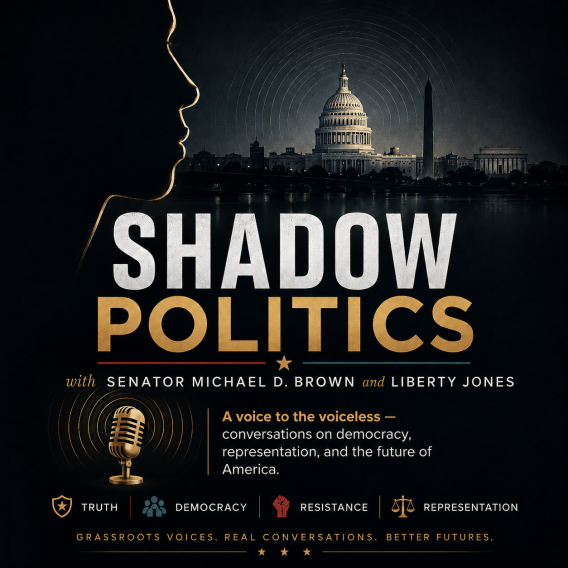

Shadow Politics with Senator Michael D. Brown and Co-host Liberty Jones
Guest, Monica Hopkins, Executive Director of the ACLU of the District of Columbia - ICE overreach, the threat of martial law, and reimagining democracy in a polarized America.
In this episode of Shadow Politics, the hosts and Monica Hopkins discuss the precarious state of American democracy, highlighting fears regarding the potential invocation of martial law and the aggressive deployment of federal law enforcement like ICE. The conversation explores the critical need for institutional checks and balances, the unique political struggles of Washington D.C. regarding statehood and home rule, and the necessity of restoring civility to bridge the widening political divide.
Detailed Summary
The Threat of Executive Overreach and Martial Law
The discussion begins with concerns that current civil unrest could be a precursor to the President invoking the Insurrection Act or martial law to suspend election results. Hopkins acknowledges these fears, citing the deployment of ICE in Southern California and Minnesota, and the National Guard in D.C. and Chicago, as evidence of a "pathway being developed" toward government overreach. However, she notes that pushback from figures like Representative Comer regarding ICE's presence in Minnesota suggests that a total consolidation of power might face internal political resistance. The consensus is that while the threat is real, the public's refusal to stay silent is a crucial countermeasure.
Institutional Checks and the Role of the Judiciary
A significant portion of the dialogue focuses on whether democratic institutions can withstand authoritarian pressure. While there is concern that Congress represents a failure to check executive power, Hopkins emphasizes that the Supreme Court is not the only judicial body; thousands of local courts across the country are ruling against administration overreach. She highlights that the concept of "due process" is becoming part of the common vernacular as citizens realize that individuals should not be treated as guilty until proven innocent. The group agrees that while relying solely on leaders to respect limits is dangerous, the combination of judicial rulings and public outcry provides a necessary defense.
Immigration Enforcement and Agency Accountability
The conversation turns to the specific conduct of ICE, described by the hosts as resembling a "rogue law enforcement agency." Hopkins argues that the chaos created by ICE—such as stopping off-duty local officers and demanding papers—erodes public safety trust so severely that the agency must pull back. While state governments cannot legally force federal agents out, Congress holds the power of the purse and can defund these operations. The difficulty of holding federal agents accountable is highlighted by the ACLU's ongoing, six-year lawsuit regarding the Lafayette Square protests, demonstrating the challenges posed by qualified immunity and the distinction between local and federal liability.
Washington D.C.: A Testing Ground for Policy
Hopkins explains that D.C. often serves as a laboratory for restrictive policies before they are applied nationally. She clarifies that the ACLU of D.C.'s fight for "statehood" encompasses both the proactive path to full representation and the defensive battle to protect existing "home rule." The discussion touches on the "Schedule F" executive order, which attempted to strip civil service protections from federal workers—a major issue for D.C.'s workforce. The ACLU is actively educating Congress members to prevent them from circumventing the D.C. Council's legislative authority.
Bridging the Political Divide
Drawing on her experience leading the ACLU in Idaho, Hopkins contrasts the "D.C. bubble" with the rest of the country. She suggests that Democrats often fail by "talking down" to the middle of the country and missing the shared values that exist in the center of the Venn diagram. The path forward, she argues, requires a return to civility and a genuine willingness to listen to opposing viewpoints rather than shutting people out, which only drives them toward authoritarian alternatives.
Key Data & Legislative References
250th Anniversary: The U.S. is approaching the semi-quincentennial of the Declaration of Independence.
Lafayette Square Lawsuit: The ACLU is nearly 6 years into litigation regarding the clearing of protesters for a photo op.
D.C. Criminal Code: The current code relies on a 1901 interpretation; the reform bill was the result of a 16-year transparent process before being blocked.
Guest, Monica Hopkins

Monica Hopkins is the executive director of the ACLU of the District of Columbia (ACLU-DC). She took the helm of the D.C. affiliate of the American Civil Liberties Union in 2014.
Prior to joining the ACLU-DC Monica served as the executive director of the ACLU of Idaho from 2008–2014 during which time she oversaw sweeping statewide victories, particularly in the areas of criminal justice reform, LGBTQIA equality, immigrants’ rights and upholding the First Amendment. Prior to joining the ACLU, Monica had a held several executive and development positions in the nonprofit sector.
Under Monica’s leadership, the ACLU-DC has grown its capacity and reach allowing the organization to become a resource for all District residents. As executive director, Monica oversees substantive programmatic and advocacy efforts to defend and advance the ACLU-DC’s work on civil rights and civil liberties for the over 700,000 residents of the District of Columbia.
As the organization’s principal spokesperson she helps increase public awareness of the ACLU-DC’s work. Monica has been quoted by national radio, television, and print media outlets, including the Washington Post, the New York Times, the Atlantic Monthly, Al-Jazeera, Politico, and NPR.
Monica is a graduate of Boise State University. She is also a 2012–2013 Rockwood Institute LGBT Advocacy Fellow and currently serves on the board of the National Reentry Network for Returning Citizens.
Shadow Politics

Shadow Politics is a grass roots talk show giving a voice to the voiceless. For more than 200 years the people of the Nation's Capital have ironically been excluded from the national political conversation. With no voting member of either house of Congress, Washingtonians have lacked the representation they need to be equal and to have their voices heard. Shadow Politics will provide a platform for them, as well as the millions of others nationwide who feel politically disenfranchised and disconnected, to be included in a national dialog.
We need to start a new conversation in America, one that is more inclusive and diverse and one that will lead our great nation forward to meet the challenges of the 21st century. At Shadow Politics, we hope to get this conversation started by bringing Americans together to talk about issues important to them. We look forward to having you be part of the discussion so call in and join the conversation. America is calling and we're listening… Shadow Politics is about America hearing what you have to say. It's your chance to talk to an elected official who has spent more than 30 years in Washington politics. We believe that if we start a dialog and others add their voices, we will create a chorus. Even if those other politicians in Washington don't hear you — Senator Brown will. He's on a mission to listen to what America has to say and use it to start a productive dialog to make our democracy stronger and more inclusive. If we are all part of the solution, we can solve any problem.
[00:00] Speaker 1: Welcome to Shadow Politics, an hour-long grassroots talk show which is on a mission to make America think again. A vote is a terrible thing to waste, so our show is oriented towards bringing forth the people that are doing the work in the background so that you know what's going on in the world and you can make, uh, the appropriate decisions. I'm here with my co-host, Liberty Jones, and we're excited tonight to have with us, uh, Monica Hopkins, who's the director, executive director of the ACLU of District Columbia. Prior to her position in DC, she was, uh, the director of the Idaho, um, um, ACLU, and she's also had a distinguished career in nonprofits and, uh, with executive and deve- development positions, and we're so happy to have her here today. Um, thanks for being on the show, Monica, and welcome.
[01:03] Speaker 2: Thank you so much for having me tonight.
[01:06] Speaker 1: Can, can we start... I know there are certain specifics you cannot talk about and that's fine, but can we just start w- by talking about overall what's going on in America right now? Uh, I have this crazy theory that just won't go out of the back of my head, and I hope I'm wrong, but I'd like to have your, uh, uh, assessment of this. But I think that the overall plan here in America is to cause enough unrest that the president of the United States could, uh, invoke martial law and, and, and first invoke the Insurrection Act, call on troops, ultimately, um, call for martial law, invoke ma- martial law, and wouldn't that give him the right to either suspend the elections next year or to suspend the results of the elections?
[02:03] Speaker 2: I, I mean, I, I think that's (laughs) , you know, a big, a really big question. Um, I think talking about what is going on in our nation, it is sort of the lead up to everything you are talking about, um, Senator Brown. So, you know, the things that we saw with the ICE deployment, um, in Southern California, um, the National Guard deployments in DC and Chicago, um, and Memphis, uh, and now this massive, massive sort of, uh, ICE operation in Minnesota, in Minneapolis, um, that has resulted in, uh, the killing of two, uh, American citizens who were, uh, protesting. Um, it is deeply, deeply concerning, um, the far overreach of the government in the deployment of federal law enforcement, of National Guard throughout the country. It seems like there is, sort of, a pathway being developed.
[03:15] Speaker 2: Now, what I think is very interesting is, uh, today, I think, uh, you know, Representative Comer came out, um, and said, you know, "I think enough is enough, you know, we should pull ICE out of, uh, Minnesota." Um, and that, to me, says that, that maybe the path toward the (laughs) Insurrection Act is, is, is not gonna be complete if that is the plan.
[03:46] Speaker 1: Well, G- from, from, from, from your mouth to God's ears. I hope you're absolutely-
[03:51] Speaker 2: (laughs)
[03:52] Speaker 1: ... I, I hope you're absolutely right about that.
[03:55] Speaker 2: Well, I, I think the more people who, who keep showing up, um... I, I just remember, you know, uh, Benjamin Franklin's words after, uh, coming out of the Constitutional, uh-
[04:08] Speaker 1: Yeah.
[04:08] Speaker 2: ... Convention and, and (laughs) , you know-
[04:10] Speaker 1: Yeah.
[04:10] Speaker 2: ... it's the 250th anniversary of the Declaration, and, and he said, uh, you know, "A republic, if you can keep it." And it seems-
[04:21] Speaker 1: Yeah.
[04:21] Speaker 2: ... that we are remembering that in this moment, um, and people are doing everything they can to try to keep this democracy, to try to keep this republic.
[04:34] Speaker 1: Yeah, it sure f- it sure feels that way, and I hope that's it, the truth. I know that people are, brave people are out there.
[04:41] Speaker 3: Yeah. You know, that's a really interesting point you bring up because, you know, martial law is one thing and that is something that's really constitutionally ingrained. I'm really scared that he's gonna continue misusing our emergency powers that we have in place. And, you know, his actions are so authoritarian. My fear is that this will set a new standard for American democracy overall. So, for someone who's in the field like yourself, I, I want to understand, do you think... How much does our democracy depend on individual leaders respecting limits rather than them actually being legally forced to? Because it seems like we're under a situation where the only thing keeping Trump from preserving our democratic values is the little hinge of Constitution left to defend those values.
[05:43] Speaker 2: Yeah. I think, um... I don't think it's an either/or. Um, I, I think it's a, sort of a both/and. If we look at, you know, the expansion of presidential power, um, you have to go all the way back-... to Lincoln, um, who, you know, suspended habeas corpus during the Civil War. Um, and, you know, that was an extension (laughs) of, uh, presidential power. Um, and since Lincoln, there has been this, you know, expansion. There's been more and more, um, sort of executive power. I think in, in this time what we are seeing is the far reach of, you know, executive power and the sort of systems that we have that would be the checks and balances against that executive power don't seem to be working. Um, so you have the judiciary, um, uh, you have, uh, Congress who are not checking that executive power. Um, and, uh, you know, I brought up Comer earlier. This is, this is sort of the, it's not individual sort of leaders.
[07:02] Speaker 2: Um, I would say it's up to the institutions and, and the people within those institutions to be that check. That's sort of how our democracy is set up. Um, and what we have seen is, you know, uh, the public out in the streets, um, uh, saying they will not stand for this. Um, we have seen, um, you know, the massive amount of calling and showing up at town halls, um, or congressional members, um, y- you know, people looking to flip seats becau- in, in districts, uh, that are really upset about the way that this country is going. And then real talk about the judiciary, and when we say the judiciary, everyone goes, "Oh, but the Supreme Court seems lost." And what a lot of people lose is the Supreme Court isn't the only court in this country. There are thousands of courts across this country and we are seeing rule against the Trump administration.
[08:13] Speaker 2: Um, I think that, you know, Minnesota will be sort of a test, um, uh, seeing what happen now the, uh, judge, you know, uh, imposed a stay on, on a ruling and last night, um, there were emergency briefs filed to undo the stay, um, and, you know, bring charges against, uh, ICE. So, you know, I think we will see, um, as this progresses, but I do think that the, the, the tenor has changed across the country and you hear more people talking about what are fundamentally the principles of our democracy. Um, I've never heard due process said in more places, um, you know, in all the years (laughs) I've been doing this where people actually understand, you know, that, that due process, uh, means that we have to look at these individual cases and that people are not, you know, guilty until proven innocent. That people, uh, you know, uh, have a right, um, in this country, uh, to be free of this sort of abuse of power.
[09:39] Speaker 3: But I think that was, I think that was really beautifully said. I really appreciate how, you know, right now this is true, the people are rising to power. But my worry is that, you know, this democracy should be in place so that we could have the expectation that the leaders in place will respect their authority. And I think that right now a lot of Americans feel at a loss, and on one hand though it's really beautiful people are rising to convene in what they want done, I don't... I wish for a world that we wouldn't have to be in this position in the first place. And do you think that's a possibility or do you think maybe that we need to move towards different types of government restrictions in the long run and kind of evolve our current democracy?
[10:35] Speaker 2: I'm trying to picture what that would-
[10:40] Speaker 3: Well-
[10:40] Speaker 2: ... look like.
[10:42] Speaker 3: Well, and I don't wanna sound too crazy, but-
[10:47] Speaker 2: (laughs)
[10:47] Speaker 3: ... maybe something... (laughs)
[10:48] Speaker 2: Well, if you, if you were in this moment, in this world, uh, now, you know, I think there is something, um, at the heart of what you're saying and it, and it is something that, you know, people are talking about. I, I would say that what they're talking about is, you know, reimagining our democracy. Like, our democracy as, you know, um, uh, hopeful and idealistic as it seems did not work for a lot of people. Um, it was not as multicultural and, you know, um, uh, expansive as the Constitution would make you think that it was.
[11:35] Speaker 2: Um-
[11:35] Speaker 3: Yes.
[11:35] Speaker 2: ... I think the, the ideals and the hopes are there but I think what, what you're getting at, and I really do want to hear how you've (laughs) reimagined it, but is in this moment where everything is falling apart can we keep some of those things that worked, but can we also reimagine how it will work for all of us?
[11:58] Speaker 1: Let m- let me ask you a, a very practical question as a lawyer-Let me ask you, do you think... How important do you think it is that we need to prosecute the individuals who have been involved in different incidences, uh, with ICE in order to get con- them under control? I mean, isn't that the... If you start... If, if you start sending, uh, uh, prosecuting ICE agents who are doing things that are outside the bounds of, of the law and beyond their, uh, what they're supposed to do as law enforcement people, isn't that the best way to curtail bad behavior? Start prosecuting some of these people?
[12:46] Speaker 2: Um, so I think the problem, um, that we have there is, uh, sort of the accountability measures that we have, um, around qualified immunity. Um, so I think first and foremost, um, the avenues that we have currently, um, to curb that bad behavior have not existed. Um, and so, for example, if you look at Lafayette Square, and so folks remember when Trump, you know, went out in front of the church-
[13:23] Speaker 1: Yeah.
[13:23] Speaker 2: ... and held the Bible upside down-
[13:26] Speaker 1: Upside down. Yeah.
[13:27] Speaker 2: ... in the last, (laughs) upside down in the last administration. Um, the ACLU of D.C. sued on behalf of, um, protestors, um, and that was, there were some metropolitan police department officers there. There were also, um, federal, um, uh, law enforcement officers, uh, there. And we are still, because it was suing the, uh, the federal government, (laughs) um, we are still five, almost six years into that, trying to get accountability, because the accountability, um, is different, um, between local and federal, um, law enforcement agents. So, I, I don't disagree that, you know, having some, uh, measure of accountability, uh, is really important to curb this behavior. And, and that's not to say we don't see it on, um, the local level, as well, but it is much, much harder on the federal level.
[14:32] Speaker 1: I think that, um, you know, o- one thing that I have a problem with is that, um, when I hear... I'm sorry, I'm switching gears real quick. When I hear-
[14:46] Speaker 2: Mm-hmm.
[14:46] Speaker 1: ... uh, Governor Walz and, uh, Senator Klobuchar and other people say, "ICE out of Minnesota." Should we really be... Just as a practical matter, shouldn't we be saying, "Get ICE under control." Rather than get them out? Because we can't get them out. Can we legally? Can they... Can, can we force? Can the state of Minnesota force them out, or can the state of California force these people out? They really can't, can they?
[15:19] Speaker 2: I don't think the state can force them out. Um, I do think, you know, Congress has a decision in front of them, actually right now, um, about the funding of ICE.
[15:34] Speaker 1: Right.
[15:35] Speaker 2: Um, and I think, you know, this call for getting ICE, um, out of Minnesota, you know, right now, um, in Minnesota, it's my understanding that, you know, local law enforcement, um, I watched a press conference, uh, with local law enforcement officers in Minnesota where they told stories of law enforcement officers, um, Minnesota law enforcement officers who were, uh, you know, uh, sort of cornered by ICE agents, um, coming up to the car, demanding to see their papers, and they were American citizens. They, you know, off-duty officers. Um, and once they finally said that they were off-duty officers, then they, they went, you know, the ICE agents went away. The chaos that ICE has created in these communities, um, you know, state governments may not be able to send ICE out, but at this point, you know, it is creating such chaos that what we know is the state will not be able to protect its own citizens, to have public safety because all of that trust is lost.
[17:11] Speaker 2: And the chaos is so great that I think the only answer is for ICE to pull back, right? And get out, to see what the damage is and what has gone out, has gone on, because you cannot have immigration enforcement, um, if that is what is actually going on, and we could say (laughs) if that's what's actually going on or not, um, if you have this kind of, uh, you know, operation, this kind of occupation, um, especially when what you have are essentially ICE agents with faces covered, sometimes not clearly identified, um, this is like a, a, a rogue law enforcement agency.
[18:12] Speaker 1: Yeah, it- it- it really is, uh, it really is horrible to watch this stuff on TV unfold, and to see these guys in masks, and to hear over and over again people saying things like, "Ah, this reminds me of, uh, uh, 19, the 1940s in Europe, this reminds me of Nazi Germany, this reminds me of, of, uh, fascist takeovers in places like Italy." Um, but, uh, let- let me ask you, are we doing... Are we, are we playing into their hands by protesting too much? I saw the protests in the church, for example, and I thought, um, when I saw the protests in the church, I said, "Oh my gosh," because this is gonna give them ammunition, right? They're in there all you n- all you fundamentalist Christians who support this horrible person in the White House, they're all gonna be like, "Yeah, they're attacking us in church," uh, you know, and I just thought, "Uh-huh, they're doing more damage there than good." Do you think we're doing more damage than good or- or do you think this is helping?
[19:20] Speaker 2: Well, I- I mean, I want, uh, I sort of wanna pull apart, um, a couple things that you're asking. Um, you know, I think that exercising your First Amendment right, um, is incredibly, incredibly important, particularly in this moment. This is actually what the First Amendment was written for.
[19:44] Speaker 1: Right. I agree.
[19:45] Speaker 2: Um, you know. Uh, and so in this moment, to stand up, um, and express your opinions and petition your government in the most visible way possible, I think is incredibly, incredibly important. And I wanna say, you know, like, protesting, um, as we're seeing it, is taking so many different forms, um, as well. So, you know, people on the ground just documenting, um, in their neighborhoods, in their communities what's going on with these ICE agents, um, you know, uh, protesting in ways that you wouldn't think of typically protesting. So, you know, when, uh, the National Guard, uh, you know, was deployed here in DC and there was, um, uh, immigration enforcement ramped up, we saw parents making, you know, walking school buses to ensure, you know, their- that kids got to school safely, um, because some were being stopped or their parents were being stopped and questioned and, you know, so protesting can take all sorts of different, um, uh, uh, forms.
[21:07] Speaker 2: What you are saying with, and this is what I think and correct me if I'm wrong, but, um, I think the distinction here is how, um, we engage with assumptions about, um, about other folks. So, um, not having seen the video, um, of the protest in- in a fundamentalist church, I'm assuming you're saying someone went into the church and- and made a blanket statement that everyone in that church believed, you know, that everything this administration was doing was correct.
[21:46] Speaker 2: And I think-
[21:47] Speaker 1: Well-
[21:48] Speaker 2: ... that it... Oh, go ahead.
[21:50] Speaker 1: No, I was just gonna say, you know, just as a practical matter, because I'm- I was a politician and not... A- and part activist, part politician, but the politician part of me wants to be practical, you know? When I had a problem with, in DC, when we sent a reform crime bill up to the Hill, which was perfectly our right to do and made sense, but I said we shouldn't have done it because the Congress was so conservative and we knew they were gonna overturn it, and we lost 44 Democrats. So, that's the dilemma that I have sometimes, is, um, shouldn't we be, shouldn't we be more thoughtful in our actions sometimes, rather than just reactive?
[22:33] Speaker 1: But, uh-
[22:35] Speaker 2: Mm.
[22:35] Speaker 1: ... I- I'm sorry, go ahead.
[22:36] Speaker 2: But, uh, I think, no, that's a great, that's- that's a great example of something else though, um, the revised criminal code bill, uh, that was sent up to the Hill, um, i- you know, many, many, many, many people latched onto the, um, talking points and about all the crime and everything like that, and did not ask questions, did not look at the details of that bill.
[23:05] Speaker 1: Right.
[23:05] Speaker 2: That was a-
[23:06] Speaker 1: Right.
[23:06] Speaker 2: ... 16-year process and one of the most transparent government processes I think I've ever seen. You could go to the, um, you know, Criminal Code Reform Commission web page and you could see, um, every single proposal, every single comment on every proposal, um, every single red line. Um, it was a, uh, committee made up of all the parts of the criminal justice system. It was putting into place, um, essentially a penal code that corrected our current penal code which relies on the 1901, uh, interpretation of the penal code which Congress was actually supposed to fix before DC became... Uh, was allowed to govern itself under Home Rule. And what they did is they said, "We're not gonna finish it in time," and so they turned it over to DC in 1973-... still basing our criminal code on that 1901 law.
[24:18] Speaker 2: And if you look at some of the sentencing, in the proposed, uh, in the proposed, uh, revised criminal code, some of them, uh, you know, had proposed sentences that were, uh, higher than some other states. Uh, and it was all based on data from the sentencing that was going on in our courts. So, I, I think it's a really, really important lesson about if we're going to be rational and if we are going to, to say that we are going to do rational things, we have to, like, dig down into, into the details, um, o- of these moments.
[25:04] Speaker 1: Yeah, I think you're right. And I never doubted that it was the right thing to do from a, from a criminal justice standpoint. But, uh, you know, just, just under the, I, I, under the rule of that the road to hell is paved with good intentions, uh, I, I thought it shouldn't have been sent up there. Um, but I don't wanna monopolize things here. Uh, go ahead, by the way.
[25:28] Speaker 3: Well, if I can jump in really quick, I'm loving this part of the conversation. Uh, you know how much I love the quote, "Divide and conquer." (laughs)
[25:37] Speaker 1: Yeah. (laughs)
[25:37] Speaker 3: Um, (laughs) as a first generation in the world of what I like to call screenagers, I really do think that the media has a really big effect on how extremist right now our ideologies are. And to that, I have to say, as much as I understand that we do need to consider, you know, bring a level of levity with it, like Gandhi did, you know, Martin Luther King Jr., they achieved it not through violence or aggression, their goals, but they achieved it through acts of peace. I think that right now, it is practical to fight the situation with the fire it's being given. Because at the end of the day, ICE is a federal law enforcement agency, and its authority comes from federal immigration law. And so, I think right now, its expansion ... Like the other day, guys, I read that they're doing ... they're invading houses without warrants or anything like that. To me, that is practically illegal. And to me, that's something that needs to be held up to court.
[26:40] Speaker 3: So, I do agree with that, but my question is, do you think that in this certain circumstance and the types of reactivity that Trump has, 'cause he's extremely reactive, he likes to shift blame, as we've talked about before, do you think that truly trying to show him strength in unity and truly trying to demonstrate the extreme possibility of success is, is going to work like it has before? Or do you think it's gonna make him just go down on us more in hopes that we will be silenced because his fear tactics have been successful in the past?
[27:24] Speaker 2: Yeah, I mean, I think in this moment, I think there are a lot of individuals who would have given this administration the power it needed-
[27:37] Speaker 3: Mm-hmm.
[27:37] Speaker 2: ... to come down harder who are backing away. So, y- you know, it ... The other day, someone, I did not hear, (laughs) hear this talk, but the other day, someone told me that, you know, Rand Paul was on Joe Rogan talking about due process and, you know, limiting (laughs) the powers of this administration.
[28:00] Speaker 3: (laughs)
[28:01] Speaker 2: Um, and, you know, it, it's like, "Oh, okay." (laughs)
[28:05] Speaker 3: (laughs)
[28:06] Speaker 2: Uh, you know, we might not agree on ... We, we might not agree on the policies, we might not agree on what is right for this country, but more and more people are saying, "Wait a second, that is a step too far." Um, and so, I, I do think ... You know, we have a, um, we have a January, what is it? January 30th, uh, deadline, um, for the budget, and, uh, will we get, you know, um ... will we have another government shutdown? And with everything going on in Minnesota, you know, more and more people are coming out (laughs) and saying, "Do not pass this budget with the amount of appropriations that are in there for ICE." Um, and you can't have, you know, come down harder on people, um, with an agency, uh, that is smaller, um, and that is not funded.
[29:15] Speaker 1: Yeah.
[29:15] Speaker 2: So, I think the checks and balances are coming back.
[29:18] Speaker 3: Yeah, that's good.
[29:20] Speaker 1: Let's hope. And, and I think that we, we both know that, uh, uh, politicians are particularly pusillanimous. So, if they feel like they're gonna lose in November, uh, things will change quickly, will they not? I mean, they'll do it ... We'll, we'll see them, we'll see the support that, uh, Trump has in Congress, for example, I think fade away i- if these guys see their own, uh, offices threatened. Um-
[29:49] Speaker 2: Yeah, I mean-
[29:50] Speaker 1: Let's hope.
[29:50] Speaker 2: ... we're in an election year. (laughs)
[29:52] Speaker 1: Yeah, we are in an election year. So, everybody get out there if you're not out there, or do something. Write a letter, make a phone call, whatever-
[30:00] Speaker 2: (laughs)
[30:00] Speaker 1: ... you're, you're able to do, right? And, and, and, and, and let these people know that we're gonna hold them ac- accountable. But let's move on. I wanna move back to the District of Columbia, a, a place that, uh, you and I both know and love, all three of us know and love, uh, and talk about what's going on in DC specifically. Because, you know, I think the, that, uh, a lot of these, uh, half-baked ideas come out of, uh, things that they try in the District of Columbia first. We seem to be, we seem to be their testing ground for, uh, uh, some of these ridiculous ideas. And there are a lot of ... You brought up the budget, there are a lot of DC riders on the budget.Uh, one of which is to totally defund the delegation in which I served.
[30:48] Speaker 1: Um, you think any-
[30:51] Speaker 2: I saw that.
[30:51] Speaker 1: You think any-
[30:51] Speaker 2: I, I saw that (laughs) from the other day.
[30:53] Speaker 1: Yeah, yeah. Well, you know, and there was one before... Look, this is wh- I, I, I, I decided not to run for re-election for a third term. I was considering it, but when Trump got elected, I said, "Nothing good's gonna happen for the next couple of years, and, and I'm getting too old to, to, to, you know, look at this fight 10 years down the road." But do you think we have to do that? Do you think we have to look at this fight 10 down, 10 years down the road? Or does this give us an opportunity... And when I say the fight, I mean the fight to become equal, become a state. Uh, does this give us an opportunity now that this is... All these things seem to be on the front burner, do we have a real opportunity here to get America behind, uh, the idea of making District of Columbia a state?
[31:45] Speaker 2: Oh, absolutely. I, I wanna say, you know, at, at the ACLU of DC, when we talk about statehood, um, for DC, uh, it's sort of an umbrella term of we are fighting for statehood, and that means both the proactive, uh, road to full, um, statehood, to, uh, be full participants (laughs) in our democracy, um, and it also means the defense of our limited self-governance through home rule. Um, and those two things are tied together. And so while in this moment, you know, we are fighting, um, to defend home rule, uh, we are laying the groundwork by educating people about the importance of home rule and how we are actually being used as this, um, you know, sort of an experiment for, uh, what Congress or this administration, uh, would like to do in other places.
[32:49] Speaker 2: And I think that elevates, um, the details of what is going on in DC, not just, uh, you know, with the National Guard and the deployment of National Guard that we saw very early on because the President, although he forgot he had that power somehow on January 6th in 2021, um, he, you know, does have the power to call up our National Guard, um, and, you know, ask other states to deploy theirs. Um, but all the way down to some of the details that are embedded in, you know, some of the over 60 bills relating to DC that are in Congress right now, um, some of which have already been voted out of the House. Um, and so buried in some of those details are things that, you know, the rest (laughs) of the nation, you know, should be concerned about, um, should, you know, this Congress try to take up issues like are buried in these bills.
[33:57] Speaker 1: Well, before I let Liberty ask another brilliant question, let me just say that it's always amazed me that I couldn't get the Democrats more involved in this when we spent 80 million dollars to get two senators from Georgia. I always said, "Give me 80 million dollars, and I'll get you two Democratic senators from, from the District of Columbia," right? We could, we could become a state and we need to put some money into this, but that's another issue altogether.
[34:29] Speaker 1: Go ahead-
[34:29] Speaker 2: (laughs)
[34:30] Speaker 1: ... uh, Liberty.
[34:31] Speaker 3: So (clears throat) I have kind of a simple question, but I wanna know how has, you know, your work under Trump's term been... And I'm sure there are many answers to this, but how has it been different from what you've done in the past? You know, are there... is there more to do with the federal agencies today or, you know, how does that really prevail in practice?
[34:57] Speaker 2: Yeah, I mean, the ACLU of DC and sort of the national ACLU federated organization is a unique, um, I'll just... We're a state affiliate, um, um, but, but a unique one because of the lack of statehood. So it's always been a little interesting to be in this job, um, because you need to know, uh, how the federal government, um, interacts with DC. So, you know, the, the US attorney is our local prosecutor, um, there are certain things... I like to call it, you know this very, very well so I don't have to go through the whole thing, but the civics lesson inside the civics lesson that is how a bill becomes law in DC. Um, and, you know, so there was that baseline of the job just being a little bit different in what you had to know. Um, our legal program also is a little bit different, um, than other affiliates. We have... The district court is here, so we are on a lot of big national cases, um, with our national office, um, but in this administration, it has been, um, sort of a switch in...
[36:20] Speaker 2: Not really a switch, but a deepening maybe of the work that we do. Um, what we saw at the end of the Biden administration, uh, or I'm sorry, the end of the first Trump administration, sort of as Trump was walking out the door and, you know, passed an executive order known as Schedule F. And, you know, Biden overturned immediately that, um, executive order, and that was to do away with the due process rights of federal workers.... um, and create a, you know, a, a whole nother class of, of federal workers that would be political, uh, appointees, um, in the civil service. So, so doing away with civil servants that did not have an allegiance to any political party or administration but had an allegiance to the Constitution. That's sort of the backbone of our, um, institutions of government. Um, and here in the District, our work around federal worker rights, um, we saw, uh, go up. We currently have, um, a, uh, case, um, a DEI case.
[37:37] Speaker 2: There were a lot of, um, federal workers who were purged because they, you know, took a, a DEI course that was, um, mandated by their job. Um, uh, and those individual federal workers are all across the United States. Um, but here, the agencies they serve are here in the District of Columbia. Um, additionally, um, on the local level, uh, we are making sure that we are watching more closely what is coming out of the council and going up to the Hill. And then also, we actually have a federal advocacy program now, um, where we have built relationships, um, with House members and also, uh, senators on the Hill. Um, and since January have been do- January of last year, have been doing some deep education around, um, DC home rule, uh, the intricacies of some of the bills, um, that have been placed before them, um, that relate to DC.
[38:49] Speaker 2: And, um, you know, also informing them (laughs) when, uh, things go on in DC and people try to circumvent our legislative process and go directly to Congress to have them, uh, try to overrule, um, what our, uh, council has put into place. So, I think that expanse- expansion of our federal program, and then additionally, you know, we are doing public education, uh, through some of our affiliates and partnering with some of our affiliates to, uh, educate, you know, in strategic states, um, the electorate about the need to protect DC home rule, about what that means. Um, so that if... in some of these states, there are new congressional members, um, that, you know, they understand how important it is to stand up for DC statehood and for DC home rule.
[39:53] Speaker 1: Uh, let me, let me ask you, I think that, uh, one of the reasons that we as Democrats have been hoisted on our own petard is that we never thought that Donald Trump would get reelected. Uh, here in Washington, I mean, is one of the only up things I can say, uh, about his election is that my family never... no longer asked me for my political opinion because I said, "Ah, what are you? Crazy? Nobody's gonna like this guy."
[40:24] Speaker 2: (laughs)
[40:25] Speaker 1: So, uh, uh, let me ask you a question, given your unique experience. I had a friend tell me I felt that way because I lived in a bubble, and I think she's right. I think I do live in a bubble. So do the people of Washington DC, the people that make laws here, uh, do we people on the East Coast, do we understand what it's like to live in Idaho? Do we understand how the people of Idaho feel? Or are we just, uh, oblivious to what the rest of the country feels?
[40:57] Speaker 2: It's so funny that you ask that question. Um, I, you know, I've told, uh, some friends that living in DC now under this administration, um, feels a little like, uh, you know, running the ACLU of, of Idaho. And, and what I mean by that is, um, I'll hearken back to what I said before, is really like... in order to have conversations, really focusing in on, you know, what I call the center of the Venn diagram. We may disagree on a lot of things, but can we find that thing in the center that we really agree upon? What are those, you know, key core values and ideals that we wanna hold true? And I think that, you know, in DC, that isn't an exercise that has to be done a lot because a lot of people, uh, seem... and I'm making broad generalizations, but seem to think the same way, right? That it may be different a little bit around the edges. Um, but when you live in other places there, uh, y- encounter much more of a wide variety of disagreement.
[42:24] Speaker 2: Um, and living in places and having, uh, interactions, um, and friendships with, you know, folks that, um, may not believe politically with you, um, they have different ideas about how government should be run or what should be done with your local street. Um, so I, I think the difference, um, is in that, um, I will say also that...You know, across the country, folks could have predicted, um, the, the first Trump administration, um, I think in the second, um, Trump administration too, when you look at sort of how, how people are spoken to, um, that becomes a big thing, and on the East Coast, particularly in Washington D.C., the city that has, you know, a ton of (laughs) lawyers and academics and, um, when we talk about politics, um, you know, I think we are missing, you know, the middle of the country. We are missing, um, some of the red places who may not have the language that we do, but they do understand politics.
[43:58] Speaker 2: They do understand what they want out of their government, um, and it is can we be open to rolling up our sleeves and, and figuring out, um, how to make this a democracy where we work those things out through the processes that we have, um, in studying, instead of shutting people out? And I think that was the biggest problem is people felt shut out of the conversation and Trump gave them a path through.
[44:31] Speaker 1: Yeah, I think that too. I think, you know, I, I think that the Achilles' heel of the Democratic party, and we need to take some responsibility for what happened, uh, I think that, uh, since I've been a Democrat, uh, for more than 50 years, our Achilles' heel has been we tend to talk down to the rest of the country, and they, they resent that, you know, because we don't understand some of the things you, you, you just outlined. Uh, Liberty Jones asked a good question.
[45:00] Speaker 3: Yeah, I think that's what, I think that's what makes this election so interesting 'cause we're finally seeing a shift in the people who support Republicans, uh, versus who supports the Democrats. Um, my question to you is, you know, w- I think we're, we might be running out of time. This might be my last question, so let me make it fun. Um, moving forward, what is one, let's say, political norm, or maybe a right in society that you think is something that we need to focus on in terms of reconstructing our democracy? Where should we, if we had to pick one area to advocate our energy towards, where do you think that should be?
[46:00] Speaker 2: Hmm. You know, that's, that's a really, that's a great question, Liberty. (laughs) Um... So I don't, I don't think that we are going to put our democ- be able to put our democracy back together or even start reimagining putting our country back together until we can focus on the ability of actually hearing each other and, and this isn't like a political through line, but, you know, if we actually want to engage in politics and the exercise, uh, of politics and government and governance, um, we actually have to be able to listen to the other side, to question, um, and I think we've lost a lot of that civility. And so I guess that, you know, that would be my sort of first step, um, and I think without that, it, it's hard to say we could mandate anything. Um, we saw, you know, the Civil Rights Act of, um, 1964 went into place, but you can't sort of just legislate and enforce.
[47:35] Speaker 2: Um, there was a lot of work that, you know, still has to be done but had to be done sort of on, um, the individual and the societal level, um, to make sure that portions of that were a reality. And, and I would say civility has, um, a big role in how we reimagine this democracy.
[47:58] Speaker 1: Well, and, and given what you just said, did those laws like the Civil Rights Act and the Voting Rights Act and those things that mandated, uh, equality, did they, they, did they help bring it about or did they push it underground and are we seeing a result of that-
[48:20] Speaker 2: Mm-hmm.
[48:20] Speaker 1: ... now? Because I notice that these, the ICE guys aren't stopping anybody that looks like me, you know? Uh, uh, my daughter-
[48:29] Speaker 2: Mm-hmm.
[48:29] Speaker 1: ... in, in the Midwest told me that we were in a lot of trouble when, when Donald Trump got elected and I said, "No, honey, you're in a lot of trouble." Women are in a lot of trouble. Minorities are in a lot of trouble.
[48:40] Speaker 2: Mm-hmm.
[48:40] Speaker 1: But I'm a wealthy white guy and I'm not in any trouble. So did we just, do those laws, did, do we not do enough to bring about a, a change in our society, our feeling about race, uh, and all, all, do we, you think, did we just push it down and do we have to do more in regards to what you said to bring people together to talk and are there s- do we need to create institutions that allow us to do that?
[49:08] Speaker 2: Well, and- and I think we have to put back some of the institutions that exist to in- to enforce the law. So when you're looking at the Department of Justice, you know, uh, the Civil Rights Division, the Department of Education, the Civil Rights Division, (laughs) the Department of-
[49:26] Speaker 1: Yeah.
[49:26] Speaker 2: ... Education, um, you know. And- and I don't- I don't necessarily think that it was pushed underground, um, you know, by laws. Um, I think going back to sort of civility of, um, you know, people hold ideas. That's- that is part of the First Amendment as well is that, you know, um, you can think about the First Amendment almost in the six parts is like the freedom to believe, the freedom to think, the freedom to, uh, speak and say what you want, right? Um, it doesn't mean that there aren't consequences, but over the last 50 years, there was rapid, rapid change, um, uh, in the law, uh, faster than we had seen in the previous decades. Uh, and along with that came, um, what I think it was the pushing underground because it became, um, not okay for folks to say certain things or express certain things or have a difference of opinion.
[50:48] Speaker 2: Um, and I think there is a line between someone having a difference of opinion and, you know, thinking that certain things should be a certain way than having the power of the government behind you to do this incredible, you know, government overreach and abuse of power and things like that. And I think, you know, along the way, individuals sort of stopped being civil, stopped being- stopped talking, um, about these differences. Um, and it had real ramifications. And I think that is what you're actually seeing now are, um, sort of divisive factions, um, and a leader who has the power of the government behind him now to do these abuses of power.
[51:52] Speaker 1: Well, we are... Liberty is right. We're running out of time so let me ask you in the couple of minutes we have left, was there anything that you wanted to say that we haven't asked you or anything you wanna say to our listening audience?
[52:06] Speaker 2: Yeah. I mean, I- I think in this time, it's really important, um, to sort of plug our Know Your Rights (laughs) um, and the ACLU of DC, um, on our website, acludc.org, uh, we have an immigrants' rights hub with a lot of information for folks, uh, that, um, are looking for resources. Uh, we also have a Know Your Rights guide when encountering, uh, law enforcement and federal agents. Um, we updated that after the, um, occupation of the National Guard, um, which is really helpful for folks. Um, so there's a lot of resources there. Um, and we hope that people do exercise their First Amendment right, um, and engage in a political process, um, to be able to save our democracy.
[53:00] Speaker 1: Well, thank you for that and thank you for the work you do, Monica Hopkins. We really appreciate it and I especially appreciate you accepting the invitation to be on this show because it was very last minute and- and that was very nice of you. And what you have to say is so important. We hope you'll- you'll come back 'cause there's more things we have to discuss. And I would be- it would be, uh... I would be remiss if, as a former fundraiser, I didn't mention in January, if you're looking for somebody to give a contribution to, the ACLU of DC would be a good place to send your money in my opinion. Uh, you are a non-profit, I believe, and- and- and as such, that would be a tax deductible contribution. So if you're out there listening, please support the work that Monica and the brave people that work with her do. Uh, thank you so much for being on our show.
[53:56] Speaker 1: Every time, uh, we have somebody on our show, we play a song at the end of the show to- to- to- to go off the air and we dedicate it to our guest, so this goes out to you, Monica Hopkins. Thank you for everything you do. Here's Nina Simone with I Wish I Knew How It Would Feel To Be Free, uh, Liberty Jones, thank you, study hard. We'll see you next week.
[54:21] Speaker 2: Thank you. Thank you.