
LEO Round Table, May 8, 2026

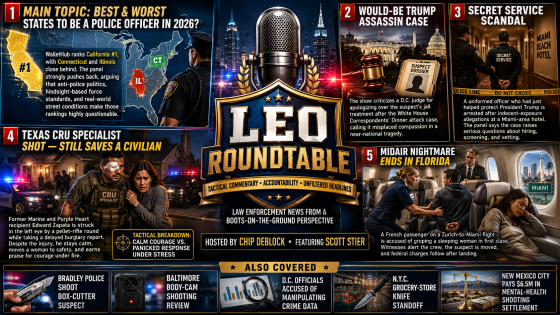

LEO Round Table with Chip DeBlock
S11E090, Shocking News As Judge Apologizes To Would-Be Trump Assassin In Court!
The best states to be a cop according to WalletHub. Shocking news as judge apologizes to would-be trump assassin in court. Trump Secret Service officer arrested for pleasuring himself in front of female hotel guests. Man charged with groping woman on a plane. CRU specialist shot in the eye and still manages to help woman.
LEO Roundtable: Law Enforcement Perspectives on Policy, Judicial Bias, and Field Heroism
LEO Round Table: Law Enforcement Perspective
Analysis of the 2026-05-08 Briefing: Judicial apologies, training failures, and the "WalletHub" controversy.
Top Editorial Briefs
CONTROVERSY
The WalletHub "Propaganda"
Hosts slam 2026 rankings placing California as the #1 state for police. Scott Stier labels it a "propaganda hit piece" that ignores restrictive "necessary" use-of-force standards and high cost of living.
JUDICIAL
DC Judge Apologizes to Assassin
Judge Zia Faruqui criticized for apologizing to a would-be Trump assassin regarding jail conditions. The panel highlights the "ironic empathy" compared to the treatment of J6 defendants.
HEROISM
Fort Worth Training Contrast
CRU Specialist Edward Zapata (former Marine) shot in the eye with a pellet rifle but remains calm to save a citizen. Panel contrasts his composure with a responding officer's "pure panic" and weapon handling errors.
The Panel
Key Concepts
"I thought justice was blind. What are we doing here? It's suicidal empathy towards criminals."
— Scott Stier
46 min listen
This episode of the Leo Roundtable features host Chip DeBlock and former Delta Force operative Scott Stier discussing the controversial 2026 law enforcement state rankings, a federal judge's apology to a would-be assassin, and a dramatic shooting incident in Fort Worth involving a civilian specialist. The discussion highlights the disconnect between statistical rankings and the "real-world" legal and physical risks faced by officers today.
Detailed Summary
The WalletHub State Rankings Controversy
The hosts strongly criticize WalletHub’s 2026 report, which ranks California as the best state for police officers, followed by Connecticut and Illinois. Chip and Scott argue that these rankings are "propaganda" because they rely on metrics like high median salaries (~$77,270) and "police friendliness" without accounting for restrictive legal standards. Specifically, they highlight California’s "necessary" use-of-force standard, which requires exhausting all non-lethal options, as a major liability that could lead to officers being jailed for justifiable actions. They contrast this with the "reasonable" standard used in more conservative states like Florida, which ranked 24th despite having more supportive executive leadership.
2026 Law Enforcement State Rankings (WalletHub)
- #1 California: Criticized by hosts for restrictive "necessary" force standards.
- #2 Connecticut: Noted for "20/20 hindsight" legal reviews of officer conduct.
- #3 Illinois: Ranked high despite urban crime challenges.
- #24 Florida: Deemed "common sense" by hosts despite lower statistical ranking.
Note: Hosts argue high pay in top states is offset by cost of living and legal risk.
Judicial Bias and Federal Agency Scandals
The conversation shifts to a "shocking" display of judicial compassion where DC Judge Zia Faruqui apologized to a suspect accused of attempting to assassinate Donald Trump at the White House Correspondents' Dinner. The apology concerned the suspect's treatment on suicide watch, which the hosts describe as "coddling" compared to the harsher treatment of January 6 defendants. This perceived bias is discussed alongside a recent scandal involving Secret Service Uniform Division officer John Andrew Spillman, who was arrested in Miami for indecent exposure. The hosts attribute such lapses in professionalism to a "hiring and vetting crisis," noting reports of the agency advertising for recruits on pizza boxes in Washington, DC.
Heroism vs. Panic: The Fort Worth Shooting
A significant portion of the show analyzes bodycam footage from a Fort Worth shooting. Edward Zapata, a civilian Community Response Unit (CRU) specialist and former Marine, was shot in the eye with a high-powered pellet rifle while taking a burglary report. Despite the injury and heavy bleeding, Zapata remained calm and successfully guided a female complainant to safety over a fence. Scott Stier contrasts Zapata’s "cool, calm demeanor" with the "pure panic mode" of a responding sworn officer who dropped his rifle, fired blindly through his own cruiser window, and failed to maintain accountability for his shots.
Incident Spotlight: Fort Worth Field Response
Heroic Action (Zapata)
Former Marine/Civilian specialist shot in eye; prioritized victim safety; maintained radio discipline while bleeding.
Tactical Failure (Officer)
Dropped rifle under stress; fired pistol through vehicle glass; failed to aim or account for backdrop in neighborhood.
Key Data
- Mean Annual Police Wage: $77,270 (National average cited by WalletHub).
- WalletHub Metrics: 30 key indicators used to rank "police friendliness."
- Fort Worth Incident: Suspect Angel Cantu, 39, faces three counts of aggravated battery on a public servant after a 5-hour manhunt.
- Fundraising: A $5,000 goal has been set for Edward Zapata’s medical recovery.
To-Do / Next Steps
- Use discount code REDIO15 at Galls.com for 15% off law enforcement gear.
- Visit leoroundtable.com to purchase "Thin Blue Line" dri-fit shirts and other support gear.
- Donate to the "Help A Hero" fundraiser to support Edward Zapata’s recovery and upcoming eye surgery.
- Explore certified firearms specialist training at GunLearn.com to earn college credits through SmarterDegree.
Conclusion
The episode underscores a growing frustration within the law enforcement community regarding "woke" policies and judicial empathy for violent offenders. While administrative data may suggest certain states are ideal for policing, the hosts argue that true professional satisfaction depends on legal protection and rigorous training—qualities exemplified by the heroic actions of Edward Zapata and found lacking in the tactical panic of his sworn counterparts.
LEO Round Table


LEO Round Table is a nationally syndicated law enforcement satellite radio talk show discussing today's news and issues from a law enforcement perspective. They also have components on TV, Podcasts, and Social Media. Their panelists are among a Who's Who of law enforcement professionals and attorneys from around the country.
https://leoroundtable.com/how-to-become-a-panelist/
[00:13] Speaker 1: Welcome to Leo Roundtable at leoroundtable.com. And my name is Chip The Block. I'm your host for a group of law enforcement professionals that talk about today's news and issues, but we do it from a law enforcement perspective. And you recognize him, I know he's a crowd favorite, we've got Scott Stired on the show. Retired Green Beret, former Delta Force operative, and, uh, he's living the dream right now. I ca- I can never keep up with you, Scott, you know, Wyoming, you know, and Colorado. You're in Colorado right now, currently, is that right?
[00:38] Speaker 2: Yeah.
[00:38] Speaker 1: All right. I love it. I love it. So, of course, we've got, you know, Chief Chris Knowles there in Pueblo, and, uh, and some other guys. So MVS, who watches our show over on Rumble, he's over in Northwest Colorado, so. Uh, so thanks for being on the show, Scott. Um, Scott's also with, um, Aero Precision at aeroprecision.com as well. Hey, uh, a shout-out to our, our satellite s-... Well, I, I should start off with our title sponsor, Galls at galls.com. And you know they've given us that 15% off discount code, it's REDIO15. So, if you guys want a hookup, you're- you're get- I'm giving it to you right now. Galls.com is the website. You can buy anything but guns and ammo. And if you wanna get 15% off your next purchase, type in REDIO15 in order to get 15% off. It works on most items. We've also got compliantetechnologies.com, our satellite sponsor. And yes, you guys are aware, Monday was our last day on satellite with Westwood One, which is for radio stations.
[01:29] Speaker 1: And we're looking to make the transition to Sirius XM, which would still be satellite, so we'll keep you guys informed on that. We've actually, um, picked up some really cool radio stations along the way. A shout-out to Joe Spara, our former, uh, radio syndicator. Um, you know, i- i- if people wanna know what ha- what happened with the satellite, you know, we were paying about two grand a month to have the show on, on satellite for radio stations. And we only picked up one or two stations over the last year doing that. So, 24K, one or two radio stations, not cost productive, so that's why we're leaning towards the Sirius XM model. But we are on 47 stations right now. We just picked up 100,000 watt station that's carrying us, um, five days a week, Monday through Friday. Th- uh, it, so that's going great, you know.
[02:13] Speaker 1: So the only difference between being on satellite and doing it, giving them the show another way, like maybe FTP or Dropbox, it just means that they're, they're not gonna be carrying the show the same day. They'll be carrying like yesterday's shows, so not, not that big of a deal. Um, also we've got gunlearn.com, mymedicare.live, Safeguard Recruiting and 2bellas.com that built their new online store at leoroundtable.com. So if you guys want some cool gear, like the mug behind me, um, hats, shirts, and we're, we even have dri-fit clothing too. We've got a, a, a, a, and Scott knows, we've got a, um, a long sleeve, uh, dri-fit shirt. It's got, it says leoroundtable.com on the sleeve. It's got a American flag on the back in black and white with a blue thin loo- uh, thin blue line down the middle of it. And it's got our logo.
[02:59] Speaker 1: I- it's a, it's a great looking, you know, um, it's, it's like a, um, what do you call it, a, um, what do you call it when you, when you surf and you wear the shirt underneath the shirt, a rash guard, it's li- it's like a rash guard.
[03:10] Speaker 2: Rash guard, yeah.
[03:10] Speaker 1: Yeah. Um, so check that out at leoroundtable.com, upper right corner, we got our store. A shout-out to Brian Burns for the Tampa Free Press at tampafp.com. Thanks for carrying our content. We also have Ray Dietrich with formerlawman.com, and Travis Yeates with lawofficer.com. Thanks to all those entities for helping make this show happen. And guys, we are on pod, we're, if it's podcast, we're on it, but we're, we're, we're especially on Spotify, Apple iTunes, which are two of the most popular. Uh, we're on radio, social media, Rumble, YouTube, Facebook, Twitter, Truth Social. Go to the leoroundtable.com and it'll tell you every outlet that we're on, the dates, the times, all that stuff, so check that out. Now, um, the Whet The Appetite, what in the world are Scott and I gonna be talking about today? Uh, and Scott, we can take this out of order, you know, I always cover this WalletHub crap because they say the best and worst states to be a police officer for 2026.
[03:58] Speaker 1: Scott, it comes out every year. And, and when you, when you read it, it makes, it makes a little bit of sense, their, how they choose it, but when you put California as the number one spot to be a cop, you know something's wrong, right? I mean...
[04:11] Speaker 2: Yeah.
[04:11] Speaker 1: Cal- Cal- California's number one. That's where they think the cops need to go work at, the state of California.
[04:16] Speaker 2: Well, I, I, when I saw that, a- and knowing many, many law enforcement officers in the state of California, um...
[04:24] Speaker 1: Yeah, you probably trained half of them.
[04:26] Speaker 2: It is... Yeah, I, I train a lot of, and I tell you, I mean, I don't, I, it's almost like, is this propaganda? Are they, is this some kind of...
[04:34] Speaker 1: (laughs)
[04:34] Speaker 2: Like I, I thought, I thought maybe, maybe they're being paid or, you know what I mean, and I, I mean, I know they're hurting for, I mean, because they're way understaffed. Why?
[04:41] Speaker 1: Yeah.
[04:42] Speaker 2: Nobody wants to be a cop in California.
[04:44] Speaker 1: Yeah.
[04:44] Speaker 2: I mean, it's like, and, and most people I talk... Now, you know, the pay is good, um, th- you know, there, there, there's, you know, obviously a great workforce, great-
[04:51] Speaker 1: Well, hold that, hold that thought. We'll talk about that in a minute.
[04:53] Speaker 2: Yeah.
[04:53] Speaker 1: But I'm just kinda like, whetting the appetite.
[04:55] Speaker 2: Okay.
[04:55] Speaker 1: But yeah.
[04:55] Speaker 2: Yeah, yeah.
[04:55] Speaker 1: But I, you, so you picked up on the flag right away too, so.
[04:58] Speaker 2: Oh, yeah, I picked up on it. I picked up on it.
[04:58] Speaker 1: So, the, the other main story that we have is the would, the would-be Trump killer, he gets red carpet treatment from a, from a DC judge, if you can believe that. Now, that's been on the news cycle, most people probably heard about that. And then we've got another one, after protecting Trump, secret service officer arrested for pleasuring himself naked in front of a female hotel guest. That's plural, actually. We're gonna be talking about that. Then body cam shows gunfire injuring a Texas, a, a, a CRU age, it's a, it's a civilian, it's a Civilian Response Unit specialist, but this dude's former military and got the, got a Purple Heart previously. And, and, and he's, and, uh, he's in, they're in a, they're in a, they're in a gunfight with a dude with a BB pellet rifle (laughs) . So Scott, I can't wait to get your commentary on this. Then we got a guy armed with a box cutter fatally shot by Bradley police officers. We have a, a, a midair nightmare ends in Florida.
[05:49] Speaker 1: Of course, it's given people in Florida a bad name, but, but at least he's a French dude, so, uh, you can't blame it all on Florida. This French dude on a plane is next to a female passenger that's sleeping and he's freaking groping her, and she's sleeping through it. She doesn't even know what happened until she wakes up and passengers and, and stewardesses are telling her, and then she breaks down. It, it's just crazy. Then we got B- Baltimore PD releasing body cam, uh, it's a shooting of a 35-year-old. Uh, we've got, uh, top DC police officials, they're, they're gonna be maybe fired because they've been playing around with the crime data. Uh, man with a 13-inch kitchen knife at a New York City grocery store, um, you know-He's willing to stand before police sh- shoot him, and then New Mexico City is paying six-and-a-half million in the fatal shooting of a guy during a mental health call. Um, so that's the stuff that we're, that we're looking at right now.
[06:40] Speaker 1: So I tell you what, Scott, let's cover the first two main stories, if that's okay. We got-
[06:43] Speaker 2: Sure.
[06:43] Speaker 1: ... almost five-and-a-half minutes, and then we'll kind of figure it out from there. So, um, yeah. So I hinted at it, best and worst states to be a police officer in 2026. So like I said, I'm looking at a map here, and California is number one. It looks like Connecticut is number two. And when I see, when I think of Connecticut, that was the ones that wanted, like, when you talk about use-of-force criteria and stuff, like, we all know California is a, they work off the, the, um, necessary standard. You know, we have the reasonable standard over here, uh, in the, in the, you know, the states that have common sense. So whatever is reasonable. But they have a necessary standard, which means you pretty much have to exhaust every less lethal, non-lethal means before you can sh- put a bullet in a bad guy. And then Connecticut, I remember, they're famous for, um, 20/20 hindsight.
[07:32] Speaker 1: So most, most agencies and states, they view whether your shoot is justified or not based on the information you had available at the time. Uh, Connecticut wanted to go to a 20/20 hindsight, which means that if they became aware of information after the fact. I'll give you an example. Let's say that you found out after the fact the guy had a BB gun, or maybe the gun wasn't loaded, or maybe it wasn't a real gun, or maybe it was like a, it was, uh, the slide was locked back or something, it wasn't fully operational or whatever. No firing pin. They would use that against you if you used lethal force against the guy, and they would want to fire you or put you in jail, that kind of crap. And they've got Illi- the state of Illinois, is rated number three. Now Florida, where I- where I'm at, where we've got Governor Ron DeSantis, need I say more? We're ranked at 24. Now guys, there's only 50 s- there's only 50 states, you know?
[08:24] Speaker 1: And, uh, and they've got, um, they've got it, well, they got 51 here, so, um, I know they got Alaska and stuff, so maybe they got the Virgin Islands or something in here somewhere, but they got, they got... I'm looking at the count of places, and they got, what, 51? Maybe they're using DC.
[08:38] Speaker 2: Yep, yeah.
[08:38] Speaker 1: But anyhow, we're, we're, we're about halfway down the list. And, and let me just see. Colorado, wow, you guys are number six. But you guys have got a little liberal thing going on there too. So, uh, and just to kind of read through some of this stuff, um, the Justice Department and some local police departments have implemented po- policy changes. They're banning chokeholds, restricting the use of no-knock warrants in certain situations. So these are the things they w- they want you to know they're taking it into account when they're picking out where to work at. So like I said, it sounds good so far. While some officers have failed to uphold their responsibilities, so they're talking about bad cops now. That's a flag. Many others risk their lives every day. How about saying, like, almost a majority of others risk their lives every day to protect the public?
[09:18] Speaker 1: Policing is significantly more dangerous than many other occupations, which makes it more important for agencies to provide strong incentives to attract and retain qualified officers. Currently, the profession offers a, a mean annual wage of about $77,270, so about 77 grand. But that's the mean. So it doesn't mean entry-level officers are not making that much money as a mean. It's talking about places like New York and California where they have to elevate the co- because of the cost of living. So even though 77 grand sounds like a lot, that's the mean. They're taking into account police chiefs making 200 grand, you know, that kind of stuff. And they have benefit packages, it says too, that include retirement contribution matches, tuition, leave, leave policies, take-home cars, access to health and fitness facilities, yada yada. Compensation and working conditions, however, vary widely by location. Agreed.
[10:07] Speaker 1: Officers are more likely to be drawn to departments if they maintain transparency with their communities and avoid issues related to scandal or corruption. I partially believe in that. The whole transparency thing, I don't, I don't agree with that, because, you know, you get carried away with that. To identify the best states, here we go. For pursuing a career in law enforcement, WalletHub compared the 50 states and the District of Columbia across 30 key indicators of police, police friendliness. So they're basing this on police friendliness. These metrics range from the median income from law enforcement officers to police deaths per 1,000 officers and state and local spending on police protection per capita. And, uh, and so that's pretty... And then they got, uh, some analyst, Chip Lupo, um, WalletHub analyst, kind of, like, taking up for how they decided. So yeah, California's number one, Connecticut two, Illinois is three. I'll do the top 10.
[10:57] Speaker 1: Maryland four, DC, we got an article about DC fabricating crime stats, and they're gonna be firing a lot of people. They're number five. Colorado, where Scott's at, is six. Um, Minnesota seven, Minneapolis. Uh, Washington State, where our Chief Kreider is, and they're whacked out with their gun laws, they're eight. We got Tennessee nine, and Ohio is 10. An- and of course, I already said my state, Florida's 24. Scott's tired, 42 seconds.
[11:24] Speaker 2: Well, it's, it's obviously this person has no clue what... Like, it has no real-world experience of being a cop or understanding, um, what, what, what police do. This is all based on a very lopsided view of, of a policy that is very liberal and very woke, that is, that really just endangers law enforcement every day. It's like it makes their job harder to do. And this is like... In, in the, in the five and a half years I spent training law enforcement, the, the, the top five are the states that I hear most people complaining about because they can't ..........................
[11:59] Speaker 1: You're right. Commercial break. We'll be right back, guys.
[12:04] Speaker 2: My family only cares about one thing, that I come home safe.
[12:09] Speaker 3: At Gulls, every order begins with a promise. Made with purpose. Stitched for support. Backed with pride. Answered by dedicated hands.
[12:36] Speaker 4: Delivering the standard you have sworn to uphold. We serve more than the mission. We serve the person. Each piece is engineered to help get our first responders through the shift and back home safe.
[13:02] Speaker 1: Welcome back. Leo Roundtable at leoroundtable.com, the law enforcement talk show. My name is Chip DeBlock, and I'm your host. We're joined by Scott Stier, former Green Beret, Delta Force operative, and we've been talking about an article on a site called wallethub.com. Comes out every year. This is the best and worst states to be a police officer for the year 2026. Um, their opinion, at least, anyhow. Not Scott's obviously. Any more words on this, or, are you ready to move on, Scott?
[13:28] Speaker 2: No, I just, uh, it, it's almost comical. I, that's all. I, I, I think I-
[13:32] Speaker 1: Yeah.
[13:32] Speaker 2: ... just view this as a propaganda hit piece and, um, that's pretty much how I see it, but.
[13:37] Speaker 1: We, we have to slam them. You know what? I, I kinda feel like I need to slam them 'cause, you know, you don't want people to make poor decisions based off of crap like this, and this is bad information. So, I don't want cops going to California and then because they don't abide by the necessary standard, they end up shooting and killing a guy to save their life or someone else's life, which they had to do, but they didn't have, they didn't use a taser, or they didn't run the car.
[14:01] Speaker 2: Yeah.
[14:01] Speaker 1: Or they didn't have time to get the, uh, you know, the, uh, the, you know, the, uh, the foam round out on the, you know, the less lethal or something from the shotgun and now they're in a jail cell. You know, they don't get this stuff, you know.
[14:11] Speaker 2: Yeah, yeah.
[14:12] Speaker 1: And that's probably the most important issue. Not, it's not pay, it's not benefits. It's, it's working in a state where you know the agency and, and, and the laws there are gonna back you up. So.
[14:22] Speaker 2: Yeah. It's the, th- this, this just goes to show or prove the point, before you, you know, you have to look at the source of, of the information. I mean, you always, always go to the source and find out, and like is it, uh, you know, is it someone who knows what they're actually talking about? Is, do they have an ul- ulterior motive for what they're saying? But, uh, yeah.
[14:40] Speaker 1: So, Chip-
[14:41] Speaker 2: Let's just keep going.
[14:41] Speaker 1: Chip Lupo, um, WalletHub analyst, um, that's quoted in the article, I'm sure you're a great guy, but putting out this information, you guys, your, um, your algorithm is, is, um, is flawed. You are giving out bad information to would-be cops or current cops.
[14:59] Speaker 2: (laughs)
[14:59] Speaker 1: And, uh, if you watch the show, we will help educate you on that, but you're, yeah, it i- it is definitely, it is definitely flawed. And people listening to your information might go into California. You know, it doesn't matter what kind of, what the pay. Of course, higher pay there, but it doesn't, I mean, it doesn't really matter. The cost of living's higher, so it's not like your living's gonna be any better, but guess what? I don't care how much money you're making. When you're sitting in a jail cell for doing your job, it doesn't make a difference, does it? You know? (laughs) I mean, you know, crap. You know?
[15:26] Speaker 2: Yeah.
[15:26] Speaker 1: Who cares? So, all right. WalletHub, one down, and l- let's see. Our, our, look, our next main story, they have a tendency to be a little bit deeper, guys. Uh, rvmnews.com. Would-be Trump killer gets red carpet treatment from a DC judge. So, I, I don't wanna say the bad guy's name, and the other day I screwed up. I, I gave, like, the first name, and then I caught myself on, on the back. So, this guy, it starts off for an incredibly incredible display of misplaced compassion, Judge Zia Farquh, F-A-R-U-Q-U-H-I, issued an apology to our bad guy, the would-be Trump assasion, assassin, from the, you know, White House Correspondents' Dinner. Um, this guy accused of attempting to assassinate President Donald Trump, and the judge got compassionate about what he called treatment that this bad guy was enduring in jail. The exchange took place on Monday during a hearing in the shocking White House Correspondents' Dinner shooting case.
[16:19] Speaker 1: Now, this bad guy allegedly opened fire near an event that was packed with political figures and journalists and, of course, and, we know a Secret Service guy was shot. And he was placed on suicide watch following his arrest. Now, instead of prioritizing justice for a man who nearly turned a political dinner into a national tragedy, the judge, Farquh... It kinda, like, sounds like a name that would be in, um, um, what do you call the, um, Farque? It's, it's, uh, what's that green guy that, uh, y- you know, that's animated series, you know?
[16:50] Speaker 2: Sh- Shrek?
[16:51] Speaker 1: Shrek. Shrek, yeah.
[16:51] Speaker 2: Shrek. Yeah.
[16:52] Speaker 1: Farque.
[16:52] Speaker 2: Yeah.
[16:52] Speaker 1: It sounds like it would be, like, in a Shrek movie-
[16:54] Speaker 2: Yeah, yeah.
[16:54] Speaker 1: ... doesn't it? I mean, Judge Farquh-
[16:55] Speaker 2: Yeah, yeah. Kind of. Yeah.
[16:56] Speaker 1: ... you know? I mean, you know.
[16:57] Speaker 2: Yeah.
[16:57] Speaker 1: He's probably green. Um.
[16:58] Speaker 2: I love that movie, by the way. (laughs)
[17:00] Speaker 1: (laughs) Yeah, it was good.
[17:01] Speaker 2: I love that movie.
[17:01] Speaker 1: Good sound, good soundtrack, man.
[17:03] Speaker 2: Yeah. Yeah.
[17:03] Speaker 1: Good soundtrack. Judge Farquh, uh, decided the real problem was how the suspect feels behind bars, so according to Fox News correspondent Mike Emanuel, the judge apologized to the, if you guys can believe it, he apologizes to the suspect for the treatment that he's received so far. The single sentence, uh, or, or that single sentence reveals a broader and deeper troubling issue. Federal judges seemingly more concerned with coddling suspects accused of violent crimes other than supporting the victims or actually protecting the public. And to put this in, in perspective, according to an article, the same judicial system has watched hundreds of January 6 defendants treated like hardened criminals. Um, they have been locked in isolation, denied medical care, mocked by prosecutors, but when the target of potential violence is Donald Trump, suddenly the concern shifts to whether the accused assassin is, is comfortable in his holding cell. The irony is astounding.
[17:56] Speaker 1: Now, this is at, um, r- uh, RVM, Red Voice Media, news.com a- and I love the site. I love their commentary. Scott Stier.
[18:06] Speaker 2: When is it, when, when is this going to start to shift the other way? This is ridiculous. I, there's no way... Now, I'm sure the majority of people in that district probably agree with the judge as be- I, I, I'm, uh, you know, I would assume. But it's, it's, like, you wonder why these states are so, uh, have so much crime. They're so lax on crime. It's all, it's like, it's just suicidal empathy that, that the woke and, and, and, uh, as a whole have towards criminals. It's like, it's, they, they, you know, they, they say that the, uh, the opposite of logic, uh, or, um, uh, of logic is, is, is empathy, right? Like, if you have .......................... I'm using the wrong term here. But it's, like...... where is the logic in this, you know?
[18:47] Speaker 2: It's like-
[18:47] Speaker 1: Right.
[18:48] Speaker 2: ... i- i- it doesn't make any sense. I mean, this is a criminal who tried to kill the Unit- the President of the United States, att- A- and you feel sorry for him? It's like, and it, it has to be politically driven. Just crazy. It's crazy. I thought, I thought, I thought justice was blind. I mean, what, what, what are we doing here?
[19:06] Speaker 1: Yeah.
[19:06] Speaker 2: I don't know.
[19:07] Speaker 1: No-
[19:07] Speaker 2: I don't know. It's just, it, it's disheartening. It really is. I don't know.
[19:10] Speaker 1: I agree. I agree.
[19:11] Speaker 2: It's sad. Very sad.
[19:14] Speaker 1: Well, w- great, great commentary. I know we got a little over a minute here and, uh, I'm checking. Betty Dunn is on from, uh, looks like she's on Facebook, so welcome to the show, Betty Dunn. Uh, Bill BC, um, you know, thanks for watching the show. We appreciate it over there on Rumble. Um, guys, moving on. Scott, I'm gonna let you help pick the, uh, the topics here on an update. We can talk about the Secret Service dude. Well, th- you know, the first two stories are guys that are doing some manly stuff, but it's not necessarily good manly stuff. So we got the Secret Service agent that was like doing some stuff in front of some women, and then we've got, uh, what was the other, what was the other one here? Oh, I know, it's the mid-air nightmare ends in Florida.
[19:52] Speaker 1: We got the French passenger-
[19:53] Speaker 2: French passenger.
[19:54] Speaker 1: ... groping the sleeping woman. Uh, we've got DC police that are, um, the crime data thing, and then we've got New Mexico City paying that, um, six and a half million for the, uh, shooting of the mental health call.
[20:06] Speaker 2: I mean, hon- honestly, they're all good. I mean, (laughs) the, you, you have to wonder, like, uh, when, when, when you start talking about the, uh, the, the Secret Service guy who's masturbating in public, like-
[20:17] Speaker 1: Yeah, well, he was pleasuring himself is what we'll say.
[20:21] Speaker 2: Okay.
[20:21] Speaker 1: But, um-
[20:21] Speaker 2: Oh, sorry. Yeah.
[20:22] Speaker 1: But no, no, we're good. I mean, it's not one of the seven words, but, you know, we'll, we'll just-
[20:26] Speaker 2: Yeah.
[20:26] Speaker 1: Ah, we're 12 minutes away. We're saved by the bell. Um, so look, we're, we're... Guys, yeah, we're ta- we're gonna go to the Secret Service route.
[20:32] Speaker 2: Yeah.
[20:32] Speaker 1: Stick with us. It's gonna get really interesting. We'll be right back. All right. It's time to talk about Compliant Technologies at complianttechnologies.com, our satellite sponsor. You know, they are committed to providing non-lethal solutions to help officers gain the upper hand safely and rapidly in a humane, low optics manner, utilizing what they call their CD3. That sup- stands for conductive distraction and de-escalation device technology. Now, their flagship product, we all know, Scott knows, I certainly know, I know Scott does, it's called The Glove. It's helped officers not only tens of thousands of times, but they've actually had over 250,000 deployments, and guess what? No injuries, no deaths. Th- that is like an unheard of stat.
[21:08] Speaker 1: They've actually achieved non-lethal status in an arena that predominantly can only offer less lethal results, and when it comes to weapons retention, if you're transitioning to a sidearm or a conducted energy weapon, The Glove at complianttechnologies.com, they have virtually eliminated weapons confusion. So stay ahead of the game with Compliant Technologies and the revolutionary CD3 that hundreds of agencies have already turned to nationwide. And friends, take it from me, when it comes to safety, this is one of the most common sense, hands-on solutions that's ever come along, so go to complianttechnologies.com and tell them that Chip and Scott sent you. Welcome back. Leo Roundtable at leoroundtable.com, the law enforcement talk show. My name is Chip The Block and I'm your host. We're joined by former Green Beret Delta Force operative, Scott Skyert, and, uh, I whet the appetite with the, uh, with the next story. I'm gonna go ahead and do it again.
[21:49] Speaker 1: We just had a commentary, uh, from, I think that was Sergeant George. I think he's on YouTube talking about, uh, he feels bad for... We have, our two Secret Service guys are from Fox News, uh, Rich Giropoli and Frank Loveridge, and he was talking about them having to cover this. Now, they're not... I'm not gonna hold this story for them, I'm just gonna, you know, it's not, you know... I think this is something that just about anybody can cover. We don't need any Secret Service expertise to discover why this guy was pleasuring himself, but... So this is on the, the libertydaily.com, and Scott, if it's okay with you, we've got two similar stories that I'm gonna cover back to back on this before we go to a video. Um, so the libertydaily.com, after protecting Trump, Secret Service officer arrested pleasuring himself naked in front of female hotel guests. And I'm trying to accentuate the S at the end of that, because it's plural, not just one female hotel guest, it's plural female guest.
[22:41] Speaker 1: So, uh, a US Secret Service agent was arrested on Monday, arrested (laughs) , wow, allegedly exposing himself naked to female hotel guests and pleasuring himself in public view. I'm gonna try to pay attention to the, I, there's certain words and things I don't wanna say, so I'm trying to be careful. Uh, John Andrew Spillman... Gotta love that last name, Spillman.
[23:03] Speaker 2: (laughs)
[23:03] Speaker 1: 33 years old. Is... (laughs) I can't help it, sorry. Is a Uniform Division officer, so, so yeah, you have Uniform Division of the Secret Service. So he's a Uniform Division officer with the federal agency. He had just provided security to President Donald Trump at the weekend PGA Tour at Trump's golf course in Doral, Florida. So he's in uniform, so he's not one of these plainclothes... Not, he's not one of these guys in suits with the freaking Ray-Bans and he's got the machine gun under his jacket. That's not him. He's a, he's a... I don't want to say he's not as important, but he's more, he's, he's in the Uniform Division. He, he's not in the division that everybody wants to go to, all right?
[23:41] Speaker 2: He's not.
[23:41] Speaker 1: So, so he was arrested shortly after midnight Monday for allegedly pleasuring himself n- naked on the sixth floor of the DoubleTree Hotel near Miami International Airport. Now, police al- uh, allegedly caught him literally with his pants down in the act, according to the arresting affidavit, uh, reported by Susan Crabtree of Real Clear Politics, as deputies from the Miami-Dade County Sheriff's Office responded. Now, Crabtree reported that a victim told police that she was in the lobby when Spillman allegedly followed her and her mo- and, and, well, not her mother, her and another upstairs and immediately entered a room because she was in fear for their lives. The victim saw the defendant pleasuring himself next to their hotel room, according to the arrest affidavit. Um, Spillman is from Marble Falls, Texas. He had a bail of only $1000 and he's been, uh, he has a hearing scheduled for May the 27th. It's a misdemeanor charge of indecent exposure.
[24:35] Speaker 1: He's now on administrative leave pending the outcome of his criminal case and an internal review by federal officers. Now, former US Rep Jason Sh- uh, Chaffetz of Wisconsin spent years probing the Secret Service as House Oversight Committee Chair. He actually told Crabtree that the agency has serious hiring and vetting problems as it deals with lack of manpower, which is kinda scary, a- and so kind of explaining how this happened. There's a lot of good heroic people there at the Secret Service, but they were advertising for agents and officers, "officers", uniformed officers, on pizza boxes in Washington, DC.... yeah. Come join the Secret Service, is what they said. And I met some of those who responded to the pizza box ads, and suddenly they're in the White House with a gun guarding the president. It's that bad. That is freaking scary, dude. Scott, talk to me.
[25:21] Speaker 2: I- it is. You would think, right, (clears throat) for that organization, for that agency, that should be, like, at least the one agency where they're, like, everybody wants to be a part of it because it's such a select group, and there's such a tough selection and, um, and, uh, and, and training process. And yet, here we are. I mean, and this, you know, the unfortunate thing is just it's coming off of, you know, the attempt on, on, on the president's life. I mean, uh, I, I don't know. I mean, at what point are there gonna be like, "Hey, we need to, like, fix this." Uh, i- it's... But, um, uh, he'll probably say that it was stress-induced, and, you know, he'll probably get, uh, disability and... You know, it really depends on, like, you know... It's tough. It's a tough job because you get an administration that says, like, e- essentially, uh, "Bad, bad guys are okay.
[26:12] Speaker 2: You know, let's, let's be nice," and you have a, you know, a, um, you know, a pre- a presidency or an administration that says, "Hey, bad guys are bad. You know, we're gonna treat them..." It is just like, it's like, it's almost like, you know, people come in and then the way they do business is bad, go back to this way. It's, it's confusing. And, you know, I, I think, I, I just feel like there's a lack of consistency, uh, and, and, uh... But anyhow, yeah. I mean, who knows? I'd like to know what the heck this guy was thinking. Like, what, what was going on in his head? I mean, what, what, why? What, how does somebody do that?
[26:44] Speaker 2: I mean-
[26:45] Speaker 1: Yeah.
[26:46] Speaker 2: ... I don't know. I mean, and he's, he's like, his face is everywhere. I mean, did he not think that he wasn't gonna get caught? Did he not see-
[26:51] Speaker 1: He is.
[26:51] Speaker 2: ... the cameras? I, I-
[26:53] Speaker 1: Sick.
[26:53] Speaker 2: I don't know, man.
[26:54] Speaker 1: Thank God he was-
[26:55] Speaker 2: I don't know.
[26:55] Speaker 1: ... just in the uniform division and, and, you know, I'm sure had more limited access to the president. But even, he's just, you know, they didn't really give a timeline on when he was hired and stuff. I'm sure he's just a newbie, um, that's getting weeded out. The system works, you know. But crap, what they had to go through and how they identified this guy as being a bad apple, crap. Um, so-
[27:15] Speaker 2: Yeah. It's just, I, I know, I know there's not a perfect system. I, I, I get that, you know. It, it's just, it is what it is. I mean... But it's just, again, like, (laughs) what was he thinking?
[27:26] Speaker 1: Well, I'll tell you what. Let's talk, let's, let's jump over to Swiss International Airlines. Now, you know, our server, our server... Now, we started the new Leo Affairs at leoaffairs.ch. And these, the, um, servers are actually... And, uh, they started off being... It was Switzerland. Now it, now it's, um, Sweden is where they're at. But that, that's fine because the, you know, the company we use, they're rock solid as far as, you know, protecting information. But Swiss International Airlines had an issue the other day. So, the Tampa Free Press at tampafp.com, we have a midair nightmare ending in Florida. French passenger charged with groping a sleeping woman. So, a little similar. Um, a 48-year-old French guy is facing federal charges in Florida after authorities say he sexually assaulted now a sleeping woman during a Swiss International Airline flight from Zurich to Miami. And it gives his name, golly. Jalam Sebastian Roger Mattler.
[28:20] Speaker 1: He's taken into custody and charged with one count of, of, uh, abusive sexual contact following the incident that happened on Tuesday, April the 28th. Now, the victim's a 29-year-old woman. She was sleeping. It was in first class. She was, she's sleeping in the first-class cabin when the assault occurred. Apparently, she slept through it. According to the criminal complaint, witnesses watched as Mattler, our bad guy, allegedly is touching the woman's lower back several times, attempting to make contact, to, to make the contact look accidental. Now, a passenger, one of the passengers is actually watching this and, um, told investigators they saw him moving his hand in a, in a submarine motion. (laughs) That doesn't make... In a submarine motion to get under the woman's clothing. So, I don't know, I don't know what that means, Scott. Maybe you can tell me. If you know what it means, it might scare me.
[29:06] Speaker 1: But, uh, the situation was brought to the attention of a flight attendant who reported seeing the bad guy with his hand on the victim's crotch, performing a scooping-and-rubbing motion over her jeans, so on the outside of her jeans. After confirming that the two were not traveling together, the crew moved Mattler, the bad guy, to the, to economy, you know, on the plane. Now, in a disturbing turn, it says that he was later allowed to return to first class to get some of his personal belongings. And sure enough, he tries to slip the victim a note. The note, uh, it was written on his business card, told the woman that she looked beautiful or cute while sleeping. Uh, the victim did not learn of the encounter until the flight attendant woke her up, told her what had happened, and then she was shocked, started crying and shaking. So, she slept through it.
[29:53] Speaker 1: When questioned by authorities when they got to Miami, the bad guy initially denied any physical contact, and then when he was told that there were multiple eyewitnesses and there was video evidence, which I wish we had, he allegedly admitted to the touching, stating that he did not think it was such a big deal. He told officials his intention was simply to get the woman's phone number (laughs) . He's currently being held at the Federal Detention Center in Miami. Two minutes, Scott.
[30:15] Speaker 2: Yeah. He didn't make it.
[30:16] Speaker 1: We worked it out for you today.
[30:17] Speaker 2: Well, so he didn't think it was a big deal. That's why he was lying until he knew he was caught.
[30:22] Speaker 1: Yeah.
[30:22] Speaker 2: I mean, it, it, a- a- again, I, I don't... It may... A- and, and the audacity (laughs) to go back and give the girl his phone number and think, like... I, I, again, I don't understand. I don't get it. Like, these people, um, they have this, uh, skewed sense of reality. I mean, how were they brought up? I mean, what are they, uh, exposed to? I, I mean, I, I don't know. I, I don't know. I just think it's crazy. It just blows my mind.
[30:49] Speaker 2: I, I, I'm-
[30:50] Speaker 1: Well-
[30:50] Speaker 2: ... I'm flabbergasted.
[30:51] Speaker 1: Well, lucky for him, there was a position opened up at the Secret Service office-
[30:55] Speaker 2: (laughs)
[30:55] Speaker 1: ... in Washington, DC. It's a uniform position, but, you know-
[30:59] Speaker 2: (laughs)
[30:59] Speaker 1: ... he may be a good candidate is what I'm thinking, Scott.
[31:01] Speaker 2: Yeah, yeah.
[31:01] Speaker 1: How about you? (laughs)
[31:02] Speaker 2: Oh, my God. No kidding.
[31:05] Speaker 1: Wow. So, uh-
[31:07] Speaker 2: Right.
[31:07] Speaker 1: ... yeah. I'll tell you. Look, uh, we don't, we don't, we don't make these stories, people. Uh, we, look, uh, we don't build them.We just fly them.
[31:15] Speaker 5: (laughs)
[31:15] Speaker 1: Well that, that's, that's, that's from an attorney. Bob McCabe told me that. He says, "Yeah, we don't build them, we just fly them." So don't blame us for the content of the story. This is what they've given us to work with. And, uh, and Scott and I, I think we're the... I think that you and I, given what we have to work with, Scott, I think that we're pulling it off, so.
[31:31] Speaker 5: Yeah.
[31:31] Speaker 1: So we've got, uh-
[31:32] Speaker 5: Well, you know, they say st- uh, truth is stranger than fiction. Uh, uh, it's, it's crazy.
[31:37] Speaker 1: Yeah. No, you're right. Yeah, we got Betty Dunn-
[31:38] Speaker 5: Here-
[31:38] Speaker 1: ... weighing in, saying that re- recruits should be hired under a magnifying glasses. Totally agree. And, uh, and, and then goes on to say that the world is full of whackos. And, uh, that's all I have to say about both the Secret Service agent that was... Well, I can't even-
[31:52] Speaker 5: (laughs)
[31:52] Speaker 1: Betty, I can't even say... Oh, that was George who wrote that. Okay, that was... (laughs) Sorry. I can't... George, I can't say that on, yeah, FCC. Scott'll probably say it, but no, anyhow.
[32:02] Speaker 5: (laughs)
[32:02] Speaker 1: So, uh, so that's where we're at. So, well, we got 19 seconds. Let me whet the appetite for the next story. It, it, it's a wild video. Body cam shows gunfire injuring a Texas CRU, uh, a civilian, uh, who helped a woman to safety after he's shot. You guys aren't gonna believe this. Stick with us. Commercial break. We'll be right back. All right, guys. It's time to talk about GunLearn at GunLearn.com. And, you know, GunLearn is the first and it's the only company they offer that step-by-step program that takes you from your present knowledge level to become a safe, accurate and competent certified firearms specialist. Now, this is where it changes. Now, they've got a new deal going. So if you've actually obtained that certified firearm specialist, now they partner with SmarterDegree. And through SmarterDegree and their un- university partners, it's actually worth college credits. Even if you got it five years ago, you've got those college credits now that'll help you out.
[32:50] Speaker 1: And of course, they provide citations from federal law and ATF rulings and they've been doing this since 1996. They've been teaching everything that LEOs and, you know, law enforcement officers need to know involving firearms and also ammunition to all facets of law enforcement. You can start today with online training or you can sign up to attend a live seminar. And if you have your, your own agency, if you're a chief, a sheriff, you can host a seminar for absolutely no cost. Awesome opportunity. Go to the GunLearn.com to get more information. Welcome back. Leo Roundtable at LeoRoundtable.com, the law enforcement talk show. My name is Chip The Block and I'm your host. We're joined by the former Green Beret Delta Force operative, Scott Styric. So thanks so much for being on the show, Scott. And, and, d- dude, we've got the topics for you today. You're, you're getting a, you're getting your workout and you're really gonna get your workout on this next one, Scott.
[33:33] Speaker 5: Ugh.
[33:33] Speaker 1: So there is a video of... Scott and I spent a lot of time on this. I'm just looking at my show notes on this. It's just ridiculous. So we're gonna go through, we're gonna spend, um, some time.
[33:44] Speaker 5: (laughs)
[33:44] Speaker 1: We may, and you know, we may end up closing the show out talking about this 'cause there's, there's a lot to talk about. Um, when you guys watch tomorrow's version of the show, a, a, a version of the live show will come out tomorrow morning at, um, at nine o'clock on our Rumble channel at Rumble.com. Look up Leo Roundtable and producer Will will have this video embedded into that. And, and you guys aren't gonna believe it. So body cam shows gunfire or shows gunfire injuring a Texas CRU specialist who helped a woman to safety after being shot.
[34:15] Speaker 5: Do you have the video of that? And maybe I can get a plate or something off that, or at least a, or at least a description of the vehicle. Yeah, I think you might.
[34:26] Speaker 3: (gunshot) Oh, my gosh. What the (beep) was that? Oh, my God.
[34:28] Speaker 5: Get down. Get over here.
[34:29] Speaker 3: Oh, my God. Oh, my God.
[34:30] Speaker 5: Come here, quick. Come here, come here.
[34:34] Speaker 3: (laughs) Oh, my God. Oh, my God. 911 Operator: CRU 122. Need officers at my location. Just got, uh, took a shot to the face. If I can get an officer over here now. Drop the gun! Shots fired, shots fired. Black. What's this house number? Frank five-10, I'm gonna move again to the north and try to extract the shot officer. (door knocking) Fort Worth Police! Frank five-10, I'm at the door. Trying to get to our person.
[35:33] Speaker 3: Come on
[35:34] Speaker 5: I need a... Right here. Right here.
[35:35] Speaker 3: What's the address?
[35:37] Speaker 5: Where's he at? Where's he at? Let me see your hands!
[35:48] Speaker 3: He's at the garage. He's got a rifle. .
[35:53] Speaker 5: Back up and get cover. Shots fired, shots fired. Let's go. Rescue, rescue. In here, in here.
[36:02] Speaker 3: What are you doing? Okay, stay in the house. Close the door. Move, move, move, move, move.
[36:12] Speaker 5: I'm moving. I'm moving. I'm in.
[36:20] Speaker 1: So this is at Rumble.com. Our favorite law enforcement video channel called This is Better. So we're in Fortworth, Fortworth, Texas, and it's a, um, they released this body cam showing the moment a community response unit specialist, so he's a CRU specialist, and he ends up being shot. It happened as Edward Zapata responded to a home to take a report about a burglary that had happened days before. So what that tells me is that Edward Zapata is a civilian, although he's former military, he's a civilian employee, um, for the Fort Worth Police Department, and he's doing delayed call. This is a delayed burglary, so no need to send a, you know, a, a marked unit out there. It's not like a burglary in progress or anything, right? And the, and the, and the threat level for going to a delayed call like this, um, it, it should be relatively low, should be.
[37:09] Speaker 1: So the video shows our CRU specialist, Edward Zapata, um, falling to the ground after being struck in the left eye on April the 28th while at work just after 2:00, just after 12:30 PM. So it's in the middle of the afternoon, and actually he's talking with the complainant. It didn't actually happen like that. He's talking with the complainant and you hear a sound, it's actually for... I mean, I've had BB and pellet guns, I've had BB pellet rifles.And, and look, these suckers can go 300, 450 feet a second. You know, they're, they're, they're hauling butt. And it could be a BB or these, these pellets, which are like a soft lead, kind of easy to manipulate, you know. I mean, when they hit stuff, they flatten out and stuff. So you hear it, and, and he's, he, he starts grabbing her. He doesn't go down, but he says he's been... He goes on radio and says, "I've been shot in the face." And he, but his total concern was getting the woman around the corner of the house.
[37:56] Speaker 1: They're out in the front yard, and he gets her around the corner of the house. And, um, and then the, it appear... I hear another, I hear that same kind of sound again, Scott. And, and, and then he does go down, and then I'm seeing all the blood. And he's still trying to get the woman over this, this wooden fence and trying to get her out of the way. And he's calm, cool, collected, but he's freaking bleedi-... But then he says he got shot in the left eye. And so I think that there were two shots. You, maybe you picked up more than I did, but he's dealing with all this stuff and there's blood everywhere, so. Um, the chief of the Fort Worth Police Department confirmed the suspect identified as 39-year-old Angel Cont- uh, Cantu, that he was using a pellet gun during the shooting. We later find out it's a, it's a rifle. Uh, despite the injury, the video shows Zapata, a civilian employee, bleeding as he's helping the woman climb over a wooden fence to safety.
[38:44] Speaker 1: And he even just starts to go over the fence himself. He's trying to, he's just trying to see. There's blood everywhere. And, and you know, when, when you're bleeding, it gets, Scott knows, it, you get, it get, things just get extremely slippery. It's very hard. Uh, dude, if you're not careful and you're walking on, on a bloody surface, you're, you're going down. I mean, it's that slippery. Um, and, and right when he's on the top of the fence trying to go over it to get away, um, you hear the cavalry coming and the sirens, so they, I, I, I think that's why he jumped back on the, on the outside of it. Police said that other officers engaged in the shootout with Cantu, or bad guy, who had already fired at Zapata. Uh, Cantu fled the scene, prompting an hours-long search involving K9 units, dozens of officers, and a police helicopter. Um, there is a shootout that's going on with Cantu. I'll let Scott cover that. Uh, body cam shows officers eventually arresting Cantu around 5:30 PM.
[39:31] Speaker 1: Now, remember, this happened, what, around 12:30, I believe. Um, yeah, 12:30. So we're talking like five hours later, they get the guy, for five hours. Uh, jail records show that he faces three counts of aggravated battery on a public servant. Additional body cam shows, uh, police calling for an extraction team. When they locate the officer, he's inside, uh, of, of the house now with his injured eye. So Fort Worth cops, they go there, they show officers rescuing him, getting him out of there, taking him to the hospital. Um, he was released from the hospital on May the 1st, um, and fellow officers and team members lined up outside the emergency room to cheer him on. So it says... I'm trying to find the date again of this thing, when it went down. It, it comes out on, on the fir-... Oh, this happened on April the 28th. So there's only 30 days... So this is about three days in the hospital, I guess, is, is what he was in, in for.
[40:20] Speaker 1: And, uh, it says that he's a former Marine, a Purple Heart recipient. He had been working on the street as a CRU specialist for only two weeks at the time this went down.
[40:29] Speaker 2: (clears throat)
[40:29] Speaker 1: The extent of his injury remains unknown, but they say that he has to go do a second eye surgery scheduled this week. And that Fort Worth PD, and I'm gonna tell you guys how to donate money, so be ready to write it down. Uh, but the PD Family and Wellness, they started a recovery fundraiser called Help A Hero. They're trying to raise $5,000 for Edward Zapata. Um, so Scott Steyer, the floor is yours. Four minutes, seven seconds.
[40:54] Speaker 2: Well, first off, kudos to this kid. Uh, I, I call him a kid. Ho- how old was he? I don't even think he was out of range. But he, he's probably, he's probably not a kid.
[41:02] Speaker 1: Yeah, I don't remember back for military, but...
[41:03] Speaker 2: This young, this, this young man, this young man.
[41:06] Speaker 1: Yeah.
[41:06] Speaker 2: You know, he, he, he, he, uh, he was out there, it sounds like, maybe volunteer status or, you know, just kind of like, you know, helping out, um, may- maybe with the hope of one day getting on with the police f- uh, the, the police force. But anyhow, kudos to him. Like, the whole time he was very calm. He was, um, he just, he didn't, he didn't get worked up. He was, he was helping the lady, and even after he was shot, the whole time. And when he's dumping blood, uh, which, which, which when something like that happens, it's not necessarily... You know, the first thing you don't think about is the pain and everything. But when you see the blood and you know it's your eye and you know it's your head, like, yo- you know, you start thinking, "Am I gonna be blind?" You know? I mean, and they're so... But still, he maintained this cool, calm, um, demeanor about him. He, he, he helped the lady over the fence to get her protected first. I mean, the guy did a, a great job. Okay?
[41:55] Speaker 2: Um, so kudos to him. Then, the, you know, a lot was going on there, but the, the, the one cop that comes in there and he's behind his cruiser, and he is the opposite of this guy. He is in pure panic mode. Um, he gets shot at, I guess, or sees a gun. I don't know if he was shot at or not with a, with a, with a, with a pellet gun, which I'm not... Which hey, can kill you, and, and if not, you know, obviously injure you. But he loses his mind. He, he's trying to get his rifle out of the back of the car, which in my opinion, should never be there in the first place.
[42:28] Speaker 1: Agree.
[42:28] Speaker 2: Why even have it if it's locked in the back of your car inside a bag? So he's trying to... And then he drops it. He goes into pure panic mode, and then he just pulls out his pistol, dumps his mag, shooting through his car, which what happened to being accountable for your shots? What happened to being accountable to where every bullet you shoot as a law enforcement agent? He's shooting in a neighborhood. It just blows my mind. So you have this, this young man who's not even a law enforcement officer. He's super calm under, under the conditions of been to... His eyes probably, you know, he might be blind. He doesn't know what's going on. And you have this trained cop, you know, who is in pure panic mode. Uh, my God, uh, they need to really look at that, go back and do some extra training. Like, they need to look hard at this and that with, with an AR. But, um, you know, h- he shoulda had his AR out.
[43:16] Speaker 2: I mean, I get, I understand there, there, there, there's policies for that, so maybe that, that wasn't his fault. But the fact that he dropped it under panic, under stress, this guy obviously does not train under stress. He's not, you know, inoculated to stress. He does not incorporate that in training. And it seems like he was more concerned with his self-welfare.... and his hea- and his own safety, than that of the safety of the public and the people around him, um, to me, that was a total disgrace, man, an embarrassment, just a total embarrassment.
[43:43] Speaker 1: Wow. Wow. Yeah. Yeah.
[43:45] Speaker 2: Yeah.
[43:45] Speaker 1: That was ... You know, I, I look at the, um, at where these long guns are at. And, Scott, I know I want the long gun. These, these guys are driving cr- um, um, SUVs. I want it up there, um, you know, in the cockpit is what I call the, of the, of the, uh, cruiser. It needs to be available to these guys. This cop not only ... He took, I believe ... You know, I heard the same sound of this pellet being fired. I mean, look, it's coming from a rifle. It's cruising probably 350, 400 feet a second at least, and he goes to the rear. Now, he's gotta pop, he's gotta pop the hatch on the back of the SUV, and then he's got a metal box that at least he didn't have to friggin' punch a code into the ... He- he ... But he had to open it up, and the rifle ... So we're still not at the rifle yet because now the rifle is in there, but it's in a cloth, uh, case with a zippered end, and he's gotta take that out. So it's still not ready to go.
[44:38] Speaker 1: And, and as he takes it out, there's a, I believe another round that comes in. So he, so he's in a battle with a dude with a rifle and now he goes pistol mode, and, and he's, he's behind cover. Um, je- I was, I was ... A- a- and I know we're going a little over time here, but I- I was just dumbfounded that he didn't commit himself to going with the one weapon that could provide a r- a- a- a- a at least a lethal response is which is what he needed, and, uh, and he abandoned it. But he ended up going to it eventually, of after he blew out the win- the rear, right rear (laughs) window of the side of the vehicle.
[45:12] Speaker 2: That's right. After he dumped his whole magazine-
[45:15] Speaker 1: He did.
[45:15] Speaker 2: ... and he didn't even aim the gun. I mean-
[45:17] Speaker 1: Yeah.
[45:18] Speaker 2: ... i- i- it's ... They're t- they need to be held accountable for that. That i- that is crazy. And may- and maybe when, when, when cops are held accountable for, for their actions as far as like how they shoot like that, maybe they'll go back and they'll be f- and the command will have the force to get the training that they need that obviously they're lacking, um, but they-
[45:35] Speaker 1: Yeah, they might not be doing stressful training and, uh, and that, that might be why. But, hey, we are out of time. Scott Stier, um, thank you so much. Scott, fantastic breakdown. Perfect stories for you. Um, The Wounded Blue at thewoundedblue.org. Also wanna mention golis.com, complianttechnologies.com, gunlearn.com, mymedicare.lifesaverrecruiting.com, and twobellz.com. We'll see you guys back tomorrow, 12:00 noon Eastern.
[45:59] Speaker 1: (rock music plays)


