
LEO Round Table, May 7, 2026


LEO Round Table with Chip DeBlock
S11E089, Man With Machete Goes Insane On Officers After Attacking Three Civilians
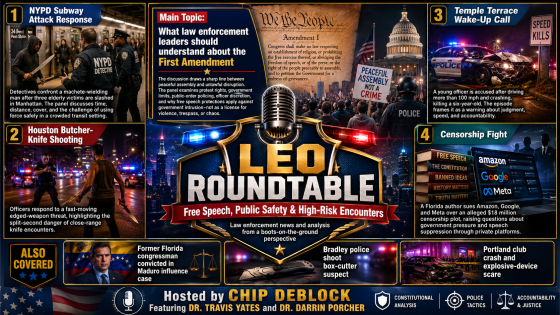
What LE leaders should understand about the First Amendment. Author sues big tech companies for $18M for censorship. Suspect with butcher knife fatally shot by officers. Man with machete goes insane on officers after attacking three civilians.
LEO Round Table: First Amendment Rights, Big Tech Censorship, and Urban Policing Crises
LEO Roundtable: Law Enforcement Insights
Analyzing the intersection of constitutional rights, public safety, and political accountability.
CORE ARGUMENT
"The First Amendment protects peaceable assembly, not a generalized license for disruption or criminal violence."
Key Discussion Pillars
-
The Censorship Battle
Florida author Chris Courtney sues Amazon, Google, and Meta for $18M over alleged "jawboning"—government-pressured suppression of conservative content.
-
Tactical Use of Force
Analysis of recent knife/machete attacks in Houston and NYC Grand Central. Emphasis on "Time, Distance, and Cover" and the legal standard of Graham v. Connor.
-
The Staffing "Sabotage"
Experts argue major cities (NYC/Phoenix) are intentionally maintaining short-staffing to "defund by proxy," leading to massive overtime costs ($98M+).
Executive Summary
This session of the LEO Round Table features law enforcement experts discussing the legal boundaries of the First Amendment, a high-stakes censorship lawsuit against Big Tech, and the tactical realities of recent officer-involved shootings in Houston and New York City. The panel highlights the growing friction between government influence, private platform policies, and the operational challenges of understaffed police departments.
Detailed Summary
1. The First Amendment and the "Right to Protest"
The panel explored the legal framework of the First Amendment, emphasizing that the Constitution protects "peaceable assembly" rather than a generalized license for disruption. Dr. Travis Yates and Dr. Darrin Porcher clarified that the First Amendment specifically restricts government intrusion, not the policies of private entities or workplaces. They noted a concerning trend where modern protests often bypass the original intent of "petitioning for redress" in favor of confrontational participation. A critical distinction was made: while the government cannot eliminate access to public forums, it can regulate use to prevent violence, trespassing, or criminal activity.
Constitutional Framework: Private vs. Public
- ✅ Government Restriction: The First Amendment prohibits government actors from suppressing speech or assembly.
- 🚫 Private Entities: Private businesses, social media platforms, and employers have the legal right to limit or ban speech within their domains.
- ⚖️ Law Enforcement Gap: Policing operates in the tension between original "peaceable assembly" language and contemporary confrontational expectations.
2. Big Tech Censorship and Government "Jawboning"
The discussion shifted to a federal lawsuit filed by Florida author Chris Courtney against Google, Amazon, and Meta, seeking $18 million in damages. Courtney alleges a coordinated effort to dismantle his career through "shadow banning" and algorithmic demotion following government pressure. The hosts shared personal experiences with "medical misinformation" strikes on YouTube, which led to the loss of over 2,400 archived episodes. The panel criticized "jawboning"—where government actors use proxies like social media companies to circumvent First Amendment restrictions—as a dangerous violation of constitutional boundaries.
3. Urban Mismanagement and the Staffing Crisis
The panel addressed political and operational failures in major cities. In Los Angeles, the discussion centered on Spencer Pratt’s mayoral run and his lawsuit against Governor Newsom regarding the mismanagement of the Palisades fire and homelessness funds. In New York City, Dr. Porcher highlighted a critical shortage of 4,000 to 7,000 officers, arguing that the city is suffering from "defunding by attrition." The experts alleged that some municipalities are intentionally maintaining short-staffing levels to avoid the political fallout of explicit "defund" policies while achieving the same results through recruitment neglect.
NYC Grand Central Machete Attack
Incident Summary: May 2026
Officers utilized Time, Distance, and Cover in a chaotic subway environment to neutralize a suspect claiming to be "Lucifer" after he inflicted skull fractures and lacerations on elderly commuters.
4. Critical Incidents and Use of Force Standards
Two recent shootings were analyzed: a butcher knife incident in Houston and a machete attack at NYC’s Grand Central Station. In both cases, the experts commended the officers' restraint and adherence to the Graham v. Connor "objectively reasonable" standard. They emphasized that "shooting to stop" is the protocol when faced with deadly weapons. The NYC incident was particularly complex due to the crowded mezzanine and the suspect's erratic behavior. The panel noted that political support for officers is vital; when departments back "good shoots," it reinforces officer confidence and public trust.
Key Data
- Lawsuit Damages: Chris Courtney is seeking $18 million from Google, Amazon, and Meta for alleged censorship.
- NYPD Staffing: The department is currently down upwards of 4,000 officers, with a perceived need for 7,000 more to reach optimal levels.
- Phoenix PD Budget: Spent $98 million on "hire backs" (overtime) last year to fill staffing gaps.
- Victim Demographics: The NYC machete attack targeted individuals aged 84, 65, and 70.
To-Do / Next Steps
- Professional Development: Attend the PLECET Conference (Professionalizing Law Enforcement Community Engagement Training) featuring Chip DeBlock and Dr. Travis Yates.
- Charitable Support: Check out and support The Wounded Blue at thewoundedblue.org to assist injured officers.
- Agency Recruitment: Agencies facing staffing issues should contact SafeguardRecruiting.com for specialized recruitment solutions.
- Equipment Discount: Use discount code Radio15 for 15% off at gaulus.com.
Conclusion
The discussion underscores a period of high volatility for law enforcement, where officers must navigate complex constitutional interpretations and staffing shortages while managing high-stakes critical incidents. The panel concludes that without political backing and honest recruitment efforts, urban safety will continue to decline under the weight of attrition and administrative mismanagement.
LEO Round Table


LEO Round Table is a nationally syndicated law enforcement satellite radio talk show discussing today's news and issues from a law enforcement perspective. They also have components on TV, Podcasts, and Social Media. Their panelists are among a Who's Who of law enforcement professionals and attorneys from around the country.
https://leoroundtable.com/how-to-become-a-panelist/
[00:13] Speaker 1: Welcome to LEO Roundtable at leoroundtable.com, the law enforcement talk show. My name is Chip DeBlock, and I'm your host for a group of law enforcement professionals that talk about today's news and issues, but we do it from a law enforcement perspective. And let me introduce the crew. Guys, if you don't mind waiting for the video portion of our show, uh, we have, we have two doctors on the show today so yeah, I am, I am, uh, being outgunned heavily today. Doctor, look at him shaking his head no. Dr. Travis Yates, retired major from the Tulsa Police Department, and then we've got, uh, Dr. Darrin Porcher, retired NYPD lieutenant. Thank you guys so much for being on the show. And, uh, a shout-out to our sponsors. You know, our title sponsor is gaulus@gaulus.com. Don't forget that. 15% off, discount code Radio15, next time you go to gaulus.com.
[00:57] Speaker 1: We have ComplyTechnologies.com, our satellite sponsor, GunLearn.com, MyMedicare.live, SafeguardRecruiting.com, our streaming sponsor, and thanks to them, and I gotta get with Dr. Travis Yates about, about them, uh, they're, they are... If you have an agency and you're having a recruitment issue, man, that is why you need to hook up with SafeguardRecruiting.com. And they're also our streaming sponsor, allowing us to stream to about a million people during the live show, so big shout-out to Safeguard Recruiting. And finally, TwoBells.com, they built the new online store at leoroundtable.com. A shout-out to Bryan Burns for the Tampa Free Press at tampafp.com and Ray Dietrich with formerlawman.com, and our very own Travis Yates with lawofficer.com. Thanks to all the entities for helping make this show happen. And, like, I, I have a lot of people saying, "Hey, Chip, how can we listen to the show? You need to get it out there." So yeah, podcast, we're on...
[01:42] Speaker 1: If, if it, if it exists, we're on it, but certainly Spotify and Apple, uh, iTunes, we're on, we're on, uh, social media, uh, we're on Rumble and YouTube and Facebook and Twitter and, and, uh, Truth Social, and we're also in the process now of transitioning from, uh, Westwood One. We wanna stay on Satellite Radio, but we're trying to get on Satellite Radio with SiriusXM, so I'll keep you guys posted as, uh, that goes along as well. Um, so thanks to all those entities for helping make this show happen. And now the what the appetite, what in the world are we gonna be talking about today? You know, our first article, it's a main topic that we're gonna be adding on, uh, what law enforcement leaders should understand about the First Amendment, and that's from lawofficer.com, uh, Travis Yates' site. And going from there, what we're also gonna be talking about as time permits a former Florida congressman convicted of, of, uh, secretly selling influence to the Maduro regime.
[02:31] Speaker 1: We've got a man armed with a butcher knife fatally being shot by Houston police officers, and now we're gonna jump over to Darrin's NYPD where officers shoot a machete-wielding man, uh, because that's the way they roll there in New York. Uh, we've got Temple Terrace police officers, which is in my neck of the woods, an officer arrested. This is a wake-up call for all of our junior officers. This Temple Terrace cop, small agency right on the outskirts of Tampa, Florida where I'm at, this dude's going over 100 miles an hour and he ends up crashing his police car and he kills a six-year-old. And, uh, yeah, getting charged with that. And we've also got a man armed with a box cutter fatally shot by Bradley police officers, a man dead after driving through, driving through a window of a Portland athletic club, and then he attempts to detonate a number of explosive devices. And I didn't really hear anything about this in the news cycle, so I, I find that story kind of fascinating.
[03:23] Speaker 1: Baltimore PD, there's a, uh, body cam involving the shooting of a 35-year-old, and then finally, a Florida author, he's suing Amazon, Google, and Meta over an alleged $18 million censorship plot, and that's a pretty horrific story here in how that goes down and how the government put pressure on those entities to block this guy. It's a, it's a nasty story. So if you guys are ready, let's pop into the first one, the main topic from lawofficer.com, what law enforcement leaders should understand about the First Amendment. I'm only gonna go through a couple of the paragraphs here. Uh, this was really authored, uh, by, uh, by a guy named, uh, Kevin Engel, uh, PhD. For law enforcement officers and for police executives, he talks about how few constitutional subjects, uh, are more operationally important than the First Amendment. I'd have to agree.
[04:10] Speaker 1: He said it's a legal framework, framework that shapes crowd management, uh, public order policing, officer discretion, municipal risk, and also public trust. He goes on to say that one of the most frequently invoked protections is also what is most understood, and he talks about the Constitution does not expressly guarantee a right to protest. And so now maybe you guys can kind of see where I'm going with this, because what have we been dealing with for like, you know, the last few years now? He talks about the right to protest, but it's evolved into something that it didn't really start off, um, you know, being. Uh, instead, the First Amendment protects the right of the people peaceably to assemble and to petition the government for a redress of grievances. Now, the word, the wording matters. He says it reflects a constitutional tradition that's older than the republic itself. It points to a more precise original understanding, uh, than many modern public debates acknowledge.
[05:02] Speaker 1: And then he gets to the, to the, uh, to the teeth of this thing. To understand present-day demonstrations, officers and executives, they must first understand the constitutional right of assembly, that it did not begin as a generalized license for disruption, which is what we're seeing today. It developed as a political right tied to... And, uh, when I say right, I don't mean left-right. I mean, uh, uh, a political, you know, right, uh, that is bestowed upon you, tied to consultation, collective grievance, and to, and to, uh, uh, petitioning governing authority. And over time, he says American law and culture, it's actually transformed this right, um, that procedural right, into what is now commonly understood as a broader right to protest. He says a public, expressive, and often confrontational form of political participation, modern policing operates in that gap between the founders' language and the contemporary expectations that we have today.
[05:53] Speaker 1: And, um, and so I just kind of what are the, what the appetite there. I'm gonna let Dr. Travis Yates take it from here.
[05:59] Speaker 2: Yeah. Thanks, Chip. And Dr. Engel is a regular contributor over at lawofficer.com, and as he usually does, he did an excellent job on this article, and I think it's something we don't think about a lot. I think it's something that we often...
[06:09] Speaker 3: ... take for granted, but our founding fathers... You know, this sort of started with the, uh, English Par- Parliament Bill of- Bill of Rights, which wasn't as s- strict on First Amendment as it was, is for us. There were limitations, but the founding fathers thought that that was so important, because you gotta think about, without debate, without discourse with political leaders, where would we be? Right? I mean, we- we- we sometimes can come to a, a final decision, sort of meet in the middle, so to speak, because we enable people to have these public debates, and we hold government officials accountable through those debates. So, that's very important. And so they brought that over from the Atlantic, uh, and I'll f- I often find it interesting that it's the First Amendment, right? I, I wonder if there's sort of some subconscious, like, this is the most important, this is the first thing we're gonna solidify in our Constitution, so I think that's interesting.
[06:59] Speaker 3: And there's a couple of misconceptions that I think everyone should understand, 'cause you see this all the time online, you know. The First Amendment is for government intrusion. So, a p- a private entity, a private business, they can limit free speech. They can f- totally limit your w- your job, your workplace. They can be l- there's no right to free speech, but it's about government intrusion, and, uh, and the government can regulate its use, but it cannot eliminate complete access. And so the first mistake is on one side, where we think the First Amendment gives people the right to do whatever they want. Uh, that's not true, in the name of protest. It's just not true. You can't be violent. You can't commit crimes. You can't trespass. You can't do things like that. But the other side of it is, uh, oftentimes from the law enforcement perspective, that s- some small violation of that eliminates the First Amendment altogether. It doesn't.
[07:52] Speaker 3: You should eliminate the problem within that First Amendment regulation or that First Amendment protest, or assembly, or whatever it is. You eliminate the problem inside that, but you can't eliminate the entire assembly. And so this is obviously more difficult today than ever. I mean, obviously, law enforcement is facing people in the name of the First Amendment, uh, in more difficult times than ever before. So it's really important to sort of understand this. And I think what it got brushed off, and I'll leave with this, the last presidential administration, there was actually government intrusion of the First Amendment. Uh, and they, and they were doing it through proxies, right? Putting pressure on social media companies, putting pressure on Amazon, Facebook, and the government has no role in that. If Facebook wants to ban somebody, they can do it. They're private.
[08:35] Speaker 3: But the government really has no role in that, and that was really upsetting to sort of see that, because once we cross that line, uh, a lot of other things start going wrong.
[08:44] Speaker 1: Yeah. That was, that was beautiful, and of course, a good segue for, for our next story, which I'll have to take out of order now, 'cause you just set me up for that one. But, uh, Dr., Dr. Porcher.
[08:53] Speaker 4: Uh, I thought Travis eloquently presented a scenario or a situation that has been problematic for y- us for years on end, not just the last administration, as Travis referred to the Biden administration, but this is something that's been going for decades on end. I live at ground zero of violations of the First Amendment here in the City of New York, whether it's these, um, these Gaza demonstrations, whether it's these demonstrations in front of re- religious organizations, or pro-life, pro-choice rallies. Um, it- it- it- it's just, uh, you know, it- it just goes abo- it- it goes beyond the pale here. We have the United- the UN General Assembly here once a year, and you have an assemblance of protests, and the challenges to the First Amendment are something that are always, uh, on front stage. And I think the interpretation of this, uh, is something that Travis rolled out in such a great way. Public or, um... The First Amendment is something that applies to government.
[09:54] Speaker 4: It doesn't apply to, uh, private citizens or private entities. So case in point, uh, if you work at a particular, um, organization, be it, uh... If you have a job, for example, and then you elect to come into your job and you wanna protest, that employer has a right to ban you from or prohibit you from embarking i- on these levels of protest, um, based on your perception of what the First Amendment is. It's totally out the window when it comes to civilians. And I just kinda wanna go back to how Travis presented that. It was easily digestible. I commend how you presented it, and I'm going to look to your blog, because it s- it appears to me that this is empirical data that's been produced that can help not just me, but most of the people out here in terms of clarifying a lot of these issues as it relates to First Amendment.
[10:46] Speaker 1: You know, do you guys mind if I cover the, uh, if I jump out of order and I go to the, uh, update number four, um, from Florida, if that's okay? I've got, um, a minute here, but we- before we take our first commercial break. But, uh, the Tampa Free Press at Tamp- tampafp.com, our, our friend, Bryan Burns, has that publication. Florida author sues Amazon, Google, and Meta, you know, basically the, uh, essentially the big three, over alleged $18 million censorship plot. We've experienced some of this with Leo Roundtable i- in the show e- involving these same outlets. Uh, a Florida-based artist and author, who's conservative by the way, has filed a federal lawsuit against three of the world's largest tech giants alleging coordinated effort to dismantle his career through government-influenced censorship and antitrust violations, the exact same thing that you two just talked about. Now, we're, we're kind of getting close to our first commercial break.
[11:35] Speaker 1: Um, this guy is Chris Courtney, disabled senior. He's seeking upwards of $18 million in damages from Google, Amazon, and Meta, claiming the platforms worked in tandem to suppress his work following pressure from the government. Um, we're gonna cover this in just one more second. We got a commercial break coming up. We'll be right back. Stick with us. (instrumental music plays) My family only cares about one thing, that I come home safe.
[11:59] Speaker 5: At Galls, every order begins with a promise. Made with purpose. Stitched for support.
[12:15] Speaker 6: ... backed with pride, answered by dedicated hands, delivering the standard you have sworn to uphold. We serve more than the mission. We serve the person. Each piece is engineered to help get our first responders through the shift and back home safe.
[12:52] Speaker 1: Welcome back. Leo Roundtable at leoroundtable.com, the law enforcement talk show. My name is Chip DeBlock, and I'm your host. We're joined by Dr. Travis Shatz, retired police major from Tulsa, and also Dr. Darren Porcher, retired lieutenant from NYPD. You know, during the commercial break, I had mentioned that, uh, there is a Google founder that just, in California, they just kind of flipped. Uh, he got into it with Gavin Newsom. He doesn't like what they're doing, like, you know, charging, you know, the billionaires to pay for everything. And, and the guy, and I can't remember his name. I know he's got a, uh, a, a, a conservative girlfriend, and, uh, and Travis, you were just making a, you were just making some commentary on that. So I'll let you go ahead and pick it up from there before we jump into the, the next story.
[13:32] Speaker 3: Yeah. Very interesting take out of California is, uh, Spencer Pratt is running for-
[13:37] Speaker 1: Oh.
[13:38] Speaker 3: ... mayor out of Los Angeles.
[13:40] Speaker 1: L.A.
[13:40] Speaker 3: And this guy has been all over social media calling out the Palisades fire, calling out the homeless situation, calling out the waste of taxpayers' money. And it's not just talk. He filed a lawsuit, uh, against the governor, and I believe, uh, Mayor Bass with the City of Los Angeles about the Palisades fire 'cause he, he, he lost his home. He's living in a mobile home right now. Uh, so a bunch of people lost their home, obviously out of there. Well, he apparently has the golden goose. Like, he's got them dead to right on a bunch of text messages, the things they didn't do. And just, I think just this week, the judge ruled that that's, trial's gonna, that, that lawsuit's gonna move forward with discovery. And Karen Bass allegedly deleted, has deleted a whole bunch of emails. They were using emails off the city server, personal emails. He's gonna get access to all that, and, um, and Mayor Bass just sued Governor Newsom over this whole thing.
[14:37] Speaker 3: So they're all, now they're all throwing daggers at everybody. So it's gonna be interesting to see how that plays out. Uh, I have a lot of sources with Los Angeles County, and they told me from the very beginning, I had, had them on my podcast that the politicians at the highest level were responsible for a lot of not knocking down the brush and all, and keeping all the d- d-, you know, the deposits empty of water and underfunding the fire department. I mean, basically, they saw it coming. In fact, uh, they're, they have prediction models. There's so many fires in California, and these prediction models were pinging off the chart before this fire, and those at the highest level just simply ignored it. And so, that's gonna be interesting to see, especially if Governor Newsom continues with a presidential campaign. Will that affect that? Because I think almost like the governor of Minnesota, that could re- resonate with the nation of what that's found out.
[15:26] Speaker 3: And of course, they all thought it would be hidden, but this lawsuit is gonna expose it. And so I don't know if Pratt's got a chance to win. He's a Republican in Los Angeles. But I think there's a lot of frustrations there, and he's doing what no other politician is doing is he's exposing a lot of these things that we sort of look at and go, "You've spent how many billions on homeless, and now you have a record level of homeless? You've spent how many billions on the high-rail speed system, and you've never built any tracks?" And so, all of these things are going on there, and so I think it's gonna be interesting to watch. Just, just a side note.
[15:55] Speaker 1: No, you're right. And he, he's got a cool-looking Airstream too. Of course, I'm sure he'd rather be in his home back in
[15:59] Speaker 7: (laughs)
[15:59] Speaker 1: ... Burnt down, but yeah.
[16:00] Speaker 3: It, it's hard to feel bad for Spencer Pratt. I think he's got a few more dollars than myself and Dr. Porcher, but he is exposing some of these things, right?
[16:09] Speaker 1: Good for him.
[16:10] Speaker 4: You know what? I, I, I tell you. My daughter lived in Pacific Palisades, and her house was burned down, and, uh-
[16:16] Speaker 1: Oh, that's right.
[16:16] Speaker 4: ... she paid, my, my daughter had se- I was paying 35K a month, and she had other roommates. So just to tell you how expensive the house that she was living in was. And, you know, we speak to what Spencer Pratt is, um, supporting as it relates to what's happening in LA. Um, there's been, there's been numerous pitfalls, as Travis mentioned, such as, you know, the, uh, the hydrants not having the capability to pump water, um, the early assessments, um, from L- from LA County, um, or I should say the, uh, the City of Los Angeles, to do and provide the necessary, um, foundational support that a municip- municipality is tasked with. Karen Bass has been a colossal failure for years on end. And, uh, one of the things that I look at in Los Angeles is, they have taxes in LA that we don't have in a lot of places.
[17:11] Speaker 4: Like, like case in point, like, I've sent my daughter things, and, or I've purchased things in LA, and I couldn't believe the monumental number of these additional taxes or, quote-unquote, "junk fees" that were attached. And you as a res- a- as a resident of Los Angeles are not the recipient of any level of prominence. And I kind of parallel that with me living in New York City. The, the top 1% pay 61% of all of the taxes in the City of New York. And you hear a lot of complaints about, you know, the, the rich, um, these people are, are just, they need to be taxed more and more. But at what point do we stop the runaway train in taxation and tet- and tighten our belts and focus on the betterment in terms of the quality of life in cities like New York and Los Angeles? I thought the L- I thought the, the citizens of LA got it right when they removed George Gaston as the district attorney in that last election. And I was hoping that they would move more towards the center.
[18:12] Speaker 4: But it seems like they're in a state of sus- uh, suspended animation in terms of-
[18:18] Speaker 1: (laughs)
[18:18] Speaker 4: ... what, wh- what...... candidate they're gonna pick moving forward. The best thing that can happen for the City of Los Angeles is them to pick a conservative candidate, but I also do question Spencer Pratt as it relates to that being the, uh, the person that would be best suited for the job. But unfortunately, you have to take what, you have to pick what's there, and they still got at, they have an enormous challenge in front of them in Los Angeles-
[18:43] Speaker 1: Mm-hmm.
[18:43] Speaker 4: ... because, um, it's just been detrimental in terms of what their pollic- politics have been for years and years in the past.
[18:50] Speaker 1: And, and, you know, the, the irony, Daren, is you talk about the high taxes, um, and I actually think the citizens don't mind paying taxes if that money comes back to them in the form of public safety and water and fire hydrants and zombies not walking the streets when you take your kids to school. I, you know, I, I, I think that that's the problem, is you, you're paying the high taxes and you see nothing for it. That's really the whole problem, I think, in LA.
[19:19] Speaker 4: You know, another point, Travis, uh, was they were paying gang members, like heads of the Bloods and Crips and a lot of these, uh, these gangs throughout the City of Los Angeles, to act as facilitators for the, you know, gun violence and things to that effect. And bear in mind, I'm all for it if you have a competent and capable source that can assist, um, in public safety. However, there was completely no oversight. So, what was happening with this money that was being funneled into these gang leaders, in essence what it did is it went to fund the illegal and illicit activity of these gangs, and the gang leaders that were paid this money were not doing what they paid them to do. So, it's just a gross level of incompetence as it relates to the funding of tax dollars in the City of Los Angeles.
[20:11] Speaker 1: Well, perfect, (laughs) perfect timing, Dr. Porcher. Hey, it's u- we're up for our second commercial break. We will make it to that article, I promise you guys, when we come back, (laughs) so stick with us. We'll be right back. All right, guys. It's time to talk about Compliant Technologies at complianttechnologies.com. And they are committed to providing non-lethal solutions to help officers gain the upper hand safely and rapidly in a humane, law-upping manner utilizing what they call their CD3. It stands for conductive distraction and de-escalation device technology. Now, their flagship product we all know by now is called the Glove. It's not only helped officers tens of thousands of times, but they've actually had over 250,000 deployments and guess what? No injuries, no deaths. Amazing statistic. They've actually achieved, uh, non-lethal st- status in an arena that predominantly can only offer less lethal results.
[20:57] Speaker 1: And when it comes to weapons trans- uh, weapons retention, transitioning to a, a sidearm or a conducted energy weapon, theglove@complianttechnologies.com, they have virtually eliminated weapons confusion. So, stay ahead of the game with Compliant Technologies and their revolutionary CD3 that hundreds of agencies have already turned to nationwide. And friends, take it from me, when it comes to safety, this is one of the most commonsense hands-on solutions that's ever come along. Go to complianttechnologies.com today, tell them that Chip and Travis sent you. Welcome back. Leo Roundtable at leoroundtable.com, the law enforcement talk show. My name is Chip DeBlock. I'm your host. We're joined by Dr. Travis Yates, retired major of Tulsa Police Department, Dr. Daren Porcher, retired lieutenant, NYPD. And, uh, hey, we, you know, it, it, it's, look, this happens. It's, it's a great... What makes it great is the personalities. Anybody can tell the news, uh, but i- it's about the personalities.
[21:42] Speaker 1: We want you to fall in love with the guys that are bringing it to you. And so, uh, we were gonna go to the story which I'm getting ready to cover now, uh, but, uh, Travis and Daren, uh, were talking about, you know, the, the Palisades, California, and, and Cr- it just, it was a great conversation, and Daren had a connection 'cause his daughter lived there. Her house burned down, and we're talking about politics and, and the, uh, the, the, m- running for, uh, for mayor in, in LA. It sh- it was a great conversation. So, that's, uh, you know, some special, special moments happen sometimes when you watch the live shows, so thanks guys for making that happen. Um, jumping back onto this, uh, this segue from our first main story, uh, Florida author sues Amazon, Google, and Meta over alleged four- $18 million censorship plot. I'm gonna cover this quickly, but this Florida-based artist and author, he filed a federal lawsuit against three of the world's top tech giants.
[22:33] Speaker 1: And his name is Chris Courtney, and he's suing Google, Amazon, and Meta Platforms, and claiming that they worked in tandem to pro- to, uh, suppress his work following pressure from the government. And he says a legal complaint filed by the Southern District of Florida, or filed there, outlines a rapid decline for his creative portfolio. He had a book called Florida Retirement is Murder, interesting title, and it, it gained significant momentum back in 2023, so not that long ago. And he reportedly was attracting interest in film and television producers as well. But the suit alleges that on June the 18th of 2024, Amazon abruptly banned the paperback version of his book in the United States. And then, with the ban, more than 30 reader reviews were deleted, and that caused book sales to plummet, and it ended his commercial viability. You know, no more producers talking to him. And then he alleges that it was not an isolated technical glitch.
[23:26] Speaker 1: It was a systemic effort, uh, that spread to his audiobooks, his social media presence, and he calls it, it's called, he says it's called, like, shadow banning, and it was a- a- algorithmic demotion and manipulation across Meta and Google platforms. And according to the complaint, the suppression was triggered by the plaintiff's patriotic artwork and conservative-leaning content, like our show, which the defendant's allegedly targeted under jawboning pressure from the government actors. And he did a Freedom of Information, uh, Act request, and he's got all kinds of stuff to substantiate this. It's really, it's really a fascinating case. I can't wait to see where it goes. And, you know, we've had our own issues, you know, on Facebook and on YouTube, especially YouTube, to where that used to be our platform of choice. But then we started getting strikes for s- for stupid stuff.
[24:12] Speaker 1: I mean, a, a bad guy had a knife in his hand, and, and we had a picture of it as a thumbnail, and they thought that it was a, a-... a organ, a male organ that was attached to his body that's not suppo- that's supposed to be clothed and it was a, it was a, it was a stupid knife. And, uh, and then other things saying that we're talking about, um, the vaccines and cops losing their jobs because they're not taking the vaccine and people that are fighting to get their jobs back. And they said that we're giving medical, uh, misinformation. And so if you get three strikes on YouTube within, uh, 90 days they'll not only delete your channel and delete all your subscribers, it's irrevocable, you cannot undo it. Can't appeal it after that point. So we got two strikes within, like, two or three weeks and, and the last one was for medical misinformation and it was only a matter of time, so I ended up having to self-delete about 2,400 shows.
[25:01] Speaker 1: I hired a company to back them up, verified with the company that everything was backed up, and then after I self-deleted, the company said that there was a glitch with the backups and we lost 2,400, you know, videos for the show. Yeah, that's the way... So I, I, I can relate a little bit and I believe what this guy is saying. Um, any commentary or do you guys have any... I mean, we're all conservatives and, and these are our, these are our platforms and it just kind of sucks when you've got people like Google and YouTube and Facebook that are doing this stuff. Travis?
[25:33] Speaker 3: Well, Amazon's got pretty specific rules. I, I have some experience, uh, mo- mo- most people listening are familiar with the book The Fall of Minneapolis, uh, by Liz Coll and the, one of the only reporters that still exist in America who exposed with thousands of citations what actually happened in Minneapolis. And they left that book alone until the day the documentary dropped. The day the documentary dropped, they, they banned the book from Amazon.
[25:57] Speaker 1: Oh, is that right? I didn't... I wasn't aware of that. Wow.
[25:59] Speaker 3: And they banned it from, you know... They, they, they have to give a little clause of why it is and it was, it was a copyright clause on a photograph that she actually owned. Of course they sent all the documentation in and had to get some lawyers involved and it was put back up. And so I'm, I'm very curious if this guy can connect this to the government. He's got a pretty solid case, but if it's just Amazon doing it on their own, I'm not sure how much of a case he actually has.
[26:26] Speaker 1: Interesting. Well, I'll, I'll, I will be watching this. And it's in Florida, so it'll be easier for me to watch it, so I'm, I'm kind of curious, you know, where this, where this is gonna go. Um, and, uh, Darren, did you have something you want to throw in there real quick?
[26:38] Speaker 4: I just think that, you know, these monopolies that these, uh, companies like Amazon, Google and Meta have, they make it impossible for you as a common citizen to try to refute what their practices are. And so even if you're right, they just bring so many resources to the table that make it ultimately impossible for you to, um, to go against what they're doing. And, you know, that being said, it's, uh, it's a tough... It, it, it, it's, it's, uh, it's an uphill battle and the average citizen can't win it.
[27:10] Speaker 1: No, you're right. You're right. Well, guys, going to a video and we're going to hop over to Houston real quick. Rumble.com, our favorite law enforcement video channel, uh, and it's called This Is Butter at rumble.com and he gets the videos out pretty much before everybody. Man armed with a butcher knife is fatally shot by Houston police officers.
[27:29] Speaker 5: Put the knife down. Sir, put the knife down.
[27:37] Speaker 1: So, um, we got a guy in the front lobby of an apartment complex, called around 11:18 in the morning to report that a guy identified as Gaziani is in a parking lot making jabbing motions with a butcher, butcher knife. Now, when the officers get there, uh, they're directed to an upstairs apartment, uh, where this guy was last seen. So in the body cam you got two women that were seen coming out of this apartment unit as the officers are approaching, and one officer is trying to talk to this guy Gaziani who's behind the closed door. It... Well, at this point he ended up slamming the officer's face and so then the guy's yelling and stuff. So another officer made his way up the balcony and so Gaziani opens the door suddenly, he comes out with a large knife and now we got three officers trying to give him verbal commands because they didn't really want to have to shoot him. They tell him to put the knife down, he does not.
[28:24] Speaker 1: Three officers open fire on the guy when he takes a step out the door at them and he's pronounced dead at the scene. Any, any, uh, commentary, Dr Yates?
[28:32] Speaker 3: Well, I think generally when we see these videos, we're letting officers let these guys with knives get way too close to them. And I understand why. We don't, we don't want to have to use deadly force, but I think we're putting ourselves in a very dangerous situation. We'll watch the video later. I'll be interested in hearing, uh, Dr Porcher's stance on that. But in this case, uh, we didn't, you know... We didn't talk like Chick-fil-A, we talked more like Burger King and we took care of business fairly quickly. We didn't let him get real close. Uh, but the thing that struck me about this video was, is just how calm and collective the officers were. I mean, it looked like they do this every day of the week. I mean, this is a very critical incident that they were involved in and they just... that training kicked in.
[29:12] Speaker 3: I don't know what type of training they have in Houston, but from the looks of that video, I mean, you know, you typically see some effects of a high critical incident even in the officers afterwards, but they... I mean, it was... They were, they remained sort of ve- very, um, methodical, even after this event happened, so I commend them for that.
[29:30] Speaker 1: Yeah, I love it. I love it. Darren?
[29:33] Speaker 4: Well, when we speak to police use of force, it falls under the purview of the 1989 Supreme Court decision titled Graham versus Connor. And the force that a police officer can use should be objectively reasonable. That being said, when we speak to what's objectively reasonable, it's through the lens of the officer at that time in the given moment. So could a... Could the person with a knife create a serious physical injury or death to the officer based on their actions? Absolutely. So the average officer does not want to shoot... Go out and shoot and kill someone. You know, oftentimes we watch these videos, um, and they constantly show police officers that are shooting people and you have people on both sides that will say, "Hey, look, why didn't they shoot him in the arm? Why didn't they shoot him in the leg?" And the truth of the matter is, you shoot to stop. We don't shoot to kill, we shoot to stop or terminate the threat.
[30:26] Speaker 4: And the threat was a knife that can cause a serious physical injury or death. The officer's actions were appropriate and I just want to kind of salute...
[30:35] Speaker 1: ... the city of Houston, um, they do a great job and- and many year- years on end, they've had Democratic mayors in the city of, uh, Houston. But at the same token, they've gone above and beyond to back their police department and HPD. And this is just another example of how important or how significant it is for the municipality to back the officers because when the officers use deadly physical force, as you mentioned, or as Dr. Yates mentioned, the officers were calm, cool and collected, and they relied on their training. But bigger than that, they were comfortable knowing the fact that this department will be backed by the political structure in the city of Houston. And this is a classic example of cops that are doing the right thing, operating under Graham versus Connor.
[31:24] Speaker 3: Yeah, it's a great point, Dr. Porcher. And just think about this, Chip. Uh, change the, change the scenario up. Same exact scenario, but instead of the city supporting the officers like you heard, the mayor comes out and says, "We're looking at this and we put the officers on suspension and we don't, we don't understand why this happened, and I've had a sit-down lunch with the family," and this and that. That happens in other cities and then the public, very rightfully, starts questioning law enforcement. So that's why that support is so vital, uh, when these incidents happen. Hey, if it's bad, call it bad, but if it's good, as Dr. Porcher said, it's- it's within the lines of what case law says, then support it.
[32:03] Speaker 1: Perfect timing, guys, and good commentary. It's time for our third commercial break. Stick with us. We'll be right back. All right, guys. It's time to talk about GunLearn at gunlearn.com. And you know, there's some new stuff going on with GunLearn, you know. They provide citations from federal law and ATF rulings for every point taught to ensure accuracy, and that's from that step-by-step program that they have that takes you from your present knowledge level to become a safe, accurate and competent certified firearms specialist. And, you know, they deal with forensic organizations, law enforcement agencies and firearm manufacturers. They've been endorsed by all those and they've been doing this since 1996. But here's what's different about that, uh, Certified Firearms Specialist degree. If you have one, even if you got it five years ago, they have partnered with Smarter Degree and through their Smarter Degrees university partners, now that is worth college credit.
[32:48] Speaker 1: So that is a big step up. And since they've been doing this since 1996, teaching everything that LEOs, that's law enforcement officers, need to know about firearms and ammunition to all facets of law enforcement. You can start today with online training or you can sign up to register, uh, to attend a live seminar. You can also get free, free training for yourself and your agency by hosting a seminar for no cost. GunLearn.com. Welcome back. LEO Roundtable at leoroundtable.com, the law enforcement talk show. My name is Chip DeBloquian and I'm your host. We're joined by Dr. Daren Porcher, retired NYPD lieutenant, and also Dr. Travis Yates, retired Tulsa police major. And, uh, we've got a- we're gonna- we're gonna jump to New York 'cause we wanna hear what, we wanna hear Dr. Daren Porcher defend his peeps in New York. And rumble.com, This is Butter channel. NYPD officers, they fatally shoot a machete-wielding man after he attacked three people.
[33:41] Speaker 8: Hey. Listen, drop, drop it.
[33:44] Speaker 5: Put that down.
[33:45] Speaker 8: Drop it.
[33:45] Speaker 5: Put it down. Put it down! Put it down!
[33:47] Speaker 8: Drop it.
[33:48] Speaker 5: Put it down. Put it down.
[33:50] Speaker 8: Drop the fucking knife.
[33:52] Speaker 5: Put it down.
[33:52] Speaker 8: Dude, drop the fucking knife now. Drop the fucking knife. Drop the fucking knife. Drop the knife.
[33:59] Speaker 5: I didn't shoot him. Please.
[33:59] Speaker 8: Nobody wants to shoot you. Drop the fucking knife.
[34:07] Speaker 5: Sir, take his hands.
[34:09] Speaker 8: Drop it.
[34:10] Speaker 5: Mr. ******.
[34:10] Speaker 8: Listen, get on the ground please. Get on the fucking ground. Get on the fucking ground.
[34:16] Speaker 5: I didn't shoot him.
[34:16] Speaker 8: Nobody wants to hurt you.
[34:18] Speaker 5: Come on!
[34:18] Speaker 8: We can talk about it.
[34:20] Speaker 5: I don't wanna be here!
[34:20] Speaker 8: Get down!
[34:21] Speaker 5: I don't wanna be here!
[34:21] Speaker 8: Get down!
[34:22] Speaker 5: Get down!
[34:23] Speaker 8: Dude! I'm not gonna ask you again. Please.
[34:26] Speaker 5: That's it.
[34:27] Speaker 8: Please.
[34:28] Speaker 5: That's it!
[34:28] Speaker 8: Please.
[34:28] Speaker 5: Put it down!
[34:29] Speaker 8: Get down.
[34:30] Speaker 5: Put it down. Don't shoot me. Put it down, please.
[34:32] Speaker 8: Stop.
[34:33] Speaker 5: No, no.
[34:33] Speaker 8: Stop.
[34:34] Speaker 5: Please, stupid! Put it down
[34:38] Speaker 8: Stop.
[34:38] Speaker 5: Shoot them all!
[34:38] Speaker 8: Stop!
[34:38] Speaker 5: Put it down.
[34:38] Speaker 8: Stop. Watch, watch Cross. We're not doing it. We're not doing it. Get down.
[34:43] Speaker 5: No!
[34:44] Speaker 8: We're gonna get you help.
[34:45] Speaker 5: I don't wanna be here.
[34:46] Speaker 8: We're gonna get you help.
[34:48] Speaker 5: I am Lucifer! Gentlemen, I-
[34:51] Speaker 8: Stop. (gun firing)
[34:56] Speaker 5: Cops are about to open. Get down. No!
[34:58] Speaker 8: Put it down!
[34:59] Speaker 5: I don't wanna be here!
[34:59] Speaker 8: Put it down.
[35:00] Speaker 5: I am Lucifer!
[35:01] Speaker 8: Put it down!
[35:02] Speaker 5: I am Lucifer! Gentlemen, I am Lucifer. (gun firing)
[35:11] Speaker 1: (sniffs) I really think they should've waited til they attacked the fourth person, Daren, before they used lethal force on- force on this guy. That's just my opinion. I'm joking with you, but... We're in Manhattan. So NYPD, they released this body cam footage of a fatal police-involved shooting at Grand Central Station. From the video alone, I was just amazed at how chaotic everything... I mean, there's a lot going on at Grand Central Station apparently, and police, they fired at a 44-year-old bad guy named Anthony Griffin after he attacked not just three people with a machete, but these are three elderly people. I mean, it just, it just sounds horrible. It's 9:40 in the morning. Uh, police say the victims, they were all older, they were left with serious injuries. We have Detective Ryan Guthrie assigned to the transit bureau. He's working overtime and so I'm assuming it's, like, an off-duty gig. Uh, uh, and I'll let Dr. Daren correct me if I'm wrong.
[36:03] Speaker 1: He had a partner with him, Detective Anthony Mineta. They're standing in the mezzanine on the four, five, six and seven subway lines at the time of the attacks. The footage shows the detectives, they're walking towards the platform stairs and they briefly are talking to one of the victims who had been stabbed. Uh, a short time later, they see our bad guy, Griffin, and he's walking up the stairs and he's got the machete in his right hand. So Detective Guthrie orders him to drop the- the- the machete multiple times, but of course we all know he does not. Instead, he walks back down the stairs towards the train platform while Guthrie and Mineta are following after him. Of course, now he's, you know, there's people freaking everywhere. They again plead with him to drop the machete and they say they're gonna get him help. And he's doing little things like, like......
[36:45] Speaker 1: like, moving towards, uh, you know, a detective and then backing away at the last minute, moving forward, and there, and there's, like, poles and obstructions and the detectives are having to constantly move around and the backdrop is changing to where it would be a good, safe backdrop to shoot, perhaps, and then maybe not as safe. So there's a, there's a... I'm just trying to, to get a verbal picture going for the audience that's listening to me describe this because it's not just like it's a static scene. There's a lot of, of moving things and it's, it's going from good shoot, bad shoot constantly. And so Griffin can be heard proclaiming, "I'm Lucifer!" (laughs) This tells you where his mind's at. Uh,, e- e- he moves towards Detective Guthrie with a machete. Its blade facing outward. Guthrie fires two rounds from his gun, he hits the bad guy, and they take him into custody, and he ends up dying at the hospital later on.
[37:32] Speaker 1: Now, I'm gonna mention, I'm gonna talk about the victims real quick. The first victim of the machete attack ... Remember, it's a machete. Uh, before the shooting happened, it's a 85, 8- 84-year-old man. He was slashed on the 7 train platform. He suffered significant lacerations to his head and his face. And then our second victim, 65-year-old man, attacked on the 4, 5, and 6, and he had slash wounds and an open skull fracture. Crap. And then we have a 70-year-old woman, suffered a laceration to the shul- to the shoulder. Amazingly, it says that all the victims are expected to make a, a recovery. Uh, it doesn't say what, w- how good of shape they're gonna be in after they recover, but it says they're gonna recover. Dr. Darren Forger.
[38:12] Speaker 4: This was a travesty, to say the least, and one of the challenges that we have in the City of New York is we have mental health, people that are suffering from mental health issues that are not receiving the appropriate treatment. Uh, it, it's just unfortunate that we pay such a, we pay more money into our budget in the City of New York than the State of Florida does as a whole, and what does that tell you in terms of financial mismanagement? But when we speak to what police are doing, ultimately, they are the front line in maintaining that social contract in protecting the common citizens, the eight and a half million residents that reside in the City of New York. One of the key focuses from a tactical perspective is time, distance, and cover.
[38:53] Speaker 4: So when you're dealing with a person that's in possession of a, a, a- of a machete, as Travis mentioned earlier, these people with knives are just getting too close to, uh, too close to our officers, but you still need to manage that, um, equation of time, distance, and cover, because that's what keeps you safe. Another challenge that you have in the subway system is because you have so many innocent civilians in the area, you need to be careful and cautious in terms of how and where you discharge, um, your rounds into the subject in question. Fortunately, the officer only discharged two w- two rounds, which was enough to neutralize the subject, and he subsequently expired. Uh, but I thought it was a valiant job on the part of the officers, but I, I wanna say a, a hit on the, the, the political structure of the City of New York is the NYPD is down upwards of 4,000 cops. So you ask, in terms ...
[39:49] Speaker 4: You asked about the pay detail or how w- these officers, these officers working on overtime. Because we have the attrition rate that's so high in the NYPD, we're often forced to have officers work on either overtime or we have something that we refer to as pay detail, whereas police officers are paid by a private entity to provide protection for an area in question. That's because the mayor, Mo- um, Zoram Admonani, refuses to backfill the attrition rate of the NYPD. We need 7,000 cops here, and he just doesn't get it.
[40:24] Speaker 4: He believes the platform of less police is better, but that's just clearly not the case, and unfortunately, we had an officer-
[40:31] Speaker 1: Huh.
[40:31] Speaker 4: ... that was on overtime that shot and killed these people, but if we had a greater presence, uh, a, a greater omnipresence component on these subway platforms, it would act as a deterrent, and it's just, it's a sad story, but this is the life that we live in-
[40:46] Speaker 1: Mm-hmm.
[40:46] Speaker 4: ... in the City of New York with a progressive mayor being Zoram Admonani.
[40:52] Speaker 3: Well, you're seeing, uh, this shortage across a lot of major cities. Uh, Phoenix comes to mind, Minneapolis comes to mind, and these officers, people need to understand when these officers are working 70, 80, 90 hours a week, that's gonna cause problems, not only for them, but for their judgment also. Now we don't have no idea whether that was the case here. My point is, it's problematic, even if you're filling the beats with overtime officers for the number of hours they're working, but there's something else that's, I think, more sinister here, gentlemen. The defund police movement was politically a disaster. Everybody that supported that pretty much got booted outta office because who ever thought that was a good idea?
[41:31] Speaker 3: But you see cities now, and this comes directly from some sources of mine in some other major cities, I just mentioned them earlier, where they're saying they won't verbally say, "Defund police," but they know if they don't continue to hire police, they don't take the measures to hire correctly and recruit correctly, they're gonna essentially be defunding or getting rid of police through that metric, and then they can just go, "We don't ... It's our fault. We ... There's a crisis in recruiting and people don't ..." They're ... It's being done on purpose. Last year, the Phoenix Police Department spent $98 million on hire backs to fill the beats. I would imagine the NYPD's budget is over that just to fill the holes they're having because they're not recruiting properly. I personally have offered with Phoenix, I personally have offered NYPD to fix the problem, 'cause as you know with Safeguard Recruiting Chip, we fix this problem wherever we go. They have flat out said no.
[42:23] Speaker 3: So-
[42:23] Speaker 1: Wow.
[42:24] Speaker 3: ... I believe there's a intention to maintain the short staffing-
[42:28] Speaker 1: (laughs)
[42:28] Speaker 3: ... because they actually know the problems it's gonna cause and, uh, and I don't, I think the public is sort of don't, they don't understand this. They've sort of bought the lie that, "Oh, it's just really tough to be a policeman today and these departments can't recruit." No. Departments across this country are fully staffed, so there is an intention, I think, to keep them understaffed.
[42:46] Speaker 1: Wow.Surprising, Daren, huh? Yeah, and you've offered it. I, I think you're... I, I believe you. They don't want to fix the problem. I, I totally believe you. A- a- and we have Safeguard, you know, that, that, that's sad. Guys, we got about a, a minute and, and 17 seconds, so not really enough to get into another story, but, uh, Dr. Daren?
[43:05] Speaker 4: You know, i- i- it's amazing, Travis, that you have these elected officials that support this anti-police, uh, sentiment, and a lot of the Democrats have since lost many down battle elec- down ballot elections based on the support of that, because we clearly saw that it didn't work and crime just totally ran through the roof. And I give you an example of what happened in Minneapolis after the death of George Floyd. What did they do? They defunded the police and crime became a tidal wave, and the first thing that the city council did was they said, "Look, we need to get more police in there." And that fictitious narrative of, be, well, "These guys are leaving, um, the departments, and we are staffed because we don't have the recruitment," is complete nonsense, because these politicians just don't want to fund it.
[43:52] Speaker 1: Wow. All right. That's scary. Great commentary, gentlemen. Thank you guys so much for being on the show. I appreciate it. Um, I do wanna... Well, I do wanna mention the, the PLECET Conference that is coming up. That is, uh, P-L-E-C-E-T, and actually five people from Legal Roundtable are gonna be there, including myself and Dr. Travis Yates and also, um, you know, Jeff Nickless, the CEO of Compliant Technologies, which has the glove. He's gonna be there as well, um, so we're gonna have a, uh, we're gonna have a good time, and, uh, if, uh, if you don't mind, if you can pull up that PLECET conference and just r- and so that I can get the, uh, the name, what the acronym stands for, Travis, that would help me out, and, uh, in the meantime I do want to mention The Wounded Blue, thewoundedblue.org. If you guys are unfamiliar with The Wounded Blue and haven't supported them yet, we got two thumbs up for Dr. Daren, please check them out.
[44:41] Speaker 1: Do you have anything for me, uh, Travis, before I go to, uh...
[44:45] Speaker 3: Prof- professionalizing law enforcement community engagement training. It's an initiative by Movement Forward. So, a lot of people are gonna be there, excited to be there, and we'll, we'll see how it goes.
[44:56] Speaker 1: Well, I love it, love it. So, I absolutely can't wait. So, Dr. uh, Travis Yates, Dr. Daren Porchard, thank you guys for being on the show. A shout-out to our sponsors. Guys, please support them. Golus.com, complianttechnologies.com, gunlearn.com, My Medicare, Safeguard Recruiting, and 2Bellas.com. We'll see you guys back tomorrow at 12 noon Eastern.
[45:16] Speaker 9: (rock music plays)