
LEO Round Table, March 10, 2026

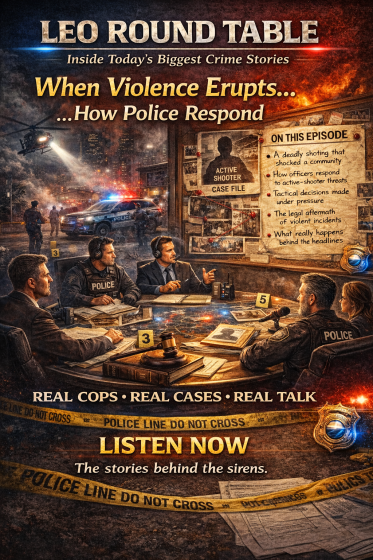

LEO Round Table with Chip DeBlock
S11E047, Gunman Opens Fire Killing Three And Injuring Multiple Before Being Killed
Pastor who heckled pride parade and was arrested battles in court. Kristi Noem fired and replaced by Trump with Sen. Markwayne Mullin. Gunman opens fire killing three and injuring multiple before being killed. Man punched by officer during dispute dies soon after.
Law Enforcement Perspectives: Constitutional Rights, Digital Privacy, and Tactical Heroism
LEO Round Table: Law & Constitution
Briefing Analysis: First Amendment Battles, DHS Shifts, and Field Incidents (2026-03-10)
The "Heckler’s Veto" Conflict
Legal battle in NYC (Rumsfeld v. City of NY) regarding a street preacher arrested during Pridefest. The core dispute: Should police silence a speaker to appease a hostile crowd?
"Law enforcement cannot allow the heckler’s veto to cancel the First Amendment... otherwise, the first group that resorts to violence wins the debate."
DHS Leadership Swap
- ●Kristi Noem: Moving to "Shield of the Americas" envoy.
- ●Markwayne Mullin: Tapped as new DHS Secretary (Effective March 31).
Platform Launch: LeoAffairs.ch
Resurrecting the LEO forum with extreme privacy measures.
Guest: Dr. Joel Schultz
This episode of the LEO Round Table features host Chip The Block and retired Chief Joel Schultz discussing the legal complexities of the First Amendment, the relaunch of a secure whistleblower platform for officers, and a review of recent high-profile tactical incidents in Austin and Baltimore.
Detailed Point Summary
The "Heckler's Veto" and the First Amendment
The discussion centered on a significant legal battle in New York City (Rumsfeld v. City of New York) involving a street preacher arrested during Pridefest. The Liberty Justice Center argues that the NYPD overstepped by arresting the speaker for "failing to disperse" rather than restraining a hostile crowd that was throwing objects at him. The panel emphasized that a "heckler’s veto"—where the government silences a speaker because the audience threatens violence—sets a dangerous precedent that could effectively cancel First Amendment rights. They clarified that exercising free speech does not constitute "inciting a riot" simply because the audience reacts poorly, and that law enforcement's higher loyalty must be to constitutional rights rather than mere tactical convenience.
Legal Framework: The Heckler's Veto
A conflict between Public Order and Constitutional Rights:
- Standard Applied: "Promote Public Order" (currently places burden on the speaker).
- Proposed Standard: "Strict Scrutiny" (highest legal bar for government intervention).
- Core Risk: If the most violent group wins the debate, free speech is effectively dead.
Relaunching LEO Affairs: Digital Privacy in Switzerland
Host Chip The Block announced the resurrection of leoaffairs.ch, a platform designed to give law enforcement officers a "voice for the voiceless" without fear of agency repercussion. Drawing from his own history of internal affairs investigations and a landmark legal victory against the Hillsborough County Sheriff’s Office regarding anonymous speech, the host explained the move to Swiss hosting. By utilizing Switzerland's strict privacy laws and AI-driven moderation, the site aims to protect officer identities and IP addresses from subpoenas related to internal policy violations, ensuring a secure space for discussing workplace issues and government transparency.
Tactical Reviews: Austin Mass Shooting and Baltimore Fatality
The panel reviewed bodycam footage from a mass shooting in Austin's 6th Street district, praising the "gaggle of heroes" who ran toward AR-15 gunfire despite the chaotic environment. They noted the suspect's potential links to international tensions and the bravery of officers engaging with limited equipment. Conversely, they discussed a tragic incident in Baltimore where a suspect died after being punched by an officer during a welfare check. While noting the suspect was non-compliant and aggressive, the panel reiterated the fundamental rule that there is "no routine contact" in police work and emphasized the importance of civilian compliance during lawful stops.
Incident Brief: Austin Mass Shooting
Casualties: 3 deceased, 19 struck by gunfire.
Weaponry: Suspect utilized an AR-15 rifle.
Response: Officers engaged and neutralized the suspect under fire.
Key Data
- Safety Record: Compliant Technologies' "The Glove" has reached over 250,000 deployments with zero reported injuries or deaths.
- Austin Shooting Toll: 19 people were struck by gunfire; 3 victims (ages 19, 21, and 30) were killed.
- Political Shift: Markwayne Mullin is set to replace Kristi Noem as Secretary of Homeland Security effective March 31st.
To-Do / Next Steps
- Use discount code RADIO15 for 15% off purchases at gulls.com.
- Register and participate in the new law enforcement forums at leoaffairs.ch.
- Subscribe to the daily newsletter at CoffeeAndCOVID.com for strategic political analysis.
- Agency leaders can host a firearm knowledge seminar at no cost via GunLearn.com.
Conclusion
The discussion highlights a critical juncture for law enforcement, where the protection of individual liberties—both for the public and for officers themselves—must be balanced against the immediate demands of public order. Whether through the courts or secure digital forums, the panel argues that transparency and constitutional fidelity remain the ultimate safeguards for a free society.
LEO Round Table


LEO Round Table is a nationally syndicated law enforcement satellite radio talk show discussing today's news and issues from a law enforcement perspective. They also have components on TV, Podcasts, and Social Media. Their panelists are among a Who's Who of law enforcement professionals and attorneys from around the country.
https://leoroundtable.com/how-to-become-a-panelist/
[00:13] Speaker 1: Welcome to Leo Roundtable at leoroundtable.com. My name is Chip The Block and I'm your host. We're a group of law enforcement professionals that talk about today's news and issues, but we do it from a law enforcement perspective. And let me introduce, we have Chief Joel Schultz, a doctor, retired police chief, uh, thank you so much for being back on the show, Chief. Um, also I want to give a shout-out to our sponsors, we have Gulls, our title sponsor, at gulls.com, complighttechnologies.com, our satellite sponsor, and we've got gunlearn.com, mymedicare.live, Safeguard Recruiting, our streaming sponsor, thanks to them we're streaming to over a million followers right now during the live show, and twobells.com. They built the new online store at leoroundtable.com. A shout-out to Bryan Burns for the Tampa Free Press at tampafp.com. Thanks for carrying our content, Bryan. Also Ray Dietrich, formerlawman.com, and also our very own Travis Schatz with lawofficer.com.
[00:59] Speaker 1: Thanks to all those entities for helping make this show happen. And, uh, I just want to throw out, since we're talking about Gulls, RADIO15, that's that code that they gave me to give to you in order to get 15% off your next purchase at gulls.com, .com, so remember that. Now, guys, what are we gonna be talking about today? Here's the topics, assuming we have time to get to them. The cops or the Constitution? The legal battle over a heckler's veto in New York City. I'm kinda fascinated by that article. I don't know what's gonna happen, uh, 'cause it hasn't gone to trial yet, but, uh, I, I, I suspect the chief is gonna be all over this one. And then we've got an update on, uh, our, our new Secretary of Homeland Security. Uh, Kristi Noem has got a new position and we're gonna be talking about the replacement, and then San Diego deputy convicted in a fatal shooting.
[01:47] Speaker 1: We got Austin Police releasing 911 calls and video from a deadly mass shooting, probed as a potential terrorism link, we got video from that. Um, we got a 2023 video release of a shootout between a murder suspect and a Pierce, and Pierce County deputies, plural. We got a man accused of killing his, his, uh, his daughter's alleged rapist. He wins the Arkansas sheriff primary? Wow. And then a suspect died after being punched by a Baltimore police officer during a welfare check, and, yeah, there's video. So guys, uh, um, before we get started, uh, you know, the chief and I were talking, and the chief made a comment about sometimes war/conflict is necessary in order to really see how good you are, what your limitations are, and you, you know, and, and, and the learn.
[02:30] Speaker 1: And I made a comment about, you know, go, a, a, in police work, you know, you train, train, train and you kinda go through life kinda always wanting to be prepared and but you, you see things as a challenge and, and, and you wanna be, you wanna be, you know, you wanna step up to the, to the plate. (laughs) So, you don't wanna be the guy that's on video pulling a George Peterson at the Marjory Stoneman Douglas, you know, School down in, in Parkland where you're, you're cowering and not wanting to go in and s- y- either, you know? And you know what I've learned? People, most people, well, I think everybody, you just don't know. You can think in your mind you know what you're gonna do, but you really don't know what you're gonna do until you get there.
[03:07] Speaker 1: I've, I've, I've been at so many scenes and covered so many things to where the, the, the, um, the performance of people, it's not a g- it's not a given, it's not a guarantee, and I have been shocked by the performance of certain people in certain situations that you just, you don't necessarily know how you're gonna react into- to a situation 'til you get there. Um, would you, would you agree with that, Chief, or do you have a different, a difference of opinion on that, or... I'm curious.
[03:34] Speaker 2: Um, no, you know, this, this, uh, this anti-warrior mindset that had, uh, arisen during the, um, George Floyd defunding kind of thing and back when Obama wanted us all to be guardians instead of warriors, um, you find out who the warriors are when the lead's flying and when the sound of gunfire is erupting. Uh, and particularly in the two videos, if we get to them, the one in Austin and the one in Pierce County, j- just a gaggle of heroes. I mean, these, these officers are ready to engage, uh, running into the fray, being concerned about the innocents, um, taking care of business, and doing so professionally and assertively, um. And, and I, I, I, I love heroes. I, I have been blessed to have been in the company of heroes, uh, during my career, um, and you, you do see the ones that are like, um, "Okay, my safety first." You know, we talk about officer safety.
[04:37] Speaker 1: (laughs)
[04:37] Speaker 2: Um, a- and officer safety is a moral imperative because, uh, that keeps you in the fight.
[04:44] Speaker 1: Yeah.
[04:44] Speaker 2: That keeps you from being somebody that needs to be rescued. It keeps, uh, keeps you from somebody who's, uh, giving over their equipment to another person. N- now, that doesn't denigrate if you get wounded or, or killed in the line of duty. That's, that's certainly honorable. I don't wanna take anything away from that. But it's not selfish to wanna survive, um, unless that survival instinct, um, out-governs your actions, um, relative to your service instinct, and, you know, w- you've gotta put other people first, uh, and allow yourself to be at risk, and that's, that's the only place it can be tested is when it's tested.
[05:25] Speaker 1: Good point. I, I think I, I think I screwed up. I, I think I said George Peterson and I meant Scot Peterson, um, the SRO from Parkland, so, uh, my bad. I'm sorry.
[05:34] Speaker 2: Yeah. Right. I don't know who George Peterson is, but we apologize.
[05:37] Speaker 1: Yeah, there's been a couple George Petersons in the, uh, in the news, not in a g- not in a good way either, but yeah, this, this dude was Scot Peterson, and that's, yeah, not, yeah, not much good to say about him. So, if you're ready, Chief, uh, you ready to cover our first story, our first main topic?
[05:53] Speaker 2: Absolutely. Let me check my notes. We're ready to go.
[05:57] Speaker 1: We're ready to go. Okay, so Tampa Free Press at tampafp.com. I, I gotta tell you, Chief, you know, it seems like you are on the show when I come, when I, when I find these articles a- and this one...... it's, it, it gets your brain thinking, uh, at, at least mine, um, which probably doesn't take a lot. Uh, cops-
[06:15] Speaker 2: (laughs)
[06:15] Speaker 1: ... or the Constitution with a question mark. The legal battle over a heckler's veto in New York City. So, a peaceful speaker should not be silenced just because a crowd gets rowdy according to a legal challenge now sitting before the US Court of Appeals for the Second Circuit. So, on the surface, that makes a lot of sense, right? But let's, let's get, dive into this and let's see what an agency did in New York. So, the Liberty Justice Center filed an amicus brief, uh, this week in the case of Rumsfeld versus City of New York. They argued that the New York Police Department, NYPD, that they overstepped because they arrested a street preacher instead of restraining the angry crowd surrounding him. Now, this incident dates back to June of 2021 and, uh, remember that timeframe, guys, 'cause that was, uh, you know, just over a year after COVID started, during New York City's Pridefest.
[07:09] Speaker 1: Now, the pastor, uh, Adin Rumsfeld, he's on a public sidewalk in Lower Manhattan, but remember, he's a pastor and it's Pridefest, okay? So, you know, there's a lot of, you know, it's, it's a, it's a gay, it's a gay, a gay thing going on. And so, there's, you know, he may not be welcome is what I'm going. But he's on a sidewalk in Lower Manhattan. He's not even on the parade route, he's away from it and he's holding a sign and he's preaching. While his message was described as inflammatory and deeply offensive to those people that were present, he remained non-violent. As the situation escalated, members of the crowd, they started shouting at him, making threats. They even started throwing objects at him. Now, when NYPD gets there, rather than stopping the crowd, the aggression and, and focus on, they focus on the, on the pastor and they tell him to, to leave. Now, he refuses.
[07:58] Speaker 1: He says he has a First Amendment right to be there in a public forum (laughs) and they arrest him for failing to disperse. Now, a federal jury, federal by the way, federal, uh, previously sided with the city and the district court later upheld that verdict. So, you've got a, uh, a federal jury, district court that, that upholds the verdict from the jury, and the court used a "promote public order standard" to place the burden on Rumsfeld, the pastor, to prove that the officers lacked a reason to arrest him. However, this is where it gets good, the Liberty Justice Center, they're coming to the rescue, the calvary. They argue, uh, that this creates a "heckler's veto" and it's a scenario where the government shuts down a speaker because an audience threatens violence. And here's a quote from, uh, senior counsel Ryan Morrison from the Liberty Justice Center. He says, "Law enforcement cannot allow the heckler's veto to cancel the First Amendment in today's polarized society.
[08:59] Speaker 1: Otherwise, the first group that resorts or, or, or, or retorts will always win the debate." Um, the legal brief argues that when the government's response is triggered by the consent of a person's speech or the hostility that it causes, it must meet strict scrutiny, the highest legal standard for the government to justify its actions. Now, the Liberty Justice Center, they maintain that the city, uh, you know, uh, New York, uh, that they cannot meet the standard and is asking the Second Circuit to reaffirm that the police must, uh, protect speech even when it provokes a hostile reaction. Chief Schultz?
[09:34] Speaker 2: Well, I think the Liberty Justice Center, and I, that's the first I've heard of them, um, is, uh, is on legal sound ground there, um, and I, I follow closely and contribute to the American Center for Law and Justice, ACLJ, and they take up a lot of these kinds of cases where pastors have been arrested. Part of this goes back to our, oh, I don't wanna sound like an old guy, but, um, to our hyper-sensitive, um, uh, population that just can't stand to hear something, uh, that doesn't validate their feelings. Um, and I understand from, from a New York City cops, uh, point of view, okay, do I get this one guy to leave and call it a day or do I try to repel these 50 angry, uh, Pridefest celebrants? So from a practical, tactical point of view, I, I, I have a hard time, um, uh, faulting the, the cops. But it is NYPD.
[10:34] Speaker 2: They've got, you know, there, there are hundreds of officers (laughs) that could've come and, and, uh, set up a line or something, and I'm sure they had officers on, on, on duty for the, for the Pridefest as well. So, um, you know, protecting individual liberty and, um, allowing free speech to encourage the, uh, interchange of ideas in a civil way is really a central tenet of our First Amendment. You know, there, we have a lot of amendments, but this, (laughs) this is the first one, um, and, and we, we just can't allow the, uh, the cro- And I like that phrase, um, uh, the, with the, with the veto thing because, uh, I'd heard it in relation to an assassin veto, okay? We don't like Trump, let's kill him.
[11:23] Speaker 2: We don't like Charlie Kirk's voice-
[11:25] Speaker 1: Right.
[11:25] Speaker 2: ... let's kill him. And so, we, we simply cannot allow these forces to snuff out free speech. We see this happening in the UK where everybody's so sensitive that if you make a, a, a, an X post or a Facebook post or a meme or a joke, uh, you can go to jail, and we don't want that to happen here.
[11:44] Speaker 1: Guys, uh, well, thank you, thank you Chief. We got a great question, um, that one of our users posted and, uh, it's about whether this was inciting a riot. We're gonna address that. We got a commercial break first. Stick with us, we'll be right back. My family only cares about one thing, that I come home safe.
[12:03] Speaker 2: At Galls, every order begins with a promise. Made with purpose.
[12:14] Speaker 3: Stitched for support. Back with pride. Answered by dedicated hands. Delivering the standard you have sworn to uphold. We serve more than the mission. We serve the person. Each piece is engineered to help get our first responders through the shift and back home safe.
[12:56] Speaker 1: Welcome back. Leo Roundtable at leoroundtable.com, the law enforcement talk show. My name is Chip The Block and I'm your host. We're joined by Dr. Joel Schulz, retired police chief. And you know what? We're talking about a, a case from New York, NYPD, uh, where a pastor, uh, was, um, not even on the parade route for PrideFest, but it was about roughly a year and a half after COVID. And, uh, in, uh, in 2021. And he's just, um, he's talking. The crowd did not like what he was saying. But remember, PrideFest, remember the crowd. And so, the cops, instead of doing anything to, um, to, to repel the crowd or to quiet them down, they're th- even throwing stuff at them and hurling insults. It was getting a little outrageous. They arrest the pastor when he refuses to leave. And so, that's what we're talking about. Um, so, I, I know you were on ... I know that you had just finished, I think, before commercial break, uh, Chief. An- and I was hoping to ...
[13:51] Speaker 1: I'm gonna see if I can find that comment real quick that a user posted. And it was a, um, it was an interesting one. It was Jackson Long. I'm gonna put it up on the screen. Jackson Long said, "Wouldn't that be inciting," uh, well, he said, "To riot," but i- inciting a riot is what he meant, "At least if the crowd keeps getting worse, out of control." Um, so if you don't mind, let me, uh, let me take this, Chief, and then whatever I screw up on, you can correct me.
[14:18] Speaker 2: (laughs)
[14:18] Speaker 1: (laughs) And take credit for it. Um, so the, the sh- the easy answer, uh, Jackson, is that absolutely not. Um, so, um, and, and s- so, you ... I'm gonna use your terminology. Inciting to riot, but it's really inciting a riot. So, the, the pastor is not doing anything, um, assertive to incite them. Uh, i- inciting a riot would be if he was, uh ... If there was a group of protestors that did not like the Pride Parade and he was, you know, inciting them to, like, "Hey, you know, here's rocks, here's bottles," or, or, "Go hit him," or, "Sabotage that." Or, you know, if he, if he was encouraging people to do stuff, that would be inciting a riot. Um, if he's calling people to arms or, or, or, or calling people to ... If he's, if he's ... Uh, disorderly conduct would be, you know, if you're creating a scene and you're disrupting the normal business activity of, like, a business or something. But this would not be inciting a riot.
[15:12] Speaker 1: Now, the people that were there doing it, they could likely be charged with inciting a riot, uh, by festering this, this movement, you know, to get people to, um, to yell at him and then they're throwing ... Then it, then it increases to where they're, like, throwing stuff at him and hitting him and stuff. So, that would be. Uh, but no. Just because you're up there and saying things or reading from a book and people don't like what you say, you're not responsible for that reaction unless you've gone, um, so much further and, and against the law. So, did I, did I leave anything out, Chief?
[15:44] Speaker 2: No. You're absolutely right, Chip. And this, this is not, uh, like yelling fire in a crowded theater. Um, i- i- i- if, if we get to the point where we say, um, "You can't speak in public any content that might offend somebody," um-
[16:02] Speaker 1: Oh, yeah.
[16:03] Speaker 2: ... then we've, then we've lost it. And so, it ... And, and, and I agree with your assessment, you know, with the question, wouldn't it be inciting a riot. Um, yeah. Who's, who's doing the inciting, the inciting? You know, if you, if you're w- lawful- lawfully participating, uh, a- as a person or as a ... in a group and exercising your First Amendment free speech rights, um, o- o- as opposed to somebody who's doing something unlawful, uh, like throwing stuff, then, you know, the, the case is pretty clear.
[16:34] Speaker 2: But, but it's a good question and I appreciate you-
[16:36] Speaker 1: It is.
[16:36] Speaker 2: ... clarity on that.
[16:37] Speaker 1: You know, um, let's put the shoe on the other foot. Imagine, imagine how much fun it would be if, um, if that was the case though, if this case ... Let's just say this case, um, did not get, um, um, overturned. Could you imagine that? If someone's on a street corner and you don't like what they're saying, so you get some buddies and you just start acting violent, throwing things, and they're gonna go arrest him and put him in jail, but he doesn't leave?
[16:59] Speaker 2: Right.
[16:59] Speaker 1: How great would that be, huh?
[17:00] Speaker 2: Right.
[17:01] Speaker 1: I mean, it would be such an injustice, but I'm just saying, no one would ever be able to get on a street corner again and say anything. You know, it, it would just, it would just be ... It would be, it would be horrific, you know? And, and the, and the founding fathers would be rolling in their graves. So, um, just, you know, food for thought, so, um ...
[17:16] Speaker 2: Yeah. I had ... I, I, I know of a, a, a person who's on the faculty at a major university in, uh ... Uh, they had ... Kyle Rittenhouse was scheduled to speak and, and we've seen this kind of pattern, you know, all along. You get a right-wing-
[17:29] Speaker 1: Right.
[17:29] Speaker 2: ... speaker and the, and the lefties get mad. So, this one kid, a student, um, decided he was gonna go play his saxophone really, really loud and drown out Kyle Rittenhouse. Well-
[17:40] Speaker 1: (laughs) Oh. Oh, yeah.
[17:41] Speaker 2: Guess who got arrested for- (laughs)
[17:44] Speaker 1: Disorderly or ...
[17:45] Speaker 2: Um, disorderly conduct, yeah.
[17:47] Speaker 1: Yeah, yeah.
[17:47] Speaker 2: And he was, like, shocked, you know. This, this ... It's ... It ... So, that, that ... And, and it's a continuing conflict-
[17:54] Speaker 1: Well, I'm sure they warned him.
[17:54] Speaker 2: Yeah, absolutely.
[17:55] Speaker 1: I'm sure they warned him first, so, you know. You know, and that's what ... And that's, uh, you know, it's, it's when ... And I'm, I'm not saying ... Or, or, or a person watching the show that had a question, legitimate question, but that's when-
[18:05] Speaker 2: Yeah.
[18:05] Speaker 1: ... you know, when, when, when cops give you a warning and say, "Hey, I'm telling you, you gotta leave. It's trespass after a warning." Or, or, you know, "Hey, shut the music down. Disorderly. You're attracting a lot of attention. People are ... You know, you're interfering with a normal business operation which must be going on," whatever. Um, some ... A, a lot of people think they know more about the law than they, than they really do. Now, I'm glad this, this pastor-He was, he was, you know, he knew he was right and, and he was testing the system. And had he not been arrested, we would never be having this conversation and this wouldn't be going to court. So, I, I, I actually am glad that he ... I'm glad he did this and st- ... and I'm glad that the Justice Center came in, and that they picked up the tab on this, and took, and took this. And we'll, we'll see what happens, but, I'm, I'm sure ...
[18:51] Speaker 1: It's just a little, you know, it's just a little, you know, a little mental note that cops hearing this show can ... You know, you get a call, you know, you don't necessarily have a supervise- supervisor with you telling you what to do and I, I would hate to think, but I'm sure, like, in- in, like, with NYPD, you could get cops showing up that would act- ... I would, I would certainly hope ... I would never do it. I, I, you know, I, you know, we see things in black and white, so I, I, it just bothers me that there are cops that went there and they saw the scene and they made a decision (laughs) a pu- to punitively affect, you know, the, the, the pastor who's just, you know, talking about Biblical stuff, I'm sure, which obviously upsets the people at PrideFest, who, you, you know? And, and I, it just bothers me to the core, you know? So, yeah.
[19:36] Speaker 2: I, I, I, I think it's similar to the situation when Don Lemon and his group went into the church in Minneapolis. It's, uh-
[19:43] Speaker 1: Do you?
[19:43] Speaker 2: ... you know, does number, do numbers and volume, uh, and, and a sense of moral righteousness supersede somebody else's, uh, right to, to express themselves.
[19:54] Speaker 1: Okay.
[19:54] Speaker 2: Um, and, and officers ... Now, I like your point that officers have to make this decision, um, and as I said earlier, sure, it would make sense. Uh, this, this is gonna solve a problem, get this guy out of the way.
[20:05] Speaker 1: Yeah.
[20:05] Speaker 2: But our higher loyalty is not just to solve the immediate problem. Our high- higher loyalty is our oath to protect the constitutional rights of individual citizens, and sometimes that be- that becomes very, very inconvenient, um, and I, and I agree with you. I think they made the wrong call on this. I hope the courts sustain this pastor's right.
[20:26] Speaker 1: Well, thanks, Chief. Already, time for a second commercial break, so here we go, guys. We'll be right back. All right, guys. And we're talking about Compliant Technologies at complianttechnologies.com and they are committed to providing you non-lethal solutions to help officers gain the upper hand safely and rapidly in a humane, low optics manner, utilizing what they call their CD3, which stands for Conductive Distraction and De-escalation Technology. Now, their flagship product, we all know by now, is called The Glove. It's helped officers ... Well, I was gonna say t- ... I usually say tens of thousands of times. Now, there are over 250,000 deployments with no injuries or deaths. Amazing stat. Um, a- and you heard that correctly: no injuries.
[21:03] Speaker 1: The Glove has actually achieved non-lethal status in an arena that predominately can only offer less lethal results, and when it comes to weapons pretension, transitioning to a sidearm or conductive energy weapon, The Glove at complianttechnologies.com, they have virtually eliminated weapons confusion. So, stay ahead of the game with Compliant Technologies and their revolutionary CD3 that hundreds of agencies have already turned to nationwide. And friends, take it from me, when it comes to safety, this is one of the most common sense, hands-on solutions to ever come along. Go to the complianttechnologies.com today. Welcome back. Leo Round Table at leoroundtable.com, the law enforcement talk show. My name is Chip The Block and I'm your host. We're joined by Dr. Joel Schultz, retired police chief, and wow, we've been, uh, having a lot of fun talking about, uh, freedom of speech.
[21:42] Speaker 1: I mean, the only thing that would make this show any better is if we had, uh, First Amendment guru, Luke LaRoe, on the show, and, uh, this has been a great, a great topic. So, uh, the, the, the NYPD arrest, the street preacher, the crowd didn't like what he was saying during PrideFest, and they arrest him for refusing to leave instead of doing anything to get the crowd to calm down, stop throwing and hitting him with stuff, all that stuff. So, uh, we'll watch, uh, for that decision in court, uh, but, uh, before we talk about ... Ar- are you ready to move on, Chief? Because I was gonna talk about Leo Affairs, if that's okay.
[22:14] Speaker 2: I, I heard about this amazing new website that's coming up. I wanna hear about that.
[22:18] Speaker 1: (laughs) So, I have been waiting to make this announcement. I wanted to wait till we were back on radio. So, look, the, the ... We're letting the cat out of the bag just before the weekend, and you guys, and, and, yeah, Jack, Jackson Long, you're gonna like this news, and, uh, he's still there with us on Facebook. Um, so here's what I've done. Uh, a lot of you guys know that, uh, when I was with Tampa Police, I was there 30 years, and when I had 18 years on, I had a hellacious internal affairs, um, investigation against me, and then it turned into a criminal probe. Um, it, it was a lot of stuff to go through, a lot of stress, and I got cleared on everything. I got cleared on the 21 allegations against me in Internal Affairs, and I even weathered the storm of the criminal, uh, complaint against me, the criminal investigation.
[23:04] Speaker 1: And, as you know, if you're involved in law enforcement, they do the criminal first, and then they wait to do the IA, the internal affair stuff, which is m- an administrative thing. They do that afterwards 'cause if they do it in the other order, it could adversely affect your criminal case. Stuff in the administrative stuff could adversely affect what's going on in criminal court. Things that normally aren't allowed could get released, all that kind of stuff. So, um, I, uh, was recording bad guys, and since I was doing the public corruption and organized crime and adult entertainment, uh, unit, um, I was, I was recording attorneys that were fixing cases. And, uh, there ended up being one attorney that was, uh, one of ... I guess two attorneys that, that were involved in that. So, anyhow, um, they investigated me for seven months.
[23:45] Speaker 1: I didn't do anything wrong, of course, and I ultimately got cleared, but it went all the way to Governor Jeb Bush's office, the Hillsborough County Sherif- uh, Hillsborough County State Attorney's Office had to recuse themselves because I was investigating their attorneys, and it went to the, um, uh, Sarasota County, uh, uh, State Attorney's Office and, uh, that's kinda the way everything rolled. So, I, um, I started a website back then 'cause I didn't want what happened to me to happen to other people, and, uh, it was called leoaffairs.com, and it allowed officers to talk about issues going on in the workplace, uh, and with anonymity, without the fear of repercussion from the agency. And I partnered with a, uh, a Sergeant Jim Preston with my agency, and oh my gosh, this thing blew up. So, ran it for 12 years... uh, before I sold it.
[24:32] Speaker 1: And Jim and I, uh, towards the end, there was an issue with the FOP boycotting the site because there were some, um, FOP presidents in South Florida, uh, that the members were having a huge issue with, and I was letting the members talk about it. When the FOP presidents told me to shut down the message boards, I refused. They did a boycott, a Florida boycott, and then they boycotted me nationally. That's fine. Um, but, um, so I, I started this website and, uh, by the time, uh, after 12 years, by the time it was sold, uh, had over 500 law enforcement agencies on it in 18 countries and had over 400 volunteer moderators. Now, think about that. I- i- it was the absolutely, to this day, the largest law enforcement message board that's ever existed, and it was the third-largest law enforcement website in the world at its time.
[25:20] Speaker 1: Now, it's since been taken down by the company that I sold it to, and, um, I am, uh, resurrecting, uh, the, uh, the website, especially with what happened in, uh, Minneapolis and watching, you know, uh, the ICE and Border Patrol going into, uh, neighboring St. Paul and, you know, like Minneapolis PD. We don't have the staff, the manpower to send out the troops to control the rioters and the protestors. So, they sit in the office. They sit in c- in the- in headquarters and they wait for somebody, an ICE agent having to shoot somebody that hits them with a car. And now, all of a sudden, they have enough manpower to send out, you know, the cavalry and they'll shut the scene down and they start collecting evidence because they want to criminally charge the ICE agent that ended up shooting somebody that hit them with a car. And so, that's the way it goes.
[26:04] Speaker 1: So that, that bothers me, so I'm giving cops the forum to be able to talk about that without the fear of, um, without the fear of repercussion from the agency. Now, that said, this is like Leo Affairs 2.0. It is like Leo Affairs on steroids. So, um, it is now being hosted in Switzerland. And there are huge, huge privacy laws that protect everybody in Switzerland. It, it's arguably the best in, in the world. So, the servers are over there, so that means if a chief or sheriff wants to backdoor, you know, me and try to get all the IP addresses, they're not gonna have any luck doing that. And it also means that the software we're using, I don't have access to IP addresses, so even I cannot get the IP addresses on postings and stuff. Um, so that is why I'm, um, I believe heavily in moderation. So, if there's an issue come to us, we'll, we'll take care of it.
[26:56] Speaker 1: We also are gonna be using AI, artificial intelligence, to do automated, uh, moderation, and it's gonna learn as it goes and it's gonna be running 24/7. And there's other things that we're doing, uh, but let me tell you, your identity is protected so well with this thing. So, the, the URL, which is the uniform, uh, resource locator or the domain name, it is leoaffairs.ch. So, it's not .com, it's C-H. C-H tells you that it's in Switzerland, so that is the, the extension for the domain name. It stands for something that's related to Switzerland. I can't remember off the top of my head. But leoaffairs.ch is the, uh, domain name. If you go there, register, get the conversations going. We've already got about roughly 10 forums that are built. Yeah, including ICE, Border Patrol, Minneapolis, St. Paul, even Portland, uh, where that shooting happened. And when we had Leo Affairs, the most popular message boards were Broward County Sheriff's Office and Miami PD, and those are on there as well.
[27:53] Speaker 1: So, guys, you guys are getting to be the first people to go there and start interacting on the website, get the conversation going before this thing blows up. And I want you guys to help me get this thing blown up and get the word out there. So, leoaffairs.ch. Spread the word. Let's get people back on this thing and blow this thing back up. And it... the software, you can share your postings on social media. Let's start getting some, um, some viral stuff going. So, any, uh, any commentary yet, Chief? I leave anything out?
[28:20] Speaker 2: Well, you know, uh, the last, uh, topic that we talked about was First Amendment rights. And I think ple- uh, people m- maybe not realize how precarious, uh, the First Amendment rights of police officers, uh, are, uh, when they have something that they want to say. It's either the investigation process keeps them silenced, or the politics keeps them silenced, or department policy keeps them silenced. Um, and it, it can be very frustrating to have something on your heart and mind and know that something is wrong, uh, that that hurts the whole system and i- it puts police officers and citizens at risk by the, by the secret keeping. So, I'm, I'm really excited about this, uh, steam valve, uh, you know, being, being put into place by, by you and your colleagues. I, I think it's, uh, I think it's a great asset.
[29:12] Speaker 1: Oh. Well, thank you. I, uh, I appreciate that. You know, I, um, I remember when I was in... at an FOP conference, before they boycotted me, and, uh, I was in New Orleans and I started getting phone calls from reporters saying, "Hey, what do you think about the lawsuit?" I'm like, "What lawsuit?" And I had found out that way that the Hillsborough County Sheriff's Office, I live within Hillsborough County, Campus within Hillsborough County, but the sheriff's office was suing us to identify anonymous John and Jane Does that had posted on the Leo Affairs website or, or, or message board. And, uh, so in short, there was a person with the handle of She Devil, uh, which apparently seemed to be a deputy, and there was a missing baby investigation, the Eisenberg investi- investigation, and the sheriff's office had bugged the house where the parents lived and it went, it went south from there.
[30:00] Speaker 1: So, the person, She Devil, posted that the sheriff's office had screwed up the investigation and that they were gonna pay royally for it, which they did. And the sheriff got upset, and it really wasn't so much the sheriff, uh, David Gee, it was Jose DeCobo, the under-sheriff, the number two in charge, and he hated me. And so, he's the one, from what I understand, that spearheaded the effort to do the lawsuit. So, they started going through courts to identify anonymous Jane and John Does. They wanted to find out who the deputies were and they wanted to take action against them, but they said that they wanted to interview them because they apparently had information in reference to the Eisenberg investigation and they wanted to get information to help them out in the investigation, but, you know, we know what they really wanted to do. So, I went to court, so I mean, uh, Judge Crawford here and there was another judge here. Um, it went all the way......
[30:45] Speaker 1: to the, uh, second DCA right under- under the Florida Supreme Court. And man, we kicked butt all along the way. Hired attorney Luke LaReau, First Amendment guru that I mentioned earlier. And now we ... and then we had case law on our side. And the court essentially said that ... And I attended the hearing. Um, "You don't have the right to make s- to subpoena people, um, on a policy violation for an agency. They have, uh, they have First Amendment right, the right of speech, uh, of, uh, freedom of speech. And, uh, y- you don't even know for sure that these guys are deputies, so you certainly don't have the right to force the identification of people that are posting by IP address." And, uh, and we won. So it was a long, it was a long fight. There's been other major battles along the way, but we've always gone out of our way. We've never been forced to, um, honor a subpoena to give up an IP address. So it's, uh, it's been a wild ride.
[31:34] Speaker 2: Well, listen, I haven't been what you- been through what you have been through with the IA and the, the potential criminal stuff and the, the PNF heists and all that. But, um, I- I have certainly had forces try to crush me, uh, to, um, uh, to- to put my career at risk. And, and, uh, so it ... I- I'm just ... This, this, this voice for the voiceless is, is really important. I'm, I'm anxious to see what happens.
[31:59] Speaker 1: Well, thank ... Thanks. Thanks, Chief. I appreciate it. Well, guys, uh, we're coming up on our next commercial break, so, uh, wow. Time is getting, getting out- getting out of control here. So I'm gonna start the music. We'll go to commercial break, our third commercial break, and we're gonna be covering some videos after this. Stick with us. We'll be right back. All right, guys. It's time to talk about GunLearn at GunLearn.com. And, you know, as law enforcement officers, we deal with guns every day, but it's what we don't know about them that gets us into trouble. Injuries, civil lawsuits, accidental discharges, misidentifications, lost prosecutions, and also disciplinary issues. But GunLearn.com, they have your back. You can quickly become extremely firearm knowledgeable by simply learning 14 training modules from the convenience of your home or your office, or by attending a live seminar at GunLearn.com.
[32:41] Speaker 1: You could also become a safe, accurate, and competent certified firearms specialist like our very own Captain Brett Bartlett, and also attorney Ken Affianco. Now, the course has had huge success in raising the bar of firearm knowledge, and GunLearn has been a trusted source since way back in 2011 by gun manufacturers, federal agencies, forensic organizations, and even police departments nationwide. Now, the founder, Dan O'Kelly, has got a deal for you if you have your own agency. If you're a chief or a sheriff, you could actually host a seminar for absolutely no cost. It's an amazing opportunity. You can go to the GunLearn.com to get more information. Again, that is GunLearn.com. Welcome back. Leo Roundtable at LeoRoundtable.com, the law enforcement talk show. My name is Chip The Block and I'm your host. We're joined by Dr. Joel Schultz, retired police chief. And, you know, we've got, uh, a little over nine minutes and we're gonna, I'm gonna, we're gonna roll.
[33:26] Speaker 1: We're gonna make this quick. So the next one, we've had some great conversations, so thanks for letting us talk about this, uh, new Leo Affairs at LeoAffairs.ch. Please check it out, register, get that going. So this next story, it's on, uh, the- the LibertyDaily.com and TampaFP.com, which is the Tampa Free Press, and TruthSocial.com, Donald Trump's, uh, page, and also Coffee and COVID.com. And I'm just gonna read these titles to you. "Trump taps Oklahoma Senator Markwayne Mullin to replace Kristi Noem at the Department of Homeland Security." The, the Trump, uh, post that he made on social media, on Truth Social, "Trump says Kristi Noem is out as DHS secretary." So, um, he actually, actually ... Let me just make sure that this is actua- I'm sorry, this is actually the Tampa Free Press.
[34:10] Speaker 1: "I'm pleased to announce that the highly respected United States senator from the great state of Oklahoma, Markwayne Mullin, will become the United States Secretary of Homeland Security effective March the 31st," um, so later this month. "The current secretary, Kristi Noem, who has served us well and has been, um, and has had numerous and spectacular results, especially on the border, will be moving, uh, to be special envoy for the Shield of the Americas, our new security initiative in the Western Hemisphere. We are announcing on Saturday in Doral, Florida. I thank Kristi for her service at Homeland." Now, um, we've, uh, so we- we've kind of covered what Trump said, everybody said. Now, you know I- I- I love Coffee and COVID. Attorney Jeff Childers in Gainesville has the publication, and it's free Monday through Saturday. I pay extra to get the one on Sunday, but I'm trying to support him too. So Jeff Childers writes at Coffee and COVID. It's CoffeeAndCOVID.com.
[35:02] Speaker 1: Um, he's talking about this. He says, "The timing shows that, uh, Noem's transfer was about repositioning her for this specific role at this specific moment." So it's a lot deeper. There's a lot of, you know, there's a lot of people on the left that are trying to say other things happened, and whether or not that's true or not, I- I don't know. I- I do believe ... Well, I do n- I don't believe that she would still be in the Trump organization if there were serious issues with Kristi Noem, um, and I think that he strategically put her there. But there's even a de- a- a darker, or not a darker, a- a more complicated play here. It's ... He goes on ... And I'm talking about attorney Jeff Childers. "Trump spun the senatorial carousel again. He drew in Oklahoma junior Senator Markwayne Mullin, our newest DHX secretary, and at the same time he bumped the total number of senatorial swaps up to seven.
[35:47] Speaker 1: And Governor Kevin Stitt will appoint a temporary replacement for the safe GOP seat that he's leaving to serve until the general election in November. And Senator Mullin is perfect for DHS." H- h- he talks about him, you know, being a MMA fighter and all this kind of stuff. And he says that Mullin is built like an above average fire hydrant and is now in charge of the border. "Noem was a beauty queen. Mullin is an MMA fighter. It's a serious upgrade. If you kick a fire hydrant, the hydrant doesn't move and your foot hurts." (laughs) So I- I- I l- I know. You- you love the publication, Chief. Um, but he's talking about the strategy with Trump replacing some of these older congressmen, and he's doing it ... He- he- he's just got a strategy and now he's at, like, number seven and the Dems are not doing this. So he's talking about the strategy.
[36:33] Speaker 1: I don't wanna go too far down the- the- the rabbit hole on this one because you guys can simply subscribe to CoffeeandCOVID.com for free and- and get the daily newsletter and- and find out for yourselves. It gets emailed to you every day. Uh, but that's the nuts and bolts on that. Any commentary on that, Chief, before we, uh, move on to the next one?
[36:50] Speaker 2: It'll be interesting to see how Mullins, who's kind of bellicose and super MAGA, is gonna survive in this. Uh, the other thing, other two things I'd say is, uh, Noem was too much like, um, Trump, um, in a lot of ways that I could describe if we had more time, and I think he, he didn't like her in the spotlight. The third thing is, if she's gonna be over, um, South America and the Southern Hemisphere narco-terrorism, which I think is gonna be one of her responsibilities, that's gonna put her directly in, um, dealing with the Chinese. Because the Chinese had involvement in Venezuela and one of, was one of our motives for taking Maduro out. Um, and they're heavily involved in supplying precursor chemicals for the, uh, fentanyl trade out of Mexico, uh, with those wars going on. It's out of the news right now, but it's still, um, you know, something really cooking there. 'Cu- so she's gonna have some real responsibilities if, if they, if they give her, uh, that position.
[37:47] Speaker 1: All right. Good. Good, good for her. And, uh, Jackson Long, glad you are, you're a big fan of the show and, yeah, please keep, please keep watching. So guys, moving along here. We've got a story with a video component. At rumble.com, our favorite law enforcement video channel called This Is Better, Austin Police release 911 calls and a video from a deadly mass shooting probe says there's a possible terrorism link. And of course, we're talking about the one in Austin, Texas. And so, they released this footage, and there's radio traffic and recordings from 911 calls in the early morning hours. Um, this deadly mass shooting happened in the 6th Street entertainment district, and we've got footage, um, you know, showing the bars closing Sunday, crowded street. Video shows a suspect walking with what, um, Austin Police Chief, uh, Lisa Davis said was an AR-15 rifle. So I, uh, you know... Earlier, he shot from his vehicle through the open window with a pistol. Then he gets out with the AR-15.
[38:37] Speaker 1: You see him kind of walking around. People are running haphazardly. Suspect appears to be firing, um, along a popular intersection. The way he was holding the rifle, though, Chief, it looked like... It looked like he didn't know how to shoot is what it looked like. I'm, I'm just curious what you thought. Police, uh, body cam footage showed officers, um, rushing towards the gunman while the gunshot's being exchanged.
[39:01] Speaker 3: Where is he? Where? Right there, right there, right there. Hey. (gunshots) Make no move! Don't move! Light skin. Black hoodie, bl- light sweater, light camo pants. On the ground! Where is he? Where is he? Over there, over there, over there, over there. Six, six, six. Over there, over there. Over there. Over there. He's on 6th Street. Where is he? Where is he? Push off! (gunshots) Shots fired, shots fired. The suspect is down.
[39:48] Speaker 1: Uh, the suspect goes down on the ground. Additional officers arrive. Um, they're directed to the suspect's location, uh, by people who are hiding, you know, taking cover and stuff. So it was... You know, when you get there and there's... If... Unless there's gunfire going on, you just don't know what's going on. So they're out... You know, you're always asking, "Hey, where, where's he at?" You know, "Where'd he go? Where's it coming from? Who's got the gun?" So the, uh, release of materials comes as authorities continue to investigate whether the gunman... I'm not gonna give his name out, but he's a 53-year-old. What... They want to know whether it was inspired by what's going on between, uh, the US, Israel, and Iran. And, uh, it talks about the, um, the three people that were, were dead or, you know, killed, unfortunately. 19 years old, 21 years old, and 30 years old. Now they're saying 19 people were struck by gunfire during the shooting.
[40:30] Speaker 1: Two people remain in area hospitals, with one in critical condition. So, um, Chief Schultz?
[40:36] Speaker 2: Um, yeah. What, what tremendously brave, um, cops. In, in, in parti- they continued to do police work in Travis County. Um, you know, there was originally rumors that, uh, they were gonna be, you know, there was a prosecutorial investigation of this thing. But, but fortunately that was, that was not true. Um, you know, just it, it... Just so many things I, I thought about with this thing. Um, and, uh, the decisions that have to be made by the individual officers. Um, and, and I hearken back to the days when I had a shotgun and a six-shooter, which would have been so inadequate in, in dealing with this, uh, kind of thing. Um, and it's always amusing, just as a little aside in the midst of this tragedy. It's always amusing when a bike cop shows up in their, you know, bike shorts. You know, I think (laughs) I think there was one guy that, you know, that was finally there. But, uh, you know, they were taking cover. They were asking, uh, bystanders, you know, where the guy were, was.
[41:36] Speaker 2: Uh, they were, they were firing for effect. Um, and, uh, just, just a, just a great job. I just, I just love heroes and, uh, each one of them deserves a medal.
[41:46] Speaker 1: Agreed, agreed. I, I would still... Look, we saw some long guns. I'm talking about from the police. I'd still like to see more cops with long guns. I don't think that they... I don't know what... I, I don't know why... I mean, we had a lot of cops with pistols. We had one or two with long guns, which I think saved the day. But, you know, when you're going up against a guy with an AR-15, even though he was holding it out like he's like push... It was just so weird. He didn't have it... It was just so weird how he's holding it.
[42:08] Speaker 1: But, um, I think-
[42:08] Speaker 2: Well, you don't need a lot of skill. You, you really don't need a lot of skill if you're just gonna s- uh, spray and pay- spray and pray with a...
[42:15] Speaker 1: Spray and pray.
[42:16] Speaker 2: And I... You know, we, we, we talked about this one when we talked about Iran, that there were gonna be some domestic, uh, incidents that were inspired by this.
[42:23] Speaker 1: Yeah. Yeah.
[42:23] Speaker 2: Whether it's a direct connection or not, or just in this guy's head. Um, I, I, I, I, I'd like to say we called it.
[42:30] Speaker 1: Good, good point. Yeah, good point. Well, look. Lastly, we got just enough time, I think. This should be quick. But we've got rumble.com. This is Better again. Suspect died after being punched by Baltimore police officer during a welfare check. Uh, the chief mentioned this earlier. I'm just gonna, um, s- give a synopsis of it. Guy in a park after hours and, um, he had, uh... Am I, am I right on that? Or he... No, he had been sitting at a, uh, at a, at a traffic light, right? Yeah, sitting at a traffic light for an extended period of time, they said.
[42:56] Speaker 3: Get in your car. Get in your car, sir. I got out of my car. I climbed, I had my- Get in your car, sir. I climbed out my- Get in your fucking car, sir. Get in your car.46th, start me a medic. Whitehead Court and Security Boulevard.
[43:16] Speaker 1: And, um, the cop goes up. The guy... There's some kinda alt... I don't know what was being said 'cause the, the mic wasn't activated. But the cop slams the guy's door closed, walks away. Guy opens up the door, gets out. And so the cop... The guy is agitated, starts getting too close to the cop. Cop puts his left hand out to kinda, like, touch the guy's chest to keep distance, and the guy takes his hand and, like, slams it down. And look, I thought he hit the cop the first time. Cop just says, "Hey, get back in your car, get back in car." He's now going 10-15, not arresting the guy yet. But then the guy gets in the cop's face again. Cop puts his hand up, touches him, and the guy swipes at the cop again. And the cop moves his hand out of the way within time, so he misses him. And, uh, and then the guy, uh, you know, cop has to, um, punch the guy. It looked like he had two quick, one punch with each hand real quick. Guy goes down. I didn't think it was like a hellacious hit.
[44:06] Speaker 1: And, uh, but it looked like the guy... There was so much blood on the pavement, looked like he was bleeding pretty profusely when he hit the ground face down. Ended up dying at the hospital, Chief. I mean, we're on, we got 50 seconds, so take 30 of 'em.
[44:18] Speaker 2: (laughs)
[44:19] Speaker 1: (laughs)
[44:19] Speaker 2: Well, I'd say, uh, you know, again, the rule one in a police contact, for the police officer, there is no routine contact, um, uh, because you never know how this story's gonna play out. And number two, uh, rule of contact, if you're a, a civilian and you're being contacted by the police officer, do what the nice officer says.
[44:41] Speaker 1: Yeah. Beautiful, I love it. Well, Chief Schultz, thank you so much for being on the show. I appreciate it. And guys, please support our sponsors that go to great lengths to bring this good, quality content to you. We have our title sponsor, Gulls at Gulls.com. We have ComplianceTechnologies.com, GunLearn.com, MyMedicare.live, SafeguardRecruiting.com, and 2Bells.com. Guys, we'll look for you back on Monday 12 noon Eastern for the live show. Go to leo, uh, affairs.ch as well.
[45:05] Speaker 1: (rock music plays)