
LEO Round Table, February 12, 2026

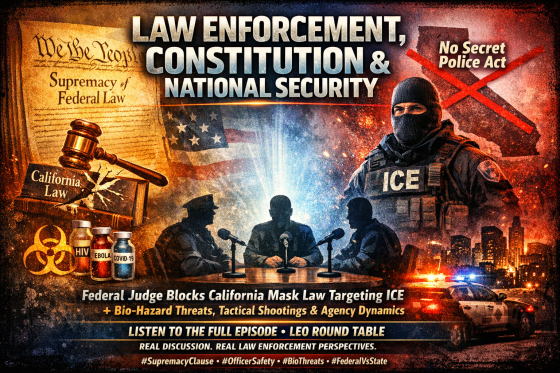

LEO Round Table with Chip DeBlock
S11E029, Special Ops Officers Fatally Shoot Gunman Who Was Harboring A Teenage Girl
LEO Round Table: Federal Injunctions, Bio-Hazard Threats, and Agency Dynamics
LEO Round Table: Law Enforcement News
Professional perspectives on the California Mask Ban ruling and national security threats.
Top Story Analysis
Federal Judge Blocks California's "No Secret Police Act"
Judge Kristina Schneider (Clinton appointee) issued a preliminary injunction against the law forcing ICE agents to remove masks during operations, citing the Supremacy Clause.
"These federal agents are harassed, doxed, obstructed, and attacked on a regular basis just for doing their jobs. We have no tolerance for it."— Pam Bondi, Attorney General
Legal Conflict
CA exempted state officers while penalizing feds with $10k fines.
The "Win" Claim
Newsom claims victory as the court upheld agency ID requirements.
Incident Briefings
-
Vegas Illicit Bio Lab
1,000+ pieces of evidence found in home owned by Chinese nationals; labels for HIV, Ebola, and COVID-19.
-
Baltimore OIS
Suspect on bicycle fired a .357 Taurus revolver at officers during a ground struggle; suspect fatally shot.
-
Vermont Use of Force
Officers cleared in fatal shooting of suspect attempting to ram them with a vehicle in reverse/drive.
Panelists
This episode of the LEO Round Table features a panel of law enforcement veterans discussing a federal judge's block of California's mask ban for ICE agents, the discovery of an illicit bio lab in Las Vegas, and a rigorous debate on the competence and challenges of small-town versus large-city policing. The discussion highlights the intersection of constitutional law, national security, and tactical reality.
Detailed Summary
1. Legal Victory Against California’s "No Secret Police Act"
A federal judge, Kristina Schneider, issued a preliminary injunction against California's law that sought to prevent ICE agents from wearing masks during operations. The court ruled that the act likely violates the Supremacy Clause, as it specifically targeted federal agents while exempting state and local officers. The panel criticized Governor Gavin Newsom's attempt to frame the ruling as a "win" for accountability, arguing that the law was political theater designed to facilitate the doxing and harassment of federal officers.
Legal Focus: The Supremacy Clause
The court's decision hinged on the principle that federal law takes precedence over conflicting state laws. Key points included:
- Discriminatory Enforcement: The law penalized federal agents while allowing state officers to remain masked.
- Operational Safety: Masking is essential to prevent federal agents from being doxed or targeted by retaliatory threats.
- Injunction Status: Granted because the federal government is highly likely to prevail on the merits.
2. The Debate: Small Town vs. Large Agency Competence
The panel engaged in a sharp debate regarding the "second string" stereotype of campus and rural police. While host Chip DeBlock suggested that elite candidates gravitate toward large agencies like Tampa PD, Dr. Joel Schultz and Dr. Travis Yates countered that small-town officers often possess a broader range of experience because they must handle investigations from start to finish. They emphasized that rural officers face unique dangers, such as responding to high-risk calls solo with backup often an hour or more away.
3. National Security: Illicit Bio Lab in Las Vegas
Authorities recently uncovered a bio lab in a Las Vegas residence owned by Chinese nationals. The site contained over 1,000 pieces of evidence, including vials labeled with pathogens such as HIV, Ebola, Malaria, and COVID-19. The panel expressed concern over the lack of national media coverage and emphasized that local patrol officers or informants are often the first line of defense against such unconventional threats. They also noted the importance of maintaining specialized equipment like hazmat suits, which are often funded through post-9/11 federal grants.
Evidence Summary: Las Vegas Bio Lab
| Pathogens Found: | HIV, Ebola, TB, Malaria, COVID-19 |
| Ownership: | Chinese National (Xu), previously linked to a CA lab |
| Scale: | 1,000+ pieces of biological/hazardous material |
4. Tactical Analysis of Officer-Involved Shootings
The panel reviewed two recent incidents:
- Baltimore, MD: Officers shot a suspect who produced a .357 Taurus revolver during a struggle. The panel noted the importance of "tactical reloads" and the need for high urgency when a suspect is known to be armed.
- Springfield, VT: A suspect was fatally shot after attempting to use his vehicle as a weapon against officers. The panel defended the officers' actions, stating that the legal standard is "reasonable and articulable fear," and that a vehicle's intent is defined by the officer's perception of the imminent threat.
Key Data
- $10,000: The starting civil fine California intended to charge for each violation of the mask ban.
- 1,000+: Pieces of evidence recovered from the Las Vegas illicit bio lab.
- 250,000: Deployments of "The Glove" (conductive distraction technology) with zero reported deaths.
- .357 Taurus: The high-caliber revolver used by the suspect in the Baltimore shooting.
To-Do / Next Steps
- Training Requirement: Officers must practice tactical reloads without taking their eyes off the threat.
- Report Writing: Officers must ensure reports for use-of-force incidents are "articulable," documenting the science of perception and physics to justify deadly force.
- Vigilance: Local agencies must remain alert for unconventional threats like illicit labs, as they are often the first to encounter them before federal intervention.
Conclusion
The discussion underscores a period of high tension between state policy and federal law enforcement safety. Whether dealing with biological threats in residential areas or the split-second decision to fire on a vehicle, the panel concludes that rigorous training, clear report writing, and constitutional protections remain the primary safeguards for law enforcement professionals.
LEO Round Table


LEO Round Table is a nationally syndicated law enforcement satellite radio talk show discussing today's news and issues from a law enforcement perspective. They also have components on TV, Podcasts, and Social Media. Their panelists are among a Who's Who of law enforcement professionals and attorneys from around the country.
https://leoroundtable.com/how-to-become-a-panelist/
[00:13] Speaker 1: Welcome to Leo Roundtable at leoroundtable.com. My name is Chip DeBlock, and I'm your host, and we're a group of law enforcement professionals that talk about today's news and issues, but we do it from a law enforcement perspective. And let me introduce the crew, guys. If you normally waiting for the video portion of our show, uh, Dr. Joel Schultz, retired police chief, uh, somewhere in the beautiful state of Colorado. Thank you, Chief, for being on the show. Also, Dr. Travis Yates, retired Tulsa Police Department major. Yes. Can you believe that? That's a big, that's a big guy and a big major for that department, man. Tulsa, TPD, the same, uh, the same ab-abbreviation for my agency. You always confuse me when we're hanging out and you're talking about TBD, Travis. So, thanks for being on the show, guys. A shout-out to our sponsors, and guys, please support our sponsors. They go to great lengths to bring this good-quality content to you.
[00:56] Speaker 1: We have our title sponsor, Gullis at gullis.com. Also, Compliant Technologies, our satellite sponsor. That's compliantetechnologies.com. We have gunlearn.com, mymedicare.live, safeguardrecruiting.com, our streaming sponsor, and thanks to them, we're streaming to over a million followers right now on social media during the live show. And hey, if you have any retention issues or you have any, uh, any issues with trying to get candidates, and I'm talking about a pool of candidates, recruits for your police agency, whether police, sheriff, or federal, guys, safeguardrecruiting.com. Travis can tell you more about them, but they are an excellent outfit and they're doing it the right way. You don't need to be paying all these incentives to get the wrong guy. Um, and then we got tubelis.com. They built a new online store at leoroundtable.com.
[01:36] Speaker 1: So if you want cool gear like the, uh, the mug behind me, they've actually got a new and improved mug that, that is in production right now, and, uh, the shirt that I'm wearing. Uh, go to our Leo Round Table website. Go to the online store that was built by Tube Ellis and check out the gear. We don't make a dime off of anything. We keep the prices low so that you guys will get our gear and get our, get our name out there. A shout-out to Bryan Burns for the Tampa Free Press at tampafv.com. Thanks for carrying our content, Bryan. Ray Detrick, formerlawman.com. And our very own Travis Yates with lawofficer.com. Thanks to all those entities for helping make this show happen. And, and guys, here's what we're gonna be talking about. I did throw in a new article, um, that I was privy to last night. Uh, newsbreak.com. We've got a federal judge blocking a California law that's forcing ICE agents to remove masks during the operat- during operations.
[02:21] Speaker 1: You know, originally, they came out with this. Gavin Newsom signed into law, and now we've, we've got LAPD police chief and the Los Angeles County sheriff, uh, saying, "Hey, we're not gonna enforce this thing." And so Newsom said, "That's fine. We'll go and, and we'll enforce it civilly and be charging $10,000 start, f-fines start at $10,000 for each violation," encouraging civilians in the state of California to continue to film and take pictures of cops and stuff, and es- especially the feds, ICE, so they can, you know, make them pay the civil. And now we got a judge stepping in. And I, I, it's a federal judge stepping in so I, I'm, I'm, I don't know if I should assume, maybe Travis or Dr., uh, Schultz would, would know whether this would prevent them from going after the, the guy civilly. But we'll talk about that i- in just a second. Some of the other stuff on the agenda, we've got authorities uncover illicit violab operating in the United States. Guess where? Las Vegas.
[03:15] Speaker 1: That's right. Owned by who? Chinese nationals. (laughs) Wow. You can't make that up. Suspect dead after he shot at a Baltimore police officer during a fight, and then we got body cam that shows he eventually leading up to a fatal shooting of a guy, Christopher Taylor. Uh, he's reinstated as a police officer. Tashan Rogers fired a shot at a plainclothes officers before being fatally shot by other officers. And then we got video shows a fallen officer fatally shooting a knife-wielding suspect after two people are stabbed. Uh, they survived, though, so, wow, just a lot of stuff going on. So let's start off with this, uh, Newsbreak article. Federal judge blocks California law forcing ICE agents to remove masks during operations. You know, this is the third time we covered this, and, and the news on this keeps changing, you know. Gavin Newsom thought he'd get cute and, and don't... I mean, make, let's make this very clear.
[04:00] Speaker 1: This is totally against the feds and against ICE officers and, and, and, and border patrol, but i-i-even though it's written for law enforcement to not be able to wear a mask and stuff, that's what he's doing. But if you, anyone saw, uh, Gavin Newsom go up against our own governor, Ron DeSantis, you know, in that debate and where, when his lips are moving, Gavin Newsom's lying. I mean, you know, the sky is green. I'm gonna convince you. And it's just, it's amazing. Even with this huge loss, he takes it as a win, which is not a surprise 'cause it's Gavin Newsom, but you'll see what I'm talking about in a second A Los Angeles-based federal judge on Monday blocked California from enforcing its law that would require ICE agents to remove masks during immigration enforcement operations. Now, the judge surprisingly is a Clinton a-appointee, Judge Kristina Schneider.
[04:48] Speaker 1: She granted a preliminary injunction against the No Secret Police Act, arguing that it discriminated against the federal government by violating the Supremacy Clause. Now, you know, you only do these preliminary injunctions if that side is likely to win. Uh, so I, I, I, I know that's what, I know that's what she believes and, and why she did it. Under the Constitutional Clause of Supremacy Clause, federal law, it takes precedence over any conflicting state or lower law, lo- you know, or, or local law, which is, of course, lower laws rendering the lower-level law unenforceable. Now, Schneider, the judge, said that the No Secret Police ruling hinged on California exempting its own state officers while penalizing federal officers or federal agents. So, wow, that... not too bright there. The court finds that federal officers can perform their federal functions without wearing masks, uh, Judge Schneider said. However, because the No Secret Police Act.....
[05:40] Speaker 1: as presently enacted, does not apply equally to all law enforcement officers in the state. It unlawfully discriminates against the feds. So Attorney General Pam Bondi, she applauded the ruling in a post on X on Monday, saying that federal agents are being increasingly targeted for doing their jobs, and warned the law would have worsened existing safety risks. And here's a quote saying, from her post, "Another key court victory thanks to our outstanding, the Justice Department attorneys," Bondi said. "Following our arguments, the district court in California blocked the enforcement of a law that would have banned federal agents from wearing masks to protect our identities. These federal agents are harassed, doxed, obstructed, and attacked on a regular basis just for doing their jobs. We have no tolerance for it." And that's irrefutable. You can't even argue that, that she's wrong on that. And it goes on to say... Now here's where the...
[06:25] Speaker 1: Gavin Newsom muddies the water because he's taken this as a win. Although the, the ruling blocking the facial covering ban, the court allowed the state's No Vigilantes Act remain in effect. Now that mandates that officers... it doesn't have anything to do with masks, that they just, uh, show their agency affiliation and a personal identifier like, like a badge number on their uniforms. Big deal. California Governor Newsom, uh, he called the ruling a win, framing the decision as a victory for his poli- uh, policy goals, despite the scourt- the, the, the court striking down the other measure. And here's a quote saying, "A federal court upheld California's law requiring federal agents to identify themselves, a clear win for the rule of law. No badge and no name mean no accountability." And this is what Newsom said.
[07:09] Speaker 1: He continued saying, "California will keep standing up for civil rights and our democracy." Uh, of course they didn't say anything about him standing up for, you know, more so for the rights of the illegals and taking the rights away from his citizens by allowing the illegals to be there in a sanctuary state. So commentary on this, gentlemen? I, I find this... I find Gavin Newsom fascinating that people continue to elect him in office even though he just has no shame any, and if his lips are moving, he's lying. Travis Yates?
[07:39] Speaker 2: You know, both political parties use emotion as a, as a power weapon, but no one does it better than Newsom's party. It's, it's always about appearances and virtue signaling and pulling on emotions. And very little of it is fact-based, and that's why Newsom is so successful. I mean this, this mask thing is ridiculous. Everyone with a brain knows they have to wear masks because they're getting doxed and death threats. Uh, you don't... And not one politician is speaking out against that. Can they... And by the way, Newsom knows. They all know. So this is all about feelgood and, and everything else. Anyone that knows anything about the law knows it's a supremacy clause issue. It's not a surprise the judge overruled it. It was all done by Newsom for appearances and for emotions and for whatever side that follows him claps their hands. But they're being played because he's playing them like a fiddle. And, uh, while he's doing that, real work's not getting done.
[08:30] Speaker 2: But that sort of seems to be the politics of the day.
[08:34] Speaker 1: Chief Schultz?
[08:34] Speaker 3: Yeah. I, I absolutely agree with Travis on, on two counts. Uh, first of all, it's, it's theater. And secondly, um, it, it would never have survived, um, court scrutiny. Uh, the, the ACLU would find a plaintiff to, to go the civil suit route. But you, you obviously have the supremacy clause. You've got the, the rationale for the masks and, and, uh, uh, other uniform r- requirements. Uh, Weiner apparently is gonna go back and try to readjust the law to, to make it palatable. But a- again, it's just, it's just not gonna... It's not gonna happen. Um, a- and, the... You know, the, the idea that (laughs) that a state legislature is going to make a rule that applies only to federal agencies i- is ridiculous on its face. It, it's just absolutely unsustainable. But it gets the press going. It makes Newsom look like he's a big advocate for, uh, for whatever. I'm not, I'm not sure. Um, so yeah. It's, it's a... And the thing is, you know, if, if you file a civil lawsuit... I don't understand.
[09:42] Speaker 3: Maybe we... if we had an attorney that, that could explain this. You, you've gotta have some harm that happens. You have to have a tort in order to file a suit.
[09:51] Speaker 1: Mm-hmm.
[09:51] Speaker 3: I don't know what, I don't know what a plaintiff could claim, um, that, that they're being harmed in some substantial way by seeing a cop with a mask on. I, I just, I just don't see the foundation of it.
[10:04] Speaker 1: $10,000, starting at $10,000 if they were able to pull that off. Could you imagine?
[10:10] Speaker 3: And, and, and I'm curious, and Travis may have some input on this. If, if... Is it the individual officer's decision to wear a mask or is that a mandate from somebody else? And I don't know how that would play out in court. Um, I just know that, uh, if, if an agency on the local level anyway, the ones that I've been involved in, state and local, um, if, if you do something that's within policy that's, that's mandated or allowed, there is some kind of protection. And of course they always want to sue the department because that's where the money is. Um, if it's just y- your own decision and you've done something, uh, discretionary and y- getting the grease in, in it, as, as you would say, the department's gonna be like, "Ah, we don't even know the guy," right? They're gonna back off. You're gonna have personal liability.
[10:54] Speaker 3: So I don't know how that would play in, uh, if, if, uh, if, if the mandates are coming from a, a, a policy for the masking or whether it's an individual officer's decision.
[11:06] Speaker 2: I mean Newsom has no issue whatsoever with Antifa wearing masks and criminals wearing masks. It's just as, as, uh, Dr. Schultz said, it's, it's a bunch of theater kids that get together to make these policy decisions.
[11:19] Speaker 1: Yeah. Good, good point. You're right. The, um, the other side, the protesters hiding their identities. They're smashing windows and stealing items and they're able to mask up. There's no law that I'm aware of, uh, or at least one that's being enforced preventing them from doing that, as there would be where I live. So, um, yeah. Interesting stuff. Guys, we are perfect timing. We're coming up on our first commercial break. So we're gonna be talking about our, uh, our title sponsor, Galls at Galls.com. So guys, commercial break. Stick with us. We'll be right back.
[11:50] Speaker 2: My family only cares about one thing, that I come home safe. (instrumental music)
[11:56] Speaker 4: At Gulls, every order begins with a promise. Made with purpose. Stitched for support. Back with pride. Answered by dedicated hands. Delivering the standard you have sworn to uphold. We serve more than the mission. We serve the person. Each piece is engineered to help get our first responders through the shift and back home safe.
[12:46] Speaker 1: Welcome back. Leo Roundtable at leoroundtable.com, the law enforcement talk show. My name is Chip The Block, and I'm your host. We're joined by Dr. Joel Schultz, retired police chief, and also Dr. Travis Yates, retired police major from Tulsa. Um, uh, y- you know, during the break, I tell you, Dr. Schultz slid it right in, right at, right in the nick of time. He was talking about a comment I made about, uh, campus police officers yesterday, and I cracked a joke about their campus cops, because they couldn't get on... I didn't, I don't think I said the rural police department, but I was implying that they would have gone with a, with a bigger agency first and they, and they, and they, and they, and they couldn't, so they went with, you know, they went with a smaller agency. And, uh, and, and so I was kind of re- retelling the story about how the campus cop sued the Tallahassee Police Department when he, when one of their K9s bit him.
[13:36] Speaker 1: While he's chasing a bad guy, and I, and I was, you know, kind of recounting stories on, at least when I was chasing bad guys, whenever they released the K9 and you knew about it, you did not budge. You stood still. You didn't move, 'cause that dog's like a, an unguided missile. It's gonna lock onto whatever's moving (laughs) and just take them out. So, uh, uh, but that is pretty much the luck of the draw. Is it not, Chief? I mean, you, I mean, the A- you, m- guys go to the best agency, the best pay, the best benefits, and, and it trickles down from there, so the agencies, like in my neck of the woods, my agency, Tampa, has the pick of the litter, and guys who don't make it into Tampa, can't get in, they'll go to the Hillsborough County Sheriff's Office, and the guys that can't get into there, they'll go into the other surrounding agencies, and they'll eventually, you know, get to where they're going to the USF Police Department, where I went to school, or Tampa International Airport.
[14:25] Speaker 1: Now, some of the agencies, like TIA, the airport, they'll get a lot of the guys that's retired from the other agencies, like Tampa. They'll get second careers going there, but, but that's... Is that not the luck... Is that pretty much the way things-
[14:36] Speaker 3: Well, that's a, that's a, that, that's a, that's a common bias that I see within the police community. I've worked for rural agencies and I was, uh, spent, uh, over seven years as a campus police chief, apparently because I couldn't get a job with a real department, Chip.
[14:51] Speaker 1: (laughs)
[14:52] Speaker 3: Um, and, you know, what, what I've seen and what I've done, what I've experienced, uh, the, the, the, the training that I see, the competence, uh, the choices that people make about lifestyle and, and how they want to live and where they want to live and what they want to do for their families, um, I, I have not seen a, uh, a deficit of competence, um, or like they're all second string or, or, you know, on the bench or wannabe. So, I th- just, I just, at the category, dis- categorically disagree with, with your observations and, and assumptions, 'cause I'm, um... And, and the same way with, with rural policing. You know, I've, I've had a lot of competent cops, some of the best cops and best detectives that, that I've ever, uh, worked with or know about.
[15:38] Speaker 3: And, and, uh, again, I've done ride-alongs with 50 different agencies, many big ones, um, you know all over the-
[15:45] Speaker 1: I'm not saying there's not outliers, but, but it is quite clear-
[15:47] Speaker 3: No, no, no, no, no, no, no, no, no, no. You're talking about an outlier? I'm, I'm talking about they are cops. They are cops.
[15:55] Speaker 2: I, I, I think, I think one of the benefits of a small town agency is, is your officers oftentimes have a more wide range of experience, 'cause they have to do more.
[16:06] Speaker 3: Exactly.
[16:06] Speaker 2: They have to not only take the report, but they have to go and follow up the investigation. They have to interview people. I mean, at a big department, you could just be a report taker. That's all, uh, that's, uh, there's a lot of officers that you just, you just take a report and send it on. So, uh...
[16:20] Speaker 1: But do you not, is there, I mean, it's, in my circles it's perly, i- it's fairly well known that, you know, that a lot of agencies, the small agencies suffer from, w- from a lack of training and, and you have to rely... Not that it's not... I mean, in some cases, you've got a good, strong sheriff's office or another agency that will, that you can partner with for your training and stuff. But there are a lot of smaller agencies out there, and we cover them on the show, where they, they just don't have-
[16:42] Speaker 2: Yeah.
[16:42] Speaker 1: ... the training that they... I mean, it's not a, not the cop's fault, but they just don't have the training.
[16:46] Speaker 2: I, I would say, I would say... I would also say it's the opposite. I actually, some of the best-trained people I know work at small to mid-sized agencies 'cause they had those opportunities, and you get lost in the shuffle at a big agency. But you're also picking on... I think, I think it's also easy to pick on very small departments when that's 92, 93% of all departments, right? So if you find a bad cop somewhere, there's a 90% chance they work at a small department, because that's just what departments are. Um, so I, I don't know. I think we're talking about stereotypes. I think, I think a cop is a cop, and there are bad cops, good cop, and they're spread out all over. It just so happens that very few departments are over 50 officers. So when you run into a bad story, they don't tend to work for big departments, because out of most departments are smaller departments.
[17:35] Speaker 3: And conversely, you know, we, we see, we see big departments that we review their actions and we think, "Well that was, that was stupid. They should have known better." They were the MIPD-
[17:43] Speaker 2: Right.
[17:43] Speaker 3: ... of Dallas or, you know, whatever. And I, and I will... Here's my tirade about small agencies. I, I, I would be very careful about criticizing small agencies unless you have ever responded to a bank robbery as a solo officer.... gone to a bar fight as a solo officer, worked your entire career without any air support, have been up to an hour away from a backup, and maybe three to four hours away from a SWAT team or a bomb squad, uh, because that's the reality of, of working out there, where you, where you're not surrounded by, um, a, a, a hundred other cops on the shift. So that, that's, that... You just tripped a trigger there, Chip.
[18:26] Speaker 3: And, and, uh-
[18:26] Speaker 1: No, I... Look, you could-
[18:27] Speaker 3: ... I w- I wanted to hold you accountable for it on-
[18:30] Speaker 1: You could-
[18:30] Speaker 3: ... on the air.
[18:31] Speaker 1: You could tot- Look, I'm man enough to admit you could totally be right and I could totally be wrong. I'm just going off of my, you know, just my experience. But look, I am isolated in, in Tampa, Florida, even though I've worked with a lot of feds and stuff. No, I, I've m- I've never experienced that with the feds. But, uh, there are some smaller agencies here. Um, I've worked with, um, some, some average people, some state agent people and stuff. And, and even with the sheriff's office here, and, and my... and, and even when I... When I worked at the police union and people... we, we had these badges that we were... and we had people coming from different agencies, it was just like, oh my gosh, having a conversation with some of these guys, it was just like really very apparent that there was a, you know, a, a, a, a, a difference. But I, I can't say that that is like blanket across America or everywhere. But I just... uh, uh, you know, in my experience, it, it's, it, it's shown.
[19:15] Speaker 1: But I could totally, I could totally be wrong. So I... and, and I'm talking... and I have high respect for you, so there's a, a good chance that you're right and I'm wrong, Chief. So...
[19:24] Speaker 3: Well, I just, I just wanted to say that in case there were any, any of those, uh, campus cops still listening after yesterday.
[19:30] Speaker 1: (laughs)
[19:30] Speaker 3: I wanted to let them know that they're-
[19:33] Speaker 1: No, I, I get it.
[19:34] Speaker 3: ... good at it or not.
[19:34] Speaker 1: All right. If I offended anybody, sorry. Um, and, uh... except for the chief. I don't mind if I offend him. But, uh, but no, uh, I, I, I could, I could be wrong on that. Uh, but anyhow, um, a lot goes... a lot of factors go into play when you're going for agencies. And I'll tell you what, you bring up a good point. If I... if Milwaukee was the best paying agency with the best benefits on the planet, I would not want to work for Milwaukee. Uh, I, I think that, um... or I say... I'm sorry, Minneapolis, uh, Minne- (laughs) I tell you, that goes with... that almost goes without saying.
[20:05] Speaker 1: Now, Chief succeeded in, in taking up airtime for the next segment and, and, and yet-
[20:10] Speaker 3: (laughs) Yes, I did.
[20:12] Speaker 1: We got to go to another commercial break. So guys, it's gonna get real, it's gonna get real good. We got some great stuff coming up. Stick with us. We'll be right back. Commercial break. All right, guys, it's time to talk about our satellite sponsor, Comply Technologies, at complytechnologies.com, and they're committed to providing non-lethal solutions that help officers gain the upper hand safely and rapidly in a humane, low optics manner, utilizing what they're calling their CD3, which stands for Conductive Distraction and De-Escalation Technology. And Travis Shakes knows exactly what I'm talking about. Now, their flagship product, we all know by now, it's called the Glove. It's helped officers not only tens of thousands of times, but they've had over 250,000 deployments with no injuries and no deaths. You heard that correctly. Uh, they've actually achieved non-lethal status in an arena that predominantly can only offer less lethal results.
[20:55] Speaker 1: And when it comes to weapons retention, transitioning to a sidearm or conducted energy weapon, the Glove at complytechnologies.com. They have virtually eliminated weapons confusion. So stay ahead of the game with Comply Technologies and their revolutionary CD3 that hundreds of agencies have already turned to nationwide. And friends, take it from me, when it comes to safety, this is one of the most common sense, hands-on solutions that has ever come along. Go to the complytechnologies.com. Welcome back to LEO Roundtable, leoroundtable.com, the law enforcement talk show. My name is Chip The Block and I'm your host. We're joined by Dr. Travis Shakes, retired police major from the Tulsa Police Department, and Dr. Joel Schultz, retired police chief. Uh, a- and I was... you know, I just got publicly spanked by Dr. Schultz, uh, you know, and, uh, and, and then I'm reading, uh, Spook Dog on, uh... it looks like he's on YouTube.
[21:39] Speaker 1: Campus cops in my area used to be students taking criminology (laughs) classes. That doesn't necessarily mean anything bad, 'cause I was a criminology student at one point too. And then we got Rocky Allen saying, "I was bit by the dogs at least six times, all my fault. I didn't follow the handler's instruction." And I bet Rocky, on Facebook, I bet you didn't sue the agency either, did you? And, uh, and so, uh, anyhow, but thanks guys. And, uh, so if you guys missed the, uh, the public smackdown, uh, that I just went through from Dr. Schultz, you have to replay it on, uh, you know, on, on YouTube or on Rumble in order to witness it. Maybe our hits will go up. So it was, it was, it was brutal. So, uh, if you guys are ready, let's, uh, let's move on to a story. I think we've got an update article here, and it is, uh, the libertydaily.com, authorities uncover illicit bio lab operating in Las Vegas home owned by Chinese nationals.
[22:30] Speaker 1: So, you know, when I first read the article, I had to run... I, I had to go through quickly and see, make sure it wasn't Randy Sutton's home or, or Jamie Borden's home. But after I cleared the air there, I went back and I read the article, uh, 'cause I knew it was safe and we could cover it on the show. A- and so a federal investigation has been launched after the discovery of an illicit bio lab operating in, in a Las Vegas home. And they said that they found files labeled HIV, malaria, TB, COVID-19, and Ebola, and more. Now, they did... a Fox News reporter said the lab allegedly is tied to China. Doesn't story... it doesn't make the story any better. SWAT officers served a search warrant Saturday at a residence on the city's east side after receiving a tip that a bio lab was operating inside the home, according to the Las Vegas Metropolitan Police Department where, of course, Lieutenant Randy Sutton retired from.
[23:18] Speaker 1: A row of re- refrigerators was found all containing vials of unknown liquids, but with horrifying labels. Police said the evidence, including biological samples, that they were sent for testing. Investigators protected themselves with hazmat suits, thank God. The owner of the home was identified. I- I'm not gonna... uh, his last name is Xu. Um, they said that he was, uh, a Chinese national, um, in the title. He's already in federal custody following the discovery of a, of a unauthorized bio lab in Reedley, California back in 2023, if that gives you any clue about this guy's background. He was accused in that case of making and distributing misbranded medical devices, such as tests for COVID-19 and more. His trial... he hasn't... it hasn't even been to trial yet. That's gonna happen in April. And then Sheriff Kevin m- McMayhill, he said, uh, and...
[24:01] Speaker 1: that in the Las Vegas home, there were more than 1,000 pieces of evidence involving potential biological and hazardous materials.How would you- Chief, how would you like to get, get that call (laughs) and have to go out there for that one?
[24:14] Speaker 3: Well... I, I'm just waiting for the left to come to the defense of Chinese communists, uh, because that's, you know, that, that's typically their response to, uh, a law enforcement crackdown. Um, I, I think the whole... And Travis had his mic open before I did, so I'll, I'll yield to him pretty quickly. But this whole... You know, we could be very paranoid and, and, uh, uh, conspiracy, uh, absorbed with this Chinese stuff.
[24:42] Speaker 3: I mean, they're, they're taking over agriculture, they're buying land, they're getting stuff near military bases, uh, they're involved in the Venezuela, uh, situation that, that the Trump administration has addressed, and even encroaching on, uh, influence in Greenland, which, which has, uh, defensive, um-
[25:00] Speaker 1: And law, yeah.
[25:02] Speaker 3: Yeah. A- and so it, it's, um... It's, it's a real scary thing that, uh, that there's so much Chinese influence and, uh, uh, it, it, it's interesting to me that, uh, it, it's a, a local agency that peeled this back. And of course, the feds are in it now. And we're s- we're still in a terrorism fight. We're, we're still worried about, um, nuclear issues. We're worried about, um, you know, the, the grid, the power grid. We're worried about, uh, biological assaults. And when we have all these preparations in place, whether it's for, um, you know, an ultimate destruction or, or, um, uh, targeted attacks, it, it just scares the bejeebers out of me. I don't have an answer for it, don't have a solution for it. But, uh, um, I'm, I'm glad that's being peeled back. And it's kind of like the old, uh, if you find one, look for another, you know, when you're searching somebody and you find a gun you don't stop. There's probably another gun somewhere or might be another weapon.
[26:06] Speaker 3: So we can't stop and say, "Oh, well, I'm, I'm glad we put a cap on this thing in Las Vegas," because how many other places are, are happening? And, and how are they gonna be exposed? They're gonna be exposed like so many major criminal investigations. Um, some patrol officer or confidential informant or detective is gonna be the first one to spot this. Um, so we all need to remain vigilant.
[26:30] Speaker 1: Mm.
[26:30] Speaker 2: I was just gonna say the same thing. Like, this is in a home in Vegas. What's going on in the desert? (laughs) I mean, where, where else is this stuff happening? I, I'm trying to wrap my head around the seriousness of this and it's not even in the news anymore. It's like this dude's rolling around with all these biohazards. I mean, honestly, the COVID-19 vial doesn't bother me too much. But those other ones seem to bother me. Uh, I'm sure if there's a liberal listening, they're freaking out about that COVID-19 viral, viral. They're going to get their boosters.
[26:59] Speaker 1: (laughs)
[26:59] Speaker 2: But, uh, I, I'm just trying to... What I haven't heard is what the motive was and what the intent was and what (laughs) what is going on, right? But, you know, that and we announced that JFK was killed by our own government and that aliens exist, it's out of the news the next day. So it's really a weird time in America. This to me should be major news all over the place. That and of course ransom letters. So yeah, pretty odd.
[27:23] Speaker 1: Uh, I was impressed the sheriff's office had biohazard suits. Um-
[27:27] Speaker 2: Well, I'm surprised Newsom hasn't made a law against that, right? I mean, they're covering up to protect themselves, so I- that's really surprising.
[27:34] Speaker 1: Yeah. But I mean, actually this is where having the right equipment... I mean, I, I, I used to have a, uh... You know, you know I'm a big fan of go-bags, but we had one. I had my gas mask, my bio suit in my trunk. And, uh, I, I'm just glad to hear that they're still equipping guys with that kind of stuff, because, you know, they would have had to call some three-letter agency to come, you know, take over before they went in.
[27:56] Speaker 3: You know, there was a lot of that stuff that was distributed post-9/11. And I, I always said during the years of my, um, police work, you know, in the '80s if you wanted money, had to be for drugs. If... In the '90s, it had to be for community policing. Uh, you know, in the 2000s, it was for terrorism. You always wanted the same thing. I want equipment, manpower, cars and guns.
[28:17] Speaker 1: Oh, okay.
[28:18] Speaker 3: Um, so I, I just wonder if, if they're looking back into the, you know, 10-year-old stock of, of, uh, hazmat suits that they got from federal grants. But these things are, um, you know, they're, they're so central. Now, again, talking about rural law enfor- enforcement agencies, um, we, we can have central... Um, you know, not every little department has to have a whole bunch of hazmat suits, but, uh, we would have regional-
[28:42] Speaker 1: Right.
[28:42] Speaker 3: ... things that were funded through 9/11 funds. Um, so you'd, you'd have a hazmat unit maybe for s- for several counties, uh, that, that would come together. But, you know, when, when people l- look at that before something happens, "So why do you need that? Why do you need that armored vehicle?"
[28:58] Speaker 1: Oh.
[28:58] Speaker 3: "Why do you need those suits? What do you need those, uh, uh, rifles?" Um, you don't need them until you need them.
[29:06] Speaker 1: Yeah, you're right. You're right. I, I, I totally agree. Well, guys, if you're ready, uh, I think we've got a story with a video component that's coming up next. So, um, this next one, rumble.com, our, our favorite law enforcement video channel called This is Better, suspect dead after he shot at a Baltimore police officer during a fight, during a struggle.
[29:23] Speaker 4: Hey, g- get your hands. Okay.
[29:26] Speaker 5: Okay, sir.
[29:26] Speaker 4: Listen to me. Oh, shots fired, shots fired. (gun firing)
[29:33] Speaker 1: So we're in, uh, Baltimore, Maryland. This Baltimore officer narrowly escaped a bullet in what later turned out to be a fatal police shooting.Totally agree. Um, the agency publicly released a video on Thursday afternoon. It shows the intense mome- moments that happened on January the 20th. So, this just happened and... of a late-night shooting that happened near Anchor Square Shopping Center. That is in Southeast Baltimore. Now, police said the timeline has started a block away. There was a fight at somebody's house. This guy named Jamari Muse, 40 years old, or bad guy, um, he pulled a gun out before he leaves on a bicycle. So, that was a block away. And those involved in this fight, they called 99- uh, 911, and an officer sees Muse, or bad guy, nearby. And the video released on Thursday shows the officer. He tackles this dude off the bicycle, and they get on the ground and then more officers arrive.
[30:23] Speaker 1: Now, when you're watching the body cam, we've got an officer, our officer wearing the body cam is running up. Bad guy's on the ground, and we've already got two other officers fighting with him. Bad guy appears to be on his back, and these guys are on top of him. So, our- our officer is our third officer that's arriving there but- but this is right when it goes bad. So, this third officer gets there, and as they're trying to get this guy to put his hands behind his back, it's in that struggle, uh, that when all of a sudden he- he- he... and he- and he starts turning around, um, his body position. He produces a revolver and he fires it, and, uh, shocks everybody. And you can see the blast, and then multiple officers return fire. And, uh, the... and- and- and the bad gun... it wasn't just a bad gun. I know people are saying a revolver. Well, it's probably a 38. This was a .357, uh, revolver. Um, he only pulled the trigger one time, but it's a .357 Taurus and, uh...
[31:17] Speaker 1: and assuming that he was shooting a .357 Magnum out of that instead of like a 38, 'cause it'll shoot both, that's a wicked round that you don't want to be hit. You don't want to be hit with any round, but especially like a .357 or 44. Uh, police said the two officers, they each fired six shots, hit the bad guy who died at the scene. Thank God no officers were, um, injured in the shooting. Uh, extremely close call. Commentary on this, gentlemen? Any flashbacks, Travis, from what happened in Tulsa with you or...
[31:45] Speaker 2: Well, uh, you know, it- it- it goes to show you that... I don't really know if the third officer was aware that this guy was suspected of having a gun. In the details, it said that they... that he was suspected of assaulting someone with a gun before they got him on the ground. So, this third officer runs up there. But, boy, I tell you what, there didn't... there didn't seem to be a whole lot of urgency when this guy supposedly had a gun and he's fighting them. I mean, there ought to be some Hulk Hogan, WWE, something going on to get this guy to comply quickly because the urgency didn't seem to be there before that shot went off.
[32:17] Speaker 1: Commercial break, guys. We'll be right back. All right, guys. It's time to talk about GunLearn at gunlearn.com. And, you know, as law enforcement officers, we deal with guns and we deal with ammo every day. But it's what we don't know about them that gets us into trouble: injuries, civil lawsuits, accidental discharges, misidentifications, lost prosecutions, and disciplinary issues. But gunlearn.com, they have your back. You can quickly become extremely firearm knowledgeable by simply learning 14 training modules from the convenience of your home or your office or by attending a live seminar at gunlearn.com. You can also become a safe, accurate, and competent certified firearms specialist like our very own Captain Brett Bartlett and also Attorney Ken Affianco. Now, the course has had huge success in raising the bar of firearm knowledge.
[32:57] Speaker 1: And GunLearn has been a trusted source since way back in 2011 by gun manufacturers, federal agencies, forensic organizations, and police departments nationwide. Now, the founder, Dan O'Kelly, has got a deal for you if you have your own agency. If you're a chief or a sheriff, you can host a seminar for absolutely no cost. It's an amazing opportunity. You can go to thegunlearn.com to get more information. Welcome back. LEO Roundtable at leoroundtable.com, the law enforcement talk show. My name is Chip The Block and I'm your host. We're joined by Dr. Joel Schultz, retired police chief, and also Dr. Travis Schatz, retired police major from Tulsa. We've been talking about a use of force. Uh, we have a- a- a bad guy that flees the scene, flees the fight on a bicycle after he produces a gun. We have a cop tackling him, and now we got our third cop arriving on the scene. They're trying to get his hands behind his back and, uh...
[33:44] Speaker 1: yeah, he produces a gun, a .357 Taurus revolver, fires one shot and, uh, the officers light him up. I think they each fired like six- six rounds and- and- and- and the bad guy dies. Um, I know that, um... I think Travis was, uh, commenting before the break. Uh, Chief Schultz, I believe you were up.
[34:01] Speaker 3: Yeah, I just- just wanted to say a couple of things. Uh, you know, the application of a glove could have put an end to that, uh, on first contact.
[34:08] Speaker 1: Oh. Good point.
[34:09] Speaker 3: Uh, you know, just- just- just as an aside. And secondly, I have never had to engage in a tactical reload after I'd just killed somebody, so I don't want to be too critical of the officer. But just for officers and- and training officers, you need to be able to do a tactical reload without putting eyes on your weapon. Um, and I... and I don't say that as a big critique, just kind of a... maybe a- a training issue 'cause the officer had a- a little bit of, uh, hard time. At least they realized... and I- and I've seen some of the videos. Haven't had the chance to, um, comment on them. Sometimes they'll empty a mag, uh, and the slide is back and- and they don't... they're- they're... they've still got their weapon on the bad guy because they don't know that they're out of ammo. Um, so, uh, you know, happy ending on this one. They finally got around to it. I agree with Travis. They- they were probably far too... I mean, they drove fast with lots of sirens in the background.
[35:04] Speaker 3: That was part of the exciting part of the video. But, uh... and- and, you know, and- and I would- I would say, um, it's just interesting when you- when you've... uh, when the getaway vehicle is a bicycle. I don't know. It just tells you something about the offender. I'm not sure what.
[35:23] Speaker 2: A bicycle, a Taurus-
[35:25] Speaker 3: (laughs)
[35:25] Speaker 2: ... and a Cricket phone.
[35:27] Speaker 1: (laughs)
[35:27] Speaker 3: And the Cri-... Yeah, there you go.
[35:28] Speaker 1: Or a Nokia phone.
[35:28] Speaker 3: That's the triad.
[35:31] Speaker 1: Hey, uh, did e-... did either of you guys ever carry a Taurus?
[35:37] Speaker 2: No, I'm a man, Chip. I'm a man.
[35:39] Speaker 3: (laughs)
[35:40] Speaker 1: A- a- and- and tell them-
[35:40] Speaker 3: I've owned them. I never carried them as a duty weapon.
[35:43] Speaker 1: Okay, yeah. I've- I've, uh... I, until recently, was carrying a Taurus Slim.... and, uh, and it is a, um, a compact. Now they have micro compacts, right, which are even smaller. But it, it's a, you know, it's a slim, so it's a small profile you can carry in your pocket. Here in Florida, we wear shorts everywhere, so you can literally have it in, in your shorts pocket. Nobody would be the wiser. Um, and I, and I, I just... A buddy of mine's got it now. I'm gonna probably be selling it to him. But, um, but they make a good gun. I, I tell you, it had a Glock trigger, uh, which is a little unusual. So, you know, I'm a big fan of Glock triggers, um, you know, because you get that, you get that short reset, you know? So, um, anyhow, I just thought I'd give Taurus a little plug. I do like the Taurus.
[36:22] Speaker 3: Well, I, I, I will confess that I, that I carried a, a Raven 25.
[36:28] Speaker 1: Oh, don't say.
[36:29] Speaker 3: (laughs)
[36:30] Speaker 1: Did you really?
[36:31] Speaker 3: As a, as a backup gun, yeah.
[36:33] Speaker 1: Was it like... Was it one of the gold-plated Ravens? (laughs) What, what was-
[36:38] Speaker 3: No, it was, it was black.
[36:40] Speaker 1: You got a handle on it?
[36:41] Speaker 3: Now, mine had, mine had an unusual striation on it because I just carried it on the inside pocket of my Tuffy jack and, uh, about the third time it fell out during a fight, I said, "You know, this could possibly do more harm than good."
[36:53] Speaker 1: (laughs)
[36:54] Speaker 3: So, I, I retired it.
[36:54] Speaker 1: Raven. Wow. We used to find all kinds of stuff on bad guys. Wow. All right, guys. So, we got six minutes. I think we got time for another story with a video component. So, this next one, rumble.com. This is Butter Still TheChannel. Body cam footage shows events that... leading up to a fatal shooting of a man.
[37:08] Speaker 2: Show me your fucking hands! Stop it!
[37:10] Speaker 4: Hey!
[37:10] Speaker 2: Turn it off!
[37:11] Speaker 4: He says that you're 10-
[37:11] Speaker 1: Turn it off! Turn it off!
[37:21] Speaker 2: Shots fired! Shots fired!
[37:22] Speaker 1: So, Springfield, Vermont. So, the Vermont Attorney General Charity Clark has decl-... I, I hate it when they start a mob like... They've declined to prosecute the Springfield police officer named Vincent Franchi and also a Windsor County deputy, uh, Brian Jalava, after they shot and killed James Crary while responding to a call for an alleged assault, robbery, and a kidnapping. So, the call seems like it was sort of a, a pretty substantial, uh, uh, assault, robbery, and kidnapping, but we have a Springfield police officer and a Windsor County deputy that are responding to the same call. So, I, I, I do like to see that, um, 'cause you don't see that e-... you don't see that every day, you know, two different agencies responding. The footage released shows the perspective of the officer Franchi and, uh, and also Deputy Jalava. They're trying to arrest this bad guy, Crary, during their investigation.
[38:11] Speaker 1: Now, Crary, our bad guy, he's leaving the home, um, and he does not stop his vehicle and he puts the officers at risk for serious injury. Wait till you hear how he's... what he's doing in the car. But this is all determined by the AG Clark's office. So, the, uh, Clark, the attorney general said the body cam footage shows the officer and the deputy that are trying to stop this white vehicle that the bad guy is in, and he, uh, you know, he's, he's... He starts the car, he drives forward away from them, goes in an opposite direction, but then all of a sudden, he puts the car in reverse and, and backs it up kind of like where he came from, and now he's facing them. He puts it in drive and he's driving towards them. Now it's late, it's dark, but you can see a row of cars and obstacles that are, that are, um... They have no escape to the left. I, I can't remember if it was, like, blocked by brush or whatever.
[39:00] Speaker 1: But to the right, you've got, like, a bu- a bunch of cars and stuff and a building. And this dude steps on the gas and he's coming at him, and they turn, they turn, they turn about face and they're, like, bamboozing. They're, like, running, trying to outrun this car that's, that's encroaching on them. And I'm thinking, "Man, these guys don't stand a chance." I'm thinking this car is gonna, like, run these guys... It's like watching a, a, a pretty good movie with, with a, with a pretty good action scene, you know? I'm thinking, "Man, there's no way these guys are gonna get away." So, they end up s-... They, they fire at the guy while he's revving his engine and he's coming at them, and, and they literally their, their, their path was blocked, so they... It looks like they just made it to a, to a break where the cars were parked at where they're able to dive out of the way, and both officers fired their service weapons, um, and the bad guy crashes.
[39:43] Speaker 1: At least he didn't crash into the police officer's car. He crashes into the deputy's car, the cruiser, and he's able to get out of the car but he dies at the scene anyhow. So, that's the way that ends. Um, commentary on that, gentlemen? We have three minutes and, uh, about 15 seconds. Travis Yates
[39:58] Speaker 2: No, I mean, we see this constantly. This is what I said when that Minneapolis shooting happened is, this is not unique. Every week there are people trying to drive towards officers or drive around officers or to officers. And we make a big deal about watching the video and going, "Okay, was the car angled directly at the officer? What was her intent?" That's got nothing to do with it. What was the perception of the officers, right?
[40:21] Speaker 1: Yeah.
[40:21] Speaker 2: Was there an eminent, was there an eminent threat towards the officers? And the people that are saying this have guaranteed have never had a vehicle drive close to you at all, right? It's happened to me. It's probably happened to everybody on this show. Most of the time we're not firing our weapon, but there are times that has to occur. And so, uh, this is not gonna be controversial because it's not happening in Minneapolis or the media doesn't care, but what we saw in Minneapolis is not unique whatsoever. It's just unfortunate that e- everybody lost their mind for it. You know, we have Shawn Hess here on the show listening who is so offended that these guys were talking about these factual police issues. You need to take a breath, stop drinking so much coffee, don't watch NBC The View, and just look around and have a clear head about things. This is not unique. It's not controversial whatsoever.
[41:09] Speaker 2: Unfortunately, there are people that try to kill us with their cars, amongst other things, and the only thing we have at our disposal is, unfortunately, a firearm.
[41:17] Speaker 1: And, you know, it's funny though, that Shawn Hess, even though he thinks that, uh, no one listens to what we have to say or is interested, he's, he's watching the show 'cause that's not the first... that's not the only comment he's med-... he's made, so interesting.
[41:29] Speaker 3: Yeah. Welcome to, uh, offend the audience week here at-
[41:33] Speaker 1: (laughs)
[41:33] Speaker 3: ... Leo Roundtable. Um, you know, it, it... There's, there's two skills, um, three skills really that are important in these kind of events. One is firearms training. Um, the other is the investigation, uh...And, uh, the third is reporting, uh, report writing. Because this, this is a, this is a math issue, it's a physics issue, it's a human performance and, uh, physical capacity issue, perception. It's, it's the science of it. Um, you know, I, I, I hear from time to time, "Oh, all an officer has to do is to say, 'I'm scared.'" No, you have to have a reasonable and articulable fear, uh, that, that meets the definition of the justification for, for deadly force. And so that needs to get documented so that the people reviewing this, the prosecutors and potentially the judge and the, and the jury, um, can look at this and recreate it in their mind.
[42:40] Speaker 3: When you write a report, you've gotta tell the story so that it implants itself in the brain and then as much as possible, the, the hearer of the story experiences it as much as possible as the officer did. So, um, I, I agree with Travis. I think this'll be a, you know, no-brainer. I'm glad that, uh, uh, the disposition of the prosecutor was, was the right call.
[43:04] Speaker 1: Excellent. Well, excellent commentary guys. You know, it's funny that we've got, uh, Bill BC saying o- on, on Rumble he had a .357 Taurus, a seven-shot. How in the world... Uh, a .357 seven-shot, are you kidding me? I can think maybe, maybe a six-shot, but have you ever heard of a, of a .357, a seven-shot? Do you know how big the cylinder would have to be on that sucker?
[43:28] Speaker 3: I've had a nine-shot, but it was a 22.
[43:31] Speaker 1: Yeah.
[43:31] Speaker 3: You've gotta have some wall space between those cylinders with a .357 load.
[43:36] Speaker 1: Yeah. Yeah, that would be. I'd like to see that. I'd like to see the hands of the dude that carries that sucker. Maybe some dude the size of Travis Yates probably, you know. But, uh, uh, hey gentlemen, uh, thank you so much. Uh, Dr. Schultz, uh, retired police chief, and also Dr. Travis Yates, retired police major from Tulsa. Thank you gentlemen for being on the show. I do wanna mention The Window Blue at thewindowblue.org, Lieutenant Raines 501 (c) (3) , helping cops out in the world of hurt. And also wanna mention our sponsors. We have golis.com, complianttechnologies.com, governor.com, americare.lifesaferecruiting.com, and twobells.com. Thanks for watching the show. We'll see you guys back tomorrow, 12:00 noon Eastern.
[44:15] Speaker 1: (rock music plays)