Breaking the Silence, August 9, 2026

Breaking The Silence with Dr Gregory Williams
ASL Picture Books and the Power of Accessible Communication
Dr. Gregory Williams hosts Breaking the Silence with guest Kathleen Marcath for a heartfelt conversation about American Sign Language, deaf and hard-of-hearing children, inclusive picture books, My Monster Truck Goes Everywhere With Me, ASL classifiers, deaf representation, brain benefits, classroom learning, family communication, and the hope that sign language can become more visible, normal, and accessible for everyone.
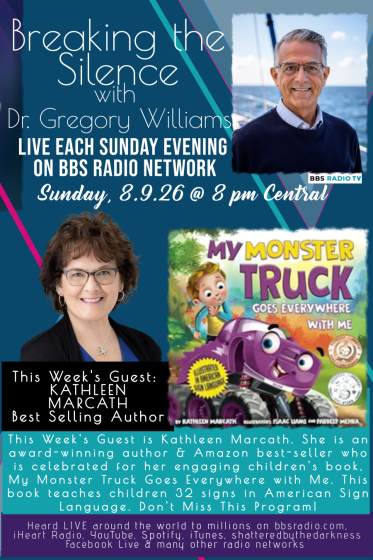
This week's guest is Kathleen Marcath.
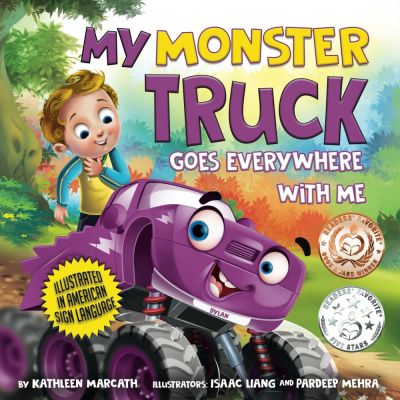
She is an award-winning author and Amazon best-seller who is celebrated for her engaging children's book. "My Monster Truck Goes Everywhere with Me" This book teaches children 32 signs in American Sign Language.
Guest Spotlight: Kathleen Marcath
This episode of Breaking the Silence, hosted by Dr. Gregory Williams and dated August 9, 2026, features guest Kathleen Marcath is the author of My Monster Truck Goes Everywhere With Me and related ASL learning resources.
Dr. Gregory Williams Opens With Gratitude, Housekeeping, and Hope
Dr. Gregory Williams opens from Houston, Texas, welcoming listeners, noting the approaching back-to-school season, and sharing updates about his own writing projects. He mentions the upcoming seventh anniversary of Breaking the Silence, gives call-in and text information, praises the BBS Radio team, and introduces the evening’s guest as a subject he has never quite had on the show before. His personal connection is immediate: he recalls having deaf family members, watching relatives communicate through sign language, and wishing he had learned more himself.
Kathleen Marcath’s Path Into American Sign Language
Kathleen explains that her interest in sign language began at a retreat where a group learned to sign the song “Our God Is an Awesome God.” That experience stayed with her, eventually leading her to study sign language at Madonna University. While taking a class that required her to choose and sign a picture book, she looked for children’s books that naturally included signing children but could not find what she wanted. Years later, after working in schools and spending time with her grandson, she entered a writing contest and realized her story could become the kind of ASL picture book she had once searched for.
Why Representation and Natural ASL Learning Matter
The conversation highlights the importance of representing deaf and hard-of-hearing children in books and classrooms. Kathleen says American Sign Language is a full language, even though it is not spoken, and describes how children become excited when they learn it. She shares a classroom story about a child she calls Jonathan, who began to smile and participate more after using sign language activities to tell simple stories. Dr. Williams connects this to his own awe at watching deaf relatives communicate, emphasizing how powerful and overlooked this form of communication can be.
My Monster Truck Goes Everywhere With Me and the 32 Signs
Kathleen describes My Monster Truck Goes Everywhere With Me as a fun, natural way to introduce ASL. Each page includes at least one sign, and the book teaches 32 signs. To support readers, the back of the book includes QR codes linking to videos with deaf storytellers signing the story and teaching the signs with variations. Dr. Williams praises the book’s layout, illustrations, and accessibility, noting that even someone unfamiliar with ASL can begin to understand what is being shown. Kathleen explains that babies can learn sign language from birth and emphasizes that it is not “baby sign language,” but sign language that babies learn.
Deaf Illustration, Purple Monster Trucks, and ASL Classifiers
Kathleen explains that it was important to her to work with a deaf illustrator, and she found Isaac Ling in Singapore, who created the storyboard and drawings, while Perdi Mira handled the coloring. Dr. Williams praises the book’s bright color and asks about the purple monster truck, which Kathleen says emerged after the original red did not feel right. The discussion also explores ASL classifiers, especially the vehicle classifier used for the monster truck. Kathleen explains that after a signer identifies an object, a classifier can represent it throughout the story, making it a powerful storytelling tool.
Activity Books, Schools, Seniors, and Untapped ASL Potential
Kathleen discusses the companion coloring and activity book, which includes 77 pages of coloring, math, writing, clocks, handshapes, and activities meant to work for younger children as well as first-, second-, and third-grade students. Dr. Williams asks why ASL is not taught more widely in schools, and Kathleen points to deaf history, oralism, signing debates, teacher preparation, and the need for even small daily exposure when deaf children are present. She describes ASL as an untapped resource with unlimited potential, useful not only for children but also for seniors, couples, underwater communication, space, baseball signs, and everyday across-the-room communication.
Website Resources, Freebies, and the Call for Broader Awareness
Kathleen directs listeners to ASLPictureBooks.com, where people can find her books, blog, favorite-book resources, free charts, coloring pages, and information about classifiers, signer space, and sign selection. Dr. Williams repeatedly frames the book as a valuable gift for children, grandchildren, families, and anyone who wants a gentle introduction to ASL. Kathleen also mentions other authors and books connected with deaf representation, including stories about deaf and deaf-blind children and families learning to communicate. Together, they present ASL as not only practical, but normal, fun, brain-engaging, and deeply human.
Closing Encouragement: Hope, Resilience, and Never Giving Up
After saying goodbye to Kathleen, Dr. Williams closes with a message for children and families heading into the school year. He reminds listeners that no matter what they are facing, there is always a better day and always hope. Using the image of the sun setting behind him over the Texas Medical Center, he says that no matter how dark things get outside or inside, the sun will rise again tomorrow. He encourages children and adults to hold on, stay resilient, discover the resilience already inside them, and return next week for Chief Matt’s appearance.
Guest, Kathleen Marcath
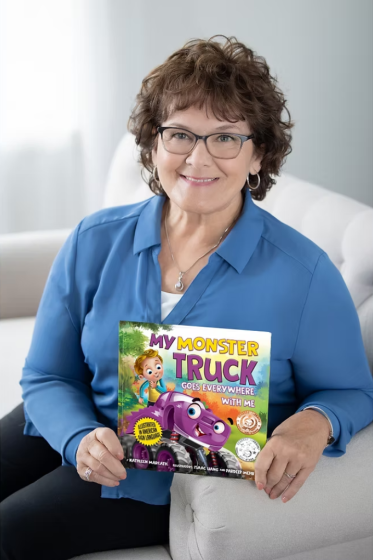
Kathleen Marcath is a children’s book author who first discovered American Sign Language (ASL) when she learned to sign the song “Our God Is an Awesome God.” The beauty and power of ASL captured her heart and never let go. Countless times, she’s witnessed the same magic transpire in people (deaf and hearing alike) when they learn this beautiful language.
Kathleen holds a bachelor’s degree in Deaf Community Studies from Madonna University. Her studies inspired her to promote ASL literacy and raise awareness of its importance to audiences of all ages and backgrounds.
In 2020, Kathleen founded ASL Picture Books to address the lack of Deaf representation in children's books. That same year, she published her award-winning debut children’s book, My Monster Truck Goes Everywhere With Me: Illustrated in American Sign Language.
Kathleen lives in Michigan, and when she’s not writing, she enjoys time with her family—especially her grandchildren. Kathleen’s favorite family activities are playing games, baking, exploring the outdoors, and hiking through their woods. Children's imagination and joy inspire her.
Our mission at ASL Picture Books is to help fill the need for inclusive and diverse picture books and other resources about deafness and American Sign Language (ASL). Help d/Deaf and Hard-of-Hearing (DHH) and hearing children discover the gift they hold and the skills to share it with the world as only they can. We work hard to foster understanding, inspire creativity and develop a greater appreciation for the unlimited potential of ASL.
Breaking the Silence
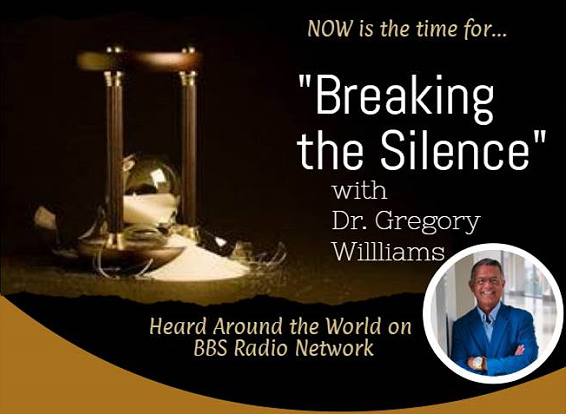
“Breaking the Silence with Dr. Gregory Williams”
Now is the time for you to step out of your own personal darkness and break the silence that has been hidden and closed up inside of you.
“Breaking the Silence with Dr. Gregory Williams” radio program will offer the listeners a Road Map to Hope each and every week with keys to discover within yourself that ray of light to make your day better and brighter. Dr. Williams will not only discuss his own personal journey of overcoming the darkness of years of horrific sexual child abuse in the hands of his father and his father’s friends, but Dr. Williams will also feature special guests that have their own personal stories of overcoming obstacles in their lives and becoming victors instead of victims.
“Breaking the Silence” will also feature information from the professional and medical field that will dive into the important research involving Adverse Childhood Experiences (ACEs) and how to build Resiliency in yourself and in your children. Along with this information will be special guests from greatest minds in the United States to share their expert research and thoughts on this very important subject that each person needs to be aware of.
Now is the time to invest a few minutes each week with some awesome information to give you steps to HOPE and keys to HAPPINESS and PEACE. NOW is the time to Break YOUR Silence and breakout into a NEW and BETTER YOU! Join us each week beginning August 13, 2019 for “Breaking the Silence with Dr. Gregory Williams”. You won’t want to miss a single program. Heard around the world on the best radio network on the airwaves, BSS Radio Network available on iTunes, Google Play, iHeart Radio, Facebook Radio, Spotify and over 100 other high quality digital radio stations.
Speaker Identification
Station Announcer - Program introduction, promotional break, and closing announcement.
Speaker 1 - Host, Dr. Gregory Williams - Host of Breaking the Silence.
Speaker 2 - Guest, Kathleen Marcath - Author of My Monster Truck Goes Everywhere With Me and related ASL learning resources.
Station Announcer:
Welcome to Breaking the Silence with Dr. Gregory Williams. Dr. Williams is the author of the acclaimed book, Shattered by the Darkness, putting the pieces back together after child abuse. Dr. Williams is on the senior leadership team at Baylor College of Medicine in Houston, Texas. And Dr. Williams travels the United States speaking and training professionals, parents and victims about the importance of dealing with abuse and personal trauma head on and not being afraid to break the silence of your own personal pain. Feel free to call in to tonight's show at 888-627-6008 and speak with Dr. Williams and his guests live on air. And now, your host, Dr. Williams.
Speaker 1 - Host, Dr. Gregory Williams:
Well, good evening and welcome to my house right here in the beautiful city of Houston, Texas. And we're looking at the sun go down right here over the Texas Medical Center. And the pinkness is right there. The sun, you can't hardly see it now because it is going down. But just great to have you with us tonight. Here we are in what? The second Sunday of August. And just like, wow, time is flying by and didn't seem like kids are getting ready to go back to school again. But here we go. So I appreciate you being here tonight. We're going to try to have a great show. We're still waiting for our guests to hop on from Michigan. And when she does that, we will bring her right in. But we will do a little bit of housekeeping. And then I'll share a little bit about trying to finish up the thoughts that I have a Chief Matt last week or the week before. He's going to be our guest again next week. He's getting ready to have the kickoff for his book in the next week or so. So we want to welcome that. And I promise to have him on to help him with that book and hopefully push that thing to go to number one, which is so hard today. I tell you what. I think I've just read yesterday that the average author right now, the writes a book sells approximately 250 books a year. Wow. Now, we're not talking about the political books and the big named authors like Stephen King and all that. You sell millions before, you know, it ever goes to press and pre publication cells and things of that order. But just the average author sells 250 a year, 250 books a year. I think I sell that in about a week, but some days I do it in a day and some days it takes a little longer than that. But God's blessed us. And I have another booking ready to come out. Hopefully next month, if all goes well. It's my first children's book and looking forward to that little Gregory's not so good. No, good days and not so good days. So that's going to be coming out and looking forward to seeing how the children deal with that between the ages of seven, eight years old, all the way up to probably 12, 13 years old. And I'm really been enjoying writing it, whether it's going to be a good read or not. We'll find out and hopefully the kids will enjoy it, but that'll be coming out. And we'll tell you all about that a little bit later on. So when the author comes on TJ just patch her right on through, you've want to get involved tonight. There's several different ways, 888-627-6008. And I'd love to have you on. Looks like our guest is going to be here. You can talk right to our wonderful TJ Thomas. We have a great young man. One of the true friends that I have in this world and we have yet to meet. I have yet to meet any of the staff of BBS radio, but it's one of the best radio companies, corporations, stations, in my opinion, in the world. And they're just great people to work with. And we've been working with them for years and years and years. 888-627-6008. You can also text me right here. 832-399-6525. Or you can get on the Shattered by the Darkness Facebook page. And I'm looking at it right now. And it's live and we're going to go. So we've got people on there already. And I have a few texts coming through already probably saying, Hey, who's the guest tonight? Won't you tell us who it is? I see that she has made it out of the shower and she's dressed and got her hair all done. And we're going to bring her in pretty shortly. I tell you what, why don't we go ahead and TJ bring her in.
Speaker 1 - Host, Dr. Gregory Williams:
Hello, Kathleen. How are you?
Speaker 2 - Guest, Kathleen Marcath:
Great. How are you doing? It is so good to be here. Thank you.
Speaker 1 - Host, Dr. Gregory Williams:
Just sit back and catch your breath a little bit because I know it may be a little stressful right now of trying to get you on and get you in. And I hope the link wasn't too difficult to manipulate trying to get you into the radio show. But TJ just said, well, TJ, we're getting ready to experience our seventh year anniversary coming up on the radio show. I don't have. Yeah. Okay. That's wonderful. Next week, be seven year celebration. And we'll be doing that with Chief Matt right here. Eight o'clock next 79. I tell you what, I have never had a subject like this on the show. And I get, I was just talking to TJ before the radio show. I probably get five to 10 offers from publishers around the country to say, hey, would you have our guest on? And I deny probably nine of those because it's not about subjects that I'm interested in or really does it. I think I'll relate to the audience that we have. But when I saw this one, my heart kind of was tugged a little bit. And when I read about it and then Kathleen, when I actually read the book, I've read the book and we're going to do, we're going to do this. And I want to find out what this word means and that what was that as a classifier, what that means and how they came up with that. But I had an aunt and uncle that were deaf, completely deaf. My dad was completely deaf in one ear. I am completely deaf in one ear. He can't hear out the other type of thing. And I would set in total awe of watching my aunt, not called Donda and Raleigh communicate with each other. And their kids would tell us when we were at Family Reunions or whatever, what they were saying. And I always wanted to learn. And if you have that desire, then you want to get out your little pen and a piece of paper and you're going to want to write down some information because this is a fun way to learn how to sign. And I want to welcome to the program tonight, Kathleen Marcath. Marcath, she's an award winning, not just an author, but an award winning author and an Amazon bestseller who's celebrated for her children's book that is beautifully illustrated, beautifully written. And it's not only entertaining and fun, but it's also educational. And that book is called My Monster Truck Goes Everywhere With Me. And now she has created, which I think is a neat addition to that, coloring and activity book to go with that. I bought the book, but I have not seen the color and activity book. But she is on a journey into the world of ASL. And that is American Sign Language where she discovered the transforming power of sign communication. And she has a BA in Deaf Communication Studies from Madonna University. And she's dedicated herself to promoting language access for deaf and hard-of-hearing children. And she imagines a world where we just embrace sign language. And I want to welcome to the program, Kathleen. And thank you for giving up an hour of your time tonight.
Speaker 2 - Guest, Kathleen Marcath:
Yes. I am in Michigan, about half an hour south of Port Huron.
Speaker 1 - Host, Dr. Gregory Williams:
I've been up to Michigan a lot of times. I'm from southern Illinois, born and raised. And then I'm moving down here to Houston. So I'm very aware with Michigan and I'm very aware of the temperatures. It's 100 degrees here. I don't know if it's that way in Michigan right now. But welcome to the program. What made you, I don't know if your followers are told you, hey, beware of the sky doesn't go by the rules. He just, he reads the book and just talks about it. What made you want to connect with this population, but not only with this population, but with people that may need to learn some basic signs, gestures, and American Sign Language with your readers. What kind of instigated your interest in that to begin with? Well, personal or didn't know about something you felt led to.
Speaker 2 - Guest, Kathleen Marcath:
I can tell you the story of how that happened. So you think I kind of always wanted to write children's books. That was, I take it of course, it instituted children's literature years ago. And you know, life happens. You get busy and I put that aside. But then I was invited to a retreat. And at the retreat, we learned a song and sign language. Oh yeah. Yeah. And the song was? It was like our God Is an Awesome God. Isn't awesome. God. And so you would learn how to sign that. Yeah, we learned how to sign the song. And then we, following week, a little group of women, we got together and we signed it for the church. And it was in that moment that sign language grabbed me. Years went by and I eventually enrolled at Madonna University to learn sign language because it kept finding me and kept pulling. And it was when I was going to school there, we needed one class was to pick a picture book and sign it. So, so I thought, well, I'll go to the library. I'll find a picture book with little children signing in it. And somehow that would help me learn how to sign the story. But I couldn't find any. So years later, after working in schools for a while, I was home with my grandson and I entered a writing contest. And as I was writing the story, I thought this would be perfect for a picture book with sign language that is fun. It shows it in a natural way. And then that population would be represented. So that's how that came to be.
Speaker 1 - Host, Dr. Gregory Williams:
So it came to be you had no personal family that had been involved with deafness or that that less ability to hear than normal people or people they can hear completely. And you just was at a retreat. Yeah. You listen to or have you ever seen because I remember going to several Sandy Patty concerts and she would do the We Shall Behold in a song and just having the hands describe what you're singing while you're singing it. Puts a whole different level of communication on it, does it not?
Speaker 2 - Guest, Kathleen Marcath:
Well, it does. You know, there's power in the word. Whether you're speaking it or signing it. And American Sign Language is a language. So even though it's not spoken, it is still a language. So it is speaking.
Speaker 1 - Host, Dr. Gregory Williams:
Do you sign as a teacher now? Or do you ever work next to somebody that's doing speeches and you're telling people what they're saying in sign language?
Speaker 2 - Guest, Kathleen Marcath:
No, I'm not certified as an interpreter. So in Michigan, you're that's against the law to do that unless you volunteer and you are allowed to do it in your church. But I did work while I was going to school. I did work with a group of children teaching them sign language and it was remarkable. The students were like so eager to learn, so excited to learn. And there was one child that had cochlear implant and the teacher wanted the rest of the class to know sign language for her, which was amazing. And then there was, I like to tell the story about Jonathan. Calling him Jonathan. He was a young man in one of the classes that he was just never quite like, you know, it's kind of like I'm here, but I'm not excited. I don't say anything, but I sit at my desk and so eventually in the class they were learning all kinds of signs. And then each week they get two picture cards that they knew the sign for and then they would get up in front of class and they would tell the story. The story, the alligator played piano. That might be the story. And then after doing that a few times, he started to smile, participate in other things in the classroom. So that's just like one small example of how amazing the language is and helpful and good and useful.
Speaker 1 - Host, Dr. Gregory Williams:
So when you have a classroom full of students and you're in there on the first day, what's the first element, the first technique, the first motion that you make to engage them of saying, Hey, wait, this isn't as difficult as you think, but let's take it. I mean, you go straight into the alphabet or do you do the simple ones, you know, like eating or something of that order? How do you engage a classroom of kids and how do you break through that first barrier?
Speaker 2 - Guest, Kathleen Marcath:
Yeah, that's the alphabet's great. The alphabet's great because along with the alphabet, you can show them a word. So you can do a alligator, your alligator. So then with each letter of the alphabet, they learn a sign. So they learn alphabet and a word vocabulary. So that's a good place to begin. And then that's one thing that I did in the picture book of my monster truck. Each page character signs at least one word or one sign just and the response I've gotten on that and hope for was that it makes it very natural. Like, Oh, get that. It's normal. So the book teaches 32 signs. And then we took it a step further. We had two deaf storytellers sign the story, the QR codes in the back of the book, and you can click on that. And there's four videos that you can watch. So, um, yeah. Yeah. So Michelle Osterhout, she signs the story. And then she also recorded a video where she also teaches you each of 32 signs in the book with variations. So, so if you're looking at the book and like, I'm not quite sure what's going on there. There is a video to show and explain. Right.
Speaker 1 - Host, Dr. Gregory Williams:
Because some of the, I mean, it's, it's pretty simple if somebody like me can understand it, but it was like, I know what that classifier is that that was really easy. But some of them were like, okay, are they going up or they going in? They, you know, so having that actually, yeah, taught. So it's a great lesson. How what's the age? How young can you go down to teaching?
Speaker 2 - Guest, Kathleen Marcath:
Um, ASL to children from birth. Yeah. Yeah. You want a lot of people they talk about, um, you know, teaching babies sign language. It's not baby, baby sign language. It's sign language that babies learn. Okay. So yeah, they can, you can start signing to them very early and earlier the better, especially if there's a hearing loss, you know, but they're hungry. They can, you know, do whatever.
Speaker 1 - Host, Dr. Gregory Williams:
Right. Yeah. Yeah. You have your book right there behind you. Yep. You mind, right there next to you. There it is. And folks, you can do it either way. Go ahead and put yours up there. And this is what it looks like on Kindle. And I'll try to get it to where you can actually see it with your color. I don't know if you can. But it's absolutely illustrated beautifully. And I just, I really, really tell me about the illustrations. How did you come up with? Because I think it was,, Singapore. I'm sorry. Uh, one of your illustrators is from Korea. Uh, Singapore. Singapore. Singapore. Okay. Singapore. Yeah.
Speaker 2 - Guest, Kathleen Marcath:
Well, I was looking for someone local and, um, I wasn't able to find someone and I kept searching and then I came across Isaac Ling and he lives in Singapore. He had been to the United States and studied art and very excited about art and he's deaf. So it was important to me to have a deaf illustrator, um, do the book. So he was in Singapore. And, um, yeah, he, he did the storyboard. So like on this page here, um, we wanted a host, a host sentence in sign language. And then he added like from sunrise to sunset. So like my master truck goes everywhere with me all the time, like just like I go everywhere, my language and my truck go with me. So that was. And so he did the storyboard. He, he drew all pictures for the book. And then we had, um, Perdi Mira. He came in and did the color. This was, um, Isaac's first book and he hadn't done a picture book before. So, um, he did the, what they call the storyboard, you know, each, how each page, how, and then pretty did the coloring.
Speaker 1 - Host, Dr. Gregory Williams:
And the color is beautiful. It's, it's a beautifully laid out, illustrated book and easy to read. Uh, and I think kids would thoroughly enjoy it. So this has been out a couple of years.
Speaker 2 - Guest, Kathleen Marcath:
It's been out a while. Um, published November, 2020. So it's 2020.
Speaker 1 - Host, Dr. Gregory Williams:
The news decided, Hey, I want to make a book that goes long as the companion book. Uh, what, what,, instilled you to do that. Uh, and what's that book look like? This is the coloring book. Um, there's 77 pages in it. All the, all the coloring pages. And then, um, there's other activities like here's a clock. And, but it's the, the, the hands, the number of hand shapes. One, two, three. Um, well, I just thought they would like to learn more. And,, some children love coloring and activity books. Other ones, you know, maybe not, but there's math. There's, um, some writing. They practice. We kind of designed it so that the youngest child would enjoy it and could do several things in there. But also for an older, you know, first second, third grade child, there are bar challenging's writing. They can write a story. They can draw pictures and things like that. So we made it kind of versatile that way. So when you go into Barnes and Noble, why isn't there a large section of ASL books? Because I got a feeling there's probably not many, especially here toward children.
Speaker 2 - Guest, Kathleen Marcath:
That's a great question. And I, and I didn't know why. And, and that was like, what a huge, huge need for, you know, for children to be represented. But I am happy to say that since I got started, I kind of jumped in with a website. And on my website, I, I do a blog and I've talked to lots of other authors. And so we've created a favorite book page where we have lots of books from other, um, authors, like this is, um, Ezra, the magnificent King. This is written by Dr. Desmond Simmons. Yes, Simon's. She's deaf blind. Oh, wow. So, and she's a sign. So she's, she's jumped into, you know, re-encourage, encourage those children that are fighting with Usher Central. You know, like, okay. You're not the only one. Yeah, right. There, there are more. And then this is a book by Hannah, Hannah's, she has two meanings. Hannah Jensen Conway and her son was born, um, deaf, which is interesting that 90 to 95% of children born deaf are born to hearing families. So that really complicates life. Hmm.
Speaker 1 - Host, Dr. Gregory Williams:
When you started laying out the book, is there personal elements in there that has your skin on it? This boy is really in the back of my mind of this person that I know or this person that I love, or the characters just randomly picked out and created, or did you have a, a reason for the madness of how you put all the characters together?
Speaker 2 - Guest, Kathleen Marcath:
So, um, what I decided, I wanted to write the book. I posted a question on Facebook to a writing group, an authors group, and I said, do any of you self publish? And I got a resounding,, yeah, we all do. Right. So in that group was April clocks from, and she created a course. So she walked us through it. And in that course, she suggested, why not use your, you know, your, um, send the illustrator pictures of what inspired the story. So yeah, I sent the illustrator pictures of my grandson playing with his monster trucks, eating pancakes and sausage and having, you know, monster truck races. So yeah, they were all kind of inspired.
Speaker 1 - Host, Dr. Gregory Williams:
That's neat. It is. When you go through and you notice,, that first page,, where this is my, and then you spell out monster truck. Um, and this being a classifier. I, you know, all my years,, and I had a friend of one time that was going through,, the sign language,, degree,, college,, in Missouri. And I never heard that before. What, what's this mean? Can you put this classifier on anything or is it just about what you want that word to mean?
Speaker 2 - Guest, Kathleen Marcath:
You can explain that. Um, so classifier. This is a typical one for any kind of vehicle for a bus, car, truck, a motorcycle. This is very common classifier for that. But typically what you would do and what we did in the book is we signed, we showed you how to fingerspell monster and truck. And then we, I, I, I make it, sorry. And then I, then we identify that what we fingerspell monster truck is represents it. Now, instead of fingerspelling monster truck every time I say it, you can just show it. So it's a great storytelling tool and there's many different classifiers. What you do when you're, you're signing is first you identify it, you know, your fingerspell or identify it in some way so that throughout the story, you can just bring out the classifier and then it's known what it is.
Speaker 1 - Host, Dr. Gregory Williams:
Is this always the sign for that classifier?
Speaker 2 - Guest, Kathleen Marcath:
No.
Speaker 1 - Host, Dr. Gregory Williams:
Like a savior. Many say I'm going to have a long,, discussion with somebody about my, my, my grand piano back here and I spell out grand piano and then I say from here on out, I'm just going to do this. Or can I say I'm going to do this and that's going to stand for that. Whatever I establish up front is going to carry on through that train of thought. Is that, am I understanding that correctly?
Speaker 2 - Guest, Kathleen Marcath:
Yeah. You understand that correctly. Yeah. That's called classifier.
Speaker 1 - Host, Dr. Gregory Williams:
That's very, very useful. I have a feeling I'm getting text here that I want to read during the commercial break. The break is only about a minute long. I'm going to read these texts and see if there's any questions or comments for you, Kathleen. And on the other side of this, I want to find out if you have another book inside of you,, about the color purple and there's some other things that I want,, to work in with you and some questions. And if you want to get involved, eight, eight, eight, six, two, seven, six, zero, zero, eight. And while we're doing this, you can actually get on Amazon is a perfect place to buy this book. Uh, look up My Monster Truck Goes Everywhere With Me and you even have time to buy that during this many commercial break. We'll be right back. I'll just in a few seconds. Hang with us.
Station Announcer:
Who is back. Get ready for a life changing journey from the best selling author of Shattered by the Darkness. And when the dark clouds come, Dr. Gregory Williams is back with his highly anticipated third book, Embracing Your Scars, Learning How to Turn life's pain into light, power and Purpose. Have you ever wondered how to transform your struggles and the strength? Do you want to stop hiding behind the pain, the heartache, and instead learn how to turn those scars into the very fuel that propels you towards greatness? If you do, then this book is for you in Embracing Your Scars, Dr. Williams shows you how to take the negative experiences of your past and turn them into the very source of your future success. Don't miss out because your transformation begins here. The book is available soon on Amazon, Barnes & Noble, and wherever great books are sold.
Speaker 1 - Host, Dr. Gregory Williams:
Welcome back. We have Kathleen Marcath that is with us and she has written a book. My monster truck goes everywhere with me. I have a couple of comments and questions. I have several, but some that I just want to specifically ask you. First of all, you mentioned your website. Can you name that website because people are looking for it right now? How do they get in touch with you if you want to find out these resources, how to give both books? What's the best way to contact with you over that website?
Speaker 2 - Guest, Kathleen Marcath:
It's www.aslpicturebooks.com. www.aslpicturebooks.com.
Speaker 1 - Host, Dr. Gregory Williams:
Now, another question that came across. Why isn't and why doesn't all schools require at least one short course of training on this some time during the education of a typical child? I never learned any of this. I still don't know any of this. This is why one reason it was so fascinating to me, even though I experienced lots of people that had the need to be able to communicate with them, why is it at talk?
Speaker 2 - Guest, Kathleen Marcath:
That's a great question. I suppose there's lots of reasons. If you go back through the deaf history, there was a time when the residential schools wanted to ban signing and they did ban signing altogether, which is ridiculous. That was a dark time back then. It depends. There's always been a great divide between oralism and signing. When a child's deaf, there's the great debate. What do we do? Do we teach them sign language or do we try to force them to speak and hear and all that? There's always been big about that. Some schools promote oral, some schools promote signing. That's one. I don't know. I get that from a lot of people who say, this should be taught in every school. It would be magnificent if it were taught in every school. I don't know why it's not. Education's one. The teachers aren't given the education for that. Especially when you have a child in a school that needs the sign language, it should definitely, you know, a couple minutes a day would be magnificent. It's not. That's a great question to ask, like, your audience. What do they think? How do you make that happen? Because I'm not sure.
Speaker 1 - Host, Dr. Gregory Williams:
I think being in Houston, we really strive to incorporate the ability to be bilingual, to have that availability to all the patients that walk into the hospital that I work at, to make sure there's always those type of folks available for the people that can't speak English that only speak Spanish. We put extra effort and effort, extra money and extra signage. But I don't know of who to even contact at our place if I needed to find somebody that was fluent in ASL to be able to communicate in an emergency situation with somebody that walks into one of our emergency rooms.
Speaker 2 - Guest, Kathleen Marcath:
Right. Well, you would, you, there should be like a local interpreting agency that might be able to step in and help with that. That's what we have here in Michigan. You would contact an interpreting agency and they would, you know, make arrangements to send someone out. In the schools, if you have a deaf child that needs an interpreter, they will provide one for you.
Speaker 1 - Host, Dr. Gregory Williams:
I have to say I've got a 10 minute warning. On my computer. Yeah. Okay. We'll go hard for 10 minutes and we can finish up ourselves. You mentioned your publisher sent some things to me that you mentioned that you thought ASL was just an absolute untapped reservoir of continual information that needs to be more progressively addressed. What do you, what do you mean by that? What's the key to that?
Speaker 2 - Guest, Kathleen Marcath:
Well, yeah, what I say is ASL, American Sign Language, it's an untapped resource with unlimited potential. When I was taking classes at Madonna, I thought, gosh, this could be used for the elderly. Maybe when they aren't making connections, they could use sign language because it activates a different part of your brain. And then I would get to schools and ask students, what do you think sign language could be used for? And I learned they use it in space. They can use it underwater. Did you know that the signs in baseball, like out, say, those were created by William Hoei, who was deaf? I did not know that. Yeah. So there are just so many applications. And then I know parents and families, I know couples who use sign language so they can communicate across the room without getting loud or making a, you know, just a kind of a simple communication. So I just think-
Speaker 1 - Host, Dr. Gregory Williams:
You know, I was sitting there thinking by, by, I was waiting for you to hop on before the program. You know, this would be awesome for me in a gathering, be able to look across the room at my wife and sign. Are you ready to go? And I don't know what that would look like, but that would be great that they'd going, hey, let's, you know, something like that. I would think that would just be something that nobody else would be able to pick up, but there's a great benefit in that to be able to communicate all the way across the room instead of texting all the time.
Speaker 2 - Guest, Kathleen Marcath:
Yeah, absolutely. Yeah, absolutely. So I did connect with another lady, Deanna Elaine, and we did do this book, Seniors Sign Tooo. So she has two of them out. I helped her a lot this, but it's, it's very cute little. So I think personally, I think the sign language uses a different part of your brain. And if you keep using your brain, your brain is going to keep growing. So why not learn a little sign language? And then when your hearing fails, you can still communicate.
Speaker 1 - Host, Dr. Gregory Williams:
In your experience with your education at Madonna, did they ever indicate that there is a different part of your brain that is activated or focused to when you, you signing compared to verbal communication? Was there a different part that was uncovered?
Speaker 2 - Guest, Kathleen Marcath:
Yeah, I actually did a research paper on that because there was a question I wanted to ask, and I wanted to know. And so yeah, there's been research done on that. And your different areas of your brain will light up with sign language that do not through an FMRI when they do those. So sign language does activate different portion of your brain than like speaking. So we have the capacity to be able to do it.
Speaker 1 - Host, Dr. Gregory Williams:
We just have to tap into it. Yeah. Absolutely. Yeah. When you were writing the book, what was your biggest challenge? What was the biggest speed bump to be able to go, okay, I don't know if I'm going to do this or not. But how did that process through you?
Speaker 2 - Guest, Kathleen Marcath:
Well, there were a lot of things. Technology is not my favorite friend. Mind you. So those were very challenging. The whole process, I mean, the illustrations were fun, but there were, in every step, there were challenges. But what kept me going was my granddaughter was younger than, and she told everybody. She told her, get the groceries start. I told her teacher, she told Santa Claus, my name is right now. She's writing a book. So there was no turning back. That's a good thing. Yeah, because there would have been turning back, but that was the thing that, you know, wouldn't allow me to do that. So because it was very challenging. It was extremely challenging.
Speaker 1 - Host, Dr. Gregory Williams:
And before your computer gives out, the color purple, any significance there for you?
Speaker 2 - Guest, Kathleen Marcath:
Well, the purple came about. Originally, my grandson said, yeah, the truck should be red. So we were going with red. And then I said, no, this is not the right color. It's not going to work. So I gave it to Perdi Mira that I said, we have to choose another color. So he came up with purple. And I was like, okay, well, we're having purple. And it turned out good.
Speaker 1 - Host, Dr. Gregory Williams:
Yeah, I love that purple. Yeah, thank you. The flame down the, or the, the thunder lightning down the door. That's beautiful.
Speaker 2 - Guest, Kathleen Marcath:
Yeah. The first printing that I had from a local printer, she sent me the books and there was one short. Oh, I wonder why. And then I got an email. She goes, I'm so sorry. My daughter found the book and she kind of snuck away with it. She loved the color purple. Oh, right. She liked it. Yeah. Yeah, that was fun.
Speaker 1 - Host, Dr. Gregory Williams:
Before we let you go, do you have another book inside of you?
Speaker 2 - Guest, Kathleen Marcath:
Yeah, there's lots of them and they've been. Nothing's come out yet. I am working on one and I have so many ideas, but they've been very busy with the blog and all the other other things. So yeah, I think, I think we're going to have another one.
Speaker 1 - Host, Dr. Gregory Williams:
And that was the activity. You said the first one came out in like 2020. Yeah. Then this new activity book, was that just recently? Yeah, that was, I believe last October. It was what I'm sorry. Just last October.
Speaker 2 - Guest, Kathleen Marcath:
Now, to me, I think this would be a neat bundle for birthdays, Christmas presents, because this is so beautifully done. I don't think there's a child in what age group are you focusing on? If we had to say, Hey, what, what's the focus age of the book? Well, it was written for three to eight. Three to eight. Yeah, three to eight. Um, but again, I say it's ageless because we have, we have grandparents buying it for their children who are going to school to learn sign language. And we have people who are deaf that just like they just want to have something showing, so there's a huge variety of people that have been interested in it and enjoying it and sharing it. We had a mom in Florida who gave birth to deaf twins. And their family was be like, Oh, yeah, we're not going to do that signing thing. And then they saw the book and they go, Oh, people do that. And they go, yeah. So they're like, okay, well, we'll try. So like that. It seems like that. This be more those books that you take,, putting your granddaughter to bed or grandson or even your son or daughter. You're reading this book and you're doing the signs together that this could be really fun. It's just not reading and putting the sleep. There's activity that could be involved in both learning the process at the same time and have a good time learning and then not even realizing their learning, but you're done getting better than that.
Speaker 1 - Host, Dr. Gregory Williams:
Right. It's perfect. Great. So good.
Speaker 2 - Guest, Kathleen Marcath:
Um, day, June for September, I'm working with a group. I showed you a couple of their books of other authors. And we're going to do some special things in September. So tune into our website. And then for all your viewers, I do have, um, they can get a chart. Wow. You can download that on the website. Oh, so this is straight from your website. Didn't call us anything. No, this is free. Okay. There are four, just four pages. It gives you information like we talked about, you know, what's a classifier tells you more about that. Where the signer spaces, there's a space for signing and then sign selection. So those come free along with some coloring pages that they can get for free. And that helps too if you're thinking, I want to learn this, you know, a little couple
Speaker 1 - Host, Dr. Gregory Williams:
Well, that's great. I really enjoyed it. It's obviously an awesome. I'm scanning through all the pages right now to get to the back. I overlook. I love this back page that has all the words. You probably can't see from the brightness, but it's the one that has all the different icons of the different words that you learn. Oh, like a glossary. The page before that second to the last page, I believe. Yes. This one's the best. That is an awesome page to have because it actually goes through each one. Yeah. That was the wonderful work of the graphic designer. She was able to capture the pictures from the illustrations and put them on that page, which was wonderful. And this is a hardback book, correct? Hard copy. Yeah. You can get a hard copy or paper back either one. Okay. But the Kindle is beautiful too. So any three of those choices are going to be a good choice for you. And again, the author is Kathleen Marcath. Am I saying that right? Yep. Marcath. Marcath. And the book is My Monster Truck Goes Everywhere With Me. It's on Amazon right now and give the web page one more time because everybody, right now everybody's listening all the download of those pages just to have them accessible. And what's the web page again? It's www.aslpicturebooks.com. And if they do the slash freebies, that'll take them to the freebies. You go straight to the page. Okay. Fantastic.
Speaker 1 - Host, Dr. Gregory Williams:
Well, thanks for being with us tonight. I don't want the computer to shut down on you before we finish. But thank you so much for being with us. Thank you for sharing your time. And hopefully people are going to be on there right now just buying this book and it's going to just start going up that ladder. Isn't the Amazon algorithms, do they drive you crazy when you try to figure out how often just to treat two authors, how often do you get in there and look? I used to get in there quite often, but not so much anymore. Yeah, I do quite often. I like just to play the game and see how it's doing that day or whatever. But congratulations. It's fun to see that. Both of these are absolutely must have for grandparents to give to their grandkids or their own children. I think Christmas would be an awesome gift for it.
Speaker 2 - Guest, Kathleen Marcath:
Perfect. Yeah. Well, thank you so much. I'm really honored that you did have me on being you turned so many people away.
Speaker 1 - Host, Dr. Gregory Williams:
Well, I only turn people away that I think that wait, I'm not going to talk about mystic things and UFOs and things that really don't deal with. But this in reality, and that's what I love about this Kathleen is in reality, doesn't everybody need to know this? I think it's an overlooked ability that we should all be able to have.
Speaker 2 - Guest, Kathleen Marcath:
Yeah, I think like what I said earlier about ASL being an untapped resource with limited possibilities, I don't think we've even conceived benefits that it has for us because it really is good for your brain. Number one, and then communication, it's invaluable. So I really think there's so many more applications out. We could be like, oh, wow, that's pretty cool.
Speaker 1 - Host, Dr. Gregory Williams:
And I think also about going the elevator and you push the floor number three and there's little bubbles there next to that number when it comes to Braille. I wouldn't even know one thing about that either. And that's something that I'm ignorant on on both sides, the ASL and the Braille for blind folks. And I don't know why. I think our country can do better than that. I think in this type of book is perfect to help us step into that world. Yeah, just a little introduction. It's fun. It's normal. It's not like overpowering. So maybe with my book and some of these other authors that are bringing them out, just make it a little more comfortable for everybody to see it, to use it, explore it and get to know the deaf community.
Speaker 1 - Host, Dr. Gregory Williams:
Yeah, I would think, have you ever thought about in that next book of having the deaf person going through some type of stress of their life because other people around them don't know how to communicate with them?
Speaker 2 - Guest, Kathleen Marcath:
But these other authors have because there's this one, lighting me, he does that. And Dr. Jasmine occurs to do that too. But there's other books like this, Can Bears Ski???. That's written by Raymond Antrobus. An interesting thing about this book is he was trying to deny that he was deaf and couldn't hear. But eventually he had to admit to himself in the world, like, no, I'm deaf. I'm not hearing. I am deaf. And when he did that, his whole life just blossomed. He's a very famous poet. But then he wrote this book to say, hey, look, here, I'm not hearing you. You're asking me, am I okay? But I think you're asking me. Yeah.
Speaker 1 - Host, Dr. Gregory Williams:
Kathleen, thanks for being with tonight. We appreciate it so much.
Speaker 2 - Guest, Kathleen Marcath:
Yeah. Thank you.
Speaker 1 - Host, Dr. Gregory Williams:
Appreciate you. I hope it just goes, continues to sell well in this new activity book, just adds to it. And again, every parent, every person really ought to buy one bundle of this, at least. I agree. Thank you. For their own, their own use. Thank you for being with us tonight.
Speaker 2 - Guest, Kathleen Marcath:
Appreciate it. Thank you.
Speaker 1 - Host, Dr. Gregory Williams:
Good night. Well, hopefully talk soon. Next book comes out. Call me and we'll get you on again.
Speaker 2 - Guest, Kathleen Marcath:
Okay. Absolutely. Absolutely. Thank you. Thank you for your time. Thank you.
Speaker 1 - Host, Dr. Gregory Williams:
And I want to say this sincerely. No matter what's going on in your world, no matter what has happened to you, no matter what you're gonna face tomorrow. And if we have parents that have their kids right now, because a lot of times the children are watching the radio show or listening to it too, when you're getting ready to go into school, some schools start Thursday, this coming week, believe it or not. the summer's over and I know the parents are excited but the children may be stressed. I want to let you know kids if you want to just lean into the computer right now just for a second and listen to my brief words that no matter what you're facing, no matter what you have to deal with, there's always going to be a better day and there's always hope. You saw right behind me as I was talking Kathleen, the sun go down and it turned dark behind me over the Texas Medical Center. I want to promise you that no matter how dark it gets out there, no matter how dark it gets in here or dark it gets in here, the sun's going to rise tomorrow and you can find that same hope inside of you that there's always going to be another day that you can get through whatever so never give up, hang on to hope and be resilient and let that resilience come out in you. You can't really learn it, it's already just built inside of you, you just have to discover it. God bless you, be with us next week as we have Chief Matt coming on talking about the releasing of his new book and that's going to be the trifecta of him being with us on breaking the silence. Have an awesome, awesome week, stay cool if you're in the 100 degree weather like we are here in Houston and stay safe and God bless, and we will see you next week for another live edition of breaking the silence. On behalf of the BBS radio station staff and TJ this morning the board tonight, we all say good night and God bless, have an awesome week. We'll see you later.
Station Announcer:
Thank you for listening to Breaking the Silence with Dr. Gregory Williams. To contact Dr. Williams dial 832-396-6525 or email him at shatteredbythedarkness at gmail.com and don't forget to join us each Sunday night at 8 p.m. Central Time, 6 p.m. Pacific on BBS radio station one for the next episode of breaking the silence.