Ark of Grace, April 2, 2026

Ark Of Grace with Amanda Grace
LIVE PASSOVER SEDER – APRIL 2, 2026
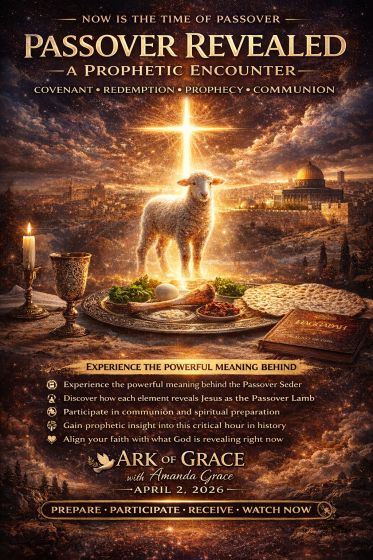
Join Amanda Grace for a powerful LIVE Passover Seder tonight at 6 PM ET! Experience the deep prophetic meaning behind each element of the Seder and how it points to Jesus as the Passover Lamb. We will also be taking communion together, so be sure to have your bread and cup ready to participate. Don’t miss this moving and timely teaching, invite friends and family to watch with you! Seder Shopping List: arkofgrace.org/events
#Passover2026 #PassoverSeder #Faith #Communion #JesusIsLord #Biblical #Christian #SpiritualGrowth #AmandaGrace #HolyWeek #Pray
NEW! Prayer Lines now available Mon - Fri, 9am-5pm ET. CALL 845-743-6500 or 845-743-2583
The Revelationary War is available NOW! Get your copy here: https://buff.ly/4fnuDd7
Preorder Amanda’s second book, Brace for Impact: https://buff.ly/PiQgPcE
Music Copyright References:
-131615741-Awards Inspirational Cinematic Music (Short 3) [Upbeat Nomination Epic Orchestra]
Stock Media provided by JadSound / Pond5
-21981893-Corporate And Inspirational Cinematic Background Music (1.00 Minutes Version)
Stock Media provided by StockAudios / Pond5
-151471022-Uplifting Inspirational Corporate
Stock Media provided by Patrick_Schlebes / Pond5
-154756307-Magic Fireflies Loop Version2(Modern And Relaxing Background)
Stock Media provided by Lesya_NZ / Pond5
-123859534-Successful Product Presentation 60S - P5
Stock Media provided by Wolfgangwoehrle / Pond5
105166597-Believe in You (Inspirational And Uplifting) P5
Stock Media provided by DivaProductionMusic / Pond5
Music License: https://www.pond5.com/legal/license/2...
Purchase ID/Date: 7365245 / 9-29-2023
Website: https://arkofgrace.org
Prayer Requests: https://arkofgrace.org/prayer-requests
Donate: https://arkofgrace.org/donate
Partners: https://arkofgrace.org/ministry-partners
Follow Amanda Grace:
YOUTUBE @ArkOfGraceMinistries
Rumble @ArkOfGraceMinistries
X/Twitter @AmandaGrace_AOG
Facebook @ArkOfGraceMinistry
Instagram @ArkOfGrace88
TIK TOK @arkofgraceministries
TELEGRAM @arkofgraceministries
Truth @ArkOfGraceMinistries
Passover Seder 2026: Spiritual Observance and Prophetic Fulfillment
Ark of Grace: 2026 Passover Seder
Live Broadcast Analysis: Ritual Symbolism & Prophetic Global Transitions
Sacred Elements & Meaning
-
✓The Matzo: Symbolizes Christ being "pierced and bruised" for iniquities; unleavened for haste.
-
✓The Blood: Placed on doorposts in the shape of a cross; a sign for the plague to "Pass Over."
-
✓The Afikomen: Wrapped and hidden (Tomb) then brought back (Resurrection/Holy Spirit).
Current Event Alignment
Launched on 1st night of Passover. Named after a pagan goddess of "the hunt." Interpreted as an attempt to open spiritual gates.
Fulfillment of Feb 10, 2023 prophecy: "Their bridge is about to fall down." Trump confirms largest bridge in Iran destroyed.
This broadcast, hosted by Amanda Grace and Chris on April 2, 2026, commemorates the second night of Passover through a traditional Seder meal and a deep-dive into the prophetic significance of current global events. The session bridges ancient biblical ordinances with modern-day occurrences, emphasizing the role of Jesus Christ as the ultimate Passover Lamb.
The Passover Seder and Christological Symbolism
The observance began with a ceremonial cleaning of the home (removal of chametz) and the lighting of the festival candles, signifying the official start of the Seder. Central to the evening was the recognition of Jesus Christ (Yeshua HaMashiach) as the fulfillment of the Passover sacrifice. Participants partook in communion, identifying the matzo as His broken body and the wine as the blood of the new covenant that redeems and reconciles believers to God.
The Seder plate elements were explained through both historical and spiritual lenses. The Maror (bitter herbs) represents the bitterness of slavery, while the Charoset (apple mixture) symbolizes the mortar used by Israelites in Egypt. A significant highlight was the Afikomen ritual; the broken middle matzo, wrapped and hidden, was compared to Christ being wrapped and hidden in the tomb, with its subsequent "ransom" symbolizing the promise of the Holy Spirit.
The Seder Plate: Symbolic Elements
Prophetic Analysis of April 2026 Events
Following the Seder, the broadcast shifted to analyzing three major events occurring during the Passover window, which were framed as fulfillments of prior prophecies. First, the launch of the Artemis II rocket on April 1st was criticized for its pagan naming (after a Greek false goddess) and its timing on the first day of Passover. This was interpreted as a deliberate attempt by secular powers to "open gates" and summon ancient principalities in high places.
Second, the firing of Pam Bondi as Attorney General on the second day of Passover was linked to a prophecy from March 27, 2026, which predicted a "great transition within the administration" and a "rearranging of what was out of order". Finally, the reported collapse of a major bridge in Iran was highlighted as a direct fulfillment of a February 10, 2023, prophecy stating that "their bridge is about to fall down" as a sign of leadership crumbling.
Prophetic Alignment: April 2026
| Event | Prophetic Connection |
|---|---|
| Artemis II Launch | Spiritual "hunting" and gate-opening on Passover. |
| Bondi Ouster | "Great transition" within the administration (Prophecy: March 2026). |
| Iran Bridge Collapse | "Their bridge is about to fall down" (Prophecy: Feb 2023). |
Key Data
- Event Date: April 2, 2026 (Second night of Passover).
- Prophecy Source 1: February 10, 2023 (Regarding Iran's bridge collapse).
- Prophecy Source 2: March 17, 2025 (Regarding Iran being broken at Passover).
- Prophecy Source 3: March 27, 2026 (Regarding administration transitions).
- Artemis II Mission Duration: 10 days (paralleling the 10 plagues of Egypt).
To-Do / Next Steps
- Pre-order "Brace For Impact": The new book is available for pre-order on the Arc of Grace website and launches everywhere on April 7, 2026.
- Daily Spiritual Armor: Viewers are encouraged to pray Ephesians 6 and Psalm 91 daily to remain "armored up" during this season of transition.
- Scriptural Study: Re-read the Book of Exodus to understand the patterns of deliverance and how they foreshadow Christ's work.
- Watchman Vigilance: Maintain a "watchman" posture and pray as events continue to unfold during the remainder of the Passover week.
Conclusion
The 2026 Passover Seder serves as a sobering reminder of God's deliverance and the precision of His prophetic word. As global administrations shift and geopolitical tensions rise, the broadcast concludes that the "Passover Lamb" remains the only source of true freedom and protection.
Ark of Grace

DONATE TO ARK OF GRACE MINISTERY DIRECTLY
Please help support my show!
OUR MINISTRY
Welcome to Ark of Grace Ministries! We are a unique ministry called to fulfill the great commission in Mark 16:15, to spread the Gospel and reach out to all of God's creation, both people and animals. We provide biblical prophecy and teaching online, also during live events. We are also an animal sanctuary that currently houses approximately 60 rescued animals.
ONTHE WINGS OF GRACE
The teachings and messages of our ministry On the Wings of Grace, resonates deeply within those on a spiritual journey. A high priority is placed on ensuring that the Gospel of Jesus Christ is reachable for all people. Throughout the year, Amanda Grace is invited to preach at many different churches and events. With her passion she imparts wisdom and encourages spiritual growth. She empowers believers to discover and walk in their divine destinies. Her dedication transforms lives and makes her a respected leader in the prophetic community.
MISSION CHRIST LOVE
Mission Christ Love is one of our outreach ministries. It shows that by looking beyond ourselves we can play a vital role for those who are feeling lost. Many people today are struggling with a variety of needs, loss of job, medical issues, financial hardship, to name a few. We provide emotional support as well as financial support for those who need it. Giving back to others builds a sense of purpose and increases faith. God has called upon us to follow the teachings of Jesus Christ by showing love and support for others. To receive emotional support contact hello@arkofgrace-ministries.com or submit a form on our contact page.
[00:02] Speaker 1: (instrumental music plays) Hello, hello, everyone. Welcome. Amanda Grace and Chris here tonight on April 2nd, 2026. Chag Sameach Pesach to our Jewish brothers and sisters and all who celebrate Passover. We are thrilled to be celebrating this Passover with you tonight. Happy Passover to everybody coming into the chat now. As they have been notified, we are live and we are going to partake together, (clears throat) excuse me, in the Passover Seder in just a few minutes. We're gonna talk about some things. Man, are there things going on right now on Passover. And we will be discussing some of those things after we complete the entire Passover Seder with you. So, let's say hi to a few of you coming in right now. I see Chag, uh, Chag Sameach Pesach. I see you putting it in the chat. Very, very happy Passover to you. Let's see who else is coming in. Uh, we're gonna see who's coming in from the United States and around the world, as usual. I see Canada. Hello to all our Canadian viewers.
[02:11] Speaker 1: God bless you. Very happy to have you on with us tonight. Surprise, Arizona, God bless you. Happy birthday to those of you who it's your birthday on Passover. That's some birthday to be celebrating. Very happy about that. Shalom to you in Scotland.
[02:25] Speaker 2: Shalom.
[02:25] Speaker 1: Hello to our international audience coming in right now, uh, to celebrate this Passover with us. I see South Carolina and Michigan. God bless you. Georgia, Cincinnati, Ohio, God bless you. Uh, let's see. Texas. Many, many viewers in Texas. God bless all our viewers in Texas. Very happy to have you with us. Nigeria. Hello to our brothers and sisters in Nigeria that are gonna partake of Passover with us tonight. Very excited to have you on. Blessings to you. I see, uh, California as well. Boston, Massachusetts. El Paso, Texas. God bless all of you. I see Oregon as well. God bless you. Louisiana. India. Hello to those of you watching in India tonight that are on to celebrate the Passover Seder with us. I see South Africa coming in as well. God bless you as well. Very happy to have our South African brothers and sisters on with us tonight. Eureka, Montana. Gulf Coast, Mississippi. God bless all of you as well coming on in. Let's see who else is coming in tonight.
[03:30] Speaker 1: I see Thomasville, Georgia, Pennsylvania, and our neighbors in Upstate New York. God bless all of you. Very happy to have you on with us. Delaware as well, and Bellwood, Pennsylvania, and Tulsa, Oklahoma. God bless all of you as well who are coming in. There's so many of you actually coming in from so many places, which we're thrilled about. Toronto, Canada. Hello, God bless you. I see New Jersey as well. God bless you. And Maine and, uh, Ft. Lauderdale, Florida. God bless you, all of you as well. And Chicago and Wisconsin I see as well. As well as Kissimmee, Florida. I see Woodbridge, Virginia, West Virginia, Michigan, Central New Jersey. God bless all of you as well. Let's see. Union- oh, Unionville, New York. Okay. God bless our neighbors there. Very happy to have you on tonight. Mexico. Hello to those of you watching in Mexico tonight. Very happy to have you on with us. Thrilled to have all of you coming in from so many areas around the world. Melbourne, Australia, God bless you.
[04:34] Speaker 1: Very happy to have you on with us tonight as well. England. God bless all our viewers in England jumping on right now. Very happy to have you on with us as well. Um, and I see also Albuquerque, New Mexico and Indiana. So, hello to all of you. Hello to our moderators, our Arc of Grace team. Thank you for helping us do what we do for the Lord. So, on this incredible Passover night, the second night of Passover, we're gonna open up in prayer. We are gonna hand this over to the Lord. Uh, we are going to partake of communion first because Christ is the Pesach Lamb, the Passover Lamb, so if you want to run and get your communion elements now, your, your bread and your, your wine or your juice, uh, we encourage you to do that right now so you can partake of communion with us. We're gonna open, uh, in communion and then we are going to be doing the Hagaddah, the Passover Seder together. So, send us too, if you could, send us a picture of your Passover plates.
[05:35] Speaker 1: So, if you can email us at hello, a picture of your Passover plate, uh, we could post some of them maybe. If you can post it, uh, beneath on our social media a picture of your Passover Seder plate and you guys doing it along with us on our Facebook, on our YouTube, on our Rumble, and, uh, we're live on our app as well, and on X. So, please post pictures of all of you doing the Seder with us. We would love to see that and be able to share some of that. So-Let's open up in prayer. We'll show you our Seder plate when we're done praying. Uh, and then we are gonna start Pesach 2026. Ready?
[06:14] Speaker 3: Yes.
[06:15] Speaker 1: Okay. We gonna pray?
[06:16] Speaker 3: Yes.
[06:17] Speaker 1: Okay. Okay. Father God, in the precious name of Your Son, Jesus Christ, Yeshua HaMashiach, we come before You this day. We praise You. You are Almighty God. You are high and lifted up far above every power, principality, and might. Father, we give You all the glory, honor, and praise due Your precious holy name.
[06:35] Speaker 3: Amen.
[06:35] Speaker 1: Father, we humble ourselves before You this day-
[06:38] Speaker 3: Amen.
[06:38] Speaker 1: ... asking You to forgive us of our sins, cleanse us of all unrighteousness, forgive us of every way we've sinned and fallen short. We praise You, Lord-
[06:45] Speaker 3: Amen.
[06:45] Speaker 1: ... that Your mercies are new every single day.
[06:48] Speaker 3: Amen. Amen.
[06:48] Speaker 1: Father, we come before Your courts with thanksgiving and praise, boldly but humbly to the throne of grace, saying, "Your kingdom come. Your will be done on Earth as it is in heaven." Father, we come before You this day, acknowledging, Father God, that Jesus Christ is the Passover lamb, Father God, that He purchased us. We ask You to forgive us of our sins, cleanse us of all unrighteousness, Father God-
[07:11] Speaker 3: Amen. Amen.
[07:11] Speaker 1: ... as we come before You today-
[07:12] Speaker 3: Amen.
[07:12] Speaker 1: ... acknowledging the Pesach lamb.
[07:14] Speaker 3: Amen. Amen, Father.
[07:14] Speaker 1: That Jesus Christ was the sacrifice for our sins. He was... The Word became flesh. He dwelt among us. He willingly died at Calvary. He was beaten for our transgressions. He was bruised for our iniquities. The chastisement of our peace was upon Him, and by His stripes, we are healed. And we praise You that, at the cross, He paid the price in full. He blotted out ordinances. He disarmed principalities and powers.
[07:40] Speaker 3: Amen. Amen.
[07:40] Speaker 1: He made an open showing spectacle of the enemy-
[07:43] Speaker 3: Jesus.
[07:43] Speaker 1: ... on Passover, before all of creation-
[07:46] Speaker 3: Yes, Lord.
[07:46] Speaker 1: ... when He said, "It is finished."
[07:48] Speaker 3: Amen. Amen, Jesus.
[07:48] Speaker 1: And we praise You that Jesus Christ rose again miraculously-
[07:52] Speaker 3: Bless You, Lord.
[07:52] Speaker 1: ... after defeating hell, death, and the grave.
[07:53] Speaker 3: Mercy, mercy.
[07:54] Speaker 1: He ascended back to be with the Father. He victoriously took His rightful place at His right hand, where He rules and reigns forevermore. He is the King of kings, the Lord of lords, the Name above all names, and our advocate without ceasing before Your throne. And we honor that before You this day.
[08:10] Speaker 3: Yes, Lord. Amen.
[08:10] Speaker 1: Father God, in the name of Jesus Christ, we welcome Your presence in, the presence of Ruach Elohim-
[08:14] Speaker 3: Yes.
[08:14] Speaker 1: ... the Spirit of the living God, and the Ruach HaKodesh, the Holy Spirit, into this place. Father, let the weight of Your glory, Your power, Your presence, the reverence of who You are, Your Holiness, Father God, let it saturate the atmosphere. Let people tangibly feel Your presence tonight, the reverence of who You are, the weight of who You are.
[08:34] Speaker 3: Amen.
[08:34] Speaker 1: Let the Holy Spirit be the counselor, Father God-
[08:37] Speaker 3: Amen.
[08:37] Speaker 1: ... and go forth and minister to those who are watching. Let people come to know Jesus Christ as their Lord and Savior, Father God, through this Passover, Lord. We just ask for that, Father, in the name of Jesus Christ.
[08:48] Speaker 3: Amen.
[08:48] Speaker 1: You are our shepherd, Father God. And Lord, in the name of Jesus Christ, we ask You to go before us tonight.
[08:55] Speaker 3: Amen. Yes, Lord.
[08:55] Speaker 1: Be our front and rear guard. Order our words. Order our steps tonight, Father God, as we mightily go forth in You. Fill us with Your-
[09:03] Speaker 3: Yes, Lord. Yes, Lord.
[09:03] Speaker 1: ... wisdom, counsel, might, power, and the reverential fear of the Lord. By the power of the blood of Jesus Christ, by the spirit of the one true living God, may only the truth and power of Almighty God with authority now come forth, Lord, in the name of Jesus Christ. Father, let nothing pass through my mouth that doesn't pass through Your throne first. Allow us, Father, the humble privilege of being vessels of Your power, Lord. Father, we ask in the name of Jesus Christ You would loose end and dispatch Your holy angels of all offices, rankings, and divisions to surround the skies, the land, above, below, North, South, East, and West, and against any dimensional access point, Father, that they would guard against it, that every work of darkness and iniquity be struck down in the name of Jesus Christ.
[09:42] Speaker 3: Amen.
[09:42] Speaker 1: Father, in the name of Jesus Christ, we take authority over every plot, scheme, contract, assignment, weaponry, blueprint, attack, strategy, sabotage-
[09:48] Speaker 3: Amen. Amen.
[09:48] Speaker 1: ... witchcraft, enchantment, spell, uh, dark arts of any kind, and any form of weaponized demonic activity, and command it dismantle, destroyed, disabled, thwarted, disrupted, blocked, nullified, voided, disarmed, rendered powerless, and their communication lines disrupted so they cannot carry out their plans. And it cast out, Father God, to not return or have anything sent to this place. Father, we praise You.
[10:12] Speaker 3: Amen. Amen, Father. Praise You.
[10:12] Speaker 1: You are our deliverer.
[10:13] Speaker 3: Praise You, Lord. Praise You, Lord.
[10:13] Speaker 1: We praise You that You delivered Your people, Father God-
[10:16] Speaker 3: Praise You, Lord. Praise You, Lord.
[10:16] Speaker 1: ... out of Egypt.
[10:18] Speaker 3: Praise You, Lord. Praise You, Lord.
[10:18] Speaker 1: We praise You that You are our strong tower.
[10:20] Speaker 3: Holy are You, Lord. Holy are You, Lord.
[10:20] Speaker 1: We praise You that You are the righteous judge, that You are God the Father. You are our righteousness. You are our banner, Father God. We praise You that You are holy, Father God. We praise You, Father God-
[10:32] Speaker 3: Amen. Amen. Praise You, Lord.
[10:32] Speaker 1: ... that the justice of Yahweh has gone-
[10:34] Speaker 3: Amen. Amen, Lord. Praise You, Lord.
[10:34] Speaker 1: ... into the Earth in this hour, Lord.
[10:36] Speaker 3: Yes, Lord. Praise You, Lord.
[10:36] Speaker 1: That You weigh the matters of men and nations before Your throne, Father. And Lord, we just bless-
[10:42] Speaker 3: Amen. Amen, Lord.
[10:42] Speaker 1: ... Your holy name.
[10:43] Speaker 3: Praise You, Lord.
[10:43] Speaker 1: We praise You, Father God, that You fill us as Your vessels, Father God. You are the potter. We are just the clay.
[10:49] Speaker 3: Amen. Amen. Praise You, Lord.
[10:49] Speaker 1: We praise You for a filling, Father God, of Your Spirit. Create in-
[10:52] Speaker 3: Hallelujah.
[10:52] Speaker 1: ... us a clean heart, oh God. Renew a steadfast spirit within us.
[10:55] Speaker 3: Praise You, Lord. Praise You, Lord.
[10:55] Speaker 1: Cast us not away from Thy presence, oh Lord.
[10:57] Speaker 3: Hallelujah. Praise You, Lord.
[10:57] Speaker 1: Take not Thy Holy Spirit from us. Restore unto us the joy of Your salvation, and renew a steadfast spirit within us.
[11:04] Speaker 3: Praise You, Lord. Praise You, Lord.
[11:05] Speaker 1: Father-
[11:05] Speaker 3: Amen. Thank You, Lord.
[11:06] Speaker 1: ... we praise You, Father God, that the Earth is the Lord's and the fullness thereof, Father God. We praise You, Father God, that You are a holy God, that You, that, that-
[11:15] Speaker 3: Amen. Holy, amen.
[11:15] Speaker 1: ... in the heavens, Father God, before You, they cry, "Holy, holy, holy is the Lord God Almighty-"
[11:20] Speaker 3: Hallowed be Your name. Amen. Amen, Lord.
[11:20] Speaker 1: "... who was and is and is to come."
[11:22] Speaker 3: Yes, Lord. Praise You, Lord.
[11:22] Speaker 1: We praise You tonight, Father. Take all the glory-
[11:24] Speaker 3: Amen. Praise You, Lord.
[11:24] Speaker 1: ... for Yourself, Father.
[11:25] Speaker 3: Amen. Praise You, Lord.
[11:25] Speaker 1: We honor, Father God, who You are, Lord-
[11:28] Speaker 3: Amen. Praise You, Lord.
[11:28] Speaker 1: ... and what You're doing in this hour.
[11:30] Speaker 3: Amen. Praise You, Lord.
[11:30] Speaker 1: In the name of Jesus Christ, we pray. Amen-
[11:33] Speaker 3: In the name, Lord. Amen.
[11:33] Speaker 1: ... and amen. Amen. Welcome to those of you jumping on during prayer. Very happy to have you on with us. Chag Samach Pesach. To all of you who are watching, Happy Passover. If you could share this broadcast so others can join us for the Seder, too, and like and subscribe, we would very, very much appreciate it, um, because it is important to keep the Passover. We are going to do communion in a moment, so if you'd like to get your communion elements, we're gonna open up with communion. But what I'm going to do is I'm going to read you-... Exodus 12, chapter 12, verse 13 through 14 where it talks about the ordinance of keeping the Passover. So happy, those of you who this is your first time and you're on, you're gonna absolutely love this. Christ is throughout the entire Passover meal. We'll show you how. So Exodus 12:13-14 says, "The blood shall be a sign for you on the doorpost of the houses where you live.
[12:37] Speaker 1: When I see the blood, I shall pass over you and no affliction shall happen to you to destroy you when I strike the land of Egypt. Now this day will be a memorial to you, and you shall keep it as a feast to the Lord throughout your generations. You are to celebrate it as an ordinance forever." What did the Lord say? We are to celebrate this as an ordinance forever, and this is why it's so important to honor and keep the Passover. It is scriptural and Christ was the fulfillment of Passover as well when he died on the cross for our sins. So what we're gonna do, to start, Chris, I'm gonna give you your juice. We have grape juice here, Kadem grape juice. My father used to work for Kadem. Fun fact, he was an Italian working for Orthodox Jews, it was quite comical most of the time. So I'm gonna give you... Here, you want this piece? I'll give you the bigger piece here. So we got our matzo right here, and we've got our juice, and we're gonna take communion together to begin this Passover.
[13:43] Speaker 1: You ready?
[13:44] Speaker 4: Yes.
[13:44] Speaker 1: Okay. We've already asked the Lord for forgiveness in our prayer. Just we, we want to cleanse our hearts, bring our heart posture right before the Lord. And when Jesus Christ was with his disciples at the Last Supper, the last meal he would share with them, that Passover meal, he took the bread before them and he broke it. And he said, "This represents his body." Now, I put a little bit in the blood because the body mixed with the blood, so I put a little bit actually in my cup when I take communion. This is his body that was broken for us. It was beaten, bruised, crushed and pierced for our sin and iniquity 'cause we had a debt we could never ever pay, and Christ paid that debt for us at Calvary, and he paid that price in full. And we eat of this in remembrance of what Jesus Christ did for us at Calvary, Lord, and what you did because you so love the world, John 3:16, and we can eat the bread now. Praise the Lord.
[14:44] Speaker 1: And then he took the cup, he said, "This represents the cup of his suffering. It was poured out and shed for us at Calvary, and was poured out and shed for us at Calvary. We were purchased by the precious priceless blood of Jesus Christ when he was beaten and bled and nailed to a cross and bled, and that blood dripped onto the mercy seat. It purchased us, it redeemed us, it reconciled us back to you, Father. It paid the price in full for our sin and our shame, and we praise you that we're in covenant with you, Lord, through Jesus Christ, and we drink of this in remembrance of what Jesus Christ did for us on this Earth and at Calvary, and what you did, Father God, because you so love the world, and we can drink of it now." And then when I take communion afterwards, I say, "Let the words of my mouth and the meditation of my heart be acceptable in your sight, oh Lord, in Jesus' name, amen and amen." Praise the Lord. Okay.
[15:40] Speaker 1: We're starting this off right with communion, because Christ is the Passover lamb, and that's what Passover was all about, foreshadowing the coming of Christ to die as the spotless lamb for our sins. So Chris, we're gonna get our Passover Seder out, and we're gonna begin. Okay. So, what they do first, and I'll read this part to you. So traditionally with Passover... Oh, before we do that, hold on. We want to show you, Chris, you want to show them our Seder plates? Here are our Passover Seder plates that we have put together. And so show us a picture of your Seder plate, but that's our Seder plates right there, we'll show it to you throughout as we, uh, we do different, uh, elements for the Passover. So hold on one second here, let me just tighten this up. We don't want this, we don't want this to come out, which it has. Hold on one second here.
[16:43] Speaker 1: I have to, have to, have to adjust this before we start the Passover because I do not want this falling out in the middle of Passover, the microphone. So we're just going to adjust it, here we go. And we're gonna make sure it's nice and tight because it was a little wobbly and I do not want it falling out during Passover. There we go, okay. Just want to make sure it's not gonna fall out during the meal. Now, the first thing they do is something called the ha- the chametz removal, which is the leaven. And so I'll read this part to you, but this is before they even do the Passover Seder, they do this part. Before the sun sets and we sit down to our Seder, it is customary as well as commanded by the Torah to remove all chametz from the home. Chametz is any food that's been leavened, especially the five grains of wheat, barley, spelt, rye and oats. Matzo is unleavened bread, so that is okay.
[17:39] Speaker 1: One tradition carried over from Eastern Europe has a member of the household hide ten pieces of bread around the house, followed by an after dark search on the night before Passover. The head of the household by flashlight or candlelight searches each room for hidden chametz. Once the bread is found, a feather is used to sweep any stray crumbs onto a wooden spoon, which is all then burned together. This removal of the chametz is preceded by the following prayer. "Blessed are you, Adonai, our God, creator of the universe, who makes us holy with your mitzvah."... and who commanded us concerning the removal of chametz. To symbolize the search and removal of all chametz at the Seder, each person should look under their plate and remove or pretend to remove any traces of chametz that they might find. So you pretend to look under your plate, you remove any traces. You found it? Okay. You, we found it, we removed it, and immediately following the search, this prayer is said.
[18:40] Speaker 1: "Any chametz which is in my possession that I did or did not see, which I did or did not remove, shall be nullified and be ownerless as the dust of the earth." Praise the Lord. Okay. Now, we have to do the Sabbath candle. Next is the Sabbath candle lighting. They always begin Passover with the lighting of a candle. We do have it right here. We are going to light it for you, and as we light it, Chris, will you light it for me while I pray? So we're gonna light the candle which begins the official Passover Seder. So this is what begins the official Seder. Okay, you ready? Yes. Okay. If you could please light it. (lighter clicking) Is it working? There we go. Blessed are you, Adonai, our God, creator of the universe, who makes us holy with your mitzvah, who commanded us to light the festival candle. Here, you want me to do it? There you go. You all right? Mm-hmm. Okay. We can, uh... (lighter clicks) There we go.
[19:46] Speaker 1: Blessed are you, Adonai, our God, creator of the universe, who gave us life, sustained us, and enabled us to reach this season of joy. And there we go, it's lit. Mm-mm. Mm-mm. It's okay. Here, I'll put the fan a little bit. Waist. There we go. Oh, yeah. Yeah, it was the fan. It's okay. So we have the candle lit. We're officially starting the Passover Seder, and we're going to do the opening prayer. Now, some of this will be in English and some of this will be in Hebrew, just so you know. So the Seder traditionally, sometimes they do it all in Hebrew, sometimes they do it part in English and part in Hebrew. And here is the opening prayer. May all who are enslaved throughout the world come to know freedom. May all who are free appreciate the blessings of abundance. And may all of us dwell in the house of God and give thanks for our good fortune as we celebrate these rituals of Passover. Now, for the Seder plate now, we're gonna go over what is on the Seder plate here.
[20:49] Speaker 1: So we have the matzo, which I have the matzo right here in its own separate compartment, right here. And we will be taking it out throughout the evening. And then on this plate we have the maror, um, and ha- uh, charoset, which is the bitter herb symbolizing the bitter life that Jews led while they were slaves in Egypt. That's right here, that's what that symbolizes. It's eaten twice during the Seder. Then we have the charoset, which is right here, it's this apple mixture. And it, uh, is symbolic to look like the mortar because it's symbolic of the bricks and mortar the slaves used in making, uh, the Egyptian buildings. And so that is what that represents. And then we have a zaruo, which is the roasted bone, uh, which Cyrus almost got away with before the Seder- (laughs) ... because he came over to see what was going on. But you either have a, traditionally a roasted lamb shank or you have a roasted chicken leg. And then we have the Beitza, which is the egg, which is right here.
[21:53] Speaker 1: Our hard-boiled egg represents the second sacrifice that was offered on the eve of Passover at the temple, and that's what it's used for. Then we have the karpas, which is the flat-leaf parsley right here. And it's a vegetable that's not the bitter herb, it's another vegetable on the plate. And since Passover was also an agricultural festival celebrated by our ancestors, karpas represents the arrival of spring. And we will dip it in the saltwater that I have right here at a, a po- a point during the Seder, and we will eat it. And then we have the horseradish here as well. So there's horseradish on the plate as well that we will be partaking in. We have the saltwater which I showed you, which represents the sweat and tears of our ancestors that were in bondage. And then we have the wine or the juice, we have grape juice in our cups here. And we have, uh, about four that's going to be consumed during the Seder. Uh, and so that is how we will continue to pour.
[22:54] Speaker 1: We have our kadim grape juice and we will continue to pour them throughout the Seder. Uh, they serve as a reminder of the four references to redemption that are mentioned in the Book of Exodus. "I will bring you out of Egypt, I will deliver you from bondage, I will redeem you with an outstretched arm, I will ta- I will take you to me for my people." Okay. Now we're gonna do the blessing over the wine. So now the blessings begin on the Passover Seder meal. So we're gonna do the blessing over the wine, and this is gonna be done in Hebrew and in English, this blessing. So there's your juice, Chris. Your juice is here, here. Mm. Right here. Sorry. That's your juice. Okay. (lighter clicks) Here we go. (paper rustling) Barukh atah Adonai, Eloheinu, melech ha'olam, bereishit kei'olam chagafen. Blessed are you, Adonai, our God, creator of the universe, who creates the fruit of the vine.
[23:53] Speaker 1: Blessed are you, Adonai, our God, creator of the universe, who has chosen us from all nations, raised us above all tongues, and made us holy with your mitzvot, which is your commands. And you, Adonai, our God, have lovingly given us Sabbaths for rest and festivals for rejoicing, holidays and seasons for gladness. This Sabbath day and this Festival of Matzah, the season of our freedom, a holy gathering, remembrance of the Exodus out of Egypt. For you have chosen and made us holy above all peoples, and your holy Shabbat and festivals in joy and gladness, you granted us as a heritage.... blessed are You, Adonai, who makes holy the Shabbat and Israel and the festive seasons. Blessed are You, Adonai, God, creator of the universe, who has kept us alive, sustained us, and brought us to this season. And now what we do is, we drink the cup of juice or wine while reclining.
[24:47] Speaker 1: So you recline one way, you take a drink of the juice, and they do this with the leaning, when they lean, you're gonna see this a lot during the Seder. It's to generate awareness of freedom and wealth. It is customary to recline leaning to the left, as did the aristocracy in ancient times. So the aristocracy in ancient times would lean to the left. So I don't hit Chris, I'm leaning to the right now, otherwise we're gonna bump into each other-
[25:23] Speaker 5: That's all right. (laughs)
[25:23] Speaker 1: ... during the Seder meal. Okay. They also have, which we did already, the washing of the hands, so everyone would wash their hands at the sink or at the table, uh, in order to as well signify, uh, the blessings and the beginning of the Seder. Now, so what we're gonna do now is we're going to take one of the vegetables, which is the parsley, right here, so we're gonna take some parsley. We're gonna dip it into the salt water, so here's our salt water. We're gonna dip it in, okay? We're gonna dip it into the salt water, and we are going to say the following blessing over it. (Hebrew) Blessed are You, Adonai, our God, creator of the universe, who creates the fruit of the earth. And so that's blessed now. You can eat it or you can put it back down, yep, whatever you wanna do. And now we're gonna do the breaking of the matzo and the creation of the afikomen.
[26:37] Speaker 1: The afikomen is fascinating because you'll see what it symbolizes as we go forth in this, how Christ is actually shown through the afikomen and the Holy Spirit actually. So, this is an afikomen bag, we're gonna be putting, uh, the piece of matzo, that is the afikomen, in this bag in just a moment. So we have to uncover the matzo, so the leader uncovers the matzo. Chris has his own matzo too he can uncover. And we are going to take the middle matzo and break it in two, so I have a middle matzo here, right? I'm gonna take the middle matzo, I'm gonna break it in two, just like that. And then what we're going to do is place the smaller part back. The smaller part will go back in between the matzo, and this larger part is going to go into the afikomen bag. So we're gonna take the larger part, we're gonna put it in the afikomen bag, just like this. We're gonna take this and put it over here, and we're gonna use that later on in the Seder.
[27:52] Speaker 1: And now what they do is, the l- the leader is gonna place the afikomen portion on their shoulder. So this is gonna be taken, we're gonna place it on our shoulder, just like this, and say, "In haste did we go out of Egypt," which is true. They left in haste. At this point, what would happen, the children at the Seder would take the afikomen and they would hide it somewhere in the house where the adults could not see, and later on you actually have to go find the afikomen. Now, the story of Passover.
[28:30] Speaker 5: It's something about this.
[28:32] Speaker 1: Yes.
[28:33] Speaker 5: And the Spirit.
[28:34] Speaker 1: The Holy Spirit, yes.
[28:35] Speaker 5: You, maybe you'd say something about it.
[28:39] Speaker 1: So, when they go to find the afikomen later, the way the, the adults have to find it from the children is they have to try to bribe them. Like, "W- I'll buy you a bike if you tell me where the afikomen is." And if the child agrees, what the adult will say is, "I don't have the bike now, but let me give you this $5 bill as a symbol that that gift is coming." And what this represents is the afikomen is wrapped up and hidden like Christ was wrapped up and hidden away in the tomb, and then the part of, "I'm going, I don't have the, the gift now but I'm sending you the gift. Here is my promise I'm sending you the gift," that represents the coming of the Holy Spirit.
[29:28] Speaker 5: Mm.
[29:28] Speaker 1: So that bargaining between the adult and the child for, to, to bring the afikomen out of hiding represents the Holy Spirit as well-
[29:39] Speaker 5: Amen.
[29:40] Speaker 1: ... within the Seder meal. Now, the story of Passover. Okay, the broken matzo now, the broken matzo piece that we have is lifted for all to see, and we are gonna recite this. This matzo is a symbol of affliction and poverty. The story of Passover tells us about the hardships and suffering that our ancestors endured. It reminds of, of, uh, us of those who are in need today, so we say, "Whoever is hungry, come share our food and celebrate Passover. To those who are poor or oppressed, we pray for them and hope that the coming year will bring a better life for all." Okay. We're gonna put that back. We're gonna get our juice again, and we are going to...... you would pour the second cup of juice, now, we still have some leftover. And the youngest at the table would ask the following questions. "Ma nishtana halala haze mikor halelo?
[30:45] Speaker 1: Why is this night different from all other nights?" The leader now asks, "In what ways do you find this night different?" The youngest makes the following statement and then gives four examples of how this night is different. "In four ways do I find this night different. Shebecho halelo anu ochlin chametz unmatza, ha-layilah hazeh kulo matza. On all other nights we may eat chametz and matzo, but on this night, only matzo. Shebecho halelo anu ochlin shag yich rakho, ha-layilah hazeh maror. On all other nights we eat many vegetables, but on this night only maror," which is like the bitter herb. "Shebecho halelo ein anu matbilin afilu paam echat, ha-layilah hazeh shitei faamim. On all other nights we don't dip even once, but on this night, we dip twice. Shebecho halelo anu ochlin bin yoshbin uvin misubin, ha-layilah hazeh kul-anu misubin.
[32:01] Speaker 1: On all other nights we eat either sitting up or reclining, but on this night, we all recline." The four questions are, in fact, not four questions at all, they are four statements that clarify the main question of the Seder. Why is this night different from all other nights? This night is different from all other nights because on this night we tell the story of Passover as inscribed in the Book of Exodus. This night is also different because we participate in rituals that have been observed at Passover Seders for centuries by our Jewish ancestors. We remind ourselves every year at this time that we were slaves to Pharaoh in Egypt, and God took us out with a mighty hand and an outstretched arm. If God had not liberated our ancestors from Egyptian slavery, then we and our children and our children's children might still be slaves in the land of Egypt. Even if we know the story well and have told it many times, it is essential to be reminded of the details so we do not forget.
[32:59] Speaker 1: By recognizing the oppression of our enslaved ancestors, we gain a greater appreciation of the freedom we enjoy today. As we participate in the rituals of the Seder, we should not only make sure the story of Passover is told and that the significance of each component of the Seder is explained, but we should also engage the children in the proceedings. So basically, that's the part where they will engage the children, and they will talk about the wise child, the wicked child, the simple child, and the child that's too young to ask, and they basically will address all those four. So what we'll do is, we'll turn the page, and we will go right here. "To toast a..." To... It, it says, "We toast our endurance as a people." So the matzo right here is covered, so the matzo is covered, and the wine cup is lifted as the following paragraph is proclaimed joyously.
[33:53] Speaker 1: "Throughout the ages we have endured, for not only has one risen against us to annihilate us, but in every generation they rise against us to annihilate us. But Adonai, the Holy One of blessing, rescues us from their hand."
[34:07] Speaker 6: Amen.
[34:08] Speaker 1: Okay, we're gonna put down the wine cup, or the juice cup. We're gonna uncover our matzo again. So here's the uncovered matzo right here. We weren't always slaves in Egypt, we became slaves. And the story of how we became slaves to the pharaohs of Egypt and ultimately how we were freed is really the basis of the story of Passover. It's a part of the history that belongs to all of us. By telling the story year after year, we're ensuring that we'll never forget our oppression or our freedom. As with most religious history, the story has been passed on from generation to generation, and tonight especially, if there are children present, you're perpetuating an important ritual. Many years ago in the land of Egypt, Joseph, the son of Jacob and Rachel, was sold into slavery by his brothers. Joseph was skilled and intelligent, and soon became an official in the court of the Egyptian Pharaoh. Joseph could interpret dreams, which he sometimes used to predict the future.
[35:08] Speaker 1: He offered the Pharaoh his prediction of an unco- up- upcoming famine, which the Pharaoh heeded. Because Joseph's timely advice saved the land from a great famine, Pharaoh invited them to stay when Joseph's family came to Egypt searching for food. They lived in peace for many years and became known as Israelites, and they lived in the land of Goshen, is where Joseph's family was sent. Years later, a new Pharaoh came to rule. He did not remember Joseph and all he had done for the Egyptians. He saw that the Israelites population was growing rapidly, and feared that in a war they might side with the enemy and become a danger to Egypt. To remove this problem of the Israelites, Pharaoh enslaved them. He forced them to work hard building his cities and palaces, baking bricks and carrying stones in the desert heat. They knew neither peace nor rest, only misery and pain. To limit their population, Pharaoh decreed every baby boy born to an Israelite woman shall be drowned in the Nile.
[36:08] Speaker 1: In an effort to save their baby, Amram and Jochebed, a Jewish slave couple, hid him in a basket on the riverbank. When Pharaoh's daughter, the princess, came down to the river to bathe, she found the baby and decided to take him home to the palace. The princess named the baby Moses, which means brought out of the water. Because she needed a nurse to feed and care for the baby, the princess looked for a Jewish nurse. Jochebed's daughter Miriam, who was hiding by the river watching, came out and told the princess that she knew of a nurse. She ran home...... and brought Yocheved back to the princess, not revealing that she was really Moses' mother. Yocheved became Moses' nurse and was able to care for him throughout his childhood. Moses, being the adopted son of the princess, would have lived a rich life in Pharaoh's palace, but he could not bear to see his people suffer as slaves. One day, he came upon an Egyptian taskmaster who was beating an Israelite slave.
[37:04] Speaker 1: In a fit of rage, Moses beat the Egyptian to death. His crime soon became known, and Moses was forced to leave his homeland and flee into the desert. Wandering around the desert, he came upon a family of shepherds in the land of Midian. He was taken in and became a shepherd himself. One day while tending to his sheep, Moses came upon a bush that was on fire. Although it was burning, it was not being consumed. Now, it was on fire, but it was not consumed, represents how the Jewish people had been on fire for over 400 years in slavery, but never consumed and destroyed completely as a people. He heard God's voice coming from the bush, telling Moses to go back to Egypt and free his people from slavery, and lead them out of Egypt. Because Moses was merely a shepherd, he asked God, "How may I accomplish this great task? I am but a lowly shepherd, and I am of impaired speech." God replied, "Go forth to Egypt with your wooden staff.
[38:02] Speaker 1: I will be by your side, and Pharaoh will be forced to free your people." And that's the story, in a nutshell, (clears throat) of what happened with Moses in Egypt. Now, Moses then returns to Egypt, is what comes next. "And went to see Pharaoh..." So it continues, "I will be by your side and the Pharaoh will be forced to free your people." And went to see the Pharaoh with his brother, Aaron, as his spokesperson. "Let my people go," Moses demanded. But Pharaoh had a hardened heart and refused. Through Moses, God brought forth 10 plagues on the people of Egypt. The plagues at first amused Pharaoh, but soon frightened him. The Pharaoh promised to free the slaves several times, but God hardened the Pharaoh's heart many times. And each time he agreed to free the Israelite slaves, Pharaoh went back on his word. After the ninth plague, God said to Moses, "I will bring one more plague upon Pharaoh and upon Egypt.
[39:02] Speaker 1: Toward midnight, I will go forth among the Egyptians and every firstborn in the land of Egypt shall die, from the firstborn of Pharaoh who sits on his throne, to the firstborn of the slave girl who is behind the millstones, and all the firstborn of the cattle. And there shall be a loud cry in all of Egypt such as has never been seen and never will again." God then instructed Moses to tell his people to take a lamb from among their flock and sacrifice it at twilight, taking some of the blood to paint a mark on the two doorposts and lintel of their home. So they had to paint the blood here, and here, and here. And guess what that makes? A cross. Where they did the blood on the doorposts actually makes a cross, and was foreshadowing the death that Christ would die as the Passover lamb. Moses was further instructed by God to have his people roast the lamb over a fire and eat it with unleavened bread, and with bitter herbs that same night.
[39:58] Speaker 1: At midnight, God brought the fourth, the 10th, and most devastating plague, the killing of the firstborn. In every Egyptian household, the firstborn child suddenly took ill and died, but the plague passed over the homes of the Israelite slaves. It was then that the Pharaoh finally agreed to free the Israelites. While we celebrate the freeing of the Israelites from slavery, God has instructed us to take no pleasure in the suffering of the Egyptians. To commemorate their suffering, each person dips their little finger into their wine and places a drop on their plate as we recite the 10 plagues that God brought down to Egypt. So, we're gonna take our plate, and we're gonna take our cup, and we're gonna dip our pinky in the cup for each one. So we're gonna dip our pinky in.
[40:42] Speaker 5: I'm gonna go this way.
[40:43] Speaker 1: Okay. You're gonna put it there? Okay.
[40:48] Speaker 5: Yep.
[40:48] Speaker 1: Okay. Dip our pinky in, and the first one is blood, and you put it on the plate like that. So this is what we're gonna do for all of them. We're gonna do this 10 times.
[40:58] Speaker 5: Blood.
[40:58] Speaker 1: Frogs.
[41:01] Speaker 5: Blood.
[41:02] Speaker 1: Lice.
[41:03] Speaker 5: Lice.
[41:04] Speaker 1: Wild beasts.
[41:05] Speaker 5: Wild beasts.
[41:07] Speaker 1: Cattle plague.
[41:08] Speaker 5: Cattle plague.
[41:08] Speaker 1: Boils.
[41:11] Speaker 5: Oh, boils.
[41:13] Speaker 1: Hail.
[41:14] Speaker 5: Hail.
[41:15] Speaker 1: Locusts.
[41:17] Speaker 5: Locusts.
[41:18] Speaker 1: Darkness.
[41:19] Speaker 5: Darkness.
[41:20] Speaker 1: And the killing of the firstborn.
[41:22] Speaker 5: And killing of the firstborn.
[41:25] Speaker 1: Okay. Moses did not trust the Pharaoh. He told his people to quickly pack whatever they could carry, and Moses led them out of Egypt into the desert, with no time to bake their bread. And the people carried their kneading bowls and their dough wrapped in cloaks upon their shoulders. Once freed and in the desert, they baked the dough on the hot rocks into matzah. But once again, the Pharaoh changed his mind and sent his soldiers to capture the Israelites. As Pharaoh's army caught up with the Israelites at the Red Sea, God told Moses to hold up his wooden staff. Suddenly, a huge wind came up and the Red Sea parted, allowing all the freed slaves to pass. Once all of the Israelites were safely across, Moses again held his staff and the waters closed up over Pharaoh's soldiers, killing them. Finally, the Israelites were truly free.
[42:18] Speaker 1: As a way of giving praise to God and showing appreciation for all the blessings given us, we recite Dayenu, which means, "Which would have been enough." So Dayenu means, "It would have been enough and we are grateful." After each line is read, everyone present will proclaim, "Dayenu." Okay? You ready for this?
[42:38] Speaker 5: Where do we go there?
[42:40] Speaker 1: You, okay, here.Here, here, let me help you. Let me help you. Here we go, right here. Okay. So every one sentence I'm gonna say, after it we're gonna say, all of us together, Dayenu. Had God brought us out of Egypt, but not executed judgments against the Egyptians, it would have been enough. Dayenu.
[43:05] Speaker 7: Dayenu.
[43:05] Speaker 1: Had God executed judgments against them, but not upon their gods, it would have been enough. Dayenu.
[43:11] Speaker 7: Dayenu.
[43:11] Speaker 1: Had God executed judgments against their gods, but not slain their firstborn, it would have been enough. Dayenu.
[43:18] Speaker 7: Dayenu.
[43:18] Speaker 1: Had God slain their firstborn, but not given us their wealth, it would have been enough. Dayenu.
[43:23] Speaker 7: Dayenu.
[43:23] Speaker 1: Had God given us their wealth, but not split the sea for us, it would have been enough. Dayenu.
[43:28] Speaker 7: Dayenu.
[43:28] Speaker 1: Had God split the sea for us, but not led us through it on dry land, it would have been enough. Dayenu.
[43:34] Speaker 7: Dayenu.
[43:34] Speaker 1: Had God led us through it on dry land, but not drowned our oppressors in it, it would have been enough. Dayenu.
[43:40] Speaker 7: Dayenu.
[43:40] Speaker 1: Had God drowned our oppressors in it, but not provided for our needs in the desert for 40 years, it would have been enough. Dayenu.
[43:48] Speaker 7: Dayenu.
[43:48] Speaker 1: Had God provided our needs in the desert for 40 years, but not fed us the manna, it would have been enough. Dayenu.
[43:55] Speaker 7: Dayenu.
[43:55] Speaker 1: Had God fed us the manna, but not given us the Sabbath, it would have been enough. Dayenu.
[44:01] Speaker 7: Dayenu.
[44:01] Speaker 1: Had God given us the Sabbath, but not brought us to Mount Sinai, it would have been enough. Dayenu.
[44:06] Speaker 7: Dayenu.
[44:06] Speaker 1: Had God brought us to Mount Sinai, but not given us the Torah, it would have been enough. Dayenu.
[44:11] Speaker 7: Dayenu.
[44:11] Speaker 1: Had God given us the Torah, but not brought us into the land of Israel, it would have been enough. Dayenu.
[44:19] Speaker 7: Dayenu.
[44:19] Speaker 1: Thank you, Almighty God, for all the favors you have bestowed upon us. You lead us out of Egypt's slavery-
[44:24] Speaker 7: (hums)
[44:24] Speaker 1: ... and oppression. You brought the plagues against the Egyptians, slew their firstborn, and brought us their wealth. You split open the Red Sea, then drowned our oppressors. Thank you for taking care of us in the desert for 40 years. You fed us manna, gave us the Sabbath, and brought us to Mount Sinai to give us the Torah and your commandments. Thank you, oh God, for bringing us to the land of Israel, making us a great nation. Then the matzah is recovered. We're gonna recover the matzah now, here on my plate right here, I have the matzah now covered. And we are gonna recite the following together. We're gonna grab our glass of grape juice and say, "We join together to glorify and bless God for bringing us out of slavery and bondage, for granting us our freedom, and for turning our sorrow into joy.
[45:15] Speaker 1: We give thanks to God for helping us reach this night so that we may carry out the rituals of the Seder, eating the offerings and symbolic sacrifices, while singing praise for our redemption and freedom."
[45:28] Speaker 7: Dayenu.
[45:28] Speaker 1: Baruch ata Adonai Eloheinu Melech Haolam, borai v'cha hafen. Blessed are You, Adonai, our God, creator of the universe, who creates the fruit of the vine. So we're gonna drink this while reclining. You're supposed to lean to the left side here, like this. And take a drink, gonna drink it reclining. And we're still good, we don't have to refill yet. One of Judaism's greatest scholars, Rabbi Gamaliel, decreed that the Seder is not complete unless we explain the meaning of the three main symbols of Pesach, matzo, and maror. So the Pesach, which is the roasted bone, which we have right here, this is the Pesach. This bone represents the mighty arm of God that convinced the Egyptians to free the slaves. It also represents the Paschal lamb that was used as a special sacrifice in the days of the ancient temple in Jerusalem.
[46:29] Speaker 1: It also represents our Passover lamb, Jesus Christ-
[46:33] Speaker 7: Dayenu.
[46:33] Speaker 1: ... and how he died for our sins.
[46:36] Speaker 7: Amen.
[46:37] Speaker 1: Amen. Now we're gonna raise the matzo on the Seder plate here. Here we go. We're gonna raise the matzo and recite the following: Baruch ata Adonai Eloheinu Melech Haolam, hamotzi lechem min ha'aretz. Blessed are You, Adonai, our God, creator of the universe, who brings forth bread from the earth. Baruch ata Adonai Eloheinu Melech Haolam, asher kidshanu b'mitzvotav v'zevanu al hatich matza. Blessed are You, Adonai, our God, creator of the universe, who makes us holy with Your commandments and has instructed us in the eating of matza. So now what we're gonna do is we're gonna take the top matzo and we're gonna break it. We're gonna break it, and we're gonna give pieces out. I'm gonna give you a piece, and I'm gonna take a piece right here from the top matzo.
[47:38] Speaker 1: And we're gonna recite the following: We now take this matzo, for not only is it commanded in the Torah by God, seven days you shall eat unleavened bread, but this matzo also symbolizes the unleavened bread of our ancestors, that they ate while in the desert, and in their great haste while fleeing Egypt. Because they did not have time to allow the dough to rise, they were forced to bake their dough before it leavened and eat it in the form of hard, flat crackers, which we now call matzo. Now we eat it and take a bite of it while reclining to the left side. So we go to the left. Take a bite. Now, I'm gonna show you this about the matzo before we do the blessing over the bitter herb. You see how matzo is made? It's got these tiny holes in it, and it's bruised. He was beaten for our transgressions, He was bruised for our iniquities. The chastisement of our peace was upon Him, and by His stripes we are healed. Jesus Christ was pierced and He was bruised.
[48:40] Speaker 1: And this is what this represents, that He was pierced, He was crushed, He was bruised.... for our sin and iniquity. Now, isn't that fascinating that that's what the matzah looks like? And that truly represents what Christ endured. Now we're gonna do the blessing over the bitter herb, or the maror. So, we're gonna take the bitter herb and we're gonna put it on, you could actually put it on... I'll make this for Chris here.
[49:09] Speaker 1: So, what we're going to do-
[49:11] Speaker 5: Our friend list.
[49:13] Speaker 1: ... is we're gonna take some of the bitter herb right here, right? The maror. And we're gonna take some of the charoset. Here we go. We're gonna give that to you. Okay. I'm gonna take some and I'm gonna make it right now. Little bit. Charoset, okay. Okay. So, we have our matzah, our maror, and our charoset and we're going to recite the blessing over this. Because the maror symbolizes the bitter life of slavery, while charoset represents the mortar used by the slaves to build the pharaoh's cities. We are going to recite the following blessing and then eat them together. (hebrew) Blessed are You, Adonai, our God, creator of the universe, who makes us holy with Your mitvah and has commanded us concerning the eating of the maror. And so, what you can do is you can take this and you can eat it. It's quite tasty, actually. You can actually make a sandwich out of it and use two matzah and actually make a sandwich for yourself.
[50:33] Speaker 1: Now, as we're doing this, we're gonna hold up our glass and we're gonna recite this blessing. (hebrew) Blessed are You, Adonai, our God, creator of the universe, who creates the fruit of the vine. And then we drink. Praise the Lord. Now, at the Seder, what they do, in the Jewish faith, is they have a plate and a cup on the table that is put there for Elijah. So, they put a whole Seder plate out and a glass of juice or wine out for Elijah the prophet, and they leave their door open and this is what they say: "Some day, the Prophet Elijah will return to Earth to lead the way for an age of peace. In the spirit of Passover, as a celebration of freedom, we welcome Elijah into our home and our Seder. We welcome Ruach Elohim, the spirit of the living God." It's believed that Elijah may be one of the two witnesses that comes back to Earth in the latter events of the Book of Revelation.
[51:46] Speaker 1: And they open the door, someone then opens the door and peeks and looks, and the leader says they, they welcome Elijah the prophet, in which we're not gonna do because we, we, we are welcoming the spirit of the Lord in. Um, and they, uh, and that's what they do when it comes to Elijah the prophet. Now, the fourth cup. So, we- we, there's normally four cups on the table, but we're just doing it out of the one cup. We raise the glass again and we're gonna recite this blessing. (hebrew) Blessed are You, Adonai, our God, creator of the universe, who creates the fruit of the vine. And we drink and we recline to the left. Take it and drink of it. At this point, sometimes they sing a song actually, and then it moves on. It is traditional in many families to serve hard-boiled eggs dipped in salt water at this time as a symbol of spring and the beginning of new life. And here we have our hard-boiled egg right here. As with many of the symbols used at the Seder, the egg has another meaning.
[52:55] Speaker 1: It represents, it rep- it reminds us of the Jewish midwives who showed bravery in refusing to follow Pharaoh's demand that every baby born to an Israelite woman shall be drowned in the river. This brave action ensured the survival of the Jewish nation. And so, they eat of it sometimes, they will eat of the egg and they will dip it in the salt water and do that at this time. Then, at the conclusion of the meal, the afikomen, which I showed you before, is found by the leader of the Seder, often by buying hints from the children who hid it, and it is now distributed among all the participants to be eaten. So, let's bring the afikomen back out. That's been hidden away. So, it's, it's wrapped up in a cloth, it's hidden away. It is then found and brought back out, like Christ was wrapped up after He died, hidden away in a tomb for three days, and was found and brought back out. And then He said, "I must go so a gift can come," which was the Holy Spirit.
[53:57] Speaker 1: Then He had to go back to be with the Father, and the gift of the Holy Spirit then would come to the Earth and has been with us ever since, also known as the Ruach HaKodesh. Also, um, they invite, at the end of the Seder, all Jews are invited one day to return to the promised land of Israel and celebrate Passover as our ancestors once did. It is the desire and hope of many Jews to someday make that journey and make Seder in Jerusalem. It is in that spirit that all present at the Seder say together, we're gonna say it in Hebrew and then we're gonna say it in English. ʼL-shaw-naw chaw-baw ahb ee-reeshoo lay-heem. Next year in Jerusalem. So, next year we will celebrate the Seder in Jerusalem. And they always say that at the end of the Seder. And now the rest of the Seder begins. They actually will sing songs. One is Go Down Moses, Let My People Go. Dayenu is another song they will sing. They will sing Eliye hu haNavi, Elijah the Prophet, that is another song.
[55:10] Speaker 1: And Ahad Gadiyah, One Little Goat, is another song in here that they...... like to sing at the conclusion of the Seder. I'm just gonna put the afikomen over here for a moment. And that concludes the Seder portion of our broadcast. I hope those of you who have celebrated this for the first time absolutely loved it. The symbolism of Christ and what Almighty God did for us through the Passover lamb is throughout the Seder, throughout the Seder meal. The symbolism is incredible, and so we hope you truly enjoyed the Seder time with us. We're gonna now talk about a couple things that are going on on Passover now, including what got announced today. So if you'd like to share this, we are gonna talk about Pam Bondi and this Artemis rocket for a moment, because of what's happening on Passover. So we're gonna (blows) blow this out right now. We'll blow out the candle, right? We're gonna make some room here.
[56:14] Speaker 1: Cyrus will probably get this chicken leg in a little while, and he'll be very, very, very happy with that. And then we're gonna bring my keyboard forward, and we're gonna discuss a few things right now after we have concluded our Passover Seder. We love being able to do the Passover Seder with you. We really do, because it's a time for all of us to come together, honor what God did, keep it as an ordinance, for it is written in the Word of God it is to be kept as an ordinance forever. And it allows us to come together as the body of Christ and to celebrate that, and to honor what the Lord did for his people and how he delivered his people out of the hands of Egypt. So I'm so glad all of you loved it. We see people writing that in the chat, that you really enjoy doing it. We hope you join us again next year for it. We will be doing that Seder again. But let's get into what has gone on now, because now we have concluded the Seder.
[57:15] Speaker 1: It is sundown now, so we, you do the Seder at sundown, so that is wonderful. The sun is completely pretty much gone down almost, and we have concluded the Seder. So two things happened yesterday and today that have been pretty wild to mark the beginning of Passover. So, let's put up the article from the Artemis. This is insane that they did this on Passover, but you know what? Given what's going on, I'm not surprised. "Artemis II launches on first human mission to the moon in more than 50 years." So the first day of Passover, April 1st, at the Kennedy Space Center in Florida, this launch of the Artemis II occurs. In ancient Greek, in the ancient Greek religion and mythology, Artemis was the f- I call her the false goddess, 'cause she is. The false goddess of hunting, the wilderness, wild animals, and transitions. Hunting, as in like the hunter becomes the hunted.
[58:22] Speaker 1: Of all times, of all seasons, this is when they choose to take a false goddess named for the hunt on Passover and do what they did. It's a 10-day mission, which is the, almost the entire length of Passover, they're going to be on this mission, and 10 plagues were exacted upon Egypt at Passover. Th- and the worship of Artemis extended into Egypt. It wasn't just in Greece. The worship of Artemis and those temples did extend into Egypt. And now the first day of Passover, NASA launches a space shuttle named after a false goddess that has to do with hunting that extended into Egypt, and they launched it into a high place. So, they ended up sending this rocket, right, high, high, high, high, high past the atmosphere, into a high place. We don't think something's on the move in the Spirit? We don't think something's going on, that gates are attempting to be opened on Passover, in the midst of this?
[59:26] Speaker 1: This is not an accident that they chose to do this on Passover, of all times, first night too, which happens to be one of the nights that they do the Passover Seder. They do it on one or two nights, the Passover Seder. The first night happens to be one of those. Uh, there's also astronauts, apparently, in this space shuttle. I don't like the looks of this. I don't like what this is named. I don't like that this is named after a pagan god, that it's sent up to a high place on the first night of Passover, and we don't think that they're trying to open gates here. We don't think they're trying to summon ancient principalities right now. In the midst of what is happening in this nation, with the midterms coming up, do you really think they chose the first day of Passover randomly to set up a rocket called Artemis? I don't think so. I don't think so. I think this was all planned. This is all deliberate. This all has to do with gates being opened.
[01:00:31] Speaker 1: This all has to do with what is happening in this nation. This all has to do with what's coming in the midterms, and the principalities they're attempting to call upon now. We have to understand that many times when these things happens, there are spiritual reasons for this. There's a spiritual reason and component behind what's aligning and why. So we have to watch that as well. We can close in prayer when we are done. I'm gonna have Chris close in prayer, actually, when we're done. So that happened yesterday, and that's how Passover kicks off, right? Well, today, we're gonna put up the article for you, because the second day of Passover, Pam Bondi...... gets fired. Pam Bondi already fired as attorney general, cabinet official teed up as replacement, source says. President Donald Trump reportedly has already fired Attorney General Pam Bondi, according to two sources familiar with the matter, who spoke with Fox News Digital.
[01:01:38] Speaker 1: Bondi met with Trump in the Oval Office Wednesday night, first night of Passover, guys, first night of Passover, ahead of his speech to the nation on the war in Iran, where she reportedly was informed of her ouster, according to two sources familiar with the meeting. Trump also... So if you think about this, the first day of Passover, this Artemis rocket gets fired, in the air, Pam Bondi gets fired, and then President Trump addresses the nation about Iran, all three on Passover. Now, I'm going to... Let me get this up, because I think this is worth reading right now, bef- oh, you know what? I'll read it last. I'll read it after this. I want to go to the word from the Lord first having to do with this with Pam Bondi, because there's prophecy having to do with what we are watching unfold before our very eyes. Um, so let's see. July 14th, 2025, it was titled the broadcast An Urgent Call to Prayer for Leaders, or to Pray for Leaders, and this is what I said.
[01:02:50] Speaker 1: "I'm going to make a suggestion to Pam Bondi, Kash Patel, and Dan Bongino. Put the ego aside for a moment, get literally on your face before the Lord, humble yourselves. I don't care what position you hold, none of it is anywhere close to Almighty God, and you need him right now. No other god is going to help you in the quagmire you are in. It's Almighty God or it's a fall. It's your choice." March 27th, 2026, word of the Lord from last week, when I released that word of the Lord on the heels of Passover. March 27th, 2026. "Thus says the Lord, 'This is a time of great transition within the administration.'" What does the first sentence say? "Thus says the Lord, 'This is a time of great transition within the administration, a serious time of change and rearranging what was out of order from the beginning,' says the Lord. 'For square pegs were attempted in round holes, and it has caused great pressure from within. The transition shall be great. It shall be public.
[01:03:59] Speaker 1: It shall be what is required for the exposure of the heart conditions of Cabinet and justice, as in the Department of Justice.'" That's the word of the Lord from March 27th, 2026. "This is a time of great transition within the administration." Right out of the gate. And the second day of Passover, this is announced. These things are not by accident, the way they're happening and the way they're aligning. I'm telling you right now, um, it is not an, it is not random many times when we see these things begin to cluster around Purim and Passover and other points on the calendar. So we'll continue to watch what happens here, but this is just the beginning, I'm telling you. If the Lord is saying this is a time of great transition with the administration, the Lord means it. A serious time of change and rearranging what was out of order from the beginning.
[01:05:04] Speaker 1: Very interesting, sobering words from the Lord, uh, put out literally, uh, four or five days before this announcement has been made, the word of the Lord was put out. Also, I'm going to read to you, let me see here if I can find it. I want to read to you this word of the Lord having to do with Iran, because Iran announced... Well, President Trump announced that Iran is looking for some type of ceasefire, and this announcement came, uh, the first, uh, it came around the first day of Passover. So the eve before Passover, Iran apparently gives an indication that they want a h- a ceasefire, and it's Passover. Well, March 17th, 2025, word of the Lord, "Iran is about to be shaken from the ground and the skies. The one who has held the seat for decades is about to fall from their high position. The plots with other communist nations have brought further charges before the throne of God. After such a shaking, hostages in Iran will be released." Listen to this line.
[01:06:30] Speaker 1: "Just as Egypt was broken at Passover, so shall Iran be, for their crimes are great, and the time of the fullness of their blasphemy has come. The Ayatollah's court shall be sifted, the head..." And then I went on about the head of ISIS, uh, in Iraq and Syria falling on Purim, was the Lord putting all the Arab nations on notice of what is to come in this season. The hunters shall become the hunted. That was March 17th, 2025, word of the Lord, and President Trump's 10-day pause on attacking Iran's power infrastructure concludes in the middle of Iran. That 10 d- uh, uh, i- in the middle of Passover. That 10 days concludes in the middle of Passover. And what did the Lord say? "Just as Egypt was broken at Passover, so shall Iran be."And look where we are. That was March 17th, 2025, uh, when that was given, that word. So, that is, uh, watching this unfold is, uh, is fascinating.
[01:07:43] Speaker 1: Something else I can give you from a word from the Lord now, we'll put a short of, out about this tomorrow, but President Trump posted something. If we could, uh, if we could find it quickly, he posted on his Truth Social about the biggest bridge in Iran came tumbling down. So, if we could just do that real quick, I happen to have it up in front of me, and we'll go over this as well on Passover. But today on Passover, President Trump posted that the biggest bridge in Iran came tumbling down, never to be used again. He said, "It's time for Iran to make a deal before it's too late." Well, there's a word of the Lord that has to do with this as well. (sniffs) And so, we will, uh, we'll, we'll talk about that. It's actually from 2023, this word, it's from February 10th, 2023. So, over three years ago, this word, uh, was given.
[01:08:38] Speaker 1: And so, it has, uh, eh, eh, the wording that we are watching now be put out by President Trump, three years later, you're gonna see in a few minutes why, uh, this word is so significant and connects to what President Trump is doing. I know Benny, oh, there it is. Perfect, thank you. (sniffs) So, here's his post. "The biggest bridge in Iran comes tumbling down, never to be used again. Much more to follow. It is time for Iran to make a deal before it's too late and there is nothing left of what still could become a great country. President Donald J. Trump." Our team is very good at finding these things on the fly when I do ask for it, so I very much appreciate that. Word of the Lord, February 10th, 2023, "And says the spirit of the Lord this day, 'The leadership of Iran is on a crumbling pedestal and the innocent blood they shed is being accounted to them for their wage.'" Listen to this, "'For their bridge is about to fall down, for the people are desperate and crying out.
[01:09:47] Speaker 1: I, the Lord, hear their cries and I, the Lord, am moving upon my firstborn to covertly assist the people of Iran, as leadership shall be removed under mysterious circumstances, as some deep within the government of Iran are assisting Israel.'" What was the word of the Lord February 10th, 2023? "Iran is on a crumbling pedestal and the innocent blood they shed is being accounted to them for their wage, for their bridge is about to fall down." That was the word three years ago. And now, today, President Trump posts that the largest bridge in Iran has fell down, has been taken out, never to be seen again. So, praise the Lord. Praise the Lord. We'll be putting this out. I'll put this out as a short tomorrow also, so we can do it as a short, but that was three years ago. So, we are watching these things actively come to pass in this time, in this season, between Purim and Passover.
[01:10:47] Speaker 1: This has been a Purim to Passover war or conflict, whatever you wanna call it, and now we are watching even more unfold the first couple of days of Passover, a great transition within the White House. And they are trying to set up something called Artemis to a high place at the time of Passover. So, lots to keep an eye on, for sure, in the midst of what is happening in our nation and within the Earth. So, just keep that in mind, uh, to, to just be watchmen right now, and watch and pray as these events unfold. What I want to do, uh, before we, we conclude, and I do just a couple of announcements here, I'm actually gonna do the announcements first, and I'm gonna have Chris pray after. So, that's what I'm gonna do. I want Chris to end the night in prayer. Um, so, um, what, what we'll just do is we'll just put up Brace For Impact tonight and that's it. So, this is Brace For Impact, this book has to do with what's going on now into 2028.
[01:11:52] Speaker 1: You can go to our arcofgrace.org website and search for this picture you see in front of you, and you can click pre-order now. It's gonna be available everywhere books are sold April 7th, 2026. So, in five days, it will be out everywhere. Um, and so we are definitely bracing for impact in the middle of what we are watching happen in this nation. So, what I wanna do right now is I wanna have Chris pray and end us this Passover that we've all spent together in prayer. And we are going to, we be- we, we began it with prayer, and we're gonna end it with prayer tonight. Okay, Chris?
[01:12:33] Speaker 5: Yes. One, one thing I, I, um, question.
[01:12:38] Speaker 1: Yes.
[01:12:39] Speaker 5: Um, the word itself.
[01:12:43] Speaker 1: Yes.
[01:12:44] Speaker 5: Passover.
[01:12:45] Speaker 1: Passover, yes.
[01:12:47] Speaker 5: What is the meaning? Passed away.
[01:12:52] Speaker 1: Mm-hmm.
[01:12:52] Speaker 5: Uh, no. Passover.
[01:12:55] Speaker 1: Mm-hmm.
[01:12:55] Speaker 5: No. Not passed away.
[01:12:59] Speaker 1: Mm-hmm.
[01:13:00] Speaker 5: Passover.
[01:13:02] Speaker 1: Yes, Passover.
[01:13:04] Speaker 5: Meant, why?
[01:13:06] Speaker 1: What does it mean?
[01:13:07] Speaker 5: Yeah, yeah.
[01:13:08] Speaker 1: Well, when Almighty God was gonna exact the tenth plague on Egypt, He had said to them He was going to pass over Egypt. So, He was going to send this angel that had to do with death over Egypt. And anybody that had the blood on the doorpost that actually made the shape of a cross-... they would pass over and no harm would come to that household.
[01:13:36] Speaker 5: Mm.
[01:13:36] Speaker 1: So it was called the Passover.
[01:13:39] Speaker 5: Oh, okay.
[01:13:40] Speaker 1: Mm-hmm. In a nutshell, that's what it-
[01:13:44] Speaker 5: Yeah.
[01:13:44] Speaker 1: That's what it means.
[01:13:45] Speaker 5: Okay.
[01:13:46] Speaker 1: Mm-hmm. Okay. You gonna pray for- for the people now?
[01:13:49] Speaker 5: Yes, I will.
[01:13:50] Speaker 1: Okay.
[01:13:54] Speaker 5: Jesus, Adonai, oh, Lord, we come right now, your presence is thick in this atmosphere and pre- we pray, Lord, more power abound us, on us, and into us. Holy Spirit of Jesus, we praise you right now for the good things you live in us, that Jesus passed over into kingdom, oh, Lord. We praise you. You're here right now with us always, right here. Oh, Lord. Praise you, Lord. We praise you, Lord. Holy Spirit of Jesus, filling its, every temple. Oh, Lord.
[01:15:03] Speaker 5: Thank you, Lord, for this Passover meal and that prayer and all the things that your people, Israel, has-
[01:15:23] Speaker 1: Yes.
[01:15:24] Speaker 5: ... done. And I pray Shalom to the people of Israel, oh, Lord. Trust and bless the country of Israel and Yerushalam. Oh, Lord, I pray right now in your presence, oh, Lord, and all the people here-
[01:15:51] Speaker 1: Yes, Lord.
[01:15:54] Speaker 5: ... who would, did, that did this Seder, bless them.
[01:16:02] Speaker 1: Yes, Lord. Yes.
[01:16:02] Speaker 5: Oh, Lord. Peace, but holy power and love.
[01:16:07] Speaker 1: Yes, Lord.
[01:16:07] Speaker 5: (laughs) Thank you, Lord. You're so mighty and loving, oh, Lord.
[01:16:15] Speaker 1: Yes, Lord. Thank you, Lord.
[01:16:15] Speaker 5: And you touch every soul with Holy Spirit power from Jesus. He's right here with us. So, oh, Lord, we believe it.
[01:16:30] Speaker 1: Mm-hmm.
[01:16:31] Speaker 5: And we receive it right now, Jesus. Amen. Amen.
[01:16:37] Speaker 1: Amen. Amen. Thank you. And thank you everyone who joined us tonight. We always want to encourage you in the Word as we leave. So we encourage you to armor up according to Ephesians chapter 6, Psalm 91. I say it every single day, I encourage you to say it every single day, as well as the other Psalms we have up on the screen, 'cause the Word is living, active, and current for every generation and you have to speak it. Ephesians 1:16-20 and 3:14-19. I say those scriptures every single night before bed, as well as the Lord's Prayer in Matthew 6. I incorporate that as well. It was so important, the order of that prayer and how Christ taught his disciples to pray, and we should be doing the same. Also, the Book of Exodus right now, very important with what's going on.
[01:17:22] Speaker 1: Go back and read the Book of Exodus, read about the Passover, read about it because it symbolizes Christ, the foreshadowing of Christ coming to this earth and dying for our sins at Calvary is all throughout the Exodus account, so we encourage you to go read that as well.
[01:17:37] Speaker 5: Amen.
[01:17:37] Speaker 1: And be in the Word and be the watchman right now. So thank you everyone for joining us on this Pesach 2026. We were thrilled to have you do it with us. Uh, we were, those of you who did it for the first time, we are so happy you did. Those of you who have done it with us year after year, we're so happy you enjoy doing with us, uh, and you come back year after year. And we just pray you have a wonderful rest of your evening. If something happens (hands clap) , 'cause it looks like there is a lot going on on Passover, we probably will be live again before Monday. If not, you will see us then. So thank you everyone. Have a wonderful (hands clap) rest of your evening. (Hebrew) and keep the faith. God bless.
[01:18:17] Speaker 1: (wings flapping)