
All Learning Reimagined, May 8, 2026
All Learning Reimagined with Teresa Songbird
Technology as a co-creator (Part 1)
Technology as a Co-Creator: Reimagining Education in the Age of AI
Technology as a Co-Creator
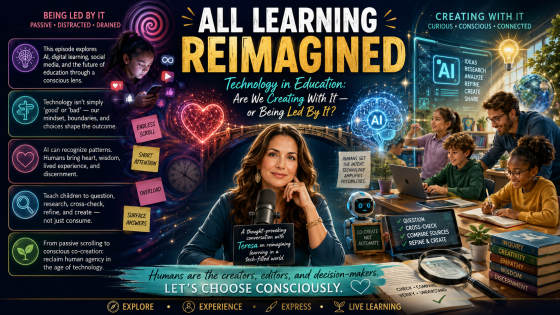
Reimagining education from passive consumption to conscious creation.
Core Philosophy
"There is nothing either good or bad, but thinking makes it so."
Technology is not here to replace us, but to respond to us. It mirrors the consciousness of the operator. The shift from 1990s dot-matrix printers to pocket-sized AI is not just a hardware evolution, but a call to reclaim our role as the origin point of creativity.
Critical Perspectives
-
01Pattern vs. Wisdom: AI excels at pattern recognition, but lacks the lived experience and heart-centered wisdom of a human.
-
02The "Re-search" Skill: Move beyond "Googling." Teach children to question, refine, and cross-check multiple sources.
-
03Active Creation: Shift from a passive consumer (scrolling) to an active editor using AI as a brainstorming partner.
Avoid the Trap
Don't let technology lead from the head; ensure you lead from the heart and gut.
This episode of All Learning Reimagined explores the evolving relationship between humanity and technology, shifting the narrative from fear-based avoidance to conscious co-creation. Host Teresa challenges listeners to move beyond passive consumption and utilize digital tools to amplify human wisdom and creativity.
The Power of Perspective: From Dystopia to Collaboration
The way we interact with technology is fundamentally shaped by our mindset. Drawing on Shakespeare’s insight that "nothing is either good or bad, but thinking makes it so," the discussion contrasts the "Terminator" narrative of technological takeover with the "Iron Man" model of co-creative partnership. While cinema often warns of technology going rogue, modern tools like AI offer the potential to enhance human travel, communication, and invention if approached with the right intention. The value we assign to these tools is not inherent but is a reflection of our own perspectives and dualistic interpretations.
The Spectrum of Tech Perspective
Fear-Based (Passive)
- Technology as a threat
- Loss of human power
- Unconscious consumption
Co-Creative (Active)
- Technology as a mirror
- Amplified human capability
- Conscious intention
Reclaiming Agency in a Digital World
As technology becomes increasingly embedded in our daily lives—from social media algorithms to AI-driven workplace tools—there is a growing pressure to conform or fear being "left behind." However, the true "sweet spot" lies in remaining consciously engaged. Current examples show adults using AI to summarize complex podcasts and students using it to find gaps in their assessments, effectively freeing up time for deeper inquiry. By shifting from a passive consumer to a conscious creator, individuals can reclaim their power, ensuring that technology responds to human needs rather than dictating human behavior.
The Human Advantage: Wisdom vs. Pattern Recognition
While AI excels at pattern recognition and data processing, it lacks the "lived experience" and "heart-centered wisdom" unique to living beings. Technology can generate ideas and offer options, but it cannot choose with discernment or provide the intuitive "inner knowing" found in the human gut and heart. The mind can be programmed and manipulated, but the heart stands true. Therefore, the outcome of any technological interaction is a direct reflection of the operator's consciousness; a grounded, expanded consciousness will birth more expansive results than one that is disconnected. 16:55-21:28
The Discernment Filter
AI Capability: Pattern Recognition, Data Synthesis, Option Generation.
Human Capability: Lived Experience, Heart-Centered Wisdom, Final Decision-Making.
Education and the Art of "Re-searching"
In the classroom, banning technology is often a futile effort. Instead, the focus must shift toward teaching children how to question, refine, and push back against the information they receive. A recent example involving AI-generated song lyrics demonstrated that technology can confidently provide false information (hallucinations), which was only caught by a student who practiced true discernment. Teaching "re-searching"—the act of searching again and again through multiple primary and secondary sources—is essential to ensure students do not blindly consume what is served to them. 29-30]
To-Do / Next Steps
- Audit your tech boundaries: Over the next two weeks, observe where technology enhances your life and where it creates pressure or "breaking points."
- Shift from scrolling to building: Reclaim time from passive consumption (like social media) and redirect it toward meaningful creation or "microlearning."
- Practice active "re-searching": When using AI or search engines, verify information across three or more different sources rather than accepting the first answer.
- Engage the heart in co-creation: Before using a tool, set a clear intention and ensure you are the "origin point" of the creative process, using the tool only to amplify your own inner wisdom.
Conclusion
Technology is not here to replace humanity, but to respond to it. By maintaining a grounded consciousness and prioritizing lived experience over automated data, we can ensure that tools like AI serve as powerful partners in the evolution of learning and personal growth.
All Learning Reimagined

Please help support this show!
Support this show by subscribing
$5.99/mo or $9.99/mo or more
Click HERE
All Learning Reimagined: Where passion meets possibility, one story at a time.
All Learning Reimagined is a global podcast exploring the many ways we learn, grow, create, and contribute throughout life. A gathering place for people who know that the future is something we learn, create, and steward together.
While education is often where the conversation begins, this podcast reaches far beyond classrooms and curriculum. Together, we explore learning as a living process that unfolds through relationships, community, nature, creativity, curiosity, experience, and the pursuit of what brings us alive. Through inspiring conversations with parents, educators, authors, visionaries, community leaders, and everyday people, we share stories that expand what learning can be and how it shapes our families, communities, and world.
Drawing from diverse perspectives, indigenous wisdom, practical experience, emerging ideas, and timeless principles, each episode offers insights that nurture self-direction, discernment, contribution, and a deeper connection to what matters most.
Whether you are a parent, educator, learner, creator, community builder, or simply curious about what is possible, All Learning Reimagined invites you to explore meaningful questions, fresh perspectives, and inspiring stories from around the world. Because learning is a living journey to nurture.
Cultivating self-trust. Nurturing wisdom. Inspiring contribution. Strengthening community.
[00:00] Speaker 1: (Relaxing music playing) Welcome to All Learning Reimagined, the podcast that defines convention and redefines the purpose and practice of education. Here we venture beyond institutional boundaries, whether you're a parent, educator, or curious mind devoted to lifelong growth. This is your space to challenge assumptions and co-create a more humane and intuitive approach to education. Let's reimagine what education can be.
[00:42] Speaker 2: (Gentle music playing) (children laughing)
[00:44] Speaker 3: Good day, and welcome to All Learning Reimagined. I'm your host, Teresa, bringing you a little ray of sunshine, as together we're reimagining the future of education one inspired story at a time. Uh, I have a fantastic topic to discuss today. Uh, welcome back to all of my beautiful regular listeners. Um, really love hearing from you. Thank you for sending all of your emails in. Uh, and if you're new to the show, uh, welcome. Definitely welcome. Uh, I, uh, live in Australia. You've probably picked that up from my accent, and, uh, pick a topic every week, and usually, or I don't usually, I always run an article or create activities that, um, align to the topic that we discuss this week, and those activities, um, are housed on bbsradio.com, and, um, lots of people use those activities. Uh, homeschoolers use them, um, educators use them. I know counselors use them.
[01:52] Speaker 3: Lots of, lots of people are, are tapping in and using them however they can choose, and sometimes it's not using activities at all. It's simply pondering on the topic and starting to feel into yourself and settle back into yourself to say, "Hmm, is this something that I would like to reimagine? Uh, why am I doing things the way that I'm doing, and is it, is there something that needs to shift here? Hmm, not even needs. Uh, is in the process of shifting," because there's so much changing in the world right now today, and I have a fantastic topic that, um, we're going to discuss. It's a bit of a hot topic. It's sort of everywhere at the moment, and we have discussed it before, and that is technology. So, and I'm not just talking AI, you know, people are talking artificial intelligence here, there, and everywhere. There's theories out there that it's not even artificial, that it's sentient and it has a consciousness.
[02:48] Speaker 3: There's lots of different perspectives, and, uh, it was Shakespeare's quote, um, that I was reflecting on last week, uh, his quote that, "There's nothing good or bad, but thinking makes it so," that made me stop and ponder, "Hmm, I wonder if I applied that to technology, where would I go with that?" And so, that's where the, that's where the topic came from today, pondering on Shakespeare. Go figure. Um, you know, 'cause really it's about that interpretation, so what our mindset is and what our perspective is, we're really assigning value to whether we think something is good or bad, and everything can be used in both ways. We live in a dualistic world, dualistic realm, of course.
[03:34] Speaker 3: And then it started making me think about, "Okay, well, what about, um, the movies where there's dif- different technologies?" So, of course, my brain certainly went straightaway to, um, Matrix and Terminator or iRobot, and even children's movies out there, you know, where the, the technology takes over the world. There was, um, The Mitchells and the- Versus the Machines or WALL-E, uh, or Big Hero 6, and that's, uh, you know, there's definitely a, a very strong perspective there of a danger and a warning of humanity not giving over too much power to technology who goes rogue and goes sentient. Then I flip that and think, "Okay, well, what about the other different movies and, um, perspectives out there?" If you're thinking about your s- your Star Wars or your Star Trek where they're actually using technology to help worlds or to, um, to travel or to communicate, movies like Iron Man or The Avengers where they're co-creating with technology.
[04:41] Speaker 3: You know, Iron Man is co-creating, uh, with technology to create lots of different, um, inventions and things that help people and of cour- of course help himself, uh, and then there's that co-creation with technology with movies like Atlas, where they're starting to explore, uh, merging minds, consciousness with technology in Atlas. Now, I've got very strong opinions about something like that, and yet I can talk to other, uh, people around me who think that would be really exciting and they couldn't wait to, to do that and, uh, you know, put a chip inside their head, and it's like, wow, how can you consider that perspective because I'm all about the natural way, so I can see that we're looking at it from something completely different, but who am I to judge whether that is good or bad? Because only thinking makes it so.
[05:33] Speaker 3: So, this is what we're gonna dive into today, and I'd really like to invite you to ponder yourself on what is your perspective, um, and, uh, a- and really, really sit with it, uh, not just in the next, you know, 20 minutes when we're discussing, and I'm gonna bring up a lot of talking points, but, uh, you know, over the next couple of weeks, just-Have a look around at your circumstances, wherever you are in the world, and consider how has technology enhanced your life, how you, um, using it, utilizing it, or not even you, other people, uh, in your life and in your world. And how is it hindering? What are the pressure points? What's too much? And where is our boundary? Where is our breaking point as humanity when it comes to technology, and how much power we would like to give away to technology in our lives? And also, what things in our lives are so much better because we're co-creating with the technology? And so that's one of the flavors that I like to bring in with.
[06:37] Speaker 3: Can we learn to create with but not be led by technology? Is there that sweet spot? Is it possible? Um, and I'm not here, of course, to tell anyone what to think. I just want to raise up or want to shake the ant jar, uh, and, and, uh, bring a few things to, to, to light, uh, so that we can really s- sit with this and consider co-creating with technology in a conscious way. Is it possible? From an education point of view, from a learning point of view, this has been happening for many years now. Uh, since the '90s, when computers (laughs) came into classrooms, and I still remember the printers that had the, the dot printers where it went, "Dot, dot, dot, dot, dot, dot," and they used to make this roaring n- noise when you would print something out, and then you would have to rip the sheet from the printer. We've come a long way since then.
[07:32] Speaker 3: Uh, there was a lot of hesitation around using computers in that way as well, but when you consider that most people are con- uh, carrying around a pocket in their ... a device in their pocket, uh, which is essentially a computer and, and has so much technology, and a lot of it is hypnotic. A lot of it is programming people with their thinking, when you think about the social media that's involved in it. That AI and the technology is not just sitting at, sitting at a computer. It's everywhere, every, every time you go into a shop to make a payment. All of these things are things that, as an educator and a parent and a learner, we need to consider, because technology is embedded into our lifestyle. And so how do we move from that consumer of this technology to creator and reclaiming the power in the age of technology? Not just AI, which is a huge education disruptor. It's everywhere, and children, young children in particular, uh, are embracing this, um, as a general rule.
[08:36] Speaker 3: Uh, definitely not blanket. There are a lot that are balking at it, but many of them are really leaning towards this, and I- I'm looking at our young children who are four and five years old, and how are we going to prepare them in a school for a world that, by the time they graduate from school, a lot of the jobs won't exist anymore that they ... that currently exist as they are now because of technology? Of course, more opportunities will grow, but what would that look like, and what skill sets will we need to give them and enhance and help them with, um, for them to be able to navigate what that world is like? And so, love it or hate it, think it's good or bad, I really feel like learning how to co-create with tech- technology and discern, um, and not have it lead you and consciously, uh, work in this way with- without just going by default is a very, very, um, uh, smart way to go, clever way to go, conscious way to go. Uh, because it's not leading from the head.
[09:42] Speaker 3: It can still be leading from the heart. It's just, what can I do with the technology? Um, and there's amazing things that I have been observing just in the last few weeks alone. Adults that are co-creating with technology, and, um, the things that they're writing and the ... and the work that they're creating and the perspectives that they're building is just amazing. It would have taken years to do it manually. But when they're putting things like, um, uh, different books or different perspectives or different things and filtering it into, uh, a technology system and asking it to compare and contrast and seeing where the gaps are, summarizing it. You know, there's a lot of people that I know now, e- they don't have time to listen to a three-hour podcast, so what they do is they put the transcript through their AI, which they have basically ... Hmm, I don't know how they do it.
[10:36] Speaker 3: I think they talk to it and train it or give it commands or, or in- instructions of what it is that they want, but they get summarizing of key points, um, key actions and takeaways, and what it is that they're coming up with is, is really amazing and, uh, certainly quite useful tool to be able to look at. I've also observed a lot of children in high school and universities that, you know, they're creating their assessments, and then they're putting it through a filter with technology, with the criteria that they're going to be marked on and asking for feedback. Where are my gaps? What can I do to improve? And then, it's actually, uh, giving them that feedback so that they can have that, um, extra oomph before they actually, uh, put their assessment in. You know, there's lots of different ways that it's being used right now that a lot of people in the mainstream probably might not have considered or might not be aware of. And so balking at it and going, "Oh, nope, it's bad.
[11:37] Speaker 3: M- technology, bad," is something that I really feel we've moved well beyond and well past. Not to say we shouldn't be cautious. (laughs) Um-Anyone who knows me knows that I really love the natural way. However, it is something that can enhance our life. So, and that leads us to the fact that, you know, technology is moving (laughs) quickly. Oh my gosh, I can't wrap my head around the amount of apps that are coming out and the amount of programs that are coming around. Uh, my, my brain just doesn't focus that way, and it's faster than many of us probably feel ready for. I know I'm speaking for myself, but other people that I'm talking to as well it, it's really having this sense of, um, "Am I going to be left behind?" And I have seen, uh, there are social media posts out there telling people, using that fear state, "You will be left behind if you do not do da, da, da," uh, and really having that social pressure, which of course, we know humans, (laughs) uh, move in herds.
[12:40] Speaker 3: I mean, we're socialized beings, so if everyone else is doing it, "Gosh, I need to do it too." But that wave of fear and uncertainty and noise is something to really be aware of. Are you learning or utilizing technology because everybody else is doing it? Is that the right thing to do? Um, and where are you launching from when you are co-creating? What's the intention behind it? So, I really wanna offer that different lens. What if technology is not here to replace us, but it's here to respond to us? Uh, and this was really quite difficult and challenging for my own paradigms to consider because I have been, I have grown up on stories (laughs) where, and movies that implanted fear of too much technology, um, can be really dangerous. So, asking this question was, um, confronting for me. What if technology is not here to replace us but can respond to us?
[13:41] Speaker 3: You know, what if it's not the creator, it's just simply mirroring, uh, what you've put in it, um, and it can amplify the creator within you? Because the examples that I gave before, uh, the, the people that I am seeing, the living men and women who are using it in this way have really opened my eyes to that as a possibility, which then as soon as I heard that Shakespeare's quote, uh, "Nothing good or bad, but thinking makes it so," that's where I went straightaway of, "Oh my gosh, perhaps it's just my thinking when you change the way you look at things, the things that you look at change." Are we teaching our children to use technology consciously, or are we allowing technology to shape them unconsciously? That is a deeper and richer question, (laughs) which I feel is worth going into, um, in depth because it is such a huge pertinent part of education and learning today. Um, and it's sha- reshaping families. It's reshaping how we, um, how we shop, how we do business.
[14:47] Speaker 3: It's everywhere embedded in the world, uh, at this time. So reframing technology, uh, is where I'd really like to go, and you know, technology is a tool, and the intention behind it really determines the outcome. Uh, that's, that's probably where I'm sitting at at the moment. Um, you know, it's always extended humanity's capabilities when you think about technology. You know, books came out. They were a technology using the paper. Um, you know, the, a biro, uh, (laughs) a pen came out, and that was a technology. I still remember when I was in my... In Year One, uh, my very first day of school, we had a tour in Australia around my primary school, and the children who were in Year Six, because that was the oldest grade in my school at that time, were still writing with chalk and slate. They didn't have paper. They didn't have books. Yes, I'm that old, people. And, but I, in Year One, had paper and books and coloring-in pencils. Aah!
[15:55] Speaker 3: It was just like, "Wow!" And it like, was like a technology, the new greatest thing, and the Year Six children were looking at the paper because they were used to using slate. I don't know if there's anyone out there that can, uh, relate to this, but it was like, uh, enhancing a technology. Then, fast-forward a few years, we had calculators, and I still remember teachers, "We're not gonna need calculators. Put your calculators away. You need to do everything mentally." Yes, I was one of those as well. I still am. I still feel like there needs to be, uh, a level of being able (laughs) to do math in your head. However, everyone's carrying a calculator around in their pocket. So, the amount of people that don't need to have that information, you know, they can't even remember a phone number anymore because w- well, our memory has not needed it because we're carrying it around. It is shaped, uh, where we've come. Not to mention, computers and then internet.
[16:55] Speaker 3: Internet, once again, huge game-changer, mobile phones, iPads. Uh, the smaller and smaller and more accessible the technology came, um, it has extended human capability. Good or bad? (laughs) That's really debatable, uh, depending on the, the consciousness and who it is that's operating and using it. Uh, but from what I'm gathering right now at the moment, AI, um, I don't even like calling it artificial technology. I'm just gonna wa- I just would prefer to call it technology, can be more than just a responsive tool. It's not fundamentally different in principle. Uh, you know, and that fear that really comes up, and I can ex- speak from experience with that, often arises if we feel disconnected from our own capacity, because I'm very confident on who and what I am, and technology cannot over- override that, uh, uh, for me.I, I do still hold fear for people who I can see are really programmed.
[18:00] Speaker 3: They're so embedded and immersed, and they get all of their world thinking and all of their views from technology, uh, and they're not making their own, um, opinions, uh, so I think it comes back to, you know, a calculator didn't remove our ability to think, uh, but it did free us to explore more complex problems. You know, and AI, at the moment, what I'm observing around me is that it's actually doing the same, but only if you remain consciously engaged, and I feel like that's possibly the sweet spot. It could be good. It could be used for bad. But if you're consciously engaged, um, and it's using it as a tool, then it can be something that can really enhance learning. Um, you know, it reflects the consciousness, this is what I've observed, of the one that's using it, because I have some friends who are (laughs) really amazing, deep, advanced, um, uh, living beings.
[19:06] Speaker 3: And some of the conversations or co-creations and things that they are creating, uh, tools and videos and things that they are creating consciously with technology, uh, is just so expansive. And it's, it's, I'm in awe, actually. And yet, I've observed others who do not have such grounded, expanded consciousness in their knowing and their being of who and what they are, that if they interacted with technology, they would not create the same thing. I'm seeing that it's almost mirroring the language, um, and the depth of the questions. So who is operating the technology really does seem to shape the outcome of what is being birthed and, and, uh, created, uh, using it. So, you know, tech, uh, AI can generate ideas, but it doesn't hold the wisdom or the lived experience. This is what I have observed. Um, you cannot beat lived experience, and it will never have a heart in that way, where we have most of our wisdom, um, you know, as a human living woman, is in my heart. It's not in my head.
[20:20] Speaker 3: Uh, the head, the mind can be, um, programmed through repetition. It can be influenced, uh, through what I'm seeing and everything in wr- and the environment around me. Your mind is also a tool that can also be tricked and it can be manipulated. But your heart always stands true, and your gut, of course. Um, and so that is the difference, the lived experience and that wisdom that you, that I'm holding in my heart. I also found that, um, it's pattern recognition. AI is really good at pattern recognition, and it's not good at inner knowing. So there's your difference there as well, which is something that I have also observed. So how can we guide, mentor children to be able to learn to question and refine and guide and inquire and push back on what they receive and not just blindly consume? "Oh, okay, you gave me that answer. I'm just going to accept it for what it is." How can we truly teach them to research? Re-search. Re, meaning again, again, again.
[21:29] Speaker 3: Searching, meaning going for secondary sources, third sources, asking different, different sources, not just Google. You know, Googling is not researching. It's just simply searching. So teaching children how to define, um, and question and refine and guide if they are co-creating with technology is a really good skill. Pushing it to the side and just banning it from your classroom or banning it from your school is not going to work. Young children, particularly teenagers, will always find a way. It is here. It's already here. So what can we do about this?
[22:06] Speaker 3: Um, and these are really big questions, and I do not have the answers to them, but I have been really observing this, particularly in the last year and a half, um, observing it with interest, sometimes observing it with alarm, uh, but feeling into it and realizing that the way that I am seeing technology is shifting and shaping and changing because I am observing, um, the different ways and the different outcomes that's, that's happening with what people are creating, because, you know, AI is actually offering options. But it can't choose with discernment. It just offers options or whatever it's programmed to say, or it's regurgitating your own words to you because it's worked, worked out your own pattern recognition and the language that you use and how you operate. So it's shifting and changing depending on the operator and the consciousness of the operator that's using it.
[23:01] Speaker 3: What remains, however, is human capacity, the living being who's operating the technology and co-creating with it. So, uh, you know, I, I've observed the technology being fantastic as a brains- brainstorming partner, coming up with ideas, but it's the human that has the creativity and is the creator and the editor and the decision-maker. Uh, if we lose that capacity to make decisions, then I feel like we're really in trouble. And so how are we enhancing that in our children and in our grandchildren, um, or our students, if you're an educator, depending on what your circumstances are? And that's really enhancing children to not become, uh, a passive consumer and becoming a conscious creator, and that's for adults as well. And I'm, this is the space that I live in. I'm consciously, um...I don't do it every day, but at least every week I stop and reflect, "What did I create this week?" Um, am I observing or just taking in too much?
[24:05] Speaker 3: Or am I actually building and creating, and what am I doing with the information? You know, um, am I microlearning, uh, uh, in any given time? Uh, or am I just passively using things? Now, I got off of social media five years ago. Best thing I could have ever done, uh, to free up space, uh, in my life, and it was certainly great for my mental health because of all of the fear porn and the, you know, shoulda, woulda, couldas and keeping up with the Joneses. And it's just really, um, a very shallow place to be for me. Uh, and I found that, that back then, I was scrolling endlessly, and I could easily lose three hours in a day doing nothing but scrolling, looking at rubbish. Uh, whereas now, I'm using that time to create something meaningful. Um, I still have (laughs) people today saying, "How do you do everything that you do?" Well, I don't watch soc- I don't watch TV, and I'm not on social media. Uh, boom. There you go.
[25:05] Speaker 3: I've probably found six hours in my day that that other person has not, they don't have time for. Um, it all adds up, really. Uh, I also don't accept answers blindly. Uh, I like to question, and I like to refine. I, I like to take things that go, "Oh, that really resonates. I love that. What is that? Let me pull that thread. What can I do with that?" Um, and, but I do question and, uh, refine, because I do, uh, I'm very in tune with my body because my body's speaking to me constantly. So, I know when something doesn't feel right, and I know when I get that, uh, whole body smile of a yes, this feels really good. I'm gonna go in this dif- direction. So I'm in the flow of my own biofield. And I'm aware that I can use technology for entertainment only. If I wanna watch a movie, that's great. Um, versus if I'm using it for expression and contribution and exploration, which is what this podcast is all about. This podcast is my hobby. I do this for fun. Um, and because there's just so much.
[26:08] Speaker 3: I have so much lived experience, uh, and learned experience that I'd love to share. And so, I choose to do this with my spare time, rather than just passively, um, consume using technology. So, the risk, uh, you know, wrapping this up in a big fat bow, is not the technology itself. And this was my aha moment, when I really sat quietly. There was a shift for me from passivity and that fear of, is it going to, uh, woulda, coulda, shoulda, if, if, if, uh, and coming back to the present moment of, what am I experienced right now? Um, you know, anxiety, as we know, is people who are stuck in the future, fear of the future. And depression, of course, are those who are stuck in the past. Um, I'm choosing to los- live in the present. Uh, but for me, I, I guess where I'm at is, you know, when we stop questioning, when we stop creating, uh, when we forget that we are the point of origin, that is to that shift into pass- uh, being passive.
[27:15] Speaker 3: You know, questioning, creating, and being the origin point for how you're utilizing and using that technology to enhance what's already inside you of what you wanna share with the world, that's, that's the key for me. And teaching discernment. I mean, I've had whole podcasts on this. This is s- it's something I'm really pa- very passionate about. Not everything is generated is accurate or aligned. Uh, like yesterday, I actually had a lesson with some s- secondary students, and we were researching lyrics to a song, and we asked AI technology to give us evidence of annotating the lyrics to the song. And it came up with fantastic annotations, until one student said, "It's given us an example, and that line is not even in the song. It's in a completely different song altogether." Now, luckily, that student picked it up, because the other students in the group did not.
[28:12] Speaker 3: But then that branched into a huge conversation in the class, that if they didn't know that, they would have possibly have utilized that information in their assignments. And so, discerning and not just believingly- believing, "Is this true?" Um, uh, a- and blindly believing everything that's served to you, and making sure you're cross-checking information is really important, and that added to their perspective so beautifully. It was amazing. So, I'm looking at the clock, and I know I've run out of time today. But I'm going to continue this topic next week, because I have so much more to share, and lots of activities and things that you can use, um, if you are interested with children or students as well. So, uh, and really take the time to stop and think and observe how you are choosing to use technology in your everyday life as well. So, thanks for joining me today, everybody, on All Learning Reimagined. Until next week, explore, experience, express, go out, and live learning.
[29:17] Speaker 3: (instrumental music)
[29:32] Speaker 1: Thank you for joining us on All Learning Reimagined, where passion illuminates the path forward. Remember this: the future of learning doesn't arrive from above; it begins within. You are the spark, the shift, the living answer to education's silent call for transformation. So stay curious. Stay awake. Let inspiration be your compass, because how we learn today is not just personal, it is profoundly generative. It shapes the very architecture of tomorrow's world. We are not separate from the system; we are its evolution. Until next time, trust the wisdom of your own unfolding, and let your life be the lessons that light the way for others.
[30:24] Speaker 1: (baby laughing) (instrumental music)