
All Learning Reimagined, February 6, 2026

All Learning Reimagined with Teresa Songbird
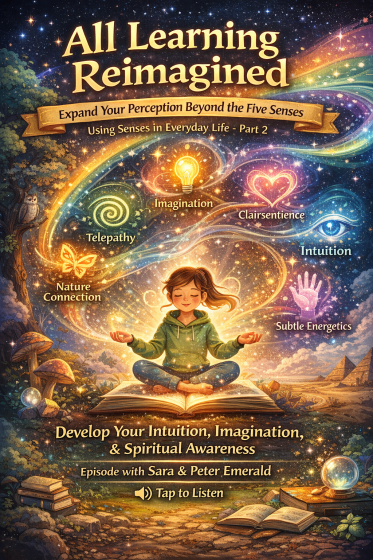
Topic: Using Senses in Everyday Life - Part 2
Beyond the Five Senses: Reimagining Human Perception and Connection
All Learning Reimagined: Beyond the Five Senses
Redefining education through intuitive perception and the wisdom of nature.
The Sensory Spectrum
- Clairvoyance: Inner seeing, visions, and symbols.
- Clairsentience: Sensing vibrations and emotions.
- Clair cognizance: The "Gut Knowing" or instant truth.
- Clairaudience: Perceiving internal sounds/music.
The Story: Children of the Whale Song
Moving beyond mindfulness to "pondering" in nature. Dropping out of the mind-space to listen to trees, wind, and stones.
This episode of All Learning Reimagined explores the expansive spectrum of human and animal perception, moving far beyond the traditional five senses. Host Teresa discusses the integration of mental, emotional, and spiritual awareness, using nature and storytelling to illustrate how we can reconnect with a more intuitive and humane approach to education and life.
The Multi-Layered Human Experience
True education involves recognizing that humans possess multiple "bodies"—physical, mental, emotional, and etheric. While mainstream schooling focuses heavily on the five physical senses, ignoring our more subtle faculties blocks our ability to navigate everyday life effectively. Modern society often traps individuals in a "mental loop" of intellect and neuroscience, frequently at the expense of the "heart space" and willpower. Reclaiming self-discipline and self-governance is essential to breaking the cycle of instant gratification that has dominated the last few decades.
The "subtle" or spiritual senses are often misrepresented in popular media as overt "bells and whistles," but in reality, they are gentle and require attunement to nature. These include clairvoyance (inner seeing), clairaudience (inner hearing), clairsentience (sensing vibrations and emotions), and Clair cognizance (an innate gut knowing). Developing these allows for a deeper perception of reality that exists beneath the surface of physical interaction.
The Spectrum of Subtle Perception
# Beyond the Five Senses: Reimagining Human Perception and Connection
Introduction
This episode of All Learning Reimagined challenges the traditional boundaries of education by exploring the full spectrum of human perception. Host Teresa discusses how moving beyond the five basic physical senses to embrace mental, spiritual, and intuitive "bodies" allows for a more humane and connected way of navigating everyday life.
Detailed Summary of Key Themes
The Multi-Layered Human Experience
Traditional education often limits the study of human perception to the five physical senses: sight, sound, smell, taste, and touch. However, humans possess multiple "bodies"—physical, mental, emotional, and etheric—each with its own set of senses. By focusing solely on the physical, society often blocks out subtle intuitive and mental faculties such as imagination, memory, reasoning, and willpower. There is a growing concern that willpower and self-discipline have declined over the last 30 years due to a societal "programming loop" that prioritizes instant gratification over self-governance. To break this loop, individuals are encouraged to drop from the "head space" into the "heart space" to access deeper levels of awareness.
The Spectrum of Human Senses
The Basic 5
Willpower, Intuition
Clairvoyance, Sensing
True education involves integrating all layers of the human field to perceive the world accurately.
Lessons from the Animal Kingdom
Animals often exhibit sensory capabilities that far exceed human limits, largely because they are not trapped in mental loops or belief-based programming. For instance, eagles possess sight four to eight times more powerful than humans, while dogs navigate the world through 300 million scent receptors. Beyond the physical, animals demonstrate profound emotional and intuitive intelligence; elephants mourn their dead for decades, and horses have the unique ability to synchronize their heart rates with humans, offering a form of intuitive healing. These examples suggest that the natural world is constantly communicating through frequencies and vibrations that humans can learn to perceive if they remain "in tune".
"The Children of the Whale Song": A Narrative for Awakening
To help children (and adults) reconnect with these forgotten senses, Teresa shares a story about "Listeners"—children born with open senses. The narrative serves as a teaching tool for five "Gifts": Inner Seeing (imagination as a heart-language), Clairsentience (sensing energy and truth), Heart Telepathy (communication through the heart rather than the mind), Timeline Listening (using intuition to sense the best path), and Energetic Creation (shaping the world through quiet intention). The story emphasizes that these are not supernatural powers but natural human gifts that have been forgotten by modern society.
The Five Gifts of the Listeners
- 👁️ Inner Seeing: Heart-based imagery beyond imagination.
- 🌊 Clairsentience: Feeling the truth beneath spoken words.
- ❤️ Heart Telepathy: True connection through shared resonance.
- 🌀 Timeline Listening: Sensing harmony before a choice is made.
- ✨ Energetic Creation: Shaping reality with a steady heart.
Nature as a Living Mirror
The environment acts as a companion and teacher for those who practice contemplation. Trees can offer impressions of stability and patience, the wind acts as a messenger for transition and change, and stones communicate in the language of continuity and stillness. Water, in particular, is described as having "memory," reflecting and amplifying the emotions and intentions of humanity. By engaging in "contemplation"—a state of silent awareness and pondering—individuals can drop out of the mind space and experience a sense of belonging to the moment.
Key Data & Comparisons
- Scent Receptors: Dogs have approximately 300 million receptors, while humans have only about 6 million.
- Visual Range: Eagles can see 4 to 8 times further than humans.
- Human Senses: While mainstream schools teach 5 senses, this discussion highlights at least 15 distinct human senses across physical, mental, and spiritual categories.
To-Do / Next Steps
- Visit the BBS Radio website to access archived shows and educational activities related to the senses.
- Download and share the story "The Children of the Whale Song" to use as an inspirational tool for children.
- Practice "contemplation" (mindfulness) in nature by sitting in silence and dropping out of the "mind space."
- Observe the behavior of pets or local wildlife to see how they respond to energetic shifts or environmental changes.
Conclusion
True education is not merely the acquisition of facts but the awakening of the "Listener" within. By acknowledging our mental and spiritual senses and learning from the intuitive wisdom of nature and animals, we can transform our personal experience and, ultimately, the architecture of the world around us.
All Learning Reimagined

Please help support this show!
Support this show by subscribing
$5.99/mo or $9.99/mo or more
Click HERE
All Learning Reimagined: Where passion meets possibility, one story at a time.
All Learning Reimagined is a global podcast exploring the many ways we learn, grow, create, and contribute throughout life. A gathering place for people who know that the future is something we learn, create, and steward together.
While education is often where the conversation begins, this podcast reaches far beyond classrooms and curriculum. Together, we explore learning as a living process that unfolds through relationships, community, nature, creativity, curiosity, experience, and the pursuit of what brings us alive. Through inspiring conversations with parents, educators, authors, visionaries, community leaders, and everyday people, we share stories that expand what learning can be and how it shapes our families, communities, and world.
Drawing from diverse perspectives, indigenous wisdom, practical experience, emerging ideas, and timeless principles, each episode offers insights that nurture self-direction, discernment, contribution, and a deeper connection to what matters most.
Whether you are a parent, educator, learner, creator, community builder, or simply curious about what is possible, All Learning Reimagined invites you to explore meaningful questions, fresh perspectives, and inspiring stories from around the world. Because learning is a living journey to nurture.
Cultivating self-trust. Nurturing wisdom. Inspiring contribution. Strengthening community.
[00:00] Speaker 1: (Relaxing music playing) Welcome to All Learning Reimagined, the podcast that defines convention and redefines the purpose and practice of education. Here we venture beyond institutional boundaries. Whether you're a parent, educator, or curious mind devoted to lifelong growth, this is your space to challenge assumptions and co-create a more humane and intuitive approach to education. Let's reimagine what education can be.
[00:42] Speaker 2: (laughs)
[00:48] Speaker 3: Good day, and welcome to All Learning Reimagined. I'm your host, Teresa, bringing you a little ray of sunshine as together we're reimagining the future of education one inspired story at a time. Uh, it's lovely to be back with you all again. Um, it always is every week, and, um, this week we're actually doing part two of last week, when we discussed, um, different senses that humans have. And, uh, it was really interesting, and I had some, um, fantastic feedback. Thank you for those who reached out and were really interested in the activities that I created, um, to go with the senses. So, to recap, uh, I just focused m- mainly on 15 human senses, even though there's so many more than that that are really subtle. But we looked at the obvious five that are pretty much taught in mainstream schools, you know, sight, sound, smell, taste, and touch.
[01:47] Speaker 3: But, uh, the point I was making last week is the fact that if we only focus on those, then we really become blind to all of the other senses that our body ... Because we have many different bodies. We have a physical body, but we also have a mental body, we have an emotional body, um, we have an etheric body. We have all different layers within our body, within our field, and when we're ignoring, uh, tapping into things other than the physical, then we are really blocking out a lot of our senses. And a way of navigating everyday life is to really to sit back and become in tune with yourself, and that was one of the main points from last week. I mean, the other five senses we talked about very briefly last week was the five of the mental senses, and (laughs) , you know, society today really is in the head space. They're always pushing neuroscience, and intellect, and being in the mental space.
[02:46] Speaker 3: Um, so there's imagination, there's memory, intuition, which can be gut and stomach, but it also can be a mental, um, uh, a mental sense as well, reasoning, and willpower, which is something, in my opinion, that I have b- been observing. Willpower has been going out the window for probably at least the last thir- 20 to 30 years. Uh, self-discipline, self-governance, um, and wanting to have something now and not giving yourself the, the willpower or the discipline to be able to, to wait, uh, to, for whatever it happens to be. It's that push now, now, now, um, society programming loop that we seem to be in, which is something that, uh, is one of my missions to try and break it. So, the mental senses are very useful, but, um, being in your, in your mind is not the only way of life. We definitely want to tap in and drop into our heart space, and then we wa- want to also tap into the other senses that we have throughout our body.
[03:52] Speaker 3: And so, we also talked about the subtle senses, which are more the spiritual senses. Um, and I know there's lots of movies and television shows that talk about this, but I think that some of those, um, some of those shows actually do not necessarily show these senses in a correct light. They make it all bells and whistles and obvious. Whereas the, the spiritual senses, um, are really, really, uh, subtle and very gentle, and if you're not in tune with your own body or with nature around you and the elements around you, then you're going to miss them. It's, it's not something very obvious like it's sort of led to believe. Well, in most cases, anyway. So, we talked about, um, clairvoyance, uh, which is of course inner seeing, you know, uh, visions, and symbols, and, and images in your mind really perceiving. Clairaudience, which are more sounds, um, music.
[04:50] Speaker 3: Um, clairsentience, which is, you know, feeling and sensing emotions, vibrations, like the physical sensations, and really being in tune with your body. Uh, claircognizance, which is that gut knowing. Um, uh, that, that's a really important one, and in my opinion it's something that we all have. It's just, do we ignore it or do we listen to our own gut knowing? Um, and clairalience is the other one that we talked about, which is the taste, sensing taste. And of course, there is another one, which is smell, but we didn't go into that in too much detail, um, last week. So, for this week, um, uh, expanding on this, uh, someone did actually ask me a question and said, why didn't I mention senses with the animals and the pets around us, which was a brilliant point. So, thank you, Claire, for mentioning that. Um, yes. Animals also have the same senses that humans have, but of course even more so. Uh, I don't know if anyone's ever lived with a cat (laughs) .
[05:53] Speaker 3: They can definitely see and sense things that are around us that we cannot see with our sight, um, and-Uh, uh, it's just amazing how their intuit- intuition and even their telepathy and their emotional and energetic perception is so advanced. The animals are, they really know where it's at because they're in tune. And in my opinion, it's because they're not stuck in their head space. They're not stuck in that mental loop with beliefs and programming like we are. Well, many of us are, I should, I should correct that. Um, and I would say with animals, I mean, think about the sight. Think about an eagle. Like, they can see four to eight times further than humans. That's why they can spot that fish, um, and, and spot that animal, spot that snake, whatever it is that they're going for. And we cannot see it with our eyes. And then you have sound. I mean, dogs, I mean, uh, dogs are amazing and they hear frequencies that we cannot.
[06:53] Speaker 3: I'm not telling you anything you don't know, uh, but still, their senses with their hearing is off the charts. And same with bats, who use echolocation, uh, which is an amazing sense to be able to have. Um, I know some whales have that as well, of course. Um, smells, dog can smell up to 300 million, they've got s- 300 million scent receptors. I'd love to know who actually counted those. Um, and humans have about six million. So our sense of smell is nothing like what a dog's is. So a dog can actually go up to a person, smell them, and then they can smell if there's something wrong with that person. So I know we, dogs are always sniffing all sorts of things and rolling in it, uh, but their sense of smell is, uh, um, an advanced sense. Of course, taste, um, catfish have taste buds that are all across their bodies. That's amazing, uh, an amazing sense to have. And then things like touch.
[07:55] Speaker 3: So an example of that would be cats' whiskers, um, which really do sense that vibration and then that air movement, so they're tapping into the elements as well. So, and then you've got... That's the physical senses that animals may have. And then you have mental and emotional senses. So elephants, uh, elephants, beautiful, beautiful elephants, they can mourn and they remember individual across decades. Their memory is phenomenal, uh, and that's also a well-known fact. Crows, whether you like crows or not as a bird, they are so intelligent and they can use tools and they can actually plan multiple steps ahead. They're very, very clever birds, and they can use a lot of mental senses. Dolphins, uh, create bubble art. They can play. They have huge signs of imagination. Dolphins are incredibly intelligent and, and also utilize many, many senses. And then horses, um, who doesn't love a horse, right? Um, horses synchronate, uh, syn- synchronize, I should say, with human heart rates.
[09:05] Speaker 3: Now, I don't know about you, but horses are very healing, and I have observed horses, um, uh, surround a, a person who was in distress and then they would just walk around and they would place themselves and stand around this person. And you could tell that they were synchronizing something. They were showing empathy, uh, they had this intuitive sensing. And in my opinion, I don't know what it was that they did, but they were definitely tapping into the human heart rates. And I feel that they, they were, they were healing, um, and then they were helping that little girl that I actually observed on that day. And cats and dogs do it too. There's a reason why they come and sit with you sometimes, and it's just being near them, um, is somehow shifting, uh, our frequency and clearing it. There's just so much that we don't know about, about the senses of animals. And that's just a couple.
[10:04] Speaker 3: So the main thing I actually wanted to do today was to tell you a story, and this story is one that I will publish, of course, every week. I publish an article or some activities, um, on the BBS website, and you can go to all the archived ones as well. So you go to bbsradio.com is where you will find the main article of the week published on the main page. Or you can go to bbs.radio.com/alllearningreimagined, and that's where you can find all the archived shows. And then the, uh, when you scroll down a little bit further, you'll find all of the matching articles or educational activities that I may have created to match that week's topic. So this week you've got a s- you've got a story, and this is a really great story to use with children of all ages because it models the senses all the way through the story. It's pretty much just threaded through very gently.
[11:05] Speaker 3: And it's really great to see if the children can, um, align with them, if they can, if they can pick them out, and then if they can sit and contemplate if they have any of these senses as well. And I'm not a huge fan of meditation, personally. I've not meditated in years and years and years. Uh, but I am a huge fan of contemplation. Some people call it mindfulness. So if you're walking on the beach or if you're walking in the forest or if you're just walking in the park, it's being aware of all the things that are around you and tapping in. But just that silence, no talking, and dropping out of the mind space. Now, some people may argue that that's, um, meditation, but for me it's contemplation. I usually have a question that I just sit and ponder and contemplate.
[11:53] Speaker 3: May- might only be five minutes, might only be 10 minutes, but that slowing of the heart rate and tapping in is a really important skill, and it's a great skill to have, to learn to contemplate something like this story.So, let me get started 'cause it's actually quite a long one. Uh, I got a bit carried away (laughs) . Not like me. Goodness me, Theresa. Okay, so this song, uh, this story is called The Children of the Whale Song. Uh, I love whales and dolphins. Um, have a very special place in my heart. Sirius has a very special place in my heart, and whales and dolphins in the ocean. Uh, so this is where the theme happens to be. So, the prologue is, "Be- long before children learn to read letters or numbers, they learned to read the world. They feel the truth in their bellies, they hear the whispers in the wind, and they see colors that adults no longer notice. Some children hold onto these senses, but some forget.
[12:58] Speaker 3: Every few generations, a group of children is born with their senses still wide open. These children are called listeners, and this story is about them. The dreams began quietly. At first, they came only to a handful of children living in a small coastal town, dreams that smelled of salt and sunlight, dreams where enormous shapes moved between tur- be- beneath turquoise water, and dreams woven with a strange haunting song that lingered long after waking. Twelve-year-old Lina heard the song first. It had a deep, ancient vibration that made her chest warm as though a candle had been lit inside her. She asked her mother where the song came from, but her mother only smiled tiredly and said, 'Maybe you're sleeping too close to the open window.' Across town, a boy named Kai dreamed of spirals of bubbles rising like galaxies in the sea. Another girl, Naya, dreamed of a huge shimmering blue eye looking gently into hers. Not frightening, but it felt very familiar.
[14:14] Speaker 3: And each child woke up with the same feeling, someone is calling me." Chapter two. "One warm night when the moon floated like a silver seed above the ocean, all the dreaming children found themselves drawn to the beach. None of them had planned it. None of them had spoken to each other. They simply carried them there, guided by the strange knowing that rises from the heart and not from the mind. They gathered in silence on the sand, watching the waves glow blue with bioluminescence, swirling like living stars. And then, they heard it, not with their ears but inside their ribs, the whale song. It rose from beneath the depths of the long harmonic tones that shimmered in the children's bones. The ocean peeled back its veil and a magnificent blue whale surfaced, her skin glowing softly like the moon. Lina gasped, Kai dropped to his knees in awe, and Naya felt tears run down her face without understanding why.
[15:26] Speaker 3: The whale's great eye met theirs, and instantly, as if they were all part of one shared breath, every child felt the same words inside of them, 'You are ready.'" Chapter three, The School Beneath the Waves. "The water around them brightened, becoming light instead of liquid. The children found that they could walk forward without sinking. Hand-in-hand, they entered the ocean until the world around them transformed into a vast luminous hall of drifting light, The School Beneath The Waves. A pod of dolphins spiraled joyfully around them, sending bursts of color that landed in the children's minds as laughter. A great whale glided beside them and spoke without sound, 'Welcome, young ones. You are listeners. Your world teaches you that you only have five senses, but you have many more. You were born with them, you simply forgot.' The children stood back and stood still, awestruck. 'Tonight,' the whale continued, 'you will remember.'" Chapter four, The First Gift: Inner Seeing.
[16:48] Speaker 3: "A gentle light swirled around Lina. 'Close your eyes,' the whale instructed. Lina did. She felt an image rise inside her, a glowing shell spiraled like a galaxy. 'Inner seeing,' the whale said. 'Humans call it imagination, but it is much more. It is the way your heart speaks in pictures.' Lina opened her eyes, stunned. She had never, never seen the shell before, but she knew it perfectly. The whale dipped her head. 'Your inner sight is as real as your outer sight. Both are needed for truth.'" Chapter five, The Second Gift: Feeling Between Worlds. "A dolphin approached Kai and bumped him gently. At once, Kai felt a wave of emotion waver, wash over him, joy, curiosity, with a little bit of dolphin mischief, as if the dolphin had poured its feelings straight into his chest. The dolphin twirled, and Kai (laughs) burst into laughter. 'This is clairsentience,' the whale explained.
[18:00] Speaker 3: 'Feeling the truth beneath what is spoken, sensing energy the way you sense weather.' Kai nodded slowly.He could feel everything, the heartbeat of the water, the mood of the pod, and even the gentle sadness hidden deep inside the ocean. "I didn't know I could feel this much," he whispered. "You always could," the whale replied. Chapter six, The Third Gift: Heart Telepathy. Naya stood before the whale, whose great forehead glowed with light. A warmth spread from her chest outward, like a door opening, and suddenly she heard, not in her ears but in her heart, "You are safe. You are seen. You are part of us." Naya began to cry again, but this time from a feeling she had no name for. The whale lowered her head. "This is heart telepathy. Humans think telepathy is a mind skill, but true communication comes from the heart." The children all felt it then, a soft, humming unity, like being wrapped in belonging. Chapter seven, The Fourth Gift: Timeline Listening.
[19:29] Speaker 3: A humpback whale approached, ancient and wise. He swam in a spiral pattern, and the water filled with shimmering lines of light. "Every choice creates a current," he said, through images and tones. "When you listen deeply, you can sense which current will bring harmony and which will bring struggle." Each child stepped into the spiral and felt something extraordinary, a subtle pull, like the ocean itself was guiding them towards the best path. This was intuition, not guessing, but sensing the truth before it arrives, allowing you to choose your timeline. Chapter eight, The Fifth Gift: Energetic Creation. A baby dolphin darted around playfully, sending small bubbles drifting upward. She nudged one toward the children. "Move it with your mind," the dolphin encouraged. The children concentrated. The bubble quivered and drifted, but then floated sideways. They gasped. "You see?" the whale said gently.
[20:43] Speaker 3: "When the mind is quiet and the heart is steady, your intention shapes the subtle world." The children stood in a ring, moving bubbles with thought, giggling as they did. They loved this school. Chapter nine, The Return. The light began to fade, and the whales and dolphins gathered around them in a shimmering circle. "You will return to your world," the great whale said. "But you will not be the same. You now remember all your senses, the one your world forgot to teach you." The water rose in a swirl of brightness, and the children found themselves back on the moonlit beach. The ocean was calm, the stars were bright, but the children were changed. They could still feel the whale song inside them, a hum of truth, clarity, and connection. Chapter 10, A New Way of Seeing. The next morning, the children noticed the world differently. The trees glowed with quiet colors. Animals looked at them knowingly, and when they imagined something, it felt real, like a seed ready to grow.
[22:04] Speaker 3: When they spoke to each other, they often knew the answer before the words came out. They began to share what they had learned, and soon other children wanted to learn too. And slowly, gently, the world began to change. For the first time in many generations, people began to remember humans are not limited. You were born with many senses, and when you awaken them, the whole world becomes whole again. Chapter 11, The Whispering Forest. In the weeks after the children's night at the ocean, something curious began to happen. Whenever Lina walked through the forest near her home, she felt a soft pull, like an invisible thread tugging at her heart. Trees she passed a hundred times suddenly felt awake, as if they were waiting. One afternoon, as golden light dripped through the leaves, Lina placed her hand on an old peppermint gum tree. The moment her ha- her palm touched the bark, a deep warmth flowed upward through her arm, not hot, not cold, just steady and ancient.
[23:28] Speaker 3: Then, a gentle impression rose within her mind, like a leaf drifting upward through water, "Slow down." She froze. Had she imagined that? She breathed again, her hand still on the tree, but another tr- the another impression came, "We feel you." Lina's eyes filled with tears. The tree wasn't speaking in words, not really, but in something older and simpler, a feeling, an emotion, a presence. She leaned her forehead gently against the trunk. "What can I learn from you?" she whispered into her mind, or inside her mind, and the answer came, clear as sunlight, "Stand.""... root. Grow slowly. All things unfold in time ..." Lina walked home with a new kind of steadiness in her chest, the quiet strength of a being who remembers she is never alone. Chapter 12, The Wind That Carried Messages. Kai was the first to hear them. Not with his ears, but with the space inside his ribs, where the whale's song once echoed. One breezy morning while riding his bike, Kai felt the wind shift suddenly.
[24:56] Speaker 3: It brushed his face with unusual intention, almost as if it wanted his attention. Kai slowed, closed his eyes, and let the breeze wrap around him. A playful tingling filled his skin, and a picture flashed in his mind, a bird swooping, wings wide. And then a phrase, light and airy, "Lift up." R- Kai blinked. That afternoon, the wind came again, swirling around him while he played outside. This time, he felt curiosity from the air itself, a restless, joyful motion that (laughs) made him laugh. He spread his arms like wings and turned in a circle. The wind spun with him, brushing his cheeks with tiny sparks of delight. "We move what is stuck," the wind whispered in tones he could feel no more than hear. "We clear, we change, we don't fear what shifts." Kai realized then that the wind wasn't just air in motion, it was a messenger, a companion for moments of transition, creativity and courage, and it had been waiting for him to listen. Chapter 13, Lessons from the Stone Elders.
[26:19] Speaker 3: Naya always collected stones, but now they felt different. One afternoon, she sat beside the river, turning a stone river s- uh, a, a smooth river stone in her hand. It pulsed faintly with warmth, almost like a heartbeat. She closed her eyes. A deep stillness filled her body, spreading downward from her hand to her feet, anchoring her like a mountain. Then, a simple, steady thought arose, "Be here." Naya inhaled. The stone felt patient, profoundly patient, full of lifetimes of quiet observation. Another message surfaced, slow and grounding, "You need not rush. Strength grows in stillness." She realized that stones and crystals and minerals didn't speak quickly like the wind, or emotionally, like dolphins. They communicated in the language of continuity, of time measured in centuries rather than in seconds. When Naya placed the stone on her heart, she felt her breath deepen. She felt supported and she felt clear.
[27:35] Speaker 3: For the first time in her young life, she felt what it was to belong entirely to the moment. Chapter 14, The Memory of Water. The children gathered again at the beach, drawn to the ocean, the one that was, uh, the one that remembers your name. And as they sat in the shallows, pools of water sat around them and swirled around them, warm and shimmering and attentive. Lina closed her eyes and sent gratitude into the waves. Instantly, a wavelet shimmered back. A soft, cool vibration rippled through her fingers. Kai felt sudden clarity as the water was washing, not just his skin, but his mind. And Naya sensed colors dancing underneath the surface, blues she had no name for. The ocean rose and fell in a rhythm that felt like breathing. A collective knowing drifted towards them. Water remembers everything, touched with emotion. The water whispered, "What you speak to us, we carry. What you feel in us, we amplify.
[28:42] Speaker 3: We are the mirror of your inner world." The children realized then that the water had been listening to humanity for longer than a book had been written, and it continued to reflect hum- humanity's heart back to itself. They waded out of the ocean changed again, not by the whales of this time, but by the ancient liquid memory of the Earth. And I'm going to leave it there. I hope you enjoyed this story. It's one that is so rich, full of conversation, and it's meant to be, uh, rent- uh, read in small chunks with children, so then they can go an- and learn, and explore, and play, and use their imagination themselves. So it's completely meant to be inspirational. And if you're interested in it, go to bbsradio.com/alllearningreimagined, and you can certainly take a copy and use it, adapt it, adopt it, play with it, share it, um, that would just bring my heart so much joy, make my heart sing. Thank you so much for being with us again this week.
[29:44] Speaker 3: Uh, until next week, explore, experience, express, go out, and live learning.
[29:50] Speaker 1: (Instrumental music.) Thank you for joining us on All Learning Reimagined, where passion illuminates the path forward. Remember this, the future of learning doesn't arrive from above, it begins within. You are the spark, the shift, the living answer to education's silent call for transformation. So stay curious, stay awake, let inspiration be your compass. Because how we learn today is not just personal, it is profoundly generative. It shapes the very architecture of tomorrow's world. We are not separate from the system, we are its evolution. Until next time, trust the wisdom of your own unfolding, and let your life be the lessons that light the way for others.


