All Learning Reimagined, February 20, 2026

All Learning Reimagined with Teresa Songbird
Inquiry Learning
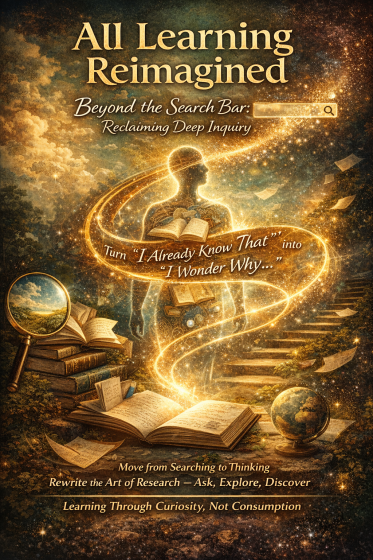
Beyond the Search Bar: Reclaiming the Lost Art of Deep Inquiry
All Learning Reimagined: Inquiry & Research
Reawakening the learner by moving from "Knowing" to "Exploring"
The Core Philosophy
"If you change the way you look at things, the things you look at change."
Critical Insights
- ✕Cognitive Closure: Saying "I already know that" signals the brain to stop searching and shuts down curiosity.
- ✓The Brain as a Filter: Our beliefs dictate what we notice (e.g., seeing cars/pregnancy everywhere only when relevant).
- ✓Human Antenna: Learning is a whole-body process involving senses, intuition, and resonance, not just the intellect.
Searching vs. Researching
The Deep Research Checklist
To separate fact from opinion; to sift, divide, and perceive clearly.
This episode of All Learning Reimagined explores the transformative power of inquiry-based learning and the critical distinction between "searching" and "researching." Host Teresa discusses how to overcome cognitive closure, utilize the brain's natural filtering mechanisms, and teach children to become active seekers of truth rather than passive consumers of information.
Detailed Summary
The Trap of "I Already Know That"
The journey toward deep learning begins by identifying and dismantling the "I already know that" mindset. This phrase acts as a cognitive closure statement, signaling the brain to stop thinking, searching, and being curious. By accepting information blindly from traditional systems—schooling, culture, or family programming—learners often shut down the very pathways required for growth. Reawakening the learner requires shifting from a state of "knowing" to a state of "exploring," where questions like "How do I know this is true?" open up new paradigms of possibility.
The Cognitive Shift
"I already know that."
Shuts down curiosity and stops neural search.
"I'm curious..."
Opens portals of possibility and new perspectives.
The Brain as a Selective Filter
Understanding the biological basis of learning is essential for self-directed inquiry. The brain naturally filters the overwhelming amount of sensory data it receives, prioritizing information that aligns with our existing belief systems. This "validation seeking" means we often miss what we aren't looking for, such as noticing pregnancy only when it becomes personally relevant. By teaching children how their brains filter information, we empower them to use their minds as tools for conscious exploration rather than being unconsciously controlled by pre-existing programming.
Redefining Research in the Digital Age
In a world dominated by algorithms, "Googling" has often been mistaken for "researching." True research is rooted in the etymology of the word: the prefix "re-" implies thoroughness and going back again. Deep inquiry requires looking beyond the first page of search results, which are often influenced by sponsorship or popularity rather than accuracy. It involves analyzing the etymology of words—such as "discern" (to sift or separate)—and recognizing how AI-generated overviews may simplify or sanitize our language, potentially stripping away the essence of true meaning.
The 4 Pillars of Deep Research
- ✔Multiple Sources: Moving beyond search engines to old books, primary documents, and fieldwork.
- ✔Direct Experience: Interviewing experts and people with "lived experience."
- ✔Cross-Checking: Looking for patterns, contradictions, and subtle biases in narratives.
- ✔Intuitive Resonance: Feeling into the body to see what "resonates" as true.
The Human Element of Discovery
Effective learning is not a linear path but a "messy" cycle of questioning, discovering, and re-questioning. It bypasses the ego and connects the learner to the world through active listening and sensory awareness. By modeling curiosity and valuing high-quality questions over easy answers, educators and parents can help children develop the critical thinking skills necessary to navigate a society increasingly prone to repetition and bias. Ultimately, the goal of inquiry is not just to complete an assignment, but to shape one's identity and deepen one's paradigm for life.
To-Do / Next Steps
- Visit the BBS Radio website to access the full article and archived shows.
- Download the "Mini Educator Guide" to help teach inquiry across any subject or year level.
- Utilize the "Real Research Activity Sheet" for children to move beyond basic Googling.
- Review the "Real Research Checklist" designed for teachers and parents working with young learners.
- Examine the two provided inquiry samples (one for younger children and one for teenagers) to see the process in action.
Conclusion
True learning is an active, lifelong pursuit that requires us to look with "fresh eyes" and challenge the surface-level information provided by modern technology. By reclaiming the art of deep research and fostering a culture of curiosity, we can transform education from a system of passive consumption into a journey of profound personal and collective evolution.
All Learning Reimagined

Please help support this show!
Support this show by subscribing
$5.99/mo or $9.99/mo or more
Click HERE
All Learning Reimagined: Where passion meets possibility, one story at a time.
All Learning Reimagined is a global podcast exploring the many ways we learn, grow, create, and contribute throughout life. A gathering place for people who know that the future is something we learn, create, and steward together.
While education is often where the conversation begins, this podcast reaches far beyond classrooms and curriculum. Together, we explore learning as a living process that unfolds through relationships, community, nature, creativity, curiosity, experience, and the pursuit of what brings us alive. Through inspiring conversations with parents, educators, authors, visionaries, community leaders, and everyday people, we share stories that expand what learning can be and how it shapes our families, communities, and world.
Drawing from diverse perspectives, indigenous wisdom, practical experience, emerging ideas, and timeless principles, each episode offers insights that nurture self-direction, discernment, contribution, and a deeper connection to what matters most.
Whether you are a parent, educator, learner, creator, community builder, or simply curious about what is possible, All Learning Reimagined invites you to explore meaningful questions, fresh perspectives, and inspiring stories from around the world. Because learning is a living journey to nurture.
Cultivating self-trust. Nurturing wisdom. Inspiring contribution. Strengthening community.
[00:00] Speaker 1: (piano music plays) Welcome to All Learning Reimagined, the podcast that defines convention and redefines the purpose and practice of education. Here we venture beyond institutional boundaries. Whether you're a parent, educator, or curious mind devoted to lifelong growth, this is your space to challenge assumptions and co-create a more humane and intuitive approach to education. Let's reimagine what education can be.
[00:42] Speaker 2: (laughs)
[00:48] Speaker 3: Good day, and welcome to All Learning Reimagined. I'm your host, Teresa, bringing you a little ray of sunshine, as together, we're reimagining the future of education one inspired story at a time. And it's just wonderful to be back here with you again. And if there are any first-time listeners, welcome to All Learning Reimagined. Uh, today, we're actually talking about part two of discussing inquiry and questions and how they are an amazing tool, uh, for learning, for learners of all ages. It doesn't have to be, um, young children, offspring. It can be adults. It could be- it could be anyone. (laughs) And, uh, I did actually mention last week the danger of someone having the attitude of, "I already know that," like, you know, "I already know that." As soon as somebody says that, it basically, it basically shuts down something in their brain. I mean, it's a cognitive closure statement.
[01:47] Speaker 3: You're basically announcing to close yourself to all curiosity, and it signals the brain that there's no need to learn, there's no need to think, and you can stop searching. So, the things that we're going to be discussing today, which will be around how to do real research and what real inquiry is, deep inquiry is, will help anyone that you know in your life, including yourself, if you see that- if you see that reflection of yourself, um, of people who need to reawaken the learner in themselves. We have been, for decades now, just accepting, blindly accepting information that has been handed to us through books, um, lectures, schooling systems, um, family and cultural programming. And it's time for us to turn around and say, "You know what? Just because that was what I was taught doesn't necessarily mean that it is true," um, and shift your way of thinking and your curiosity.
[02:50] Speaker 3: And when you start to do this, you will find you will meet people that'll say, "No, that can't be possible, because I already know that." But when you start asking the question of, "Well, why do you know that? How do you know that? And where did that person or that book or that author get their research from?" uh, and really start digging into those whys, it can open up a whole new world of possibilities. And in the last few years alone, the amount of information, uh, thank you internet, that's one benefit of the internet, that is coming out that we are- that is available at our fingertips, is really starting to shift paradigms and shift perspectives of what is actually true. And there are a lot of things that we thought were mythical or might have been in movies or in stories that are the facts and the reality are there that they actually exist. And so many things are shifting. We- we really need to question what is true and what is not. Um, and this is a fantastic skill.
[03:53] Speaker 3: I know that, um, children in particular really love exploring rather than just consuming that information and being told. So, for the, "I already know that," crew, and I'm- p- personally, I'm pretty sure all of us are on that spectrum for something. It could be, you know, "The sky is blue." "Well, I already know that." Um, but then you have philosophical questions like, "Well, is it blue because we're making it blue because we believe that it's blue? What if we all thought that the sky was green or the sky was periwinkle purple? Um, would the sky change color under our observation because we are creator beings?" So, having these sorts of conversations can certainly open up perspectives. It's not telling anyone whether they're right or wrong. It's not even mentioning answers. It's the curiosity and the exploration and the opening up of that perspective. So, invitation questions are certainly a fantastic tool for this.
[04:56] Speaker 3: You know, the, "I'm curious," and I know that "I'm curious" is used in coaching, you know, um, corporate coaching for many, many years, but it- there's a reason for that, because it is a really good hook, because it's saying, you know, what new perspective might appear if I look at this differently? Which brings us to the Eye-Joll quote, if, um, uh, what is it? Are they things, uh, "If I change the way I look at things, the things I look at change"? I think that's the quote. I can't remember the exact wording. Correct me if I'm wrong. Uh, but it is so true. When you do change perspective and you start looking at things from a different angle, quite often, your perspective of what you're looking at will shift and change, and it will open up and will deepen your learning. So, you know, questions like, "What would you discover if you explored this with fresh eyes?" I like to use the conversation of, um, you know, there's a being that's just come to the planet.
[05:54] Speaker 3: They've never been here before. Can you explain to them...... um, what this is and how we know, and how would they be seeing this perspective or seeing this object or seeing this place, whatever it is? So when you have the fresh eyes perspective, sometimes, particularly with children, it completely opens up the way that they see something outside of what their, um, belief or programming is. It's a very good strategy, um, and it's really effective. And then there's also questions like, what is one thing that you might not know yet? Like, okay, you're telling me that you know everything, but what is something that you might not know yet? And that's... it's a very subtle question but can certainly help, particularly with, with, um, uh, that stubborn programming that can get in there. Uh, the other thing that we know is our brain seeks validations of what we think we know and our belief systems.
[06:51] Speaker 3: So what you believe, your brain will actually seek out that information to verify what it is you believe. There's a lot of, um, people in the world that have completely different opposite, uh, opinions, and when you talk to them, they can justify it so well, but it's because their brain is seeking the infide-... information to validate so that they are right. And it naturally does this. It naturally does this sorting. But when you teach children or adults that your brain does this and you're aware that it does the sorting, you know, the basel ganglia is, is, is a huge part of this as well. Um, it's, it's really an information-seeking, um, tool your brain, parts of your brain. It just seeks it. And it also has to filter, uh, all of the information that it's taking in from your senses. You know, the sounds and the smells and the feel of the chair under your legs, and, um, all of the senses that are around. If you, if you felt all of them at once, you would be completely overwhelmed.
[07:55] Speaker 3: So your brain is a tool that filters out everything you don't need except what it believes is important to you based on your belief system. So when children understand that, they can then go, "Oh, okay, so how can I utilize my brain as a tool and not allow my brain to unconsciously control me and what I'm seeing and what I'm believing?" Um, and an example that I would give for this is for adults, particularly women, uh, often, you don't really notice pregnancy around you until you're pregnant yourself. And then all of a sudden, you see, you see things that are... that... to do with babies and pregnancy everywhere. It's because your brain has all of a sudden realized that this is important to you, and it will... allows that information to come within your filter. But if you, um, are not interested in pregnancy, it's not even crossing your mind, it's not really even in your sphere of influence, it's not something that you care about, then often, you...
[08:57] Speaker 3: you know, you might see that pregnant woman walking past you, but you do not take that information in at all. It's not important. So the filter doesn't see it anymore. Same with people who decide to get a new car. Um, they might deci-... determine a type of car that they want, and then all of a sudden, they start seeing that type of car everywhere. They were always there. Those types of cars were always there. It's just that your brain filtered out that information. So when you start doing an inquiry, um, the information will often come to you because you've asked the question. It's, it's like the ask and you sol-... shall receive. When you put it out there, and you ask the question, and then you are observant, and you are aware, the answers will come to you. And it will not necessarily come to you on a computer. It might be in a conversation someone mentions. It might be in, um, an animal that comes past, and that animal actually, uh...
[09:56] Speaker 3: When you look up the meanings of different animals, it's giving you a message. Sometimes it's your body that's giving it a message. It's not necessarily has to be, um, a book or something on technology that's, that's giving you the answer to what you are seeking. So it's a really... it's a whole body, all of your sensen-... sensations and senses, um, process. That's how we are built. Our bodies are like a human antenna. We send our thoughts out, and our feelings and emotions magnetize and draw back in, but our questions also do that. It's almost like it opens a portal. I don't know if it does, but it just feels like it does. It seems to open up a portal of possibilities in the field around us for us to be able to explore. And I really love this. I mean, novelty is fantastic. It wakes the brain up. And sometimes the u-... complete unexpected appears. So asking questions can do this. And experiment...
[10:56] Speaker 3: experiential learning, particularly hands-on exploration, really it just bypasses that ego, and it connects the learner to discovery Um, totally speaking from direct experience here, with just releasing that ego and going on a discovery, particularly when you just go, "You know what? I'm just gonna see where this lands and see where this goes, regardless of what I personally believe." And you'll be amazed at where it takes you when you actually unlock those, um, traps in your brain of, "I already know that," or, "That's my belief system." Um, it really encourages, I feel, like a g- a growth in your identity as well, because you shift from that knowing to exploring. And the best learners... And I, I ta-... teach this to children. I've been teaching this to children for years. Really, the best learners aren't the ones that have the most answers. The best learners are the...
[11:53] Speaker 3: are the, the children who have the best questions, that are constantly seeking, are constantly looking at progress, and are constantly seeking to learn, not just that they..... think they have all of the answers. And because I know that those children are going to go far in life regardless of where they land, regardless of, um, what circumstance and environment they're in, because they're asking questions, which is such a healthy thing to do. And unfortunately, when I look around society today, uh, I'm seeing a lot of people that have just shut that part of questions down. They're in survival mode. They're too busy working, they're too busy being distracted by various things, um, and they're not seeking and asking questions anymore. On the flip side, uh, I personally know lots of people that are starting to ask a lot of questions, and they're not necessarily liking what they see.
[12:49] Speaker 3: And it's like, well, you can sit around and you can whinge- whinge about it or you can actually contribute and do something about it. That's one of the reasons why I started this podcast, because I was tired of hearing teachers and educators and parents and children complain about our system, um, our education, and I- I kept trying to share with them the fact that we are the system. The people are the system. (laughs) It's not the other way around, and when we shift and reimagine, uh, what it is that we choose to see, we can actually make a huge impact. One person can make a massive ripple effect. And that's important. Um, and so, you know, well, the podcast is not the only thing that I'm doing personally, but I was like, okay, I can sit around and I can talk about this and go, what can I do? Or I can say, no, I can see issues here. I can see the path that education is on and I don't like it.
[13:46] Speaker 3: Um, it's time to come back to a natural way of learning and come back to something that is more practical because too many of our children today are disconnecting from the learning and the curriculum and what can I do? How can I contribute? Um, and then going down those sorts of questions where I can interview and talk to lots of fascinating people and learn their stories. I'm constantly learning by listening to people's stories. So, it's the power of the question and the modeling of the curiosity itself, which is really showing that, um, you know, I may not be a spring chicken, but I'm still lifelong learning. Okay, so quick shift, let's shift gears because I really wanted to talk today about the lost art of research.
[14:32] Speaker 3: Now, I don't know how many times a week I say this these days, but Googling is not researching, and if you are working with children in particular who are researching on the computer, it's very important to point out to them the algorithms with search engines like Google. Um, I know lots... that's what most schools use. Um, they don't use the alternatives, um, search engines like DuckDuckGo or Brave or those sorts of search engines in schooling settings, particularly in the Western society, Goo- Google seems to be the go-to. But when you show the children and demonstrate the very small...
[15:11] Speaker 3: sometimes there's a piece of information and then there's a very small, um, word or the name of the company there, which shows you that that information is sponsored, and it's really interesting for them to shift their awareness of the fact that sometimes the information that comes up first when you search in Google or a search engine, the information that comes up first might be the company that's paid a lot of money for that information to come up first. Not always. Quite often they give you the information that comes up first that it beats the algorithm and is the most popular information. Hmm, personally, I- I think that's debatable these days. I think that there's... it's a business and there's certainly money, um, or influence somehow involved in that. And so I also make sure that children know to scroll right down to the end of that page that...
[16:05] Speaker 3: with search to see how many more pages of information there is there, because the exact information you need could be buried on page 96 of the information that comes up in the search engine. And no one's got time to a- to search all of those, but when you type in the correct words that you want and you understand how to ask questions, then it can certainly help filter information out. Uh, the other thing I guess we probably need to mention is also the AI. There's also an AI overview when you are doing a search in computers that comes up straight away and it gives you just the AI version of the answers, and I've noticed that the AI is using quite generic language There's a lot of words that seem to be disappearing from our lexicon on the internet, and I personally think that it is from AI. It is... it is removing certain words or not using them as often and then pushing other words forward. Now, who's programming this? Who's in charge of this? How do we know, um, what's going on here?
[17:16] Speaker 3: And we are also wanting to make sure that we do not lose the essence of what the true meaning of words are as well, so teaching children to also continually look at the etymology of words and the true meaning of words is a part of research when you're looking at particular words that are very important. So words like discern, um, it's an overused word in my opinion these days. A lot of people say, "You need to discern," but what does that even mean? When you go back, it actually means to distinguish differences, to perceive clearly, um, to sift, uh, to separate, to dis- to divide means to deser- discern. So it's to separate the information that's fact versus opinion, um, which is a very difficult skill to do these daysSo, the word discern is a word that I always explicitly teach the meaning of. And then also words that start with re, R-E. Um, re often means, as a prefix, means thoroughness. It also means again, a back, uh, to come back, or anew.
[18:27] Speaker 3: So, as soon as you see a word that has re in front of it, you know that it either means thoroughness or again, come back again and renew and do it again. So, like, reactivate, it means come back and activate. Reawaken means to come back and awaken again. For my show, I've used reimagine, because I want us to come back to ima- our imagination and not just, um, consuming information that's handed to us. I want us to go back to coming back and using our imagination. So, the word re, research has re in front of it. To research, we want them to go back into searching, not just blindly believing the first thing that is offered to you as a possible solution. So, looking at words is a part of research, and, um, uh, something that is really, uh, valuable. It's a valuable tool, and it's a lifelong lesson and it's a lifelong, uh, skill, as far as I'm concerned. It's a life skill. Um, and then there's, you know, other prepositions like dis. So, D-I-S means apart, away, not.
[19:41] Speaker 3: Um, so disinformation, not information. That's, um ... And it's amazing how many exceptions to the rule there are in education. And yet if that's what the meaning of the word is and we're using the word, then, um, what is it really doing energetically around us if we're misusing words and we don't even realize it? So, definitely looking at words is part of research. And of course, in the Google era, lots of young people in particular consu- con- confuse searching on a search engine like Google with researching. No. Searching, I can search something up on Google, not a problem. It can give me information. It might give me a fantastic website. It might help me and point me in the direction of where I need to do. But to research means to go back again. You need to be thorough. That's what the re means. So, it means that we need to gather from multiple sources, and when you unpack this with children, they really go, "Oh, okay. I see.
[20:47] Speaker 3: If I just blindly look at whatever the AI produced when I typed in that question," or the, "Some people may ask," and then you drop, pick a, pick a dropdown menu and then there's a very short paragraph answer. The amount of children that go, "Okay, that's good enough. I'll just use that," but that's not deep research. Where's the facts? Where's the information? That's not researching. That's just searching. So, there is a level of ignorance here, or possibly a level of laziness, because some people go, "Oh, well, near enough is good enough. It'll do." Uh, I mean, the amount of, of, (laughs) the amount of children today that are just getting AI, um, to just do their work for them is phenomenal. And they're really going to lose this opinion for critical thinking, these, these skill sets for critical thinking. And the asking of the right questions is key, so teaching inquiry and how to inquire, how to research, how to ask questions is a vital life skill.
[21:45] Speaker 3: Parents can do this, grandparents can do this, children can do this. Um, so when you're gathering from multiple resource- resources, basically we talk about things like books, and some children go, "Books? Do I really wanna use books?" Yes. Some of the old books have the best information, and sometimes it has information that is no longer on the internet. It's been filtered out, or the bias might not be there. Some of the information in the books might be old-fashioned and it might not be correct, but it's still giving you an alternative perspective. Interviewing people with direct experience is one of the fantastic research ch- um, skills. So, not all of the answers are on the internet, so going and asking a person. So, if you're doing a research assignment on, um, I don't know, farming, go and ask someone that lives and breathes this stuff and ask for their opinion and get their information, so you're going straight for facts.
[22:43] Speaker 3: Going for primary source documents, not people who have taken a primary source and then done- put their own YouTube spin on it. That's not necessarily research. Um, lived experience, as I mentioned before, and then fieldwork. You know, create your own investigations, find out your own, um, observations. And yes, this is very scientific. There are so many ways to do this, but teaching children how to create their own investigations and inquiries and fieldwork, um, is a really fun activity. It's so engaging. It hooks them in. And you'll be surprised, delightfully surprised, where they pick it up and take it. Um, and so these things are gathering multiple resources, not just one page from a search engine. You know, "I'm just gonna look at the first thing on the search engine." That's searching. That's not researching. It is not thorough. Then, after that, you still cannot blindly believe everything that you've been told. You need to cross-check. You need to verify.
[23:46] Speaker 3: Um, you need to look for patterns, look for contradictions, look for that authenticity, um, and also look for signs of bias. Now, this is time-consuming and it's not easy, because (laughs) sometimes it's not obvious what the answer happens to be. And this is where children needs to sit and, sit and see what resonates with them in order for them to make a judgment. So, if they have no idea about the topic, they don't know what it is that they're searching for and looking for, so whilst you're inquiring, you're actually educating yourself, and this is deep learning. Simply copying answers off a search engine that comes up-... and writing that down, or even worse, cutting and pasting it, is not deep learning. You are not going to remember it, quite often not even comprehend what it is that you've copied and paste. And they, and, you know, children just hand it in as an assignment and go, "Oh, you know, monkey off my back, it's done." And yet they've missed the point.
[24:44] Speaker 3: The whole point of the task and the inquiry is for them to shape themselves and to, um, deepen their own perspectives and their own paradigms and their own skill sets so that they can have this information, embody this information, to take it forward and carry it forward and apply it in their own context through their life. This is the whole point. We love learning. Why have we just turned into, um, living beings who seem to just do a quick search and then expect that that's the answer and just take that at surface value? It's a really dangerous place for us to go, because humans, in my opinion, are very easy to program and through repetition, and very easy, um, to trick through bias, very subtle bias.
[25:34] Speaker 3: Because if you have large companies who control the textbooks, the media, the information that's coming out, and they repeat the same narrative, the same information in various areas when you are cross-checking, you might say, "Okay, I've cross-checked it from this, this, this," not realizing that they've cross-checked it from the same companies, and then they can believe that that is real. That's why it's important to look at old books and talk to people with real-life direct experience and see if it does align or if it does not. And if it aligns, great, but if it does not, then go deeper, ask more questions, or possibly bring that point up in whatever the inquiry happens to be. And this brings me to the third part of real research, and that is listening. Listening, um, you know, people hold wisdom through their stories and their experiences and their memories. Cultural knowledge is absolutely amazing.
[26:33] Speaker 3: Having experiments, the mistakes are the best part, because the s- mistakes are where the learning comes up and when you start to actually question things. So, teaching children to truly listen with curiosity and without an agenda at all, just looking at the facts of what comes up is one of the most powerful research s- s- um, sk- skills, uh, of all. And I also teach them to feel into their body what resonates with them, what feels true, what does not feel true. Your body is always communicating with you, so don't make this cerebral, don't make this all intellectual in your head. Get children to sometimes just sit with the information and feel into their body, um, of whether they get a yes or a no, so that kinesiology can actually be really useful, um, as well.
[27:20] Speaker 3: Um, letting questions, um, guide the search, so y- you want to question, then you want to explore, you want to discover, you want to re-question, go back again and re-question, there's that re- again going back, and then you want to deepen. So, real research does not go in a straight line. It's not a step, step, step. You often have to go backwards and forwards and backwards and forwards. It's very messy, completely messy. Um, so this week with the article that I'm co- creating, so for those who are new listeners, every week I create an article on... or activities that can help align to the topic of the week, and this week, with real research, I actually have, um, a mini educator guide which is helping you to teach inquiry for any subject. You can use it for any subject and for any year level. Uh, there's some re- fantastic activities there.
[28:14] Speaker 3: I've also got an activity sheet for children for real research, not just Googling, um, and then I also have, um, a real research checklist, and that's more for the teacher or the adult if you're working with young children. So, there's three tools that are going to be with the article this week, um, and I also have two, um, samples of inquiries, one for younger children and one for teenagers, where you can actually see an example of one in progress if you're curious about that, and because unfortunately we've run out of time this week. Um, and so to find that article, you can go to bbsradio.com/alllearningreimagined. That's bbsradio.com/alllearningreimagined, and that's where you'll find all of the articles for every week, all of the archived shows. They're only half an hour, really great, um, uh, time, time I feel to be able to just pop on when you've got half an hour to listen and, um, take on the information.
[29:18] Speaker 3: So, thanks for joining us again this week everybody on All Learning Reimagined. What I would love to encourage you to do is explore, experience, express, go out, and live learning. Thank you, everybody.
[29:32] Speaker 1: (Instrumental music) Thank you for joining us on All Learning Reimagined, where passion illuminates the path forward. Remember this, the future of learning doesn't arrive from above, it begins within. You are the spark, the shift, the living answer to education's silent call for transformation, so stay curious, stay awake. Let inspiration be your compass, because how we learn today is not just personal, it is profoundly generative, it shapes the very architecture of tomorrow's world. We are not separate from the system, we are its evolution. Until next time, trust the wisdom of your own unfolding and let your life be the lessons that light the way for others.
[30:43] Speaker 1: (baby laughing)