
All Learning Reimagined, April 24, 2026

All Learning Reimagined with Teresa Songbird
Raising conscious thinkers within the system
Beyond the Classroom: Cultivating Conscious Thinkers at Home
All Learning Reimagined
Nurturing sovereign thinkers within the mainstream schooling system.
Core Philosophy
"You don't have to remove your child from the schooling system to remain deeply connected to their learning. You can do both."
Influence vs. Control
Shift from managing actions to guiding values. Stewardship replaces indoctrination through conscious response.
The "Resonance" Metric
Teaching children to listen to their "inner knowing" or "Spidey-senses" to discern truth from external propaganda.
Practical Integration
- ✦Real-Life Mastery: Use household chores (cooking, cleaning, time management) as empowerment tools, not burdens.
- ✦Storytelling Influence: Use bedtime stories or family history to embed values and shape subconscious patterns.
- ✦Research Literacy: Teach cross-referencing (Brave/DuckDuckGo) and identifying bias in documentaries and AI.
- ✦The Dinner Table: Play "What If" or "Would You Rather" to challenge paradigms and celebrate "spectacular failures."
39 min read/listen
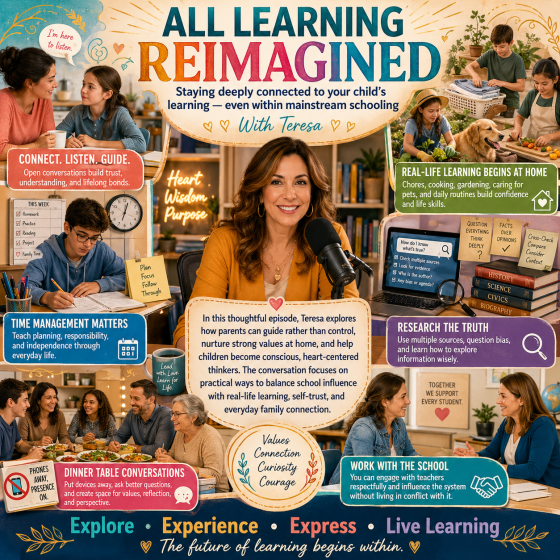
This episode of All Learning Reimagined explores how parents can deeply influence their children's values and life skills while remaining within the mainstream schooling system. Host Teresa emphasizes shifting from a mindset of control to one of conscious stewardship, raising children who possess the "sovereignty" to think for themselves .
The Shift from Control to Influence
The conversation begins with the realization that many parents feel trapped between the necessity of mainstream schooling and the desire to protect their children from misaligned values. The solution is not necessarily to withdraw from school, but to "equal the equation" by raising conscious thinkers at home. This requires a fundamental shift in the parental role: moving from trying to control every external exposure to influencing the child’s "inner knowing." By fostering strong home values and personal discernment, children can maintain their sovereignty regardless of the setting they are in.
The Stewardship Framework
Fear-based reaction, trashing the house, managing indoctrination.
Conscious response, nurturing discernment, modeling sovereignty.
Real-Life Learning and Responsibility
Empowerment begins with practical life skills that schools often overlook. Teresa argues that "real-life learning begins in the home" through chores like vacuuming, gardening, and meal preparation, which build a child's sense of self-worth and contribution. A critical component of this is time management; teaching children to manage their own schedules, social lives, and deadlines from a young age creates independent adults. Furthermore, parents should allow children to fail in low-stakes environments—like baking or tree climbing—to build the grit and physical efficacy that worksheets cannot provide.
Nurturing Intuition and Critical Thinking
To counter "groupthink," parents can use bedtime stories and "imagineering" games to subtly embed family values and fables that shape a child's inner voice. Teresa introduces the concept of "resonance"—teaching children to listen to their bodies to determine if information feels true. This "Spidey-Sense" allows them to question authority figures or peers respectfully when something feels "off." In an era of AI and media bias, children must also be taught to cross-reference multiple search engines and identify the underlying narratives in documentaries or curriculum content.
The "Resonance Check" Technique
A simple somatic exercise to help children (and adults) tap into their intuition when facing a decision or new information:
- ✅ Lean Forward: The body's natural "Yes" or attraction to truth/alignment.
- ❌ Lean Backward: The body's natural "No" or signal of discomfort/misalignment.
- 🔍 The Pin: If it's "off," put a pin in it and research further.
Collaborative Engagement with the System
Finally, the podcast advocates for direct, respectful engagement with schools. Rather than demonizing teachers, parents should use "honey over vinegar" to communicate their family values and request that specific life skills be reinforced in the classroom. Establishing home traditions, such as device-free dinners or the "What did you fail at today?" game, creates a safe space for children to share perspectives and challenge paradigms, ensuring they grow into authentic individuals rather than "clones" of the system.
To-Do
- Integrate children into household chores (vacuuming, laundry, yard work) to build self-worth and life skills.
- Teach children time management by having them backward-map their own commitments and exercise routines.
- Establish a "responsibilities before play" rule for technology use to prevent addiction and promote accountability.
- Use bedtime stories to share family history and fables that contain specific moral messages.
- Practice the "body lean" exercise with children to help them identify their intuitive "yes" or "no."
- Train children to cross-reference information using multiple search engines like DuckDuckGo or Brave to identify bias.
- Implement a weekly device-free family dinner to discuss perspectives and celebrate "spectacular failures."
- Initiate a brave, respectful conversation with school teachers to share family values and co-create learning goals.
Conclusion
True education is not confined to school hours; it is a continuous process of stewardship that happens at the dinner table and in the backyard. By focusing on discernment, intuition, and practical responsibility, parents can ensure their children are not just "fitting in," but are evolving into original, heart-centered thinkers ready for a changing world.
All Learning Reimagined

Please help support this show!
Support this show by subscribing
$5.99/mo or $9.99/mo or more
Click HERE
All Learning Reimagined: Where passion meets possibility, one story at a time.
All Learning Reimagined is a global podcast exploring the many ways we learn, grow, create, and contribute throughout life. A gathering place for people who know that the future is something we learn, create, and steward together.
While education is often where the conversation begins, this podcast reaches far beyond classrooms and curriculum. Together, we explore learning as a living process that unfolds through relationships, community, nature, creativity, curiosity, experience, and the pursuit of what brings us alive. Through inspiring conversations with parents, educators, authors, visionaries, community leaders, and everyday people, we share stories that expand what learning can be and how it shapes our families, communities, and world.
Drawing from diverse perspectives, indigenous wisdom, practical experience, emerging ideas, and timeless principles, each episode offers insights that nurture self-direction, discernment, contribution, and a deeper connection to what matters most.
Whether you are a parent, educator, learner, creator, community builder, or simply curious about what is possible, All Learning Reimagined invites you to explore meaningful questions, fresh perspectives, and inspiring stories from around the world. Because learning is a living journey to nurture.
Cultivating self-trust. Nurturing wisdom. Inspiring contribution. Strengthening community.
[00:00] Speaker 1: (Relaxing music playing) Welcome to All Learning Reimagined, the podcast that defines convention and redefines the purpose and practice of education. Here we venture beyond institutional boundaries. Whether you're a parent, educator, or curious mind devoted to lifelong growth, this is your space to challenge assumptions and co-create a more humane and intuitive approach to education. Let's reimagine what education can be.
[00:43] Speaker 2: (laughs)
[00:48] Speaker 3: Good day, and welcome to All Learning Reimagined. I'm your host, Teresa, bringing you a little ray of sunshine, as together we're reimagining the future of education one inspired story at a time. Welcome back, dear listeners, (laughs) solution seekers. Um, it's lovely to be with you again, and welcome to any new listeners who are joining us today. Um, so today we have, uh, a conversation that is going to be an extension of one that I had with a parent recently. Uh, she came to speak to me and ask for advice because, um, she's got children in our mainstream schooling system here in Australia, and she's not in a financial position to be able to homeschool. So they, the- the children need to go to a school, but she's very concerned with some of the content that the children be- are being taught, and she shared her concerns about how they're just not, um, learning skills that she feels is going to get them ready for, um, when they leave school.
[01:55] Speaker 3: You know, to have a career, and- and to have life skills. And so we were having this long conversation over coffee, and it really occurred to me that there are actually a lot of people out there that are asking the same questions, it's not the first time I've had this conversation, and that it might be, uh, a useful topic for a podcast. So, here I am today. Um, and I mean, this was a really heartfelt moment, because this parent was so concerned about her children being exposed at school, um, and she didn't have a problem with the school they're going to. It's a really good school. But, uh, she just had, um, uh, I guess an inkling, she doesn't really want strangers to raise her children and embed their own values in her children. And, uh, I just wanna say this really clearly, you don't have to remove your child from the schooling system to remain deeply connected to their learning. You can do both.
[02:57] Speaker 3: You know, you can influence their values and you can influence their, and nurture their inner knowing, um, even though they're going to school. But you have to remember how many hours they're spending in a school environment, and then consider how can you balance that out, um, and equal the equation? And the answer for me is really, uh, is raising conscious thinkers who can feel into themselves and know when something is right and something is wrong. Their discernment is really strong, so they can feel or see, um, into the truth of whatever is being taught to them if it doesn't align with their own values. So they're strong, um, and confident, and if they've got good, strong home values, and then they can stand in their own sovereignty of what they believe, regardless of what is presented to them in any setting, not just a school. It could be anywhere. Uh, and this is what we want.
[03:56] Speaker 3: We want our children, we want our offspring to be able to think for themselves and make decisions, um, and not just be critical thinkers but be heart-centered and follow their passions as- at the same time. And there is so much influence available at the home within your presence, within your conversations, everyday conversations. Um, so I wanna share some practical, grounded ways that you could support your child, or perhaps you're a grandparent and, um, and you would like to, um, to support your grandchildren, um, to think and feel and basically live in alignment with- with good values whilst they're still navigating, um, school. Whether it be a- a school that you feel is working well or is not working well, uh, that's beside the point. It's still things that you can do, um, and also to shift from trying to control your child's life or your child's learning experiences, to influencing them.
[05:01] Speaker 3: There's a big, um, shift in dynamics there when you take that, "I need to control what's happening," to influencing. And so, one of the first things, uh, we did have a conversation about was why this parent felt the need to control, because control was the wording that she was using with me, um, and she had a couple of aha moments around, um, things about herself, and the fact that she does like to control everything around her, and- and you know, children are not there to control, but they are there to guide and they are there to influence so that they can make their own decisions. Of course, depending on what age group they are. And then that shifted her from that fear space of things are being done to them, they're being indoctrinated, and all of these, uh, uh, concerns that she'd actually brought up, to more in her as a parent being as a- a stewardship role of- of helping support her children.And that, um, then shifts her actions from reaction to conscious response.
[06:13] Speaker 3: And let's face it, we are all so busy these days, and I know many people who are working more than one job just to put food on the table. Uh, it's, it's tough. It's, it's (laughs) really tough. And when you get home from work, uh, you're tired and, and some people are cranky and you... then there's housework to do and everything else that seems to go in between. Uh, but that doesn't mean that you can't still embed certain things and routines into your day, um, uh, to be able to help balance this. So, my talking points today are very short and very, um, succinct because I'm just going to give lots of little suggestions and then take what resonates with you, like, "Ooh, I could do that. Whis- that's a really good idea," and if it doesn't resonate with your circumstances, then just let it go. Um, this is definitely not a list, and I am not telling anyone to do whatsoever.
[07:11] Speaker 3: I'm purely offering some inspiration for a few things that you can do if you're finding that you are in this circumstance. Or perhaps you are not in this circumstance, but you know somebody that... somebody else that is. And it might be, you know, your neighbor, um, who is doing the same thing with their children, and as I mentioned, you could be a grandchild. Or you could possibly be an educator and you would like to be able to give this sort of advice to parents at a parent/teacher interview or, um, uh, in a parent workshop. Uh, so regardless of what background you are, uh, you come from and that you have, uh, hopefully... Well, not hopefully. Some of these will, um, will be able to help and support. So, the first thing, uh, that I really wanna point out, and this was probably the first (laughs) thing I, I mentioned to this mother, was that real-life learning begins in the home.
[08:11] Speaker 3: If she is coming home tired from work and she's got to do all of the household chores, why is she doing it? Why are the children not helping? Um, because in her circumstance, she pretty much did everything for the children. And it's like, well, you know, surely they can vacuum, they can help with the washing, they can help fold the washing, they can help with the yard. Um, taking the time to teach them the skills so that they can empower themselves and they can help out around the house, which certainly helps also with their sense of self-worth because they're contributing. Uh, so that's really important, um, part of the process. Uh, y- you're not doing your children any favors if you're doing everything for them. So, it's a win-win because it helps you get things done around the house, but it's also empowering their life skills, real-life learning, every single day.
[09:03] Speaker 3: Even if it's cutting up and preparing the food for cooking, uh, to cleaning away and washing the dishes, to gardening, uh, harvesting, uh, food that's in the garden, um, taking care of the pets, walking the pets, um, brushing them, uh, feeding them, uh, even down to time management. And this is something that I did with my own daughter, was teaching her time management skills from a very, very young age and helping her to manage her time. And by the time she got to high school, I did not need to do anything. She runs everything independently. She manages her time. Um, sometimes she doesn't make the best d- decision, but that's very rare these days. Uh, she knows how to manage her social life compared to what she needs with commitments, she knows where the deadlines are and how to back ma- backward map what needs to be done.
[10:00] Speaker 3: Um, all of these skills sh- she was able to, um, see me as an example, like I'm modeling that as well, but that time management is holding her in really good stead, uh, today. Because I do know that some schools do try to instill these skills in children, but it's an everyday life skill. It's not just within those hours of school and processing, you know, when their assessment is due. Time management in life is, when do you need to put your car in for a service? When are you booking your haircut? When are you going for a walk and, and putting in your exercise into the day? It's, it's life. It's everywhere. So, if your children, your offspring, do not have any sense of time and time management, that is a really good place to start. A really good place to start.
[10:53] Speaker 3: Um, I have had many chu- many parents in the past lament and say, you know, "But they're always on the computer and they just wanna play computer games and, and they get sucked into that world and they don't wanna take it away from them because that's their social life, that's how they're socializing." Yes, uh, it's a double-edged sword, that one, that conves- conversation with... But once again, this fits into time management. It's, it's okay if you want them to have that opportunity to play online and socialize with friends, but it doesn't have to take over their life. There needs to be set time, um, a- aligned with that, and it can be, "Well, once you've done this, this, this, then you can do this." And, um, you know, then you can go and play and do these things. But first of all come responsibilities, because once again, accountability and responsibilities is life. We're not all going to cruise through (laughs) life with, um, someone waiting on you hand and foot.
[11:54] Speaker 3: So, children, teaching that responsibility of getting in, doing the work, and then you can rest and play. The rest is very important, um, but having that balance is essential. And...Uh, you know, I've had some very sad stories over the years of parents have, where children have huge tantrums, and they're just not coping when they take the technology away. They trash the house, basically. In some instances, police have had to been called because the children have absolutely lost the plot. Um, and that, uh, that's a whole nother addiction that needs to be addressed. So, I would urge you to, to do everything you can before it even would get to that stage. I mean, m- my, um, initial reaction as a parent would be, well, I would simply just take... I would cold turkey it and just take all of the devices away completely if that was the sort of behavior.
[12:49] Speaker 3: Um, and I, I know I have, in the past, taken certain cords to PlayStations and I take them to work with me, so that if they do get home and they're there, uh, they can't access it because the equipment's not there. Um, so you can work around it if you really need to. Uh, hopefully, m- not many people do need to do that, but it seems to be a really common theme and a common story these days, uh, when we're talking about life skills with children. Um, so coming back though to doing things around the house, I have actually had one parent, it was a dad, who, years ago, had actually said, well, he doesn't want his son to do things because his son stuffs it up all the time and doesn't get it right. And the conversation we had there was, m- well, you, you learn through mistakes, of course, and if you don't, um, allow him to fail and then, uh, teach and tutor and nurture him, um, how is he ever going to learn?
[13:46] Speaker 3: So, you're just taking over because they're not doing it properly, um, you know, it could even be, uh, someone teaching a child to, to bake in the kitchen. If they're not making the cupcakes the right way, does it really matter? We're not playing for sheepstations here. It's not a life or death situation. Allow them to learn through their mistakes. Uh, it's a really important part of that life lesson, and in some cases, it's a deeper lite- le- life lesson than anything that they would get in a schooling setting. So, definitely encourage them to take risks. Um, I know I've told this story before, but my daughter was always up a tree when she was a child. She was constantly climbing trees. She had incredible upper body strength, and she just loved climbing anything, you know?
[14:33] Speaker 3: She was always on the monkey bars, but climbing trees was a really favorite pastime, and I had some very interesting conversations with other parents, you know, when we would meet together as playdates when she was only very small, and they were horrified that I allowed her to, uh, to climb a tree, you know? What if she fell out and broke her arm? What if, what if, what if, what if? Uh, but she never did, uh, and I had absolute trust in her. It was something that she loved, and it was giving her that sense of, um, self and self-worth and efficacy because she was able to have these skills.
[15:09] Speaker 3: So, um, really feel into what is it that your child is attracted to to doing at home, and then consider if it's risky and risk-taking, well, then, yes, you're there to guide them and help teach them, but at the same time, it could be one of the best things that you could possibly do because those life skills build confidence, they build discernment, and they build capability in a way that school worksheets never can, never can. And, well, that's speaking from my direct experience, anyway. That's pretty much all I can talk about from this stage. So, from there, the other, uh, suggestion that I actually gave to this mother was bedtime. Uh, the environment at bedtime. I mean, at the end of the day, it doesn't matter how tired you are, particularly when you have smaller children or younger children, um, e- even in primary school, bedtime stories are fantastic, and, uh, you're never too, you're never too old for a bedtime story.
[16:11] Speaker 3: You could even have a teenager where you go in and you tell them a story. It doesn't have to be sitting and reading a book. You could just tell them a story about your life or something that you did or something that your grandparents did and share history from your family in the conversation, because it's very easily to have subtle influence and add your values and beliefs within those stories, and they really do. We learn by stories, and the children will remember them, um, and you can, you can, uh, discern what language you're going to do because language shapes subconscious patterns. We know this. The stories that you tell can become an inner voice that they hear. There's a reason why there's lots of fables out there that are telling a life message and a moral. So, you've got your, your allegories, you've got your fairy tales, you know, your Hansel and Gretels that are, are warning signs towards, um, life skills. You can do exactly the same thing.
[17:12] Speaker 3: And one of the fun games my daughter and I used to play was she would give me characters, and sometimes they would be characters... So, when she was, uh, I don't know, probably about four or five years old, um, and even when she was seven or eight or nine years old, she would talk about favorite characters that she liked, and they might have been from a movie, so Captain Jack Sparrow was always a favorite she loved (laughs) . She loved Captain Jack Sparrow because who doesn't love a good pirate in a story? Um, or it might have been, you know, a Star Wars character or a toy character. It, it could be anyone. It could be someone in the neighborhood, and so she used to mention a couple of random characters, and then I would just create a story and imagineer it then and there, and we would take turns.
[18:00] Speaker 3: So, sometimes I would start the story off, and then I would hand it over to her, and then she would continue imagineering what would happen next in the story, and we would co-create at this story time. It was fun. It was great to have connection. It was really good to get the imagina- imaginative juices flowing, but it was also very interesting because (clears throat) ,I know that there's a lot of truth in the world that is starting to be revealed. Um, some people would call it disclosure, uh, whatever you wanna name it, but I've been aware of many things in the world for a very, very long time, and I was abe- able to embed, uh, belief systems and actions and truth within these stories, so that when things are being revealed in life, uh, she can handle it. She's like, "Okay. Oh, yeah, I get that," because it's already there in her unconscious, um, uh, I would, I would probably even say programming because that's what we all, we all run by programs. Our belief systems are our programs.
[19:11] Speaker 3: That also leads into the fact that, um, through a lot of things that we did, you're ab- she was able to become an independent thinker, and her discernment was quite smart. She was able... Her BS meter was quite good. She was able to learn to feel into how her body reacted. Um, and I did teach her a, a few short activities, (laughs) like things like, "If you're standing in front of the fridge, and you don't know what to eat, uh, pick something up and hold it or even look at it, and then if your body is leaning forward towards it, that's a yes, you want it. If your body's leaning back, then that's a no." Um, and so tiny little tips like this were things that we used to play with, but now I know that she's helping it to, to make decisions when she needs to. And it might sound so silly, but sometimes logical thinking is not enough. Sometimes you need that intuition and t- tapping into yourself to questioned any external influence, um, and, to make a decision.
[20:15] Speaker 3: So, um, there's lots of little things that you can do like that that can help, uh, give your children skills that they're not going to learn in a school setting. And having said that, teaching them that it's okay to disagree, respectfully disagree, you don't have to be disrespectful about it, but it's okay to disagree with someone else's opinion. It's healthy. Groupthink is not healthy. Just going along with what everyone else is doing is not healthy if it doesn't feel right inside. If your Spidey-Senses are up, if you feel uncomfortable, well then question it. And teach them how to ask a question, because deep questioning, smart questioning is a skill that we all need, adults need as well, but this is a skill that you can do. You can embed it into daily life. It doesn't have to be, "Well, today we're going to sit down, and we're going to learn how to ask questions." It's something that you can do, um, at any given time.
[21:17] Speaker 3: I mean, because we're not raising children so that they can fit in. We're not raising an army of clones here. We want them to be clearly thinking, their own authentic, original self. All of us are original. We want them to embrace that, but we also want them to choose consciously. And, uh, you know, that doesn't happen overnight. Young children have this innately, until, in my opinion, schooling set em s- sk- um, schooling settings seem to indoctrinate them more into not listening to themselves and listening to an authority outside of themselves. That's how the structure is set up. Um, and so getting them to be able to think clearly, feel clearly, listen to their heart space, and what's their highest excitement, of course, and choose consciously is a skill that is so precious, and it is w- definitely one that any parent or grandparent, um, can do. It's, it's just so important.
[22:23] Speaker 3: Um, and there's something else that I actually shared with the mother that I was talking with that day, and it was the idea of resonance. And I could tell by her facial expression when she looked at me that she wasn't quite sure what resonance means. I mean, she'd obviously heard of the word, but it was not something that, um, she has ne- has ever been, um... It's not really been in her field, and I guess that's because beyond logic and beyond researching, 'cause I mean, let's face it, everybody researches via Google these days. They don't necessarily even look for secondary sources. They just do a search and then take that as gospel. They take that as, as the truth rather than actually researching and going deeper. Um, but beyond what we're even taught in a school, there is an inner knowing within each child. There's in en, inner knowing within each adult as well.
[23:15] Speaker 3: Um, it's there if you get rid of the distractions, and you ha- (laughs) and you sit quiet enough, and you have that silence, and you can tap into it, that inner knowing, it's, um, it's really, really important. So I was explaining to her it's, it's a feeling. It's a sense. It's really a quiet awareness, um, and that resonance really means when you're feeling, hmm, this feels true for me, um, or, hmm, that doesn't quite sit right. It doesn't resonate. It's not sitting right. It might feel a li- it's a little bit true, but there's just something off about that, and I'm not sure what it is. And when you get that feeling, then you can go and research, ask more questions, or maybe put a pin in it and say, "I'll come back to that later.
[24:03] Speaker 3: I obviously need more information." But if it does really feel right, and you have that whole body, "Yes, this is in alignment with me, it feels true," then that's good, uh, a good guiding system that you can use, and this is something I'm quite passionate about, you can probably tell from my voice. It's something we really need to nurture today.Because the children who are being born today, they don't suffer fools. Th- A lot of them are pushing back from the system in that they're pushing back from the old careers. They don't wanna work a nine-to-five job and slave their, their whole life in order to retire and have one or two good years of traveling and then, and then be unwell. They wanna live their best life now. And I can say this with authority because I (laughs) work with so many... I've worked with hundreds, thousands of children over the years.
[24:54] Speaker 3: I've ex- I've known them and they express this, and I've seen the, the change and the shift in attitude and actions, uh, particularly through the last 10 years with the children coming through. (smacks lips) And it would be no surprise that in four or five years' time, the majority of the jobs out there, not just because of AI and technology, but also because of the mindset, heartset, um, (clicks tongue) of our teenagers coming through, uh, they're shifting. They're seeking something different. They, they wanna, um, (clicks tongue) they want a life... work-life balance. Th- It's not that they don't wanna work, but they actually wanna have a life. And who can blame them? Let's face it. I mean, we do what we do today because this is what we've always been taught and this is the way that it's been. Doesn't necessarily mean that things cannot shift and change, and that's the other thing. If children cannot cope with change, then (laughs) how are they going to cope in today's society?
[25:56] Speaker 3: We cannot put a bubble around them all of the time and constantly protect them. You cannot bubble wrap them from life. They need to be exposed to it and have the skills and the self-confidence to be able to navigate that. (clicks tongue) School can help only so far. It's their everyday life and that trust and allowing them to take risks in order to be able to do this. And so, when we teach children to pause and notice what's happening in their body and then listen to that subtle response within them, 'cause it's not... It's very subtle. It's not always obvious. (clicks tongue) And not always to just blindly accept whatever the teacher is telling them or the doctor is telling them, or the dot, dot, dot, so-called expert is telling them. They still have to listen to themselves.
[26:47] Speaker 3: Um, you know, it might be a book that they're reading th- and they're saying it and they're going, "Hmm, I'm actually not quite sure I can believe that." 'Cause let's face it, today, anybody can write a book, um, and they may not m- have any expertise at all, and there's quite a lot of propaganda (laughs) in books these days. So, to teach them to consider that just because the majority agrees, um, with this, with this perspective or with this point of view doesn't necessarily mean it's right for me. And so, they're tapping in, once again, to themselves. Ah, such an important skill. And so, one of the words they could ask is, "Does this resonate with me?" And I know that the mother that I was talking to was really excited about this. She's like, "Oh, I hadn't even thought about that before." She's just been too busy, uh, living a life of being in survival mode, quite frankly, to even tap into this.
[27:40] Speaker 3: But it's definitely worth exploring and questioning things, feeling into it, and it's not rejecting everything, not at all. If anything, it can be affirming that a lot of things are, uh, in alignment and in, in the right place. But it's, it's learning to engage with information consciously. And when you teach your children this skill, it doesn't matter that they... if they're going off to university that's teaching all the woke information that might go against your personal family values. Because if they have that s- strong sense of self and discernment, they can make up their own mind and their own decisions for their own life path. They're not living a parent's life. They should be living their own life and making their own choices. And so, this is a skill, this inner guidance system, I guess you could possibly say, um, is where they're becoming far less dependent on getting approval, even if it's approval from peers. They're quite happy to say, "No, thanks.
[28:39] Speaker 3: I don't wanna vape." "No, thanks. I don't wanna do drugs," um, because they've got that sense of self and they, they've learnt how to disagree and they've learnt how to put up boundaries, personal boundaries is also (laughs) another very good skill. Um, and these are skills that will anchor them to who they are, and this is a skill that will help them for life. (clicks tongue) Ah, okay, so that actually feels like it's a complete thought, so I'm going to move on to my next topic that I had written on my list 'cause I actually had a w- list written down to try and keep me on track today (laughs) 'cause I do know I go off on tangents. Um, and that's researching. I did mention researching before, and I have done whole shows on this with lots of skills and teaching how to teach research. But it's very (clicks tongue) important that children know how to research properly and to be aware of bias. Uh, bias is everywhere.
[29:36] Speaker 3: I mean, you just have to turn on the television to see that there is bias. I mean, and I'm talking about politics. I just don't even wanna go there with politics. It's just a mess. It's a big old mess. Uh, but there is bias, subtle bias, in lots of different things, and it could be that you're sitting and you're watching a documentary. And the documentaries are usually, uh, opinion, but they're trying to give you their point of view, which is biased. Very rarely does a documentary give equal points of view to both, um, both sides of the argument. (smacks lips) So, there's always three sides to the argument, isn't there? There's like, this person's side, that person's side, and then the truth is somewhere in the middle. Um, so, we were watching a, a documentary not long ago called Blackfish, which is about the captivity of killer whales, um-... in, you know, like, SeaWorld type envir- environments.
[30:32] Speaker 3: And it was very clear, the opinion of the director and the angle that they were showing, but we were able to have a conversation about bias and, um, and discuss this with, uh, questioning and considering and understanding what bias is. So, it could be something that you're just threading very gently into a conversation when you're watching a show, when you're reading a book, when someone has a conversation and you're thinking, "Oh, that's actually a little bit biased." What does biased mean? So, you can teach them subtly just in everyday life. Uh, research, however, it's very important to teach them how to research and to make sure that they're using more than one search engine. Um, you know, Google seems to be the go-to for the majority of the world, but I know that if I'm searching something and I'm using DuckDuckGo or Brave, um, or Chrome, or I'm using different search engines, often the information, if I put the exact same search in, different information comes up, which is great.
[31:37] Speaker 3: Teaching them to cross-reference multiple sources and also not to blindly believe whatever AI technology is serving up to them. Because, once again, there can often be biases programmed, programmed into some of these programs. Um, I've had direct experience where I have used an AI program to ask a question. The answer they gave me I knew was wrong, so I pushed back and, and told, told it, put it in there, and it said, "Oh, you're absolutely correct." And then, it completely changed the story of the information that it gave me. Now, if I didn't know any better, I would have, um, blindly believed the information they gave me in the first place, which was definitely incorrect and actually quite dangerous, because it was advice that if I'd taken, uh, could have had, could have had health effects. So, that really got my Spidey senses up.
[32:34] Speaker 3: So, teaching them these sorts of skills with research and how to properly research, and being aware of bias and the fact that it's there, teaching them not what to think, teaching them how to explore truth, um, is a vital life skill. And yes, I know that schools try really hard to do this, but it's very difficult to do that when you've only got children for a certain amount of time and the cr- curriculum is crammed with so much information. And, in my opinion, and in my experience, the curriculum has already made up its mind about the narrative. The curriculum is quite biased one way or the other, and the children are being presented with information year after year after year, and layering it into their subconscious. Um, uh, I truly believe that, and I've seen evidence of that over the last 30-plus years, seeing how much, um, it has changed and how much it is aligning with, um, politics, actually. Uh, didn't wanna go there, but it is, it's there.
[33:45] Speaker 3: So, following that, teaching children self-governance, uh, emotional awareness, self-regulation, um, is important. Uh, don't forget the dinner table. Now, I don't know if anyone actually ever eats at the dinner table anymore, but it's a really good skill to be able to say, "Okay, uh, you can all have breakfast at different times, everyone scattered everywhere for lunch, but at dinnertime, we're going to come together." And if that doesn't suit your lifestyle, at least try and do it once a week where you c- phones away, devices away, let's sit at the table, let's have a c- have a conversation. Start a tradition, if you can. Um, and there's some great games that you can play. Uh, I know that there was a... Oh, gosh, what was her name? There was a famous woman, um, she runs a multimillion-dollar company and her father, oh, gosh, cannot remember. It was, mm, cannot remember her name.
[34:41] Speaker 3: But she was saying as a child, her father, they used to sit around the dinner table and he would say, "What did you fail at today?" And they would actually have to say what they had a go at, 'cause it was brand new, and they spectacularly failed, and he would celebrate that. I was like, "Wow, that's amazing." Um, I like to play What If, and if you don't do it at the dinner table, it's a good, it's a good car game if you're going on a long car trip and you're traveling. Um, What If, so you basically give a scenario, um, and, uh, some people call the game Would You Rather. Would you rather this or would you rather that? And then they share their opinion and then you basically have a discussion about that opinion as well. It's so much fun. It's a real eye-opener, um, because it can, it can challenge paradigms and it can challenge values as well. So, Would You Rather, it's a great, it's a great game for sharing perspectives.
[35:34] Speaker 3: And one of the last things, I'm gonna wrap this up 'cause I know I've been talking for quite a while. One of the last things that I would really advocate for is engagement directly with the school. If you're a parent or a grandparent and you're really quite concerned with what your children are being exposed to, and if you have really strong, um, beliefs, I know that, you know, some people have strong religious beliefs or they have just strong beliefs in, in, uh, with certain subjects, communicate that with the school. I mean, they're not mind readers. If you don't kn- if you don't tell them, they don't know to be able to be aware of that. So, speak with the teachers, you know. They are people too. Um, they have families as well. And, um, and provide them with some feedback on things that they're doing well and, and let them know, and use the appropriate channels to communicate with the school.
[36:24] Speaker 3: Um, you don't have to see them and demonize them and victimize them, uh, and, and s- and basically think that they're out to get to your child. Uh, these systems are full of people who have got beautiful hearts, who genuinely care for children, um, and would work with youAnd co-create with you. Uh, but you have to be brave enough to take that step to have that conversation. Um, and you know, uh, you, you catch more flies with honey, uh, so, than vinegar. So it's not going in and attacking, bang, bang, bang, and demanding and commanding. It's going and having a conversation and, "This is where I'm at. These are the skills that I'm instilling in my, my son or my daughter. Would really love it if you can embed it into your conversations in the classroom as well." And most teachers would be going, "This is great," because, uh, chances are it would be good for all of the children. So you can engage with the system without being in conflict with it, um, and it's, it's very easy to do.
[37:27] Speaker 3: So besides that, I think, uh, I've actually got lots more, but as you know, I write an article each week. I've actually put together a booklet for parents this week, uh, to help, um, in this space, and there's many other activities and suggestions that I have not had time to talk to today. So if you're interested in a copy of that, you can go to bbsradio.com/alllearningreimagined and you'll be able to find it there. Thanks everybody for joining me on All Learning Reimagined. Until next week, explore, experience, express, go out and live learning.
[38:03] Speaker 4: (Instrumental music)
[38:21] Speaker 1: Thank you for joining us on All Learning Reimagined, where passion illuminates the path forward. Remember this, the future of learning doesn't arrive from above, it begins within. You are the spark, the shift, the living answer to education's silent call for transformation. So stay curious, stay awake. Let inspiration be your compass, because how we learn today is not just personal, it is profoundly generative. It shapes the very architecture of tomorrow's world. We are not separate from the system, we are its evolution. Until next time, trust the wisdom of your own unfolding and let your life be the lessons that light the way for others.


