
All Learning Reimagined, April 17, 2026

All Learning Reimagined with Teresa Songbird
Embodying learning - Wisdom through the body
Embodied Learning: Reimagining Education Through the Wisdom of the Body
Embodying Learning: Wisdom Through the Body
Redefining education as a whole-being experience where movement, sensation, and safety drive deep intelligence.
The Core Thesis
"Thinking alone does not create deep learning. Experience does. We remember what we live."
Biological Safety
A dysregulated nervous system prioritizes survival over cognition. Safety is the prerequisite for deep learning.
Somatic Memory
The body holds memory in every cell. Physical repetition (like handwriting) deepens neural pathways.
Practical Toolkit
- ✔Walking & Talking
- ✔Sensory Integration
- ✔Grounding (Barefoot)
- ✔Failure Experiments
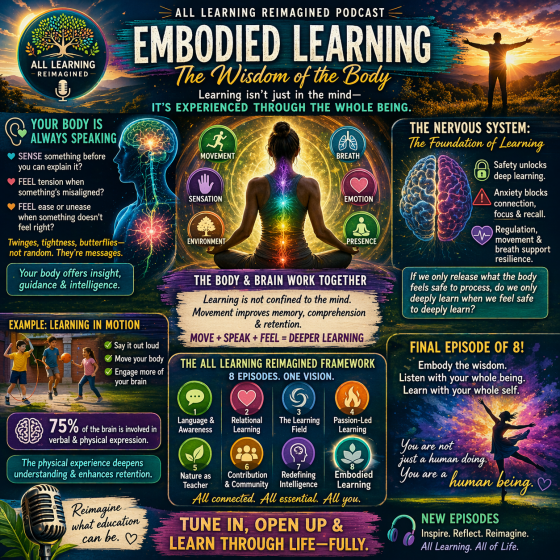
The 8-Part Framework
Key Insights
This episode explores the concept of "Embodied Learning," shifting the educational focus from purely mental processes to the holistic intelligence of the human body. Host Teresa concludes her eight-part series by examining how movement, the nervous system, and physical experience are not just supplements to learning, but its very foundation. By integrating the body’s wisdom, educators and parents can foster deeper comprehension and more resilient learners.
The Body as an Instrument of Intelligence
Learning is often mistakenly viewed as a purely mental exercise, yet the body and brain work in tandem to shape how we process information. Movement has been shown to significantly improve memory, comprehension, and retention, with verbal and motor parts of the brain accounting for a vast majority of our cognitive engagement. Physical experiences—such as using a skipping rope while reciting times tables—deepen the understanding of abstract concepts by anchoring them in the physical realm. The body is not merely a vehicle for the brain; it is an active participant in the thinking process, constantly communicating through sensations and "muscle memory".
The 8 Pillars of Learning Reimagined
A journey through the framework of intuitive education
Safety, the Nervous System, and Sensory Integration
A regulated nervous system is a prerequisite for curiosity and deep learning. When a learner feels stressed or psychologically unsafe, the body enters a survival mode that prioritizes safety over cognition, effectively shutting down the parts of the brain responsible for complex thought. Creating an environment that supports emotional safety and sensory regulation—such as allowing movement, grounding through bare feet, or providing fidget tools—enables students to move from surface-level "cramming" to genuine comprehension. Sensory-rich environments that move beyond just auditory or visual stimuli help prevent the "scattered focus" often seen in the digital age, allowing learners to engage their internal sensations and spatial awareness.
Experience as the "Glue" of Memory
Deep learning is created through experience rather than thinking alone. The body holds memory in every cell, and physical repetition forms patterns that integrate knowledge more effectively than digital "copy-pasting." For example, the act of handwriting creates a unique connection between the hand and the heart, lighting up different cognitive pathways than typing. By "living the learning"—much like the repetitive physical training seen in the Karate Kid’s "wax on, wax off" method—skills become second nature. When students are encouraged to fail through hands-on experiments, they build character and resilience, learning that mistakes are simply different perspectives on a problem.
Practical Embodied Strategies
- 🚶 Walk & Talk: Conduct discussions while moving to increase blood flow and focus.
- 🌱 Natural Materials: Use rocks, leaves, or pebbles for tactile math and counting.
- 🧘 Body Pause: Stop to ask, "What is my body trying to tell me right now?"
- 🎭 Concept Acting: Use drama and movement to make abstract ideas memorable.
Key Data
- Brain Engagement: Approximately 75% of the brain is involved in verbal and movement-related processing.
- Biological Composition: The human body is composed of 70%+ water, which acts as a medium for storing physical and emotional memory.
- Series Scope: This discussion marks the conclusion of an 8-part framework for reimagining education.
To-Do / Next Steps
- Implement "Walk and Talk" sessions for group discussions to improve focus and mood.
- Incorporate natural materials (rocks, feathers, leaves) into tactile learning activities.
- Practice "Body Awareness Pauses" by asking learners if they need movement, rest, or stillness.
- Encourage "safe failure" through hands-on experiments to reduce perfectionism and build resilience.
- Utilize physical handwriting and speaking aloud to deepen cognitive retention.
- Access free archived articles and activities at
bbsradio.com/alllearningreimagined.
Conclusion
Education is not something to be consumed mentally, but something to be lived and expressed through the whole being. By trusting the wisdom of the body and prioritizing emotional safety and movement, we can transform the architecture of learning into a more humane, intuitive, and generative experience.
All Learning Reimagined

Please help support this show!
Support this show by subscribing
$5.99/mo or $9.99/mo or more
Click HERE
All Learning Reimagined: Where passion meets possibility, one story at a time.
All Learning Reimagined is a global podcast exploring the many ways we learn, grow, create, and contribute throughout life. A gathering place for people who know that the future is something we learn, create, and steward together.
While education is often where the conversation begins, this podcast reaches far beyond classrooms and curriculum. Together, we explore learning as a living process that unfolds through relationships, community, nature, creativity, curiosity, experience, and the pursuit of what brings us alive. Through inspiring conversations with parents, educators, authors, visionaries, community leaders, and everyday people, we share stories that expand what learning can be and how it shapes our families, communities, and world.
Drawing from diverse perspectives, indigenous wisdom, practical experience, emerging ideas, and timeless principles, each episode offers insights that nurture self-direction, discernment, contribution, and a deeper connection to what matters most.
Whether you are a parent, educator, learner, creator, community builder, or simply curious about what is possible, All Learning Reimagined invites you to explore meaningful questions, fresh perspectives, and inspiring stories from around the world. Because learning is a living journey to nurture.
Cultivating self-trust. Nurturing wisdom. Inspiring contribution. Strengthening community.
[00:00] Speaker 1: (Relaxing music playing) Welcome to All Learning Reimagined, the podcast that defines convention and redefines the purpose and practice of education. Here we venture beyond institutional boundaries. Whether you're a parent, educator, or curious mind devoted to lifelong growth, this is your space to challenge assumptions and co-create a more humane and intuitive approach to education. Let's reimagine what education can be.
[00:42] Speaker 2: (laughs)
[00:49] Speaker 3: G'day, and welcome to All Learning Reimagined. I'm your host, Teresa, bringing you a little ray of sunshine, as together, we're reimagining the future of education one inspired story at a time. And a big shout-out to all our new listeners today. Uh, welcome. Welcome, welcome, welcome. (laughs) Um, now, in our previous episode, we explored ways of knowing and expanded our comprehension of intelligence beyond the traditional definitions. But today, we're gonna int- continue that journey. I sort of stepped it up last week, uh, and mentioned this week, um, but we're going to step into the wisdom of the body. So, the show today is called Embodied Learning, which is looking at that wisdom throughout the body, and it invites us to reimagine learning, um, that's not just in the mind. 'Cause most people think of learning, they think it's something that's a mental, um, a mental process, but it's also experienced through the whole, um, the whole body, the whole, uh, being, human being.
[01:54] Speaker 3: We're not a do-... We're human doing. We're a human being. So, because the truth is quite profound, but it's actually very, very simple, no need to overcomplicate it, um, we learn through the body as well as the mind. And, um, so question for you then, uh, dear listener, have you ever sensed something before you can explain it? We've talked about this a little bit before, about the, the field that we have, our biofield that's there, and you can actually feel tension, um, when something's misaligned. You can feel ease or unease, uh, when something, it just doesn't quite feel right. So, and I'm not necessarily talking intuition, although that does, um, often express ourselves in the body. I mean, our bodies are constantly communicating with us. It might be a twinge in the shoulder or the knee, um, and it's often offering us insight or guidance or, um, a type of intelligence.
[02:57] Speaker 3: And today, we're g- that's what we're exploring, is embodied learning, where the body is our powerful instrument, um, of wisdom. (laughs) And, of course, uh, we have to consider the role of the nervous system here. Um, healing comes into that, I guess, but the nervous system's actually a huge part of this learning. And, in my experience over decades and decades of working in education, the nervous system and anxiety and movement is a really integral part of learning. It's not an add-on. It's not something to consider. It's, um, it's embedded in everything we do. Um, so, uh, a reflection for us then would be, if we only release and heal what the body feels safe to process, does the same thing apply to deep learning? Do we only really deeply learn when we feel safe to be able to deeply learn? Because, um, that's a really po- important part of the question when it comes to emotional and nervous and somatic, um, uh, processes, I guess, in the body.
[04:10] Speaker 3: I mean, taking a deep breath and settling into presence and listening, not just with your mind, but listening with your whole being, is actually a really big part of the learning process. (laughs) I know there's a lot of information, but that's my introduction basically today, just to sort of step it through. As you know, this is the final, number eight, final show, um, one of eight, a series for our All Learning Reimagined framework. So we started with Language and Awareness, how words shape our reality. Then we went to Relational Learning where there was, you know, talking about connection before the content. Um, the Learning Field, which is emergence and flow. Passion-led Learning, which is following what really lights you up, what's your highest excitement. Uh, Nature as Teacher, which is really the wisdom of the natural world. Uh, Contribution and Community, uh, something I'm very passionate about, which is giving and belonging.
[05:11] Speaker 3: And Redefining Intelligence was last week, which is the many way of knowing. So today, um, rounding all of this off and embodying this learning, putting all of this together and wrapping a big fat bow around it, and that wisdom through the body, this is our final show of eight. So let's get started. The first thing I would like to bring up, basically as a talking point, would be that the body shapes our thinking. I mean, the brain and the body work together with movement and sensation, and the environment, um, really shapes how we think and learn. I mean, the learning is not just confined to the mind. And movement, as we know, improves memory and contra- comprehension and retention. And I'll give you a very short example of that.
[06:00] Speaker 3: Um, many schools might have children that are learning their times tables or their spelling, and they take children outside, and they might give them a skipping rope or a handball, um, to bounce up against a wall perhaps, um, whilst they're saying out loud, 'cause stating and decla- declaring out aloud deepens the learning and uses another part of the brain as well. So, the movement and the voice, um...Uh, the verbal parts of our brain actually add up to close to 75% of, of our brain. So you're, when you're using movement and you're using all different parts of your body, you're actually deepening the learning. And the physical experience deepens also the understanding, the comprehension. It enhances the learning retention. And this is not new, it has been around for years.
[06:53] Speaker 3: Things like Brain Gym, um, and, and using all sorts of (laughs) , I mean, I know there's lots of phonics programs out there that sort of embed all of these things together, but for those of you who might be new and might not be a trained educator, this might be something to consider. You know, the body isn't just carrying the brain, it's actually part of how we think, and it's constantly communicating. Um, so a reflection question for you, if you're a grandparent, a parent, you know, if you're homeschooling, um, or you, you are an educator, when do you learn best? Is it when you're sitting still or is it when you're actively engaged? And there's not one size fits all. I mean, some people like stillness and then things will flow from them, and others like a lot of movement or hands-on learning and getting their body involved. And also, th- there's muscle memory.
[07:48] Speaker 3: When you think about, um, dancers or, um, professional sports, um, uh, men and women, they have that muscle memory as well, so having your body actively engaged, you know, if you're a mechanic, uh, there's just so many different ways that you can deepen the learning when you're considering, how do you learn best and how has movement enhanced your understanding? So this is something that came to my realization, uh, decades ago actually, when I remember ... This is well before, um, when my classroom very, had very few autistic children in them, or ADHD, or ADD, or whatever labels and strings of words and i- identity that we seem to be bandying around today as, um, as if it is normal. And yet back then, none of these labels existed. I would simply look and observe children who were in my room, uh, classroom, and I would be reading their body language, constantly reading their body language. I could tell when, um, I was talking too long, when they needed movement.
[09:05] Speaker 3: I could tell, uh, often by facial expressions children who could comprehend and children who just didn't quite get it, uh, when it was time for a break. Um, there were lots of different things that you could do just by reading the field and reading the room and body language. And I also, way back then, was teaching children different things that they could do through things like Brain Gym, uh, to tap into their own learning as well. And we always started our day with movement, we always started our day with a walk and talk around the school oval. And, uh, the reason why I did that was because, uh, there was one boy I had in particular who just had so much energy and hormones coursing through his body, um, that he had to release it before he could go into a classroom and have any, um, chance of sitting and doing any of the l- of the literacy work in particular that we needed to do for that morning.
[10:03] Speaker 3: So that movement and, you know, we would walk and talk, he would run and talk, he would lap, he would lap us, he would (laughs) just go around and around and around. Um, it was fantastic. And that movement really did enhance the learning as well, because I quite often did a lot of group work, I had a lot of activity stations and learning stations and places for, um, ch- children to get up and move to if they needed that movement. Um, I know today it seems to be quite popular for children to have fidget toys, they're, you know ... Uh, back in the day, you know, decades ago, we would just give them a piece of Blu-Tack and they would basically just roll that around in their hands if they needed to. Or roll a tennis ball under their foot, just take their shoe off, have the ball of their foot and roll a tennis ball underneath their foot.
[10:50] Speaker 3: And that movement really seemed to calm and soothe them while they were concentrating, while they were listening, um, because the body needed that excess energy and the nervous system as well. So grounding was definitely a part of it. Taking shoes off is a really (laughs) , is a really highly recommended. Um, doesn't necessarily work in places like high schools where children move from classroom to classroom, um, lesson to lesson. Uh, however, it is something that is worth considering because it does make a big difference. You know, and exercise increases blood flow to the brain. We know this, we know that it improves focus and mood and, of course, cognitive performance as well. Um, so I would encourage you to consider things that you're doing, like if you have to have a discussion, well, go for a walk and have that discussion. Um, and it doesn't have to be outside if y- you need to be supervising others, but taking everybody outside and getting them to walk and discuss in groups.
[11:52] Speaker 3: Um, uh, uh, I used to take my class to the monkey bars, to the playground, and they had to talk through in a group, they could, they could be sliding down slides, hanging upside down, doing cartwheels, I really didn't care at this stage. I just wanted them to connect and collaborate and talk. And they did what they needed to feel comfortable. And usually, they felt quite connected and that movement really deepened the learning. And when they had to come back and it was time to share what it, whatever it was that they were s- problem that they were solving or something that they were designing, I found that allowing them the choice..... to be able to choose to sit, I mean, some would choose to sit, and they'd often sit in a circle. As we know, circle time is important, um, and a very effective tool. And others needed that movement, or they would get up and have a break if they needed to.
[12:44] Speaker 3: And I found often they would have aha moments in their creativity and play, particularly when they had that lens of what it was that they were thinking about and wanting to contribute and create. When they were playing and they had their brain focused on the lens, more ideas often would come to them. So, some need stillness because we know that stillness also brings out haha moments, but some of us are wired for that movement. It enhances the learning. And when the body moves, the brain engages. I mean, that's just basically science. I mean, building and creating and anything hands-on is really important, and i- it gives you clarity. So, you know, movement can transform traditional classrooms if you are, um, working in that environment at this stage. So, then that leads me to beyond the five senses, and I've done whole podcasts on this, the fact that we have more than five senses. There's a plethora of senses which I would encourage.
[13:45] Speaker 3: But children and adults learn through touch, they learn through movement, sound, spatial awareness, and certainly internal sensations, and being in tune with your body, listening to your body is really key. Um, and this expanded awareness aligns with holistic and experimental approaches to education. Um, and so my question to you would be, what senses do you rely on most when you are learning? Back before television was here and everyone used to sit around and listen to the radio, I'm imagining their listening skills, their auditory skills would have been quite honed. Today, however, I'm seeing lots of children have scattered focus because they're used to, um, what some would call multitasking. I personally don't believe it's multitasking because you're actually splitting your focus in many different places.
[14:38] Speaker 3: But the fact that they are, they are expecting sound and color and movement and all of these different things, uh, is sort of what their body has been trained, if, if they've grown up with an iPad, um, to learn and to expect. So then if you put them in a room and just have just auditory and get them to listen to a radio, some children really struggle with that because it, they've, they've developed a preference for their learning. Not necessarily saying that's a good thing or a bad thing. I'm not judging at all. I'm just stating observations that I have made. And so, as an educator, it really makes me wonder, how can I have a more sensory-rich environment? Um, because (laughs) I don't know about you, but I used to, um, teach the way that I learned, and th- until I realized that not all children learn the way that I learned.
[15:33] Speaker 3: And so sometimes you can have complete sensory overload for them, and I needed to pare back what the choices were, pare back the color, um, and those sorts of things. So it really depends on the learner, whether it's you, uh, or others that you might be guiding and mentoring. Um, I've already mentioned the nervous system and learning, but I, I do want to circle back to that because regulated nervous system fits into what I'm just discussing. It's, you know, we know it supports curiosity and openness, but stress, if it's too much, or even feeling psychologically stressed, if they're feeling psychologically challenged with working in a group, and it might be with others that they don't know or they don't necessarily get along with, but that stress activates survival responses.
[16:21] Speaker 3: And so children knowing their body, feeling the energy in their body and the emotions in their body, and being able to know how to regulate it, because a stressed body is survival mode, but a regulated body is receptive to learning So, how can we embody learning unless we tap into that wisdom of the body? Because the body is communicating with us. And often it's the teacher that's looking and seeing the cues of a child that's headed for a meltdown, um, but how can we teach the children to see the cues in themselves? Uh, instead of having someone external to them helping to drive their behavior, teaching them, uh, to, to have that self-authorization, um, and that sovereignty in their own self. You know, a dysregulated body prioritizes safety over cognition any day. Basically, the cognition part of the brain is quite compromised when they're not feeling safe.
[17:21] Speaker 3: So emotional safety, that routine, that repetition, knowing what to expect, um, really enables that deep comprehension and learning. And that's what we're going for today, isn't it? You know, deep learning. We don't want surface learning. "I'm gonna cram something in for a test and then never remember it again." What a complete waste of our time. Why would we be learning something that we can literally search, um, search on a computer and in seconds have the answer? Why would we be doing that? It's embodying the skills and making sure we're investing in ourselves and teaching the children what it is we need to do, um, and how they can learn and knowing themselves. Really, really vital key, I feel, is that knowing themselves. You know, know thyself. Uh, and the fact that the body tells us when it's safe to learn, um, and communicate, uh, is, is a really important part of the process.
[18:20] Speaker 3: And then that really leads me to the next point I wanted to talk about today, and that's that the body holds memory. So, water holds memory. Dr. Emoto has proven that with his thousands of, um, experiments that he made with words and water. But our body is created or made up of..Well, it's really like a plasma, but, uh, like a, l- well, let's just say water. I'm not even gonna go down the complicated track for the moment. There's just not enough time to go into that topic. But, okay, so we have 70% plus, you know, it's variable, uh, looking at different studies, it's all over the place, um, parts of water is in our body. Our body holds memory. In my opinion, it's because water holds memory, and we have water in every single cell. Experiences are not stored, not only mentally, but experiences are also stored physically. So repetition forms patterns within the body.
[19:25] Speaker 3: That's why the old-fashioned handwriting, sitting up straight, having your posture, using your hand to hand-write was such an essential part of learning. We know that the hand-eye coordination is there, and yes, there is a... you light up a different part of your brain when you're handwriting comparing to typing or copying and pasting, which really doesn't use too much cognitive, um, bandwidth. But the hand also has a connection to the heart and the heart space, and the heart also holds huge wisdom, a lot more mis- wisdom. Our heart coherence field is hu- is much larger than our mind. Um, so there's links here, uh, to things like handwriting. So if you are not handwriting at all in your classroom, um, or whatsoever, I would really advise (laughs) to stop and go, "Why is that?" Was that the frog in the pot thing, where we're sort of slowly boiling and slowly changing over time, and then it, it sort of fell by the wayside? It's definitely a tool worth looking at and considering.
[20:29] Speaker 3: Speaking out aloud and physically writing things down deepens the learning. Habits, posture, emotional responses, all of these things reflect our lived experience, and today, you know, there seems to be more and more, um, children that I see, in particular, teenagers and young children, who are holding trauma in their body, that it's in their body. Um, and so it's a matter of going, "What can we do about this as well?" So that ties in with the nervous system, but it does affect the learning. Some people say, "Well, but I'm not a counselor," and, "I'm not a psychologist." No, we're not. We might not be. However, there are still some very simple practices, daily practices, that we can still do instead of outsourcing to a so-called expert that has a label.
[21:19] Speaker 3: I mean, they're for extreme cases, of course, but there are still simple things that we can do to help the learning become integrated, um, with habits and posture and emotional responses, so that it doesn't get to the stage where you need to seek out an expert for help. I mean, you know, what does your body learn through repetition, and how do physical responses reflect your past experiences? Very simple questions like this, um, can be a simple part of it. You know, from the head to the body, it really comes into integrating the learning. Thinking alone does not create deep learning. Experience does. I'm going to say that one again, because it's just so important. Thinking alone does not create deep learning. Experience does. Our life is full of experience. We're supposed to be living the learning. There's meant to be a purpose in it. Um, and we remember what we live.
[22:25] Speaker 3: If you have a shared experience, and the children don't always do e- um, extract theory, and they're actually experiencing it, we know that that emotion is the glue to memory as well within our brain. So, consider things like, um, hmm, let me think. What about the movie Karate Kid? (laughs) Where, I think it's Daniel-san learns repetition over and over with the movement. Now, I know 90% of you out there have just literally said, "Wax on, wax off." Yes, that's exactly what I'm talking about. I mean, it seems so simple to go wax on, wax off with the hand movements, but he was embodying a skill through his experience. Instead of just being told what to do or demonstrated what to do, he had to physically do it over and over again until it became second nature, and then he actually got to apply it later. Later in the movie, of course. I mean, because you can't just explain learning. It needs to be experienced.
[23:27] Speaker 3: And if that is one takeaway, one message that I would love the whole world to hear, it's this, because it does shift the way that you do everything. You know, I'm guilty of it myself when I say, "Hey, I told you how to do that." Uh, I might have shown them how to do it. I might have told them how to do it. But did they actually physically step through and do it? And this feeds into the I do, we do, you do explicit restric- expli- explicit instruction, you know, the gradual release module of learning that many teachers the world over have been using, because it works. So, yeah. Uh, I guess there's just so many things. It all really ties together. None of it stands alone, um, but considering the body is really important. So, you're probably thinking, "Okay, well, enough talking. W- what do I need to do? Can I get some practical applications?" Well, yes. Walking and talking is one that I've already talked about. Stretching in between tasks.
[24:29] Speaker 3: Um, stretching and movement is really important. It can release energy in the body. It can calm the body down, so it helps with the nervous system. Also, breath work. Um, but the movement is, uh, definitely something that you can do. Acting out the concepts, so drama is very memorable. (laughs) Um, and a lot of people think, "Oh, you know, the arts is the first to go." Well, I'm sorry, drawing, painting, music, singing, humming, drama, movement, sport, they should be non-negotiable.... as far as I'm concerned. And yet, um, you know, government authorities the world over say, "Oh, we don't have enough time to cram in this curriculum," and one of the first things to do, to go is that. And yet, it is so essential to learning, so it should be, be embodied with everything, integrated into everything, not even, t- necessarily taught as a separate subject. It should just be compulsory. That's my opinion, uh, from my experience, from my direct experience.
[25:32] Speaker 3: Uh, learning through doing, so building something, creating something, and experimenting. And I love it when the experiment goes completely wrong and it's a complete failure, because the children get to stop and reflect and talk and go, "Okay, what would I do next time? And, and let's have another go." And, and it's re- it's really helpful for your perfectionists, particularly in primary schools for the younger grades. Um, lots of children cruise through the younger grades and then they get to high school, and when they finally meet content that's too hard for them, they don't know how to fail. And their perfectionism is ingrained in them, and they really, really, um, struggle mental- mentally, um, and their stress levels go through the roof. So the best thing you can do is help children make mistakes and fail through experiments, because you didn't fail, it was just we found another way that it didn't work, so let's try again. Let's try a different way.
[26:30] Speaker 3: Let's try a different perspective. Which is really training their character building for life, which is so important. Um, sensory integration. So, you know, using natural materials. Everything doesn't have to be plastic. Everything doesn't have to be manmade. Go, if you're going to do counting, go outside and find rocks and pebbles and feathers or leaves, uh, you know, there's lots of things you can do with natural materials, and explore the outdoors as integration. Um, it is so, ah, inspiring. The children literally come alive the moment you get out of those four walls, and it's also, well, we're thinking about the energetics of the four walls and how it's contained, compared to the natural world. How many things in the world, uh, that's natural is actually straight four lines and walls? Everything has curves to it. Um, so it's really important to then observe nature. Uh, body awareness is essential, and these are the two that I use.
[27:31] Speaker 3: Um, I often get to teach children, um, and teenagers to stop and pause and ask themselves, either aloud or to themselves, it doesn't matter, sometimes they write it and journal it, "What is my body feeling right now?" Now, this is also a skill that I use at the end of a day, um, in my personal life, um, or, and, you know, "What is my body trying to tell me?" But these sorts of questions, you know, "Do I need movement? Do I need rest? Or do I need stillness?" is also my second question for that body awareness pause that I would highly recommend, because it's just so important. Um, okay. So I'm looking at the clock and going, "Oh, my goodness gracious me, I could talk for such a long time," but I am going to start to wrap it up. My article this week, um, has lots more activities in it.
[28:26] Speaker 3: And for those of you who are new to my channel, um, you can go to bbsradio.com/alllearningreimagined, and you can find all my archived shows, all the articles and activities that I create for free each week, um, that you, you, you don't have to subscribe to the channel. You can just go to the website and you can take it, adapt it, use it. Um, I encourage you, please, please do. Um, I, you know, you can subscribe to my channel. I'm, you know, people donate to my channel and subscribe to my channel, um, and, uh, thank you very much. I'm really grateful for those supporters so that I'm able to continue, um, this podcast, uh, for j- beautiful, generous donations, so I really appreciate that, and honoring my time and energy, so thank you, thank you, thank you. So to wrap everything up, though, today, um, this is the close to the eight series, um, for our All Learning Reimagined, um, framework.
[29:25] Speaker 3: And, you know, (laughs) I, I feel like it was really important, and if this conversation resonates you, I really explore, uh, invite you to explore the full All Learning Reimagination series. Thank you very much for listening again, everybody, uh, and joining me on All Learning Reimagined. Until next week, explore, experience, express, go out and live learning.
[29:53] Speaker 1: (Instrumental music) Thank you for joining us on All Learning Reimagined, where passion illuminates the path forward. Remember this: the future of learning doesn't arrive from above; it begins within. You are the spark, the shift, the living answer to education's silent call for transformation. So stay curious. Stay awake. Let inspiration be your compass, because how we learn today is not just personal, it is profoundly generative, it shapes the very architecture of tomorrow's world. We are not separate from the system, we are its evolution. Until next time, trust the wisdom of your own unfolding, and let your life be the lessons that light the way for others.
[31:00] Speaker 1: (Baby laughing) (Instrumental music)