
At The Wire, May 8, 2026


At The Wire with Scott Miller
At The Wire: 2026 Kentucky Derby Review & The Future of Racing
At The Wire: 2026 Derby Post-Mortem
From 23-1 Long Shots to the $450M Future of Belmont Park
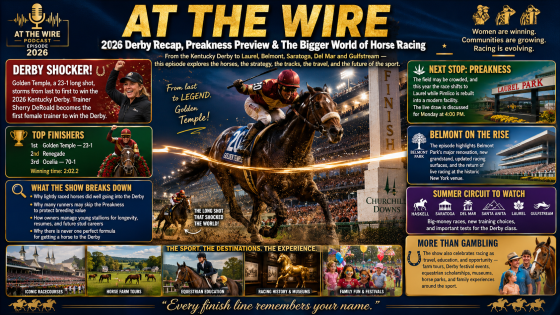
Derby Results & Milestones
Sherry DeRoald becomes the first female trainer to win the Kentucky Derby, surging from last place to victory.
- 1st: Golden Temple2:02.2
- 2nd: Renegade (Palm Beach)
- 3rd: Ocelia70-1 Odds
Infrastructure & Rebirth
Modernizing the "Big Sandy" with a 275k sq. ft. grandstand and year-round racing capabilities.
The Summer Circuit Roadmap
Management Trends
- • Breeding Protection: Top runners skipping Preakness to preserve stallion value.
- • Fan Experience: Tracks evolving into 7-day "Sports Venues" with retail/dining.
- • Education: Scholarship programs for young riders at major universities.
Introduction
This episode provides a comprehensive wrap-up of the 2026 Kentucky Derby, celebrating a historic victory for female trainers and discussing the strategic shifts in horse management. The host explores the massive infrastructure investments at major tracks like Belmont Park and the industry's broader push toward fan-centric entertainment and youth education.
Detailed Points of Interest
A Historic Derby and the Rise of Long Shots
The 2026 Kentucky Derby delivered an unpredictable outcome, characterized by a "wild weekend" of weather concerns and last-minute scratches. The race was won by Golden Temple, a 23-1 long shot who surged from last place to victory. This win marked a historic milestone as Sherry DeRoald became the first female trainer to win the Kentucky Derby. The podium was rounded out by Renegade in second and Ocelia, a staggering 70-1 long shot, in third. The winning time was clocked at 2:02.2, proving that despite the "expert" predictions, the Derby remains a race where anything can happen.
🏆 2026 Kentucky Derby Podium
Trainer: Sherry DeRoald (First Female Winner)
Strategic Management and Breeding Rights
Modern horse racing is increasingly dictated by "management" and the protection of breeding rights. Many top contenders from the Derby are choosing to skip the Preakness Stakes to avoid the strain of a two-week turnaround, opting instead to point toward the Belmont Stakes or summer meets at Saratoga. Trainers are prioritizing longevity and "stallion resumes," focusing on proving their horses can perform across different surfaces and distances. This "old school" approach of light racing leading into major events has proven successful this season.
Infrastructure Revolution: The New Belmont and Beyond
The racing industry is undergoing a massive physical transformation to become more "fan-friendly." Belmont Park is currently undergoing a $450 million renovation, which includes a new 275,000-square-foot grandstand and modernized racing surfaces (including a synthetic Tapeta track for winter). Similarly, Pimlico is being rebuilt, with racing temporarily moving to Laurel Park. These venues are being reimagined as year-round sports and entertainment destinations, featuring shopping malls, five-star dining, and luxury hotels to attract families and non-racing fans.
🏗️ Belmont Park Modernization
- 💰 Project Cost: $450 Million
- 🏟️ Grandstand: 275,000 sq. ft. (Modernized)
- 🏇 Surfaces: Main Track, 2 Turf Courses, 1 Tapeta (Synthetic)
- 📅 Reopening: September 18, 2026
- 🏁 Fall Meet: 46 Live Race Days
Community Impact and Educational Opportunities
Beyond the betting window, the horse industry provides significant economic and educational value. The Kentucky Derby festival brings immense revenue to Louisville and surrounding counties through tourism and local attractions. Furthermore, the industry offers unique pathways for youth; many young riders are now securing full-ride scholarships to major universities like Texas A&M, Kentucky, and Auburn, effectively "riding for an education." The host encourages fans to look past the gambling aspect and explore the history, farm tours, and agricultural heritage of the sport.
Key Data
- Derby Winning Time: 2:02.2.
- Belmont Renovation Cost: $450 Million.
- Belmont Grandstand Size: 275,000 square feet.
- Fall Meet Duration: 46 live race days (Sept 18 – Dec 6).
- Broadcasting Access: RTN offers feeds for as little as $5 per month.
To-Do / Next Steps
- Preakness Stakes Draw: Tune in to MSM Equine on Monday at 4:00 PM to see the live draw for the Preakness field.
- Saratoga Summer Meet: Prepare for the opening of the Saratoga meet starting Thursday, July 9th.
- Belmont Reopening: Mark the calendar for the official reopening of Belmont Park on Friday, September 18th.
- Local Exploration: Google "horse industry" or "equine" in your local area to find farm tours and local tracks.
- Next Broadcast: Catch the next episode of "At The Wire" next Friday at 4:30 PM Eastern Time.
Conclusion
The 2026 Kentucky Derby was a landmark event that defied expert predictions and broke gender barriers in training. As the industry shifts toward year-round racing models and multi-purpose entertainment venues, the focus remains on balancing the prestige of breeding rights with the need to engage a new generation of fans through technology, education, and modernized facilities.
At The Wire
Reporting on The Thoroughbred industry!
If you’re captivated by the power and grace of horses, there’s a thrilling world waiting for you—horse racing like you’ve never seen it before.
Step into the heart-pounding excitement of equestrian sports with Scott Miller, your ultimate guide to everything from the latest international racing headlines to the untold stories behind the track. Whether you're new to the sport or a lifelong fan, this program dives deep into the magic and mystery that makes horse racing one of the most exhilarating spectacles on Earth.
Discover what truly sets a champion horse apart, explore the secrets behind elite training for both standardbreds and thoroughbreds, and meet the legendary handlers and jockeys shaping the sport. Uncover the rich history, the art and science of breeding, and insider tips that could turn you into a savvy bettor.
With behind-the-scenes access and expert insight, this show brings you closer to the action than ever before. Curious? Saddle up—because this ride is just getting started.
[00:04] Speaker 1: Yeah. This is where it begins (echoes) . From the starting gate to the final stride, feel the rush as the champions ride. Every heartbeat's a Derbin call. One shot glory, winner takes all. From the dirt to the lights, hear the crowd roar higher. Every second burning, closer to the wire. At the wire, where the fastest hearts collide. At the wire, feel the thunder come alive. You're riding at the wire.
[00:58] Speaker 2: Welcome, horsemen. What a wild, wild weekend we had at the derby. Remember what we talked about all year long? We talked about the weather and we talked about the taveling, and we talked about, uh, the different horses, and, you know, horses getting hurt, horses not getting hurt. Had one flip over at the gate and he got scratched up. So you see, you never can tell what's gonna happen, you know, in the horse business, um, how they get there. And so they all got there and had two, three scratches, uh, this year. And, uh, you know, i- it ruled out pretty much the way we figured it was gonna happen this year. Uh, you know, as we said, we couldn't really pick a favorite in there. Uh, you know, i- it was just, uh, one of those crazy, you know, Kentucky Derby, you know, draws that we had.
[01:51] Speaker 2: And, um, you know, like I was saying about all the trainers and the owners and they're trying to figure out what to do with their horses and how to get them to the derby, you know, how to build up a resume for them in case they do win the derby and go on to be a stallion, you know, and then eventually down the road. And, um, what happened this year is, uh, runners not going to the Preakness because they're trying to protect his breeding rights is what they're trying to do. They're trying to figure out, you know, where he's gonna be a good stallion. And, um, they figured that, uh, two weeks off of a hard race like the derby, um, back to the Per- Preakness in Baltimore, uh, you know, they'd just rather skip over and jump right over to the Belmont Stakes. And so that's what they're gonna do, and a lot of, a lot of them have done that already.
[02:41] Speaker 2: They're already into their secondary training program, and you know, where they're gonna go, if they're gonna point, point towards, like, the Haskell and, and, uh, you know, uh, the big races at Saratoga that they have up there. Uh, y- you know, and, and it's a management, it's a management type thing, you know, they're managing these stallions the right way. Uh, they're trying to get longevity out of them. And, um, that's what they need to do, is they need to prove to the, to the breeding industry that, um, their stallion that they had, uh, is gonna do good. Uh, he can run, uh, around on ground. Uh, maybe he can run on the turf, on the dirt, you know, but the whole nine yards i- is you gotta get them there. And that's what we did all, all winter long, we talked about getting them there. Um, you know, uh, what track you go to, where you go to train, uh, you know, that type of thing, what races you run in.
[03:39] Speaker 2: Uh, they, they did pretty good yest- this year, lightly racing, uh, going back to the old school, uh, where you lightly race your horses going into the derby. And, uh, it, it, it worked out pretty good. We got a lot of, a lot of good horses that ran there. Uh, are they Preakness horses? Don't know, 'cause a lot of them aren't going to the Preakness. So they're Belmont horses, so, you know, so when we get to that bridge and cross it. So the whole lot of story of it is, is the making of your horse. It's very difficult. It's very, very difficult to manage them, because you never can tell when something might happen, you know. I mean, you know, I had a horse flip over in, in the gate. Uh, well actually, before it happened in the gate in that stretch, so. Then, you know, he ain't got much strength racing on, you know, racing different tracks, different *******. He gets there and he gets there and he flips over and gets crashed.
[04:36] Speaker 2: I mean, you know, that, that's what, uh, what it's tough to do. Now, the Kentucky Derby in 2026, yeah, the results, Golden Temple, a 23 to 1 long shot, whereas, uh, from last place to victory for Sherry DeRoald to become the first female trainer to win a Kentucky Derby. Now, remember what we were saying about during the year? Getting ready, doesn't matter where you run it, doesn't matter w- how you run, just how you run in a derby. And, and that was the problem that we had over here, is Sherry comes in with a nice horse, ran good, she brought it along properly, and next thing you know, 23 to 1, wins the derby. You know? Uh, it, it, it's just amazing when you see things like this happen. Um, you can't sit down and write a book or a training chart on how to get them there. You know? Uh, she could train another horse next year the same way and might not even get there, you know? And that's one of the things that, uh, we have to look at. Um, the winning time was 2:02 and 2.
[05:42] Speaker 2: Um, it, it was, um, it, it was a good, good race. Uh, Renegade, the horse that we had from Palm Beach County, he ran second. And then, um, the, Ocelia, uh, she r- (laughs) she, she ran third and 70 to 1. It's 70 to 1. So it just goes to show you, all the experts that we have in the industry at having shows every week-... that are on TV and they're telling them, you know, "Well, this horse likes to rail and this horse doesn't like to rail. This horse got closing speed and that horse, you know, is a sprinter and, you know, comes from a long line of winners," and all like that. And it just goes to show you, all the talk that we did for eight months on the 2026 Derby, look what happened. Long shots come in. And that's why they call it racing. That's, that's why they view it. But it, it, it was interesting. It was a good field that we had. Uh, got some good horses out of it. Um, I don't know how many are gonna go to the Preakness.
[06:44] Speaker 2: We won't know until Monday night, um, or Monday afternoon at 4:00. Uh, we'll have the Preakness draw here on, um, MSM Equine. Uh, we'll ha- we'll have that draw live on Monday. And, uh, we'll see who goes in and who doesn't. It might be a 14-horse field. And if it's a 14-horse field, then let me tell you something, that's gonna be crowded because a Pimlico Racetrack or Laurel Racetrack has got long, sweeping turns. Um, you know, it, it's gonna be interesting to see what happens there. And, uh, you know, we just won't know until the horses get there and train and see how they do it. And the reason that it's gonna be at Laurel this year is, um, they, uh, tearing down, uh, Pimlico Racetrack and they're gonna be, build a new, modern facility there, um, with it. And then, um, Pim- and then Laurel, uh, Racetrack, it, it will become a, a big training center. And that, that's what they need up in the Northeast like that, a big training center like Laurel.
[07:48] Speaker 2: And they, and they got the feed and they'll be able to t- train year round. A- and that's the good thing about that. So that's gonna help the horsemen out quite a bit, uh, you know, when they, when they get going up there. Tha- that's gonna be a good track for them to train on. But the whole long and short of it, guys, is we, we were right, we were right on, on, right on the money. We didn't have, have the winners, but we were close and, you know, we, we knew what kind of was going on, you know, with them and everything. So, uh, that, that's gonna be interesting to see where these horses go from there. And what I do is I, I do, uh, I do chart them, uh, throughout the year and, um, most all these guys right now, I tell you, are trying to, you know, stamp their resume as a, as a good stallion possibility or a good broodmare. Uh, you know, that type of thing. And what's gonna be interesting is there's a lot of, uh, good races coming up.
[08:46] Speaker 2: You know, we're looking at, uh, like the Haskell at, uh, Monmouth Park. That's gonna be good. Um, you know, uh, going to Saratoga, there's a lot of good races there for the horses getting some money in. Big, big money races that, that are really, uh, you know, test you. Um, and then, then you come along through, um, the summer meet, you know, at, uh, Del Mar. Summer meet at Santa Anita, um, summer meet at Laurel is, is gonna be good. And then, and then, uh, we've got Belmont coming up. Um, you know, Belmont's gonna be opening up here soon. Uh, the new track that they have, uh, which is really gonna be great. Um, everybody seems to love everything that they've done at Belmont. Um, Belmont Park is located in Elmont, uh, New York. It's undergoing a $450 million renovation, including, including the new 2,000, uh, 275,000 square foot grandstand, uh, modernized, uh, racing surfaces and expanded green spaces for the fans.
[09:54] Speaker 2: Um, the reopening marks the return of live racing, uh, at the historic track after a period of, of, um, of being off for a few, uh, quite a few months, a year o- year or so. And then, um, we'll, we'll see what happens there with them. Um, opening day is, uh, for Belmont, Belmont is, uh, Friday, September 18th. Um, it's a fall meeting. The duration of the fall meeting will run through September 18th through December 6th. It has 46 live race days. Uh, racing surfaces at the new Belmont feature a renovated mile and a half main track, two turf courses, and one Topeda track, synthetic track for winter and off, uh, the turf racing. And that, that's gonna be interesting and we were talking about that this morning, uh, how many, uh, um, people are gonna be changing pla- uh, venues, uh, for the training, for winter training. Now, we're getting a lot of people down here.
[10:58] Speaker 2: You'll get over 2,500 horses, people, uh, with Gulfstream and Palmettos and, um, we've got, uh, just little, uh, um, under 200 at Palm Beach Downs. So, you know, you can get quite a few horses down here. But now, the thing of it is, you see, when you got horses like, um, a derby winner coming off your track and, and a lot of stakes winners, uh, you know, coming off your track, uh, so that, that gets a good, uh, a good sign to Palmettos and to, um, uh, Gulfstream Park to see what they have. And then of course, we've got, uh, you know, our, our place here at Palm Beach Downs, which Todd Pletcher's at and, you know, he's basically, you, you know, he has 150 horses, you know, in, in our, in our system here. So, you know, that, that's another thing there that we look at.
[11:48] Speaker 2: But, you know, with, with, uh, uh, Belmont being open up year-round now, uh, that, that ma- that's a big difference and, and everything 'cause, you know, a lot of people stay at Saratoga as las- as late as they can and then ship on down to Belmont and stay there, you know, for the rest of the year. You know, which is good. And by the way, when Pimlico gets, gets back, they'll be racing year-round there too.So now, you know, we've kind of, uh, in the horse business, we've kind of fixed the situation. Um, we're taking a lot of traveling out of our, out of our training, uh, and that's gonna be really good. If you don't have to travel all over the country, you know, um, pack up and move and, you know, when, uh, Saratoga leaves and then, uh, you don't have to leave Belmont because you'll be there, you can race year-round. You'll be able to race, uh, Pimlico year-round.
[12:46] Speaker 2: Um, you got racing in Kentucky year-round, you know, so I- it makes a pretty good, uh, a pretty good scenario for, for the horse trainer, you know, to, to get where they need to get. But, uh, that's September 18th is the official opening day, um, at Belmont Park. And then we've got, uh, Saratoga coming up. Uh, they're gonna ... Everybody hightailed it up there. We got no- ... We're empty here in, in South Florida. We're totally empty and, and all, all of our thoroughbreds have gone either to, uh, Kentucky or to New York or to Saratoga. And so, you know, that's really, uh, something to be said for what we're doing. It's gonna be better for the horses. It's gonna be better for the horses. It's gonna be, uh, um, you know, a tough thing on the trainer because, you know, you got certain places that you can go and you can't hide out anymore. (laughs) You know, that's one thing you just certainly cannot do, you know, and, and I, I know the owners are excited and the owners love Saratoga.
[13:50] Speaker 2: Saratoga is the meet- the, the place to go, um, in the summertime. The purses are good, the weather's good, uh, you know, it's just, uh ... I, I don't know if you've ever been to Saratoga or not, but it's a fantastic facility. Serves its purpose. And if you've got horses that can win at Saratoga, that puts a good, uh, you know, a good stamp on the resume for your horses, uh, that you have. Um, week two, um, it's Thursday, uh, July 9th, uh, through Sunday, July 12th. Um, there, there's a Victory Ride, uh, uh, Stakes Race, uh, the Grade II, uh, Bowling Green, um, i- is there, uh, and then they have the Grade II Caress. Uh, that's the, the first, uh, weekend that we have there. It's kind of like, uh, jumping in there with, uh, 4th of July, you know, that type of thing, um, you know, kind of holiday spirit, you know, that you see.
[14:52] Speaker 2: Um, Thursday, Jun- uh, uh, July 16th through Sunday, July 19th, uh, has the Jonathan Keizer and Novice Memorial, um, has, uh, the Lila Rose, uh, Stakes Race and the Grade II Duck and Diana, uh, the Coronation Cup, um, the Gil Quilt Call Press, Race- uh, Race, uh, and the Thoroughbred Foundation, uh, Retirement, uh, Race. Which, uh, you know, they've got a lot of things that are going on there and, and that's what the racing industry is all about, I- is getting fans to, to the facilities, to the venues. And I guarantee once you get to, uh, to Belmont Park, uh, you know, and see all the things that they have there that are fan-friendly, you're gonna love it. And, you know, you can, you can live in, in Manhattan and be a, you know, in the outline boroughs, and you can go over to the, uh, track seven days, or, you know, every day of, every day of the month if you want to go, uh, you know, and, and see something there.
[16:00] Speaker 2: You don't have to have racing there to watch it because they're gonna have sports venues there and, and food and dining and shopping. Uh, you know, so you literally can go to the tracks seven days a week, you know, and be active there in it And the unusual thing about, uh, what's happened is that, uh, Churchill Downs kind of started all this a few years back, uh, when they renovated Churchill Downs and turned it into a sports venue. Uh, so then next thing you know, um, they come along and you got, uh, Belmont Park doing the same thing, you've got, um, you know, um, uh, Laurel Park all fixed up nice and neat, Pimlico is being rebuilt. Uh, you know, they've done a lot of things to these race tracks to make it convenient for the, you know, for the family, you know, to come out to. And, um, that's what we're trying to do, is get more people to the industry.
[16:56] Speaker 2: And one of the things that, um, I wanted to make a note here, that, um, I don't know if people have noticed it on the sports industry here in the last few months, especially, uh, Derby Time. Um, Derby Time had, uh, a, a, a thing going there and, uh, they were jumping around from NBC, uh, you know, dif- their different, uh, stations that they have, and, and the fans kind of got upset because if you didn't have Peacock then, you know, you couldn't do anything. Uh, it wasn't on ESPN, it wasn't on Fox, it wasn't on anybody like that. But, you could watch it here on msmequine.com, and the reason you can do that is, is because my partner at- partnered up with the, uh, with the different, uh, racing associations, uh, to do, you know, what we're doing. A- and, you know, they don't have the big contracts anymore like they used to, and that makes a big difference because now you've got, you've got Swing, you've got, uh, uh, you know, YouTube, you've got me, uh, you got BBS.
[18:03] Speaker 2: You got a lot of places you can go and see a lot of content, uh, you know, uh, of what's going on I- in the sports industry And, um, I noticed th- that a lot in NASCAR. Uh, NASCAR is kind of jumping around, you know, day-to-day and, and then you got a new football league that's come up, you got, uh, World Cup Soccer coming around and, uhYou just got so many doggone sporting, uh, you know, events that are international and, you know, worldwide. We've got the Breeders Cup coming up. You're gonna love our Breeders Cup, because, uh, every week, uh, we're gonna have a Breeders Cup race here on BB, um, um, International Equine Network, MSN Equine Network, and BBS. And, and you're gonna have a Breeders Cup win and you're in, every week. So you'll be able to stay up to date on everything that we, that we're doing here. But, um, you know, all, all the sports thing and, is just, uh, you know, just going crazy. Then it was sad, uh, Ted Turner died, uh, this past week.
[19:03] Speaker 2: Uh, Ted Turner is the one that started out cable TV and, and, uh, sporting networks and, you, you know, the whole nine yards. And I mean, it, it's just, uh, it was amazing what he did, but it's come full circle. Now, they're trying to find an off-ramp to where they can find a home to where they can do all these sporting things, and the horse business has been a great part of that, because we have the shows, the three-day Rolexs. We've got the re- uh, the, uh, Olympics, uh, you know, we've got all kinds of things, you know, the AQHA, um, all the national championships. And, and the horse industry is kinda like the foundation for all the rest of the, you know, the platforms that are out there. Um, right now, we've got some small tracks that are really doing good, uh, you know, with their simulcasting. And why are they doing it real good? Because they have a company called RTN that literally films and, and shows every racetrack in the country.
[20:06] Speaker 2: And at RTN, you can go in, and for as little as $5 a month, you can get a, a, a, you know, broadcast program into your house.
[20:15] Speaker 3: Mm.
[20:15] Speaker 2: Uh, you can do that. Um, you know, you can get all, all the tracks that you not, you used to not be able to do. Like, um, Colonial Downs in Virginia is one of them, and it was always hard to get their feed. Uh, you know, the Meadowlands, uh, in New Jersey. Um, but that's what it's all about, and, and, you know, like we started saying eight months ago, talking about the derby, you know, I si- I set the foundation, eh, you know, for everybody to, to learn about it. And, and if you stayed with us in eight months, you, you know, you, you probably had a real good derby this year. Um, you know, I would think that you would have. But the thing of it is, is we need to get the people interested into the sport. I don't care whether it's a local track, if it's the big tracks like Santa Anita and Delmar, um, you know, uh, Churchill Downs, Ellis Park's really come up, Keeneland's come up.
[21:10] Speaker 2: Uh, there's just so many things that are there now, and we wanna make sure that you understand that it's just not gambling that I'm trying to bring to you. I'm trying to bring you things like, you know, the renovations of the last four tracks that we have here. Uh, trying to tell you about the, you know, the programs they have here, you know, for all these things. A lot of people don't realize that, um, these kids that are out here, you know, uh, wanting horses and all that like that. For example, here at Sunshine Meadows, we've got a lot of college kids, we got a lot of young kids, you know, th- eight, nine, 10 years old, you know, up to 20, 25. But what they, people don't realize is these kids, when they start riding, they can learn to ride and get a scholarship. They're riding for books. They're riding for education. And we got, like, six people here that are at major colleges, uh, like Texas A&M, uh, we got a, a girl down there at Texas A&M.
[22:12] Speaker 2: We got them at Kentucky, Auburn, Florida, um, you know, all over, uh, we, we've got them. And e- every university offers a program, and they can get a full ride scholarship, you know, all riding. And man, let me tell you, that's worth some money right there, you know? But the whole thing in it, of it is, is like I confuse a lot of people here when I talk to them, because I talk so much about everything, you know. Uh, about the, well, like for example, the Kentucky Derby, you know, that was a great, great, uh, 10 days there in Kentucky. They had the balloon races and the boat races and they had the drag races and, uh, they had a lot of things that brings a lot of money to the community of Louisville, the County of, of Jefferson and the State of Kentucky. And also, on the other side of the river in Indiana, Clarksville, Jeffersonville, New Albany, uh, you know, they're all, all part of that derby festival.
[23:12] Speaker 2: And, um, you know, it brings a lot of people in to the hotels and food and, and all the attra- attractions that you have, you know, there and, uh, that's what we're trying to do.
[23:22] Speaker 3: Mm.
[23:22] Speaker 2: But let me tell you, it's getting exciting now because it's summertime and, you know, we've got pretty much good weather just about everywhere and, and, um, you know, i- it's a good place to go, and, and, you know, you can get a good summer vacation in and, and, uh, take the family. Or like, say, if you go to Louisville, for example, uh, in Louisville, they got Hiller Sh- Bradsby, which is a, um, uh, they make baseball bats for the Major Leagues. Uh, you know, you, you've got, uh, baseball there, live, uh, professional baseball. Um, you know, have just a little bit of everything there for them. Uh, you got the museum, the Kentucky Derby Museum, and you got the Falls of the Ohio between Indiana and, uh, Kentucky there, and it's a great place to go see. Uh, you know, then, then you get up to, you know, Saratoga. You got all the, uh, spas and, and you got all the, the, uh, uh, uh, SPAC, the Saratoga Performing Arts Center, which is really good. They have great concerts up there.
[24:23] Speaker 2: Uh, you got the, uh, Horse Racing Hall of Fame there.There's just so many places you can go, i- it's endless. Th- you know, when you start talking about, um, you know, the places that, that we race at. There's just more than, than racing, you know, in those communities. And so finally, you know, the industry, our industry, caught on and said, "Hey," you know, "listen to what we gotta do." And I tell you who, who was one of the first ones to start it, was Frank Stronach, down at Gulfstream Park. He came in and the historic Gulfstream Park, everybody loved. And, um, the guy tore it, tore it down. And what he did is he built a new track, a new facility. Has all the amenities that, that you can... you know, from, uh, from hamburgers and hot dogs to, you know, uh, uh, five-star dining. You know, there are... and all the hotels. There's a lot of good hotels, you know, around there that you can go to. He built a shopping mall. Shopping mall.
[25:24] Speaker 2: So like, when you go down, if the wife and the girlfriends and the girls, uh, you know, don't wanna go to the races, they got a big mall there that they can go to. And it's got everything from inexpensive items, you know, up to, to, you know, tremendously overpriced (laughs) products that I, I... sorry. But, uh, you know, that, that's what they do there. And, you know, the whole long and short of it, is getting people out to see the industry. You know, to b- be a part. And you don't have to be own, own a horse to be a part of it. Like I always say every week, you Google "horse industry", Google "horses", "equine", whatever. Just... as long as its got the name horse in it for your area, and you'd be surprised what's there. You would absolutely be surprised what is there. And, you know, a lot of these farms now, they, uh, offer tours. You can go on a tour of a farm.
[26:19] Speaker 2: Like, at WinStar where I was at in Lexington, you could go on a tour of WinStar and you can see Derby winners, Triple Crown winners. You can see the whole nine yards. You can see babies, you can see broodmares, you can see, uh, you know, colts. Uh, and you see them in their natural habitat. Um, in Lexington, the horse park, oh man, I tell you what, that's a, that's a great place to go to. They literally have every breed on this earth there in Lexington, in that horse park you can go see. And they tell you all the stories about it. You can walk up to them and pet them, and, you know, they got a great gift shop there. Um, they got a lot of polo there this week. Um, three-day Rolex they have. And, and the same thing that we have here f- in Florida at, uh, Ocala. Uh, up in Ocala, it's amazing the things that they have up there. In fact, we've got a client here that, uh, bought a horse there, and, and it's called the, the Gypsy Vanner. Uh, the Gypsy Vanner.
[27:20] Speaker 2: Now, these are the horses that pulled, um, the wagons around Eastern Europe and Europe, um, for, you know, the gypsies. And let me tell you, up there at his facility, he's got original gypsy, um, vanners. He's got the original, uh, uh, trailers and the original, uh, uh, wagons that they, they, uh, built. And, and what's neat is how they, uh, built these, uh, gypsy vanner wagons. Um, they had little, little bitty, uh, like a desk, a drawer, uh, w- a desk with drawers in it. And one of the little containers had, maybe had four or five spoons in it, and another drawer had, like, the knives and forks. Uh, they had a little cupboard where they had, like, the, the glass, the glassware, and where they store, stored dry food. Uh, you know, it was just amaze- what they had. But every state has that. Every state has that. And, and, you know, just Google horses for your state and your locality, and you'd be surprised what you can see.
[28:31] Speaker 2: And the great part about it is, is nine times out of 10, you go to these places and they're free tours. There are free tours th- that they can do. You can come here in the winter time to Sunshine Meadows and Palm Beach Downs and Delray Equestrian, those are the three farms we have here. We've got over 1100 horses in the winter time. And you can come down and visit, see them, and I'll talk- take you around and show- we'll show you alligators and deer and, uh, you know, all kinds of stuff that we have here. And it's all part of our farm, farm. So, you know, I just wanted to let you guys know that, uh, we pretty much did good on the Derby this year. We, we didn't go out on a limb and saying, "Oh, this horse is gonna win or that horse is gonna win." You know, like I said before, that horse, the horses that we had, 20 horses there, were multi-talented horses. And they're all gonna be champions in their own right.
[29:29] Speaker 2: They may not have won the Derby, but they're gonna come back for the Traverses, uh, you know, at Saratoga or, um, you know, the other races. The Haskell at Mama's, uh, you know, all, all these other hor- horses, you know. You can watch them all year long and then when we all go back to Cayman and come back to Gulfstream, you can come and visit with them. But, uh, you know, I was really pleased which way the Derby came out. Uh, it was exciting. Had a woman trainer. Now, see, there you go. That shows you that all these people saying, you know, about, "Oh, I can't do this because I'm this or that." Hey, Sherry proved them wrong. She comes from a long lines of harness, a long line of harness people and thoroughbred people. And she proved them wrong. You can do anything you want to do if you put your mind to it. Well, that's it for us t- this week, guys. I really appreciate everybody listening. All two of my people that are listening, I, I think I'm gonna give them a test.
[30:31] Speaker 2: And hey, they're not gonna get dinner if they didn't listen today, you know. But, um, be sure to go to BBS and look at all the things they have. If you ever get bored, want something to do, they got a multitude of programming there. All kinds of stuff. And they're better than I am, you know. But see, being like I am, I've got no critics, so that's good. Guys, next Friday at 4:30 in the afternoon Eastern time.
[31:02] Speaker 1: From the stories told to the races won. Every journey ends where it all begun. Legends run but the track remains. Echoes of glory in the rains. Through the dust and the dreams. Through the fire and flame. Every finish line remembers your name. At the wire. Where the spirit never died. At the wire. See the truth in every stride. We'll see you at the wire.