
At The Wire, May 1, 2026

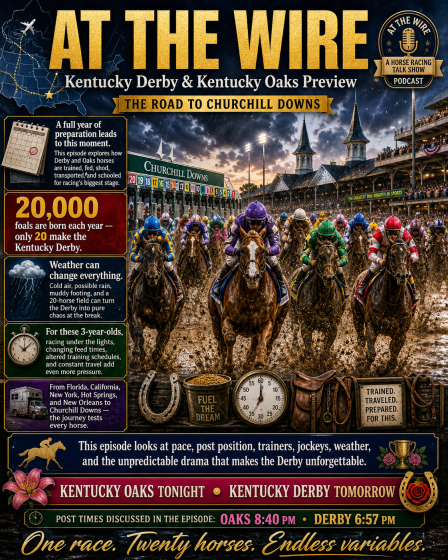

At The Wire with Scott Miller
The Road to the Wire: 2026 Kentucky Derby and Oaks Preview
At The Wire: 2026 Derby Preview
Expert analysis on the Kentucky Derby & Oaks: From the dirt to the lights.
Core Editorial Analysis
"You’re selling potential. You don’t sell the flash or the shoes... theoretically, if you breed the best to the best, you get the best, but that’s not a rule of thumb."
Churchill low of 39°F. Rain (30%) acts as a "schooling" tool for seasoned horses.
Described as a "train wreck" at the gate; jockeys must fight for a clean break.
Strategic Shifts
- ✦Under the Lights: First time Oaks/Derby are late evening; horses waking at 4:30 AM to adjust.
- ✦The #1 Post: Often feared, but allows the horse to stay inside while the field bunches outside.
- ✦Media Wars: NBC rights vs. the push for multi-platform (mobile/podcast) global exposure.
By The Numbers
$50,000: Combined entry & starting fee.
Ones to Watch
Kentucky Oaks Picks
2. Aunty Annie
3. Search Party
This document summarizes the veteran horseman's perspective on the upcoming Kentucky Derby and Kentucky Oaks. It covers the grueling journey of three-year-old thoroughbreds, the impact of environmental shifts, and an analysis of the key contenders in the 2026 field.
Detailed Summary
The Grueling Path to Churchill Downs
Getting a horse to the Kentucky Derby is a statistical anomaly and a testament to endurance. Out of approximately 20,000 foals born annually, only 20 make it to the starting gate. These three-year-olds undergo a rigorous year of development, adjusting to constant travel via van and plane, changing shoeing needs, and strict feeding schedules. The transition from a young foal to a Derby contender requires surviving a "short lifespan" of intense preparation where the odds are stacked against them from the beginning.
🏆 Race Schedule & Stakes
Kentucky OaksTonight
Kentucky DerbyTomorrow
Total PurseDerby Stakes
Environmental Factors and Operational Shifts
Weather is the most critical variable in a horse’s life, acting as a "great equalizer" on race day. This year, horses like the favorite, Renegade, are facing a significant "shock" moving from 75-degree dry weather in Florida to 39-degree lows and potential rain in Kentucky. Furthermore, for the first time, both the Oaks and the Derby will be held under the lights in the late evening. To adapt, trainers have been waking horses at 4:30 AM to simulate racing conditions, disrupting their natural habits and feeding internal clocks.
The Chaos of the 20-Horse Field
The Kentucky Derby starting gate is described as a "train wreck" due to the sheer volume of 20 horses competing for position. Success often depends on a "clean break" and the jockey's ability to find an opening, much like the historic rail-run by Mine That Bird. While pedigree and "potential" are what owners sell, the race often rewards underdogs like Rich Strike who can navigate the traffic. The speaker notes that while the #1 post is often criticized, it can be advantageous if the pace is fast, allowing the horse to save ground on the rail while others bunch up outside.
🐎 Key Contenders to Watch
| Horse | Trainer | Note |
|---|---|---|
| Renegade | Todd Pletcher | Derby Favorite; #1 Post |
| Danden Bourbon | Japanese Team | International Threat |
| Zainy | Todd Pletcher | Strong Winter Training |
| Search Party | Bob Baffert | High Quality Mare |
Media Dynamics and Industry Exposure
The horse racing industry is currently navigating "TV wars," specifically regarding NBC's exclusive rights versus the need for broader digital exposure. There is a push to make racing accessible via cell phones, computers, and international networks like BBS (reaching 24 countries) to attract new fans. The philosophy is to move away from limited single-outlet coverage to a "one-click" accessibility model to maximize the "potential" that the industry sells to its clients.
Key Data
- Derby Field Size: 20 horses.
- Financials: $5,000,000 purse, $25,000 entry fee + $25,000 starting fee ($50,000 total purse per horst).
- Post Times: Oaks at 8:40 PM; Derby at 6:57 PM.
- Weather Forecast: Low of 39°F, High of 62°F, 30% chance of rain at Churchill Downs.
To-Do / Next Steps
- Listeners should tune into the Kentucky Oaks this evening at 8:40 PM on the MSM Equine Network or NBC outlets.
- Visit the BBS Radio TV website to explore international racing content and distribution.
- Watch the 15-minute video "What Happened to the Derby Horses?" located at the bottom of the speaker's website to see the post-race careers of former contenders.
- Check the website tomorrow for a 24/7 live stream of the Derby proceedings.
Conclusion
The 2026 Kentucky Derby and Oaks represent a significant shift in tradition with the introduction of night racing and the continued influence of international contenders like the Japanese-trained Danden Bourbon. While the favorites like Renegade hold strong positions, the unpredictable nature of the weather and the 20-horse "train wreck" ensure that, as history has shown with Rich Strike and Mine That Bird, anyone in the field has a shot at glory.
At The Wire
Reporting on The Thoroughbred industry!
If you’re captivated by the power and grace of horses, there’s a thrilling world waiting for you—horse racing like you’ve never seen it before.
Step into the heart-pounding excitement of equestrian sports with Scott Miller, your ultimate guide to everything from the latest international racing headlines to the untold stories behind the track. Whether you're new to the sport or a lifelong fan, this program dives deep into the magic and mystery that makes horse racing one of the most exhilarating spectacles on Earth.
Discover what truly sets a champion horse apart, explore the secrets behind elite training for both standardbreds and thoroughbreds, and meet the legendary handlers and jockeys shaping the sport. Uncover the rich history, the art and science of breeding, and insider tips that could turn you into a savvy bettor.
With behind-the-scenes access and expert insight, this show brings you closer to the action than ever before. Curious? Saddle up—because this ride is just getting started.
[00:05] Speaker 1: Yeah. This is where it begins. (rock music) Hey, hey, hey. From the starting gate, to the final stride. Feel the rush as the champions ride. Every heartbeat's a Durham Pond call. One shot glory (glory) . Winner takes all. From the dirt to the lights. Hear the crowd roar higher. Every second burning, closer to the wire. At the wire. Where the fastest hearts collide. At the wire. Feel the thunder come alive. You're riding. At the wire.
[01:00] Speaker 2: Well, guys, we're at the wire. It's been a whole year we've been working on this project, the Kentucky Derby and the Kentucky Oaks. The Kentucky Oaks is gonna be this evening. You'll be able to see here on any, on MSM Equine Network. Uh, post time for that will be, uh, what, Nick? 8:40. 8:40 for the Kentucky Der- uh, for the Kentucky Oaks. 6:57 tomorrow night for the Kentucky Derby. Um, you know, all, all year long we've been talking about how, how they get there, the horses get there. We've been talking about, um, you know, how they get shoes, uh, how they get fed, how they get transported. Um, you know, we've gone all over that all year long. And, and it's a unique situation. From a two-year-old up, they're, they're starting to grow and they're getting used to different things usually every week. Uh, they get used to sh- traveling on a, on a van. They get used to traveling on an airplane, um, from track to track. Uh, they get used to a lot of things, you know, that, um ...
[02:12] Speaker 2: H- and just the short lifespan. And, and that's the thing that's most unique about them to get them to the Kentucky Derby is they go through so much, you know, and if they survive and they... then, you know, you got your horse in the Kentucky Derby. 20,000 foals are born a year and only 20 of them make it to the Kentucky Derby. So let this show you that the odds are, you know, against them from the get-go. And one of the things that, um, you know, I've talked ... And I, I'm a big, big fan on this. Um, I'm, I'm a fan of weather. I love the weather because the weather controls so many things that you do. Um, for example, it's been raining a little bit in Kentucky. You got a muddy track. Um, it's been dry here in Florida, it's been dry in California, so you got good tracks. But when it comes to the derby, when you get there, everybody gets dealt the same hand whether it's, um, dry, hot, cold, um, you know? Weather, uh, is the most important thing in a horse's life.
[03:18] Speaker 2: For example, uh, the low is going to be in Churchill, uh, 39 and the high is going to be 62. 30% chance of rain. So, you know, they're all in the same boat and they're not used to it. Uh, we sent a horse called Renegade, which is the favorite for the derby, up to Churchill the other day, and he left 75 degree weather dry. He gets to Kentucky and he's looking at, uh, 62 and 39 degrees and the possibility of rain. So all year long, these horses have been going through the paces, uh, dealing with the weather, and that all helps school them. So, you know, the guys that got, got the rain this year, it's good for them because they're schooled a- and they can handle anything. So, you know, that's one of the important factors of the Kentucky Derby. Um, the second factor is, is that there's a 20 horse field, um, when you got 20 horses coming out at the starting gate, well, i- i- it's ... it's ... let me tell you, it's a train wreck.
[04:26] Speaker 2: Uh, you don't know who's gonna go right, left, who's gonna stop, who's gonna start, um, you know, who's gonna try to run off with it. There's just so many things, you know, that are involved and, and the jockeys have to deal with. And hopefully everybody gets a clean break and they can find their positions along the way. And when they hit the head of the stretch at Churchill for the second time, you know, the jockeys will be in control and it could be like they did, uh ... Catlin Morrell did with the big, uh, Big Bird. Uh, I mean Mine That Bird. Um, Mine That Bird come up the rail and he just flew. An opening came up, you know, and then, I mean, i- i- it was unbelievable. And those, those are the kind of things that, um, you know, you look for in a Kentucky Derby. Uh, you know, it's gonna be interesting to see what happens, you know, with the weather and everything. And then for the first time that they're gonna have, uh, the derby i- in the Oaks are gonna be under the lights.
[05:24] Speaker 2: It's gonna be in the late evening. Um, uh, post time, l- like I said, for, uh, for the Oaks today, uh, it's going to be 8:40 and, uh, uh, the Derby is 6:57. And so it's gonna be interesting to see, you know, how they adjust to it. And, and a lot of the trends, you know, this week and the last couple weeks have been, um, uh, get them up at 4:30 in the morning. Normally they're up, uh, you know, 5:00, 5:30 and they're going out to the track. Well, they've been going out to the track at 4:30 in the morning just so they can have them under the lights.And, uh, that, you know, that helps. But that, that changes their whole system up, um, because crea- horses are creatures of habit, and they're used to eating at, like say, at 5:30 in the morning, you know, and at 5:30 at night, we'll say. Then they get a little feed in the middle of the night. Well, that, that clock is all changed around to different, different times.
[06:29] Speaker 2: And, and it's really tough on a horse, you know, to get, get out of that habit. You just can't, you know, get him out of a habit in a week's time. And, and that's what's gonna be interesting about this derby. You got, you got, uh, uh, the racing under the lights, training hours are different, um, feed times are different. Uh, you know, it's a whole, whole new ball game for them. You gotta think, the- these are just three-year-olds. And, and the three... and from the time they hit the ground, uh, and then, you know, they go through all the things, getting used to breaking them to saddles, uh, training them, uh, traveling with them, uh, doing their feed with them, their shoes. Everything changes for them, you know, and it, it's hard to throw all that at a young, uh, animal like that, uh, just to see how they do. But they survive. They adjust to it, a- and that's the good thing about it. Now, we've got a 20-horse field, uh, this year.
[07:29] Speaker 2: And let me tell you something, these horses have been all over the country two to three times, you know, from Florida to, to, uh, California, from, to New York to Hot Springs to New Orleans. Uh, these horses have been on the road. You know, that's tough. And it takes a toll on them, uh, you know, all these horses. It's some of your good trainers you have to, you know, look at in the derby. Can they get horses to recover from everything that they do? And we've got a bunch of them in here this year that they know how to keep them, you know, in shape and, you know, well-adjusted. Uh, you know, that, that's the big thing here. Then you've got 20 horses coming out of the gate. Uh, you got some that are gonna have speed, some that are gonna take back and, you know, uh, let them get in front of them, see how they, how they go. Uh, there's just so many things, you know, that we're looking at this year. And this one, me, as a horseman for over 50 years now, I've decided to not pick a winner.
[08:30] Speaker 2: (laughs) And I kinda laugh at myself for that. But that, I'm an educated horseman. I got book learning, and I got barn learning, and I got track learning. And, and I'm just telling you, it's gonna be one of the 20. I guarantee you, it'll be one of the 20 horses will win that race tomorrow. So having said that, uh, you know, you gotta start looking at the trainers. The trainers that are really seasoned, and, you know, a guy like Billy Martin said, you know, he's been there, done that. Todd Pletcher, same thing. Chad Brown's, you know, on his way through. Uh, you know, uh, Br- uh, Brad Cox. Uh, there, there's just a lot of them. So, you know, you can't really sit down and say, "Okay, here's what they did over the, you know, over the last year of racing." And say, "Okay, here's my check marks. Uh," (laughs) you know? Uh, "This one should win." If it was that easy, everybody would be gambling. You know, and they would be winning and all.
[09:28] Speaker 2: So that, that's the whole, uh, short story, or actually long story, uh, of the derby this year. Uh, we've got some good horses, good trainers, good jockeys. You know, and somebody is gonna make a name for themselves. It might be somebody like a Todd Pletcher that has won, won the derby before. It might be like Billy Martin. You know, or it could be, uh, you know, a, a host of others that are in there. Uh, the jockeys have really good mounts this year. Um, and that, that's what I play the, uh, you know, kind of thought about, you know, what jockeys to what horses. And, uh, they all seem to fit in, in all the work. But, um, you know, just for example, we got Bob Baffert, Todd Pletcher, Mark Casse, Mark Casse, McCarthy, uh, Sophie Joseph, um, Rosso, Baffert, Brown, Potts, um, we got, uh, Colebrook, uh, Walsh, uh, McCarthy again. Uh, you know, we got a lot of good trainers. And, and it's gonna be interesting to see how this all comes out.
[10:35] Speaker 2: Um, I'm telling you, I've never seen anything like it in all my life. You know, with all these good trainers that are here. Uh, some of them came to Churchill early. They were at Keeneland. Some of them stayed, you know, in Florida, like T- Todd stayed down here with Renegade at our Palm Beach Downs farm. Um, four days ago, he left. And, and so he went up. You know, he's gonna be in shock because he used to be in all, you know, the nice hot weather down here and, you know, and training at a regular time and, and all. But that's gonna be a shock for him when he gets up there, you know, to hit the cold weather and, you know, the rain, and, you know. Who knows, it could be 60 or 70 degrees, you know, on derby day. You never can tell about the derby. But it's a $5, uh, million purse, it's one of mile and a quarter on the dirt with three-year-olds, with an entry fee of $25,000 each, and a starting fee of $25,000. So to run in the derby, it's gonna cost you $50,000 to run into the derby.
[11:39] Speaker 2: That's a lot of money, you know, and you gotta be sure, be confident that your horse can win. And that, that's what, um, I think is kind of odd about it. I, I, I usually play, in, in like, uh, how they get in their little show that we do. Um, I, I, I kind of tend to go along with the owners. There's a lot of owners that have been around, uh, you know, really, really a long time and there're own- owners that are new to the game. And some of these old-timers, you know, they get in there and, you know, they always ask-Like Mr. Jones used to ask me, uh, before the '91 Kentucky Derby, we had a horse called Paul, and he was an Indiana bred. And he said, "Scotty," he said, "Is, is Paulus gonna be a family pet or a derby threat?" And I said, "I don't know, Mr. Jones." I said, "We don't know until we get there." And so, um, Sugar Nagay he was training, and there's four weeks before the derby, we're getting into April, and we really needed one more race with Paulus.
[12:45] Speaker 2: He had, he had done pretty good, you know, leading up to that point. And we couldn't f- find a race or anything, so I found, uh, a race, uh, called the Franklin Handicap down at, um, uh, Kentucky Downs. It was a mile and a half on the turf against older horses. So I told, I told Shug, and I told, uh, um, Mr. Jones, I said, "Hey," I said, "Here's a race." They just kind of laughed and blew it off, and then next thing you know, you know, they enter, entered him into the race, mile and a half against older horses, which nobody had ever done before in the Kentucky Derby. No three year old had ever run a mile and a quarter unflozen before in the Kentucky Derby, except for Paulus, and, and a horse called Cannonade from South America. Um, he, he ran a mile and a quarter, and, and did really good, and he ran in the derby, and, you know, he was, he was good horse. But Paulie beats him by six and a half lengths.
[13:48] Speaker 2: And we're sitting there thinking that, "Hey, maybe we got one shot at the derby with this here one." So long story short, we ran in the derby and he ran fifth, and he got beat and banged up pretty good, you know, for the two. Which, that wasn't an excuse, but, you know, at least it, it, it goes to show you that you don't have to stick with the rule of thumb. Uh, how they get there, they get there in their own way, uh, you know, whether it's on the grass or whether it's on the dirt, uh, long, short, you know, traveling all over, you know? But that's the unique thing about the Kentucky Derby, you know, or the Belmont or the Preakness, everybody gets there in a different way, in their own way, and that's what we try to do, you know, here, talk about is the things that happened to them and how they get them.
[14:34] Speaker 2: Um, you know, sometimes superstition plays a lot of part in it, uh, you know, they, they get into a pattern, well, okay, you know, every fourth week they get their shoes on a Thursday, you know, and their shoes on a Thursday, you know. Um, but that's not saying you have to do that, but, you know, it's a superstition some people have. And so the main thing that I'm trying to say is, is that there's no really set way to get to the Kentucky Derby. Um, I remember one time, um, a question was asked to Woody Stephens, said, "Woody, how did you win five Belmonts in a row?" And he (laughs) he said, "You know, if I knew how to ride out the five Belmonts in a row," he said, "I'd write a book and everybody be training horses trying to win, win the Belmont Stakes." You know, so you just, you never really can tell, you know, about in this day and age, this modern day and age, you know, that type...
[15:33] Speaker 2: Um, one of the things that, um, that we were talking about this morning in the barn, uh, we were talking about, um, the TV coverage. Now all of a sudden, there's TV and radio coverage, podcast coverages like we're doing here all over the world, you know. It's what I like about BBS, 24 stations they go to, you know, there, there's nobody that we can't reach. So, you know, so it throws it back on us, how do we market our program, you know? Do we go into, you know, uh, uh, iHeartRadio, uh, you know, there's so many ways that you can get it with BBS, it is, you know, it, it becomes another project altogether, you know, and so that's what we're trying to do. Big TV wars for today. Uh, NBC, they've got the rights to, um, the Kentucky Derby, and so they don't like having other people, you know, doing their programming.
[16:29] Speaker 2: And so that, that tend- has become an issue, uh, you know, with them, and Churchill Downs is right in the middle of it, you know, and so, um, uh, it's gonna be interesting to see how it works out. But there's a lot of ways that you can get it other than just on NBC, that's why the horse people are trying to get away from. We want to be able to get horse racing on as many outlets as we possibly can, whether it's on a cell phone, a computer, you know, a TV, local, national, international. You know, that's the name of the game is try to expand the opportunity for us to get new fans to the business. And the only way we can do that is through all the various means that I just talked about, you know, we need to do that. If you lim- limit yourself to just one company like NBC, then you're in trouble, you know, because NBC doesn't cover, you know, a lot of places that you can get it from.
[17:27] Speaker 2: I, I remember growing up, we'd be out in the barn, and every day at 4:30 we would, uh, get on the radio and we would listen to, uh, the featured race from, uh, Keeneland, you know, we would do that, and then hopefully wherever you lived at, you'd had a station that would cover horse racing, you know, from, um, you know, wherever it was coming from, like the featured race, that was the big thing is, you know, did, did they cover the featured race? And, and most of them didn't, you know, back in the day you had, you know, ABC, NBC and CBS and that was it. Then FOX came along, and then they started fighting for it, so there was a lot of areas that you couldn't get FOX, you know, or NBC or what have you, you know, and it, it was trou-You know, so that, that's what we're trying to do here. We're trying to get everything we can squeezed into my website so that one click will get you right to it. Now for the most part, I can do that.
[18:27] Speaker 2: You know, for the mar- most part I can do that, because I've gotten with the, all the different race tracks and said, "Hey, look," you know, said, "What can we do?" You know. "Can we go ahead and put this up for distribution?" And I don't charge them for that, for that. You know, because the whole name of the game is getting exposure to your product. The more expro- exposure you can get, the better off you are. Now, like I said, you know, with BBS, that's 24 countries right there. I'm not saying that all 24 are gonna be listening to us, but it's the potential. And that's one thing that people don't understand about the horse business. You sell potential. You don't sell the flash or the shoes or the hooves or, you know, or the whole horse. You're selling potential. You know, theoretically if you breed a Secretary to a grade one mare, theoretically, you know, you've got a, a better shot at winning a big race, or going to the derby, or to the Oaks. But that's not true.
[19:29] Speaker 2: If you breed the best of the best you're supposed to get the best, but that don't happen all the time. That's not a, that's not a rule of thumb. You know. The potential is there, and that's wha- what I try to tell people, my clients that we have here in South Florida. You're selling potential. You know, you're selling potential. And when you do that, you know, then you got something. And the key of it, and the key to it then is to make sure that the horses you breed need to have good potential and come out running. You know, that, that's what you're hoping for, but that usually doesn't happen that way. Um, uh, for example, there was, uh, a horse called Rich Strike. He wasn't bred very well. Al- almost didn't get into the derby. Um, they had a couple scratches that came out. Rich Strike got into the derby, and, uh, you know, kind of a small, uh, you know, little horse. Didn't look all that great, you know. He was glad to be at the party.
[20:34] Speaker 2: And next thing you know, they spring the gate and he's weaving his way in and out, you know, through the track. He gets down to the rail and next thing you know, he wins the derby. And there's people that spent millions of dollars, you know, on their horses that they bought and trained, and you know, ha- had the best specimen out there, the best bloodline, the best jockey, the best trainer. You know, and suddenly outta nowhere Rich Strike comes up and wins the derby. You know, and (laughs) people scratching their heads saying, "How could that happen?" And the same thing happened again, you know, a few years before that with a horse called Mine That Bird. Uh, he come out of the Southwest. He didn't have a gr- a lot of credentials. Uh, he, he, he got into the derby, and next thing you know they were all fighting to get to the lead and there's a big pass and next thing you know, Mine That Bird comes up the rail and he wins the derby.
[21:28] Speaker 2: Again, people are scratching their heads saying, "How did that happen?" You know. And, and if you got the best jockey, the best trainer, the best groom, the best hot walker, the best e- exercise rider, you know, the best owner, uh, the best trainer, that don't mean you're gonna win the derby. All's it means is it gives, it enhances your chances of winning the derby. But see, people haven't realized that, you know, uh, uh, about horsery. Um, you do everything you can to get your horse there, uh, by doing all the things that we just said. And hopefully, you know, your horse will win the derby. You know, or will do- have a good racing career. Uh, but that, that doesn't mean anything. And, and on, on my website there, if you go to the bottom down there, we've got a little, uh, video, about 15 minutes long I think it is. And it's, says, "What Happened to the, to the Derby Horses?" You know, and we go back and look at, you know, a few derby horses, where they're at and what they're doing.
[22:27] Speaker 2: Um, did they become stallions? Did they, uh, um, you know, grow to be a show horse just on the farm, or, you know, uh, w- what are, what are they, you know, they would do now? Um, I remember there was a horse called Moment of Hope, um, who, who showed in the Olympics, thoroughbred. Um, he showed in the Olympics, uh, he, uh, did hunt- he was a hunter jumper. Um, he trailed ride, did, did all, you know, a lot of show horses and everything, and he, he just, you know, he just couldn't, uh, stand having nothing to do because all his life all's he did was train, and, you know, work every day. And so, it just goes to show you that who would ever have thought, you know, an ex-racehorse, you know, would come out and be, you know, something as good as he was in all areas. But that happens. You know, so tomorrow, uh, on the Kentucky Derby we're sitting there thinking about, "Oh boy, that's gonna be good." Well, tonight we got the Kentucky Oaks.
[23:28] Speaker 2: Uh, we've got the Kentucky Oaks, uh, tonight at 8:40 PM. Um, there's a lot of nice horses in there. Uh, you know, it's, it's gotta be one of them. My dad always said, he's, "Oh boy," he said, "I'm gonna tell you something." He said, "I guarantee you one thing about that derby this year." I said, "All right, Dad, what's that?" "You know all," he said. "It's gonna be one off." So that was kind of a family joke that we had, and we'd go around talking about, you know. Uh, but there's a good horse in here we called Zainy. That's a Todd Pletcher horse, we had that here at Palm Beach now. And, uh, that horse trained good all, all winter long. It was re- really good, uh, went through a lot of weather, a lot of ups and downs, and he came through like there was no tomorrow. And, uh, so I, I like that horse, Zainy. And then, uh, Esquire, uh, from Bob Baffler.... it's a well-skoked source. It's got Gravely and Pratt on it, and I mean that horse could flat-out run.
[24:25] Speaker 2: Uh, you know, it's a Bob Backer party, and, and it's gonna be there. Uh, and who ... This is a horse that I, I don't know how good this, this horse is, but this horse is showing all indications of being a, a quality, you know, mare. Um, her name's Search Party. Uh, uh, and, and that horse can flat-out run. Um, you know, so that's gonna be interesting to see what happens with that. But, uh, those are my three picks, uh, that's Explorer, Aunty Annie, and Search Party. I, you know, I think they'll be all right there. But then that's the post time at 6:40 tonight, and it's on NBC, uh, or, uh, one of the NBC outlets. So there, you might be, you'll be able to see it on, on our website here also, 'cause our website's 24/7. Then as far as the derby goes tomorrow, uh, like I said, I can't, I can't pick out one. I'd like to see Renegade win it. Uh, Todd Pletcher and Mike Repole, they're hard workers, and they're always there with it.
[25:29] Speaker 2: Um, you know, I just don't know, you know, what the weather's gonna be like, a 20 horse field, uh, you know, if it's muddy or an off track. You got horses trying to find their footing. Some of them don't like it, you know, and then, then it makes it tough. But, uh, Renegade, uh, he's, he's breaking from the number one post, and there, and his whole theory is, is you're going from the number one post, you're not gonna do anything. Well, I like the number one post, and I'll tell you why. The number one post allows all the horses from the outside to go forward and group up and, and, you know, they're fighting and banging with each other. Uh, they've run a little bit further because they're coming from the outside to the inside. And Renegade will be on the inside, uh, you know, rail there, and he, he'll have a chance to take a look at it, uh, you know, I, I said that that's, uh, that's gonna be interesting to see.
[26:24] Speaker 2: You know, he can let it all fall in front of him, and then he can, kind of, pick and choose who's, you know, he's way up there. Now, the only thing that, that would hurt him from coming that one post, is if they hit a very slow pace. If they get a slow pace, then he ain't gonna make the race. If they get a fast pace, that would be better for him because it, it tends the group out, it spreads them out. Slow pace punches them up, fast pace spreads them out. So that's one of the good things about the, the number one hole right there. Um, there's another horse in here that, uh, Jeff Relles has, and, and he's called Intrepido. Uh, I like that horse. Uh, he seems to be a good California horse. Uh, you know, and, and like I said, it could be, uh, Commandment, um, for Brad Cox. That's a nice horse. Uh, you know, he's pretty good. Then I'll tell you one thing, y- y- that I think's gonna surprise a lot of people, is Danden Bourbon.
[27:22] Speaker 2: Uh, he's a Japanese horse, and this horse has showed all the indications at trainings in the morning that, uh, he was trained here in America but he was in Japan. And I think right now that the Japanese have got a good lock on how to, uh, you know, get these horses trained up for the derby, and they're getting more international recognition, and they're, they're getting Americanized. And I always said once the Japanese get Americanized, then boy, Katie, bar the door, because they're gonna be coming in here and taking races right and left. Uh, you know, that'll be for sure. But, um, you know, that's the way I look at the derby. Uh, it's one day, two hours, 59 minutes and 56 seconds away. Uh, you know, we're, we'll get there. But, um, to all my, my listeners out there, I like, I like having no listeners with me on the line, because you got no critics. (laughs) That's what I like. (laughs) Nobody walks out of here, "Yeah, I'm, I'm a radio TV host, uh, out there.
[28:27] Speaker 2: Never had a complaint from any of my critics." (laughs) And that makes my day. That makes my day, for sure. But guys, go to BBS Radio TV and look at all the things they got on there. They got all kinds of things on there now from, from all over the world. And, uh, things you didn't even know about. Uh, but they got it. And, uh, just call them at the station and tell them, "Where can I get this?" You know, but, uh, you can do, you can do that. So folks, I'll talk to you next Friday, and we'll tell you who's crying in your beer and who's, you know, high and drinking champagne. So have a great weekend, God bless everybody, and go to the races.
[29:21] Speaker 1: From the stories told to the races won. Every journey ends where it all begun. Legends run but the track remains. Echoes of glory in the rains. Through the dust and the dreams. Through the fire and flame. Every finish line remembers your name. At the wire. Where the spirit never died. At the wire. See the truth in every stride. We'll see you at the wire.