
At The Wire, April 24, 2026


At The Wire with Scott Miller
Chasing the Roses: The Road to the 152nd Kentucky Derby
At The Wire: 152nd Kentucky Derby
#Derby2026
Comprehensive Analysis of the Road to Churchill Downs & Triple Crown Strategy
- Post Position Draw April 25
- Kentucky Oaks May 1
- 152nd Derby Post May 2, 6:57 PM
Kentucky Derby
1.25 miles. The "Point System" hurdle.
Preakness Stakes
4 weeks later. The value-add race.
Belmont Stakes
1.5 miles. A "different training regime."
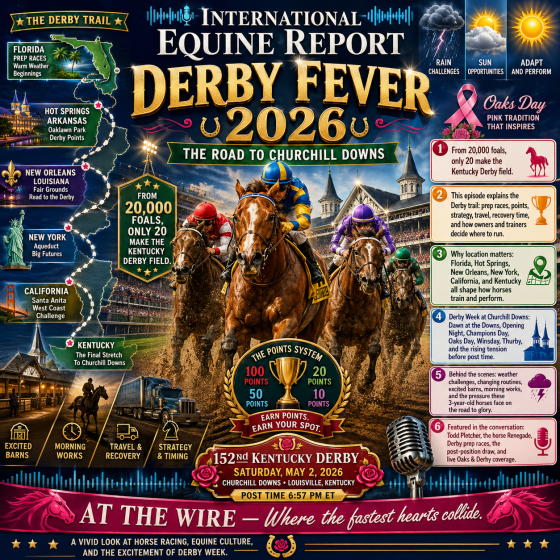
This episode of At The Wire provides a comprehensive look at the final preparations for the 2026 Kentucky Derby. It explores the rigorous qualification process, the psychological and environmental factors affecting elite thoroughbreds, and the full schedule of festivities leading up to the "Greatest Two Minutes in Sports."
The Road to the Starting Gate
The journey to the Kentucky Derby is a grueling selection process where only 20 horses emerge from an annual crop of approximately 20,000 foals. Owners and trainers must strategically navigate a nationwide point system, competing in key races across Arkansas, Louisiana, New York, and California. This "Derby Trail" requires a delicate balance: earning enough points to qualify without overworking the horse before the main event. Training environments play a crucial role; while Florida-based operations benefit from consistent weather, other regions often face disruptions like the recent lightning delays in Hot Springs, which can break a horse's habit-driven routine.
🏇 Derby Week 2026 Highlights
Psychological Dynamics and the Triple Crown Strategy
As Derby Week approaches, the atmosphere in the barns at Churchill Downs becomes electric. Horses, being highly sensitive creatures, often mirror the tension and excitement of their grooms, jockeys, and trainers. Beyond the Derby, elite teams are already calculating moves for the Triple Crown. This involves planning for the Preakness Stakes just four weeks later and the grueling 1.5-mile Belmont Stakes. Trainers face immense pressure from owners to maintain a "winning resume" for future breeding prospects, even when the physical toll on a three-year-old horse can be "wicked scary".
Beyond the Racetrack: Equine Versatility
The narrative of the thoroughbred extends past the finish line, as illustrated by the story of "Collins." After a successful racing career that included a rare victory against older horses in a 1.5-mile handicap, Collins transitioned into a second career in steeplechase and foxhunting. This highlights the "creature of habit" nature of horses; many elite athletes require constant activity and purpose even after retiring from the flat track.
• Broadcast: Peacock, MSNBC, IEN, MSN Equine
Key Data
- The Field: 20 horses selected from 20,000 annual foals.
- Prize Money: $5 million total purse, with $3.1 million guaranteed to the winner.
- Broadcast Schedule: Undercard coverage begins at 12:00 PM ET; Derby post time is set for 6:57 PM ET.
- Preparation: 21 prep races are tracked leading up to the event, starting as early as the previous September.
To-Do / Next Steps
- Follow the official post-position condition draw this Saturday, April 25th, 2026.
- Visit
msmequine.comto watch the "Morning Works" show and live race coverage. - Check local listings for equine events, horse shows, or tack shops in your area to engage with the sport.
- Watch the "Dawn at the Downs" and "Kentucky Burgoo" segments on the International Equine Network for cultural insights.
Conclusion
The 152nd Kentucky Derby is more than a race; it is the culmination of a year-long strategic journey involving precise training, environmental adaptation, and high-stakes management. Whether through the $5 million purse or the deep-rooted traditions like the PINK walk, the event remains a pinnacle of equine excellence and community celebration.
At The Wire
Reporting on The Thoroughbred industry!
If you’re captivated by the power and grace of horses, there’s a thrilling world waiting for you—horse racing like you’ve never seen it before.
Step into the heart-pounding excitement of equestrian sports with Scott Miller, your ultimate guide to everything from the latest international racing headlines to the untold stories behind the track. Whether you're new to the sport or a lifelong fan, this program dives deep into the magic and mystery that makes horse racing one of the most exhilarating spectacles on Earth.
Discover what truly sets a champion horse apart, explore the secrets behind elite training for both standardbreds and thoroughbreds, and meet the legendary handlers and jockeys shaping the sport. Uncover the rich history, the art and science of breeding, and insider tips that could turn you into a savvy bettor.
With behind-the-scenes access and expert insight, this show brings you closer to the action than ever before. Curious? Saddle up—because this ride is just getting started.
[00:05] Speaker 1: Yeah. This is where it begins. (upbeat music plays) Hey, hey, hey. From the starting gate to the final stride. Feel the rush as the champions ride. Every heartbeat's a Durham Pond call. One shot glory (glory) , winner takes all. From the dirt to the lights, hear the crowd roar higher. Every second burning, closer to the wire. At the wire. Where the fastest hearts collide. At the wire. Feel the thunder come alive. You're riding at the wire.
[00:59] Speaker 2: Well, horsemen, it's Derby time. It's Derby time. Seems like it's this last year that we had the Derby, wasn't it? Well, we got a lot of good things going on here at, uh, International Equine Network. Um, one of our clients that we have, Todd Pletcher, we just got, um, Renegade, he's one of the top horses ready for the Derby this year, he, uh, he left this morning and went up. So, um, you know, we're hoping that that's gonna be good, hope we have good, good vibes for him. He, he's in good shape, um, he traveled well, you know, it's, it's really good. But, um, you know, uh, like I was saying before, all, all year long we've been talking about, you know, how you get to the Kentucky Derby. Well, there's, there's a lot of ways you can get to the Kentucky Derby.
[01:48] Speaker 2: Uh, you know, there's a lot of races that are coming along that we go through, and, and j- just to give you an example, some of the races that we have here, um, you know, they're in Hot Springs, they're at, uh, New Orleans in the Fairgrounds, uh, they're in New York, they're in California, uh, you know, they're just all over, scattered all over the country. You have a point system that you have to get to, and, um, y- you earn enough points and you get into the Derby, because only out of 20,000 foals a year only 20 can get into the Derby, and, um, you know, that's just a real, (laughs) you know, that's just a, uh, when you look at the odds of that, uh, the odds of winning, you know, getting in the Derby, you know, are tougher than the odds of winning the Derby. And people really don't understand, you know, just how that point system goes.
[02:40] Speaker 2: Well, they get certain number of points, um, from running in the races, uh, that they run in, uh, you know, all over the country, and, and the, the hard part about it is you gotta, you gotta kinda figure out where you wanna go, you know, with your horse as an owner and a trainer. Um, y- you gotta get the points, but you don't wanna beat your horse up getting them, you know, by running against, uh, you know, usually the elite, uh, you know, week in and week out. That's, that's, the other part about it is, is you know, where do you run, how do you get your points, uh, where are you going, you know, with them and everything until the... The thing that always, uh, kind of, uh, made me wonder is, uh, why, why do you go where you go?
[03:24] Speaker 3: Mm.
[03:24] Speaker 2: You know, that, that's like me, for example. Uh, we're, we're a, a Florida-based operation, and we spend about eight months out of the year racing in Florida, and then we, uh, we got, um, like 126 horses that, that are training here, and then there's Palmettos, and they got like well over 500 over there. So you got, you got a good portion o- of your thoroughbred, your three-year-olds running here in South Florida. Uh, of course we got Tampa, we got Gulfstream Park, and, and, you know, that's, that's how it goes. And the thing that I always wondered about is what makes the horses trained so good here. What makes it different than the horses in Hot Springs, or New Orleans, or California, Kentucky, or New York, or Arkansas? Uh, you know, uh, that, that's what we look at.
[04:17] Speaker 2: So come to find out horses are creatures of habit, and when they get a good go every day, you know, that's helped, but they also gotta, you know, take the weather into consideration, and, um, you know, I s- like for example, when they, uh, at Hot Springs, they had to cancel the second and third race because of the rain and lightning. You know, so a lot of trainers there that are getting ready for the Derby, if they're still in Hot Springs, that's what they're gonna be dealing with over the next few days, you know, is bad weather. And, and, uh, so that, that makes it tough. Then, you know, like with, with us here, sending horses late, you know, up to Church Hill, and they miss all the cold weather, and, you know, we're looking at 10 days away from the Kentucky Derby, and, and that's what, you know, uh, we're hoping for, you know, that, that we get good weather up there, you know, that, that's what everybody's looking for.
[05:11] Speaker 2: And, uh, you know, I, I just don't understand, you know, the whole game, t- you know of it, we know how to train horses, we know how to get them ready for the Derby, you know, but we're sitting here looking, you know, uh, at the Derby saying, "Oh my God, we're eight days, three hours, 24 minutes, and 27 seconds away from post time at Church Hill now." You know, and so we've kind of eliminated a lot of things with horses that are going up, the weather's been pretty good here, you know, of course you got n- eight days to deal with th- the weather that you're gonna deal with up there in Kentucky. Same thing if you're in California, or if you're in Hot Springs, or New Orleans, or wherever you're at, you got those eight days and you just hope the weather, you know, gets good, good for you.
[05:56] Speaker 2: So having said all that about the weather, like we've been talking about all year long-The statement that, um, uh, you know, we're going back to now, and, and this is what we look at now, and this is where, how we start for Derby 2027. Um, you know, and it's gonna be something interesting to see, start those two-year-olds running. Now you start plan, making your plans to get to Churchill and what all do you have to, have to go through. Now, I'll give you an example. Uh, all the owners and trainers and horses in Kentucky, Kentucky Derby Week 2026 runs from April 25th to May 2nd, culminating in, uh, 152nd Kentucky Derby at Churchill Downs. Now, now having said that is you're now interjecting the excitement around Churchill Downs, the excitement at the track. Every day there's something going on at the track. There's, uh, uh, Dawn at the Downs. Um, y- you got the morning work show. You know, you've got all these things that these horses have never been exposed to.
[07:02] Speaker 2: Now they've been ex- getting, you know, the real derby fever. They're, they're catching, catching onto it. And of course, you know, the grooms and the, and the owners and the trainers and everybody are into this. Um, opening night's the official kickoff to Derby Week, featuring, um, evening racing under the lights and a start of the festi- festivity. So the first opening day at Churchill is gonna be under the lights. So now these horses are starting to, you know, get into things that they've never seen before. Um, they got Champions Day, a focus on the top thoroughbred racing leading into the derby for serious fans. Um, you got some of the best horses in the world there at Churchill and they're gonna be racing in all the undercard there, so the quality is there. Um, the Oaks is gonna be, uh, Fri- on Friday, May 1st, 2026, showcases the top three-year-old fillies, includes the PINK tradition supporting breast cancer awareness.
[08:02] Speaker 2: So they have a, a breast cancer walk on the track, um, all the ladies that has survived b- breast cancer, they're gonna w- walk along the track and they, they generate a lot of money, you know, um, for that, for that cause. Um, so, and then, and then they've got Wins- Wednesday, W-I-N-S-D-A-Y, it's on Wednesday, and then they have Thirby. And these are special themed, um, nights with Churchill there, and, uh, it, and it truly amaze- makes things a lot interesting. Um, the Thirby is for, like, the locals. Uh, they get a lot of locals out there because I'll be honest with you, all the locals there, you know, they get all caught up in the hype and, and they like to stay home. They don't like to fight the crowd. They like to leave that for the out-of-towners. Um, then they've got their of- off-lunch and, uh, and this week, uh, y- you name it, they, they got it, uh, you know, all week long.
[09:02] Speaker 2: And, you know, so that all kind of incorporates into your, your daily routine that you're not normally used to. And, you know, you just can't help it, uh, the grooms and the hot walkers and the exercise riders and the owners and, and the trainers, they all get excited, you know, the jockeys, and, and it's just a whole different thing. And you bring that tension and that excitement into the barn with you every morning when you come in. You know, you can't help but bring it in with you. And, and that, that, you know, the horses sense that and they know something's going on, but they don't know when it's gonna go, you know? And, and it's gonna be, uh, you know, a week from this Saturday when, when it's gonna be. Um, you know, I, I, I hate to say this, but I remember back in the day, back in early '80 when, um, I, I was just getting onto the track, it was kind of exciting.
[09:57] Speaker 2: Uh, you know, I was all, uh, more excited about everything and, and, uh, I brought that into the barn with me, like everybody else does. You, you can't help it, you know, you, it, it comes in on you. It's like a cologne that you have on, it goes with you everywhere you go. And, uh, so the, the long and short of that is, is that the horses, you know, go through so much in their career. You gotta remember, these are just three-year-old horses. Um, you know, a, a year ago, they were just finding out what it's like to g- get roped to a saddle and to start training, you know? And, and now they've taken the next step. They're getting into serious racing, traveling all over the country and all over the world, uh, to go to, you know, to get to the Kentucky Derby, you know? So that's a whole new aspect, uh, of the training aspect of, uh, of our business.
[10:52] Speaker 2: You know, I, I tell you, the one thing that I, I think that, uh, a lot of trainers and a lot of owners, especially the trainers that are, haven't experienced, y- you know, a horse in the derby. Uh, you know, sure, they, they're good enough to get a horse to the derby, but the thing that they have to experience i- is what do you do? Who's your jockey? When do you go to church here? You know, uh, uh, what, what's, uh, uh, the whole plan, you know, to get into the derby? To get to the derby or to get into the derby? And, and the thing that now that people don't understand is, yeah, you, you've done a good job. You've got your horse from the owner to the derby and everything. But now you gotta start thinking about the Preakness. You gotta start thinking about the Preakness, because the Preakness is four weeks off. You know, it's, it's four weeks off. And sometimes the trainer has to come in and tell a, you know, tell an owner, say, "You know what?
[12:00] Speaker 2: This derby field's gonna be pretty brutal. Gonna be pretty, pretty tough. You know, we, we can get in there and hang in there."You know, and hopefully we have good luck and, and the good luck goes with us. And, uh, we can get to the wire and, you know, on Derby day first. So now, you know, the, the owner's saying, "What the heck?" You know, "I'm trying to get here to the derby." You know, but, uh, the Preakness is, is a very valuable race. If, if you can win the Preakness, that says a lot for your horse. Um, you know, you, you, if you get into the derby and you get beat and you're banged up and beat up, you know, then you gotta pass, pass the, uh, Preakness. And then, and then you got the Belmont, which is the third, you know, leg of the Triple Crown, and it's a mile and a half, you know. So, hey, what, what do you do? You know, it's a whole different training program for a mile and a half and, and that's, that's the tough, tough thing about it, you know?
[13:00] Speaker 2: And, um, you, you gotta look at that and, and, you know, there's all kinds of ways. I, I can talk to 100 people and they're gonna tell me 100 different, you know, stories about who they think is gonna win and why they think that horse is done with. You know, and then it comes up and you get in a field of 20, and depending on where you, you know, break from the gate, um, you know, it makes, it makes (laughs) a big difference, you know? And if you get your horse all beat up and banged up, you know, what, what in the heck are you gonna do? You know, you, you, then you gotta look at, at the Preakness and say, "Well, can," you know, "Did I get beat up bad enough that I can't get to the Preakness?" Well, you know, that's something that you don't know. You just don't know what's gonna happen and, um, you know, and it's just so many things that... You know, look at me, I've been, I've been in this all my life and I'm just rattling on, you know.
[13:53] Speaker 2: But the whole long and short of it is, is you've got a game plan when you start out. Like, for example, right now, there's a game plan for a lot of two-year-olds to get to the derby this year and they're on that game plan. And, um, you know, you gotta take into consideration their setback from injuries, you know, getting into the, you know, getting into training. Um, you know, it's the weather conditions. I'm always talking weather. Um, it's the weather condition that, uh, you ha- have to go through. Uh, there's just so many things that you gotta think about. Now, you know, right now, it- it's great to be thinking about the derby, but the, the trainer, the business part as a trainer right now is maintaining that horse at an even keel right now to get into the derby and win the derby. That's what, that's what his job is right now.
[14:50] Speaker 2: But in the back of his mind, he's also thinking like, you know, "What the heck am I gonna do, uh, if we don't run good?" And, and, and there it's a twofold thing. A lot of horses will win the derby, you know, or run good in the derby and then they'll skip over the Preakness and, and go to the Belmont. You know, they'll, they'll do that. But, you know, it's kinda tough to think, you know, like, okay, let's say we run good in the derby. Okay, great. Fine, let's say we won the derby. Great, fine. Now there's the added pressure of going to the Pimlico. You know, now you start thinking about the Preakness and, in your mind, in the back of your mind, you're also thinking about the Triple Crown. That's what you're thinking about, the Triple Crown. You know, can that be done? Well, you gotta get through the Preakness first. You won the Preakness and then you can really seriously think about the Triple Crown because the, uh, uh, Belmont, it's three weeks after the Preakness.
[15:52] Speaker 2: You know, so you're looking at a mile and a half. You know, your horse has probably never been that distance before. It's a whole different training regime. And again, uh, you know, you got the hoopla and the pageantry and the parades and everything, you know, for the Pr- uh, Belmont and, and that's, that's tough. You know, that's tough. So, you know what, let's kind of take a look at what I'm, what I'm talking about. You got a two-year-old right now. Okay, you're starting to think about the Kentucky Derby. You're starting to think about what that would mean to your, to your racing program, to your breeding program, uh, you know, everything. But see, that's another thing people don't realize is you've got to get a resume good, you know, for your horse to get to, uh, you know, the breeding shed.
[16:42] Speaker 2: So now there's so many things that you're putting in, you know, on these horses and, I mean, it's, it's just wicked scary, you know, for
[16:49] Speaker 4: Mm-hmm.
[16:50] Speaker 2: And, and the guy (laughs) that's stuck in the middle is the trainer because the owner is putting pressure on him to win the derby, putting pressure on him to win the Preakness, putting pressure on him to do a lot of things. And then now all of a sudden, you know, you're starting to think, "Well, maybe we'll have a, we'll have a, a Triple Crown winner, winner here." You know, that's, that's a very real possibility. So there's so many things that you gotta do and you gotta think about for, you know, the, uh, for the owner and for the trainer, for everybody involved. You know, it's a whole different ballgame and that, that's what I don't understand. And, and I'll, I'll never be able to understand this no matter how many years I'm in, in the, you know, uh, horse business. Uh, no matter how many horses have, you've been around. Um, it, it's gonna be interesting to see, you know, hey, what happens.
[17:44] Speaker 2: You know, what happens to some of these, you know, things that you plan, uh, till you get to where you need to go. Um, you know, it's just, it's awful tough. It's awful tough. (laughs) You know, I, I was just thinking about, uh, Mr. Warner Jones. Uh, we had a horse named Collins and, um, Collins was a, was a great horse. And, and when I say great, I don't... He was good on the track, better than most.But what I, the reason I say he was a great horse is he did something that nobody, uh, no other two, uh, three-year-old has ever done. Before the Kentucky Derby, he ran a mile and a quar- mile and a half in Franklin, in Tennessee, in a Franklin handicap in Kentucky and, and he won. It was against older horses. That had never been done before. And so now, you know, you're sitting there looking at him, and we went to the derby with him. And, uh, we got him into the derby, he ran fifth and he got hurt, and, you know, that was unfortunate.
[18:49] Speaker 2: But then we put him on the shelf and then he came back and, you know, he made some more money and then, ironic, he liked jumping fences. So, you- the owners took him to, uh, jump fences. He made, uh, just as much money jumping fences as he did on the racetrack. So everybody thought that was fantastic. And so, um, when he retired, uh, the owner took him out to his farm. (laughs) It was the oddest thing. Flawless needed to run. He needed to go do things. He just couldn't, uh, you know, do what, uh, he, he'd normally been doing. He didn't like retirement, none whatsoever. And so, uh, the guy that owned him, he was getting up in quite a bit in age, and, um, it, it was kind of odd to see, you know, this happen, uh, in him with Fox. So they started foxhunting. They started foxhunting to him.
[19:45] Speaker 2: The horse always had to do something, you know, so that, the point of this story is, is that, um, when you're doing that with horses, uh, they're creatures of habit, and he was a creature of habit that had to go out every day. Uh, he had to go somewhere and do something every day, you know, and that, that was the whole point of that story. And so now, the horses that are three-year-olds now, you gotta remember that they've gone into, um, uh, what's, uh, they- they've taken another step forward, but it's constantly changing for them. And, and that's the tough part. You're always changing. You're always doing something different and they really don't know how to do it, because when you think about going from your der- to the derby from your two-year-old year, to your three-year-old year, they basically start racing, you know, in June. And, and start on their clearance. So now you're looking at, at a year's time, or actually le- less than a year's time, before that first Saturday in May.
[20:45] Speaker 2: You know, and, and they've got all these things that are being thrown at them. You've got, uh, you know, the crowds and everything that we've been talking about. Uh, you know, you've got everything, injuries, uh, you gotta, uh, take into consideration for the injuries that they have. Um, you know, just the whole nine yards. I- i- it, you can't get into a good routine, 'cause their routine literally changes every three months, weeks, uh, they make a step forward going to the derby, and that's really tough. Some, some of them handle it, some of them don't. You know, so that's what you gotta look at. So we're, we're looking at, uh, some good things that are coming up here. Now that I've confused you guys, see, that's the whole point. Uh, I like to confuse everybody. "What the heck's he talking about?" You know, getting, get you all to thinking.
[21:35] Speaker 2: Because my ultimate goal is to get everybody that, uh, all three people that listen to me, um, on my program, if they're still listening, I want them to think about it. Go home, go home, Google equine in your area. You'll find out where the horse shows are, the horse races at, uh, where the tack shops are at, uh, where you can trail ride, uh, where you can go visit these farms. Um, you know, you can do that. Hey, in Kentucky, it's three-day Rolex. Uh, it's the eventing, um, uh, it's the show, horse show of the year. Uh, it's in Lexington, it's called a three-day Rolex. It came at a, at the Lexington Horse Park. And you go out and you see some of the top riders in the world. You get to see, uh, cross country racing, uh, the s- the same horse does cross country. They do, um, show jumping and they do, do the dressage. And it, it, it's a great week to go out and see, you know, to see that. Um, that shows you some of the best equines in the world.
[22:41] Speaker 2: And they're a thrill and a sight to look at. But, um, no, the whole point is, is what I'm saying is, from their two-year-old year, when the horses start seriously training, you know, to race, you're looking at about, about 10 months. About 10 months of actual competition that these horses are gonna have to go through. And in that 10 months, they're gonna step it up every Saturday or every month they run. You know, it, it'll be the Arkansas Derby one weekend, and then you might, uh, run, uh, you know, the, uh, Louisiana Derby or San Anita Derby. Now, they're all scattered out and so you gotta be careful, you know, how you choose, um, you know, what you're gonna do. And the horses have to adjust to it. Now, some horses can race and recover in five weeks. Uh, they can recover in five weeks and go back and run again. So now you start looking at where you're gonna, how many times are you gonna run your horse?
[23:41] Speaker 2: Uh, you know, can you run the Florida Derby or the Tampa Bay Derby and then go, go to the Kentucky Derby? Sure, you can. Uh, you can do that. Always Dream Has Been, uh, it's a five fletcher. Um, you know, that, that's the thing that you're looking at now. Uh, what races, you know, have you run? Uh, can your horse really recover in five weeks? Uh, some horses can recover in four. Now, when I first started in the industry back in, uh, going to the track back in the early '80s, um, some of the horses going to the derby only run three or four times, five times.You know, nowadays, you got horses who can run eight or nine times, you know, along to the derby. An- and it kind of makes it, uh, you know. And, also, then, you know, uh, I know you don't know, and I'm not asking if you do, but the thing that we're trying to get you interested in is the whole derby trail, not just the derby. We want you to go through and follow these horses.
[24:43] Speaker 2: And, and, uh, and my website, you can sit there and you can follow these horses all year long. Now, on the website, I have, um, the derby, uh, prep racing. And with one click, you can go in and you can see all the 21 races that the horses have run leading up to the Kentucky Derby. It started with the Iroquois back in September last year. And then literally every three or four weeks there was a derby prep race across the country somewhere. And what I designed the, um, the website to do, if you go there, you click on that first race, and then that way you can go through all 21 races on there without going anywhere. Right there you can watch. You know, you can do that. Uh, that's what we're trying to do with it. But, you know, the whole long and short of it is, folks, and I know I've confused you enou- maybe I've confused you enough to get you to go to my website, msmequine.com, and, uh, you can go to that and look and see what all's going on at Churchill, the racing.
[25:45] Speaker 2: Uh, we're gonna have all the races live next Friday for Oaks Day, and on derby day we're gonna have all the races live on the website. Um, it'll tell you everything you need to know. Uh, it's quite interesting. You don't have to know a lot about horses, because there's, on there, uh, uh, a good food segment on there about Kentucky Burgoo. Um, there's, there's one segment on there about Todd Pletcher, one of the best trainers in the world. And it shows you, the segment on there shows you what he does in the morning. What time he gets up, when he goes to the track, and what his morning's like, so I think you'll really like that, you know, uh, to see that. But, uh, next, next week, uh, the 152nd Kentucky Derby is scheduled for Saturday, May 2nd, 2026, at 6:57 PM Eastern Time. The official postime condition draw, um, is set for this Saturday, April 25th, 2026.
[26:44] Speaker 2: Um, it's gonna show you what horses, uh, are gonna be running in the derby, and what horses are gonna be running in the Kentucky Oaks. And then, um, what I like about that show is they talk to the trainers and to the jockeys, and see if they like the post position they're in, and, you know, just how, how they feel, you know, where they're at. And, and so now, you know, they kind of, the nerves kind of go away then because you know what's at hand. You know what you're gonna be dealing with, with post position and everything. Okay, um, race day schedule, M- May 2nd, 2026, Churchill Downs, Louisville, Kentucky. First post is 11:00 AM eastern time. Um, they got all the u- undercard races for, uh, th- the, the Oaks and, and the derby. Um, uh, typically, uh, post times for the derby will be 6:57 if it's twel- twelfth race. Undercard, uh, coverage is 12:00 PM, uh, until 2:30 PM. And you can watch that on Peacock and MSNBC.
[27:47] Speaker 2: And then you can also watch it on International Equine Network and MSN Equine. You, you can do that. Uh, and you get live coverage all day, from the beginning, end of morning. And if you go to MSN Equine now, you can see, um, Morning Works. Uh, it's about an hour-long show. And, uh, you see all the trainers and you hear all the, um, talking that they're doing about who's gonna do what. Uh, that's, uh, Morning Works. And then we also have breakfast at the Downs, uh, which has been interesting. They're talking to a lot of people about, you know, about the derby and everything. And, uh, yeah, that's pretty good. Um, the gates open at 9:00 AM Eastern Time, so get on our nation, uh, derby features, um, the field of 23-year-old thoroughbreds, uh, competing for a $5 million prize, with $3.1 million guaranteed to the winner. Undercard races, uh, showcase top, top, uh, horses.
[28:44] Speaker 2: There's 14 races leading up to the main event, providing the full-day coverage for fans, um, both, um, onsite and via broadcast. And we're one of those ViaMarthas stations that you're gonna be able to watch it on. But, um, you know, it's really a good, good thing to do. And, you know, uh, like I said, what, what you need to do is Google equine horses in your area. You can see, uh, um, who's, who's where and what in your area. And the nice thing about it is, it's all good, it's all for the family, and it doesn't cost you very much to do that. And you don't have to know a lot about horses to come to MSN Equine or to go out to the Kentucky Horse Park or Churchill Downs. It's one of the greatest things in the world that you can do. So now that I've confused you enough, you know, fill that tank full of gas up and get out there and see a horse event somewhere. You know, you can, you can do that. And, uh, y- until next week, guys.
[29:49] Speaker 2: I got a lot of work ahead of me to start figuring out who's gonna win the derby because we have the post position live on MSN Equine, um, Saturday night. Um, it, it will be, and, uh, you know, a good thing to watch. You know, it'll tell you about everything. So call us, Google us, but go out and see the horses with the family. I'm live from Delray Beach, Florida. I'm giving up my, my hiding spot. Thank you for listening, and we'll talk to you next week on the International Equine Report.
[30:33] Speaker 1: Hey. Woo-hoo. Woo-hoo. Oh, from the stories told to the races won. Every journey ends where it all begun. Legends run but the track remains. Echoes of glory in the rains. Through the dust and the dreams. Through the fire and flame. Every finish line remembers your name. At the wire. Where the spirit never dies. At the wire. See the truth in every stride. We'll see you. At the wire.