Shadow Politics, February 22, 2026
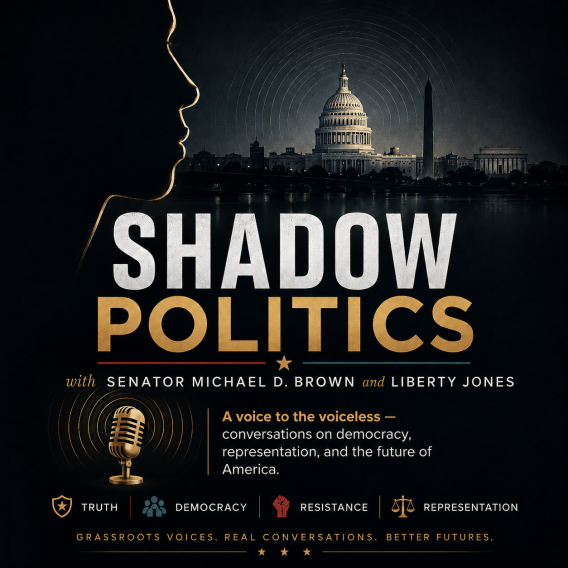

Shadow Politics with Senator Michael D. Brown and Co-host Liberty Jones
Guest, Charles Moreland 1st US Representative for DC - The Legacy of Activism
In this episode of Shadow Politics, a profound dialogue between Senator Emeritus Michael D. Brown and Representative Charles Moreland, the first elected U.S. Representative for the District of Columbia. They reflect on the mentorship of Jesse Jackson, the historical parallels between DC’s struggle and global civil rights movements, and the urgent need for a grassroots mobilization to achieve full statehood.
The Catalyst of the 1990s: Jesse Jackson’s Influence
The election of Charles Moreland and Jesse Jackson in 1990 marked a turning point for the District of Columbia. Jackson, a veteran of the Civil Rights Movement, brought national gravitas to the "Shadow" delegation, teaching local leaders the importance of visibility and national lobbying. Despite initial local skepticism regarding his arrival, Jackson acted as a master mentor, emphasizing that the fight for DC was a logical extension of the march from Selma to Montgomery.
Symbolic Protests and Civil Disobedience
The movement for statehood was characterized by direct action, including blocking Pennsylvania Avenue and dumping tea on the steps of the IRS to protest "taxation without representation". These acts were intended to mirror the founding principles of the United States, highlighting the irony that the "cradle of democracy" denies basic voting rights to its own residents.
The "Home Rule" Trap vs. True Statehood
A significant portion of the discussion focuses on the inadequacy of "Home Rule," which Moreland describes as a "dictatorship of the powerful over the powerless". Unlike a state, DC's local laws and budget are subject to Congressional veto, and its residents lack voting members in the Senate and House. The speakers argue that many residents have developed a "slave mentality," accepting the illusion of democracy provided by a local mayor while the federal government retains ultimate control over their finances and judicial appointments.
Political Analysis and the Path Forward
The dialogue touches on the 2024 election, with Moreland critiquing the Democratic Party for failing to prioritize statehood when they held the majority. He attributes political shifts to deep-seated racism and gender bias, noting that voter suppression is often ignored in mainstream post-election analysis. Ultimately, the speakers conclude that statehood will not be granted through polite lobbying alone; it requires a mass movement where citizens demand their rights, echoing Frederick Douglass’s maxim that "power concedes nothing without a demand".
The conversation serves as both a historical record and a call to action. While the legacy of leaders like Jesse Jackson and Florence Pendleton provided a foundation of hope, Moreland and Brown emphasize that the "lightning bug" of Home Rule is no substitute for the "lightning bolt" of statehood. The path to freedom requires DC residents to shed the "slave mentality" and demand the same rights enjoyed by every other citizen in a modern democracy.
Shadow Politics

Shadow Politics is a grass roots talk show giving a voice to the voiceless. For more than 200 years the people of the Nation's Capital have ironically been excluded from the national political conversation. With no voting member of either house of Congress, Washingtonians have lacked the representation they need to be equal and to have their voices heard. Shadow Politics will provide a platform for them, as well as the millions of others nationwide who feel politically disenfranchised and disconnected, to be included in a national dialog.
We need to start a new conversation in America, one that is more inclusive and diverse and one that will lead our great nation forward to meet the challenges of the 21st century. At Shadow Politics, we hope to get this conversation started by bringing Americans together to talk about issues important to them. We look forward to having you be part of the discussion so call in and join the conversation. America is calling and we're listening… Shadow Politics is about America hearing what you have to say. It's your chance to talk to an elected official who has spent more than 30 years in Washington politics. We believe that if we start a dialog and others add their voices, we will create a chorus. Even if those other politicians in Washington don't hear you — Senator Brown will. He's on a mission to listen to what America has to say and use it to start a productive dialog to make our democracy stronger and more inclusive. If we are all part of the solution, we can solve any problem.
[00:00] Speaker 1: No taxation without representation. 200 years of exploitation in the capital of this nation. Oh. No representation in the capital of this nation. No, no, no, no, no, no. Hey. 200 years of exploitation. Give the people their right to vote. Someone asked me was it true. The voting rights of the district were long overdue.
[00:36] Speaker 2: Good evening, and welcome to Shadow Politics, an hour-long grassroots talk show which is on a mission to make America think again. I'm your host, Michael D. Brown, United States Senator Emeritus, and along with my amazing co-host, Liberty Jones, we are interviewing the people who are making it happen. Not always in front of the camera, but always ahead of the curve. We're not gonna tell you how to feel or who to vote for. We're just putting information out there, because it- what goes on in the shadows that really makes the world go round. So come listen and learn, because a vote is a terrible thing to waste. And now more than ever, we need everyone listening, learning, and engaged if we are gonna make America sane again. Tonight, we are honored to have with us Representative Charles Moreland.
[01:30] Speaker 2: Charles was elected as the first elected US representative for the District of Columbia in 1990, along with the Reverend Jesse Jackson, who was, uh, elected the first United States Senator from the District of Columbia. He served as a chief national lobbyist for the DC Voting Rights Amendment, and testified before numerous state legislators to support ratification that- of the constitutional amendment that would have given DC representation. Uh, we're so happy to have you here with us tonight, Charles, thanks so much for taking time to do this.
[02:11] Speaker 3: Well, thank you so much, Senator Brown, and I'm happy to be here tonight. And again, I, and I've, I've over the years, uh, and I wanna commend you again to the outstanding work and outstanding service, uh, that you have done for many, many years. And, and I want you to know that I'm happy that you still, um, got, you know, your feet on the ground, and, and you're still in the fight. We appreciate you, good brother.
[02:43] Speaker 2: Yeah, I don't, I don't, I don't know how anybody cannot be in the fight these days, Charles bos- Charles. But let me say that when I first started this job, you were one of the few f- few first people I talked to. And you told me several things, and I thought, "Gee, I, I don't know that this guy, I don't know that this guy is telling me what's really going on in the world." And the more I got into the job, Charles, the more I started to rely on everything you s- said as gospel. Because, uh, you really, uh, you really know so much about this, and you were so much of a mentor to me. So, thank you always for your support, and, and for your wisdom, because it's a steep learning curve. Is it not, Charles? A steep learning curve when you become a representative without a vote. And so let me start there and ask you, what was it like to be the first?
[03:39] Speaker 2: This is like nobody, nobody's done this since Alaska did it in the 1950s, had elected, uh, representatives and senators when, when they're not a state. So what was that like?
[03:54] Speaker 3: Well, I tell you, it was a time of great excitement and anticipation for the future of the District of Columbia. Uh, we had the privilege of having Senator Jackson relocate here. And Jesse Jackson at that time was one of the most famous, uh, political fig- figures, uh, in the nation and in the world actually. He had run for president two times, outstanding speaker, of course, uh, one of the heirs to, um, Martin Luther King's, uh, civil rights movement and his legacy. And for Jesse to, to come here, to actually move here, relocate here, uh, to stand up for statehood, we were excited. Um, of course, uh, there's a little history that I, I want everybody to know.
[04:57] Speaker 2: Uh-
[04:57] Speaker 3: You know, Jesse, Jesse was also a carpetbagger. (laughs) DC politics, you know, we kinda hold, uh, and take pride in, in DC. So we wanted Jesse, but of course, uh, Jesse wanted to come here and, uh, and, and take control, and he, uh, put together his ticket, and it included, uh, Harry Thomas and, uh, a guy by the name of Dee Hunter who was running for US rep. Um, and so, uh, while we embraced Jesse and welcomed Jesse, we said, "Jesse, you know, this is DC." And, uh, so Senator Pendleton and I decided we would get on the ballot, and, uh, we ran, we won the, the, the primary, of course, and, and, uh, but Jesse, um, being understanding, Jesse embraced us, and, and, uh, and taught us many things about, uh, of course, national politics, and, and, uh, Jesse, uh...... helped us, uh, in, in so many ways. And he w- and he was my mentor, Jesse. Jesse didn't hold any grudges, I'll tell you that, political grudges. He'd say, "Hey, you guys did what you had to do.
[06:17] Speaker 3: I would have done the same thing, Charles Norland." So that's a, that's a little, little background that I think is important for, for everybody to know.
[06:25] Speaker 2: Yeah. And you know what?
[06:26] Speaker 3: And he helped 2020. Go ahead.
[06:28] Speaker 2: A- and excuse me, Charles. But we should point out too that the City Council passed the, the law to create the offices of senator and representative. But they really didn't implement it until Jackson said he was interested. So-
[06:47] Speaker 3: Right.
[06:47] Speaker 2: ... we really wouldn't have had the offices, would we? If, if it hadn't been-
[06:51] Speaker 3: No, not a chance.
[06:51] Speaker 2: May- may- maybe not even had them if it hadn't been for him. But yeah. I, I was b- I'm proud of the fact that I was his direct mail consultant for his first presidential campaign in, in, in, uh, uh, '84. And, uh, yeah. He was a, he was a wonderful man to work with. And, uh, but yes. All politics, all politics. I'm sorry, Charles. So-
[07:19] Speaker 3: The master politician.
[07:20] Speaker 2: Yeah, go ahead.
[07:21] Speaker 3: Master politician.
[07:23] Speaker 2: Yeah.
[07:23] Speaker 3: Outstanding human being, um, uh, a mentor that I will, will never ever, ever forget. In fact, I, um, published some pictures of myself, Jesse, Florence, uh, Senator Kennedy, and, um, uh, Mayor Kelly when we testified, uh, before the Senate, when the Senate introduced the DC Statehood Bill. So I published this, uh, this picture. And a good friend of mine called me. (laughs) He said, "Charles Moreland," 'cause I see a lot of people with, uh, pictures where they're standing beside Jesse Jackson.
[08:05] Speaker 3: 'Cause Jesse Jackson's probably taken-
[08:08] Speaker 2: Yeah. (laughs)
[08:08] Speaker 3: ... 100,000 pictures of people he took
[08:10] Speaker 2: Yeah.
[08:10] Speaker 3: ... like that.
[08:11] Speaker 2: One of the best pictures-
[08:12] Speaker 3: Yeah, yeah, yeah. Sure.
[08:12] Speaker 2: ... he ever took with me. Go ahead.
[08:14] Speaker 3: Yeah, yeah, yeah. He'll take you-
[08:15] Speaker 2: Sorry.
[08:15] Speaker 3: He's, he's, he's that kind of guy. Um, but he, he, he said, "Listen, I've never seen Jesse whisper in somebody's ear on stage." (laughs)
[08:25] Speaker 2: (laughs)
[08:26] Speaker 3: And, uh, he said, "You ****** *** a ******." And I sent that picture to you. But Jesse always-
[08:29] Speaker 2: I saw it.
[08:31] Speaker 3: Did Jesse? Yeah, Jesse was, was my mentor. He whispered things to me. He would, would always advise me and guide me. And I learned a lot of things from Jesse. Uh, in fact, right now, um, one of the funny things (laughs) I learned about, about Jesse is, when you're on stage, you gotta make sure you're always in the center of the picture. (laughs) And Jesse was master at that. And, uh-
[08:59] Speaker 2: Mm-hmm.
[08:59] Speaker 3: ... we'd joke about... He'd tell me, "Listen, if you, if you gotta elbow to the side, elbow to the side, Charles. Get in the center of the pictures." I tell you, Jesse, Jesse taught me a lot. And he was, um, very important to the, the movement in DC. In fact, I'm looking at some pictures now, and there's a, uh, it is time for, uh, appreciation, uh, it is time for, uh, for, for remembrance. And, um, that's why I'm so, so glad and so happy to have this opportunity to, uh, be on your show tonight, Michael. I'm looking at pictures.
[09:40] Speaker 3: And people-
[09:41] Speaker 2: Well, I'm... Mm.
[09:42] Speaker 3: Jesse was active. Jesse got arrested, uh, uh. So I'm looking at a picture right now where Jesse has his hands cuffed behind his back, where he had a s- we had a s- we had a, a sit-down on, on Capitol Hill, on Pennsylvania Avenue. We blocked Pennsylvania Avenue. We wouldn't let traffic go by. And we were joined by Mayor Kelly, um, Senator Pendleton. Of course, Mayor Kelly, Senator Jackson, myself, and 31 other people were actually arrested. Uh, so Je- Jesse's advocacy, his activism, it, we, we've got to get the message out about how important Jesse has been to the statehood movement.
[10:37] Speaker 2: Yeah, very much so. And can I just quickly tell you my favorite remembrance of Jackson was the first staff meeting I went to. He had a guy that ran the s- um, uh, Rainbow Coalition for him out of Philadelphia, and, uh, that's how I got to work for Jackson. I worked for the Rainbow Coalition. And this man's m- m- mother was in the hospital. And we started the, he started the staff meeting and people started to talk. And he said, "Wait a second, how's..." So, and I can't even remember the man's name. I, I'm so bad. I'm so old. "How's his mother?" And somebody said, "Uh, we haven't... We didn't check on her today." And Jackson said, "I want her checked on every day. I want a update every day. This man is a member of our family, and so we reach out and we embrace him. And there's nothing more important than that. Once you find out how she's doing, we can start the meeting." And I thought to myself, "I like this guy." You know? He has his priorities straight.
[11:47] Speaker 2: But anyway, that's my favorite story, and I know he was such a, a, an amazing figure in national politics. He just, he just was. I've been a mem-, I've been a delegate along with Liberty Jones, who was with me at the last convention, but I've been to 13 consecutive conventions. And his convention speech, uh, in 1984-I believe it was '80 or '84, still stands out as one of the classic convention speeches. He, he ga- he was an amazing-
[12:19] Speaker 3: Oh, yeah.
[12:19] Speaker 2: ... speaker. Amazing speaker.
[12:21] Speaker 3: Absolutely.
[12:23] Speaker 2: So, how important is it to block traffic on Pennsylvania Avenue? I was arrested for, for blocking traffic in front of the Senate and I must say, after the trial the judge said, "You're my hero. I appreciate people that stand up for what they believe in, but even heroes can't block the damn street. You're guilty." So, how important is it for us to block streets? Especially now in DC with all that's going on?
[12:50] Speaker 3: Well, shortly after we, um, launched our, um, protest movement in DC, um, the Congress passed a law that pretty much prohibits that now. You can do big time for blocking the streets in DC, for DC statehood.
[13:18] Speaker 2: Yeah.
[13:18] Speaker 3: Um, I, um, I want to call attention just for a minute. I'm, I'm looking at, as I say, as we talk I'm looking at these pictures. I see a picture of Jesse, my- myself, Damu Smith, Senator Tammy L. Jackson. Jesse and I and Damu are the only ones that are doing it, but we dumped tea-
[13:40] Speaker 2: Yeah.
[13:41] Speaker 3: ... in the streets. We dumped tea on the steps of the IRS, you know, as a protest against taxation without representation. Of course, um, and it wa- it was in, in remembrance of, uh, of why this nation was founded and they, uh, the British government has impo- had imposed a tax on tea. And the Boston Tea Party pretty much was ******, so, um, we, we, we staged this, uh, this tea, this tea party protest and I just- I happen to have this picture. I think I sent it to you. If not, we're gonna make sure this gets pub- gets published, because I want to just emphasize again how active Jesse was. It wasn't just that he was talking and speaking. Jesse was out in the streets with us. Um, like you, like you just said, Jesse made it happen. His involvement was really what sparked of a new phase of the, of the, um, DC statehood movement. And, Michael, do we have a moment?
[14:46] Speaker 3: I just real- want to read a couple paragraphs-
[14:49] Speaker 2: Sure.
[14:49] Speaker 3: ... of a statement that Jessie made when he spoke at the, uh, at the press conference we had, uh, when Senator Kennedy, uh, introduced the DC statehood bill in the Senate. And I quote, he said, "The march from Selma to Montgomery ended prematurely. It should have continued to the nation's capital. The march from Selma to Montgomery, Alabama, was a march for the right to vote, a march to expand democracy. Logically, it should have led us to Washington, DC, where nearly 650,000 people do not have the same democratic rights as all other Americans." He said, "We have no right to be represented or to participate in policy making at the center of power of our democracy in DC. At its core, the situation in the District of Columbia, while not exactly parallel, is not unlike the situation in Soweto." Okay. He said, "They administer laws," speaking about the Congress, "and funds on behalf of apartheid government, but they do not possess power or truly govern." Okay.
[16:14] Speaker 3: And he ended by saying, "Thus, we appeal to you to support us as we struggle to expand our democracy in the cradle of democracy, the land of the free and the home of the brave, Washington, DC. Our democracy must include all of American people. We must act upon the sound principles of democracy and practice them first by applying them at home. Democratic expansion and inclusion, that is what the state of New Columbia, uh, will represent." And, of course, DC was then, um, uh, suggested to be called New Columbia at the time.
[16:51] Speaker 3: But, uh, outstanding speech, um, if you, you ever get a chance, I'm a see if I can find a copy of it, but, uh-
[16:59] Speaker 2: Yeah.
[16:59] Speaker 3: ... just equated our struggle, uh, with, uh, the struggle, the civil rights struggle that he was so successful with, with, uh, Dr. King.
[17:10] Speaker 2: Well, and, you know, let me point out that they've resolved this, this... Well, they haven't completely resolved the situation in Soweto. I'm sure there's still, uh, there's still a lot of racism that, that, that exists. But they've, they've, they've, from a, a policy standpoint, they've revolved- resolved the situation and we still haven't resolved the situation. So, what does that say when your s- when your, uh, civil rights record, uh, falls, uh, you know, 20 years behind that of South Africa? I mean, that really says something. And while I have everybody listening, before I ask Liberty Jones to squeak out a, a question with her, with her sore throat, um, I, I implore everybody to listen to our last interview with Jesse Jackson, uh, January 23rd, 2022. He was my guest on this podcast.
[18:04] Speaker 2: And you can go back to our arch- archives at BBS Radio and we'll try to post some of the stuff that Charles has been talking about tonight-And you can also access, uh, that hour-long interview with Jackson if y- if you want. It was a good interview. Um, so yeah, this man was not only so important to DC politics, but he was just so... You, you sh- First of all, le- let me also say that I should mention that Florence Pendleton was a senator that was also elected at that time. Uh, she was an amazing woman, had climbed to the top of the education system here in DC, uh, was a teacher, was a policymaker, uh, and, and, and, and she was my predecessor and just the loveliest person. Uh, unfortunately, she's no longer with us. But, uh, that should be pointed out.
[18:59] Speaker 2: And, um, I was remiss enough to-
[19:01] Speaker 3: If she passed the mantle to you, to you, Michael, and I'll tell you, you ran a heck of a race. Speaking of, of, of, um, South Africa and apartheid, let me share something. I'm also looking at another picture. Um, we knew that as tough as that battle was, there were people that were... I mean, that... You're talking about a tough battle for... I mean, every other African state had, uh, um, the country had declared their independence. Uh, not South Africa. And, um, you may have seen this rendering by Jude Kranych. Um, back during that movement, uh, almost every church, um, let me say many churches in the United States had a single sign that said, "Free South Africa." Do you remember those signs?
[20:02] Speaker 2: Yes, I do.
[20:04] Speaker 3: Free South Africa. Well, it occurred to me that the day would come when South Africa would be liberated, apartheid would end, and churches in South Africa would have a sign saying, "Free DC."
[20:22] Speaker 2: (laughs)
[20:22] Speaker 3: We predicted that.
[20:24] Speaker 2: Yeah.
[20:25] Speaker 3: And so have you seen that, that rendering that Jude did where in the first Baptist Church, Baptist Church of Soweto, there's a sign that says, "Free DC"?
[20:38] Speaker 2: Hmm. No, I have not. Um, but now I want to see-
[20:45] Speaker 3: Well, I want to see it and send it to you. Yeah, yeah, yeah.
[20:46] Speaker 2: So-
[20:47] Speaker 3: Awesome.
[20:48] Speaker 2: Yeah.
[20:48] Speaker 3: Chilling. And it came true, it came true. We predicted that before South Africa was liberated. That's... We, we, we understand and we know the difficulty, even though this is the most noble fight for liberation and freedom and democracy on the planet. We know how difficult, we knew then, and we know now. And I, I think the only way it can be done and ever will be done, Michael, you know, you and I have talked about, uh, w- w- w- w- we're not gonna get the members of Congress to all of a sudden decide to just be good to DC citizens-
[21:33] Speaker 2: Yeah.
[21:34] Speaker 3: ... and do what's right.
[21:36] Speaker 2: Yeah.
[21:36] Speaker 3: Uh, we've been begging and pleading in as humble a fashion as any, any, any slaves have ever begged and pleaded for freedom. It's not gonna happen by us just going out to, to, to run those districts or going and lobbying on Capitol Hill. The citizens of DC have to do what Martin Luther King did. They have to do what Jesse Jackson did. We have to demand our rights. We have to mobilize, demonstrate, okay? We have to do what they did in South Africa, what people have always had to do to gain their freedom. The question has been asked, how long, how long will DC citizens be denied first-class citizenship? The answer is simple. For as long as we accept it.
[22:31] Speaker 2: Well-
[22:32] Speaker 3: A man can't ride your back if it's not bent.
[22:37] Speaker 2: Well, how many times have-
[22:38] Speaker 3: And we've been on the back. Go ahead.
[22:40] Speaker 2: And how many times, Charles, have you and I both quoted Frederick Douglass that power concedes nothing without a demand, you know?
[22:49] Speaker 3: Exactly.
[22:50] Speaker 2: Right. And, and, and when a handful of us stand up, it's not a demand. You know, I said that to somebody when it w- the last time they had a disapproval resolution, and 500 people got together, and they said, "We've started a movement." No, 500 people at a club. A movement is what happened in Selma. A movement is what happened-
[23:11] Speaker 3: Right.
[23:11] Speaker 2: ... in Montgomery. Uh, that's a movement, you know. Uh, uh, well, Liberty, I hope you've taken enough lozenges that you can ask, uh, a question. Go ahead.
[23:25] Speaker 4: I'm gonna have to say... Yeah. Oh, my goodness. I hope you can understand me. But you guys are both such wonderful storytellers. And as a young person, I'm truly inspired that you can carry on the legacy of those who inspired you, as I wish to do for you guys one day, as well. And I must say, um, on that topic, if you could sit down, which you probably can, with all of the current shadow senators and representatives that we have in DC's delegation today, what is one lesson, you know, that you have learned with your time with Jackson that you think must be applied to today's current political situation? What is something he taught you that you wish you could keep inspiring others with as well?
[24:22] Speaker 3: Well, thank you so much, Liberty, for... And you to be commended, um, for your hard work, for your commitment, for taking on this cause. And one of the things that Jesse was so good at and, um, that was keeping hope alive. (laughs) And that's, th- that, that's so important, especially for DC statehood. In particular, I wanna point out that one of the biggest problems we have in DC is that the citizens will say, "Are we never gonna get statehood?" Worst of all, when elected officials say, "DC will never be a state." Now, to those who would try to write our cause off as an impossible dream, I wanna say that when God is on your side, no dream is impossible when its time comes. God Almighty determines what is possible in this world. In God's hands are all human events. There have been many so-called impossible dreams that have become reality in my lifetime.
[25:55] Speaker 2: Right.
[25:57] Speaker 3: Crushing the vestiges of slavery under Southern American Jim Crowism. I remember that. I was born in 1948. Okay? And I know the changes that have been made. Hmm. We couldn't vote. African Americans couldn't vote. Now we can. That was an impossible dream then. Of course, we talk about the racist apartheid government of South Africa that had stubbornly resist to violent liberation struggle amid international condemnation. When the time came, it was brought down without a whimper when God decided at that time to bring it down. Election of Barack Obama defied all the odds and all the stereotypes against African-Americans, minorities, and disenfranchised american- minorities of every color. Martin Luther King said, "The arc of the universe bends towards justice." And if that is so, injustice cannot prevail and justice must prevail.
[27:21] Speaker 3: So I would say the one thing that Jesse is, is, is a phrase that he's most famous for and what we need here in DC, keep hope alive, keep hope alive that we will one day be free. So I say to you, the hope that you're bringing, the hope that you're bringing, I'm still hoping that we will achieve first class citizenship in my lifetime, and I'm 77 years old. And with your help, we can.
[27:59] Speaker 2: Mm. And it... That, that's really, really, really, uh, what, uh, this brilliant young woman brings to this show, is, is, is hope. Uh, and you're right, be- because we have so much l- you know, there's, there's so little else that we have to hold on to in DC. But, uh, yeah. Uh, when I tweeted out my, um, condolences for his passing, that's the one thing I said, "Keep hope alive." It was, uh, his, uh, uh, I don't know if you wanna call it a catchphrase, but he used it all the time and it, and it is, is so important. So Charles, how do we get... If you have any insight into this at all, how do we get from a man like Barack Obama or Joe Biden to a guy like Donald Trump? How do we get there? I mean, what, w- what are we thinking?
[29:07] Speaker 3: Well, Senator, um, I think we, we have to be very truthful. Um, racism, uh, gender bias, those are real factors. Racism is alive. Gender bias is alive. And, um, you know, people wanna blame Joe Biden's age. That had nothing to do with it. When they... When... Uh, even Democrats, uh, you know, Re- Democrats that I have always respected, when they start analyzing the election and why Kamala Harris lost, they never factor in voter suppression. How many... We know votes were suppressed. We know that, that there were states that took, uh, people of color, African Americans off the voter rolls.... been 30 days before the election, we know that. But they never factor that in. Let's have truth, let's have, let's have transparency. When they talk about who voted and why they vote, they, they, they, th- the so-called experts never factor in, they never ask the ques- how many people did not vote for Kamala Harris because of her color? As, as, as though nobody did.
[30:47] Speaker 3: When they count the numbers, they don't say, "How many people did not vote for Kamala Harris because of her gender?" There were more than 20 million Democrats who didn't even show up, Democrats who voted for Joe Biden. Did they count the numbers of people who voted for Joe Biden in the primary who were totally disgusted at them switching horses in the middle of the stream? I mean, let's have some honesty here. Factor those in. And if your numbers still come up with, with Donald Trump winning, fine, but at least be honest. Let's be truthful. How did we get here? We got here because the Democratic Party yielded and conceded to the rich and wealthy and powerful people who supported Donald Trump because Donald Trump said he was gonna give them $2 trillion, and Joe Biden said, "I'm gonna make you pay your fair share." The struggle, as you know, it's a class struggle.
[31:53] Speaker 2: Well, and, and we talked about this earlier, uh, too, Charles, uh, but is gender bias... I know what Liberty's gonna say, is gender bias stronger than racial bi- bias since Barack Obama got elected? I mean, he was an amazing candidate, but he got elected. Uh, so, so we just don't want women to run our country? I mean, you know, the British, the Germans, the French, the Indians, the, the, the... you know, you could go on and on about every industrialized country in the world that's had women leaders, but we've just shot down the last two to this... And, and is it a coincidence that they've both been women, uh, of, uh, Hillary Clinton and, and Kamala Harris? Um, and is that just it, that people in America say, "Oh, we'd rather have any guy than a woman"? Is that our problem?
[32:59] Speaker 3: Well, I think they both work together. Um, I don't know if you can... Well, they, they, they, they manifest differently, of course, (laughs) you know. Um, but I think they're both realistic, and, uh, uh, gender bias, I think, uh, manifests itself in the minds of men and women of every color.
[33:26] Speaker 2: Mm-hmm.
[33:27] Speaker 3: That's... And, and, and, and gender bias is, um, is, is almost genetic (laughs) you know.
[33:37] Speaker 2: Yeah.
[33:37] Speaker 3: Men, uh, uh, in cultures everywhere. So I don't know if it... it's like comparing apples and oranges. You got an apple and you got an orange.
[33:49] Speaker 2: Yeah.
[33:49] Speaker 3: They're both are fruit, (laughs) so...
[33:51] Speaker 2: Yeah.
[33:51] Speaker 3: I don't... I don't... I think you can't balance them, but they... the bottom line is, is to your question, they do both exist, and Kamala Harris had them both, uh-
[33:59] Speaker 2: Right.
[33:59] Speaker 3: ... had them both to deal with.
[34:02] Speaker 2: Yes, she did.
[34:02] Speaker 3: And for the Democrats to this very day... It's not, it's not just stupid, but it's dishonest to say that the Democrats lost because Joe Biden was too old and Joe Biden should have, uh... What they should have done is they should have supported Joe Biden. They should have defended Joe Biden. And then the question that always be asked, it, it... Y'all are so smart, smart people. Didn't you see? (laughs) Didn't you see? Didn't you... Couldn't you predict? You're so smart, you could predict that Joe Biden might lose. Anyway, I, I... you know, you don't wanna get me started on that.
[34:46] Speaker 2: Well...
[34:47] Speaker 3: Um, but, uh, uh, in terms of statehood, one thing that you, that you, you, that you mentioned earlier that I, I wanna bring up, and I think it was a brilliant idea, how do we get Donald Trump to support statehood? I think there might be a way we could get Donald Trump to, to support statehood. I wouldn't give up on it. I would not give up on it.
[35:12] Speaker 2: Well, I wouldn't either. I think we were close when he started talking about getting rid of the filibuster.
[35:18] Speaker 3: Right.
[35:18] Speaker 2: It was the first thing his... it was the first thing his, his press secretary said. She said, "If we get rid of the filibuster..." Because there were Republicans that were against it, of course. "We get rid of it, the first thing we're gonna do is make DC a state and make Puerto Rico a state." Well, hell yeah, let's do it then, 'cause I think, I think she's right. I think if we c- get rid of the filibuster, we could make that happen. So you're right, I wouldn't give up on him.
[35:44] Speaker 3: Yes, my-
[35:44] Speaker 2: But of course my idea was to name the city Trumpville, if he puts his name on it-
[35:50] Speaker 3: State, state of Trump, let's do that.
[35:50] Speaker 2: ... he'll prop up... The state of Trump, exactly. You know?
[35:54] Speaker 3: If we get DC statehood, by any means necessary.
[35:58] Speaker 2: By any means necessary. Yeah.
[36:00] Speaker 3: By any... You know, statehood is, uh... We need to make one.
[36:04] Speaker 2: Yeah, we could change our license plates to-
[36:07] Speaker 3: Make America great again.
[36:07] Speaker 2: ... Better Trump than no representation at all. Uh-huh. But, and-
[36:12] Speaker 3: We need to d- We need to end taxation without representation.
[36:15] Speaker 2: We do.
[36:15] Speaker 3: What do we want? We want democracy, government of the people, for the people, and by the people.DC citizens are currently governed under a home rule system in which the su- supreme power is held by Congress. In fact, you know, while we talk about, um, you know, some bizarre possibility of, of the state of Trump, there are some other bizarre things that are happening. We have elected officials now who are talking about holding on to home rule.
[36:53] Speaker 2: Yep. Yeah.
[36:55] Speaker 3: Holding on to home rule.
[36:57] Speaker 2: Yeah.
[36:57] Speaker 3: Home rule is a system of government that the US Congress imposes on the citizens of DC. It is tyranny in its most shameful form. DC residents have all the duties and responsibilities of American citizenship under home rule, and yet are denied the right to representation in Congress and self-determination. That's not democracy. And why? How could it be now that our elected officials are now saying, "Let's hold on to home rule. Let's hold on to the chains we have." Unbelievable. You talk about bizarre. I never would have thought that.
[37:44] Speaker 2: Yeah, it's absolutely true. And, and, and I want to know what... You've been in politics longer than I have, and, and I wanna know w- what you feel about the fact that, uh, everybody's talking now about the midterms and how the Democrats may do really, really well in the midterms, and if they take control of Congress again, take control of the House and increase their numbers in the Senate, they will stand to block... They will stand in the way of Donald Trump and they'll block what he can do in the United States. But nobody can block what he can do in DC because they have control over the District of Columbia, Congress does, and he does as well through executive orders. So you... So I think if the Democrats do really well and he's not able to beat up anybody else, he's not ab- no, no longer able to beat up the Minne- the poor people of, of Minnesota, he'll focus more attention on DC. And home rule will give him the ability to do that. What do you think?
[38:56] Speaker 3: Home rule... Well, home rule is not democracy. It is a dictatorship of the powerful over the powerless. It is an affront to the letter and the spirit of the US Constitution. Home rule allows taxation without representation. If you took this form of government and tried to impose it anywhere else in the world, the people would take up arms like they did in America, and shoot you down. Yet we accept taxation without representation. Home rule allows the Congress to veto legislation passed by the DC Council. It allows the US Congress and Donald Trump to pass any law that they want. Under home rule, Donald Trump, the Congress can fire, uh, our mayor and dismiss, uh, welcome... Out of their offices without notice. And so, uh, we need to demand statehood. That's the only answer, the only solution. And our, and our elected officials need to be serious about statehood inste- instead of giving just lip service to it. Um, that, that's what... And we, we need, we need, um, people to stand up.
[40:24] Speaker 3: We need people to look at what, what Jesse did, back to Jesse Jackson. We need hope and we need, um, people ready to stand up and fight for, for our rights. And we don't have that.
[40:43] Speaker 2: Yeah. Mm-hmm.
[40:44] Speaker 3: The DC, the citizens of DC, and that's what I was getting to, the citizens of DC, uh, we are, um, mere servants at the banquet table of democracy. And yet, um, we accept it.
[41:01] Speaker 2: Well, you know, um, right... W- we know that, uh, again, um, our, our, our mentor, uh, said that, uh... Frederick Douglass said that nobody can make you feel inferior without your consent, right?
[41:19] Speaker 3: Right.
[41:19] Speaker 2: Eleanor Rose- I mean, Eleanor Roosevelt gets credit for that quote, but it actually came originally from him. And, you know, I've always been... I've always marveled when you, when you say what you just said, Charles. You brought up apartheid earlier. I remember the demonstrations at the South African Embassy every day, people every day at the South African Embassy during apartheid.
[41:45] Speaker 3: Same here.
[41:45] Speaker 2: A lot of Washingtonians. And it's all... And, and, and it amazes me how we're able to stand up for other people and in the end we don't stand up for ourselves. That, that, that has always amazed me. You can find so many people in this city who have some cause that they stand up for. I, I don't care what cause it is. Y- you can... It can be the National Organization of Women or the National Rifle Association. People in the city stand up for all sorts of causes. And then when it comes to their own, DC statehood, I often, uh, you know, uh, um...... used the analogy that I had a friend whose father was a child psychologist, and his kids were the worst kids. His kids were the worst, the worst kids in the neighborhood. They were always the ones getting in trouble. And that's how I feel about DC. We're, we're willing to get, put it out there for anybody else, but not for ourselves. I, I don't get it. Uh, but it's so important to do it.
[42:47] Speaker 3: Well, Senator, you, you're absolutely right. Uh, and I think it's, um, it's because DC residents have what I like to call a slave mentality. Uh, to many DC residents, and I'm talking about DC residents, as well as some other folks around the country, home rule resembles democracy to them, because they can elect a mayor and a councilman. But home rule resembles democracy in the same way that a lightning bug resembles a lightning bolt. While a few of the principles might be the same, there's a tremendous difference in the end product. The little lightning bug does a superb job at lighting up a tiny space in the sky. A lightning bolt, on the other hand, demonstrates and dominates the sky and charges everything around it. And likewise, so-called home rule exists only in DC. While every other, every other country that has a democracy, the nation's capital is represented in the Congress. Everywhere except the United States of America. Now you, you mentioned the filibuster.
[44:24] Speaker 3: Uh, you throw in, uh, you know, the situation, taxation without representation in DC, and then you have the Electoral College. Those are three cracks in the Liberty Bell. Those are three cracks in American democracy. First and foremost, I think, and the easiest, uh, to resolve is, is, is DC statehood. Um, that's easy. Simple majority vote. Now, you talk about the upcoming election. One of the biggest problems with statehood, and I, I've ... In, in my lifetime I've seen Democrats have the majority in both houses and the presidency three times. Joe Biden, when he had it, majority in both houses and the presidency, he put statehood aside. It wasn't important. And our local government, our local government didn't demand that statehood be the highest priority. So Democrats, Democrats are, are largely responsible too.
[45:46] Speaker 2: That's right.
[45:46] Speaker 3: They've been derelict. And, and, and, and so we talk my ... And, and, and, and, and like I said, there, there have been times when, when, when DC residents, um, DC residents who just want, who don't know, who understand, uh, the need for democracy, there's time when we need to stand up, and that time is now. Uh, people are saying right now, people are saying, I'm talking to people, elected officials, talking about demanding statehood. You know what they say? Not now.
[46:19] Speaker 2: Yeah.
[46:19] Speaker 3: This is not the time.
[46:21] Speaker 2: Right.
[46:21] Speaker 3: They've been saying that forever.
[46:23] Speaker 2: Yeah.
[46:23] Speaker 3: When Democrats get both houses of Congress, and the presidency, they have said the same thing. I've heard it, Senator, you heard it too, "Now is not the time." If not now, when?
[46:33] Speaker 2: Right.
[46:33] Speaker 3: If not here, where? Democracy, freedom delayed is freedom denied. We have to understand what that means. If you delay, if you come to me with a plan to delay my freedom for another, uh, two or three or four years, that is a plan to enslave me.
[46:56] Speaker 2: Yeah. You know, and I remember one of the men that I respect, uh, uh, so much in, in, in Congress, John Lewis, I remember at the dedication to the Martin Luther King memorial, where he spoke, he said his parents begged him not to go work with Martin Luther King, for the same reason. They said, "It's not the time. Not if ... You're gonna get hurt. You're gonna ..." And, and you, Charles, and I are both parents, so we can understand why you would say that, right? You, you fear for your children.
[47:33] Speaker 2: You never want them-
[47:34] Speaker 3: Yeah.
[47:34] Speaker 2: ... to put themselves in danger. But, but so, so that's an old canard in politics. And, um, Liberty Jones, if you have it in you to ask one more question, (laughs) I know you have a sore throat and you're such a trooper for showing up to this show, you should have called in sick, but, but if you have one more question, we're running out of time, if you wanna ask Charles something, please go ahead.
[48:01] Speaker 4: What is one thing that you would like to implement when we reach statehood?
[48:10] Speaker 3: Well, one of the, one of the biggest problems that we have is that we don't have control over our own money. The Congress seizes our own locally raised tax revenue and tells us how we can and cannot spend-So, the first benefit to us... And, the most important thing is that we, by the very nature of us becoming a state, we would- we would eliminate taxation without representation. And- and that's fundamental to any democracy is that anybody, any entity that seizes, uh, your money, that collects taxes only, you should have a representative in that body deciding what that money's gonna be used for. And so, that would be a natural consequence of ending of taxation without representation, giving us control, DC control over our money, over the money that, um, that... DC tax money.
[49:40] Speaker 2: Well, and it's funny-
[49:41] Speaker 3: So-
[49:41] Speaker 2: ... because Republicans who stand against this, Charles, right? Say all the time, "It's your money and it should come back to you and you should decide what's done with it. It shouldn't be decided by Congress." They say it all the time. And it's not good enough for the people of Indiana or I- or- or Ohio or New Jersey, but for some reason, that's okay for the people of DC. I agree with you. That would be the most important thing right off the bat. DC Appleseed says we lose two billion dollars because of what you just pointed out, Charles, so. Well, Charles, we're running out of time here. We only got a couple of minutes left. Is there w- anything else you wanna say that we haven't asked you?
[50:25] Speaker 3: Uh, well, again, to just follow up on what Liberty was saying, and that's very important, very... Great question to us to understand what it means, what we've been denied. It's one thing to say statehood, but it's another thing to understand that unlike other Americans, we have- we don't have two senators. You know the power that senators give you in congress?
[50:46] Speaker 2: Yeah.
[50:46] Speaker 3: We don't have one US Representative. The President of the United States has the power to appoint judges and name the chief prosecutor. We see those things, uh, happening right now. Evictions in DC are routinely carried out by the U- by US marshals. We want democracy, government of the people, for the people, and by the people. That means a lot more than just, okay, we have a name of a state. We have rights. We- we- we- we- we- we- we- we right now, uh, have all the duties and responsibilities of citizenship, but we don't have the rights of other American citizens. We are second class citizens. We want freedom. We want democracy. And freedom is the highest desire of the human soul. That's all we want. Freedom.
[51:35] Speaker 2: Well, that's a... And thank you. And that's a perfect w- note to end on, uh, Charles. Thank you so much for your service. Uh, since the day I got involved in this movement, uh, you've been involved. Like I say, you- you've been a mentor to me and so many others, uh, and we appreciate it because, you know, i- it's you, Charles, the Reverend Jackson, and, uh, Senator Pendleton that set the tone for our office. And- and it- it was always a high bar to live up to. And, uh, uh, I'm- I'm so proud to be your friend, and, uh, I wanna thank you for everything you've done. And, you know, we sh- we- we- we dedicate a song to our guests. And this goes out to you and it goes out to our first United States Senator, Jesse Jackson. Uh, here's Joan Baez with We Shall Overcome, which she sang on the steps of the Lincoln Memorial just prior to Dr. King's I Have a Dream speech. We'll see you all next week. Thank you, Charles Moreland. Thank you, Liberty Jones, for being stand up as always and showing up.
[52:54] Speaker 2: And, uh, this is We Shall Overcome again.
[52:56] Speaker 3: Can I have one more second? One second?
[52:58] Speaker 2: Yes, please. Please.
[53:00] Speaker 3: We wanna-
[53:00] Speaker 2: Go ahead.
[53:01] Speaker 3: I wanna just recognize and thank Senator Jackson. Senator Jackson did everything that he could. And we wanna... He did his part, didn't he?
[53:11] Speaker 2: Yes, he did.
[53:11] Speaker 3: And we wanna thank Jesse for a life well lived.
[53:16] Speaker 2: Yes.
[53:16] Speaker 3: Rest in peace, Jesse.
[53:18] Speaker 2: Yes. Rest in peace.
[53:20] Speaker 5: No representation in the capital of this nation. Two hundred years of exploitation. Give the people their right to vote. Give the people their right to vote. Give the people their right to vote. Give the people their right to vote.