
LaGrave Live, March 1, 2026
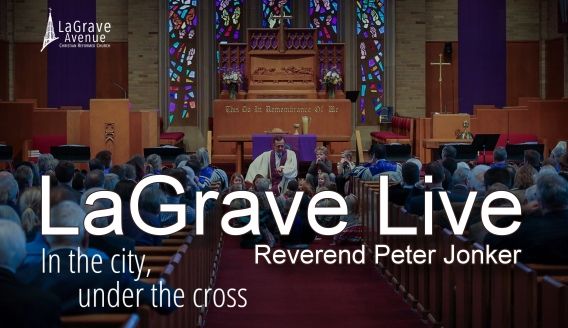

LaGrave Live
LIVE Morning Worship Service 03-01-2026
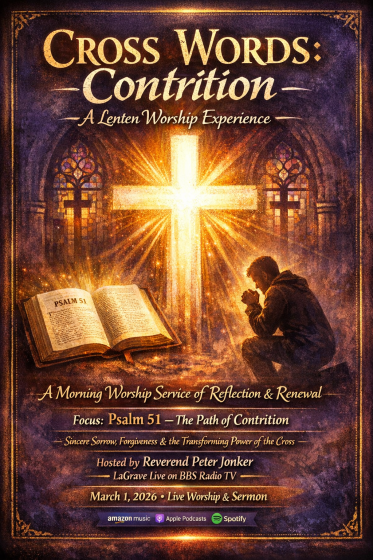
Cross Words: Contrition
About The concert:
March 2 is the second Sunday in the season of Lent and we will continue our Cross Words sermon series, a series which focuses on different aspects of the cross. Pastor Jonker will preach on Psalm 51
Order of Worship:
https://lagrave.org/wp-content/uploads/2026-3-1-AM-Order-of-Worship.pdf
About the Church:
We are a traditional CRC church in the middle of Downtown Grand Rapids, MI, worshipping at 8:40am, 11:00am, and 6:00pm. (10:00am and 6:00pm during the summer months)
We'd love to hear from you:
Connection: https://www.lagrave.org/contact
Let us pray for you:
Prayer: https://www.lagrave.org/prayerrequest/
Giving: https://www.elexiogiving.com/App/Giving/lagr107178
The March special offering is for Mel Trotter Ministries. Mel Trotter Ministries provides shelter for individuals and families with services including: meals, emergency shelter, transitional housing assistance, case management.
Listen on the go:
Amazon Music: https://bit.ly/LGPodAmazonMusic
Apple Podcast: https://apple.co/3tuOdwQ
Google Podcast: https://bit.ly/LGPodGoogle
Soundcloud: / lagravecrc https://soundcloud.com/lagravecrc
Spotify: https://spoti.fi/3yXDFaT
Follow us!
Facebook: / lagravecrc https://www.facebook.com/lagravecrc
Instagram: / lagravecrc https://www.instagram.com/lagravecrc
Website: https://www.lagrave.org
#LaGrave #LaGraveCRC
The Path of Contrition: A Lenten Service of Reflection and Renewal
This document summarizes the Lenten worship service held at LaGrave Avenue Christian Reformed Church, focusing on the spiritual discipline of contrition. The service explores the transition from the weight of human sinfulness to the transformative joy found through Christ’s sacrifice on the cross.
Detailed Points of Reflection
The Symbolism of the Cross in Worship
The service emphasizes the cross as the central motif of the Lenten season, both theologically and physically. During the children's message, it was noted that the sanctuary contains over 360 crosses—found in the architecture, windows, and light fixtures—serving as a daily reminder for the entire year that Jesus cares for the "hard things" in life. This visual abundance reinforces the message that the atonement is a "full and free" gift for those in affliction.
The Presence of the Cross
In the LaGrave sanctuary, the cross is integrated into the very fabric of the environment, symbolizing constant support:
- Reredos & Windows: Visual depictions of the crucifixion.
- Light Fixtures: 288 crosses embedded in the main lights.
- Wall Sconces: Additional crosses bringing the total to over 360.
"One cross for every day of the year."
The Theology of Contrition
The sermon defines "contrition" as a "godly sorrow for sin," distinguishing it from mere guilt. Drawing from Psalm 51 and the writings of Robert Roberts, the message argues that contrition is a vital spiritual emotion—akin to joy or peace—that every Christian should cultivate. Unlike secular remedies for unworthiness, such as denial or self-harm, contrition serves as a "remedy" and a "gift" that addresses the deep moral failures of the human heart.
The Three Stages of a Contrite Heart
Using King David’s confession after his transgressions with Bathsheba as a framework, the service outlines a three-part progression of contrition. First, one must recognize the depth of sin, acknowledging that it is not a momentary lapse but a condition that goes "all the way down". Second, the individual must accept their total helplessness to change themselves, shifting the "verbs of change" entirely to God. Finally, the process culminates in turning to the Redeemer, where the realization of helplessness meets the "unfailing love" and victory of Jesus Christ.
The Three Stages of Contrition
Community Intercession and Global Concerns
The congregation engaged in extensive prayer for local and global needs. This included petitions for the healing of hospitalized members, guidance for church leaders in the nomination process, and support for city partners addressing homelessness. The prayer also extended to world leaders and the pursuit of lasting peace in the Middle East, resting in the "good news" that God remains in control.
Key Data
- Sanctuary Symbolism: There are estimated to be more than 360 crosses within the church sanctuary.
- Mental Health Context: Approximately 1 in 5 young people in society engage in some form of non-suicidal self-injury (NSSI) to cope with feelings of unworthiness.
- Liturgical Calendar: The service marked the Second Sunday in Lent.
To-Do / Next Steps
- Participate in the Generation Spark Survey: Attendees are asked to fill out index cards on the puzzle tables in the multipurpose room to help develop intergenerational relationships.
- Attend Visitor Coffee Time: Visitors and new members (joined within the last two years) are invited to the parlor after the service for a meet-and-greet.
- Review Elder and Deacon Nominations: Members nominated for leadership roles should discern their acceptance of these positions.
- Practice Daily Contrition: Individuals are encouraged to bring specific "broken" areas of their lives to God in nightly prayer for cleansing.
Conclusion
The service concludes with the affirmation that contrition is not a "morbid" focus on failure, but a "joyful" gateway to a second chance. By standing before the cross and offering a "broken and contrite heart," the believer finds that Jesus descends into the deepest parts of human misery to bring them home.
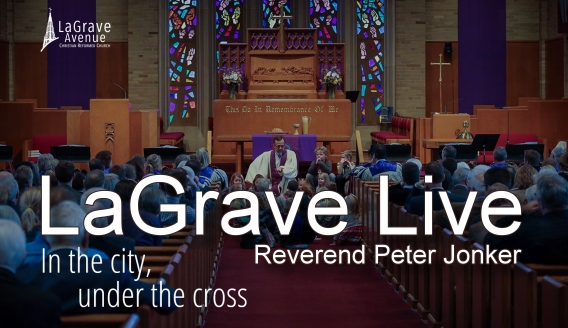
LaGrave Live

If you’re looking for a warm church that commits to an intensely pertinent Gospel in the Reformed tradition of the Christian faith, we invite you to worship with us. Our 1,800 members come from across West Michigan and gather weekly in our sanctuary for relevant Biblical preaching, beautiful music, and inspiring worship. We expand our worship through intentional outreach in our community and world, attentive care for our members, and plenty of spiritual enrichment and social opportunities for everyone.
We focus on a living Savior who provides genuine solutions to the deep needs of a hurting world. We are committed to need-meeting ministry in His name, and we are committed to being real people who enjoy real life and who cry real tears. Because we are a fairly large and diverse group in terms of age, occupation, marital status, lifestyle, and physical ability; our members create many accessible opportunities for community service, Bible study, and small social groups.
We worship God, the Almighty Creator of heaven and earth, and we enjoy expressing our vision of His holiness through traditional music and formal liturgy.
Music plays an integral part of our weekly worship gatherings. Congregational singing—of both traditional hymns and newer ones—is typically supported by our pipe organ. Vocal choirs, handbell choirs, small ensembles, instrumentalists, and vocal soloists provide additional music offerings.
Led by the Holy Spirit, we seek to worship and serve God in all of life, transforming His world and being transformed to reflect the character of Christ.
Founded by 36 Dutch immigrants on February 24, 1887, LaGrave Avenue Christian Reformed Church has always been deeply committed to both this local community and worldwide missions. God has seen fit to guide and bless these commitments with sustained growth, spiritual gifting, and a continual stream of new work for our members.
[00:00] Speaker 1: (instrumental music plays)
[06:09] Speaker 2: (organ music)
[06:19] Speaker 2: (crowd murmuring)
[12:09] Speaker 2: (bell ringing)
[12:24] Speaker 3: Lamb of God most holy, who on the cross did suffer, patient, still and lowly, thyself to scorn didst offer. Our sins by thee were taken, who could our hearts forsake them? Have mercy, Lord Jesus. Christ, to whom all
[14:29] Speaker 3: glory, Christ, the head of every host, Christ, to us yourself once given, to the darkness death suborned, through suffering death had merited, life eternal we inherited, thousand thousand thanks are due, dearest Jesus, unto you. You have suffered in
[17:25] Speaker 3: great affliction, have borne it patiently, even death by crucifixion, our atonement full and free, offered those who need tormenting, that the few should be free, thousand thousand thanks are due, dearest Jesus, unto you. Now from death has been departed, all the sorrows we have suffered, broken the chain of darkness, we will live forever. Broken the chains of death, sin and grief shall never part us, thousand thousand thanks are due, dearest Jesus, unto you.
[18:29] Speaker 4: (instrumental music plays) We gather together this morning to sing praises to our God who sent His Son to this earth to die on the cross and save us from our sins. And that gracious God is here with us this morning and greets us with these words. May grace, mercy, and peace be to you, from God our Father and the Lord Jesus Christ, through the mighty and transforming- forming work of the Holy Spirit.
[19:07] Speaker 3: Amen.
[19:12] Speaker 4: Good morning, and welcome to La Grave Avenue Christian Reformed Church. Whether you're worshiping with us here in person or through our livestream, we're glad you are here this morning. We extend a special welcome to anyone who is visiting with us, and we invite you to a special coffee time after the service that includes visitors, regular attenders, and members who have joined less than two years ago. This is a chance for you to meet some new people, and that will be down in our parlor, which is down the hall and to the left. For the rest of you, please check your bulletin for other 10:00 hour opportunities. If you choose to go to the multipurpose room during that time, you will see index cards and boxes on the puzzle tables. This is a survey method for a group here at church called Generation Spark, a group of us, including myself, that is seeking to develop more deliberate ways for our church to grow relationally and spiritually through intergenerational relationships.
[20:19] Speaker 4: So it's an important task and one that we'd like to hear from you about, uh, so take some time to fill out those cards and put them in the box. And we thank you in advance. This morning marks the second Sunday in the season of Lent. It's the time in the church calendar year where we turn our eyes toward the cross, the place where Jesus died so that we might be saved. As sinful people, God calls us to confess our sins before Him, and we will do that together this morning through song. (soft music plays) (singing) Dear God, forgive us. Forgive you and me. Love you with all our heart and strength and mind. I see the cross there, teach my heart to fear. Oh, let me see you and oh, let me know. Let us continue to confess our sins in a time of silent confession. Lord, thank you for hearing our prayers of confession. We ask that you continue to create in us clean hearts and renew steadfast spirits within us, so that we may honor you in all we say and do. Amen.
[22:29] Speaker 4: Our sinfulness is not the end of the story. Join me now as we declare the good news that through Christ's sacrifice on the cross, we are forgiven. He himself bore our sins in his body on the cross, so that we might die to sins and live for righteousness. By his wounds, we are healed, for we were like sheep, going astray. But now we have returned to the shepherd and overseer of our souls. Thanks be to God (organ music plays) (singing) And can it be that I should gain anything sweet, but the Savior's blood?
[24:27] Speaker 4: By His wound and scar and broken body
[24:39] Speaker 3: Amazing love, how can it be that you, my Lord should die for me. Amazing love, how can it be that you, my Lord should die for me. He left His Father's throne above, so free, so infinite His grace. Empty Himself of all but love and bled for ever without reprieve. Wow, mercy fits, immense and free, for oh, my God, without a plea. Amazing love, how can it be that you, my Lord should die for me. Oh, the rich can come by faith, for
[27:38] Speaker 3: Christ the Lord will be his guide. Pardon is here, and healing near, and oh, what righteousness divine. For the cross is my one hope, to live for God, to die for. Amazing love, how can it be that you, my Lord should die for me.
[27:50] Speaker 5: All right, children. Time for the children's message. Come on down. It's always good to see you, and I would like to say a few words. And, um, I, as they come up, you guys can come up and sit. Uh, the last hymn of, uh, after the sermon, it, uh, we, um, we missed in the bulletin. We wanna sing the second stanz- uh, stanzas a cappella. I was convinced that even if we just did that, you guys would pick it up and it'd be fine. But Dr. Visser thought I should tell you, so I am telling you. Hello, everyone. I'm gonna, I'm gonna talk to you a little bit about the cross. Um, in my sermons, all my sermons before we get to Easter are about the cross of Jesus and Jesus dying on the cross. And you know that sometimes, in a lot of our songs, when we sing, we sing about the cross. And the other thing we have is, as we come into this, this building, as we come into this room, w- we are surrounded by the cross. There are so many crosses in this room.
[28:50] Speaker 5: I wonder if you can even guess how many crosses are in this room. And I, I think I know. I'm gonna, I'm gonna tell you. Look around and tell me, where do you... Where is a place that you see a cross in this room? Okay, there it is up there on the top of that thing called the reredos. Okay. And there's a cross over there. And some of you pointed to the window. It's a beautiful window, especially with the sun coming through it. There's Jesus dying on the cross in the window. Here's some other ones. Yeah, see? I can see that, all that is pointing up. See those three in the bricks there? You can just see 'em. And then there's three more over there. So we're up to, I don't know, se- nine or 10? But there's way, way more. So for example, you see every time Jesus is in the windows? In his halo, right? You know that. There's a cross. Jesus is in these windows a lot, so there's a lot of crosses in the halos. And then, this is where it really starts to get a big number. Look up at those lights.
[29:51] Speaker 5: See on the side of those lights, what do you see? The cross. So every single one of those lights has eight crosses on them. So three of them, 24. 12 altogether. 12 times 24 equals 288 crosses just in those lights. Wow. And then see those things on the wall there, on the side? With the, they're lights on the wall? The sconces? There's three crosses on every one of those. By the time you count all of them, I think there's more than 360 crosses in this room. So that's like one cross for every day, every day of the year, which is, I think, pretty great. The cross is so important. We do this, we have so many crosses because it's so important, because there's so many things in our life that are hard.... and that are too hard for us. There's so many things in the world that are hard and too hard for us. When we see Jesus die on the cross, we know that He loves us and we know that He is going to take care of those things. And that's so important on every day of our life.
[31:03] Speaker 5: Congregation, what is our prayer for these children?
[31:06] Speaker 3: The Lord be with you. And also with you.
[31:09] Speaker 5: Go in peace.
[31:23] Speaker 4: One announcement before we go to God in prayer this morning, Millie Vriend is hospitalized after a fall and will head to rehab this week. So we will pray for strength and good healing for her. Let us go to God in prayer. Dear God, the psalmist writes, "Great is the Lord and most worthy of praise. His greatness, no one can fathom." While we may not be able to grasp the fullness of who you are, Lord, you are still worthy of praise. We praise you for your faithfulness from one generation to the next. We praise you for your love, a love so strong that you were willing to send your son to die on the cross and save us from our sins. And we praise you for being both just and merciful, that you can hold both of those things in perfect unity in a way that we will never fully understand. Great are you, Lord, and most worthy of praise. The psalmist writes, "Give thanks to the Lord for He is good. His love endures forever." We thank you, Lord, for the warm weather and sunshine this past Friday.
[32:39] Speaker 4: Thank you for our missionary, Reverend Mark Naby, and their work as ReFrame's French ministry leader. Thank you for our church leaders, including elders, deacons, and pastors. Be with members of our congregation as they discern whether to accept their nominations for elders and deacons. Give them wisdom and direction toward where you would have them serve. And thank you for our city, Lord, and its continued work in evaluating how to address the issue of homelessness. Be with us, Degage, Mel Trotter, and the other partners in ministry as we strive to work together. We give thanks to you, Lord, because your love endures forever. The psalmist writes, "How long, Lord? Will you forget me forever? Will you hide your face from me?" We cry out with the psalmist today, Lord, wondering how long until you come again? How long must we wait until you come and make all things new? As we await that day, we lift up to you those in need. We pray for Millie as she is in the hospital.
[33:55] Speaker 4: We think of Jean, Caleb, and Bob, as they continue to recover from different surgeries and ailments. Give them strength and swift healing. We pray for Andrea, Steve, Momwani, and others whose lives are impacted by cancer. Draw near to them and rid them of their cancer. And Lord, we pray you be with the family of Yvonne Pilemon as they grieve and prepare for her funeral service, where they can spend time sharing stories and celebrating her life. Along with our congregation, we also lift up our world. Be with world leaders, including President Trump, and grant them wisdom. Protect civilians, our servicemen and women, and bring lasting peace to the Middle East and the world as a whole. While we cry out to you, Lord, and ask how long, we also rest in the good news that you are in control. And so we end our prayer just as the psalmist concludes theirs, declaring that we trust in your unfailing love.
[35:06] Speaker 4: Our hearts rejoice in your salvation, and we will sing of your praises, for you have been good to us. In your name we pray, amen.
[35:18] Speaker 3: Call to remembrance, Lord. Call to remembrance, Lord. Call to remembrance, Lord. Call to remembrance, Lord. Thy tender mercies and thy loving kindness which hath been ever of old. Which hath been ever of old. Which hath been ever of old. Oh, remember, Jesus, thy loving kindness. Which hath been ever of old. Which hath been ever of old. Which hath been ever of old. Oh, remember, Jesus, thy loving kindness. Which hath been ever of old. Which hath been ever of old. Which hath been ever of old. (choir sings) Not according to my mercy. Think thou on me, O Lord. But according to thy mercy. Think thou on me, O Lord.
[37:25] Speaker 3: For thy
[37:29] Speaker 3: goodness.
[41:54] Speaker 3: (instrumental music plays) (choir sings) And I think about-- I think about when I was a kid, I used to come up here when I was a kid and I used to watch these guys playing and I used to love watching them play and I loved my dad used to bring me out here when I was little and he used to watch me play and he used to tell me all the time how much he loved me and he used to tell me how proud he was of me. And I remember one time when I was little, I had gotten a football and I had taken it across the field and I had thrown it and I had hit the guy and I had made him fall down and I had broken his arm. And I remember my dad coming up to me after the game that day and he goes, I'm so proud of you. And I looked at him and I went, I know, Dad. I know. You're right. I know you're proud of me. And I remember thinking in that moment, I said, That's what I want to be when I grow up. I want to be a doctor.
[42:53] Speaker 3: And I remember one time when I was a kid, I had gone to visit my grandmother in the hospital and she had told me a story about how she had been in labor and she had had this midwife come in and she had told her story to the midwife. And during the birth of my grandmother, the midwife had told her, He's going to be a doctor. She goes, I know he's going to be a doctor. And I remember thinking in that moment, I went, I know. I know what she knows. She knows I'm going to be a doctor when I grow up. And I remember one time when I was a kid, I had gone to visit my grandma in the hospital and she had told me a story about how she had been in labor and she had had this midwife come in and she had told her story to the midwife. And during the birth of my grandmother, the midwife had told her, He's going to be a doctor. She goes, I know he's going to be a doctor. And I remember thinking in that moment, I went, I know. I know what she knows. She knows I'm going to be a doctor when I grow up.
[42:53] Speaker 3: And I remember one time when I was a kid, I had gone to visit my grandma in the hospital and she had told me a story about how she had been in labor and she had had this midwife come in and she had told her story to the midwife.Praise God from whom all blessings flow. Praise Him all creatures here below. Praise Him above ye heavenly host. Praise Father, Son, and Holy Ghost. Amen.
[44:17] Speaker 5: Our Bible reading this morning is from Psalm 51, Psalm 51. I'm gonna read the whole Psalm, and that is found on page 888 of your pew Bibles. Uh, those of you who've been coming know that we are, um, and I mentioned this in the children's sermon too, of course, through this whole season of Lent we're f-focusing on different passages in scripture that bring us to the cross and teach us things about Christ's cross. And today we're doing that with Psalm 51. Psalm 51, I think many of you know, and if you don't you can read it there in those little italicized... Well, I don't know if they're italicized in your Bible, they're italicized in mine. Those words before verse one which said that these are the words that David wrote when the Prophet Nathan came to him after Da- David had committed adultery with Bathsheba. Of course, he did more than commit adultery. He also had Bathsheba's husband murdered, as you will recall.
[45:15] Speaker 5: This is what David said after he was confronted with this crime: "Have mercy on me, oh God, according to your unfailing love, according to your great compassion, blot out my transgressions. Wash away all my iniquity and cleanse me from my sin, for I know my transgressions and my sin is always before me. Against you, and you only, have I sinned and done what is evil in your sight. So you're right in your verdict and justified when you judge. Surely I was sinful at birth. Sinful from the time my mother conceived me. Yet you desired faithfulness, even in the womb. You taught me wisdom in that secret place. Cleanse me with hyssop and I will be clean. Wash me and I will be whiter than snow. Let me hear joy and gladness, let the bones you have crushed rejoice. Hide your face from my sins and blot out my iniquities. Create me a pure heart, oh God, and renew a steadfast spirit within me. Do not cast me from your presence or take your Holy Spirit from me.
[46:29] Speaker 5: Restore to me the joy of your salvation and grant a willing spirit to sustain me. Then I'll teach transgressors your ways so that sinners will turn back to you. Deliver me from the guilt of bloodshed, oh God, you who are God my Savior, and my tongue will, will sing of your righteousness. Open my lips, Lord, and my mouth will declare your praise. You do not delight in sacrifice, or I bring it. You do not take pleasure in burnt offerings. My sacrifice, oh God, is a broken spirit. A broken and contrite heart, you, God, will not despise. May it please you to prosper Zion, to build up the walls of Jerusalem, and you will delight in the sacrifice of the righteous and burnt offerings offered whole, then bil- bulls will be offered on your altar." This is the word of the Lord.
[47:25] Speaker 3: Thanks be to God.
[47:32] Speaker 5: I read Psalm 51 this morning as a way to talk about an old and familiar part of Christian piety and Christian practice, and that is the work of contrition. Contrition. Contrition, and we're gonna talk about it today, and the reason it fits into this sermon series is because contrition is, is one of the emotions, one of the attitudes of heart that it's appropriate to have when you come to the cross of Christ. When you're standing in front of the cross and you consider what Jesus did there, there are all kinds of emotions that might, and probably should, go through your heart. And, and one of those is contrition. Now, what is contrition? Some of you might be saying, "I, I, I know that word but I'm not sure exactly what it means." Contrition is godly sorrow for your sins, right? When someone is contrite, they are sorry, right? Or so-ry, depending on where you're from. And, and contrition then would be the ongoing sense of being sorry for your sins.
[48:36] Speaker 5: And it's always been a part of Christian piety, uh, for, for thousands of years. And people are still writ- writing on it. Recently I read an article by a guy named Robert Roberts, and he was pushing contrition on modern Christians. He says contrition is something that we should all consider and work on for our own hearts. It's not just for people who've committed some sort of titanic sin like, like David. Every single Christian person could stand to work on contrition and cultivate it in their hearts. It's, it's a, an important spiritual emotion like joy......or compassion or peace. Contrition belongs with all of those. Which is interesting, because if I were to say to you, "Okay, write down a list of Christian emotions. Write down a list of the sorts of attitudes that's important to keep in the Christian heart." You would put joy and compassion and hope and peace. I wonder how many of you would have written contrition. Roberts values contrition highly. So does David. So does David.
[49:46] Speaker 5: David thinks contrition is really important. David thinks that contrition is better than burnt offerings. "I do not bring you any offerings," he says at the end of the Psalm I just read. "My offering is a broken spirit. A broken spirit and a contrite heart, you, Lord, will not despise." God accepts contrition and it becomes, when we have it, a way in which He sends His mercies into our heart. So contrition is an old practice and it, it runs deep. And David approves of it and Robert Roberts approves of it, but I wonder how many of us really want it. How many of us pray for a contrite heart? For those other spiritual emotions, joy, hope, compassion, absolutely. "Lord, give me joy. Lord, make me more compassionate. Lord, fill my spirit with hope." But contrition? Psalm 51 is a revelation of what a contrite heart looks like. Do we want our heart to be in that state? I mean, David seems like he's absolutely crushed in that Psalm, right? Is that something we wanna nurture? We might.
[51:04] Speaker 5: And the reason I say we might is because contrition is a remedy, contrition is a gift that helps heal and address some of the deepest wounds of the human heart. And what contrition aims at is the deep sense of sinfulness that human beings carry around. The wound of our deep sinfulness. Now if I walked out into the world and started talking to people about their, their deep sense of sinfulness, I think this is a wound that everyone has, by the way. Every single person has this wound. If I were to go out into the world and start talking to them about that, many of them would say, "I'm not sure." It's just not, it's not a category people use these days. But you know that wound is there because people, our society has invented new language for it. They may not talk about deep sinfulness but they will talk about our sense of unworthiness, or our sense of failure. There's tons of stuff written about shame these days, or guilt, right? These things, society recognizes.
[52:09] Speaker 5: Every single person walks around with a sense of moral failure. They don't think about it all the time, but it's there, and it surges to the surface sometimes. Contrition is for those wounds. Of course, people don't all turn to contrition to deal with those wounds. In our society, people try all sorts of things to deal with that deep feeling of guilt, of unworthiness. I did some reading about self-harm this week. Apparently, according to what I read this week, one in five young people in our society try some form of self-harm, so cutting or something like that. The technical term is NSSI, non-suicidal self-injury. So one in five. And if you go on the, uh, website of the Mayo Clinic and look what are the causes of self-harm, it's feelings of worthlessness, anger, guilt, rejection, and self-loathing. So the young people have these feelings of self-loathing. They have these feels of unworthiness.
[53:19] Speaker 5: They have these feelings like, "I'm no good." And self-injury is what they turn to to try to deal with those feelings, which is obviously not great. Course, that's not the only remedy people try to apply to this wound. Drugs and alcohol are also a common attempt to medicate. Sometimes people meet these wounds with angry denial, just by pretending that they're not there. It's been increasing in our society, I think. Deny everything. Never apologize. Regrets are a form of weakness. Always show strength. Always express confidence. If there's a problem, blame somebody else. There's a lot of that around these days, and it's toxic. Yet another strategy people have for dealing with this deep wound is, is positive self-talk. And this one's a little bit more promising, and I think a little bit more biblical, right? The Bi- the Bible says lots of positive things about us. "You are made in the image of God. I will never leave you or forsake you.
[54:29] Speaker 5: You are my beloved children." These are all extremely, deeply positive things that God says about us, and we, we should say these things to ourselves. We should remind ourselves of those good things, that we are beloved of God. And we should remind ourselves of those good things, especially for the guilt and shame that's sort of excessive in our life, right? All of us, once in a while, will beat ourselves up. We'll, we'll be too hard on ourselves. We'll go too far in the way we, we treat ourselves. And for, for those kinds of issues, positive self-talk, "You're good, you're okay, you're enough," that's fine. But for our real moral failures, for our moral failures that actually do harm to another human being, is positive self-talk enough?Could David get over the pain of what he had done through positive self-talk? "You're okay, David. You're enough." For those kinds of wounds, only contrition will do. What is contrition? What does it look like? I think there are three parts to it.
[55:42] Speaker 5: And using Psalm 51, I wanna try to lay it out before you. Um, and let's start by doing that, let's remind ourselves of, of the story of, um, and I said it briefly what happened to lead to Psalm 51. I want to remind ourselves the entire story, because the first realization that you need for contrition is to realize how deep your sin goes. So David, he sees Bathsheba bathe, uh, bathing on the roof, he desires her, and in an act that we would call sexual assault today, he brings her to the palace and sleeps with her. And then when she's pregnant and he needs to cover that up, he has her husband murdered. And he thinks he's gonna get away with it until Nathan, you will remember, confronts him. And you remember that Nathan does that with a story. He says, uh, "Your Majesty, there is a rich man in the kingdom who has many, many flocks and many, many herds and many, many sheep and many, many lambs.
[56:42] Speaker 5: And he lives next door to a poor man who has one sheep, whom he loves, and he treats that sheep like a pet. He feeds her from his table. He sleeps in the same room with her at night. Well, this rich man all of a sudden had visitors come over and he needed a sheep for a meal, but instead of taking one of his many, many sheep, he took the sheep of the poor man, killed it, and served it for dinner. What are we gonna do about that, David?" And David says, "The person who did this must die." And Nathan says, "You are the man." And David is cut to the heart, and what he experiences is contrition. David does far more than admit his guilt in this psalm. He admits something deeper than guilt. When we admit our guilt, which is a good thing to do, it's possible for us to say, "Yeah, hey, you know what? I did it. I admit it. I did something wrong. But you know what? That wasn't me. That's not who I am." Right? "It was a moment of passion. I lost myself for a second.
[57:57] Speaker 5: That's not me." That's not what David does here. David says, "Surely I was sinful at birth, sinful from the moment my mother conceived me." Right? So, so the difference is, David doesn't say... The ru- He says, "The ruthlessness and lust that led me to do these things, they were not momentary. They've always been a part of me. This goes all the way down. This is deep in my heart. So God create in me a, a new heart. I need a new heart. This is deep. It's not a one-off thing," says David. David's sin is so big and baroque, let me give you a more pedestrian example. Imagine that I'm a, a father of a 15-year-old girl, and it's after dinner and I'm watching a basketball game on TV, and my daughter comes in and she's talking to me about something that happened at school that's really upsetting her and she wants my advice. And I'm, I'm sort of half watching the game and half listening to her, and she calls me out.
[59:01] Speaker 5: And she says, "Dad, you're not listening to me." If I apologize to her and say, "Yeah, I know, I admit I did that, I'm sorry," that's guilt. But if I say to myself, at some point I realize, "You know what? This... I'm... This is me. I do this all the time. I come home after work, I have dinner, I sit down in front of the TV, I watch something, I sort of numb myself, I have a drink. I'm paying all my attention, I'm putting entertainment over my care for these people who love me. There is something wrong with me. There is something that needs to change." That's contrition. Contrition sees the depth of the problem, first thing in contrition. The second thing that contrition sees is it needs help with the problem. Again, when you just admit guilt, you might say, "Uh, you know, I did it, I messed up, I w- And I won't do it again. I'm gonna change, I promise. I'm gonna change. I won't do it again, you'll see. I'm gonna make myself a new person." By contrast, contrition says, "You know what?
[01:00:13] Speaker 5: I messed up, I did it, and you know what? If I'm honest with myself, under the same conditions, I might well do this again. I might do this again." Again, look at Psalm 51. How many times in this psalm after his sin does David say to God, "I'm gonna change, Lord. I'm gonna, I'm gonna do something, I'm gonna do better for you. I'm gonna, I'm gonna turn this thing around"? Zero. Right? Zero. There's none of that. All the verbs of change, all the verbs about making David new and turning things around, they're all God's verbs. They don't belong to David. The only thing David does is offer his contrite heart. "God, have mercy. God, cleanse me. God, give me a new heart. God, please do these things because I can't do them, because I am helpless." Contrition realizes how deep it goes and that you're helpless against it. It's true in another Bible passage, Romans 7. Another contrition passage. Remember Romans 7?
[01:01:20] Speaker 5: That's that famous passage where Paul's struggling with his own sin and he's saying, "You know what? I..."I know the good and in my mind, I wanna do the good, but I keep doing what is wrong. The good that I wanna do, that's not what I do. I keep doing what's wrong." And he finishes that up by saying, "What a wretched man I am. Who will rescue me from this body of death?" I'm helpless. Which brings us to the third and last part of contrition, which is the most important part. In contrition, you realize how deep the problem goes, you realize that you're helpless against the problem, but then third, and most importantly, in the third stage, you realize that there is someone who can help you. There is a redeemer, Jesus. He can help you with this. He came to help you with this. He died to help you with exactly this. I just quoted Roman 7, where Paul finished his argument by saying, "What a wretched man I am.
[01:02:30] Speaker 5: Who will rescue me from this body of death?" Do you remember what he says right after that? "Thanks be to God. He gives us the victory through Jesus Christ, our Lord." Without this third stage, contrition is not contrition. In fact, without this third stage, contrition is just misery. If, if all you have is a, a, a knowledge of how deep the sin goes and a knowledge that you're helpless against it, that's, that's no good. That's a, that's a recipe for despair. There's a whole bunch of people in this world that all they have is stage one and two of contrition, and it's no wonder they go to the drugs and the alcohol and the cutting. But in the Psalm, David knows where to go, and he goes there right at the beginning in verse one, "Have mercy on me, oh God, according to your great compassion, according to your steadfast love." He hurls himself upon the compassion and mercy of God, 'cause he knows that's all he's got. We've got more than David.
[01:03:38] Speaker 5: Because we've seen the compassion and mercy of God become a human being in Jesus Christ, and Jesus went to the cross to wash away all our iniquity, to cleanse us from our sins, to put in us a new heart and a right spirit. I know that sometimes when there's a sermon about these kinds of subjects, and especially when Calvinists and Christian Reformed people talk about things like contrition, there's probably some of you here this morning who said, "Oh, no, talk about sin and how miserable we are and how sinful we are. Typical Calvinists, always focusing on their sin." I get why people say that, but, but contrition is not a morbid thing. It is a joyful thing. If all you have is one and two, yeah, it's morbid. But if, if it's your failure before the cross of Jesus, it's not morbid. It's joy. It's knowing that no matter what you've done, there's a second chance for you.
[01:04:43] Speaker 5: It's knowing that there's nothing that Jesus wouldn't do to go down into the deepest part of your sin and pick you up and wash you off and bring you home.
[01:04:53] Speaker 3: Amen.
[01:04:55] Speaker 5: And isn't that what everyone wants to hear, right? The world is so full of cynicism and fear and hopelessness, and here's a word that goes right down into our deepest hopelessness and lights a fire of hope. So let me say humbly, that maybe a little contrition in your life wouldn't be so bad. Like, if in your prayers every night, you brought to God the things that you know, and you know what those things are that are, that are just broken in you, the things that you struggle with again and again. "Lord, you know I care way too much about what people think. I pretend that I don't, but you know that I do. Wash me." "Lord, I've become cynical. My hope is so thin. I, I roll my eyes at happy endings. I'm quick with a snide comment. Wash me." "Lord, I'm spiritually empty. Life has just beaten me up. I'm, I'm, uh, I, my hope is almost gone. Uh, my faith is paper thin. Wash me." That would not be an easy thing to do.
[01:06:17] Speaker 5: But wouldn't it be good to know that Jesus comes to you in that place and washes you clean? So what are you waiting for? A broken spirit and a contrite heart, the Lord will not despise. Amen. Lord Jesus, I thank you for this good word, for your cross, Lord. The way that it goes down into the deepest part of our sin and the deepest part of our misery. Oh Lord, may your word of hope sink deep in our bones here this morning. Give us relief from the fears and from the guilt that we struggle with, and lead us in the paths of righteousness. Amen.
[01:07:13] Speaker 5: (instrumental music plays)
[01:07:35] Speaker 3: Nearer, still nearer, close to thy heart; Father, be thy Savior so precious a part; fold me, oh, fold me close to thy breast; shelter me safe in that haven of rest, shelter me safe in that haven of rest. Nearer, still nearer, nothing I bring, naught as an offering to Jesus, my king; only my sinful, love-contract heart; grant me the cleansing thy blood doth impart, grant me the cleansing thy blood doth impart.
[01:10:14] Speaker 3: Nearer, still nearer, Lord, to thee I sin with its follies I gladly resign; all of its pleasures, all that is mine; give me a Jesus, my Lord crucified, give me a Jesus, my Lord crucified. Nearer, still nearer, while Christ shall rise, 'till safely glory my endless heir; look down from heaven's paradise, nearer, my Savior, still nearer to. Nearer, my Savior, still nearer to me.
[01:12:14] Speaker 5: Congregation receive the blessing of your Lord. The grace of our Lord, Jesus Christ, the love of God and the fellowship of the Holy Spirit be and abide with you all.
[01:12:25] Speaker 3: Amen. Amen. Amen. (bell ringing)
[01:13:45] Speaker 6: (organ music)