
LaGrave Live, February 8, 2026
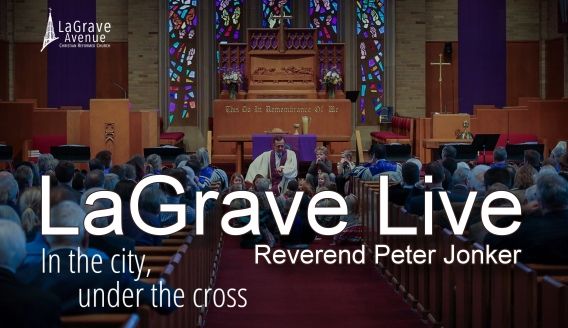

LaGrave Live
LIVE Evening Worship - 2026-02-08
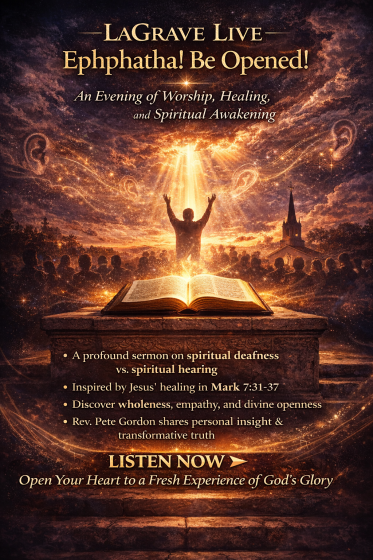
Ephphatha! Be Opened!
About The Service:
we welcome Rev. Peter Gordon to the pulpit.
Order of Worship:
https://lagrave.org/wp-content/uploads/2026-2-8-PM-Order-of-Worship.pdf
About Us:
We are a traditional CRC church in the middle of Downtown Grand Rapids, MI, worshipping at 8:40am, 11:00am, and 6:00pm. (10:00am and 6:00pm during the summer months)
We'd love to hear from you:
Connection: https://www.lagrave.org/contact
Let us pray for you:
Prayer: https://www.lagrave.org/prayerrequest/
Giving: https://www.elexiogiving.com/App/Giving/lagr107178
The February special offering is for The Bridge. The Bridge is part of Arbor Circle, which offers emergency shelter for youths, and additional counseling for youths and their families.
Listen on the go:
Amazon Music: https://bit.ly/LGPodAmazonMusic
Apple Podcast: https://apple.co/3tuOdwQ
Google Podcast: https://bit.ly/LGPodGoogle
Soundcloud: / lagravecrc https://soundcloud.com/lagravecrc
Spotify: https://spoti.fi/3yXDFaT
Follow us!
Facebook: / lagravecrc https://www.facebook.com/lagravecrc
Instagram: / lagravecrc https://www.instagram.com/lagravecrc
Website: https://www.lagrave.org
#LaGrave #LaGraveCRC
Ephphatha: Finding Wholeness in Spiritual Openness
Ephphatha: Be Opened
A Sermon on Physical Silence and Spiritual Awakening by Rev. Pete Gordon
"I am as whole as I can be, and I am as whole as God needs me to be... Spiritual deafness is a choice; physical deafness is a perspective." The "Ephphatha" Experience Beyond simple healing, it means Anoigo: opening up to a fresh experience, like clearing stale air from a room to let the glorious in. Empathy vs. Sympathy Disability is not a result of sin but a platform for God's works. The "broken" are often the ones who listen most proactively. Universal Disability Everyone is spiritually disabled post-Fall. Physical healing is the "icing," but spiritual forgiveness is the "cake."
The Core Message
Speaker Profile
Scripture Focus
Key Keywords
In this evening service, Reverend Pete Gordon explores the profound intersection of physical disability and spiritual condition through the biblical narrative of Jesus healing a deaf man. Drawing from his personal experience with profound hearing loss, Gordon challenges the traditional "healing" narrative, suggesting that true wholeness comes from being spiritually "opened" to the glory of God. The service integrates traditional liturgy, the Belgic Confession, and a call to support campus ministries at Grand Rapids Community College.
Detailed Point Summary
The Call to Worship and Liturgical Foundation
The service opened with a call to worship from Psalm 96, emphasizing the glory due to God's name and the call for all creation—from the heavens to the trees of the forest—to rejoice before the Lord’s righteous judgment. This was followed by congregational singing and a formal greeting, establishing a communal atmosphere of reverence. Reverend Gordon introduced himself as a campus pastor for Jabez Ministries at GRCC, a ministry focused on and led by people with disabilities. He noted the personal significance of the evening's music, particularly the oboe, as one of the few instruments he can hear clearly despite his severe hearing loss.
The Priority of Spiritual Healing
Central to the sermon were two accounts of healing from the Gospel of Mark. In the story of the paralytic (Mark 2), Gordon highlighted that Jesus prioritized the forgiveness of sins over physical restoration, calling the physical healing the "icing on the cake". This theme was reinforced by a communal reading of the Belgic Confession, a 17th-century document written by Guido de Brès. The confession describes the Church as a "holy congregation of true Christian believers" preserved by God across the world, regardless of size or perceived strength.
The Meaning of "Ephphatha"
In Mark 7:34, Jesus uses the Aramaic word Ephphatha. While often translated simply as "Be opened," the Greek equivalent Anoigo suggests a deeper transformation:
- Beyond the Physical: It is more than just opening a door; it is like opening a window on a summer day to let stale air out and fresh air in.
- Fresh Experience: It signifies opening oneself to a "fresh experience" of God's glory and the Word.
- Empowerment: The healing was not just a "fix," but an empowerment for the man to become a witness to the Kingdom.
Redefining Disability and Empathy
Gordon provided a deep exegesis of Mark 7:31-37, where Jesus heals a deaf man in the Decapolis. He argued that Jesus’ actions—putting fingers in ears and spitting—were not merely "fixing" a broken person but making the Gospel accessible and fulfilling the prophecy of Isaiah 35. Gordon challenged the "hermeneutic of suspicion" that views disability as a result of sin or brokenness. Instead, he posited that physical deafness could offer a unique perspective on "spiritual deafness," noting that everyone, regardless of physical ability, suffers from selective spiritual hearing as a result of the Fall.
Personal Testimony and the Theology of Wholeness
The sermon concluded with a powerful personal anecdote regarding Gordon's encounter with a "deliverance minister" who claimed his deafness was caused by unaddressed sin. Gordon rejected this view, asserting that he is "as whole as God needs [him] to be" and that his disability provides a specific lens for his ministry. He urged the congregation to move from sympathy to empathy, recognizing that the "spiritual disabilities" of the Pharisees—their pride and lack of vision—were the true targets of Jesus' corrective miracles.
Ministry Focus: Jabez Ministries (GRCC)
A campus outreach focused on students and faculty at Grand Rapids Community College.
To-Do / Next Steps
- Engage with Jabez Ministries: Seek out the ministry team members present at the service to ask questions about their work with students with disabilities.
- Support GRCC Outreach: Provide Bibles for the 50 to 100 students who visit the ministry table daily, many of whom are "hungry for the Word" or questioning their faith.
- Practice Proactive Listening: Emulate the "proactive listening" of the hearing-impaired by focusing intently on the words of others to ensure true understanding.
- Self-Reflection on Spiritual Disability: Identify personal "spiritual disabilities"—areas where one might be spiritually deaf, blind, or lame—and bring them before the Lord for healing.
- Shift Perspective on Disability: Move toward a "theology of gifts" by asking others, "What are your gifts?" rather than focusing on their perceived limitations.
Conclusion
The service serves as a reminder that physical limitations do not equate to spiritual brokenness. Through the lens of "Ephphatha," Reverend Gordon invites believers to recognize that Christ’s ultimate goal is to open the human heart to a fresh experience of grace, ensuring that everyone—regardless of their physical state—is empowered to walk the "highway of holiness."
LaGrave Live
If you’re looking for a warm church that commits to an intensely pertinent Gospel in the Reformed tradition of the Christian faith, we invite you to worship with us. Our 1,800 members come from across West Michigan and gather weekly in our sanctuary for relevant Biblical preaching, beautiful music, and inspiring worship. We expand our worship through intentional outreach in our community and world, attentive care for our members, and plenty of spiritual enrichment and social opportunities for everyone.
We focus on a living Savior who provides genuine solutions to the deep needs of a hurting world. We are committed to need-meeting ministry in His name, and we are committed to being real people who enjoy real life and who cry real tears. Because we are a fairly large and diverse group in terms of age, occupation, marital status, lifestyle, and physical ability; our members create many accessible opportunities for community service, Bible study, and small social groups.
We worship God, the Almighty Creator of heaven and earth, and we enjoy expressing our vision of His holiness through traditional music and formal liturgy.
Music plays an integral part of our weekly worship gatherings. Congregational singing—of both traditional hymns and newer ones—is typically supported by our pipe organ. Vocal choirs, handbell choirs, small ensembles, instrumentalists, and vocal soloists provide additional music offerings.
Led by the Holy Spirit, we seek to worship and serve God in all of life, transforming His world and being transformed to reflect the character of Christ.
Founded by 36 Dutch immigrants on February 24, 1887, LaGrave Avenue Christian Reformed Church has always been deeply committed to both this local community and worldwide missions. God has seen fit to guide and bless these commitments with sustained growth, spiritual gifting, and a continual stream of new work for our members.
[00:00] Speaker 1: (music)
[06:09] Speaker 2: (Slow music playing)
[10:24] Speaker 3: Our call to worship this evening is coming from, uh, Psalm 96, uh, 8, verses 8 to 13. "Ascribe to the Lord the glory that is due His name, bring an offering and come into His courts. Worship the Lord in the splendor of his holiness. Tremble before Him, all the earth. Say to the nations, 'The Lord reigns.' Yes, the world is established as to never be moved. He will judge the peoples with equity. Let the heavens be glad, and let the earth rejoice. And let the sea roar and all that is in it.
[10:59] Speaker 3: Let the field exalt and everything that is in it, that it shall be, the trees of the forest sing for joy before the Lord, he, before he comes, they come to judge the earth and He will judge the world in righteousness and peoples, all the peoples, in faithfulness."
[11:18] Speaker 2: (Piano music playing) (Congregation sings) I've got a thousand tongues to sing My great Redeemer's praise; Oh, glorious love, how I owe thee, How deep and sum this grace! Time brings a sad escape, and then my Lord, Thus listening to my name, To the sound of my name.He bears our guilt and ransom's sin. He shines the prison free. His breath has made the flower stream. Its blossoms ever more green. In freedom's valley, through death's dark vale, O merciful Savior, still carrying the cross of grace, you came to bear it to me. There, on Calvary's mountaintop, he died the curse to break; its shame, the curse of sin, forever broke. Now glory, praise, and love be thine forever, here below, above, in earth and heaven. Amen.
[13:32] Speaker 3: People of God, receive now the Lord's greeting. The grace of our Lord Jesus Christ, and the love of God, and the fellowship of the Holy Spirit be with us all.
[13:43] Speaker 2: Amen.
[13:51] Speaker 3: Well, thank you for coming out on a Super Bowl evening.
[13:59] Speaker 2: (laughs)
[14:00] Speaker 3: Um, it's great to see everyone. It's great to see some friends and some visitors. Uh, for those of you who don't know me, I am Reverend Pete Gordon. I am sent by this church to be a campus pastor at GRCC, Grand Rapids Community College. And we work Jabez Ministries, as Jabez Ministries, and it is a ministry to people with disabilities, for people with disabilities, with people with disabilities, and by people with disabilities. Um, most of my ministry team is here. Actually, I use that term, I'm more like their employee than anything else. But, uh, they're here tonight, and please seek them out and ask them some questions. Uh, they're a great bunch of young people, and I wouldn't have the ministry without the- without them. Uh, one other thing I like to mention, um, that tonight's sermon is about deafness; physical deafness and spiritual deafness. It's being preached to you by somebody who is physically deaf.
[15:05] Speaker 3: I have a profound hearing loss in one ear and a severe hearing loss in the other. I have a pretty good set of hearing aids, but it's not perfect. And I have to say, um, tonight's music, um, I'm getting a little choked up, because the oboe is one of the very few instruments I can actually hear clearly. And I am an absolute, uh, nut about Bach's Arioso, and I was just... I am ent- enth-... I can't, I don't even have words to express what I'm feeling right now, except that whatever your hearing is, like me, deaf, who has to use hearing aids and lip read, some people have to have, communicate strictly by ASL, some people communicate with a set of ears that work, partially work, or don't work at all, but they manage to communicate somehow. Somehow. I have to relin- I, I, I'm to remind people that (sighs) you, those ears are not just for hearing. God gives the stability to hear His glory, and we heard it here tonight, so thank you. (sighs) Tonight's reading is taken from Mark 2:1-12.
[16:32] Speaker 3: And as I said, we're, um, gonna be looking at deafness, but primarily spiritual deafness. Spiritual disabilities, in general. And as we- as I go through the sermon, please think about these words from Mark 2, and the order in which they're said, and the emphasis Jesus places on them. I think it's very revealing. This is Mark 2, um, starting with verse 1. "And he returned to Capernaum after some days, and it was reported that he was home." Yeah, that was Jesus' hometown, or home base. "And many were gathered together, and there were, n- so many, there was no more room, not even at the door. And as he was preaching the, the Word to them, they came, bringing him a paralytic carried on, by four men. And when they could not get near him because of the crowd, they removed the roof above him, and when they made an opening, they let the bed down on which the paralytic lay.
[17:37] Speaker 3: And when Jesus saw their faith, saw their faith, he said to the paralytic, 'Son, your sins are forgiven.' Now, some of the scribes were sitting there, questioning in their hearts, 'Why does this man speak like that? He is blaspheming. Who can forgive sins but God alone?' And immediately, Jesus, perceiving the spirit, that there's the question within themselves, and he said to them, 'Why do you question these things in your hearts? Which is easier to say to the paralytic? Your sins are forgiven? Or to say, Take up your bed and walk?' But that you may know that the Son of Man has authority on Earth to forgive sins, he said to the paralytic, 'I say to you, take up your bed and go home.'"And he rose up immediately, picked up his bed, and went out all before them. So they were all amazed and glorified God saying, "We never saw anything like this." First things first, Jesus forgave the man's sins. The icing on the cake was, "Take up your bed and walk." Remember that.
[18:52] Speaker 3: (piano music)
[18:53] Speaker 2: (Singing) All my sins and griefs to bear, I will ever to Thee, everything to God in prayer. O what peace we often forfeit, O what needless pain we bear, all because we do not carry everything to God in prayer. While we fight against temptations, it seems a mighty burden. We should never be discouraged, take it to the Lord in prayer. Can we find a friend so faithful who will all our sorrows share? Jesus knows our every weakness, take it to the Lord in prayer.
[20:38] Speaker 2: Are we weary and heavy laden, cumbered with a load of care? Precious Saviour, still our refuge, take it to the Lord in prayer. Do your graces trust your Saviour, take it to the Lord in prayer. In His heart to take and share it, who would bind us all to stay there?
[22:31] Speaker 3: Tonight's confession is taken from the Belgic Confession, which is a very old confession, it dates back to the 16th century, um, I'm sorry, 17th century. And, um, it's a very beautiful document, the church has p- used it for generations and I'd like to tell you a little bit about the history of it. It was written by a gentleman by the name of Guido de Brès. And he was, he was a Flemish person, he was from Belgium. And he was a Protestant living in a Catholic country. And he wanted this faith statement to get out somehow. Um, he had been using it in churches, he'd been using it, and he'd been getting some notoriety for it. And one day, he decided he was gonna wrap it up nicely and tie it in a bow, and walk over to the citadel where the Spanish Inquisition was going on, address it to King Philip of Spain, and throw it over the wall. That made him a marked man. He was chased by the Inquisition for many years after that and lost his life because of it.
[23:49] Speaker 3: So we have this statement and I would like you to read it with me right now. So if we could all stand to read. It's printed in your bulletin. We profess one Catholic and universal Church, which is a holy congregation of true Christian believers, all expecting salvation through Jesus Christ, being washed in His blood, and sanctified and sealed by the Holy Spirit.
[24:20] Speaker 2: This Church has existed from the beginning of the world and will last until its foundation.
[24:28] Speaker 4: ... fears from the fact that Christ is the eternal King who cannot be without subjects.
[24:39] Speaker 3: And this holy church is preserved and supported by God against the rage of the whole world through it sometimes for why it appears to be very small in- in the eyes of men to be reduced to nothing. During the perilous reign of Ahab, the Lo- the Lord reserved to him 7,000 men who would not bow their knees to Baal.
[25:02] Speaker 4: And so this holy Church is not confined, bound, or limited to a certain place or certain people, but it is spread and dispersed throughout the entire world, though still joined and united in heart and will in one living Spirit by the power of faith. (gentle piano music) I love the church of God. How safe we would stand here as the apple of God and bread of God's hand. You are my highest hope, my treasure, heavenly grace where sweet communion solemn vows fervent love embraces. I love the church of God, the people whom have loved, the church our blessed Redeemer saved with His own precious blood.
[27:09] Speaker 3: Tonight's pastoral prayer, uh, will concern itself a lot with the campus ministry that we are doing at GRCC, um, and I'm doing this for a very important reason. One, students right now are going through... It's got a variety of names, deconstruction, remixing, um, we're seeing students who are questioning the faith that we're raised in, they're asking a lot of questions, um, you could talk to anyone on the team, we get anywhere from 50 to 100 people at a table every day, they're hungry for the Word, we're trying to buy Bible so they have the Word to read. Some of them are angry, some of them are curious, so I'd like you all to keep that in mind as I pray about, uh, the work that we're doing at GRCC. Let us pray. Heavenly Father, we come to you this wonderful winter's evening and we thank you for all that you have done in your time, the people that you put before us, the people that you have as minister too.
[28:21] Speaker 3: Through your grace, we are unable to minister to them and to give them what they need and they give us more grace and they strengthen our faith. I pray for the students who are having difficult times, I pray for the faculty who are also questioning, I pray for the staff who are supporting the ministry in many great ways. I thank you for Team Jabez as we minister on campus, I'm not sure, um, I could have been doing this ministry if you hadn't blessed me with them. Students are hurting, Lord, you know this. They're curious, they want to know Your m- Word more, they ask us for Bibles, they ask us for Bible studies, they ask us for prayers. Some of these people have never been in church. It is an exciting time and we thank you for it. So be with us as we minister, be with this church as they've been a fantastic support of this ministry and a fantastic support of- of this minister.
[29:37] Speaker 3: We pray for the people of this church, we know there are several who are suffering, who are in pain, um, and that one, as you know, to- to remember names and to- to have structure in- in doing this kind of prayer but you know them and that gives us comfort that you know them even though we don't always speak their name. Have this church be continued to support them and give them your love, guide us, guard us and keep us safe in your grace in His most holy name we pray, amen.
[30:17] Speaker 3: (gentle piano music)
[30:38] Speaker 2: (slow piano music) Oh, hear my prayer. Oh, hear my prayer. Hear my cry. Answer me. Oh, hear my prayer. Oh, hear my prayer. Come and listen to me. For the Lord is my song. The Lord is my praise. From my youth, He's always so close. The Lord is my song. The Lord is my praise. On the river, He walked. He's-
[31:58] Speaker 3: (coughing) (paper rustling) I'm gonna be reading from Mark 7:31-37. I am not entirely certain where that is in your Bible. Um, it's not listed here, (laughs) but it's a familiar story. Mark 7, starting at 31. At this church, I usually preach at it years ago. Does everybody have it? So I say it again, does everybody have it? Okay. Uh, then he returned from the region of the, of Tyre, and went through Sidon to the Sea of Galilee to the region of the Decapolis. And they brought to him a man who was deaf and had a speech impediment, and they begged him to lay hand on... lay hands on him. And taking his side, he... from the crowd privately, he put his fingers in his ears, and after spitting, touched his tongue, and looked up to heaven. And he sighed, and he said, "Ephphatha," that is, "Be opened." And his ears were opened, and his tongue was released, and he spoke plainly. And Jesus charged them to tell no one. And the more He charged them, the more zealously they proclaimed it.
[33:20] Speaker 3: And they were astonished beyond measure, saying, "He has done all things well. He even makes the deaf hear and the mute speak." These are the words of the Lord.
[33:34] Speaker 2: Praise be to God.
[33:35] Speaker 3: It is fairly impossible. I've been on this earth for 65 years. It's fairly impossible to explain to people completely what a hearing loss is, what deafness is. It's very difficult. As you can hear, I'm speaking rather plainly and I practice it. I'm deaf with a little D, that means I was raised in the hearing environment, so I had to learn to communicate through lip reading and through hearing aids to communicate with people. Ask my wife, I take my hearing aids out, the world is gone. Everything disappears. I was born with a congenital loss. This gentleman here that's in scripture, it sounds to me like he had a... it was acquired later in life, because he could speak, at least to some degree. And let's, you know, look at that text. It's really, really interesting. And as you can probably guess, I, I have some... a sense of empathy with this gentleman, being deaf myself. And it's interesting that where Jesus is at the...
[34:51] Speaker 3: at this moment, we read that he's in the area of the Decapolis, which is Greek for the 10 cities, which is a place outside, on the other side of Galilee, and what was once the half kingdom of Mes- Mes- Mesasas... Manasseh, sorry. And it's a Greek place. Traditionally, in Jes- Jesus' time, Jews didn't go there, except maybe to trade, maybe. Rabbis certainly didn't go there. So Jesus is in a place where he's not expected to be. And this gentleman, this deaf mute, probably just sees Jesus as some great healer. Doesn't really know him as a rabbi. So his friends bring him to Jesus, and they're just expecting Jesus to heal. But I like to challenge that. Jesus is doing much, much more than healing. Why is Jesus doing these healings?
[35:57] Speaker 3: In all the healing miracles, like the one we read from Mark 2 earlier, and you could see, see this also in Luke 13 and John 9 and those healing miracles, there's something more going on than just the man getting his ears back, or the person born blind getting their eyes, or the per- uh, the lady with the scoliosis getting her spine straight. There's more going on. There's more in that conversation. It's the Pharisees and the disciples who start questioning all this. He's teaching them. He's bringing them that word. Now, why is this important? Well, if you know the Gospel of Mark, Mark, probably about seven times mentions Isaiah.... the prophet Isaiah. Starts off with John the Baptist, right? In Mark 1. Doesn't even start off with the birth of Christ. It's the only gospel that doesn't have a birth narrative. Starts off with John the Go- John the Baptist, and what does he say?
[36:57] Speaker 3: Well, in Mark 1, "In the beginning of the Gospel of Jesus Christ, the Son of God, as it is written, Isaiah the Prophet..." Actually, this is actually a combination of Malachi and Isaiah. "Behold, I shall send my messenger to your face, who will prepar- to prepare you your way. The voice of one crying in the wilderness, 'Prepare the way of the Lord, and make paths straight.'" This is what it's about in Mark. It isn't about just fixing somebody's ears, or his limbs. He's making the gospel accessible. And, uh, a- and it's not... You know, we tend to focus on these miracles, "Wow, this is amazing." Jesus touches the man's head, speaks in a little Aramaic, sticks his fingers in his ears, spits on the ground. Well, I won't go into any of that, 'cause that seemed to be some sort of a convention that Jesus was using, but what he was doing is, he was, he was preparing that man to hear the word of God. He was preparing the way. I mean, let's read Isaiah.
[38:12] Speaker 3: Isaiah 35, verses 5 to 6, "The eyes of the blind shall be opened, and the ears of the deaf unstopped. Then shall the layman leap forth like a deer, and the tongue of the mute sing for joy. For the waters break forth in the wilderness, and s- and streams in the desert." And then skip down to verse 8, "And a highway shall be there, and it should be called the Way of Holiness. The unclean shall not pass over it, and should not belong to those who walk... It shall belong to those who walk in the way. Even if they are fools, they shall not go astray." This is what Jesus is doing. He's not just fixing somebody. He's inviting them onto that highway, to walk on that road to holiness, to a pagan, to a place... He's in a place where this road was meant to go into. And what does the man do? Well, the text clearly says, he was told to keep it quiet, but he couldn't. Every time I get a new hearing aid and I hear more and more, I'm impossible. Ask my wife.
[39:33] Speaker 3: When I started going digital hearing aids, and I, I never knew geese made a noise flying overhead. I thought they just dropped things.
[39:43] Speaker 5: (laughs)
[39:45] Speaker 3: I was downtown, I heard the train go through. I thought Godzilla was walking through downtown. I... My wife says I jumped about 15 feet in the air. I was hearing noises I had never heard before. So if I had been this man, I couldn't keep my mouth shut, and I think that's the point that Jesus is trying to make. The man not only hears, he hears well. I have to get adjusted to every time I have a new hearing aid. It's, it's kind of a nerve-wracking thing. He's hearing perfectly, without any kind of rehab, without any kind of, of, uh, uh, of, you know... "Okay, here's what you're hearing." He's speaking plainly, without any kind of speech pathology. So what does that tell me? Well, Jesus made it so, he empowered this man to be a witness to what he had just experienced from Jesus Christ. He tells him do not say anything, probably because he doesn't want the word to get out too soon, he doesn't want to have a reputation as just a healer.
[40:54] Speaker 3: He wants to have a rap- reputation as a rabbi, as the Son of Man, the son of God. So this man now is witnessing, "Hey, this is the guy who fixed me." Jesus is establishing his kingdom, and he stepped outside to a foreign land to do so. He tried doing it within, and Pete read, read to us from last week, Mark 7:14, um, about, it's not what goes into a person that makes you unclean, it's what comes out. And I'm saying this 'cause I want to shatter one myth. If you are disabling, if you have a disability, a physical disability, God has a plan for you. It's not because you did something wrong. It's not because, you know, the world doesn't understand. It's not because you're broken. It's because God has a plan for you. Just like the man in John 9, "This man was born this way, so that the works of God may be known in his life." Let's look at people with disabilities with more of an empathy than sympathy.
[42:16] Speaker 3: Let's look at people with disabilities being perhaps more like us than we'd like to think. Now, why am I saying this? Well, nobody listens better than a deaf guy. I listen proactively. I don't take it for granted. I listen to every word somebody is saying, and sometimes I have to stop them and ask them to repeat themselves. Why? Because I need to understand what they're saying. And some people are grateful for that.Being with a hearing loss like I have, has made me the pastor that I am. And God knows this. God prepared this. (breaths deeply) So why do we have people with disabilities so much in scripture? Well, one of the things that is a bit of a, I don't know, to use the word peeve of mine, is in disability theology these days, they talk about, um, there's a long fancy word, hermeneutic, which is just a fancy word for saying interpretation of scripture. There's a hermeneutic of suspicion when it comes to people with, with hi, with disabilities in scripture.
[43:33] Speaker 3: In other words, the writers of the time were writing about people with disabilities and doing so in a negative fashion. They were doing so that they were people who were born to say and they were doing so because these are broken people. I really don't read it that way at all. What I see are the examples that I know of scripture, people being healed and being ministered by Christ, A, it's more about the people surrounding than it is abou- actually about the person. And it's about how the people around treat the pe- person with disability more than anything else. So, it's really more about empathizing with a person with disability, because they understand what spiritual blindness is all about from a physical pers- perspective. Spir- spiritual deafness, spiritual disability in general, because we have it in our bodies. But all of us are disabled spiritually. That was the result of the fall.
[44:44] Speaker 3: So if you want to know what spiritual deafness is about, ask a deaf guy, because he can relate to, she, he or she can relate to it from a physical standpoint. Case in point, my wife will tell you this also. I, I have selective hearing. Every deaf person does. We can't just take our hearing for granted. We have to pick and choose what we listen to. Isn't that the same thing we do when we have a spiritual crisis and God is trying to talk to us and we turn a deaf ear? Doesn't our hearing become, our spiritual hearing at that point become selective? So whenever you, you see in scripture the man born blind, the person who is lame, ask somebody who's got a disability what that means to them. You might find out something you didn't realize before. And as I said before, we're all spiritually disabled. Again, let's go to Isaiah 42, Isaiah ch- chapter 42. He's talking about all of his people here. "Hear you deaf and look you blind, so that you may see.
[46:00] Speaker 3: Who is blind but my servant, or deaf as my messenger whom I sent? Who is as blind as my dedicated one, or as blind as the servant of the Lord? He sees many things, but does not observe them. His ears are open, but he does not hear. The Lord was pleased for his righteousness sake, to magnify his law and make it glorious." He's talking to all of us, but he is healing the deaf man, he is talking to all of us. He wants us on that road to holiness. He's gonna tell you, "I can make it possible for you to walk on that road. Whatever your spiritual disability may be, I can make it possible." And as we read in Mark 2, it's more important for him to fi- to fix the f- the spiritual disability than the physical one. It's more important for our sins to be forgiven than to take up your palette and walk.
[47:05] Speaker 3: (breaths deeply) I think Jesus kind of nails that home a little bit in John 9:39-41, "And for judgment, I came into this world, for those who do not see may see, for those who may see become may, become blind." And those, the Pharisees near him heard him say these things and said to him, "Are we also blind?" And Jesus said, "If you were blind..." Probably indicating the man who was once born blind, "If you were blind, you would have no guilt, but now that you say we see, your guilt remains." These miracles are not just for the people who are here, they're not altruistic miracles, he's not just fixing somebody, he's giving us a message. He's speaking to our deafness, our spiritual deafness, our spiritual blindness, our spiritual lameness, our spiritual disabilities. He says, "I can fix that.
[48:06] Speaker 3: That's more important than anything else." You know, um, when you come to our t- if you ever come to our table at GSAC, and I invite everyone to please do so, uh, on Tuesdays and Thursdays, you're more than welcome, and see what we're doing, and see how the people with disabilities are ministering to people on campus. We will not often ask you, it might be sometimes we might, but usually we do not ask you what your disability is, because we figure if you're there, that's a given. What we will ask you is, "What are your gifts? How has God gifted you? How can we help you express those gifts?" Because God has gifted everyone.Disabled or not. We heard some of that tonight. God has gifted everyone. And He has gift-... He is enabling us to hear His glory, to see His glory, to feel and touch His glory in most unique and wonderful ways. (inhales deeply) So we have to ask some questions. How has God gifted you? Who have you brought before the Lord and invited them into the grace that we enjoy?
[49:30] Speaker 3: Like the man whose friends brought him to Jesus. Who have you shown God's compassion to? Jesus sighed and looked up to heaven. He was showing compassion to the man. Who have you gone out of our way for? Jesus went to a place where most Jews wouldn't go, and some Jews wouldn't be welcome, but he went. How have we lived the kingdom in the presence of others? That's what's most important. That's the way of holiness. (inhales deeply) As I said, this story resonates with me quite a bit. And (sighs) for several reasons, one is because it's a man born who's deaf, and, you know, I certainly wanted to be fixed of my hearing loss 'cause I was bullied mercilessly as a kid becau- because of it. Um, we were probably replacing my hearing aids every week 'cause kids were stomping on them. So yeah, of course, I wanted God to fix my ears. And I kept also asking, "God, what's going on? Why aren't you fixing my ears?" (inhales deeply) I've come to realize in my life I'm whole.
[50:58] Speaker 3: I'm as whole as I can be, and I'm as whole as God needs me to be. I have hearing aids which do a large part of the correcting, and they also give me a perspective on things that most people don't o- often see that becomes useful for the kingdom. I wish everybody saw that. Not everybody does. And here's another reason why I'm preaching this sermon. Some years ago, I was in a local coffee shop and struck up a conversation with a gentleman who'd been sitting at a nearby table. He had a Bible and a stack of books. So I thought, "Okay, he's a pastor." So like, you know, we... Like draws to like. So I started talking to him, and he immediately noticed that I wore hearing aids. And he said, "Would you like to be fixed of that?" It turns out he was a deliverance minister. His sole work as a pastor was to seek out people with disabilities and chronic illnesses and repair them. His word, not mine. Why? Because that's what God wants. That's what God has called him to do.
[52:02] Speaker 3: Well, naturally, we struck up a conversation. Anybody knows that me, I tend to like to get into a good old-fashioned theological debate with somebody in a public place. (inhales and exhales deeply) And I, I initially refused, and he's, he was a... He said, "No, God takes a, takes an affront to that. He wants you to be healed, Pete. He wants you to be fixed. He wants you to have your ears that work. The fact that they don't work is because there's some sin in your life." Direct contradiction to John 9. "There's some sin in your life that's unaddressed that needs to be addressed. Once that's addressed, then your hearing will be repaired, and you can give God all the glory He deserves." So to be nice, and not wanting to fight (laughs) in a, in a coffee shop, I said, "Well, what do you propose?" So he proposed to pray over me, lay his hands on my head. He also proposed to pour frankincense oil over me, which I d- didn't want.
[53:08] Speaker 3: Um, I didn't want to be sitting in a coffee shop with a, you know, greasy head. (laughs) Um, and he s- he stated too that he wanted God to bless me and that the only way the Spirit was going to work is if he poured the oil on my head. Otherwise, I'm missing part of the prescription. Again, his word, not mine. And it wouldn't work. And I said, "I was put here as a pastor to do the work that I am doing in the kingdom. What if my wholeness rested in that?" And he didn't answer me. And he, he came back.
[53:54] Speaker 3: He
[53:56] Speaker 6: (laughs)
[53:56] Speaker 3: ... did his prayer. He didn't pour any oil, although he kind of waved it over me a little bit. And he then took my head, sandwiched it in between his hands, gave it a push, and yelled, "Be opened." Nothing happened, obviously. It's interesting when Jesus said, "Be opened," he was using the Aramaic word Apophtha, but the Greek word that's later used by Mark to describe what that word means, be opened, is anigo in the Greek. And it means more than just opening a door. It means opening up to a fresh experience. Kind of like on a summer's day, you open a window in your house and expecting fresh air to come flowing in.You don't just open a window. You open it to get the stale air out and new, new air in. That's the same sense that Anoigo and Ephephotha mean. It means be opened, you're about to receive something glorious. It's not just going to be you're going to get your hearing back and your speech back. Something else is going to happen, something more necessary.
[55:25] Speaker 3: He didn't seem to under- understand that at all. He was somewhat bemused by my attitude and told me my lack of faith stood in the way of God's grace. Now, I'm sorry, maybe I'm too reformed. But the God who made all heaven and earth, space and time in six days is not going to be stopped by me. He's not going to be stopped by you. If it's God's will, it'll happen. I have to confess that, you know, when I was... As I said, when I was younger, I wanted my ears to be fixed, but I'm glad now I am who I am. I am whole. And the issue of the metaphor of deafness and blindness that a lot of people are complaining about these days using these metaphors, I don't think they were intended to be anything, as I said, a point that we sympathize with the person, but really a point that we need to empathize with the person. Sure, you may have all your hearing. Where's your spiritual deafness line? Sure, you may have all your vision. But spiritually, what aren't you seeing?
[56:41] Speaker 3: Sure, you might not be physically lame, but spiritually, where are you not going that you should go? (breaths deeply) As you can probably tell, this is somewhat of an emotional thing for me, because I've had plenty of people through time, I have heard, "The ministry is no place for a deaf person." I've heard, um, "You're not really deaf. I think you're faking it." There's, there's been all kinds of things, and I pray for those people, because they're broken just like I am. So I ask as I close, what are your spiritual disabilities? How do you empathize with all the people in scripture that Christ healed? Maybe the people you should be sympathizing with are the Pharisees and disciples and other... All these folks who got it wrong, because those are the ones Jesus is actually trying to fix, not necessarily the person who needed to be healed. And with that I say amen. Shall we pray. Heavenly Father, we come to you this, this evening. We thank you for the word preached.
[58:12] Speaker 3: We thank you for the word heard, the word seen, and the word that goes forth. Be with us as we close this week. Have us reflect on what we did and didn't do and should have done, and have us all look openly to this coming week with your words, knowing that we are all spiritually disabled in some way. But you have come to show us the way of holiness and have us, have us take people along with us on that trip, on that journey. It is God's most holy and precious name. Amen. (piano music) Praise to the Lord, the Almighty, the King of creation. O my soul, praise him, all ye his works, adore his salvation.
[01:00:32] Speaker 3: All the world again, brothers and sisters joining in one hymn of glad adoration. Praise to the Lord, the Almighty, whose power Christ made living. Again, thank you for having me here tonight. It has been a blessing to my soul. Um, here now the benediction of our Lord, which I take from Jude, Jude, uh, verse 27, which is the benediction to end all benedictions. "Now to him who is able to keep you from stumbling and to present you blameless before His presence of His glory with great joy, to the only God our Savior, through Jesus Christ our Lord, be glory, majesty, dominion, and authority before all time and now and forevermore." Amen. Amen.
[01:02:44] Speaker 3: (piano music