
LaGrave Live, April 19, 2026

LaGrave Live
LIVE Morning Worship Service 04-19-2026
More Than Merely Human
About The Service:
Pastor Jonker will preach on 1 Corinthians 3.
Order of Worship:
https://lagrave.org/wp-content/uploads/2026-4-19-AM-order-of-worship.pdf
About the Church:
We are a traditional CRC church in the middle of Downtown Grand Rapids, MI, worshipping at 8:40am, 11:00am, and 6:00pm. (10:00am and 6:00pm during the summer months)
We'd love to hear from you:
Connection: https://www.lagrave.org/contact
Let us pray for you:
Prayer: https://www.lagrave.org/prayerrequest/
Giving: https://www.elexiogiving.com/App/Giving/lagr107178
The April special offering is for Family Promise. Family Promise partners with local congregations, individuals, families, foundations and corporations to provide emergency shelter and case management for families with children facing a housing crisis.
Listen on the go:
Amazon Music: https://bit.ly/LGPodAmazonMusic
Apple Podcast: https://apple.co/3tuOdwQ
Google Podcast: https://bit.ly/LGPodGoogle
Soundcloud: / lagravecrc https://soundcloud.com/lagravecrc
Spotify: https://spoti.fi/3yXDFaT
Follow us!
Facebook: / lagravecrc https://www.facebook.com/lagravecrc
Instagram: / lagravecrc https://www.instagram.com/lagravecrc
Website: https://www.lagrave.org
#LaGrave #LaGraveCRC
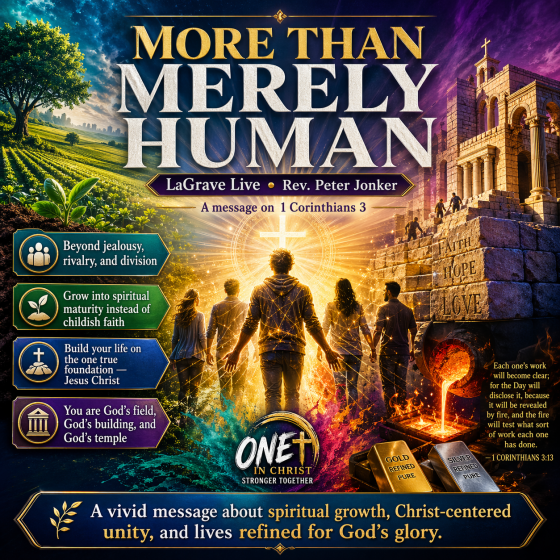
More Than Merely Human: Living the Resurrection Life
Beyond the Mortal: Reflections on Life After Easter
More Than Merely Human: A guide to spiritual reconstruction based on 1 Corinthians 3
"We are no longer defined by the sum of fear, sorrow, or sin. Our Judge is also the Redeemer, and we are the resurrected people.”
— LaGrave Sunday Sermon Summary
Core metaphor: dots and stars
Quote from Max Lucado's fable: Wemmicks wooden figures label each other every day – good for Venus and mess up gray dots.
- Secular trap: Corinthian "climbing spirit" that turns faith into competition and comparison.
- Path to Freedom: Like Lucia, the label can no longer be attached to her body due to her connection to the Creator.
Comparison of the two foundations of life
Action Guide: Build the Eternal Project
2026, at LaGrave Church. The service explores the transition from celebrating Christ's resurrection to understanding its practical implications, specifically how believers can move beyond "merely human" tendencies of competition and comparison to live a life rooted in grace.
Detailed Point Summary
The Call to Resurrection Life
The service opens with a celebration of the Easter season, emphasizing that Jesus’ victory over death allows believers to shrug off fear and live a life that is "really life." This "Resurrection Life" is not just a future hope but a present reality that redefines how individuals view their griefs, sins, and identities. By setting their minds on "things above," the congregation is encouraged to put to death earthly practices like anger and greed, instead clothing themselves in compassion, humility, and love.
The "Merely Human" vs. The New Creation
Merely Human
- Competitive Climbing
- "Dots and Stars" Validation
- Factions & Pride
- Worldly Wisdom
In Christ
- Radiant Grace
- Secure Identity in the Maker
- Unity in Love
- Faith, Hope, & Love
The Spirit of Corinth and the Climbing Culture
Drawing from 1 Corinthians 3, the sermon highlights Paul’s frustration with the early church's "worldliness." Ancient Corinth was a strategic, wealthy trade hub—a city of "competitive climbers" and aggressive entrepreneurs who sought to make something of themselves in a new Roman colony. This cultural spirit of climbing the ladder of success had infected the church, leading to factions where members competed over spiritual maturity, knowledge, and gifts like speaking in tongues. Paul critiques this as being "merely human," noting that such behavior is indistinguishable from the surrounding secular culture.
The "Dots and Stars" Analogy
To illustrate the exhaustion of a life built on comparison, the sermon references Max Lucado’s You Are Special. In the story, the "Wemmicks" spend their days sticking gold stars on the impressive and gray dots on the clumsy. This "dots and stars game" mirrors modern social media and workplace dynamics, where validation is external and performance-based. The character Lucia, however, remains unaffected by these labels because she maintains a constant relationship with her Maker. This serves as a metaphor for the Christian life: when one's foundation is the grace of Christ, the "dots and stars" of worldly opinion no longer stick.
The Foundation of Endurance
Paul identifies that while knowledge and status pass away, three things endure:
"The greatest of these is love." — 1 Corinthians 13
Building on the True Foundation
The sermon concludes by challenging the congregation to build their lives on the foundation of Jesus Christ using materials that last: faith, hope, and love. Unlike the "straw" of pride and competition, these virtues survive the "fire" of life's stresses. Living this way often appears "foolish" by worldly economic standards—such as giving generously to the needy or investing in community rather than self-advancement—but it is the hallmark of being "more than merely human".
Key Data & Milestones
- New Members/Births: Grace Elizabeth and Henry Roger were born last week.
- Milestones: Laura Jean Colbert is celebrating a milestone birthday.
- Community Arrivals: Jim and Beverly Ludema are new to the community and being welcomed.
- Missions: A mission team recently returned from service in Mexico City.
To-Do / Next Steps
- Participate in the congregational meeting during the 10:00 hour to select new elders and deacons.
- Attend the 6:00 PM evening worship service featuring a visit from missionaries Dan and Priscilla Cummings regarding their ministry in Angola.
- Engage in the daily practice of "clothing oneself with Christ" by choosing compassion and forgiveness over worldly competition.
- Support and encourage the mission team as they debrief from their recent trip to Mexico City.
- Pray for healing and strength for members recovering from illness or injury, including Ellen, Dan, Bill, and Jack.
Conclusion
The service serves as a profound reminder that the Resurrection is a call to exit the "merely human" cycle of comparison. By finding security in the Maker’s love, believers are freed from the "dots and stars" of culture, enabling them to build a lasting legacy of faith, hope, and love.
LaGrave Live

If you’re looking for a warm church that commits to an intensely pertinent Gospel in the Reformed tradition of the Christian faith, we invite you to worship with us. Our 1,800 members come from across West Michigan and gather weekly in our sanctuary for relevant Biblical preaching, beautiful music, and inspiring worship. We expand our worship through intentional outreach in our community and world, attentive care for our members, and plenty of spiritual enrichment and social opportunities for everyone.
We focus on a living Savior who provides genuine solutions to the deep needs of a hurting world. We are committed to need-meeting ministry in His name, and we are committed to being real people who enjoy real life and who cry real tears. Because we are a fairly large and diverse group in terms of age, occupation, marital status, lifestyle, and physical ability; our members create many accessible opportunities for community service, Bible study, and small social groups.
We worship God, the Almighty Creator of heaven and earth, and we enjoy expressing our vision of His holiness through traditional music and formal liturgy.
Music plays an integral part of our weekly worship gatherings. Congregational singing—of both traditional hymns and newer ones—is typically supported by our pipe organ. Vocal choirs, handbell choirs, small ensembles, instrumentalists, and vocal soloists provide additional music offerings.
Led by the Holy Spirit, we seek to worship and serve God in all of life, transforming His world and being transformed to reflect the character of Christ.
Founded by 36 Dutch immigrants on February 24, 1887, LaGrave Avenue Christian Reformed Church has always been deeply committed to both this local community and worldwide missions. God has seen fit to guide and bless these commitments with sustained growth, spiritual gifting, and a continual stream of new work for our members.
[00:08] Speaker 1: (MUSIC)
[06:09] Speaker 2: (organ music)
[11:20] Speaker 3: (bells chiming)
[12:19] Speaker 4: (organ music plays) It's joyful news to find, the labor's deed has ended. Our Lord Jesus died, and still our hearts inquire. Why Christ, who once was sinners' prince, is laid in prison, hardly believe we. But now, has Christ arisen, arisen, arisen. And now, has Christ arisen. My feet shall be twice still more in God's kingdom, here beneath me. Until the trumpet voice, shall make us from our sleep. When Christ, who once was sinners' prince, is laid in prison, hardly believe we. But now, has Christ arisen, arisen, arisen. And now, has Christ arisen.
[14:05] Speaker 4: (instrumental music plays) As God has thus redeemed, and Jesus comes again. His blood shall be too still, as mercy's forever end. Why Christ, who once was sinners' prince, is laid in prison, hardly believe we. But now, has Christ arisen, arisen, arisen. And now, has Christ arisen. (instrumental music plays)
[16:30] Speaker 5: The God whose mercy is from everlasting to everlasting gathers us and greets us right here in His co- in His company this morning. And He greets you with these words, "Grace and peace to you, from Him who is and who was and who is to come, and from the fullness of the Spirit before God's throne and from Jesus Christ, the faithful witness, the firstborn from the dead, the ruler of the kings of this earth. Friends, Christ is risen." He is risen indeed, alleluia. We gather this morning in this place to honor our Lord Jesus, who took on our humanity and walked many miles in our shoes. We gather to honor Jesus, who obeyed every word from God the Father, even when it meant death for Him on a cross. We gather to honor Jesus, who rose and shrugged off death, who thwarted our greatest enemies, because of whom nothing can take us out of the Father's grasp. Today, we celebrate the life in Jesus that is really life.
[17:53] Speaker 5: So welcome to La Grave Church as we continue to celebrate the resurrection of our Lord. Today, we'll retune our hearts, focus our minds on this Lord, and it's a gift to be in each other's company here in the sanctuary or to be joined in spirit through the livestream. We welcome those of you worshiping that way today. Following this service, during the 10:00 hour, there is regular programming for our youth and our children classrooms upstairs. Um, and for the adults there's a congregational meeting, so plan to join for that, particularly if you're a La Grave member. We'll be selecting new elders and new deacons throughout the day today.And tonight everyone is welcome for worship back here at 6:00. Uh, Pastor Jonker is preaching, and we will have a visit with missionaries Dan and Priscilla Cummings, who will be sharing about their ministry in Angola. Let's continue contemplating, um, the implications of Jesus' resurrection for our own lives of faith.
[18:51] Speaker 5: Let's do this responsive reading from Colossians 3:1-15 as we approach God's throne. Since then, we have been raised with Christ. Let us set our hearts on things above, where Christ is, seated at the right hand of God. Let us set our minds on things above, not on earthly things, for we died and our life is now hidden with Christ in God. As resurrected Christians, God calls us to kill off the practices that belong to our old life. Put to death, therefore, whatever belongs to your earthly nature. Sexual immorality, impurity, lust, evil desires, and greed, which is idolatry. As resurrected Christians, God calls us to take off the old clothes of sinfulness. Rid yourselves of all such things as these. Anger, rage, malice, slander, and filthy language from your lips. Do not lie to each other since you have taken off your old self with its practices. As resurrected Christians, by the power of the Holy Spirit, God gives us new clothes and new life.
[20:22] Speaker 5: Therefore, as God's chosen people, holy and dearly loved, clothe yourselves with compassion, kindness, humility, gentleness, and patience. Bear with each other and forgive one another if any of you has a grievance against someone. Forgive as the Lord forgave you. And over all these virtues, put on love, which binds them all together in perfect unity. Let's join our hearts and voices in the prayer of confession, saying together... We praise you, eternal God, as the overflowing source of everything good. Face-to-face with your goodness, we see and lament the ways the kingdoms of this world fall short of your kingdom, and we confess that clothing ourselves with Christ requires our daily participation. Forgive us when we do not let us dress us for the day, and when our ways resemble the ways of a world that doesn't acknowledge you more than they reflect the ways of our Lord. Clothe us with the love of Jesus, and show us how to walk with you and with each other. In Christ's name, amen.
[21:58] Speaker 5: Our risen Lord holds our past, He holds our present, and He holds our future in nail-scarred hands. And He Himself is our life, now and forever. Hear the good news we just read together. You died, and your life is now hidden with Christ in God. When Christ, who is your life, appears, you also will appear with Him in glory. Thanks be to God. (organ music) Christ is ris'n! Sound hosannas tell Of creatures gay and fierce. Christ is ris'n! And I see wonder All creation is of His. In the vesture all-surrounding, See God's friendliness grown; Feeling his embrace around thee, Free the gifts of love alone. Christ is ris'n! Raise your spirits from the caverns of despair. Walk with gladness in the morning; See what God can do in you there. Drink from life's pure spring, Thou thyself may never.
[24:29] Speaker 5: Jesus is our sun, our morning, Joy and peace of evermore.In the joy and peace that Christ brings, let's profess what we believe together using the words of the Apostle's Creed, saying, "I believe in God, the Father Almighty, creator of Heaven and Earth. I believe in Jesus Christ, His only Son, our Lord, who was conceived by the Holy Spirit, born of the Virgin Mary, suffered under Pontius Pilate, was crucified, died, and was buried. He descended to hell. The third day, He rose again from the dead. He ascended to Heaven and is seated at the right hand of God, the Father Almighty. From there, He will come to judge the living and the dead. I believe in the Holy Spirit, the holy Catholic Church, the communion of saints, the forgiveness of sins, the resurrection of the body, and the life everlasting.
[25:37] Speaker 5: Amen." (organ music plays)
[25:51] Speaker 4: (singing) Christ is risen, indeed. Oh, praise the holy and safe name. Ray of hope to all creation, birth of God, the human race. Death is vict'd, life is ours; Christ is ris'n, life is won; love us, self the same us, sin o'er, life, every bone. (music ends)
[26:39] Speaker 6: All right, children, it's time for the children's message. Come on down. Have a seat. I have a story to tell you this morning. (footsteps) You all look so nice, bathed in sunshine here. I know it sometimes makes a squint when it comes through the windows, but it's so beautiful even when it's cold. Just a few more people yet. We're almost there, you guys. Come on down. All right. So, um, I wanna tell you a story, and it's the story of a guy who is a friend of mine, or was a friend of mine. His name was Andy Keivenhoven, okay? He was a minister, just like me, and he was actually a member of the church that I used to be at. Now, he, he was quite a bit older than me, which means he's not alive anymore. He died quite a long time ago. Uh, like I said, he was a minister like me, and one thing that he did different than me is that he would sometimes walk to work in the morning. I don't walk to work. I always drive. And when it was winter and it was cold, Andy, he would also drive.
[27:53] Speaker 6: But then when it started to get nice like this, right? Like, the grass started to get green, it started to get warmer, so right around Easter time, he would walk. And when he walked, he would cut through a cemetery. Now, I think you know what a cemetery is, but just in case, when somebody dies, we put them in a cemetery, right? We bury them, and then you get a stone with their name on it that we put right by their grave, right? And so sometimes you drive by those places, lots of stones in the ground there, that's a cemetery. So when he would walk to work, he would walk through the cemetery. But because it was just after Easter and because the grass is getting green and the flowers are coming up and he was still thinking about how Jesus had risen from the dead, he would do something funny when he would walk to the grave. He would stop in front of the stones, and he would preach to them.
[28:49] Speaker 6: He would stop in front of a stone and say, "Christ is risen!" Then he'd walk a little further to another stone, and he'd stand over a grave and he'd say, "Jesus is alive! Don't be afraid!" And then he'd go a little bit further and he would say, "The trumpet shall sound and the dead shall be raised!" He was telling them all that Jesus was gonna raise them up some day. Now, don't you think that would've looked funny if you were, like, watching and you saw a guy preaching to gravestones? Wouldn't that look funny?
[29:17] Speaker 4: Yeah. (laughs)
[29:17] Speaker 6: It would look funny. Yeah, it would. I wish ... I never saw him do it. I wish I saw him do that. I wish I saw him preach to those gravestones. Like I said, Mr. Keivenhoven is dead now, so somewhere he's buried and he has a gravestone, and I've never been there. But if I ever go, guess what I'm gonna do?
[29:43] Speaker 4: Preach. Preach
[29:43] Speaker 6: Preach to that gravestone. "Andy, Christ is risen! Andy, Jesus is alive! Andy, don't be afraid! You will be with Jesus forever!" And even if I look funny doing that, I won't care, because it's the truth. (clicks tongue) That's my story for you d- today. Congregation, what is our prayer for these children?
[30:02] Speaker 4: The Lord be with you. Children of God respond- And also with you.
[30:06] Speaker 6: Go in peace. (clears throat)
[30:24] Speaker 5: Let's join our hearts again in prayer. Beautiful Savior, Living Redeemer, Mi-You who are the first and the last. You who died and are alive again. When things around us fall away, or change faster than we can adjust, the truth of who you are and what you have done is the linchpin of our lives. For us, your resurrection means we are no longer defined by the sum of our fears, the accumulation of our griefs, or by our calcified hearts. We are no longer defined by the worst moment of our worst day, or the sin that clings so closely, for our judge is also our savior, and we are his resurrection people. Thank you for the power shaped by love that calls us and animates us and identifies us and washes us and sustains us and leads us. Thank you that this power that makes even death come undone will not fail to bring us all the way home. Some of us today could use a fresh dose of Easter joy, Lord. For the carbonated holiness of belly laughter.
[32:01] Speaker 5: For those of us who need to be reminded that we will once again feel joy, encourage us when the ache of this life and the brokenness in this world constricts our hearts, and turn that ache into something else, into a hunger for your kingdom. A kingdom that comes not by our might or our, or our power, but by your spirit. And we pause today to say thank you too for places in our own lives this week where signs of your goodness and your resurrection life were evident. Thank you for faithful and godly counsel, for the company of friends and teachers and teammates who point us toward you. Thank you for work to do or impressions in our heart of what to pray for, or contact with people that allows us to participate with you in small, redemptive ways. Thank you for the ways you surprised us by your mercy or your comfort, right when we needed it. Thank you for milestones in the lives of members of this church.
[33:12] Speaker 5: Thank you for Laura Jean Colbert celebrating a milestone birthday soon, who has blessed h- others with her life in Christ. Thank you for your footprints in the work, and the learning, and the safe travels, and the service of the mission team that returned last week from Mexico City. Encourage them as they debrief, and encourage us through them. Thank you for the newest members of our church, for Grace Elizabeth and Henry Roger, born last week, making their entrance into your world. Sustain Laura and Brian, and Alex and Megan as they get to know these new babies. Bless Sarah and Caleb Ronnie, several weeks into their new marriage, and encourage them as they seek you together. Encourage and bless Jim and Beverly Ludema, who are new to this community and will be welcomed next service. We intercede also, Lord, for the troubled places of this world. For people at odds, for whatever reason, in our families. For those who wonder if you will forgive them. For those who honestly face doubts.
[34:22] Speaker 5: For places where war requires people to flee or to fight or to suffer. Bring just and lasting peace to this world, Lord. Help that peace begin in our own lives and ways with you and others, and guide leaders and conversations in other parts of the world and even in our own community as we work toward just and lasting peace. Encourage members of our church who grieve, particularly those who are reeling from the loss of Da- Dan Goris. Strengthen and encourage Debbie and her family, and those who know and love Dan. Encourage our members facing chronic illnesses or treatments, those who are today recovering after needing healing and strengthening from acute injury or illness or joint replacement. For Ellen and Dan and Bill and Jack, bring healing and strength. Go ahead of Michael Hoisington, encouraging pastors from 30 countries in Kuala Lumpur. We lift up also the leaders of the Zuni Christian School, and for the seeds of faith that are being tended in that community.
[35:34] Speaker 5: God, as we lift all of our prayers to you this morning, you know the cries of our own hearts, the uncertainties we carry, the joys we tend. As you told your disciples what must take place before your death, and you fulfilled your word, we too are assured. What you say and who you are now has the last word for us too, even if we don't understand always what you're doing. So as you released your spirit into the Father's hands, as you laid down your life and took it up again, so now we too offer painful or chaotic or incomprehensible pieces of our lives to you, sovereign Lord, inviting you to order our steps, showing us how to live as resurrection people, knowing that in you, we really live. Amen.
[36:31] Speaker 5: (instrumental music plays)
[36:48] Speaker 7: (organ playing)
[42:55] Speaker 4: (slow organ playing) (slow piano playing) (loud clear coughing) (slow choir singing) Ah.Ah.Ah.
[44:33] Speaker 4: (instrumentals tune played by orchestra)
[47:48] Speaker 4: ah.ah.ah. (orchestra tuning instruments) Praise God, from whom all blessings flow. Praising, all creatures here below.Praising above ye heav'nly host,Praise Father Son,and Holy Ghost.Omen.
[48:48] Speaker 6: (clearing throat) Our Bible reading is from Paul's first letter to the Corinthians. 1 Corinthian chapter 3. I'm gonna read the whole chapter found on page 1700-... and 72 in your pew bibles. Uh, we're still in the Easter season, uh, church is still dressed in white. Uh, we're sort of moving on though to thinking about, um, not only that Christ rose from the dead, but what the resurrection life looks like. What are the implications of Easter? And this is a pretty good passage to think about that. I'll read the whole chapter, as I said. "Brothers and sisters, I could not address you as people who live by the spirit but as people who are still worldly. Mere infants in Christ. I gave you milk, not solid food, for you were not ready for it. Indeed, you're still not ready. You're still worldly, for there's jealousy and quarreling among you. Are you not worldly? Are you not acting like mere humans? For one says, 'I follow Paul,' and another, 'I follow Apollos.' Are you not mere human beings?
[50:05] Speaker 6: And what, after all, is Apollos? And what's Paul? Only servants through whom you came to believe, as the Lord has assigned to each his task. I planted the seed, Apollos watered it, but God has been making it grow. So neither the one who plants nor the one who waters is anything, but only God, who makes things grow. The one who plants and the one who waters have one purpose, and they'll be rewarded according to their own labor, for we're coworkers in God's service. You are God's field, God's building. By the grace God has given to me, I laid a foundation as a wise builder, and someone else is building on it. But each one should build with care, for no one can lay any foundation other than the one already laid, which is Jesus Christ. If anyone builds on this foundation using silver, gold, costly stones, wood, hay, straw, their work will be shown for what it is.
[51:09] Speaker 6: Because the day will bring it to light, it will be revealed with fire, and the fire will test the quality of each person's work. If what has been built survives, the builder will receive a reward. If it's burned up, the builder will suffer loss, yet will be saved, even though only as one escaping through the flames. Do you not know that you yourselves are God's temple and that God's spirit dwells in your midst? If anyone destroys God's temple, God will destroy that person. For God's temple is sacred, and you together are God's temple. Do not deceive yourselves. If any of you think you are wise by the standards of this age, you should become fools so that you can become wise. For the wisdom of the world is foolishness in God's sight. As it is written, he catches the wise in their craftiness, and the Lord knows that the thoughts of the wise are futile. So then, no more boasting about human leaders.
[52:18] Speaker 6: All things are yours, whether Paul, Apollos, Cephas, the world, life or death, present or the future; all are yours. And you are of Christ, and Christ is of God." This is the word of the Lord.
[52:36] Speaker 4: Thanks be to God.
[52:43] Speaker 6: So I think you could hear, it's pretty clear that Paul is obviously frustrated with the Corinthian church, uh, he's not happy with them. And to understand why he's frustrated, what exactly is at the bottom of his frustration, I, I think it helps, and, and Tim Keller helped me to see this this week, it helps to have an understanding of what kind of a city Corinth was. Okay? What kind of a city Corinth was and what its spirit was. Now, Corinth is and was a city in Greece, it still exists today, more or less on the same spot that it did back in ancient times. Greece, as you probably know, is surrounded by water. And Greece is also, um, shaped kind of like a big hourglass, okay? Maybe you don't know that. There's a big northern part of the land and there's a southern part of the land, and it's connected with an isthmus. Isthmus, you know that word, right? Not a peninsula, an isthmus.
[53:38] Speaker 6: And the isthmus that connects it is the Isthmus of Corinth, which is, uh, really narrow, at, at its narrowest spot, it's only four miles, okay? That's really narrow. So it's only four miles from the Aegean Sea on one side, you walk four miles and then you'll be at the other part of the Mediterranean. Okay? So really close. And Corinth is located right at that really thin spot, okay? That made it a major trade location, because ships would come and they didn't wanna sail all the way around Greece, they wanted, it would be safer to take that shortcut. So maybe sometimes they'd come into Corinth, they'd drop off their goods, the goods would be transported over land, put in another ship and carried on to wherever they were going, right? Skip the big trip around. Sometimes the ships themselves would be moved across those four miles.
[54:29] Speaker 6: If you go to Corinth, there is a road that they made way back in those times called the Diolkos, and they would pull the ships out of the water, they'd drag 'em for four miles and dump 'em back, and they'd go onto Ephesus or they'd go onto Rome or wherever it is they were going. All this to say you can see why strategically, Corinth would've been a huge trading location. Thousands and thousands and thousands of pounds of goods would be moving through there every single day. So the people of Corinth got really, really rich on trade.That started all the way back already in the Greek times, okay? Uh, in 146 BC, the Romans came along and they conquered Greece. And when they did that, they utterly destroyed Corinth. They absolutely leveled this rich city, burned it to the ground. And typical Roman brutality, they killed every male in the city, and they took every female and child into slavery. 90,000 people are the estimates. All gone. So for a hundred years, Corinth was just a ghost town.
[55:38] Speaker 6: It did, basically didn't exist. Then 44 BC, Julius Caesar's in power and he smells a business opportunity, and he wants to restart Corinth. He's going to build it up and make it a Roman colony. He starts to build it up. And in a hundred years...' cause 44 BC, it's only about a hundred years later, from the beginning of building the city again that Paul writes this letter. In, in a mere a hundred years, Corinth has, uh, risen from the ashes. It's as strong and as prosperous as ever. Money pours into the city. Now all this history is important because it gives you a sense of the spirit of this town. Corinth was a place of climbers. Corinth was a place of competitive climbers, of hyper entrepreneurial people. Why would that be? Well, because it was a brand new city, you didn't have the old money and the old institutions and the old families that governed everything, so you could come in there if you were new and you wanted to make something of yourself.
[56:40] Speaker 6: Corinth was the place you went to, man, and you climbed the ladder and you got your piece of the pie. So it was filled with these people who are aggressively trying to climb the ladder of success, make something of themselves. Corinth was a city of climbers. This helps us know what's going on in the Corinthian church, because Paul is mad that the climbing competitive spirit that characterizes the city has become part of the church community. Corinth is a city of competitive climbers. The church has become a community of competitive climbers struggling to best each other in spiritual things. The spirit of the city had infected the church. And you know that's true because it's like the first thing Paul hits in this letter. Paul has sort of the standard introduction to his letter to the Corinthians, uh, which he always has to all his letters. And then the very first thing he talks about, he says, "You know, I'm concerned about you guys.
[57:45] Speaker 6: I've heard from Chloe's household that there's factions among you and that you're going back and forth, and some say, 'I follow Paul,' and others say, 'I follow Apollos,' and others say, 'I follow Cephas.'" So you can imagine some are saying, "I follow Paul. Oh man, that Paul, he's so theologically rich. I just love his sermons, they're so detailed and so full of information. They're just theologically powerful. His mind, he's got a beautiful mind. Apollos' sermons, they're just nowhere as near as theologically interesting." Whereas other people are saying, "Oh, I follow Apollos. Paul, oh he's so dry and intellectual, man. He's... The people who follow him, they're like the frozen chosen. When Apollos preaches, oh, it's like the Holy Spirit is in the room. My heart just opens up. I feel flooded with joy. I just don't get that with Paul." Something like that.
[58:45] Speaker 6: So these factions, they're competing with each other, and they're not just disagreeing with each other, they're saying, "We are more mature spiritually. No, we are more mature spiritually." They're competitively climbing. And the concern shows up in other places in the letter too. So, chapter eight, it's pretty clear that knowledge is one of the standards they're using to compete with each other. Each group is trying to show that they're more knowledgeable than the others. And so in chapter eight, verse two, Paul says, um, "You know what? Knowledge puffs up, but love builds up. If you guys are saying that you know so much compared to your neighbor, you don't know anything." Other people are using tongues as a standard of comparison. 'Cause they speak in tongues, they're putting themselves above other people. Paul spends a whole chapter, chapter 14 saying, "You know what? Tongues are not a better gift.
[59:37] Speaker 6: Just 'cause you speak in tongues does not make you better than your neighbor." "All this comparison is silly," says Paul. "Brothers and sisters, think of what you were when you were called. Not many of you were wise by human standards, not many of you were influential, not many of you were noble birth. This is not a competition," he says. And then in verses three and four, when he goes after this competitive spirit, he says, "You know, when you act this way, you are merely human." He says it twice. Maybe you heard it when I read it. "You are merely human." Which is just another way of saying, "You're just like all those other people around you. Uh, you're just like the culture. You haven't become new. You're just like those... Merely human." Merely human. It's a good description of this competitive spirit, uh, because there is something in us human beings that wants to compare ourselves to those around us.
[01:00:45] Speaker 6: There is something in us human beings that, uh, wants to look at our neighbor and put ourselves above them so we can feel better about ourselves. There's something in us that wants to play the dots and stars game. The dots and stars game. What are you talking about? Do you know...... the children's book, You Are Special by Max Lucado. Some of the kids are smiling 'cause they do know it. You Are Special, Max Lucado, Christian author, written many, many, many books. His best-selling book of all is this children's book called You Are Special, and it reminds me of this situation. The book takes place in the land of the Wemmicks. And the Wemmicks are these make-believe wooden creatures that have been made by the maker. And the Wemmicks live in Wemmickville and they go around all day and, and they remind me of, in their behavior, of the Corinthian church. Why? Because all day long, all the Wemmicks do is give each other dots and stars.
[01:01:44] Speaker 6: So each Wemmick has a little box, and inside this box are sticky stars, sticky gold stars or sticky gray dots. And as they walk around, they put either a dot or a star on people depending on how they behave. So if a Wemmick does something impressive, something wonderful, they get a gold star. If they ran fast, jumped high, gold star. If they had a beautiful singing voice, gold star. If they were beautiful, attractive, gold star. But if, on the other hand, the Wemmick was clumsy, if she sang off-key, if they were funny-looking, they would not get a gold star, they would get a gray dot. So the strong and beautiful Wemmicks, they walked around all day covered with stars. They were gorgeous, people flocked to them. But then there were other Wemmicks who were covered in these, these gray dots, and they walked around and kept their heads down. The center of this story is a Wemmick named Punchinello. Punchinello is definitely a gray dot Wemmick. And he tries, he really tries.
[01:02:57] Speaker 6: He tries to run fast and be impressive but he falls down, gray dot, right? He wants to be beautiful, he tries to look nice but he's kinda short and he's got a big nose, more gray dots. He comes into the circle of the other Wemmicks and he enters into conversations with them and he tries to say something witty or something smart, always comes out awkward, gray dot. And pretty soon he's covered with gray dots and because he's got so many gray dots, some other Wemmicks come up to him, put a gray dot on him just because he's got so many other gray dots. Wemmickville is not a very nice place, but it is a familiar place. There's a reason why this book and that allegory is so popular. There's a reason why this is the most popular of his books, because people read this to their children and they say, "Uh, this sounds familiar to me. I know this. I live this." This is what it's like in my high school, right? This is what it's like in my middle school. This is what it's like in my workplace.
[01:04:04] Speaker 6: This is what it's like on social media. Social media is basically just a big mechanism for giving dots and stars to people, when you think about it. So it's no wonder Paul calls the church merely human when they behave this way, because this is what human beings do. This is, we walk out the door in the morning and we enter into a world of dots and stars, and it is not so nice. It is exhausting, it is soul-killing. Paul calls it an insubstantial life. He uses that image of a foundation, you heard me use that in the reading. And he talks about how you've got to build something on that foundation which is strong and good. The dots and stars life is built on a foundation of pride, and it builds something like straw, something that will not survive stress, something that is going to burn up, fall over when the fire comes. Paul's proclaiming good news and saying there's another way. There's another kind of way to be human. We can be more than merely human.
[01:05:13] Speaker 6: As he says in another letter to the same church, "If anyone is in Christ, that person is a new creation. The old is gone, the new has come. They've been born again into a different life." When we are in Christ, we are not merely human. We are more than merely human. Paul is offering them a deeper and more radiant life. What does this life look like? How is it founded? Let's go back to the story, the You Are Special, the Max Lucado story. Poor Punchinello. There he is. He's walking around with his gray dots. He can't win- get a break, he's feeling miserable all the time. Is there any hope for them? Yes, there is. 'Cause one day, he's walking through town and he runs into another Wemmick, whose name is Lucia. And Lucia is beautiful and kind and smiling, and the most remarkable thing about her, there's not a single star or dot on her. None. And it's not that people don't try to stick 'em on her, right?
[01:06:15] Speaker 6: People come up to her all the time and put- try to put a gray dot on her, try to put a, a gold star on her. They just fall off. And she is the kindest, most wonderful person that Punchinello has ever met. And she, uh, and so he asks her, "W- well, how is it that these stars don't stick to you and that these dots don't stick to you?" And she says, "Well, it's easy. I am in a relationship with my maker, who's the maker of all Wemmicks. And every day I go to him, and he reminds me that no matter what, I am loved. That I am special, and that he has a plan for me, and he's never gonna let me go. And so I don't need stars and dots because I have him as my foundation." Punchinello hears that and he knows what he wants for his life.Now, I remember reading that to my children. If you read it to your children, maybe you reme- remember, too.
[01:07:11] Speaker 6: And I remember seeing this, the character of Lucia and saying, "Wow, that is a really attractive character." To be able to go out into the world every day, where people are giving stars and dots all over the place, and somehow be above that, to somehow have none of that stick to you, and to just live this radiant, giving life full of love, founded on Jesus? (scoffs) That's what I want. Can you hear that at the end of this passage, that's exactly what Paul is offering to us and telling us is ours in Christ Jesus, our Lord? "Stop comparing yourself to everybody else. That's that immature life," says Paul. "There's something so much richer that you've been given. You don't, you don't have to climb up to the good life, because the good life has climbed down to you. Jesus has come down to you and given his life for you. All things are yours. All things are yours. Whether Paul, Apollos, Cephas, or the world, life or death, the present or the future, all things are yours." All of it.
[01:08:19] Speaker 6: You don't have to attain anything. It's all been given. "What shall we say about these things?" Paul says in Romans 8. "If God is for us, who can be against us? He who did not spare his own Son, but gave him up for us all, how will he not also, along with him, graciously give us all things?" All things are yours. That's our foundation. That's your foundation. That's what you have in Christ. Even if you're playing the dots and stars game every day, that's what you already have in Christ. How do we build on that foundation? What kind of life do you build on that foundation of grace, that when all things are yours? Remember, the other kind of life was built on pride, dots and stars. What are we building? What do we do as human beings that lasts, right? The stone, the gold, the stuff that endures. What is that? Paul doesn't really say in our passage, but later on in Corinthians, he really makes that clear. And this is what this whole book is about, by the way.
[01:09:26] Speaker 6: When you go through Corinthians, this issue is everywhere, okay? First Corinthians 13. You think of it about weddings. It's really about this. Talks about what lasts. First, he talks about what doesn't last, right? He says, "As for prophecy, it will cease. As for tongues, they will be stilled. As for knowledge, it will pass away." Remember those words, right? Do you notice that he picks both knowledge and tongues as things that'll pass away, which were two of the standards that the Corinthians were using to compete with each other? He says, "Those things don't last. In the end, they'll be gone." What is it that Paul says does endure forever? Three things, right? Faith, hope, and love. And the greatest of these is love. Standing on the foundation of Christ's grace, where all things are ours, building with faith, hope, and love. That's the picture of this whole book.
[01:10:25] Speaker 6: When we do that, we build something radiant that will last, but we also build something that the rest of the world, playing a different game, will think is foolish. Y'all give 10% of your adjusted gross income to charity in these trying economic times? That's crazy. You are thinking of spending millions of dollars, like millions of dollars, to build something that will help some of your most needy neighbors? You r- you realize they're never gonna be able to give something back to you, right? You realize that. You realize how much this is gonna cost you. Crazy. Is this foolishness, according to the economics of dots and stars? Maybe. But according to the economics of Easter, according to the economics of the kingdom, it will be strong and beautiful because it's built with faith, hope, and love, and it's built on the foundation of the God who has promised us that all things are ours. Amen.
[01:11:42] Speaker 6: Lord, I thank you that we can come to this place and remember the assurance and the goodness that you have given us in Jesus Christ. You know how anxious we get out there in the world, Lord, and how the grind of competition and the grind of comparison can wear us down. Thank you that we can come here and remember that we are eternally secure in you. And may that knowledge give us strength to be people of faith, hope, and love in your world. Amen.
[01:12:14] Speaker 6: (organ music) (congregation claps) (organ music)
[01:13:27] Speaker 4: congregation
[01:19:17] Speaker 4: singing ]
[01:19:27] Speaker 8: (organ music)