
Hollywood and Horsepower Show, July 23, 2026


Hollywood And Horsepower Show with Mark Otto
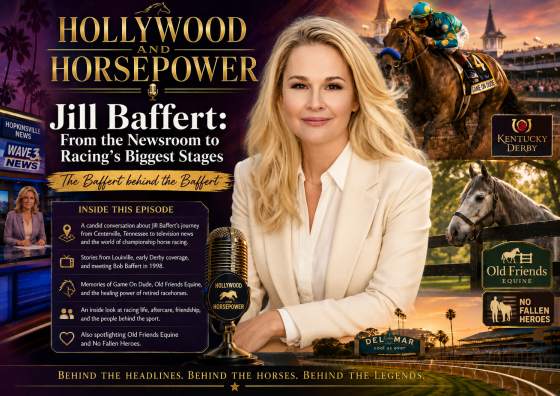
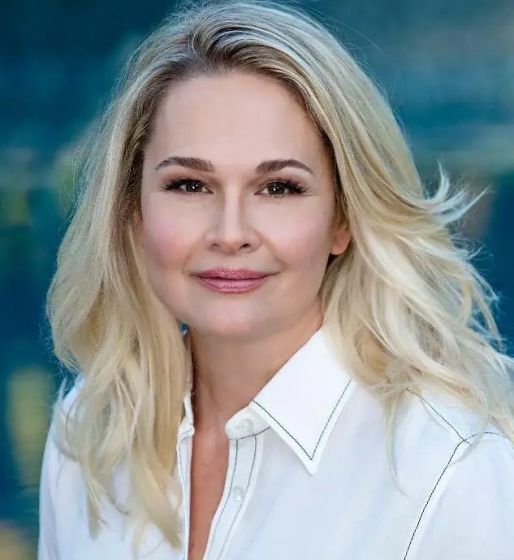
Guest: Interview with Jill Baffert, a former Network News Reporter and wife of Hall of Fame Horse Trainer Bob Baffert.
Jill Baffert: From the Newsroom to Racing's Biggest Stages
Summary
A Life Before the Racetrack
Jill Baffert describes growing up in Centerville, Tennessee, where an early fascination with television news led her to Middle Tennessee State University and a career in broadcasting. She recalls running inside to watch Peter Jennings, working at a television station in Hopkinsville, Kentucky, and later joining a Louisville morning-news team. The demanding early hours prepared her, almost humorously, for the schedule of Thoroughbred racing, even though horses were not a major part of her childhood.
Derby Coverage and Meeting Bob Baffert
Jill explains how the Kentucky Derby Festival transformed Louisville and became a central part of her reporting work. Her first Derby assignment came in 1997, the year Silver Charm gave Bob Baffert his first Kentucky Derby victory, and she met Bob the following year. She remembers an immediate connection and describes his charisma, intelligence, and approachability, while the host reflects on how carefully Bob studies past races and applies those lessons to future horses.
Game On Dude and a Full-Circle Friendship
A major portion of the conversation centers on Game On Dude, the host's favorite racehorse and one of Jill's most beloved barn personalities. The host recounts seeing the horse arrive at Old Friends Equine, feeling starstruck for the first time, and later finding emotional comfort beside his paddock during a difficult period. Jill remembers Game On Dude as an effortless front-running competitor on the track and a gentle, puppy-like horse in the barn.
Joe Torre, Old Friends, and Racing Legends
The host tells a humorous story about meeting Joe Torre without initially recognizing him, only becoming excited after learning that Torre had owned part of Game On Dude. Torre later visited Old Friends, where the host presented him with a custom Louisville Slugger bat and Game On Dude caps. The story illustrates how retired racehorses can connect people from sports, entertainment, and racing while giving their admirers rare opportunities to interact with famous equine athletes.
The Art, Teamwork, and Calm Behind Training
Jill and the host discuss Bob Baffert's instinct for selecting young horses, his willingness to learn from prior races, and his ability to adjust training to each individual athlete. They emphasize the importance of longtime team members, including Jimmy and Dana, and the unusually calm environment maintained in the barn. The conversation also argues that the condition of horses after retirement reflects the care they received during their racing careers, pointing to healthy retirees such as Silver Charm and Game On Dude.
Aftercare, Two-State Racing, and the Road Ahead
The interview closes with a discussion of Old Friends Equine, the healing relationship between people and retired horses, and the distinct personalities of horses such as Game On Dude and War Emblem. Jill describes her move from Louisville television to California, her continued support of racehorse aftercare, and the family's plan to divide time between California and Kentucky. With multiple barns, expanding Kentucky operations, and racing continuing year-round, Jill says the future will involve substantial travel and work, but the essential rhythm of their lives will remain much the same.
Guest, Bob Baffert
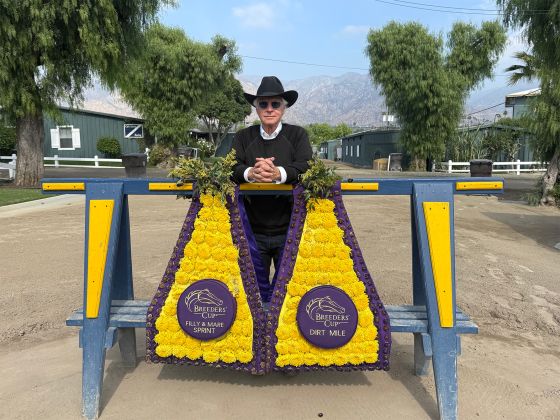
"The Most Charming, Engaging, Articulate, Horsemen”
Multiple Eclipse Award-winning writer, William Nack from GQ magazine
Bob Baffert is widely recognized as one of the most successful trainers in the history of horse racing. Throughout more than three decades of training Thoroughbreds, Bob has registered nearly seven hundred graded stakes victories and holds the record for Grade One wins in North America.
Bob Baffert is not only the all-time leading trainer by wins at Del Mar, he also boasts the most stakes victories at the seaside oval, including 18 triumphs in the Del Mar Futurity (two of which came with future Hall of Famers Silver Charm and American Pharoah), 10 in the Del Mar Debutante, and seven in Del Mar’s crown jewel, the $1 million Pacific Classic. Additionally, Bob is the all-time winningest trainer at Santa Anita Park with over 1,200 triumphs at “The Great Race Place” where he also boasts the most stakes victories. These include nine wins in the Santa Anita Derby – the prominent local prep for the Kentucky Derby – as well as six wins in the prestigious Santa Anita Handicap. Even before Bob’s Triple Crown success, His talents had earned him induction into the National Thoroughbred Racing Hall of Fame. Despite all of his awards, nothing speaks louder about Bob as a trainer and person than his two long-time clients, Mike Pegram and Hal Earnhardt, who have been with his stable for over 40 years dating back to their time in the Quarter Horse industry.
In addition to his many accomplishments as a trainer, Bob has been honored by industry turf writers for his leadership and commitment to enhancing media coverage of racing.
Hollywood and Horsepower Show

Through the relationships Mark Otto developed in Thoroughbred Horse Racing and Automotive Racing, during his global travels, the thing that most interested him was the story behind the story, with the famous people he was fortunate to meet. What was it that these people liked to do? How did they get into Hollywood or into Racing? These stories are fascinating! This is what encapsulates the “Hollywood and Horsepower Show”.
Bringing you along, we talk to so some of the most interesting people Mark met during his career. Don't be surprised if a few other guests stop by this show. This will be fun! It is where SNL meets The Tonight Show; a perfect mix of talk and comedy.
Speaker Identification
Speaker 1 - Host Mark: The host identifies himself as Mark, but the automated transcript does not render his surname clearly enough to confirm it.
Speaker 2 - Jill Baffert: Identified in the introduction as Bob Baffert's wife and addressed repeatedly as Jill throughout the interview.
Speaker 3 - Prerecorded Theme Vocalist: Performs the opening and closing Hollywood and Horsepower theme lyrics.
Speaker 3 - Prerecorded Theme Vocalist:
I've been down roads from Churchill to L.A.,
Met kings of speed and stars along the way.
They've got stories that the cameras never show;
Yeah, the truth behind the fame is what we know.
From the saddle to the silver screen,
Fast lanes and punch lines on a late-night show.
You think you've seen it all, but you don't know the half
Till the curtain lifts and we all have a laugh.
It's not just who they are; it's how they came to be,
A little horsepower, a little mystery.
Hollywood and Horsepower, baby, take a ride,
Where the legends laugh and the engines never hide.
From the track to the spotlight, stories unwind,
Candid truths, a little wild and one of a kind.
Hollywood and Horsepower, where the real ones show,
Every twist and turn is a tale you didn't know.
So pour a drink, sit back, enjoy the show.
We're the fast and famous; let it all go.
Speaker 1 - Host Mark:
Welcome to Hollywood and Horsepower. I'm your host, Mark, and this is the story behind the story - what Hollywood is really about.
We're brought to you today by Tony's Steak & Seafood, with locations in Indianapolis, Cincinnati, Lexington, and Bowling Green, Kentucky.
We also support two charities on this program. We don't take a dime from either organization. We support them because we believe in what they do.
The first is Old Friends Equine, at OldFriendsEquine.org. It was founded by Michael and Diane Blowen. Michael is a former entertainment writer for The Boston Globe and a good friend. He and Diane have done an amazing job of giving retired racehorses a place to call home while also giving people the opportunity to see these horses up close and personal. If you have a chance, visit OldFriendsEquine.org. It is an amazing place. They offer tours and welcome private events.
The other organization we support is No Fallen Heroes. My friend Matt "Whiz" Buckley, a fellow naval aviator, former Top Gun pilot, and Top Gun adversary instructor, and his wife started the program to help veterans readjust and, hopefully, reduce veteran suicide. Matt and his wife have done an amazing job of helping countless veterans, including people many listeners will recognize, such as Lone Survivor Navy SEAL Marcus Luttrell. They continue this work, and we cannot thank them enough.
If you can't do a lot, do a little. Every dollar helps both organizations. They are, truthfully, two of the best-run charitable organizations I have ever been involved with.
We're joined today by a very special guest, someone I consider a friend. People know her name, but I don't think they know everything about her. This is the Baffert behind the Baffert: Jill Baffert, Bob Baffert's wife. Jill, welcome to the show.
Speaker 2 - Jill Baffert:
Hi, Mark. Thanks for having me. I like that intro music. I feel as though I should be sitting in a smoky bar here in Del Mar with a glass of something.
Speaker 1 - Host Mark:
That was put together by our producer, Don Newsom. It is our theme song, and it is available as a download now. It has really taken off.
Speaker 2 - Jill Baffert:
It's so good.
Speaker 1 - Host Mark:
I really wanted to thank you for doing this. You and I have known each other since probably 2014 or 2015.
Speaker 2 - Jill Baffert:
I think it was actually before American Pharoah.
Speaker 1 - Host Mark:
Yes. I feel as though Game On Dude was still there, so it had to be before then.
Game On Dude is definitely one thing you and I share. We share several things: we were born in the same year and the same month, and Game On Dude was always my favorite horse. I think I've told you that, but for people listening, Game On Dude is a very famous horse whom Bob Baffert trained and raced with his partners.
He was a unique horse to me. I was working in California before I became involved in the horse industry. I would occasionally go to Santa Anita or Del Mar because I was in Southern California a lot, but I was not involved in the industry. It was entertainment for me.
Game On Dude always stood out because of his name and because he was such a phenomenal horse. I remember watching him race several times, and he made it look effortless. He did not even appear to break a sweat. The other horses would be running flat out, while he seemed to glide around the track. He always caught my eye.
When I became involved in the horse industry, my background was in sales and marketing. I was fortunate enough to be introduced to Michael Blowen. We hit it off immediately, and I became involved with Old Friends. I always tried to help with sponsorships and other needs, just as we still support Old Friends through this show.
I remember when we received the call from you asking whether there was a home for a little brown horse. I have worked around studios and many well-known people over the years, and I have never really been starstruck. But when I saw Game On Dude walk off the trailer, that was probably the first time I truly felt starstruck. I had watched him and seen him race, but I had never been that close to him. It felt as though a real celebrity had arrived.
He was, and still is, such a smart, kind, gentle horse. I'm sure you remember that I went through a divorce around 2015 or 2016. On difficult days, when things felt hopeless, I would go out to the farm and stand by his paddock. I swear he was like an old friend. He would come out, stand near me, and simply hang out. I received some free horse therapy from him.
My daughter Grace was born the same year as he was. I have a picture in my office from when she was very young and he had just arrived at Old Friends. She was sitting on a fence post - something I would not have allowed with many horses - and Game On Dude had his head resting in her lap. He was such a good guy. He was almost human in the way his personality came through. He still is.
Speaker 2 - Jill Baffert:
He was amazing. To your point, he looked effortless on the racetrack. His one Achilles' heel, perhaps, was that he liked to run on the lead. That can be detrimental if a horse does not get the lead, although he did not need an easy lead. He was simply so fast that the other horses could not keep up with him.
One race that stands out to me was one of his races at Charles Town.
Speaker 1 - Host Mark:
Oh, yes.
Speaker 2 - Jill Baffert:
He ran the entire race with his ears forward. You can go back and watch the video. Usually, horses pin their ears back when they are running hard, but he loved being out there. He would just run a hole in the wind.
In his stall, he was a puppy dog. I loved him so much. I still love him, although I do not get to see him as often as I did when he was here. He was so kind, gentle, and unassuming.
Speaker 1 - Host Mark:
He is definitely one of my all-time favorites.
I don't know whether I ever told you this story. Another time you and Bob graciously allowed Michael and me to tag along was when American Pharoah was at Belmont and we came out as guests. I was standing next to Joe Torre, whom you and Bob obviously knew. I did not know him. It is embarrassing, but I did not really know who he was.
People were greeting him and talking about what he had accomplished. I was confused, and Michael could tell. He leaned over and said, "That's Joe Torre." It still did not register. Then he said, "He owned part of Game On Dude." At that point, you could have told me Paul McCartney was standing next to me and it would not have caught my attention as quickly.
I turned to Joe and said, "Oh, my God. You owned Game On Dude." He looked at me as though he might need security. We started talking, and I told him that Game On Dude was at our farm in Georgetown, Kentucky. He immediately lit up and said, "You're kidding me. I didn't know where he went. I would love to see him."
We exchanged cards and said goodbye. Michael is always the voice of reason. He told me not to get too excited because people sometimes say they will visit but never do. I said, "No, I think he is going to come."
About two weeks later, my phone rang from a New York number. I answered, and he said, "Mark, it's Joe. Is the invitation still good to come to Old Friends?" I said, "Absolutely." He asked whether he could come on Saturday and bring some friends. They were in Cincinnati for an All-Star Game.
Meanwhile, I went to Louisville Slugger and had a bat made for him. It had Game On Dude's name and racing statistics on it, laid out like the back of a baseball card. I also had baseball caps made with the racing silks and Game On Dude's name on the back.
When Joe arrived, he asked whether I had children. I said yes, and he had brought a couple of bats for my kids. Then I told him I had something for him. When I showed him the Game On Dude bat, he was speechless. He held it and stared at it. He said, "This is going in my office. This is one of the coolest things I've ever received." Then he made the guys with him take off their hats and put on the Game On Dude hats.
They stayed for hours. We rode around in a golf cart and fed the horses carrots. He absolutely loved it.
At one point, Joe and I fell behind the group. I said, "I have to be honest with you. I didn't know who you were." He said, "I could kind of tell." I admitted that I had to Google him.
He asked whether I liked baseball. I do, but I had never really followed individual people closely. What made it worse was that I had worked in Los Angeles, but at that point he was more closely associated with the Yankees. I knew the name, but it did not click when I saw him.
I have always been interested in old Hollywood, and I know celebrities or athletes when I have worked with them, but I have never been the kind of person who follows everything about them. Joe and I had never crossed paths through my West Coast work, so it was a funny situation.
I asked him how he became interested in horse racing. He laughed and said that when he was on a farm team in Louisville, they did not have much money. An inexpensive afternoon of entertainment was to go to Churchill Downs, have a couple of hot dogs and a beer, play the ponies, and perhaps turn ten dollars into fifty. That was how he became hooked. Later, when he began making money, he bought a horse. The horse did well, and he became involved with others.
It was another connection created by Game On Dude. Some horses cross your path repeatedly through very different parts of your life. I saw Game On Dude before I was involved in racing and never imagined I would stand near him. Later, I was feeding him Great Value Jolly Ranchers at the farm, and he became my best friend. It was a full-circle moment.
What I really want to do today is go back to your life. Everybody knows you now, and everyone knows about Bob's career. I love Bob to death, but today is about you.
You grew up in Centerville, Tennessee. I understand that, from an early age, you wanted to work in television news as an anchor. What inspired that path?
Speaker 2 - Jill Baffert:
I do not think there was one specific moment. I grew up in a small town in Tennessee and always liked the news. I remember playing outside in the afternoon and running inside to watch Peter Jennings on World News Tonight.
I always had an affinity for it. I attended Middle Tennessee State University, which had - and probably still has - a good radio and television program. It is near the Nashville market, with the country music industry and all the related production work.
After school, I got a job in Hopkinsville, in western Kentucky. I think the television station was owned by the local newspaper, but I believe the station is gone now. From there, I went to Louisville. I was there for about four years, and that is where I met Bob.
Speaker 1 - Host Mark:
You became an anchor there, correct?
Speaker 2 - Jill Baffert:
I worked on the morning show. I started by reporting during the week and working weekend mornings. Then I moved to the weekday morning show. It is a tough schedule. You get up at two or two-thirty in the morning. It is a different lifestyle, and I do not miss that part.
Speaker 1 - Host Mark:
It sounds as though the universe was preparing you for horse training at an early age.
Speaker 2 - Jill Baffert:
I know. I think horse trainers may be the only people who get up earlier.
Speaker 1 - Host Mark:
Before you moved to Kentucky, did you have an interest in horses? I know you had participated in pageants and had worked as a waitress, but were horses part of your childhood?
Speaker 2 - Jill Baffert:
No. We may have had a backyard horse for a while. I remember watching the Kentucky Derby, of course, as many people do. My dad had a horse at one point, and I think my younger sister had a pony, but horses were never really in my wheelhouse.
Speaker 1 - Host Mark:
Then you arrived in Louisville and worked on the morning show. How did you first cross paths with horse racing? With Churchill Downs right there, I assume the Derby was a major story every year.
Speaker 2 - Jill Baffert:
Absolutely. At Derby time, the whole town becomes the Derby. It is like the Derby and Louisville basketball - those are enormous parts of the city's identity.
At that time, and I think it still happens, the Kentucky Derby Festival began two weeks before the race. It involved two weeks of events leading up to the Derby. We covered it wall to wall. We also broadcast our morning show live from the backside of Churchill Downs. There were so many people on the backside then, and it was a lot of fun. Access is managed more tightly now, and rightly so.
Speaker 1 - Host Mark:
To put the period in context, this was around 1997 or 1998.
Speaker 2 - Jill Baffert:
Yes. The 1997 Derby was my first.
Speaker 1 - Host Mark:
That was also a big year for Bob. He won his first Kentucky Derby with Silver Charm, who later went to Old Friends. The following year was Real Quiet.
Did you meet Bob during your first Derby?
Speaker 2 - Jill Baffert:
No. I met him in 1998.
Speaker 1 - Host Mark:
During Derby coverage, would your team begin with the morning show and stay through the day?
Speaker 2 - Jill Baffert:
Yes. We started early with the morning show, as usual. Then the evening anchors took over and continued well into the afternoon. When the national network coverage began - I think ABC had it at the time - the local station could not show the race itself. But it was still a huge day, and it remains one.
Speaker 1 - Host Mark:
For people who have never worked the Derby, whether in media, marketing, sponsorship, or another role, it is an extremely long day. It starts early.
Speaker 2 - Jill Baffert:
It is also a long day for a trainer.
Speaker 1 - Host Mark:
There is probably no sleep the night before. That must be stressful.
Speaker 2 - Jill Baffert:
It is a little stressful, yes.
Speaker 1 - Host Mark:
You met Bob in 1998. Was there an immediate connection, or was he initially just another person you were interviewing?
Speaker 2 - Jill Baffert:
I would say there was an immediate connection. Bob is very charismatic.
Speaker 1 - Host Mark:
Absolutely. People who have not met him may not realize how approachable he is. You cannot help but like him. He is also very smart.
Something that stood out to me, during the times I was able to spend around both of you, was how often he reflected on previous races and changed what he did based on what he had learned. He would talk about Silver Charm, War Emblem, and other horses. It showed how much goes into training - far more than most people see.
It is one of the toughest careers because the athlete cannot talk to you. You have to figure the horse out, sometimes in a relatively short period. Trainers may not have a horse very long before its first race.
Speaker 2 - Jill Baffert:
Bob is definitely a student of the game. He goes back and watches races, whether they involve his horses or someone else's. His experience in major races, including races he has won, is part of why he continues to be successful. He can call on that experience, and there is probably no situation he has not encountered.
He also has a great team around him. Some of those people have worked for him for three decades.
There is an art to training. You and I could train a racehorse and perhaps win at some level, but the highest level requires finesse, instinct, and experience. There is no single formula. Obviously, there are established ways to feed horses and keep them healthy, but race preparation involves judgment.
Bob is not afraid to back off a horse. He may look at a work and decide that the horse needs less next time or did not get enough out of the session. Many good trainers can see those things, but his experience in major races is invaluable. It is a real tool in his toolbox.
Speaker 1 - Host Mark:
I agree. I do not want to make this interview only about Bob's career, but a few things have always stood out to me. Because I came to horse racing from the outside, as you did, I may notice different details.
One was his willingness to reflect on past races. Another was the team. People such as Jimmy, Dana, George, and several longtime grooms have been there for years. That speaks volumes about the person running the operation.
The other thing was the calmness in the barn. I used to wander all over the backside because I worked with promotions, branding, and sponsorships. When I entered Bob's barn, it seemed quiet and calm. In other barns, you might hear shouting or see horses becoming agitated, but his barn felt different.
I have a photograph somewhere from Belmont morning, when American Pharoah was preparing for the Belmont Stakes. Michael and I were at the barn. Bob was standing at the end of the shedrow with his arms crossed, looking outside, probably deep in thought. What amazed me was that the horses were standing there almost as calmly as he was. It was as though he set the tone and they followed it.
Speaker 2 - Jill Baffert:
He would not tolerate a lot of chaos. The environment needs to be calm because horses are sensitive, sentient animals. They are flight animals and will pick up tension or disorder.
Bob has a firm rule about limiting visitors to the barn on race day, especially on major race days. He wants the horses quiet, resting, and following their normal routine.
I have not spent much time in other barns, so I cannot compare them directly.
Speaker 1 - Host Mark:
From my experience moving around the backside, that level of calm is not especially common. You may see quiet after training is finished and things settle down, but even during the busiest part of the morning, around seven or eight o'clock, Bob's barn is still composed. I cannot remember a true moment of chaos there.
Jimmy is another constant professional.
Speaker 2 - Jill Baffert:
He really is a brilliant horseman. I do not think most people give him nearly the credit he deserves. He is excellent with the horses, and he and Bob are a very good combination. They work well together.
Interestingly, Jimmy's wife, Dana, whom you mentioned earlier, worked for Bob before Jimmy did. She was an exercise rider and rode many of the major horses. She was magic on a horse. She had very light hands and could get so much run from a horse without appearing to ask. She developed a tremendous rapport with them.
She has retired now. She and Jimmy have a grandson, and life moves on.
Speaker 1 - Host Mark:
Does she still come around the barn?
Speaker 2 - Jill Baffert:
Yes. When people have been together that long, it becomes a family. You spend so much of your life with them that it has to feel that way.
Speaker 1 - Host Mark:
Horse racing is an industry in which deep friendships develop. As I said earlier, I have rarely been starstruck. I knew of Bob and was curious because he was so successful, but I did not have the opportunity to meet him until I became involved with Old Friends.
I have always said that I do not care whether someone is Alec Baldwin or the person raking the barn aisle. I judge people by how they act and how they treat others. Bob is one of those people who immediately makes others comfortable, and you are the same way. It feels as though you have known both of you for years, even when you do not see each other often.
That accessibility is also something special about horse racing. People sometimes have opportunities to meet major figures in the sport and get to know them as people.
I want to say something unsolicited, and I will not go too deeply into it because I do not want to make anyone uncomfortable, especially Bob, who does not like compliments. I have always considered both of you among the finest horse people in the industry.
I grew up on a beef farm and around horses. I know enough about the animal to recognize certain things. Michael Blowen and I have discussed this: if you want to understand someone's ability as a horseman, look at the horses when they retire. That will tell you much of what you need to know.
When you look at Silver Charm, Game On Dude, War Emblem, Danthebluegrassman, and other retirees, it is amazing how healthy they look. Game On Dude appears half his age. Silver Charm still looks remarkable.
Speaker 2 - Jill Baffert:
I know. I cannot believe how good that old man looks.
I have to say that I am not a horseman - or horsewoman, whatever the proper term would be. Bob says I have no cow in me because he considers himself a cowboy.
I love horses, but I would not call myself an expert in any way. I feel eternally grateful that I get to be around them every day.
Speaker 1 - Host Mark:
It is a tough job, and people do not always understand that. Game On Dude, whom we have mentioned several times, was not naturally an easy racehorse. Bob told me that, when they first began working with him, he was a handful. They were not sure he would make it to the track. Several decisions had to be made, including gelding him, which changed his behavior.
I once asked Bob, "How do you know?" That is part of the art of racing. You and I could become trainers and perhaps have some success, but certain trainers have an exceptional eye. D. Wayne Lukas has had it, and other great trainers throughout history have had it. Bob definitely has it.
They can look at a yearling and see that something is there: the way the horse walks, the way its back is built, or another quality that stands out. People see the finished product and think it was simply a great horse, but at one point these were young yearlings walking around a sales ring or paddock. Someone had to decide which ones to buy and send to a trainer.
Speaker 2 - Jill Baffert:
Bob selects, I would estimate, sixty or seventy percent of the horses he trains. As great a trainer as he is, I think one of his greatest talents is identifying young horses. That ability seems innate in him.
Speaker 1 - Host Mark:
That goes back to the beginning. For listeners who do not know, he started as a jockey and then trained Quarter Horses. My understanding is that one of his clients wanted to become involved with Thoroughbreds, and that led Bob into Thoroughbred racing.
Speaker 2 - Jill Baffert:
Yes. Mike Pegram, one of his longest-standing clients and one of his best friends, was involved with Bob in Quarter Horses. Bob had tremendous success in Quarter Horse racing, but Mike wanted to get his feet wet in Thoroughbred racing. They bought some Thoroughbreds, and here we are.
Speaker 1 - Host Mark:
People remember Bob for the two Triple Crowns, Kentucky Derby records, and other major accomplishments, but he had a gift for choosing horses long before that. Those horses proved successful not only in the Triple Crown races but also in Breeders' Cup races, the Hollywood Gold Cup, the Pacific Classic, the Haskell, and many other events he has dominated.
It is a rare skill to look at a yearling and recognize potential. When I look at them, they all look beautiful.
The other side of the issue is what Michael Blowen and I have seen at Old Friends. Some horses take forty-five minutes to step off a trailer because they are anxious or physically uncomfortable. When a retired horse reaches nineteen, twenty-eight, or twenty-nine years old in excellent health, walks well, and has relatively few leg problems, that says a great deal about how the horse was managed.
It stands out that so many of Bob's retired horses, from different bloodlines and different eras, have remained healthy. That is a testament to the horsemanship of Bob, Jimmy, and the entire team. They placed those horses in some of the toughest races in the world, yet many retired sound. That is a major accomplishment.
Speaker 2 - Jill Baffert:
I agree. Old Friends and other retirement facilities also do a tremendous job. They understand how to keep retired horses healthy, thriving, and happy. It takes a great team and a group effort.
Speaker 1 - Host Mark:
There are many organizations doing excellent work, but I have to give Michael and Diane Blowen special credit. Michael did not build Old Friends alone. He reached out to veterinarians, universities, owners, and other experts. He built a community that helped create what Old Friends is today.
Speaker 2 - Jill Baffert:
He was the original. Retirement facilities existed before Old Friends, but he made aftercare visible and exciting. He did not take no for an answer, and Michael is almost impossible to offend. That helped him build an amazing farm.
Anyone who has not been there should visit. Michael has said that he can walk into his backyard every day and see the Michael Jordans of horse racing. Some of the greatest athletes in the sport live there, and visitors can interact with them in a way that would rarely be possible elsewhere, even feeding them carrots.
He has always welcomed me, and I have had backstage access, for lack of a better phrase. His favorite horse in the world was Silver Charm.
Speaker 1 - Host Mark:
And my favorite was Game On Dude. One lived on one side of the driveway, and the other lived across from him. Michael and I often talked about how unlikely that seemed.
Michael and I have several things in common. We both worked in Hollywood, spent time around the entertainment industry, and initially followed horse racing from the outside. He became much more deeply involved than I did, although I have served on the Old Friends board and with other organizations, as you have.
Michael has said that the first time he saw Silver Charm race, he never imagined he would someday stand close to him. Then Silver Charm ended up in his backyard, where Michael could feed him carrots every day. I felt the same way about Game On Dude. It was surreal.
Neither Michael nor I becomes very starstruck. If Alec Baldwin pulled into the driveway, Michael would shake his hand and treat him kindly. But when Silver Charm walked off the trailer, I think it took everyone's breath away. It was as though an icon had entered the room.
Another aspect of Old Friends that has always impressed me is how much it helps people as well as horses. The farm has many volunteers from all walks of life. Some have been through serious challenges, and the horses offer a form of healing.
The tours also bring visitors with disabilities or special needs. It amazes me how the horses seem to sense when someone needs additional gentleness. There are horses that normally do not want anyone touching their ears, yet I have watched a visitor with special needs touch and pet those same ears while the horse stood quietly. It is as though the animals understand that the person needs something extra.
Coming from outside the industry, moments like that stand out. These horses are remarkable, and they are very smart.
Speaker 2 - Jill Baffert:
Very, very smart.
Speaker 1 - Host Mark:
They also have very different personalities, just like people. Among your horses, Game On Dude was like the family dog, while War Emblem did not want much contact with anyone.
Speaker 2 - Jill Baffert:
He may have been the meanest horse I ever saw. But I loved him, and we developed a relationship. He liked mints, but I would never turn my back on him.
Speaker 1 - Host Mark:
He mellowed after he had been at Old Friends for a while.
Speaker 2 - Jill Baffert:
Yes, he reached a point where people could interact with him more.
Speaker 1 - Host Mark:
That is another thing the team at Old Friends figures out quickly. Michael said something that always impressed me: "We need to let a horse be a horse. We do not tell them what to do; we let them tell us what they want to do."
When that approach is followed, many horses change. They become more interactive and engaged and are often not nearly as difficult as their reputations suggested. Several horses arrived with warnings that they could be aggressive, but over time they became manageable and comfortable.
Michael has explained that retirement may be the first time in their lives when they are not constantly being pushed to do something. Some horses accept training and racing easily, but others resist. War Emblem had a mind of his own, especially in the breeding shed, and sometimes simply refused. Other horses can be led around with almost no pressure. Their personalities are all different.
You and Bob met in 1998 and married a few years later. That was a major transition for you. You went from being an anchor in Louisville to living in California and traveling frequently. What was that change like?
Speaker 2 - Jill Baffert:
After I moved to California, I did some work for TVG, the horse-racing channel. I worked for them occasionally so I could remain connected to television and racing.
The travel eventually made it difficult to maintain that work consistently. I moved to California, and California is not hard to like. There are things about the state that can be challenging, but the weather is not one of them.
Bob's home base was here for many years. He is now branching out somewhat to Louisville, although he will maintain a barn in California.
There was some culture shock in moving from a small Tennessee town to California, but I had lived in other places and adapted fairly well.
Speaker 1 - Host Mark:
Was it difficult to be so far from your family, or were you able to return home often?
Speaker 2 - Jill Baffert:
I missed my family, of course. They came to California once or twice a year, and I went back when I could. It is easier for me to travel back now.
Speaker 1 - Host Mark:
Your family is still based in Centerville, correct?
Speaker 2 - Jill Baffert:
Yes, they are still there.
Speaker 1 - Host Mark:
You and Bob have continued to grow and evolve as a trainer-and-wife team. You have also been involved with boards, aftercare, and other projects that many people may not realize. You served on the Old Friends board. Are you still a member?
Speaker 2 - Jill Baffert:
I am off the board currently. We are in the process of moving and buying a house in Kentucky, and I felt it was a good time to take a break. I still support Old Friends, love what they do, and will always be involved in some capacity.
Speaker 1 - Host Mark:
Since you mentioned Kentucky, are you planning to move back to Louisville, or will the house primarily be for the periods when the horses are there?
Speaker 2 - Jill Baffert:
We will go back and forth. Bob will keep a barn in California, and we will also have a barn back east.
California racing is difficult right now, and I am not sure what direction it will take. Racing is so large in Kentucky, and the East offers more options. If you have two horses eligible for similar conditions, you can ship one to one track and another to a different track without an enormous logistical burden.
In California, you are more isolated. Horses now sometimes travel through FedEx's equine-shipping service, and moving them requires much more planning. It is not as quick or simple as it was when a dedicated horse plane was available.
Speaker 1 - Host Mark:
A lot of people may not realize that you and Bob are involved in breeding and the stallion side of the business as well. Much of that is based in Kentucky, correct?
Speaker 2 - Jill Baffert:
Yes. We have a couple of broodmares, sometimes more and sometimes fewer. The major sales are there, and Kentucky has always been the heart of American racing. More than ever, that seems to be the case now.
Speaker 1 - Host Mark:
Will you keep a house in California as well?
Speaker 2 - Jill Baffert:
Yes. We will stay here too.
Speaker 1 - Host Mark:
Your youngest son, Bode, must be getting close to finishing school by now.
Speaker 2 - Jill Baffert:
He is going to be a senior.
Speaker 1 - Host Mark:
That makes me feel old. My youngest, Grace, is entering her sophomore year in college, and Keith has graduated, started his career, and bought his first house.
Speaker 2 - Jill Baffert:
That is amazing. Buying a first house is unusual for young people these days. I am proud of them. I do not envy the challenges their generation faces.
Speaker 1 - Host Mark:
I have a picture of Bob with Keith and Grace from when Grace was about seven and Keith was around twelve. That shows how far back our connection goes. They have been around racing since they were young and, in a way, grew up with it.
What comes next for you? Del Mar has started, and you are preparing for this transition.
Speaker 2 - Jill Baffert:
Yes. Del Mar has started, and then we will continue the transition back to Louisville and get everything organized. Living in two places will be different.
Bob is not starting over, but he is establishing a stronger presence there. That will require a great deal of time and energy. We will be back and forth, and horse racing will continue. The thing about racing is that it never stops. It is like Groundhog Day every day, only sometimes at a different venue. In that sense, not much will change.
Speaker 1 - Host Mark:
Will Jimmy go back and forth, or will he remain in California?
Speaker 2 - Jill Baffert:
He will stay in California and run the main barn here. Bob also has a third barn in Southern California where young horses come in and horses can go for layups. He has three barns right now.
Speaker 1 - Host Mark:
Does Bob do anything with Quarter Horses anymore?
Speaker 2 - Jill Baffert:
No. He has been out of Quarter Horse racing since he transitioned to Thoroughbreds.
Speaker 1 - Host Mark:
I thought so. I knew he still liked Quarter Horses and had mentioned riding them as track ponies, but I did not know whether he still dabbled in the business or was completely focused on Thoroughbreds.
We cannot thank you enough for taking the time to do this. I hope listeners gained a better understanding of your career. I have always been impressed by you and equally impressed by Bob. You are amazing people first and exceptional horse people after that.
I cannot tell you how much I appreciate you, the friendship, and everything you and Bob have done.
This has been Jill Baffert joining us on Hollywood and Horsepower.
We are brought to you by Tony's Steak & Seafood in Indianapolis, Cincinnati, Lexington, and Bowling Green, Kentucky. Tony always says there is room at his table for one more. I always say dining at Tony's is an experience, not just dinner. You owe it to yourself to visit.
Please also visit OldFriendsEquine.org. We have talked about the organization throughout today's episode, and it is exceptionally well run. The team does tremendous work.
No Fallen Heroes is another important organization. We are losing far too many veterans to suicide, and No Fallen Heroes is one of the best organizations I have encountered for helping veterans transition and rebuild their lives.
Jill, thank you again for joining us. I truly appreciate it.
Speaker 2 - Jill Baffert:
Thank you, Mark.
Speaker 1 - Host Mark:
This has been Hollywood and Horsepower. We will see you again next week.
Speaker 3 - Prerecorded Theme Vocalist:
So stay awhile; you're in the driver's seat,
Where the road and the rhythm finally meet.
Stick around - you never know who's next,
And trust me, they've got a story worth hearing.