
Breaking the Silence, June 7, 2026


Breaking The Silence with Dr Gregory Williams
Breaking the Silence and Building Resilience: Dr. Gregory Williams and JoDee Neil on Abuse Disclosure, Justice, and Outcry Witness
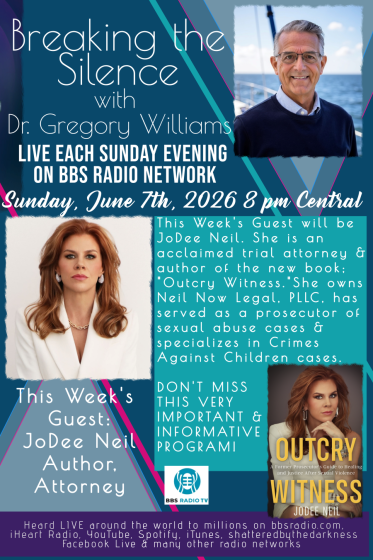
Guest, JoDee Neil, Owner of Neil Now Legal, Prosecutor, Attorney and Author of "Outcry Witness: A Former Prosecutor's Guide to Healing and Justice After Sexual Violence"
This Week's Guest will be JoDee Neil. She is an acclaimed trail attorney and author of then ew book: "Outcry Witness." She owns Neil Now Legal, PLLC. She has served as a prosecutor of sexual abuse cases and specializes in Crimes Against Children cases.
Interested in our guest? Visit their Website at: Civil Litigation Consultation | JoDee Neil for Texans
Don't forget to check out our guests book: "Outcry Witness: A Former Prosecutor's Guide to Healing and Justice After Sexual Violence" on Amazon:
Outcry Witness: A Former Prosecutor's Guide to Healing and Justice After Sexual Violence: Neil, JoDee: 9781965766194: Amazon.com: Books
Dr. Gregory Williams Opens with Concern, Resilience, and Public Awareness
In this episode of Breaking the Silence, host Dr. Gregory Williams opens from Houston by reflecting on the coming World Cup activity and the dangers that large events can create for children, including increased risks of trafficking, prostitution, and abuse. He urges listeners to stay alert and watchful in communities that may host large crowds. Before introducing his guest, Dr. Williams also shares a brief teaching on resilience, encouraging survivors to acknowledge their feelings, seek trusted support, learn about trauma, set healthy boundaries, develop coping strategies, practice self-compassion, and allow healing to unfold over time rather than trying to force it. He frames resilience not as something to buy or imitate from someone else, but as something already present inside a person that can be uncovered and strengthened.
JoDee Neil and the Purpose of Outcry Witness
Dr. Williams then welcomes JoDee Neil, an attorney who has spent more than two decades working with survivors and prosecuting or handling cases involving sexual abuse and crimes against children. He praises her recently released book, Outcry Witness, and strongly recommends it to parents, counselors, teachers, attorneys, judges, and police officers. JoDee explains that the title comes from a Texas legal term describing the first adult to whom a child discloses abuse. That adult, the outcry witness, may later testify in court about what the child said. She says she intentionally wrote the book in a concise, practical format that people could carry easily, read privately, and use as a helpful guide rather than an overwhelming legal text.
The Scale of Abuse and the Hidden Reality Survivors Carry
A major theme of the conversation is the widespread prevalence of sexual violence. JoDee cites statistics showing that one in four girls may be sexually assaulted before age 18 and that significant numbers of women and men live with the effects of contact sexual violence. She says these numbers likely remain underreported, especially for boys and men. The two discuss how abuse is often far more common than people want to admit and how many survivors carry silence, shame, and isolation for years or even decades. JoDee says some of the hardest cases for her to emotionally process involve abuse within biological families, and she also warns about the growing horror of AI-generated child sexual abuse material and the many ways new technology can exploit children.
Shame, Disclosure, and the Need to Be Believed
JoDee and Dr. Williams spend significant time discussing shame and disclosure. JoDee explains that many survivors remain frozen and unable to speak because trauma creates paralysis, fear, and deep internalized shame. She says that when a child or adult finally discloses abuse and is not believed, that response can be even more damaging than the original abuse. Both stress that a child usually has nothing to gain by making such a disclosure and that the details children share often reveal knowledge and experience they could not easily fabricate. JoDee says adults must listen carefully, believe children, and understand that disclosure is often a slow and painful process. Dr. Williams adds that survivors can spend decades suppressing trauma, only to have it damage their relationships, bodies, and emotional lives over time.
Parents, Predators, and the Failure to Take Warning Signs Seriously
The discussion then turns to what parents and adults miss or ignore. JoDee says one of the most basic failures is simply refusing to believe a child who says someone is creepy or that something bad happened. She urges adults to stop automatically giving suspicious people the benefit of the doubt when warning signs are already present. The conversation also explores predator behavior more broadly, with JoDee explaining that predators often do not resemble the stereotypical stranger in a van. Instead, they may appear respectable, trusted, polished, and safe. She argues that adults now need evidence-based self-protection and far greater vigilance in everyday life, including around sports teams, sleepovers, schools, public bathrooms, phones, social media, and internet-connected devices. Both speakers say parents must know the adults around their children, supervise access to technology, and stop assuming that danger only comes from obvious outsiders.
Technology, Sextortion, and the Limits of Legal Protection
Another major section of the interview focuses on technology and the legal difficulties surrounding online exploitation. JoDee warns about AI, deepfakes, image scraping, online grooming, and the permanence of harmful digital content once it is created or circulated. She says schools and parents are often not doing enough to lock down devices and online access. When Dr. Williams asks about sextortion and app-based exploitation, JoDee responds that large technology companies remain difficult to challenge because federal legal protections shield them from much civil liability. She explains that this leaves many survivors with little recourse even when harm began through apps, platforms, or online tools. Her frustration with those systemic barriers is part of why she says she is moving more toward consulting and broader public education rather than relying only on courtroom-based solutions.
A Justice System That Often Re-Traumatizes Survivors
JoDee also speaks candidly about the legal system itself, arguing that survivors often receive very few protections while defendants receive numerous constitutional safeguards. She describes child sexual abuse cases that drag on for years and says survivors are too often treated as though they are presumptively lying. She expresses frustration about the lack of structural protections for children and about the emotional toll of watching vulnerable people repeatedly retraumatized by court processes. When asked what kind of change is needed, she says she has a long list of reforms in mind and points especially to the need for a system that treats child survivors with greater dignity, urgency, and care. Even while acknowledging tools like forensic interviews and closed-circuit testimony, she says the broader justice framework still fails many of the people it is supposed to protect.
JoDee Neil’s Own Healing Journey and a Closing Message of Hope
Near the end of the program, JoDee shares some of her own experience as a survivor, explaining that it took her many years to meaningfully speak the truth about what happened to her. She says she survived for a long time by compartmentalizing pain, avoiding it, and using unhealthy coping strategies, but eventually began to release it through writing and truth-telling. She describes healing as a non-linear, deeply spiritual process and says holding her published book in her hands felt like reclaiming authorship over part of her life and purpose. She also mentions future writing projects, including books on how mothers are treated in family courts and how perpetrator behavior affects workplaces. Dr. Williams closes by praising Outcry Witness, encouraging listeners to buy and review the book, and reminding survivors that no matter how painful their experiences have been, there is always hope and healing remains possible.
Guest, JoDee Neil

About JoDee Neil (From her website Jodeeneil.com)
Some people choose the law. Others are chosen by it. For me, becoming a lawyer was something I knew deep in my bones from the time I was five years old.
And from the moment I first argued into a courtroom, I knew this was where I belonged – using my voice to stand up for people who needed someone in their corner.
That sense of purpose remains with me to this day.
I grew up in Dallas, tagging along after my father, a board-certified family and criminal trial lawyer. He lived his life in and out of courtrooms, cowboy hat and boots on. By the time I was thirteen, I was already helping out around the office. I soon learned the rhythms of a legal practice, and what it meant to stand beside someone when the system towered over them.
My career began in the Collin County District Attorney’s Office, where the trial court became my second home. On my second day, I conducted a Voir Dire, and soon I was trying more cases than anyone else in my division. That pace and intensity showed me I was exactly where I was meant to be – not just “Wild Bill’s daughter,” but a powerful trial lawyer in my own right.
It wasn’t long before I was assigned to the Crimes Against Children Division. At 27, I was the youngest prosecutor handling those cases. The cases were heartbreaking, and the emotional toll was heavy. But I learned how to shoulder it without losing compassion, and that shaped the lawyer I am today.
After several years, I left Dallas and moved to Singapore. But without the courtroom, I was adrift. I found work with an NGO focused on child trafficking and continued work that I began while seving as an Assistant DA– my book, Outcry Witness. It would take me nearly twenty years to finish, but its seed took root during that period of loss and longing for meaningful legal work.
When I returned to Texas, now a mother of two young girls, my criminal trial experience still qualified me for serious felony defense appointments, but instead the civil firm where I worked assigned me to the opioid litigation where I represented counties against major pharmaceutical companies. That work became some of the most significant of my career, helping to bring billions of dollars in settlements into Texas.
Today, my practice looks different. I no longer measure my work in the number of trials I try or the settlements I secure. Instead, I focus on a niche that has always been at the heart of my calling: children. Whether it’s consulting on daycare and Montessori school cases, supporting families in conflict with CPS, or amplifying the voices of young people in systems that rarely hear them, my goal is the same as it was when I stood beside those survivors years ago – to make sure kids are seen, heard, and protected.
As a lawyer, I know the power of standing in a courtroom and telling a child, “You are brave. You are believed.”
My mission now is broader than individual cases. I believe that protecting children is the key to advancing humanity itself. A society that ignores its young cannot expect to thrive. Too often, parents, institutions, and even legal systems lose sight of that simple truth. My work is about bringing us back to it.
I started this journey in my father’s office, but after decades of trials, tears, victories, betrayals, and countless hours spent listening to the stories of children, I understand why I felt called so young. The law has always been about protecting the most vulnerable. That is the purpose I was given, and it is the purpose I carry forward.

Breaking the Silence
“Breaking the Silence with Dr. Gregory Williams”
Now is the time for you to step out of your own personal darkness and break the silence that has been hidden and closed up inside of you.
“Breaking the Silence with Dr. Gregory Williams” radio program will offer the listeners a Road Map to Hope each and every week with keys to discover within yourself that ray of light to make your day better and brighter. Dr. Williams will not only discuss his own personal journey of overcoming the darkness of years of horrific sexual child abuse in the hands of his father and his father’s friends, but Dr. Williams will also feature special guests that have their own personal stories of overcoming obstacles in their lives and becoming victors instead of victims.
“Breaking the Silence” will also feature information from the professional and medical field that will dive into the important research involving Adverse Childhood Experiences (ACEs) and how to build Resiliency in yourself and in your children. Along with this information will be special guests from greatest minds in the United States to share their expert research and thoughts on this very important subject that each person needs to be aware of.
Now is the time to invest a few minutes each week with some awesome information to give you steps to HOPE and keys to HAPPINESS and PEACE. NOW is the time to Break YOUR Silence and breakout into a NEW and BETTER YOU! Join us each week beginning August 13, 2019 for “Breaking the Silence with Dr. Gregory Williams”. You won’t want to miss a single program. Heard around the world on the best radio network on the airwaves, BSS Radio Network available on iTunes, Google Play, iHeart Radio, Facebook Radio, Spotify and over 100 other high quality digital radio stations.
Welcome to Breaking the Silence with Dr. Gregory Williams.
Dr. Williams is the author of the acclaimed book, Shattered by the Darkness, putting the
pieces back together after child abuse.
Dr. Williams is on the senior leadership team at Baylor College of Medicine in Houston,
Texas.
And Dr. Williams travels the United States speaking and training professionals, parents
and victims about the importance of dealing with abuse and personal trauma head on and
not being afraid to break the silence of your own personal pain.
Feel free to call in to the night show at 888-627-6008 and speak with Dr. Williams
and his guests live on air.
And now, your host, Dr. Williams.
Well, good evening and welcome to June 2026.
And here we are in my home in Houston, Texas.
What I believe is the most beautiful and awesome city in the entire world.
Our guests tonight is probably going to fight me with another Texas city.
But I love this town.
Matter of fact, you can look right across the way here.
This is live outside right behind my view here and right across the way is where the
World Cup is going to be here next week or two and about 500,000 plus people is going
to be coming into our town, our wonderful city.
They're claiming way over 500,000 people is just going to invade us and its traffic is
going to be horrendous as if it's not horrendous already.
But the only problem with that is not the World Soccer Cup and all that, but a lot of
children are going to get hurt.
All these soccer games, because there's a lot of people from a lot of places with a
lot of money in their pocket and they're away from home.
And unfortunately, that is a perfect recipe for human trafficking, for prostitution, for
a lot of innocent people, children to be abused, to be so.
So be thinking about all the cities that are going to be hosting so many of these
games throughout the entire year, I believe almost 300-some games, something like that.
But it's going to be an exciting time, but we're going to be keeping our eyes open.
And our guests and I will be bringing her on may have some wisdom of how we can kind
of keep our eyes open.
There's several ways for you to be able to join us.
I appreciate you allowing me to have a couple of repeat weeks, the last couple of weeks.
We've repeated some of the greatest shows, I think, and TJ did a great job repeating
for me.
But the next couple of weeks, we have some great people.
Next week, we have Keith Grounsel.
He's been on a couple of times already.
He's an undercover policeman.
I think he's working over in the Philippines, something that I'd like to have right now
and an undercover work.
And he's written two books, oh no, he's written like 14 books.
And we're going to be talking about how to write books and how to get books published
and then some leadership tips from him.
And then the following week, we're going to have some awesome guests that I talked about.
I think this afternoon, we're going to try to get them on two weeks from tonight and
you will not want to miss them.
You can get involved in a couple of different ways.
You can call directly to the radio station, BBS Radio at 888-627-6008.
I have that est in my memory.
I don't know my own cell phone number, but I know BBS Radio number 888-627-6008 and
they will patch you right through live tonight to me and our guests.
And you can ask a question or a comment or even maybe something that concerns you with
what's going on in your neighborhood.
You're going to have one of the greatest experts in the nation to be able to give you some
wisdom on that tonight.
So maybe you want to comment on that or you can get on shattered by the darkness Facebook
page.
I'm looking at it right here on my iPad and you can comment there and during the commercial
break that we have in about 25 minutes.
I'll read those comments if there's any questions.
We'll read those to our guests or you can call or not call but text me on my cell phone.
And this is also the free counseling line.
Oh, I turned my line on.
This is also my free counseling line.
If you need a counseling 24-7 and that cell phone number which goes right here 832-396-6525.
Best way to do that is to text me, say, Greg, doctor, whatever you want to call me, GW or
whatever.
But anyway, text me and say, hey, do you have a few minutes to chat and I'll get back with
you and we'll set a time up that we can talk.
But if you have a comment or question for tonight, do that right away during the program.
And at the bottom of the hour, I will read those and then be ready after the commercial
break to finish up the last segment of the show this evening.
I've been up in North Dallas and I believe it's North Dallas.
Sometimes you get in the car and you head in Texas.
It sets a big state.
You can't get to St. Joe from Houston.
You got to go someplace else.
I know I drove through Dallas yesterday and it was the most god-awful rain storm I had
hardly ever been in in a big city in a downtown Dallas.
And it was terrible going up to St. Joe.
But it's a great city and a great town drive-through and came back and met some great people up
there and looking forward to some new listeners tonight with some of the training that I've
been doing around the state and around the country.
You know, one of the things that I've been kind of looking at and studying that as I'm
finishing up a children's book that we'll talk about some other time.
I don't want to take time to talk about tonight.
But is how do we not learn or go by a book on how to get it, how to receive it, but how
do we discover or build resilience inside of us?
And I'm interested in what our guest has to say about this too when we get her on.
Because I truly believe, don't go out and buy it an Oprah book or Dr. Phil book or any
of those.
Because when it says, hey, this is where you find it.
No, it's already in you.
You just have to maybe scrape some dust off it and learn how to allow it to grow in you.
And I just worked down a few things real quick because I don't want to spend too much time
on this because I'll really be happy to have a great guest tonight to just finish your
book and I'm excited.
But there's one thing I think that's important for that resilience to start blossoming is
to acknowledge what you're feeling.
Never repress it.
Never push it down.
That was my greatest mistake.
It took me 37 plus years before I told anybody.
And I really thought, hey, I keep this quiet.
Nobody ever find out.
And it started eating me inside out and literally destroying so many things inside of my body
to where I have so many things wrong with me now.
I have a feeding tube.
I have a throat that doesn't work.
I have Ray nods.
I have ALS, Lou Gehrig's disease all because I kept all those things quiet.
But to be able to build that resilience and to dust that off, acknowledge what happened
to you, acknowledge what you're feeling.
And then the second thing I think you need to do, at least it helped me, was reach out
to somebody.
Seek help.
You're not on an island by yourself.
And I guarantee you, the enemy wants you to think that.
The enemy wants you there, all isolated.
You're in a dark room.
And that's when you start thinking crazy thoughts.
I'm on a 19th floor here where I live and you go to the balcony and start looking down
and going, well, maybe this should be the night I end it all when you're alone and dark
and no seek help.
And then start reaching out to people that you trust.
And there's not too many people in my world that I trust to start building a little inner
circle support network.
And in that resilience starts becoming a matter of fact in your life and then learn as much
as you can.
And our guest tonight's book is one book that I truly believe everybody ought to have
on their bookshelf in their home.
Every counselor ought to have, every teacher ought to have.
I know every attorney ought to have.
And as I go around teaching in the state of Texas, all the judges, judges need this book.
And I'm going to every time now, Jody, every time I go out and talk, I'm going to mention
your book when I talk to judges and say, you need this.
Every police officer needs this book tonight.
And you start learning about what happened to you, how to deal with it, what happens
in the perpetrators mind, how to report it.
So many things that we need to do, but start learning about that.
And if you want to find out more books that I recommend, I don't recommend every book
that's on the program, but I do recommend our guest tonight and then start setting boundaries
that are healthy for you.
Don't allow people just to keep coming into your world and defricate on you.
That is not, you train them, you teach them, you hold them back to where they can and where
they can and how they can and how they cannot communicate with you.
And when they get close to that border, put your hands up and go, Hey, wait, wait, don't
go any further, change the way you're talking to me or whatever boundary that is that they're
getting close to those boundaries are not for their safety.
They're for yours.
And you have every right to set them in any manner to where you feel safe.
And I think that's important.
So start setting and resilience will start coming up because what it, what's it allow
you to do?
It allows you in situations that you are out of control in and maybe in the abuse situation
you were in, in the rape situation you were in, in the domestic violence situation you
were in, or in my case, being trafficked for three and a half, almost four years and then
be sexually abused from four to almost 17 years old.
I was out of control.
I had no control of any of that.
But when you start setting those boundaries, guess what?
You're controlling something and resilience starts thriving because you are back in charge.
See what we've already done.
We've already talked to you how to start training your head in your thinking process already
talked about how to fill people around you and then protect you.
And then you want to deal with coming up with a few coping strategies.
When you start getting a little nervous, when your heart rate starts going up a little
bit, how do you cope?
Come up with the ways that you know that works for you.
Some people say, oh, you got to breathe.
You have breathing techniques.
Some people, oh, you got to go to indioga.
You got everybody has a different way.
Me, I go sit in that chair right there and I start journaling.
I just start brain dumping what I'm feeling at the time and that slowly starts calming
me down.
I got to get it out of me now.
And that is such an important tool.
And then cultivate some self compassion.
Be good to yourself.
This wasn't your fault.
This wasn't anything that you done wrong.
And then award yourself self care.
You need to take a long, hot shower or a long bath or nice walk into park, park right
across the street here.
Human Herman Park is right across the street.
You can just take a walk or just whatever it is that you really enjoy.
And then I'll throw this out then I'll be done.
Consider forgiveness.
Not ever that means to you.
Every time I mentioned that I get hateful text.
What do you mean forgive?
I'll never forgive that so be for doing that to me.
Oh, wait, wait, wait, maybe you need to just forgive yourself for not realizing and dealing
with what's going on.
Maybe need to forgive a friend that tried to help and you pushed him away in a rude situation.
But try to forgive somewhere because every time you forgive, you allow some of those
weights to start dropping off and in that allow yourself time to heal and you'll be
shocked and pleasantly surprised how resilience will start blossoming through some very hard
and difficult times.
886276008 TJ bringing our guests tonight.
Jody Neal is unbelievable, acclaimed trial attorney and you can see the awesome book that's right
behind her that I just read.
She has been guiding survivors and injured parties through the criminal and civil justice
systems for more than two decades, which means she's been doing this for over 20 years.
It only looked like you just got out of college.
I don't know what happened there.
But anyway, she's been doing it over 20 years.
Legal practice she owns is Neil now legal PLLC and has served as a prosecutor of sexual
abuses, abuse cases and specializes in crimes against children cases and she lives in another
awesome Texas city in Dallas, Texas with her $2.
So great to have you Jody on the program.
Come on in.
Can you hear me all right?
Yes, sir.
Thank you so much for having me.
That was beautiful.
This is an honor.
I appreciate that.
I'm sorry for taking so much time, but I cut a little shorter than I normally do.
I just read your book.
Number one, very well done.
Thank you for that.
I love books for people that and I don't know if you can tell me.
Did you have it in mind when you have a chapter and then you have the summary points
at the end?
I love that.
When people are been abused, did you have that in mind when you started writing this
hey, who's going to be reading it and how you wrote it?
How did you approach that?
Absolutely that my objective was hey, this needs to be a book that's small, that you
can slip into someone's tote bag that someone can slip inside their jacket that they can
read discreetly on a plane.
I don't like a lot of words.
And so I like lists and I like bullet points and I like to keep things short and sweet
into the point.
We did a great end.
The thing I like about them is every point had meat on the bones that was great wisdom
and it seems like you grabbed all of it and put it in a big knot and made it into a gift
of this book.
But one thing that right off the top and you explained it in the book, but why the title
out cry witness?
Outcry witness is a term of art in the Texas code of criminal procedure.
It's a legal term that describes the first adult that a child tells about the truth,
about what's happened to them.
And that person, the outcry witness is able to come into court and to testify about what
the child told them, even though ordinarily that would be considered hearsay.
And to me that term of art just always gripped me, had so much power.
And now I was surprised no one ever took it because it is so powerful.
And when I met up with my publisher to get this book off the ground, I was very clear
I wanted the title to be outcry witness and then it stuck.
And the book came out just like six weeks ago.
Yeah, April, April, April, April, April, April.
Is it doing pretty good?
I think so.
I try and not check in, I understand this is a marathon, not a sprint.
And you know, it's going to take a lot to get this book into the hands of everyone who
needs it a lot.
It's important.
I think this is one of those books.
It's a good read, but also especially with like the things with the soccer event that's
happening all over our country.
Everybody needs to be aware that this isn't just a clean cut United States of America
anymore.
There's a lot of evil going on in every neighborhood.
Tell me about what, not specifically, but as much as you want.
But what's some of the things that you witness that you thought you would never be able
to even understand that something could happen like that in communities that we never would
even imagine?
To your first point, the prevalence is absolutely mind blowing.
I mean, you know, we all feel like we're so alone, but the reality is one in four little
girls as of 2025 will be sexually assaulted before they turn 18.
The CDC has recently put out a number that 45% of all adult American women have survived
contact sexual violence and 16.1% of men, which is one in six men.
So if you look at just these three data points, we're easily looking at half of everyone you
see out in the world is a survivor or a victim of sexual abuse.
And then of course, the hardest, the hardest thing for me always has been the biological,
you know, bio dad, bio daughter, bio son.
I still can't really wrap my head around it.
And now I, the horror of all horrors is AI child sexual abuse material.
Yeah, that's going to become, well, it's already become very, very damaging because all they
have to do is innocently grab somebody's picture.
Just on a bus on the subway, you know, just on the street and they can put them online
and they're scraping pictures off of kids.
They know off their friends Facebook.
Wow, unbelievable.
I mean, it's serious.
Do you believe that that one in four and one in six for the girls and then for the boys?
Is that a, do you think that's a fair number?
For the girls?
Yes.
Now boys, the numbers changed a lot since I first started prosecuting these cases.
And actually girls, it's gotten worse by a lot.
It used to be one in six.
And now they're saying one in four.
So in 2006, it was one in six from the CDC boys were one in eight.
And now the CDC saying one data points as one in 13.
The other one says one in 20, but I believe all of these statistics are still an under
report, especially where the boys and men are concerned.
I do too.
And I think it's because we wait 35, 40 years before we ever tell anybody because of shame.
Yeah.
And you talk about shame in your book.
How does that affect in what you've handled and seen it on the legal side of it?
How do you deal with people that say, wait, I don't want to tell anybody because of the
shame and the guilt?
How do you deal with that?
Well, really every person who is alive, who's survived a sexual crime feels that.
And it's so bizarre really because oftentimes the shame is really what you think other people
are going to say that may or may not have actually been said.
And so to some extent, it's imaginary.
And when someone doesn't want to talk about it, that means they're frozen.
It means that they are in that state of paralysis that we know is very real.
You being a doctor in your field.
You know, Dr. Bessel van der Kolk and now the trauma research really supports that you
are just frozen and you can't say it.
And so, you know, if someone that, you know, how would I know if someone hadn't disclosed,
maybe if I had seen them in a video or something, then I would go to them.
In fact, my podcast, we had a, I had a guest with me on Friday and her name was Cindy
Klemecher.
And she did not choose to disclose.
There were circumstances that came up to a family friend who asked her, hey, has anything
else like this happened to you?
And she was like, I can't say it.
I said, I wouldn't.
And she said, you need to tell me.
You need to tell me.
And so in that case, she literally, you know, pulled her into the closet and, you know,
and compelled her to say the truth about what happened to her.
So I think with kids, sometimes if you have a pretty good instinct that something really
bad has happened to a child, I think you can ask that next few several questions to make
sure that that this child is in the clear.
Well, what do you think the indicator or the aid needs to be when a parent hears this from
their child and then automatically, you know, they spend all this time disclosing something
painful.
And then automatically said, I don't believe you.
Unbelievable.
You're re-traumatizing.
You have just caused that wound to go so deep, right?
Yeah.
I mean, most, most children that I've worked with and adults who have disclosed to someone
who was not safe as the person you described clearly is not safe have said that that hurts
worse than the original abuse.
And we know too that when the child is supported by trusted adults, their parents, for example,
then they're actually able to recover much better than someone who's not believed makes
perfect sense.
What do they have to gain?
Why, you know, because I always say that when I'm doing the trainings around the country,
I always say, you know, what would a child have to gain by saying, hey, I've been abused.
There's nothing because there's no glory in that whatsoever.
It's the most shouldn't be shameful, but it's the most uneasy feeling.
I think you can ever have to go through and you wonder if anybody's ever going to trust
you or like you again.
No, you know, that, oh, they're just making it up to get an iPad or that's perpetrator
propaganda.
The fact of the matter is that disclosing the details that children share are very unique.
The way that the children understand what's happened to them, you know, sorry, I'm having
examples.
I'm like, I should not share these examples because they're graphic, you know, about what
substances look like or what things felt like, you know, I mean, they don't have the underlying
sexual knowledge to conjure up these things to there's nothing in it for the child except
just heart, heartbreak in the civil and criminal justice systems justice.
I put in quotations because, you know, anyone that knows anything at all about what we're
dealing with in America in terms of our justice infrastructure does not want to step into
that.
I mean, no one wants to be sitting across from a lawyer like me.
And it is, it is absolutely an abusive system.
Yes, there can be healing from it, but more often than not, it wears people down and traumatizes
them further.
Yeah.
There's something in it for a child and just, just listening to them and letting them tell
that story and believing them.
And like you said, I think the manner in which they express it.
Yep.
Can.
Speak volumes.
Of course.
I remember there was a on the TV.
There's a show.
Something about Neverland.
It's Michael Jackson, a couple of users did a little show on HBO.
And one of the supposed victims, alleged victims of Michael Jackson mentioned that he had cuts
on the side of his mouth that would never heal because of what was being done to him.
I immediately screamed from my chair.
He's telling the truth because I still have cuts and during dry seasons that come up right
here from being abused in such a way.
And nobody would know that unless it happened to them.
It's like, this guy's telling the truth.
There's no doubt.
Yeah.
Just the way they tell it.
Yeah, absolutely.
And then there's the emotional evidence.
What I wish we had was a system that could provide the forum for all these cases to be
heard because having a jury bear witness to someone explaining something like, well, he
would make me massage his genitals and he said, be careful with them.
You know, eight year old girl, like, come on, she doesn't know that.
I mean, and that's these moments where you can feel everyone just sink.
You can feel the just the gut punch where everyone's like, oh my God, this child really
lived there this.
No.
Just like what you describe.
From your point of view and your profession in Dallas, I'm on a couple of Governor Greg
Abbott's committees of sexual abuse and trafficking survivors.
And we always try to help with legislation and write legislation.
What's still in the state of Texas and I know when I have a minute and a half before we
go to break, but what kind of legislation are you screaming?
Please change this.
Oh boy, should I go get my notepad?
I've got my top 10 list.
I wrote sitting in trial about six weeks ago.
We're going to have to, I want to be on that committee because I have a lot to say.
But you do.
I mean, look, first of all, how do we even start addressing the infrastructure?
I mean, I, in Grayson County, I was working on a nine year old case, a nine year old
criminal case, two girls, continuous sexual abuse of a child and the defendant was on
bond.
I don't know how you can justify that in any functioning society.
Uh, two, a child went into closed circuit testimony about six weeks ago.
I was, I was sitting in a trial and had no lawyer of his own.
He was literally sitting there with the state and with three defense attorneys and had no
lawyer of his own.
And the, the bikers against child abuse guys were allowed to stay in the hallway, but I
wasn't.
So, uh, you know, the children survivors writ large have no protections.
You know, the defendant gets the presumption of innocence, the, the Fifth Amendment protection.
Oh, anything you can dream of, there's really no better place to be in court than a defendant
in criminal court, but the survivors get nothing.
In fact, they get the presumption of liar, whore, lying child.
And there's really nothing you can do to fight back against it.
Yeah.
And there has been some legislation in my, maybe wrong that prevents now, uh, a child,
let's say eight years old to videotape their testimony and not have to keep repeating over
and over and over the story.
Is there not legislation on that now?
Yeah.
Well, that's the tool is a forensic interview and those certainly exist though they're not
admissible in court at when the jury trial happens, the child does have to come to court
and there is an option for doing close circuit testimony, which is what I referenced a minute
ago.
And, you know, that's fine, but I, I believe in the power of walking into the courtroom
and saying the truth about what happened to you in front of the person who did it.
And if that's at all possible, that should be done.
And we, we don't need to sell our kids short because if things go south and, and the perpetrator
is acquitted, that child's always going to wonder if why, why he couldn't face the perpetrator
and maybe if things had gone differently if he had.
Yeah.
Can you hold your book up for us?
TJ, at the radio station, we're not going to take a commercial break.
I'll just cause you a spot to be able to cut it for the podcast release outcry witness.
Um, I believe everybody right now needs to go on Amazon.
I got it on the Kindle edition.
It was reading it immediately, but you may want to get the beautiful.
That's a hardback, right?
It's a, it's a soft cover.
Cause you know, again, I want it to be easy.
Yeah.
Easy and light.
Okay.
Yeah.
So you can carry around a good airplane read, you're going on the airplane.
That'd be awesome.
But get that right now.
Uh, 8886276008.
Get ready for a life changing journey from the best selling author of shattered by the
darkness.
And when the dark clouds come, Dr. Gregory Williams is back with his highly anticipated
third book, embracing your scars, learning how to turn life's pain into life's power
and purpose.
Have you ever wondered how to transform your struggles in the strength?
Do you want to stop hiding behind the pain?
The heartache and instead learn how to turn those scars into the very fuel that propels
you towards greatness?
If you do, then this book is for you in embracing your scars.
Dr. William shows you how to take the negative experiences of your past and turn them into
the very source of your future success.
Don't miss out because your transformation begins here.
The book is available soon on Amazon, phones and noble and wherever great books are sold.
Tell me about chapter six, the predatory, the predator behavior.
I don't think people recognize number one, they don't look like what we think they look
like doing.
It's not the guy in the long trench coat in the park saying, Hey, Gary, want some candy?
Tell me what some things that ought to raise up that alarm system that got us placed inside
of us of intuition.
What do they look like?
What kind of behavior things should we be watching for and be alarmed by?
You have a great question.
I'll tell you that chapter was thick.
It's a good chapter.
It could add a lot to keep things concise.
I have a lot to say about this.
I mean, look, you referenced the good book.
What the good book says is that the enemy comes oftentimes wearing light as a dress
as an angel of light.
My guest on Friday described that in the mega church pastor, Robert Morris.
You really, let's just think about it, right?
57,780,000 American women have survived adult context, context, sexual violence in their
lifetime, one in four little girls, one in six men.
So what are the inverse numbers of perpetrators?
No, this is not just the guy in the van, though he's there too.
And none of those data points that I gave you have anything to do with the internet.
These are people, people crimes.
So the whole, then there's the whole other strata of perpetrators on the internet looking
for targets.
There's a linguistic study you need to pull up.
They're just like criminals, like going into the gas station and trying to steal cigarettes.
They try and get in, get out and not be detected.
And that's exactly what they're doing online to kids.
The linguists studied their patterns, you know, what can they get as quick as they can
get it?
That didn't make it into the book.
And then now we have the AI perpetrators, the deep fakes and people who are working with
tools that I understand how a human generated tool cannot be stopped.
So they're perpetrators.
I mean, I really hate that I've had to come to the conclusion.
I hate it.
I did everything in my power to give everybody the benefit of the doubt, but the evidence
is clear.
We have to use evidence based self protection.
And I think the presumption needs to be a perpetrator until proven otherwise.
I'm sorry.
Wow.
Yeah.
And there's so much ever going on.
And I don't think the world even recognizes how vast AI is.
And it's really going to be every day.
It probably just triples and size and the impact of what it's doing.
I mean, a young girl can just get put on a cheerleading squad and go home excited in
her bedroom or the live pad and type in cheerleader.
And then all these sites come up that are the wrong sites for a little young girl to get
on.
And all it takes is to punch it.
And that could have another D.I.S.D. issue Chromebook.
Okay.
Like the dirty dozen list, the National Center on Sexual Exploitation.
I mean, it is so it is so impossible to regulate these spaces for our kids.
We just we just took away devices like.
Now I can't control what the school gives them.
And even the schools aren't locking it down.
But yeah.
And that that is a harm that will go on and on and on because once the images are out
there, there's no there's no pulling them down.
There's no bringing it back.
Is there something from your perspective and the legal side that you see all the time because
you're dealing with this every day that you say, man, how did the parent overlook this?
Is there things that can be simple fixes to besides, Hey, this is a privilege, not a
right.
Don't let this go to the bedroom at night with the kids and let them sleep with it underneath
their pillow and be up all night.
What's some of the things that you just go, wow, come on parents, wake up, smell the coffee.
How about believing your kid?
Yeah.
I mean, why don't we just start at the very basic level of your kid tells you someone's
creepy or, you know, a child at school disclosed that something bad is happening to them and
you just blow it off.
You just give this person the benefit of the doubt when you have evidence in front of you
that suggests otherwise.
You know, I don't think I don't think most Texans know that they're required to report
child abuse and really, and you know, I just see far too often just a lack of courage when
it comes to adults protecting kids.
And I don't understand really why because they are the pure light that we have in this world.
And the adults are the ones who lie and manipulate.
It's not the kids.
If the kids lie, it's to protect people.
And so I, I implore parents to really, you know, your kids need to know you've got their
back that you that you believe them.
And if, if they're lying about something, if you're, if you're really a little nine
year old sociopath, we're going to get to the bottom of that too.
Okay.
But, but either way, you've got my attention, baby.
And I'm going to help you.
I'm going to help you through this.
And I'm going to say whoever needs to be fought.
Yeah.
The days of having your child on a sports team and you're not knowing the coaches and
the assistant coaches name all about them, meeting them, you know, and really get to know them.
The days of letting your daughter or son go over to somebody's house for to spend the
night and you don't know the parents names or what those days are over.
The days of allowing them just to go to the bathroom on their own are over.
You don't do it's happening everywhere.
And you talk about even, I think the predator, one of the predator things was about the skirt
phones, putting the phones underneath the skirts and taking pictures where they're finding
them in Houston every day in the bathrooms.
Yeah.
We can't trust anybody anymore.
No, I know.
I was at the Ritz Carlton pool not too long ago.
And there was a young, a young man who was, who had his phone landscape style.
And I guess he was watching a video, but he was there long enough.
And I was opposite him.
And I told the waiter, I said, Hey, can you make sure that he's not filming?
Because I remember the Selena case where the coach was standing in the locker room holding
his phone like that.
And the boys out cried and it turned out he had been making videos of all these children
in the locker room.
Yeah.
I mean, we're having, we're having to go places in our mind.
We never wanted to go.
I'm so sorry.
I'm the bearer of the truth.
But I am.
Well, no, that's what we need to hear.
I think it's time we pull our head out and really understand what we're dealing with.
And I don't think if I, if you talked about, I don't remember seeing any of it, but sex
torsion.
Are you seeing lots of things on sex torsion now from the legal side is becoming a money
maker like all get out?
You know, I, I'm trying to not practice law anymore between you and me and all of your
many listeners.
I'm moving into a consulting space because I'm tired of hitting my head up against courthouse
walls, getting justice for people, sex torsion.
I've seen a few of those.
I tend to refer those to other lawyers.
But look, the fact of the matter is when it comes to any kind of internet, any kind of
app, a technology company, and you need to know big tech is outspending the gun lobby
10 to one in Washington, D.C.
And they're staffing the offices eight to one.
So big tech is untouchable.
And section 230 keeps big tech out of civil lawsuits.
They avoid civil liability exposure.
And so even if there was sex torsion through, you know, a guy you met on Bumble, I mean,
who were you going to sue Bumble because they're protected.
Like if you get sexually assaulted from a guy you met on hinge or match or whatever,
they're protected.
Roblox predator approaches your child.
Maybe.
There's there's a there's a multi-district litigation on Roblox.
Mark Lanier, our favorite Houston lawyer is the chair of that one.
But there's not much you can do.
And it's because of that that I'm just I'm taking my talents to the business community
because I I'm so tired of having to tell survivors that I can't help them.
Wow.
It's one of those things that these apps and all the kids get on.
You know, I keep telling them over and over that if it's free and they're giving all
this stuff free, guess what?
You're the product.
Yeah.
You're what and your information, your stuff is what's being sold.
That's what they want is you.
Yeah.
They want your eyeballs.
Yeah.
They want your eyeballs for as long as they can get your eyeballs.
Yeah.
Um, tell me about discussing was it in your case 24 years to disclose?
Yeah.
Well, yeah, the first adult event I was 19 and I'm 46 now.
So yeah, close not too long ago.
Yeah, 2024 that, you know, I made some strategic disclosures like, but I never went to the
police or pursued any kind of I didn't even go to a rape crisis center until the most
recent sexual assault, which was from a man I met on Bumble.
And then I contacted the Dallas area rape crisis center, but I did not pursue any kind
of case.
I just, that was really the impetus for me getting to the bottom of my silence.
Like you said, and, you know, facing the fear.
And I was so afraid of saying the truth about what had happened to me in a meaningful way,
you know, not just dropping a breadcrumb to a girlfriend.
Basically, in case I ever needed to call her as a witness, at least someone would remember
I said something.
Yeah.
You know, I, I, you know, I had to face the event horizon and release myself to the truth.
And I came out, I came out, you know, healed on the other side.
And what was you processing inside your head and your spirit and your body and thought
process when those 24 years were ticking by?
Why, why did it take so long to share?
What a great question.
Every survivor that I've ever met, including my, my 12 year old young man friend has a
box or a file cabinet.
And the human mind is really remarkable that you can put all of these horrors into, you
know, this isolated space inside your mind and really just not go there as much as you
can.
Now, my avoidance was fed by substances.
I drank.
I was a heavy drinker.
You know, it's part culture.
It's part of college and certainly law.
There's a lot of lawyers are using a lot of alcohol.
And then of course, you know, benzodiazepines, when you can't sleep because you have nightmares
and you don't trust the night, your prescribed benzodiazepines and, you know, treating anxiety
different ways.
You just, you just become invisible and you, you don't think about it.
But you know, you know that your life is not what it should be.
You know, you're getting into fights with your boyfriend or, you know, getting a divorce
or, you know, having these conflicts, needless arguing of people on Facebook, you know, whatever
it is, that is very, it's very clear evidence that you're in a state of discease.
And it wasn't until I finally, just a five page Google doc, I wrote, I stayed up one night,
I wrote it out, the three formative events that form my book, that I started to release
this, you know, funk inside of me.
And I may be so intrusive to ask, how did you share it for the first time with your
daughters?
Oh, yeah.
You know, mom, well, they knew that I was going to work in Grayson County and they knew
that I had always been someone who helps people.
And you know, I've done all kinds of stuff like registering voters and block walking and
they knew about all of that.
And so when I went to work in Grayson County, you know, mommy's going to help people.
Those bad things happen to kids.
And so it's sort of piggybacking off of that.
And it was really only when the book was shipped and arrived at the house, you know, that they
were like, oh, they haven't read it yet.
But I'm like, yeah, baby, you know, and this is what we do when bad things happen to us.
We figure out a way to heal from it and to help other people.
And so everything that I do and say, I understanding that someday my children, my daughters are
probably going to see it.
Yeah.
How old are they?
11 and nine.
11 and nine.
Yeah, that's still, that's still a little young, but, but they got to start processing
it now going, okay.
Yeah.
What's the cover mean and things like that?
You know, bad things happen to people.
They know that.
And they, they know about, you know, sexual bad things.
And they know that people hurt kids and people hurt grownups too, and that people can get
hurt like that.
They're really very innocent.
And I so want to preserve that as long as I can.
There's a quote in your book that I wrote down.
And I just want to hear what you have to say about it live.
I had to remember that healing isn't a linear process.
And that to me.
Now, well, you know, I wish I could say it's as easy as just say the truth about what
happened here and better than your yield.
But you know, the fact is, is you, you remember things at different times.
You just close things at different times.
Sometimes you're.
No matter when you disclose it.
Right?
Yeah, exactly.
Um, you know, you, you'll wake up in the night remembering something and you're, it's,
it's a process.
Disclosure is a process.
And so is healing.
And so is forgiveness.
Cindy Klimascher said that the other day.
And I thought, Oh, forgiveness is a process, isn't it?
Um, it's, it's not linear.
And it's also, um, not, you know, it's a very spiritual process.
It's not even really 3D.
It's, you know, this is your soul we're talking about.
This is your existence on this planet.
And it is, it is all very closely related to your purpose and the injury of sexual
assault takes from someone.
They're, um, they're really desired to live and it can create a real despair.
And so healing that wound is a huge part of healing from sexual assault.
I mean, really it's a full human reboot that you're doing.
So when you got your first case of books and they were delivered to your home and you
rip them open, did you at that point feel like, I finally got the reins back on my life
or just writing the stuff down was that where that process was there.
But somewhere down the line when I wrote my books, it was like, okay, I'm finally in control
of what's going on again.
How do you feel?
Yeah, it is surreal having, having your actual book in hand.
It's, it's surreal.
And it's, you know, it made me feel eternal.
Like, you know, okay, I couldn't, I couldn't control what happened to me, but I can control
how I leave this world.
And I know for a fact now that I am leaving this world a better place because this book was not
here before no one had written it.
Now it's here.
And so I have a piece about me that I didn't have before because I know I've accomplished
something important and needed.
And the I feel is the beginning of really living my purpose.
There's no, no better feeling is there?
Then knowing this is what you do with this stuff.
Yeah.
To help somebody else.
It's real power.
And there's nothing anyone can do to take it for me.
So the books come out a month or so ago.
Have you had those instances yet where somebody has emailed you or text you and said, wow,
I just read your book.
Here's my story and you go.
It was worth going through all late night edits for this one email.
I have, I've had some even my Amazon reviews.
I only have three reviews right now, but just reading those.
And it's just, it's just so heartening.
It really is.
And, you know, I'm, I'm really blessed that I have had so many meaningful experiences
with human beings throughout my law practice.
And I have been able to help a lot of people on a one by one basis.
And so I know that feeling, but the feeling that I'm really craving
is the feeling of knowing that I'm changing really a mindset for humanity.
And so I tell people, you know, if I just want to hear one person, I would stay in law
practice, but I need to heal, you know, billions of people.
And so that's I'm setting my sights.
I'm saying my sight tie.
Well, let's get that out to millions of people right now
by trying to get them to buy the book and then review it.
I will review the book before I slumber tonight.
I'll take a short nap here shortly.
And I will review it before I do that because reviews are so hard to get.
Are they not everybody promises?
But very few people do it.
I highly recommend it.
I'm not just blown wind, highly recommend everybody to buy this book
because it's a one package answer to so many scopes of the entire process.
And you handle it so beautifully.
It's a textbook of knowledge.
Thank you.
Thank you so much.
You have no idea.
Like this, you have no idea what this means to me hearing hearing.
You say this.
I'm just guessing you already have one working another one in your mind.
Of course I do.
Yes, you do.
I actually have two.
I'm working.
I have going.
I have two different drafts going right now.
Yeah.
Yeah.
I can't stop writing.
I love to write.
But when you have so much stuff and you have to, well, I got to pull that out of that chapter.
I'll save that for the next one.
You got it.
So, so if you if you wrote another book tonight and you finished up and put the end on it,
what was the title of the next one?
Just buy off the top of your head.
What's it going to be?
Well, one of them is called disposable womb.
And that is really how mothers are treated in the world and in family courts.
And then the other one is called not here.
And it is about the impact of perpetrator behaviors on workplaces.
Both of them sound excellent.
Thank you.
I'm going to let you go so you can get to work on those.
You're so fun.
You're so fun.
Do you speak at Dallas crimes against children ever?
I applied and they said no, but I love speaking.
I hope she's not listening, but I met the new CEO, which is the daughter of Bob the pastor way.
A couple of years ago, there was a CEO for years.
I will talk to her personally.
I speak there all the time.
I will talk to her personally because I think you being right there in that area,
you would be an excellent speaker for the police officers and those unbelievable amount
of people that go into those breakout sessions.
And I will personally call her this week and recommend her to contact you.
And thank you so much.
I would love that.
Because they're getting ready to have that in August.
And then they'll start right away after that planning for the following year.
So let's get you on there.
Thank you.
I'm so grateful for any help you can provide.
Truly.
Thank you for being with us tonight.
And let's do this again because I didn't even get to half of my questions from reading
your book, but everybody holds a hold the book up close to the camera.
Everybody get this book by Jody Neil out cry back it up a little bit right there out cry
witness and this money back guarantee on my part.
You will not be disappointed in this.
It is a great, great read.
And an easy read.
Vandercoel.
I know Vandercoel.
I've met him several times.
Really?
Yeah.
And you know, his book didn't do anything for me.
Everybody just all my ways.
It's a hard read.
Yeah, but yours is not.
I think yours has just as much impact on it.
And it's an easy, understandable, friendly language user friendly book.
And I think everybody will will enjoy it and be referring to it.
This is one of those your dog ear pages, your circle things and your underlying things
that you don't want to forget.
And thank you for being a part of the program.
I'd love to have you back on anytime.
Just say the word.
Let's do it.
I'll get back with your publisher and we'll get you on again in the next few weeks.
And tonight, watch and keep hidden refresh on Amazon.
Watch this thing go to number one.
Let's make this thing number one tonight.
Okay.
Thank you.
Thank you.
The best.
Thank you so much.
Okay.
Tell your daughter.
Thank you for sharing their mama tonight.
I will.
Thank you.
Thank you so much.
As we do each and every week, I always want to let you know that no matter what we talk
about, we try to talk about things that you can use it to apply that you can deal with
tomorrow at the office.
And we try to do it in a way where it's always not so dark, but these are difficult issues,
but we need to deal with them and talk about them.
So I want to let you know no matter what Jody shared tonight, what I shared, what you're
going through, what you're dealing with, what you're battling with, the hurts that you
are hiding and have hidden for years, reach out to somebody right now and always remember
and never forget there's always hope and never let loose of that hope.
Join us right here next week for another live edition from the Austin City of Houston,
Texas.
On behalf of TJ at the BBS radio station, join us again at eight o'clock central time
next week.
God bless.
Have an awesome, awesome week.
Good night.
Thank you for listening to Breaking the Silence Week.
Thank you for listening to Breaking the Silence with Dr. Gregory Williams.
To contact Dr. Williams, dial 832-396-6525 or email him at shatteredbythedarkness at gmail.com.
And don't forget to join us each Sunday night at 8 p.m. central time, 6 p.m. Pacific
on BBS radio station one for the next episode of Breaking the Silence.


