
Apple Pie Playground, March 1, 2026

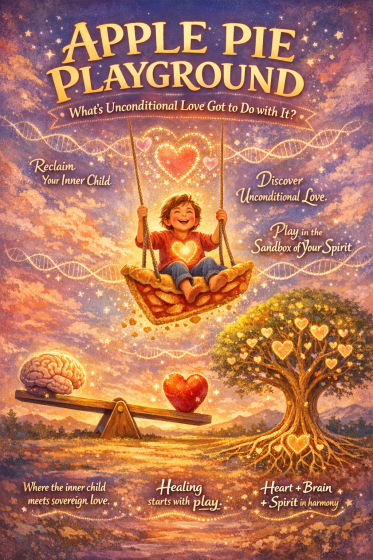

Apple Pie Playground with Valerie
Title: What's Unconditional Love Got to Do with it?
Sovereignty is the spirit's highest order and hardest lesson in physical bodies where something vital for activation is often missing. What's missing? Unconditional love. What's unconditional love got to do with it. Let's talk.
Sovereignty and the Science of Unconditional Love: Reclaiming the Inner Child
The Sovereignty of Unconditional Love
Apple Pie Playground: A Journey of Heart Healing & Inner Child Reclamation
Editorial Mode
Core Philosophy "Sovereignty is the absolute self-governing authority of a conscious entity over its own evolution, expression, and energetic signature." Unconditional love isn't just a sentiment; it's required for healthy brain development. Trauma literally shrinks the hippocampus, affecting memory and stress regulation. Sovereignty exists only in relationship to others. It is the "Herculean task" of having total power but choosing mutual respect and honoring the boundaries of other sovereign beings. Social orders and "majority rules" often act as a bait-and-switch for true spiritual sovereignty. We must awaken from "slumber" to reclaim our natural law authority. Host Insight: "Self-love is the job we have of continuing to regulate our own need for unconditional love."
Biological Necessity
The Radical Responsibility
The Matrix of Control
Reframing Workshop
Key Concepts
This episode explores the profound intersection between biological development, spiritual sovereignty, and the transformative power of unconditional love. Host Valerie discusses how reconnecting with our "inner child" is not merely a sentimental act, but a biological and spiritual necessity for achieving true self-governance and emotional health.
The Biological Necessity of Love and Brain Development
Unconditional love is identified as a biological requirement for healthy human development rather than just a psychological concept. When children experience consistent acceptance, their subconscious mind registers a level of environmental safety that allows for the development of emotional regulation, empathy, and trust. Neurologically, children raised in such nurturing environments tend to have a larger hippocampus—the area of the brain responsible for memory, learning, and stress regulation. Conversely, childhood trauma or the absence of unconditional affirmation can cause this area to atrophy, leading to adult struggles with anxiety, depression, and poor coping mechanisms.
Neurological Impact of Unconditional Love
Nurturing Environment
- Larger Hippocampus
- Enhanced Stress Regulation
- Strong Emotional Control
Trauma/Neglect
- Hippocampal Atrophy
- Chronic Anxiety/Depression
- Difficulty Learning Coping Skills
Spiritual Sovereignty and Natural Law
Sovereignty is defined as the "absolute self-governing authority of a conscious entity over its own evolution, expression, and energetic signature." This authority is inalienable and tied to "Natural Law" rather than man-made political structures. While historical documents like the Declaration of Independence attempted to secure liberty, true sovereignty cannot be granted by any government; it must be claimed by the individual. This state of being requires "radical responsibility" for one's own boundaries while simultaneously respecting the sovereign command of others. It is a shared reality where harmony is achieved through the synchronicity of conscious awareness.
Overcoming the "Amnesia" of the Matrix
The discussion highlights a "paradox of beingness" where eternal spirits navigate a temporary physical realm. Many humans exist in a state of "slumber" or "amnesia," allowing themselves to be controlled by social orders and "dark" influences that discourage individual sovereignty. This control is often maintained through the "majority rules" system, which replaces individual conscience with collective social pressure. Reclaiming sovereignty requires pulling source consciousness into the physical body and choosing to awaken to the responsibilities of a shared reality, rather than waiting for external leaders or divine intervention to provide rescue.
The 3-Column Reframing Exercise
A tool for transforming internal narratives into unconditional love.
| 1. Unlovable | 2. Tell Me Why | 3. Reframed Love |
|---|---|---|
| Identify a trait or situation. | Expose the story or judgment. | Apply grace and acceptance. |
Reconnecting Through the Geometry of the Heart
To return to a sovereign state, individuals are encouraged to engage with their inner child through joy and play. Unconditional love serves as the bridge between the spirit and the physical body, acting as the "fuel" for sovereign expression. By reframing personal narratives—moving from judgment to "authentic acceptance"—individuals can achieve an equanimity of spirit. This process is described as a "geometry of the heart" that aligns the individual with source consciousness, allowing them to navigate the dualities of the physical world as "children of God" capable of co-creation.
To-Do / Next Steps
- Reconnect with the inner child by finding a specific childhood memory and offering that version of yourself unconditional love.
- Perform the Three-Column Writing Exercise to reframe "unlovable" aspects of your body, work, the world, and family into narratives of grace.
- Choose a joyful activity this week that your inner child would love, such as singing, dancing, or eating a favorite treat like ice cream.
- Practice "radical responsibility" by recognizing the sovereign boundaries of others while maintaining your own energetic signature.
Conclusion
True sovereignty is not a gift from external authorities but an internal realization of one's own self-governing nature. By using unconditional love as a navigational tool and reclaiming the joyful, safe state of the inner child, individuals can bridge the gap between their eternal spirit and their temporal physical experience, ultimately contributing to a more harmonious shared reality.
Apple Pie Playground

Support my show
$5.99/mo or $9.99/mo or more
Click HERE
SUBSCRIBE TO TALK SHOW
Apple Pie Playground, a show serving up slices of remembrance of who we are as sacred children of the spark, where friends gather for a little levity, add in some fun and self-reflection as we use play self-therapy tools that reawaken our authentic selves on this human journey together. Can you come out and play today?
[00:00] Speaker 1: (instrumental music plays) Welcome to Apple Pie Playground, where we serve up slices of healing for the heart. Stay tuned for a journey of transformation back to the divine inner child. Can you come out and play today?
[00:26] Speaker 2: Welcome, everybody, to Apple Pie Playground. I'm your host, Valerie. Let's get out on the playground, friends, where we can talk about anything we want, and we can feel anything we want, and we can believe anything we want. And thank you, BBS, for being out on the playground with us today. We love you, BBS. What have we done for our inner child this week, friends? We talk about how humanity needs to grow into its capacity for unconditional love, and we think it's a tough thing to actually do. Does it feel kind of way too hard to see a planet of people loving each other unconditionally? It doesn't feel like that's what humans do naturally, does it? But all of us did at one time. As children, we started from this place of unconditional love. Fact, we were unconditional about everything. And the truth is, friends, children are defined by their ability to offer unconditional love, and by their need to experience it.
[02:02] Speaker 2: Unconditional love is actually considered a biological necessity for healthy development. Did you know that? A biological necessity for healthy development in children. Well, how's that? Well, did we know that when children experience unconditional love, which is an expectation of the subconscious mind of a child from birth onward, which is considered a level of parental acceptance that sustains a sense of environmental safety and affirms belonging even when children make mistakes or error in their behavior, okay? That is unconditional love as a psychological concept, and as a, a growth model for children growing, um, out of childhood and into functional adult behavior. So, dropping food on the floor, or spilling things, or running into things, or knocking stuff over, you know, all kinds of oopsies and owies that children do in the normal course of their learning curve.
[03:34] Speaker 2: When children experience unconditional affirmation even though they're learning, and they're messing up, and they're making messes, and they, they're trying to figure out how to regulate emotion and, and that sort of thing, their brains do something interesting, okay, with unconditional affirmation. Their brains do something interesting. It enjoys a level of safety, okay? And when children know that they're, that they're safe regardless of their behavior, then they are free to develop healthy emotional regulation, okay? Uh, they can develop emotional regulation, empathy, and trust. All right? Empathy and trust. So, let's think about it. Are these things sort of missing in people we know? Or a- are they, y- you know, are they things that maybe we wish we had more of ourselves as adults, and, you know, are we able to ask that kind of question without judgment as we think about it?
[04:54] Speaker 2: You know, brains who receive this kind of nurturing, who receive unconditional love, have larger hippocampi, or, or, hippocampuses, parts of, of their brain, and, and this part of the brain is associated with memory and learning and stress regulation, okay? So those are some of the big three, right? Of what the brain does. And childhood trauma actually shrinks this area of the brain, okay? And what we see is, we see results like, uh, a- a- adult depression or anxiety, right? Learning issues, poor stress regulation later on, and greater difficulty learning coping mechanisms and engaging positive self-taught, talk. These are things that-...you know, make a real difference in an adult's ability to manage our environment, especially our emotional environment. And did we know that core development is very similar to the experience of PTSD in this part of the brain? Right? And it's sort of what accompanies the, the results here in this part of the brain when it atrophies.
[06:34] Speaker 2: When it atrophies, or shrinks, right? In other words, the brain can no longer distinguish between safe and unsafe cues being translated from the environment. This is what we get when we get a child who does not experience unconditional love in their environment. Um, it takes a toll, friends. It takes a toll. And here's the thing, unconditional love is our natural predisposition. Now, most of us would never think that. Most of us would never understand or recognize that our natural predisposition from birth is unconditional love. We come into this life intending to use a body that develops according to unconditional love, and we need it in order to develop properly, right? We have to have it as self-loving spirits navigating physicality. Yet, we find it hard to believe that we should offer unconditional love, you know, to folks who don't deserve it, for example. And a lot of us have difficulty believing that we should receive it unconditionally, right?
[08:10] Speaker 2: Think of all the things that get in the way of love without conditions. All the conditions placed on us to be worthy of other people's love, and all the conditions we might place on, you know, loving others like, for example, our crappy neighbors that we like to talk about, right? Or unlovable family members, or trouble-making colleagues at work. And do we find it hard to love ourselves, right? Now, it doesn't mean that we accept bad behavior or allow abuse, okay? Please, please, please, don't misinterpret what I'm saying. It means walking into other people's lives with grace, right? With grace. Sharing what is authentic acceptance and then walking away from others with a- an, an equanimity of spirit, so to speak, that, that keeps us open and expansive as we come and go, right? And for ourselves, self-love, okay? Self-love is the job we have of continuing to regulate our own need for unconditional love. That's what self-love does.
[09:41] Speaker 2: It's not just something that we, we feel like, okay, I just, I wanna practice this idea so that I can, you know, go along with, with, uh, what the new age ideas are or figure out a new meditation, or, you know... Self-love is the centerpiece of regulating our own need for unconditional love. Do we see that? It starts with us to repair what's missing or to realign what's gone straying or, or heal what's been abused. Do we see that? Self-love is our way of ensuring we maintain a spirit of unconditional love, that we remember it, that we use it, that we maintain it for ourselves and for everyone else, and we are as children again when we do that, okay? So self-love is not an ego trip. Self-love, in its truest form, is remembering the, the unconditional nature of that childlike expression when we came into our bodies, right? So let's be as children, friends, in our spirits. And how do we get there? How does an adult feel like a child again? Well, we remember, right?
[11:13] Speaker 2: We remember how to laugh and, and do things we love and sing and dance and play and we focus on joy and we fill moments up with only what matters. We remember. And you know what, what I did today? I had cake and ice cream. Now, I haven't had cake and ice cream for maybe almost a year, and (laughs) it was so, so, so, so good, and it brought along some memories, and I remembered, as children, we used to go with our grandfather to an ice cream place in the middle of downtown and...He would order custard ice cream cones for us, and he would always get one too, and he loved them so much. He loved a good custard ice cream cone, and we'd sit there together at an old picnic table, and, you know, we wouldn't even talk. We were just sitting there together licking custard cones, and I felt so safe, and I felt loved, and the world was right, and the ice cream was yummy, and it was a perfect moment, right? Thanks to my grandfather. Thanks to my grandfather.
[12:49] Speaker 2: So pull a memory out and reconnect with it, right? Find that inner child. It's the most important thing you will do this week. Okay? No matter what's on your calendar, there is nothing more important than finding that inner child again and offering her unconditional love, right? And, you know, maybe some ice cream. So I came on today with the intention of talking about sovereignty. Okay? Sovereignty. Not liberty or freedom or control, but sovereignty. And the important thing about this topic is that we can't get there without our inner child. Okay? Who holds the mystery of an eternal heart. Okay? Who is directly connected to that tether, who, who perfectly understands the unconditional nature of the expression of source, right? The unconditional nature of this expression of source. So let's talk about this idea of sovereignty, right?
[14:13] Speaker 2: Now, the definition that I like is that sovereignty is the absolute self-governing authority of a conscious entity over its own evolution, expression, and energetic signature. And I really like that definition. I think it's... just think, it's so good. In America, we think a bunch of guys signing a Declaration of Independence made us sovereign. We think that, but think again. Think again. They tried. They tried. They're still trying, friends, for you, for all of us. They are still trying. But great men cannot make us sovereign. Okay? They can't give us what those of us who are awake and aware want most of all as humans, okay? Our sovereignty, they cannot offer it to us. They couldn't offer it then, and they can't offer it now. It's not theirs to give. Do we see that? By definition, age after age after age, we have expected to be liberated from evils and from dictators and from injustice as a matter of right, right? For divine spirits.
[15:52] Speaker 2: But in our work this year, integrating our knowing with wisdom, by realizing truths that are singular in our source creation, okay? In our work, we know that the truth is nobody can liberate us. Okay? Nobody can free us but ourselves. If sovereignty is the goal, if sovereignty is the goal, right? Until we get back to the playground of life where nobody makes the rules but us, until then, we are captives. And, uh, you know, I'll confess it, friends, I am not immune to the frustrations such a truth brings. Okay? Do we get fairly furious with what world leaders are doing and not doing on our behalf on any given day? Or what governments are not doing? Right? Or what courts are not doing, or what lawmakers are not doing, or what police are not doing? Blah, blah, blah, it goes on and on. It can be fairly infuriating, right? And worst of all, sometimes do we get angry at what God is not doing? Do we get angry at what we perceive God is not doing?
[17:31] Speaker 2: Do we get angry at the source of all creation and its flow through us and around us and among us? And yet, there is a universal truth, friends, and it cannot be denied. It cannot be denied. The truth of the underlying responsibility of our spirit to decide its own sovereignty, to decide its own sovereignty-How would that even translate, right? In a human world, where there are laws and lots of laws, dumb, stupid laws, right? And dumb, stupid rules, and norms, and beliefs, and a lot of stupid stuff like that, and all of it's controlling our interests as a physical body. And, you know, some of us realize our enslavement. Some of us realize, right? We see the matrix and we shift to move away from it, and (laughs) it... Right? Only to succeed in creating a different form of it, right? It's like we can't get, we can't get rid of this matrix physicality, um, you know, of a matrix that is, by all quantum laws, thoroughly connected to a shared field of energy and intention, right?
[19:03] Speaker 2: It's a shared reality out there. We move together, right? More than we know, more than we know. We have been moved out of our orbit and into other holograms, and how many times have we done all of that? We have been moved, and we move ourselves, and it is a shared reality, right? And we have been moved into realities that perpetuate control over us, age after age. You know, we are deceived into a recycling of human energies used for, you know, dare I say it, purposes of the dark. It's not a, a, a pleasant topic, and it's, it's one that seems to be disappearing from the Q conversation, right? It used to be front and center. Maybe it has, you know, worked its way through, but thanks to the Q Movement for putting the idea of sovereignty front and center. And you know what? It is gaining traction. Some things ebb and some things flow as our interests and needs come and go, I suppose, but the idea of sovereignty is gaining traction. I'm so very grateful for that.
[20:29] Speaker 2: It is a word that is coming into its own meaning, and it will gain in its power to be a focal point for defining what it is we're doing. That's very exciting. It's really our best gauge as a galactic narrative, I think, of how to assume our role in this age of, you know, Aquarius, so to speak. If our story is the evolution of humans through time and space, spiritual sovereignty is that connection with an ethereal plane that keeps us tethered to universal truths. You know, as we, we bounce around a quantum reality, right? We're still tethered to universal truths that work through that quantum reality as it continues to unfold, right? So, let's talk about sovereignty. Did you like that definition? Let's take another look at that definition and see if we can pick out a few things of interest, okay? Our spiritual or energetic sovereignty, which I prefer, is the absolute, self-governing authority of a conscious entity over its own evolution, expression, and energetic signature. Okay?
[22:09] Speaker 2: So, how do we even break all that down, right? To conceptualize it and make it workable in a day and age of so much social control. That's a lot of... That's a lot of self-command and independent control there in that definition. How does that even jibe with, with all of the social control around us in this particular human experience we're going through right now? Well, we can start with the idea that sovereignty exists in terms that are absolute. Okay? They are not temporal. They are not unnatural. They are not physically man-made, so to speak. Right? These ideas, this idea of sovereignty, exists in terms that are absolute. They don't change. They don't diminish. They don't stop being true, right? They are inalienable, unprescriptible, indivisible, eternal, time immemorial. Okay? Time immemorial, as a matter of what? Natural law. Natural law, the law of the one source, the singularity of all that is. Right?
[23:46] Speaker 2: In other words, our sovereignty cannot be denied because it's intrinsically intertwined with source itself. Okay? In other words, it can't be separated out. It can't be limited as a matter of source itself, and here's the problem with this, this idea right away, right?... in all of the philosophies of our age, okay? We're not gonna find support for any definition of sovereignty apart from the politics of it, apart from the social power aspect of that word. And the closest we get is the idea that sovereignty is the right to decide on the exception of something, or to have the right to do the opposite of what is expected of a man to do, okay? That's as close as we can get to, to the definition that we like, and that's not very close, is it? It's not very close at all. And as we know, humanity is now completely controlled by a social order that thoroughly undermines that kind of right, right? By design. And why would controllers want to discourage a man acting on exception to the rules?
[25:22] Speaker 2: Right? Well, because of the maxim exception proves the rule. It's a paradox. Too many exceptions cause a rule or a law to become functionally obsolete, right? What happens when there are so many exceptions that we don't have a rule anymore? Well, it means people are their own measures of the rule, right? That we provide the value of what that rule is, and, you know, that's a, that's a, a great responsibility, for sure, and, and we'll talk about that in a minute. So the greatest interest of social controllers like countries and corporations and militaries and governments and et cetera, et cetera, those strata of influencers who pull strings, right, is to make sure sovereignty is, is a non-starter, right? Like in American politics, we were founded as a republic by design. Each man was guided by his own conscience to act in his best interest as he determined it appropriate for himself, right? But it didn't last, that idea. It did not last.
[27:00] Speaker 2: We are a majority rules nation now, democracy of the majority, and not the conscience of sovereigns to a republic, okay? Right? Most Americans don't even realize the bait and switch that went on. Most Americans don't even realize that we are not in the same system we were born as, that men and women who fought and died for sovereignty ended up in, centuries later, with a mere liberty provided by a Constitution that nobody reads anymore, and that nobody can interpret, and that nobody will represent, and that no one will defend. Americans don't realize the bait and switch, right? So the realm of source consciousness co-creates, okay, as a notion of sovereign energetic expression. Now, notice I said co-creates. It's a very important word, okay? It's a very important word. It goes along with the idea of sovereignty. In fact, it's inseparable from the idea of sovereignty, which does not translate into physical human experience very well, does it, for some reason, right?
[28:37] Speaker 2: And, you know, maybe we can think about why, why that might be the case. So what controls that notion of supreme sovereignty in a physical realm, right? What keeps the cosmos in line with natural law? How do we police a system of beings who are absolutely self-governing, right? All of us in the universes of universes, all of us creating playgrounds we call planets and star systems and deciding how to control what we've made and what we've discovered and what we've conquered. Is the spiritual realm so lawless as to be unable to manage bad actors, right, like the ones enslaving humanity age after age after age? Are we getting the point here? The difficulties in presuming sovereignty, right, and, and the idea that it, that it needs to be a protection at every level of consciousness, right?
[29:59] Speaker 2: Because we end up with questions like, "Why is somebody not playing fair on the playground of source consciousness down here in this Earthly scene going on here right now," right?Which brings us to the second key idea behind the concept of sovereignty. It's the idea of self-governance, okay? And the thing with self-governance is that it has a radical responsibility to the boundaries of its own freedoms. Okay? Do we understand that? What do I mean? Sovereignty exists not because I am omniscient in my command of self. Okay? It exists because I fully appreciate your command of self. Okay? Do we understand that? Sovereignty only exists in relationship to others, to each other. I am sovereign because I am ever-aware, ever-present in knowing that you are sovereign, and together, we recognize the boundary that defines our mutual assurances. Is that hard to understand, friends? Sovereignty is- it's a Herculean task, by the way. Right?
[31:40] Speaker 2: It's like having total power to conquer and control every single thing and not using it. Do we see that? The complexity there? It's sharing a trust between each other that reciprocates a synchronicity of conscious awareness of each other. Right? And I really like that. It's what quantum might call harmony of energy. We harmonize in the idea of spiritual energetic sovereignty. We align together and create realities in, in accord with our abilities to produce a unified field of experience at whatever level we might be at. It's everything you could want in a perfect quantum romance novel, I mean, when you think about it. And how well are we doing right now w- on planet Earth, right, with this, this idea of aligning together and creating our reality in accord with our abilities to produce this unified field of experience? I mean, what does sovereignty look like for us? Well, look around, everybody. Look around. Maybe not as well as we would want, right?
[33:04] Speaker 2: And it's up to us to keep working at it. We have all the tools. We've got the language. Right? We've got the language. We've got the tools. We've been given everything there is to work at and to know and understand and implement, right, at the conscious awareness that generates sovereignty across our realm one awakening at a time, and we work at it, and we keep working at it, right? In quantum mechanics, harmony is considered the construct of a rhythmic vibrational mode or modes, okay, according to frequencies much like musical notes. Right? So when we think about this thing that we're doing, we're really creating a cosmic song together, right, in our field of reality. We're creating and orchestrating a cosmic song together across our realm. Okay? Isn't that lovely? What that song sounds like depends in large part on the harmony of it, right? Where are we at any given time in our synchronicity, the way we combine the experiences of our energies, right, according to vibration?
[34:39] Speaker 2: Does that make sense, friends? We can know what reality we're creating just by turning on the morning news, right? Or we can decide not to turn the TV on at all. We can choose to create a different reality any moment of our day, any moment. It only takes a moment, right, to serve a different vibrational mode, to write a different tune, to sing a different song together. It only takes a choice, right? So there are a lot of questions, but one might be, if universal truth is that there is no condition of the light more consequential than the sovereign spirit, right, nothing more important, nothing more powerful, then what enables the darkness that overtakes us? Have we thought about that? I'm sure many of us contemplate that. So if no co-creator of light would betray the right of sovereignty, then why is it betrayed in our human experience, right?
[36:07] Speaker 2: Is the physical realm a different playground with different rules than the cosmic one?Are we at the mercy of something more powerful than ourselves? And I can tell you, friends, the answer is, no, we're not. But, we have to remember what we've forgotten. You know, the amnesia is real. The amnesia is real. So, what really prompts the darkness that overtakes us? We look around, we see it everywhere. (gasps) What does that? Well, there's only one answer, friends. Okay? There's, there's only one answer here. We do. We do. Each of us decides whether to live by our sovereign truth or to deny it in favor of, you know, any number of other things. And those who would rescue this world, like they're doing right now, like they've done before, like they have always done, those who would rescue us, they can't stop us from choosing to slumber rather, than awaken. Okay? They, they can't command our sovereignty return back to us. They can't help us prefer it.
[37:42] Speaker 2: They can't help us choose it or demand it. They can't force us to use it. They're holding space, friends, time and space to let us remember enough of who we are to return ourselves to our own sovereignty. Okay? To pull enough source consciousness into our physical bodies to awaken to the responsibilities of our shared reality. It's part of the one truth or the natural law that the work belongs to each of us individually, together, as a truth and, you know, maybe as a paradox. Maybe as a paradox. We are in a paradox of beingness, a paradox of beingness. Eternal life, right? This eternal force, this life force spirals around the impermanence and evolution of a physicality, right? Of a polarity, a duality, in a way that kind of confounds us. Without our ability to experience conscious awareness, we spiral in and out of any number of imbalances in our lives, and we are not conscious enough to understand this spiral, this life force spiral that moves around an impermanence, right?
[39:33] Speaker 2: And an evolution of an ever-changing physical realm of energy, because without this balance, without this understanding, this harmony that we choose, right? Without that, we can't balance this temporal journey that we're on with our eternal state very well. Right? We aren't governing the temporary with the laws of the eternal, in other words. And the truth is, likely, we've forgotten how to do that, in large part. We've forgotten how to be sovereign in physical bodies. Um, and the dark parts of duality and the dark animus, that sort of assails source consciousness, it kind of conspires to take advantage of, of our slumber, so to speak. And, you know, even as the guardians are at the gate, friends, right? Even while we slowly change this tune of the song that we are singing, um, we are needing this balance to govern us. Right? We are needing this balance. We are needing to come together as an orchestra of energetic signatures playing in a shared field of vibration, right?
[41:21] Speaker 2: Creating a reality that reflects the collective intentions of our world. And remembering the truth, right? That is our wisdom as it is unveiled for us, right? And we ask the hard questions. We do the work. We put in the time. Right? And we do all of that to awaken to knowing that each of us, each of us is the absolute self-governing authority of a conscious entity over its own evolution, its own expression, and its own energetic signature. Right? Each of us. It might be something to think about. It's maybe something to honor, to return to as who we really are. Right?And to offer vigilant awareness of our singular responsibility for what, you know, unfolds in our lives if we allow it to, and how we might improve the experience together by service to teach each other, and to share with each other, and to engage this collective stream of consciousness, right?
[42:51] Speaker 2: Um, this service that we owe to the co-creation energies that we undertake, and the degree to which we can offer unconditional love as fuel for the sovereign expression in human bodies, right? Unconditional love, it's the bridge from spirit to the physical, it's the cornerstone of how to navigate duality as eternal spirits in a very temporal, physical body, and maybe there's something there that we can meditate on a little more this week. You know, it's a common sermon, uh, to hear folks talk about loving thy neighbor, right? It's a very common idea. And do unto others as, as you would have them do unto you, right? It's a very common kind of, uh, a sermon of a, of ministry, and we tend to attach a certain level of guilt to those ideas, don't we?
[44:08] Speaker 2: We sort of, we think it means needing to show self-sacrifice, right, for others' needs, and assuming great service to, to people we may not even know, and, and, a- and putting ourselves out there, and denying ourselves for the benefit of others, right? And these are all powerful ideas, for sure, but the message, it sort of gets lost in that translation a little bit. It kind of pales in comparison to the, to the real intentions that, that were laid out when Christ explained that understanding the mysteries of our divine sovereignty, it really, it would make us kings over all, okay? He was talking about a dominion over all things, right? Doing unto others is sort of an idea that grows our appreciation for the natural supremacy of a spirit's sovereign nature. Do we understand that?
[45:21] Speaker 2: We begin to understand the idea as something of a geometry of the heart, right, that connects the physical with the, the divine, that keeps us aligned in source consciousness, and that the real message was one of describing us as children of God, as a way of understanding that we're capable of our duties to sovereignty, as a shared self-determination, right? As, as a- as duties to the shared nature of co-creation, right? Because we are immeasurably loved, and we therefore immeasurably love as the nature of source. Does that make sense, friends? So, you know, what do you say we end our time together with a little self-affirming, kind of expressive activity that we like to do? I think that would be super fun. I think we have just enough time. Maybe let's investigate how we see unconditional love. You want to? Now, many of us like to use a notebook to jot down our answers and our ideas, but, you know, you don't have to do that. Any old thing to write on will do.
[46:54] Speaker 2: Any old thing to write with will do, as we, you know, like to play a little bit together. Let's think about what unconditional love really means for us. I mean, have we ever thought about it? So, let's grab a piece of paper, maybe something to write with, let's have a little fun, do a little self-reflection, and rewrite a few of the narratives that we might have around what we find unlovable, right? Let's rewrite the stories that we tell ourselves. You want to? Okay. Let's don't leave anybody behind. Grab your notebook or any old thing to write with, any old thing to write on, here are the instructions, okay? On our paper, we're gonna draw two lines down our page, all right? The idea is, we're gonna make three columns down our page, okay? And we do that just by putting two lines down the page, and we will see three different columns that we can use for information. Got it?
[48:15] Speaker 2: So, we want three columns running down the page, and what we'll do is, we're going to put headings at the top of each of the three columns, okay? So, at the top of column number one...... put the heading Unlovable. Put the heading Unlovable. That's the first heading for column number one, on the left-hand side of our page. Okay? Now, we're gonna test ourselves just a little bit here, okay? Not too much, not too much. So heading number one, column number one, is Unlovable. In our middle column, right, let's put heading number two. It goes over our second column. The heading is Tell Me Why. In our second column, Tell Me Why is the heading. Okay? And over the third column, we're gonna write the heading Unconditionally Lovable. Right? Unconditionally Lovable. Got it? That's our third heading over our very last column, Unconditionally Lovable. Okay? (laughs) We have three columns with three headings, right? Okay? Unlovable, and Tell Me Why, and Unconditionally Lovable.
[49:55] Speaker 2: Those are our columns. So, ready for some questions? I'll ask a few questions and we will work our way across the columns with each question. Okay? Are we all together, everybody? Okay. Question number one, in column number one, and so we're in the Unlovable column. Okay? Here's the question. List something about your body that, according to you, is unlovable. Okay? That according to you, and only you, that is unlovable, something about your body. What about your body have you decided is unlovable? Jot that down in column number one. Okay? And if there's nothing that's unlovable, just leave that space blank. Right? Don't even worry about it. Okay? Don't even worry about it, and let's get a, a jot down a, a short little answer in column number one. What do you think is unlovable about your body? Okay? All right. Here we go. Column number two. Tell me why you find that quality to be so unlovable. Why do you find that quality about your body to be so unlovable? Tell me why. Okay?
[51:41] Speaker 2: Just jot down ... You can use a few words, draw a picture, whatever you wanna do. Tell me why. Right? Tell yourself why. Okay? Just a few words to capture it. You got it? Okay. Third column. How can you reframe your answer in column one to show unconditional love for your body? How can you reframe that narrative into one that shows yourself unconditional love for your body? Okay? What words might you use to offer yourself unconditional love of your body? Let's try to reframe that narrative as best you can. Okay? And it might be a little uncomfortable to do that, but give it a try. Make yourself determined to create some language around that act of showing yourself unconditional love. Give it a try. Right? You got it? Okay. Let's do another one. Let's go back to column number one, where we will ask a second question. Okay? Here we go. We're back to column number one. Here's our next question. Okay? What about your employment or daily work do you find unlovable?
[53:33] Speaker 2: What about your employment or your daily work, whatever that might be, do you find unlovable? Okay? And jot that down, column, in column one. Right? Jot that down. And now let's move to the second column, Tell Me Why. Why is that particular thing about your employment or your daily work, why is it unlovable for you? Tell me why. Okay? Tell me why. Got it? Okay. Let's move to our third column. Right? Let's think about how we can reframe.... this unlovable aspect of our employment, okay? How can we reframe that so that we are offering the idea unconditional love? How would you reframe the answer to this question? Give it a try. Offer yourself unconditional love in this particular aspect of your life. See if you can give it a try, okay? See if you can put some language around the grace of offering unconditional love, all right? Got it? Okay. Let's go back to, to column number one, question three. Here we go, we're back on column number one, this is our third question, oh.
[55:25] Speaker 2: What about the world right now do you find unlovable? What about the world right now feels so unlovable to you? Okay. Jot that down. What about the world right now feels so unlovable? Right? Okay. Let's move to column two. Tell me why. Tell me why. Jot down your answer there. Tell me why. Got it? Let's go to the third column, how can we reframe this answer to offer some unconditional love toward the world right now? How can we reframe this answer and offer a little bit of unconditional love toward the world right now? Let's see if we can give it a try. What language would we use? What language would we use? Got it? You wanna do one more? Okay, let's do one more. Okay, back to column one. This is our last question. Last question, what ab- (laughs) and I saved this for last, because this is a hard one, (laughs) b- this is a hard one, okay? What about your extended family do you find unlovable? Okay, just pick only one, you can only pick one thing.
[57:12] Speaker 2: What about your extended family do you feel is unlovable, right? Jot that down. Jot that down. And then let's go to the second column and tell me why. Tell me why. Okay? Tell me why. Now, here's where the work comes in. Let's reframe that. How can we offer the situation unconditional love? How can we reframe this narrative to offer some unconditional love? And it may be hard, may be super easy. What would that sound like, okay? What would that sound like? You got it? So how did we do, right? How did we do rewriting these narratives? So, we're not trying to fool ourselves, right, or deny our feelings, okay? We're trying to make peace with what we can't control, and may, actually may not be able to change, right? Does that make sense? So column three is all about finding our peace, right? Unconditional love for what may, we may not be able to change, right? To finding an evolution within our hearts for things that we are learning to accept, right?
[58:55] Speaker 2: Which is more powerful than any angst will ever be, okay? Any, it, it's just way more powerful. So be invited to re- you know, revisit this activity, and you know, tweak your narratives if you like, return to those as to sort of think about 'em when things get kind of iffy in a situation. And I'm so, so glad you played along today. I, I hope that was helpful. I know that I enjoyed, um, this particular activity. It was, uh, it was a good way for me to check myself and the language I was using, and to give myself better language for reframing, uh, the narratives that maybe I had created that weren't so very helpful. So, it, it was a meaningful activity. I hope that you, uh, were able to gain, um, good insight and reflection in that as well, and it was so wonderful to play along with you. I can't believe the time has flown by, friends, and it's time for me to go home. Pick an activity this week that your inner child would love, and have some fun, okay?
[01:00:12] Speaker 2: It's the doorway to remembering our sovereign selves, and you know, ice cream works especially well. So give it, give it some thought, and I wanna thank you so, so much for spending time with me today, and thank you BBS for being on the playground with us. We love you so, so much, and so friends, until next time.
[01:00:41] Speaker 1: (instrumental music) Time to head home friends. Thanks for being a part of today's journey. We'll see you back on the playground next Sunday at 1:00 PM central time on bbsradio.com. Make sure to subscribe if you enjoyed the show. Find us on Telegram and X to share your insights on topics today. Your input heals the child in us all.


