
Apple Pie Playground, February 22, 2026

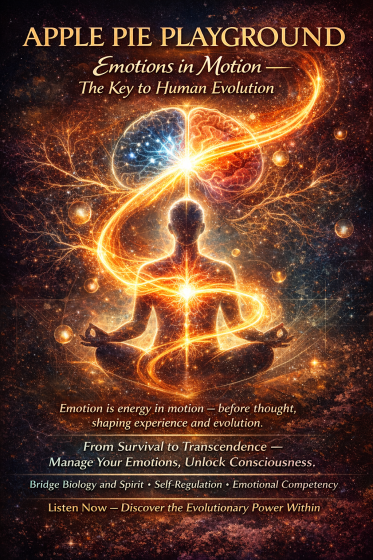

Apple Pie Playground with Valerie
Title: Emotions in Motion, The Key to Human Evolution?
Is it possible that managing emotion is the key that opens the door to human evolution mind, body, and spirit? Are we managing emotion or is it managing us? Does it really matter? Let's talk.
Emotions in Motion: The Gateway to Human Evolution and Spiritual Transcendence
Emotions in Motion
The Key to Human Evolution & Quantum Spirituality
Core Philosophy
"Emotion is energy in motion (emotere). It occurs before thought, informing the body through sensory cues before the brain even interprets the environment."
Fight, flight, or freeze. Triggered by unmanaged emotional charges in the amygdala.
Transcendence and regulation. Activated through meditation and mindful awareness.
The Cellular Impact
Unreleased emotions deposit energy into cells, forming karma and "subtle bodies." Managing this energy is the only way to unlock psychic abilities (the "clairs") and higher consciousness.
High EI Checklist
- ✔Self-Awareness & Regulation
- ✔Empathy & Social Skills
- ✔Setting Healthy Boundaries
- ✔Openness to Feedback
- ✔Conflict Resolution
The 5-Circle Activity
In this session of Apple Pie Playground, host Valerie explores the profound duality of human emotions, characterizing them as both a sensory "energy in motion" and a potential barrier to spiritual evolution. The discussion bridges the gap between quantum spirituality and neurobiology, offering a roadmap for managing emotional states to unlock higher consciousness and collective transformation.
The Dual Nature of Emotions: Physicality vs. Spirituality
Emotions are often described as the "astral field" of our physical experience or energy bodies that persist beyond the spirit's departure. While many spiritual traditions equate the highest state of being with an emotion like love, Valerie suggests that emotions are actually a characteristic of the physical realm of duality and do not necessarily translate to our "source identity". Because emotions like love can encompass a vast spectrum—from divine light to the "dark side" of obsession and possessiveness—relying on them as a sole definition of the divine can be problematic.
The Biological Mechanism of Feeling
Scientifically, emotions are electrochemical processes triggered by sensory experiences, occurring as electrical impulses in the body rather than mere brain waves. Crucially, emotion occurs before thought; the body picks up cues and shifts energy before the rational brain can define the event. If these energies are not released, they deposit into the cells, creating what some traditions call the "subtle body" or sushruma sarira, which can influence karma and physical health.
The Emotional Brain: Survival vs. Transcendence
Reptilian Brain (Amygdala)
Triggers Fight, Flight, or Freeze. Operates on survival mode and subconscious triggers, often bypassing rational thought.
Limbic & Prefrontal System
The Pineal & Pituitary glands enable higher awareness. Regulation occurs in the Prefrontal Cortex through reason.
Extreme emotions (even joy) can "hypoactivate" the brain, blocking psychic and transcendent functions 16].
The Path to Emotional Competency
Unmanaged emotions lead to a "feedback loop" of stress, hormonal imbalances, and even addictions as the brain craves certain chemical stimulations. To evolve, humans must move emotion from the subconscious limbic system to the prefrontal cortex for regulation. This is achieved through intentional practices such as meditation, deep breathing, and prayer, which scientifically recalibrate the brain and activate the "transcendent" functions of the parietal lobe.
Evolutionary Potential and Shared Reality
Valerie posits that "emotional competency" is the fastest route to human evolution. By stabilizing our emotional bodies, we may unlock latent abilities such as clairvoyance and psychic connection. Furthermore, because emotions are vibrations that affect the quantum field, a collective shift in emotional frequency—preferring joy and compassion over hate and greed—has the power to literally reshape our shared physical reality.
Indicators of High Emotional Intelligence (EQ)
- ✅ Self-Regulation: Pausing before reacting to avoid impulsive decisions.
- ✅ Empathy: Reading body language and understanding diverse perspectives.
- ✅ Openness: Viewing constructive criticism as a tool for growth.
- ✅ Boundaries: The ability to say "no" to maintain healthy limits.
- ✅ Conflict Resolution: Focusing on diplomacy rather than "winning."
Source: Apple Pie Playground
Practical Strategies for Daily Management
To prevent emotions from settling at a cellular level, individuals should practice "moving" them through the body. Techniques include reframing negative thoughts into neutral or positive ones, practicing gratitude to shake off negativity, and using grounding exercises (focusing on the five senses) to remain present during a "trigger" event. Creating space between a stimulus and a response is vital for bypassing the subconscious "fight-or-flight" mechanism.
Key Data & Observations
- The 5-Minute Rule: Just five minutes of quiet recalibration can significantly reactivate the brain's regulatory centers.
- Heart Coherence: Elevated emotions like gratitude influence the heart's electromagnetic field, aligning it with higher consciousness.
- Subconscious Triggers: A "trigger" is a subconscious reaction that completely bypasses the rational thinking brain.
To-Do / Next Steps
- Label your feelings throughout the day to increase conscious awareness of emotional shifts.
- Practice "The Pause" by breathing and waiting before responding to a triggering event.
- Perform a daily grounding exercise by identifying what you can see, touch, and hear in the present moment.
- Conduct the "Five Circles" reflection: Draw five concentric circles representing your emotions from waking up to bedtime to track your emotional evolution.
- Choose your final emotion of the night intentionally, as it often dictates the emotion you wake up with the next day.
Conclusion
Emotions are the "Achilles' heel" of humanity, often targeted by social controls and media to keep us in survival mode. However, by treating emotions as informative tools rather than our absolute identity, we can manage their energetic force. This mastery not only heals the individual but serves as the catalyst for a more beautiful, co-created global reality.
Apple Pie Playground


Support my show
$5.99/mo or $9.99/mo or more
Click HERE
SUBSCRIBE TO TALK SHOW
Apple Pie Playground, a show serving up slices of remembrance of who we are as sacred children of the spark, where friends gather for a little levity, add in some fun and self-reflection as we use play self-therapy tools that reawaken our authentic selves on this human journey together. Can you come out and play today?
[00:00] Speaker 1: (instrumental music plays) Welcome to Apple Pie Playground, where we serve up slices of healing for the heart. Stay tuned for a journey of transformation back to the divine inner child. Can you come out and play today? Welcome to Apple Pie Playground. It's always a play date on Sunday afternoons here on the playground, and I'm your host, Valerie. Shout out to BBS Radio, thank you for all you do, BBS, we love you so much. I want to talk about a topic that is all over the board, so to speak, in the many spiritual communities and in the arena of quantum spirituality, I kind of like to call it: the topic of emotions. Okay? Emotions. They can climb so high, right? And sink so, so low, and they can fill us to the brim, or they can empty us just r- right out, right? (laughs) So, emotions are the doorway to the fondest self-expression of who we are as human beings, all at the same time while really threatening a real devolution in consciousness, right? All in the same breath.
[01:34] Speaker 1: So, how's that for a dramatic topic? It's something that I have been wanting to talk about, uh, but it's such a huge topic that, um, that it was almost insurmountable. But I think this is the week for some self-care around our emotions. And so, some folks call emotions, uh, the astral field of our physical experience, which I think is a really, really cool way to think about it. Some folks call them energy bodies. Okay? Separate from the actual energetics of our physical expression, right? But, but their own kinds of energy bodies that stick around after the spirit kind of goes away. Um, some ha- folks have decided that God is actually really just an emotion called love, and so that's what God is. It's, it's sort of an emotion that, that's been boiled down to, to this expression in, in the physical realm of, of, of who we are. Some folks say that our highest realms of cosmic energies are really where perfected emotions are expressed the best.
[03:03] Speaker 1: Um, and others tend to, to think that humans actually are teaching higher cosmic energies what emotions really are. Right? And some folks say that emotions don't go with us when we leave this physical realm, right? And on and on and on. You can see the whole spectrum of speculation and, um, thought processes on the idea of emotions and what exactly do we do with them as a characteristic of spirituality that doesn't belong to the spirit realm of spirituality, right? (laughs) It's a fascinating topic, and, um, and, and we could go in a thousand different directions, but I think what I'd like to do is I'd like to go in the direction of some self-help, and some self-care by the end of our time together, right? Um, it's something of a mess when it comes to usable, helpful information in the spiritual community and how we think about emotion, and we can add to the situation that some of our spiritual practices really are teaching us to deny our emotion, our emotional aspects, right?
[04:34] Speaker 1: Some teach us to embrace our emotion, some teach us to transcend our emotions, right? So it's, it's a mixed bag out there in what I call cosmic spirituality, and in those conversations where spirituality i- integrates this idea of emotion, which is really, truly foreign to, to the, the spiritual essential self. I mean, e- e- th- as we'll find out, emotion is something of a, um, a physical experience that doesn't necessarily translate into, um, our essential selves as, uh, source identity. But, but we'll talk about that. Um, and, and sort of the biggest problem is that emotion, like for example, love, for example, is a, is a really powerful tool to use as a unifying theme among humans, right?
[05:40] Speaker 1: And we just sort of accept that what means is that the highest spiritual experience is, is love, and we kinda go with that, and it becomes how we epitomize all of that is the best of our human experience, even though we look at, at this idea of love and we see the intricacies of it and the multiplicities of human love, and the dark side of love, and we might, you know, we, we take a look at this...... this expression that, that is so very beautiful and light, and it gets so dark, and we're talking about lust and obsession and possessiveness, and it just sort of the Fifty Shades of Gray kinda stuff, right? That we all, you know, we have a fascination with at times. But, but the complexity of that idea of love, and then when we generate sort of a generality and say, "Ah, God is love," wow, that creates, um, that creates a lot of, uh, a lot of question marks, doesn't it, right? Just as an example. That's just one example, right? So let's talk about our emotions.
[06:57] Speaker 1: Um, emotion, emotion is energy in motion, right? And in Latin, emotion is emotere, which means to move through, right? To move, movement. It's dynamic. Emotions are not mental states of mind, okay? We aren't thinking that we're angry, for example, right? Emotions are sensory experiences in nature, okay? And they move to expand or contract functions in the body, right? They show up as electrical impulses in the body, okay? Not as brain waves. Do we understand that? We've talked about our energies as bodies that are energetically expanding or collapsing, right? And emotions are the energetic shifts that we experience in our nervous system, okay? And we can get a little, uh, go a little farther with that by suggesting that emotions are held, they're held in instead of released, right? Deposit their energies into our cells is what emotions do, so they're held in, and they are gonna be in the cell, right? Did we know that?
[08:31] Speaker 1: We hold the energies of our emotions, okay, on a cellular level, for better or worse, and some traditions call this our subtle body, our sushruma sarira, right? Those who see emotion as part of our subtle bodies see this part of our essence as life force essence, and part of us that reincarnates with us, and part that creates karma, right? So, you know, what is emotion scientifically then? So scientifically, we're talking about electrochemical processes in response to sensory experiences, right, that, that creates energy neurologically, okay? That's a s- sort of a scientific breakdown of emotion in the body. So the brain has the job of interpreting what the body is doing, like breathing, like heart rate, hormone activation, all of those things, and the brain has to use past experience to interpret what's going on in the body, right? It's why sometimes your brain is telling you that a situation has made you excited and scared and worried and, all at the same time, for example, right?
[10:07] Speaker 1: The brain has to interpret an electric process that becomes a chemical process that becomes a physical process that must now become a cognitive process, okay? That's what emotion does to this body of ours, okay? Our brain is trying to figure out the complexities going on in the body as our sensory experiences inform it, okay? Do we realize that emotion occurs before thought does, right? Emotion occurs before thought does in sensory experience, so our body is picking up lots of cues before the brain even has a sense of what's going on. It means that energy shifts into motion even before we are defining what it is that's going on, even before we are thinking about what could be occurring in our environment, right? And our gut feelings are a matter of the body sensing emotion even before the brain does, and so I guess, you know, we might wanna think about it. Do we tend to disregard our gut reactions and, you know, until our brains catch up to interpret what's going on?
[11:45] Speaker 1: And how many times do we sort of wish we had listened to our gut feeling instead of our heads, right, in the end of it? So it's why, if we're not in a self-aware, balanced, mindful state of conscious awareness, we can, we can be easily caught off guard with the process of the brain trying to interpret emotion energy, right? Which can be very disruptive to a body, as a matter of fact, and-When we are not self-aware, chances are good that the place emotions will begin in is fight, flight, or freeze mode. Right? When the brain is not prepared to reason or respond to emotional charges, it works off the reptilian brain, where the amygdala is, as a sort of a basic safety measure, okay? And instead of peacefulness and joy, the amygdala goes right into survi- survival mode, okay? And that leads us to the idea that our pineal gland, right, what we call the seat of the soul, right, so to speak, or our third eye, in many spiritual practices is located in the limbic system, right?
[13:17] Speaker 1: The pineal gland works alongside the pituitary gland to sort of enable higher thinking, the higher thinking mind, to engage higher awareness or transcendence, right? Now, think about a brain that is emotionally charged, okay? It's not prepared, it's not self-aware, and so it can't go to a baseline that can engage the amygdala in a way that manifests higher awareness, okay, in those things, the glands that we have there, in that inner part of our brain. And so instead what happens is it goes off the rail, right, and we experience fight, flight, or freeze, okay? Instead of the other opportunities of more spiritual kinds of practices, we are stuck in a lower brain so to speak. Do we see that? So, to take the rational mind into a meditative space as a bridge to higher consciousness, we have to activate these glands, okay?
[14:43] Speaker 1: We can do it with visualization, with deep breathing, with meditation, practices that get us beyond the rational brain and into the transcendent or spiritual brain, right? Now, notice how unlikely it is to activate transcendence when we're experiencing the churning of emotion, especially extreme emotion and, and that's emotion of any kind, good or bad, okay? Let me give you an example. Extreme joy or even blinding love, as it were, can block the transcendent brain as much as anger or fear can, okay? Do we see that? It's why many ancient, spiritual practices have methods to balance extreme excitedness or unbridled passion, as it were, just like it does grief, just like it does fear, because both sides of the coin, in their extremity, can be as off-putting for a system trying to maintain a spiritual self-expression. Does that make sense? So, you know, what do we get when the pituitary and the pineal don't function in an aligned manner in the limbic part of the brain?
[16:20] Speaker 1: Well, we get addictions, right? We get addictions. We get a failure to regulate hormones and a rewiring of pathways to stimulate those hormones as a matter of, of craving them, and the doorway is unmanaged emotion in this process. Do we see that? It's evolving into stress, or depression, or other things, okay? Emotion isn't regulated until it moves into the prefrontal cortex, all right? That's at the end of the thought process, okay? Do we understand that? That's after the brain calms down and can reason out what's going on, okay? Sometimes that takes a lot of time for the brain to do. Getting an emotional regulation out of the prefrontal cortex where rationale and reason are engaged, right, can take some time. So imagine being in the reptilian brain most of the time.
[17:39] Speaker 1: The havoc that emotion energy creates in the brain and in the body, and a feedback loop that's, you know, just sparking up and down the spine, right, trying to capture and understanding of what's happening to the body as emotions are translated, right? Now, remember, emotion is a subconscious experience, okay? It's created before the conscious mind interprets it as a matter of responding to stimuli coming into the limbic system of the brain, okay? So it is pre-conscious, it is subconscious.Okay? And the subconscious mind, it triggers automa- autonomic responses in the body, even before the brain thinks, right? So we sweat, or our pulse quickens, for example, any- all kinds of stuff, right?
[18:43] Speaker 1: Our heart beats faster, our pulse gets more intense, and this is all because our subconscious has put together sensory cues with stored memories, right, of past emotional experiences or traumas, and essentially, it's caused a scene, so to speak, in our brains, because we are just flipping through all of this information sparked by an intense emotion that has to go through all of this precognition and work its way out through to a- a final process in, you know, the rational brain. It can be a real mess. Do we see that? We can live in the mess that is our unconditioned emotional state, friends. Where we lose control of conscious awareness. We can live there. Many of us do. Many of us do. Right? And that's something we might wanna spend some time with, because we can choose an alternative. We can choose to train ourselves with more ordered preparation for experiencing emotion, right? So a question might be, how do we do that? How do we do that?
[20:23] Speaker 1: Well, let's go back to the limbic system in our brain, which is responsible for translating our emotional impulses, right, our sensory experiences, and the limbic system is in the center of the brain. It includes a lot of things, like the pituitary gland, like I talked about, like the pineal gland. There are m- you know, quite a few other parts of the brain in this system that, that work as well to do this translation, right, in the middle parts of our brain. It does something of a mystical job of higher level consciousness when we are emotionally prepared to go there, okay? Our amygdala can go one of two ways. When it is emotionally prepared to go there, it can, it can move into extraordinary things. It can become transcendent in this process of the limbic system, really elevating into, into transcendent kinds of things, or, or we can move right straight into the, the reptilian brain, where we are in survival mode, right?
[21:44] Speaker 1: So keep in mind that this part of the brain, um, these glands there, do things like manage sleep-wake cycles and produce things like melatonin, and as we can see, those things can be super important for higher levels of maybe spiritual contemplation and transcendent kinds of experiences. But we have to get there, right? We can't be held b- back by emotions that just can't take us there because we cannot control the effect it has on a body, right? And we can also harness the power of the parietal lobe to connect to the world psychically if we can get our limbic system to a place of emotional calibration and calm. But when we experience extreme emotion, right, that just, that just moves through our body, just out of control, it creates the effect of hypoactivation, or decreased activity, in the limbic system, in the parietal lobe, right? And that's the story for most functions of the brain, okay? Hypoactivation can occur, decreased activity.
[23:15] Speaker 1: Things can shut down and slow down and just sort of, you know, refuse to move forward. And they stop functioning, right? When extreme emotion, especially prolonged emotion, is experienced, we lose the ability to think clearly, to regulate our bodies. We lose capacity for conscious awareness. We lose transcendent kinds of functions like psychic abilities. All because we aren't managing our emotions, friends. So how do we do that? Well, let me give you an example of ways that we can begin to manage how we approach a body and a mind and a system that uses emotion as a primary tool of in- for information, right? Scientifically, people have been observed, okay, to experience a recalibrated, calmed brain after meditating.And even after praying, okay? These things activate the prefrontal cortex, where emotion can be regulated.
[24:46] Speaker 1: So, scientifically, we can see that sitting down, and getting quiet, and emptying the mind, uh, affirming in a meditative way, intentions of quiet contemplation, prayerfully observing a contemplative, uh, process of awareness can do great things to activate the brain in places we need it reactivated as a way to regulate emotions in the body, okay? There's tons and tons and tons of research. I could just, I could give you tons. Do some research yourself. Find some things that fascinate you, and be convinced, friends, that that five minutes that you just sit down and get quiet, and you just refuse anything getting in the way of just recalibrating, it's, it is a, uh, a very important practice, very important practice. So, let's get back to the idea that consciousness is fundamental, okay, in our physical human reality. Consciousness is what connects the dots, right, between our intentions and reality in quantum mechanics, and we know this.
[26:19] Speaker 1: We talk a lot about it, and consciousness exists outside of the matter universe, okay? So, don't forget that. It enters as a tether for our spirits in source creation, right? So, consider that the body is a physical tool for spirit that interacts with source consciousness as a blueprint of instructions for the information materialized by the quantum field that we exist in, by, by the matter experience of our human self-expression, right, who we are in a physicality. So, that's a mouthful, but that's what's going on, right? And even though we're limited in our physical bodies right now, our reach is into that conscious awareness where there is ever-present source consciousness, right? And that's where we all return to our fullest potential, outside the material world, right? But while we're here in this physicality, we have to contend with an ever-present provocation of emotion, because it's important. It's informative.
[27:59] Speaker 1: It is a primary tool of sensory information in this physical reality that we've created. At the same time, it can be very destabilizing, as we just talked about, and the problem is that we, as bodies, are constantly undermining that tether with source, right? As we undermine consciousness in the body, we undermine consciousness in the mind, and, uh, you know, how do we do that? Well, (laughs) our emotions, and just like I said, very stabilizing, right, and our flow into conscious awareness that connects us to source can be, you know, interrupted. As a unified spirit, outside the realm of duality, we don't need emotions, okay? We don't need emotions. We don't need 'em, not even love, sorry to say, okay? Sorry to say, friends. Emotions are the realm of duality, okay? Whatever that is contemplated in whatever physical realm that we have created as co-creators, that is where emotion exists, okay? It doesn't follow us when we take out of here as spirit. No, emotion don't go with us, okay?
[29:29] Speaker 1: It doesn't go with us. Yes, we learn from emotion, right? Yes, we wanna come back for more of what emotion offers in a physical experience. Many of us come back time and time again because of these extraordinary physical experiences, these emotion bodies that fill us with the most extraordinary things. I mean, love is wildly, passionately, extraordinarily, um, physical, and, and the awakening of physical love is just, it's just extraordinary, right, as, as an experience. I mean, who doesn't want more all the time? But, but that's not what goes with us when we part from, you know, this, this quantum, this material realm, right? We are so unified in higher realms of consciousness that-You know, really, emotion has too many limitations, really, to be meaningful. Uh, but we like to play around with them a whole bunch here in our physical reality, okay? Um, and it's, it's not something we have to, to lose sleep over, right? I mean, we don't have to fret, you know?
[30:53] Speaker 1: We don't have to wonder what our, what our emotions do, you know, when we, when we pass through and pass over, and you know, uh, we know that they're part of us now. It's the nature of our physicality, and, and yes, it does affect the quantum field powerfully in many, many ways, okay? Emotion does. And I'd say that the quality of our human experience really is decided on emotion, okay? I, I would say that. So emotions are vibrations that affect the quantum field, okay? And they can expand or collapse given their nature. So essentially, we are choosing every single day, every minute of every single day, with every emotion, every emotional state that we're in, we are choosing how we form a shared reality, okay? That's what emotional content does. Emotions matter, and managing emotions matter, and we can see why. Um, maybe the best takeaway is the idea that what happens consciously as a quantum connection to source happens in the quality of our spirit's relationship with our mind, right?
[32:27] Speaker 1: And this is a space plagued by emotional issues that really can debilitate that connection. Do we see that? In other words, we're building our world preferring a range of emotions, a texture of emotional content, okay? So, are we preferring things like love and joy and kindness and compassion, or are we preferring hate and, and sadness and greed, right? Are we warring with our emotions or are we at peace with them, okay? So, when enough of us share the same emotional vibrations, our shared reality changes. Do we see that? Okay. Consciousness is fundamental, remember? And quantum is the echo that sends us back what we call out into it, remember? So we don't want to lament the fact that we have emotions, okay? I think they're super cool a lot of the time, and then they're, (laughs) they're, they're super painful. They, they really hurt s- other times, okay?
[33:50] Speaker 1: They, they hurt other times because, you know, they can be so lovely and even instructive, and even the difficult ones really can be instructive. But we don't come from a cosmos intrinsic with emotion. It's something we learn here, which is maybe why we're s- we're, we're still struggling sometimes, right? We're still struggling sometimes with that affect of our physicality, and that's okay. It's okay, friends. That's a quantum experience in a matter universe that we just talked about. So yes, duality separated us, right, and emotion furthered our reproduction as biological beings, and, and we can see how that occurred, and we learned from there a whole range of feelings, right, in our evolution or through our evolution, and we can celebrate that, right, while we keep emotion in check and managed.
[34:58] Speaker 1: And if I had to point to one single thing that would move us forward in our evolution and consciousness the fastest way possible, I'd have to say it would be learning an emotional competency that meant we managed our emotions so well that we evolved the limitations of our own physical design, okay? For example, we would gain our psychic and clairvoyance abilities, right, all of our clairs. We would have those with an emotional regulation and stability. Do you see that, friends? Do you see how our limbic system could open itself up to higher consciousness without the struggle and the push and the pull and the pain and the suffering intrinsic in th- these emotion bodies, this emotion that we, that we work with and, and learn from and we carry with and we toil with? Do we see the, that evolution could really open up beautiful things if we could just get this emotional context, this texture of, of our beingness under control?
[36:23] Speaker 1: We could, we could evolve into extraordinary parts of ourselves that, that are so, so close to the veil of our, you know, of our source consciousness. We can get there. It just takes...It just takes some intention with the management of our emotions, right? You know, and we could unify as a humanity to direct the quantum field into a more beautiful reality. We could make a reality of our own choosing. We could do anything we want. We could prefer any shared reality we want. If we could get these emotions in check and managed, we could evolve into whatever it is that we would want to co-create, right? We could become navigators of our own transcendent experiences outside the physical body. Do we see that? We could do all of these things and even more, friends, even more if and when we decide to manage the energetic forces of our emotions. Do we see that?
[37:42] Speaker 1: Okay, do we see that it's not just a depression, or it's not just feeling sad, or it's not just, uh, l- anger that causes us to lose control? Right? Do we see that these aren't just moments of emotion? They are energetic forces that either propel us forward or hold us back intently in very real ways. Do we see that? It's the only way, really, to tame a human brain inundated by the emotional baggage of the subconscious mind, is, is deciding to manage the energy of our emotions, right? And when we are vexed by social controls in our environment, and there are many, they are everywhere, they are every pre- ever-present and all around, all of the social controls, right? With the thumb on humanity, the thumb on our backs everywhere we turn, that target our emotions. I mean, when you think about it, what is being targeted in our world? E- everything that we see around us targets our emotions, right? Think about it.
[39:04] Speaker 1: From the songs we sing, to our social media, to the sermons we hear on Sundays, to, you know, the car we drive, the coffee we drink, the places we shop, the clothes we wear, the way we feel about our bodies, what we call love, right? All of these things. Uh, it makes emotion our Achilles' heel, doesn't it? The sore spot of our essential selves, really. You know, but we can manage emotion. We can do it, friends. We can create habits that form our own emotional competency, and I think we have to. I think we have to begin to focus on that part of us to realize, uh, a much greater capacity in our evolution, an exciting one, right? So, you know, how do we do that as a practice? Well, you know, we can try to take every opportunity that we have to increase our conscious awareness, right?
[40:22] Speaker 1: Build in self-reflection that has us observing our emotions so we can stay more aware of how we're feeling and why, which means being willing to take a minute, right, to label our feelings, to take a look, to observe, to be aware, to reframe our thoughts, and so we might wanna remember why it is that we are wanting to take these steps, um, to, to work with our emotions, and if you recall, if we don't move our emotion out of the body, it will stay in the cells, okay? It will stay with us on a cellular level, and so therefore, moving emotion out of the body is a super important thing to do. Let's take an example. For example, we can replace a negative thought with a neutral one, or we can reframe with a positive outlook, a positive thought, right? We can do things like offer a moment of gratitude.
[41:35] Speaker 1: That's a very powerful way to shake off negative emotion, and we can learn that our emotional triggers are going to come in a way that may be unexpected and we can retrain our responses to things that trigger us, right? Do we know what an emotional trigger is? Do we know what it does? An emotional trigger is a reaction in the brain, and it's caused by a stimulus that activates the brain's fight-or-flight response, okay? So when we're triggered, the brain's fight-or-flight response is activated and that means that the rational part of the thinking brain is bypassed, and the body goes straight into fight or flight. That is a trigger, okay? And here's the thing. A trigger is subconscious in nature.Okay? It is subconscious. What is occurring when you are triggered is subconscious, and you may not even know yourself. You may not even know yourself.
[42:55] Speaker 1: Emotions reacting to a red flag somewhere in the subconscious suitcases of the mind is really showing you that you are being triggered in a way that you may not recognize what's happening. So in the case of a trigger or triggering event, what we wanna do is create space between that triggering event and our response to it. Okay? Does that make sense? We pause, and we breathe, and we wait, and we learn not to act so quickly. Does that make sense, friends? So what else can we do? Well, we can practice sitting quietly and affirmatively releasing our worries and our cares. Right? It sounds simple, but nobody does it. We talk about it all the time, and we don't ever sit and actually do it. And as we let go of what doesn't serve us, we can learn to recognize, you know, what stress feels like in our bodies and find ways to address it as soon as we can. We don't, we don't let it sit around and work on us and say, "Well, I'll go to the gym in a few days." Right?
[44:24] Speaker 1: Maybe we take a little different stance, and we do things differently now, right? We can do some grounding, and we can focus on things in the present moment, so we will become very, very present with what is around us. Um, what do we see? What can we touch? What can we hear? Being wholly engaged in our prem- present moment, that can really ground us and help us to refocus and help us release, right, the underlying stressor that we're feeling or the trigger that we're experiencing. And keep in mind, and I'm quoting here, that "Emotional regulation influences the heart's rhythm and electromagnetic field." And we, we talk about this. Cultivating elevated emotions like gratitude or compassion increases this heart coherence, mkay, which aligns with higher level, more efficient, and more awakened consciousness. So we don't wanna forget the, the heart space and its role in moving us into a higher consciousness.
[45:53] Speaker 1: Remember, that is the place in our bodies that is doing, um, all of the work of the flow of our energy, right? Um, so we wanna keep that in mind. And you know, these are all things we can do to increase our emotional intelligence. That's, that's what we're talking about here. And I don't know how many of you have heard about emotional intelligence, but that is really what we're talking about. I want to share a list of things that sort of reveal what high emotional intelligence looks like, right? So let's take a look at a list of things that show us, um, or illustrate for us what high emotional intelligence really is. And, and the first thing on the list is high self-awareness and self-regulation. So we understand our strengths. We understand our weaknesses. We have a sense of our triggers and how to be more responsive, right, rather than reactive. We are pausing before we are responding, right? We're avoiding impulsive decisions. Um, and that makes the top of the list there.
[47:17] Speaker 1: And also, we have empathy and social skills. So we can read body language. We are paying attention to facial expressions. We are trying to understand other folks' perspectives, right, and navigate social situations as effectively as we can. And then there's openness to feedback, okay? That indicates high emotional intelligence. Instead of becoming defensive, what we're doing is we are viewing constructive criticism as a tool of understanding ourselves, of growing, of learning, okay? Also, and I thought it was very interesting to show up here, setting boundaries. Setting boundaries is a sign of high emotional intelligence, okay? It means that we possess the ability to say no, as a limitation, and maintain healthy emotional limits, because boundaries support healthy emotional interplay and exchange, right? So that was an interesting one for me on the list. And adaptability and conflict resolution.Right? We're flexible.
[48:45] Speaker 1: We're focused on problem-solving rather than winning arguments, right? We're managing conflict with diplomacy (pause) and emotional regulation, right, and forgiveness. We're not, we're not harboring grudges, right? We're learning to let go. We're letting go of negativity. We're managing emotions like anger and fear, uh, and sincere empathy and connection. We are taking a genuine interest in others. We're making people feel heard. We're showing compassion. And all of these things are ways that we are revealing our emotional intelligence, and it might be worth remembering those things. And as we engage others, we can probably, using this list, you know, get a sense fairly easily of, of the degree of emotional intelligence of other folks that we're working with, and we can adjust accordingly, right? So, I thought to sort of end our time together, we could do an expressive activity, uh, focused on emotions. So, how does that sound?
[50:04] Speaker 1: Some of us like to use our notebooks for our activities, and if you do, please, please take a minute, grab your notebooks, anything to write with and anything to write on, right? Um, it's always super fun to record our reflections and our activities, and, and some of us enjoy doing that. We don't want to leave anybody behind, so let's take a minute, anything to write with and anything to write on, and then we will start this activity that I hope that you'll enjoy as much as I did. Okay, so we're going to draw some circles on our paper, and we're going to do that one at a time, okay? So, we'll follow some instructions. We will end up with a set of circles on our paper and some information, and then we can take a look at the information and try to draw some conclusions, and then, you know, decide how to move forward with the information that we're, that we have put together. So, we're going to start with a very small circle in the middle of our page, okay?
[51:22] Speaker 1: A very small circle, about the size of a quarter, okay? And then we're going to draw circles outside of each of the other circles until we get to the end of our activity, okay? Each circle will be a reflection of sorts, okay? I will ask a question for you to reflect on, and then you'll respond with an answer, and we'll need you to reflect on your own experience as you fill in each circle, okay, with information. So, here we go. First of all, draw a small quarter-sized circle in the center of your paper. Just draw a small circle. And I'd like you to put only one word in that little circle, okay? And that word is going to answer this question, and the question is, when you woke up today, with what emotion did you start your day? What emotion did you wake up with? One word inside your little circle. One word to describe the emotion that you felt starting your day today. Be as honest and open as you can. Okay? Do we have it? Okay, next circle.
[53:01] Speaker 1: We're gonna draw a larger circle just outside the first circle, okay? And we'll draw it about twice the size of the first circle. So, we're gonna draw a second circle around the first one, okay? And somewhere in that second circle, we're gonna write one word to describe the emotion we were feeling with the first person we spoke with today. Okay? One word in our second circle to describe the emotion we were feeling with the very first person we spoke with today. So, choose that one word and get it into that second circle. Okay? What were you feeling with that first conversation? You got it? Okay, our third circle. We're gonna draw a larger circle around the first two, okay, with enough space to write some information in there. Our circles are getting bigger.
[54:24] Speaker 1: We're gonna write in the third circle one word to describe the emotion we felt in the first activity we re- we performed on our phone today.When we picked up our phone and we called somebody, or we checked our email, or we went onto social media, or we wrote a response in Facebook, or we opened a chat and read a chat, what is the emotion that you felt when you first performed that very first activity on your phone today? One word. What was the emotion you felt? Mkay? Did you text somebody maybe? Now, if you don't have a phone or you haven't picked your phone up today, just think about your television. Apply it to your television. When you first clicked on that television, what was the emotion you were feeling? And get that into your circle. Got it? Okay. Circle number four, and the circles are getting bigger still. Draw your fourth circle around the other three, okay, and answer this question, what emotion did you have turning into the show today?
[56:09] Speaker 1: When you went in to get into the show today, what was the emotion you were feeling as you, as you came in, you sat down, you got ready for Apple Pie Playground? What was the emotion you were feeling? Get that into that circle. What was the, the emotion you were feeling when you tuned into the show today? Okay. Take a look at your emotional day so far. Okay? Let's reflect. How did the emotion we woke up with this morning affect the rest of our day? How did that emotion that we woke up with affect the rest of our day? Right? Because it does. The emotion we wake up with affects the tone of our whole day. Remember, if we don't clear our emotion, it settles into our cells. If we do not clear emotion and help it move on, it will settle at a cellular level, and we will carry it with us. Did we carry that first emotion throughout the course of our day, right? So, we really don't need to drag unhelpful emotions around, do we? Okay. Here's the last circle we're gonna draw. Okay?
[57:46] Speaker 1: Circle number five, the last circle we're gonna draw. We're gonna make a note in this last circle, number five, okay? Let's ask ourselves, what emotion will we decide to end our day with today? One word, circle number five. What emotion will we choose to end our day with today? And write that emotion inside our last circle, okay? Here's the thing. Chances are very good that the emotion you end on tonight, just before you go to sleep, will be the emotion you wake up with tomorrow. Right? Don't we want to make it the best emotional, emotion possible, right, to wake up with? So, I'm wondering, is the emotion you're choosing to end your day with similar to the emotion you woke up with? And if not, how has that been an evolution for you, and maybe what can you reflect on? Right? What can you reflect on?
[59:18] Speaker 1: When we think about the utility of emotions, you know, we, we really begin to realize the grand scope of pleasure and pain that emotions can give us, the color of physical experience, right? And at the same time, our knowing has little to do with emotion. Our wisdom has little to do with the element of emotion, and so using this knowing attached with our source and guided by wisdom that is our experience, guided by the values that we have and what we learn, where can we place our emotional experience in a way that tempers its utility, right? We don't rest on what emotions can give us in the way of describing our true essence, right, because we'll shed such things as we pass through, and then we'll come back around again to do it again, right, 'cause it's so much fun to be in physicality.
[01:00:28] Speaker 1: And maybe in a different time, in a different space, a different universe in our next life, but the point is our emotions navigate this physical experience that we have, and sometimes that navigation is a little disruptive and perhaps the disruption has created, um, issues in our evolution that if we cleared them away, we could experience beautiful, beautiful evolutions of this physical body in its relationship with our source energies. And wouldn't that be wonderful and super fun to do? And I am excited about those opportunities and the, the intentions behind, uh, choosing to manage our emotions and where it could take us, even as a collective body, friends. And I'm so very glad I could share our activity together, and I'm so happy we could be together, and those emotions are genuine for me, and it's wonderful, wonderful to be here with you. But now, friends, it's time for me to go, and I loved being here with you, and I want to thank you so, so much for joining me.
[01:01:48] Speaker 1: And thank you, BBS, for bringing us all together. It's been such a wonderful hour that we spent together. I hope that you learned as much as I have. So, until next time, friends. (instrumental music plays)
[01:02:08] Speaker 2: Time to head home, friends. Thanks for being a part of today's journey. We'll see you back on the playground next Sunday at 1:00 PM central time on bbsradio.com. Make sure to subscribe if you enjoyed the show. Find us on Telegram and X to share your insights on topics today. Your input heals the child in us all.