
Apple Pie Playground, April 19, 2026

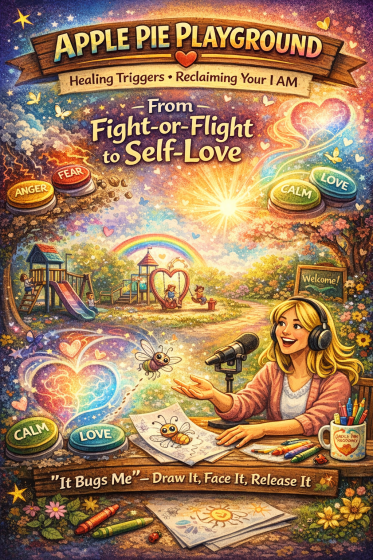

Apple Pie Playground with Valerie
Title: Health, the Surest Way to Conscious Awareness?
Building healthy minds, bodies, and spirits is the guidepost for our human evolution. On that guidepost is the sign: healthy body, conscious mind. Why would a sign say that? Let's talk.
Healing the "I AM": Navigating Triggers and Reclaiming Conscious Vitality
Podcast Summary
Health: The Surest Way to Conscious Awareness
Apple Pie Playground: A journey of transformation back to the divine inner child.
Core Philosophy
"Nobody can save us but ourselves... We are the compassion required for evolution."
The Subconscious Hijack
- • Survival Mode: Triggers bypass the conscious mind instantly.
- • Automation: Brain uses old data to inform current reactions.
- • The Threat: Perceived loss of safety, affection, or security.
The Healing Path
- • Self-Love: The cornerstone of all physical & spiritual health.
- • Internalization: Training the mind to look within for answers.
- • Action: Connecting intentions with physical movement.
🎨"It Bugs Me" Activity
Evolutionary Pillars
Nutrition & Clean Water
Movement (Qigong, Yoga)
Positive Affirmations
Emotional Re-regulation
This episode of Apple Pie Playground explores the journey of emotional transformation, focusing on how to reclaim the "I AM" presence from subconscious triggers. Host Valerie discusses the intersection of human compassion, physical health, and spiritual evolution, offering practical tools for healing the heart and inner child.
The Anatomy of the Emotional Trigger
When our "buttons are pushed," our bodies undergo an instantaneous transition into a subconscious survival mechanism. This "hijacking" of the brain bypasses the conscious mind entirely, activating a fight-or-flight response based on old information rather than current reality. These triggers often stem from perceived threats to our safety, security, or affection, leading us into automated reactions like yelling or retreating. Recognizing that these responses are predetermined subconscious plans for safety is the first step toward reclaiming presence of mind.
The Subconscious Hijack
External Button Pushed
Survival Mode (Fight/Flight)
Bypassed/Shut Down
"The conscious self is unlawfully seized by an emotional response produced in the subconscious."
The Human Elements of Evolution
The current global "evolutionary puzzle" requires specific energetic pieces that are uniquely human in origin: love, compassion, and empathy. While spiritual perfection is inherent, these emotional elements must be consciously generated by individuals to navigate the "fog of war" and move toward a unified reality. We cannot wait for external celestial forces to save us; instead, we must become the compassion and empathy required for change, using our unique human capacity for love to rebuild the physical realm.
Healing Through "Play Therapy": The Bug Activity
To address internalized trauma and triggers, Valerie introduces a "play therapy" exercise called "It Bugs Me." By visualizing a trigger as a physical bug—complete with legs, eyes, and antennae—and drawing it on paper, we externalize the emotional distress. The goal is not to destroy the "bug" through violence but to peacefully release it, such as by shaking the paper out a window or door. This act symbolizes the conscious choice to release trauma without shame, allowing the "light of source consciousness" to fill the space where the trigger once resided.
Activity: "It Bugs Me"
- Recall: Sit quietly and remember a recent negative reaction to a trigger.
- Visualize: Give that trigger a form. Does it have wings? Does it sting?
- Draw: Use markers or crayons to render the "bug" on any piece of paper.
- Release: Peacefully shake the paper to "let the bug fly away" out a door or window.
A powerful way to consciously release deeply internalized trauma.
Health as the Foundation of Awareness
True health is defined as a high degree of conscious awareness and self-love. Healthy individuals are those who "go within" to listen to their spirits and bodies, understanding how they feel and taking action to improve those feelings. This includes physical choices—such as nutrition and movement—which regulate the nervous system and allow the "light of God" to flow more fully. Improving our physicality is a necessity for evolution, as the outside world eventually follows the suit of our internal growth.
To-Do / Next Steps
- Self-Reflection: Recall the last time you reacted badly to a situation and use it as a teachable moment for growth.
- Creative Expression: Draw a "bug" that represents what triggers you, being as expressive as possible with its features.
- Peaceful Release: Practice releasing your "bug" by shaking the paper out of a door or window instead of reacting with violence or shame.
- Daily Affirmation: Look at yourself in the mirror every day and say, "I love you. Thank you, body, for my journey."
- Physical Stewardship: Make conscious choices to strengthen your field, such as choosing nourishing foods over unhealthy snacks and engaging in movement like Tai Chi or Yoga.
Conclusion
Healing is an active, intentional process that begins with self-love and the regulation of our physical and emotional being. By choosing compassion over judgment and health over neglect, we contribute to a shared reality of peace. As we walk each other back to the way of our spirits, we find that the "trick" to this reality is reclaiming our joy and our "I AM" presence.
Apple Pie Playground


Support my show
$5.99/mo or $9.99/mo or more
Click HERE
SUBSCRIBE TO TALK SHOW
Apple Pie Playground, a show serving up slices of remembrance of who we are as sacred children of the spark, where friends gather for a little levity, add in some fun and self-reflection as we use play self-therapy tools that reawaken our authentic selves on this human journey together. Can you come out and play today?
[00:06] Speaker 1: Welcome to Apple Pie Playground, where we serve up slices of healing for the heart. Stay tuned for a journey of transformation back to the divine inner child. Can you come out and play today?
[00:27] Speaker 2: Welcome, everybody, to Apple Pie Playground. I'm your host, Valerie. It's so wonderful to be here. Let's enjoy a little self-therapy for the heart. BBS Radio is right here with us and we love you so much, BBS. Let's get our inner child out to play today. What do you say? And, you know, (laughs) you know, friends, it is so easy to forget our "I AM," right? This has been a week of full of, (laughs) of F words, so to speak, friends. Full of F words. Isn't it funny how we position ourselves to practice with greater zen in our lives and then all of our buttons are pushed, like one after another, just, they're just all pushed, and the Fs just fly right out of our mouths? Or the Ss or the Ds or, you know, pick your favorite alphabet there. Uh, the alphabets just fly right on out, and I think that means that we're onto something, right? I, I think that means we're onto something. Funny how that is, isn't it?
[01:47] Speaker 2: So, if you were sidetracked a few times from your zen practice this week, no worries, friends. I, I think it's a power move, right? It's a power move, and we're learning our countermeasures, aren't we? We are learning presence of mind. We're learning these counterpunches, so to speak, and, you know, that makes for a beautiful evolution, doesn't it? I mean, what else do we have to do, right, but navigate conscious awareness, really, when you think about it? So, what is actually going on in our brain when one of our buttons is pushed? Have you ever thought about it? Well, first of all, the whole scenario is subconscious. Everything that occurs in that event, all of it, our button, is an emotional trigger. For what? Well, usually only our subconscious knows, right? Make no mistake, okay? And don't let anybody tell you differently. Our reaction to a button being pushed, it is a survival mechanism. Oh, yes. Oh, yes. Our whole body has gone into survival mode, and I mean, in a flash, right?
[03:17] Speaker 2: In an instant. There is nothing conscious going on when somebody has triggered us, okay? Somebody who maybe cuts us off when we're talking. How about that one? Or wants to tell us what to do, okay? Or maybe somebody who decides it's okay to lie to us, right? Just stand right there and look at us and lie to us. Whatever that button might be, whatever that trigger might be, our whole being goes into fight-or-flight mode, and I mean instantly. Every single thing. Our brains use old information to inform current behavior, right? It's all automated, so we don't even reflect. We just react, bam, bam, bam, every time. And the worst part, right? The worst part is when our buttons are being pushed purposefully, right? And our subconscious knows it. The threat is real, right? The threat is real. Our perceived threat to safety or security or affection, it's too real for us, and we cultivate relationships that actually perpetuate that kind of mistreatment, don't we?
[04:44] Speaker 2: It can be something of an endless cycle, right? Until we end it. Do we see that? But a question might be, how do we do that? Well, don't we have to sort of decide a few things and then pursue them to their best ends, right? Like, don't we have to decide we're worth more as our "I AM," right? Don't we have to decide that we deserve more for ourselves than what others are giving us when they, they can just so easily trigger us? I mean, so readily trigger us. Is that what we call love, friends? Is that what we call friendship? Is it what we call affection? Because it's not. Okay? It is not. There's no love in putting a heart into fight-or-flight just to make a point. Do we see that? We can't have relationships that help us feel truly safe while at the same time causing us to feel completely, utterly unsafe.
[06:00] Speaker 2: Do we see that?And when it comes to triggers, we usually get the lecture about how we should learn to pause and allow a bad reaction to pass through, and then respond to our buttons being pressed, right? And it is sound advice. It is sound advice, friends. Let's practice it as much as we can. It will serve us. At the same time, how do we learn to value our I AM a little better? To love ourselves so much that we don't share mental space with folks who are willing to put our whole body into a panic, on purpose, right? And if we catch ourselves doing such a thing to somebody else, might it be helpful to just stop, just consider how devastating our intentions might be, and really sit with the idea that we think it's okay, right? Did I offend anybody by saying that, friends? I hope not. And you know, the truth is, what I really want to talk about today is healing.
[07:24] Speaker 2: That's what I really want to talk about today, picking up the ball in this human experience and running with it, so to speak, right? Toward a better world. And we realize that the task is, well, it's, it's kind of difficult, and it can be lonely and maybe sometimes it doesn't feel like it's worth it without the company of others that we love and cherish and want to enjoy life with. You know, we are social beings, especially spiritually, especially spiritually. Our peace is driven by unifying forces that help us maintain a consciousness of the whole that we're part of. Do we see that? And when we lose interest or ability to feel into the whole of our source energy, right, we slide into dark things, don't we? We start working against each other and we feel into separation and we suffer our peace until it becomes, you know, a reality of me against the world. And that's sort of where we are now, friends.
[08:46] Speaker 2: The darkness has pretty much walked a path of separation, and we've followed right on behind, and we have to do everything we can now to reunify. So, can we afford unloving behaviors that threaten to fight or flight back into shadow? Can we afford that? Um, I have to say, truth, the one truth, and getting to that one truth requires truth-telling. Truth requires truth-telling. Wisdom needs truthful information, and knowing is a return to the practice of wise truth-telling. Can we get there from here? Well, we'll see. We will see. And when we're triggered, the brain is, is, is hijacked. By definition, it's hijacked, okay? That's the official term, hijacked. In other words, the conscious self is unlawfully seized by an emotional response produced in the subconscious, right, that has really a predetermined response as the very best way to save us. Do we see that? There is a predetermined set of conditions with a predetermined plan in place as a response to save us.
[10:31] Speaker 2: That is what is going on in this process of being triggered, and the subconscious rushes in to save us, right? And the conscious mind, it gets passed up altogether, just s- str- right on by, right? And the idea is that the subconscious mind is just interested in securing our safety, you know, with a distress signal that goes out to the whole system, to the whole body, to the whole environment, and we yell or we push or we throw something, right? And that's our scenario. And essentially, our physical being is being rescued from dangerous circumstances, you know, when it reacts to a triggering event, and there's just no two ways about it. Do we see that? Does it make sense, friends? The experience makes sure that our logical brain, our conscious brain is shut down long enough to save us, right? With hormones for taking action that starts pumping, with physical responses that move us out of danger. You know, a whole nervous system goes into automation.
[11:55] Speaker 2: It is a shock to the whole system, a triggering event, right, when a button is pushed. And in this age of evolution...We're experiencing a lot of triggering events, aren't we? I mean, if we're, if we pay attention. Now, some of us have (laughs) learned better, right? Some of us have learned not to pay attention to too much going on out there. It i- it is wisdom indeed. But this is a time of real violence against our physical being-ness, right? It, it's a time of, of really a true rescue mission for our spirits. Do we see that? Does it show us love, the environment that we're in, the evolution we're moving through? Uh, does it show us compassion? Does it show us empathy out there in the world, in all this chaos that we see? Absolutely not. It does not. It does not. And I think what might be difficult to wrap our heads around, friends, is the idea that the plan to save the world is not drawn on compassion. It is not. There is no empathy for the deception that we are experiencing.
[13:20] Speaker 2: The movie we're watching is not a romance, okay? It is not a romance. It is not family-friendly. And we hear it all the time, "We're at war," right? Spiritual warfare, physical warfare, social warfare, political warfare, right? War is hell. We hear it all the time. It is the literature of our ages, right? War is hell, and it is. And we are in an evolution that, so far, is missing key pieces that must exist in order for us to move forward, key pieces of evolution. We will not escape the dark, right, without these key elements, these pieces. And so far, these elements are not available to us through this celestial plan unfolding, okay? It's not available, and in some part, it's because these key ingredients are human in origin. They are energetic pieces, right, to this evolutionary puzzle. They are emotional elements, not spiritual ones, friends. Love is a human experience, and compassion is a human experience. Empathy is a human experience.
[15:03] Speaker 2: And anybody telling us differently is operating outside the measures of truth, okay? For any number of reasons, maybe, uh, maybe because it sounds good, maybe it's because that's the, the idea of, of what humanity needs to hear, maybe. So, where do we get these key elements of our movement forward into our evolution if we can't get it from the forces unfolding this celestial plan? What does it mean when we hear the words, "Nobody can save us but ourselves"? What does that... What could it possibly (laughs) mean to hear, "Nobody can save us but ourselves"? And I'll tell you a truth, friends, okay, that comes from our practice of gathering knowledge to apply to experience and the values that we hold so dear. We must provide these pieces for ourselves, friends, these elements and conditions of evolution. We are the compassion required for evolution. We are. We are the empathy required for change to press us forward, right? We are the love that propels us into a better way.
[16:50] Speaker 2: Does that make sense, friends? We can't afford to sit back and wait any longer as the war is being won, right? Every deception that unfolds in the plan of war has to be met with even greater compassion for humanity. It is our healing, right? It is our healing force at work added to the mix in, in our winning of this war. It is our healing by our own hands, right? And no other will offer it to this realm, but what is here to administer it already. Do we understand? We cannot afford another minute of hate, another minute of disregard. We cannot for- afford another minute of separation, another minute sitting on the couch and letting anybody else offer what only we can offer. Do we see that? We are kinetic energy. We are untapped evolution, sitting there, hoping and wishing instead of acting, instead of becoming energetically.... engaged? Do we see that?
[18:12] Speaker 2: Putting our energy to work, offering compassion in the midst of suffering, empathy that brings homeless hearts together, love that changes the energies around us, even in the fog of war. What lifts the fog, friends? What lifts the fog but our love? Do we see that? Do we understand? Nobody can save us but ourselves, because nobody has our power, our beautiful, exquisite capacity for these things that are jewels to a cosmos, things largely unlearned out across a celestial sky in any direction you want to look. Only we can save us, because we know how. We know what love is, when no other being would understand. Do we get that, friends? You know, the soldier has his duty to attack, to dismantle, to deceive, to win, and huma- humanity, we will die in the wake of such a plan if we don't do our part. The rebuilding, the unifying, the truth-telling, the thriving that must come after the winning. Do we see that?
[19:57] Speaker 2: Do we understand why we can't stand back and wait, why we can't let the dust settle, why we can't hesitate to take action? And you know, even the smallest action, moving even the smallest energy around, pushing even the smallest high vibration out into a shared field of consciousness, we must administer the winning of a war that tears the fabric of darkness away from all that we know. The violence of such a thing, the pain of such a plan, we must meet that reckoning and do our part. Do we see that? So, we have to, we have to consider, do we have time to mistreat people? Or will a smile, or a kind word, or a dollar, or five, or ten, or a meal, or a handshake, or a conversation offer more? And when we decide that we only have time for compassion, and there is only empathy and love for each other, when we decide there is victory in this war, we decide we have won this war. We decide we have won this war. We will be doing what must be done to end it, to move past the battlefield.
[21:58] Speaker 2: Do we see that? To begin the journey of healing that a new Earth offers after the dust settles. And you know, friends, I, I said I wanted to talk about healing today, and I, I hope I didn't get too far afield of that. We are bodies deceived by histories of enslavement, and we talked about the fight or flight involved in the smallest of incidents that can totally undermine our entire consciousness, right? By design, by design, that is the mastermind of truly dark deception, to build in what triggers our deepest unrest, right? And you know, I, I'm, I'm gonna leave, leave it at that for now. I'm, I'm gonna leave that alone for now. I, I hope we get the idea. But we are at an inflection point, friends, and I think we feel it. I think we feel it. We are at an inflection point where, you know, free men, free women, you know, we gotta decide how we will go after the peace is won, or be driven by the psychology of warriors or soldiers returning from war. Do we see that?
[23:36] Speaker 2: They will have done their part, and we have our part to play. Do we see that? And our bodies are something of a weak link in the evolution of spirit in this whole process. And, and that's okay. But we'll need to understand just how important it is to begin our good work now, the work of our health, of our healing, of helping others heal, right? On this journey of-... a reparation of sorts that rebuilds a new reality for humanity, a journey of reparation, and I don't mean spiritually. Okay? We are perfected spiritually, and we know this. But, but we're, we're f- we are informing our victory as a testament to the light that we can rebuild in a, in, in a physical realm, right? What we were forced to destroy as errant creators, I guess you could say. Right? We are informing our victory in our rebuilding of this physical realm in a better way, right?
[25:08] Speaker 2: It is our evolution, the task of our evolution in a material world of energies that represents what we love, the shared reality that we have co-created. Getting back to where we want to be, to where we belong, to a better world, to a better daydream, it starts, friends, with healing the within. Healing the within. We start by showing more compassion for others, and most of all, for ourselves. Right? We love others and learn to love ourselves in the process. Do we see that? The emotional re-regulation of our beingness will help our bodies return to a flow of consciousness. Do we understand that? That lets in the light of God more fully. Does that make sense? It's, it's our work to do. Right? It's our work to do. We have to connect intentions with action, and we talk about this all the time, and we know it's true. Otherwise, we won't change, right? We can't manifest what we don't believe in, what we are not intending and what we do not take action on.
[26:38] Speaker 2: What we aren't practicing, mind, body, and spirit, will not show up for us. Right? Christ, as a matter of fact, never once healed a doubting body. Not because He couldn't, but because a spirit wouldn't dwell in a body's doubt, friends. There is no crossing the bounds of sovereignty of spirit, friends. If we don't believe that we can heal ourselves, nothing or no one else can do it for us. That is the way of spirit choosing to live in human bodies. Sickness in this world is real. Illness is real. We know this. And many of us need to help through the promise of celestial healing that has been given us as faithful spirits in this war to heal the sick. Right? To heal the sickness, the illness in this world. And we will not allow anything to excuse our deserving those promises. We c- you know, we can believe the gifts that we would receive. We can begin to put action to our intentions, even small ones. Even a daydream, a meditation, even saying a positive affirmation.
[28:24] Speaker 2: Words spoken in faith are truly powerful. Even holding excited anticipation in the heart and can those of us who can make choices that strengthen the shared field of consciousness with healing energies. Can we do our part as we choose to say no to bad things that aren't good for us, to relationships that don't yield love? Right? To experiences that don't help us feel good, to foods that don't nourish our bodies, right? To behaviors that aren't exercising our physicality and offering energy to physical bodies and aiding them in longevity. I mean, as we choose these things, to sweat a little and release the toxins within, literally to walk our walk, right? Healthier, as we learn to harness a conscious mind and elevate it from, well, from the ravages of a hijacking subconsciousness. Right? And we remember that words are powerful sorcery and actions speak even louder than words. So can we take a look at ourselves in the mirror every day and say, "I love you.
[29:59] Speaker 2: Thank you, body, for my journey." All these things are acts of kindness, you know? They are acts of peace in a war-torn world, believe it or not. I mean, when you think about it, these are the things that will evolve us. They are the things that show our part as we share with others healing ways. You know, better ways as we create better days.And I hope you don't hear a lecture here, friends. I, I really don't want to give a lecture. We are (laughs) so tired of being lectured to, aren't we? I am commiserating, if you'll let me, and I have been contemplating my I AM so that I can be more with it and become more of the I AM that is me and find the purpose in that. We're on the losing end of this whole process if we lose our I AM, and there's no rules for it, for finding it, is there, for being the I AM, just breathing and allowing and cherishing ourselves, really, instead of judging and, you know, fearing and forgetting to breathe, right?
[31:21] Speaker 2: And the more we can do that together, I think the better for our shared reality, the better for our shared reality, the better our energy in a shared field of beingness, right? All beingness together, and that's the good stuff when we're ready and able to embrace life sort of without a bandage, right? Uh, we can heal, and the bandage comes off, and we lose the baggage, right, without the torment of subconscious suitcases in tow behind us, or inside us, as it were, I guess. And, you know, speaking of baggage, we like to work with our subconscious mind together, don't we? It's something we like to do on Sunday afternoons because it, it offers something of a, a deep remembrance of our beingness, and that beingness really goes back to the beginnings of who we are and our spiritual journey, while being a pain in our butts too, right? Like most of the time.
[32:34] Speaker 2: Most of our lives are lived through the subconscious, and we know that choosing to awaken, right, to a more conscious self-expression really is our good work. It is good work to do, sort of combining the history of us stowed deep in our bodies, right, so to speak, and pulling in the conscious awareness that kind of l- it allows spirit to reside within, and that's our goal, returning spirit to these bodies and, and having that spiritual energetic in every cell in our body. That's what we're doing, isn't it? And there's, there is an eternity out past the physical energetic daydream we're in, friends, and we'll get there in our next passing from this life. We will return once again to the knowing of this, this spiritual journey, right? And my suspicion is that most of us are probably gonna want to come right back here (laughs) and do living, you know, in this physicality probably all over again.
[33:52] Speaker 2: We're probably just all gonna want to come right back here or, you know, somewhere else, learning as we do to experience life more consciously in spirit, right, keeping more of our powers, and finding greater love and satisfaction and adventures of the human vacation spot, I guess you would call it, or in other places in the cosmos, right? And, you know, we're gonna be able to find home again, friends, this time around and maybe start there again where our subconscious started in the physical journey of, of becoming our I AM. It's sort of all an adventure if we can get past the suffering, right, that sort of demolishes our joy. I think that's the trick, feeling joy again here in this reality. I really think that's the trick. I say let's build it in as much as we can. Let's find meaning in what we do and where we are and who we're with and, you know, let's go from there. So what do you say we do a little expressive play with our triggers this afternoon? You want to?
[35:15] Speaker 2: You want to dip into those triggers a little bit, do a little work with them this afternoon? How about we take a little time together? Let's do something that play therapy likes to do with kids. You want to? You want to do a little something that play therapy really, really likes to do with kids? We're kids at heart, right? So let's have a little fun. Let's do a little activity called It Bugs Me. Right? You want to? It Bugs Me. It's a really super-fun little activity, super easy, reveals a lot, right? Now, remember, I present the play, and you do the reflection as expressively as you can, right? That's what we like to do. It bugs me. Some of us keep a notebook for our time together, don't we? But really, all we need is something to write with and something to write on, any old thing to write with and any old thing to write on, and this time, if you have crayons or markers handy, you can just pull 'em right out, have a little bit of fun with color.We can always add some color, right?
[36:33] Speaker 2: We always wanna add some color. That is life well spent, isn't it, in living color. We're gonna take a moment, and we're gonna sit quietly and allow ourselves to remember the last time we reacted badly to something that happened to us that triggered us. Okay, we're just gonna sit for just a second. Let's remember the last time we had a bad reaction to a button being pushed, okay? Let's think about that. We reacted negatively. Maybe we exploded or we, maybe we slammed a door or we yelled at somebody. How about that? Can you remember? Let's take a deep breath, right? Breathe in, and just hold that breath for a second and breathe it right back out. Let's recall the last time we reacted badly to a situation, and maybe it was a shock to us as much as anybody else the way we, we reacted, right? Maybe we surprised ourselves, in fact. Maybe we said under our breaths, "You know, you always know how to get me upset," right? Maybe we said something like that.
[38:07] Speaker 2: Or maybe we said, "You really push my buttons." Right? Maybe we knew somebody was trying to trigger us. Maybe we felt it, maybe we knew it. Let's just recall that scene for just a second. Let's recall that scene for a second. Let's use it as a learning moment, right, a teachable moment. Thank you for this moment to reflect and to, to learn something and grow from this particular incident that maybe did not feel so good. Let's put that painful situation to good use. You want to? Okay. We are going to draw what that scene felt like to you. Okay? We're gonna draw what that scene felt like to you, that triggering event. How did it feel to you? We are going to make it visual. We're gonna draw what that scene felt like to you. Maybe it still f- feels bad when you think about it, or maybe it really probably doesn't feel bad at all, right? However we feel about that scene, we're gonna draw how it feels. Are we ready? So on our piece of paper, and remember, it's any old paper, right?
[39:38] Speaker 2: Anything to draw, to write with, to write on, we are going to draw something particular, okay? So let's get creative. We're gonna draw something particular. We are going to draw a bug. All right? We are gonna draw a bug, and we're gonna draw this bug with a body and maybe some legs and maybe some antennae, right? Anything else that we wanna put on this bug that represents the way you feel about the last time you were triggered, right? You are gonna draw what bugs you. How's that? You are gonna draw what bugs you. Let's draw what bugs us, okay? Be as expressive as you can as you are drawing this bug, right? What does this bug look like? This thing that bugs you every time it comes around. Let's put a face to it. Let's put an image to what bugs us, right? How many legs does it have, for example? How many eyes does it have? Did you draw any eyes on there? How many body parts might it have? Right? This is your bug, your self-reflection. You can make it anything you want.
[41:22] Speaker 2: Have a little fun with it. Does this bug have wings, or does it crawl, right? What is this thing that bugs us so much? And, you know, (laughs) we can, we can ask ourselves, does it bite, right? Does it sting? Does this bug make a sound, right? Do we have our bug drawn out? Have we rendered an artistic expression of our trigger? Do we see what it looks like, this thing that bugs us? Oh, and by the way, look. Take a look at your paper. This bug has landed on our paper. It's right there on our paper. It's right in front of us, this bug thing. Look at this bug thing. My goodness. It's flown right onto our paper, or it's crawled right there onto our piece of paper. Oh my, look at that.What are we going to do with this bug? What will we do with this bug right here that's, that has come onto our paper right in front of us? How will we get it out of our way? Right? It does not belong here anyway, and we don't want it here, so we're going to get this bug out of our way.
[43:07] Speaker 2: Now, instead of swatting it or killing it, how are we going to get this bug off our page, off our table, off our laps? So, instead of violence, can we just pick up our paper and release this bug? Just shake the paper off a little bit, shake that bug off the paper. Can we do that? Maybe we want to go shake this bug out the door. Go on, bug. Get on out of here. Or maybe out the window, right? Maybe we can release this bug into the grass, right? Go away, bug. We release you to be somewhere else, but not here. Not here. So, did you release your bug as peacefully as possible? Could you do that? It has a life all its own, you know. But we don't have to be stung by it, do we? No, we do not. It has a life all its own, but we don't have to be around it, do we? We don't have to stay around it, and we don't have to be bitten by it, do we? Most certainly, we do not.
[44:39] Speaker 2: And you know, believe it or not, friends, that was a powerful activity to carefully and consciously release an idea that is deeply internalized inside of us, right? And probably internalized as a, as a real trauma, right? So, we sort of drew a real trauma on our page, and we released it in the most peaceful way we could, didn't we? And so, maybe the next time that we're triggered, we can reflect a little bit on our bug and we can try to release the experience as peacefully as we possibly can. Maybe not perfectly, right? Maybe not perfectly, but a little more consciously, and we can release it, and maybe the next time we're triggered, maybe we can release it a little better until it finally goes away for good. It just flies on away or crawls away, right? And, and it's gone from our subconscious for good, and that will be a wonderful, wonderful ending, won't it? You know, instead of the alternative of hating what triggers us, right?
[45:57] Speaker 2: And we hate it, and we, we, we're so sh- we feel s- so much shame that it happened to us or that we yelled or that we acted that way and it was, felt so shameful. Instead of doing all of that, we can love this bug away from us, can't we? Does that make sense? We can love this bug away. We can peaceably offer an opportunity for this little creature to move away from us, can't we, consciously? Does that make sense? You know, the dark will not stay where there's no hope for the light. The dark is not going to stay there. Do we understand that? When we shine on an issue with compassion, and with love or self-love, we are rebuilding healthy connections to the self because we are letting in the light. We are letting in the light. We are letting in the love of source consciousness, right, that we can feel in physical bodies. That source consciousness works through us as what we identify as love in a human experience. Do we see that? It's why it's so powerful in the human experience.
[47:16] Speaker 2: Source consciousness patriots our being-ness in this physical world as an administration of love and compassion. Do we see why that is so powerful for us? We are engaging conscious awareness as much as we can to promote a new way of safety for ourselves, right? For the subconscious mind to feel and accept. Does that make sense? Well, that's what we're doing. And when we think about our health and welfare, those things that are foundational for compassion and empathy for ourselves and others, really, it starts with our health and welfare, it truly does. It all starts with loving ourselves. Everything starts from that point. That is the starting point. And any conversation, really, that centers on health and welfare, it has to start with a focus on self-love. It, it just has to. That's the key element. It's the cornerstone. Now, we can ask ourselves, well, why might that be, right? Why might that be?
[48:32] Speaker 2: What we know psychologically about people who have a high regard for themselves, right, is that they have trained their minds and their bodies to go within for understanding and answers, right? Well, what do I mean by that? Well-We are not going to find a healthy person who has no regard for themselves. It's not going to happen. We will not find that kind of healthy person, because they have learned to listen to their spirits. What does that mean? They have learned to listen to their thoughts, and to their bodies, to figure out what's being communicated. They are in touch with the eternal, with the internal, right? They are in touch with the internal, with their beingness, with what's on the inside communicating to them what they need, right? Does that make sense? They are aware of how they feel, why they feel that way, and what they might do to improve those feelings, right? And that is what we call healthy.
[49:51] Speaker 2: That is a high degree of conscious awareness, and that is what we call health. Do we see that? And it's not a judgment, okay, 'cause we're not in the business of judgment. It serves no purpose whatsoever. It's just s- maybe an important observation to make. What do you think? Healthy folks are going within. They are checking in, aren't they? They are checking in. They are considering their realities from the inside out, right, and improving the condition of their realities by taking positive action. What's gonna make me feel better? What's going to make me look better in my action and the way I can flex and stretch and move and walk and run and laugh and hug and love, right? This is a truth, friends. This is a truth in our physical realm. Our health is a testament to the degree of consciousness we are holding at any given time. Now, do healthy people get sick? Well, sure, maybe. Not much. And even less going forward, right, as we clean our food and our air and our water, right?
[51:19] Speaker 2: As we evolve forward, we can expect foreign pollutants and the such to be removed from those things that sustain us. We can have that. We can hold that expectation. We can be part of making those changes. In fact, we have to be. We have to be part of making those changes. Our choices matter, each and every one of 'em. Our preferences matter, each and every one of 'em. We are gonna eat Cheetos through an entire ascension cycle for the rest of the cosmos. Maybe not us. We are going to eat Cheetos until we decide not to, (laughs) right? We're gonna do it. We're gonna grab that bag until we decide not to. And please don't let me suggest that we will not ascend without having our Cheetos. Please, please, don't let me suggest something like that. But you get the point, right? I hope. I hope we get the point. It's something of a f- maybe a fun little point. I hope I didn't make people mad talking about our snacks.
[52:22] Speaker 2: But as we do our part to choose what is healthy over what is not, our conscious awareness cannot help but grow. It cannot help but grow. We are naturally checking in. We are naturally going within, right? Our good work in this evolution of humanity is a necessary step into purpo- purposeful healing. Can we see that? Purposeful healing, one choice at a time, one action point at a time, right? One, you know, carrot at a time, (laughs) you could say. So doing what we can to recondition the mind, right, the emotions, the body, and helping others to do it, it means we learn new skills, right? We try out new ideas. We read new science. We apply new science. We learn new techniques and hacks for better living, right? This is what we are going to learn to do. We get on our feet. We move ourselves in healthy ways, right?
[53:32] Speaker 2: We combine our meditations with our exercise through, you know, expressive things like maybe Qigong and Tai Chi, stretching, yoga, those things that can create beautiful flows of hormone that can regulate our nervous system. We do all these things as a necessity, friends, as a necessity for our, our evolution. Health is a necessity, and maybe if we are not reaching the level of conscious awareness that we truly desire, perhaps it's, it's a task for our physicality, and maybe we deserve to take a look at that, how better we might serve our physicality, right, a necessity for our evolution. We can't improve a world without ourselves. Improving our physicality, right? Until the outside reflects who we are within, right? Does that make sense? We go within, we grow within, and our world follows suit, and that's a beautiful thing. That's, that's a beautiful, beautiful thing, friends, and I hope you didn't hear a lecture today. This has been on my mind.
[54:55] Speaker 2: I think it's been on our hearts as well, and, you know, we have looked at this practice of Zen and...Maybe we keep bumping up against the, the physical limitations of, of a better experience in our day, and maybe checking in with our physicality and looking at the, the healthy way of improving our conscious awareness. And those things that we do to build in conscious awareness might be a beautiful meditation for us. It's a beautiful thing when we can pull a body into a spirit and unify that experience in a healthy way. It is the evolution of our humanity. It is the peaceable way of moving forward, and as we build in that self-love for taking time to be healthy, we are gonna build in love for others and compassion for others, and the empathy, right, for putting ourselves in other people's shoes, and we are creating a beautiful thing. As the war ends, friends, our good work begins, and there's no time like the present to start. There's no time like the present to start.
[56:19] Speaker 2: It's a beautiful task and a beautiful thing, and you are a beautiful thing. You are so beautiful, a beautiful being, and I love you so much. I am so grateful to be in your company today. Thank you, thank you, thank you for being with me on this journey. We're all here together, right, walking each other into a, you know, a better way, back to the way of our spirits. We are walking back to the way of our spirits and I like to be mindful of that whenever I can. And I'm so grateful for what you do in the name of humanity each and every day. It's what you do that matters. And I always enjoy our time together, but now, it's time to go home, and off the play- playground we go for a- another Sunday afternoon. And thank you so much, BBS, for being here with us. You keep showing up for us. (laughs) I, I imagine sometimes it's not easy. We love you, BBS. You are always there showing up for us, and we're so grateful. And so, friends, until next time.
[57:38] Speaker 1: (instrumental music) Time to head home, friends. Thanks for being a part of today's journey. We'll see you back on the playground next Sunday at 1:00 PM central time on bbsradio.com. Make sure to subscribe if you enjoyed the show. Find us on Telegram and X to share your insights on topics today. Your input heals the child in us all.