
Apple Pie Playground, April 12, 2026

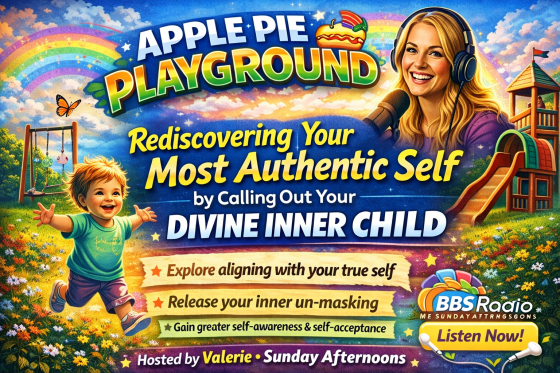

Apple Pie Playground with Valerie
Title: Put a little zen in; life as meditation
What does zen practice have to do with being your authentic self? Find zen, find within. Let's talk.
The Zen of Authenticity: Rewiring the Mind for a New Reality
Apple Pie Playground: The Zen of Authenticity
#Self-Therapy
Unmasking the inner child through neuroplasticity and the art of dynamic living.
The Evolution Model
The Top: Dismantling Old Systems
Waking up to the "matrix" and rejecting dark agendas of control.
The Bottleneck: Chaos & Shift
A narrow point of destabilization where we shift our vibration.
The Bottom: New Earth Co-Creation
Sovereign living in a shared field of light and growth.
"You have power over your mind, not outside events. Realize this, and you will find strength."
Neuro-Authenticity
- ✔Neuroplasticity: Restructuring pathways via novelty and adventure.
- ✔Neurogenesis: Creating new neurons in the hippocampus through exercise.
- ✔Self-Discovery: A "brain clean-up" that closes unhealthy old pathways.
Samu: Dynamic Living
Meditation is not just sitting; it's the Zen of washing dishes, eating, and even cleaning toilets.
This episode of Apple Pie Playground explores the intersection of spiritual authenticity, neuroplasticity, and the practice of "Samu" or dynamic meditation. Host Valerie discusses how we can unmask our true selves and navigate a changing world by transforming everyday tasks into meditative experiences.
The Foundation of Authenticity and the Rewireable Brain
Authenticity is defined as the unmasking of the true self, requiring a transparent orientation toward life and the alignment of actions with core values. This process involves "balanced processing," where an individual objectively analyzes feedback and internalizes a moral perspective. By fostering self-awareness and self-acceptance—the cornerstones of enlightenment—we transition from playing roles to living as our most natural, spiritual selves.
The human brain is uniquely equipped for this transformation through neuroplasticity and neurogenesis. The brain can restructure itself, building new pathways in the hippocampus to overwrite old, unhealthy memories. This "self-cleanup" is significantly boosted by curiosity, complex learning, and adventure, which prompt the brain's lymphatic system to clear toxins and establish a new working order.
🧠 Neuroplasticity Boosters
The brain's ability to reinvent itself is driven by specific activities that trigger neurogenesis and synaptic growth.
The Hourglass Metaphor and Global Evolution
The current state of the world is compared to an hourglass, where humanity is passing through a "bottleneck" of chaos and destabilization. As old systems of control dismantle, individuals are shifting their vibrations to emerge as sovereign, co-creative beings. This transition requires stripping away illusions and suffering to reveal a renewed spirit capable of functioning in a positively charged reality.
Samu: Living Life as a Continuous Meditation
While dedicated, quiet meditation is essential, the most powerful tool for maintaining peace in a chaotic world is "Samu," or dynamic living meditation. This Zen practice involves being fully present in every pedestrian task—whether making breakfast, mowing the grass, or washing dishes. By unifying with each action and offering it complete attention, mindless habits are transformed into regenerative opportunities for conscious awareness. This approach ensures that our "being-ness" is never separate from our "doing-ness".
The Art of Samu
- ✨ Unify: Become one with the task at hand.
- ✨ Sensory Focus: Use all five senses to observe each step.
- ✨ Single-Tasking: Dedicate 100% attention to one task at a time.
- ✨ Gratitude: View every moment as a teacher, not a barrier.
Stoicism and the Subconscious
The philosophy of Marcus Aurelius mirrors Zen teachings, emphasizing that while we cannot control outside events, we have absolute power over our own minds. This detachment allows for inner strength and resilience. To explore the deeper layers of the mind, the host utilizes "Dixit card" visualizations—such as imagining eggs with human teeth—to open "subconscious suitcases" and examine underlying thought processes without judgment.
Key Data & Concepts
- Neurogenesis: The creation of new neurons from neural stem cells, occurring primarily in the hippocampus.
- Synaptic Plasticity: The brain's ability to build new pathways of knowing through novel experiences.
- Limbic System: The emotional nervous system that often drives unhealthy attachments when safety or worthiness is threatened.
- The Hourglass Model: A mental model for human evolution from a dark paradigm to a co-creative, high-vibrational reality.
To-Do / Next Steps
- Practice mindful awareness during your next meal by recalling specific details like clothing, utensils, and the sequence of bites.
- Research Zen philosophy and the Stoic practices of Marcus Aurelius to expand your understanding of mental discipline.
- Incorporate regular exercise and "complex learning" into your weekly routine to boost neurogenesis.
- Attempt to perform one "mindless" daily chore (like washing the dishes or a toilet) as a dedicated meditation on humility and presence.
- Join the community on Telegram or X to share insights and reflections on the inner child.
Conclusion
Authenticity is not a destination but a lifelong practice of unmasking and rewiring. By embracing the "Zen of the ordinary" and maintaining curiosity, we can navigate the world's current chaos with resilience, moving through the bottleneck of evolution toward a more sovereign and peaceful existence.
Apple Pie Playground


Support my show
$5.99/mo or $9.99/mo or more
Click HERE
SUBSCRIBE TO TALK SHOW
Apple Pie Playground, a show serving up slices of remembrance of who we are as sacred children of the spark, where friends gather for a little levity, add in some fun and self-reflection as we use play self-therapy tools that reawaken our authentic selves on this human journey together. Can you come out and play today?
[00:00] Speaker 1: (instrumental music plays) Welcome to Apple Pie Playground, where we serve up slices of healing for the heart. Stay tuned for a journey of transformation back to the divine inner child. Can you come out and play today?
[00:26] Speaker 2: Welcome, everybody, to Apple Pie Playground, where we enjoy a little self-therapy for the heart. I'm your host, Valerie, and shout-out to BBS Radio, we love you so much, BBS. We are calling our inner child out to play on Sunday afternoons. Now, why is it we do that, friends, call out our inner child? Well, if nothing else, the idea is a, a beautiful metaphor of how we can restore our beingness to our most authentic selves, isn't it? And I have heard that word a lot this week, authenticity and being our authentic selves, and I, I had to ask myself the question, who am I really as my most authentic self? What does that really, really mean? And I had to sort of mull over the idea of authenticity and what it means for us as perfect spirits having not-so-perfect human experiences, and, you know, it's, it's possible that we're actually having perfect experiences and we, we just don't realize it, right? But I'll let you be the judge of that one.
[01:59] Speaker 2: And as in all things here on the playground, we, we're returning to our wisdom together on Sunday afternoons. It's work in progress, remembering the truth behind what we know about our true selves as we combine our experiences and our values so that we can avail ourselves of a greater wisdom of who we are. We are in the best position to do that when we are our most authentic selves, which is not so easy sometimes in human lives when we play so many roles that require different skill sets and different strategies and different perspectives. So, just think about how many roles we actually play, and how much of every one of those roles offers us our authenticity, and how much actually masks it. It's maybe something to think about. So what does it mean to be authentic? You know, have we ever really thought about it? All the world's a stage right now, isn't it? And if nothing else, COVID provided a very powerful visual of what a masked humanity looks like, right?
[03:38] Speaker 2: We don't have to imagine it. We can feel it, we remember it, we see it in our mind's eye. We know what a humanity experiencing a masking of the self actually looks like. Now, imagine us all energetically masked, because many of us are. And I only say that because part of the definition of authenticity is an unmasking of our true selves, and it's the willingness to express a transparency, I guess you would say, that, that reveals who we are instead of hides it, and we're open and we're honest and we're transparent in our orientation to the lives we lead and the relationships we have and the goals we have and the philosophies that we live by, et cetera, et cetera. It's called having a true relational orientation to our human story when we live with authenticity. It's called having a true relational orientation, and the authentic behavior that comes with that is aligning our actions with our core values, and the wisdom of the truth that we build about ourselves.
[05:14] Speaker 2: So, in other words, we internalize something of a moral perspective, right? Well, what's that? Well, it's when we're inwardly motivated and we're self-guided, and then we're, we are more equipped to do this thing called balanced processing, okay? Balanced processing, where we're able to objectify feedback, and we can look at our circumstances in an honest way, and we can analyze what we observe, and we can take in our own recommendations. You know, as we grow from what we learn, and, and we improve by what we aspire to, all of this is, is-... is considered a balanced processing when we internalize a moral perspective on our world, and this balanced processing creates re- two really important things. As we become more authentically ourselves, it creates increased self-awareness and self-acceptance. Now, when you think about it, these two things, self-awareness and self-acceptance, are cornerstones of enlightenment when you think about it, right?
[06:44] Speaker 2: The bringer of balance and en- and alignment, these two cornerstone ideas. So when we talk about our truest authentic self, we're talking about our most aligned self, right? Our most natural self in the scheme of spiritual experiences. Does that make sense, friends? And what is the wisdom that we get from it when we, when we're able to do that? Well, by definition, we cultivate self-knowledge, we learn emotional regulation, and we experience a deeper life understanding, by definition, right? And I know that's a lot of definitions today. And who would think that that much would go into a single idea of authenticity? So, let's take a look at this idea of spirits having a relational orientation with a human experience, and I'm hoping that time together today will sort of avail us of the idea that our highest good and maybe closest measure of who we are in the divine lies in our ability to release control of a narrative that, that may not be serving us.
[08:24] Speaker 2: And are we in a storyline that we don't prefer? Have we pinned an identity that we really don't like? You know, are we doing things that alienate us from our true selves and masking our true beingness, and how many kinds of ways might we be masking our true beingness? And so, where do we, where do we always like to start with questions like that? Well, we start in that place that has us wondering how on earth to create positive change in the body when we have to deal with the brain that we have, right? So, uh, maybe a s- a question might be, to begin with, how do we, as energetic beings, build a relational orientation to a human storyline, with a brain that sees authenticity as something of a, you know, a dangerous proposition, right? Not always safe, and certainly not maskable. So, how do we convince the mind to serve a higher purpose here? Well, we do it with a wonderful opportunity that comes with these human bodies that we have.
[09:58] Speaker 2: It's an opportunity to re-network and refocus brain activity. It's the opportunity to rebuild and re-circuit how the brain functions, and it's called neuroplasticity. Neuroplasticity. It's the ability of the brain to restructure brain functions from damaged pathways to new, healthy pathways. And, you know, we do this every time we learn something new, mkay? Every time we experience something novel or different or unexpected or, or, or exciting, we're building new pathways of knowing in our brains. It's called synaptic plasticity, okay? And our brains can even create new neurons from neural stem cells, and that's called neurogenesis, right? So, fun fact, neurogenesis works in the hippocampus, campus part of the brain, and it forms and it stores new memories that overwrite similar old memories, okay? So, so it's forming and it's storing new memories on top of old memories, right? It's overriding old memories.
[11:33] Speaker 2: So, imagine that we are deciding to experience new things and to have new adventures, and these new experiences can help us erase old memories that weren't so great if we'll get out there, right, and try new things. And we can boost neurogenesis in the brain with things like regular exercise.... okay? And taking on complex learning, or we can call, we can do what we call self-discovery, right? By doing things not readily associated with our store of information and experience in the brain, we can go out there and create for ourselves self-discovery. Self-discovery is a must-do in our lives, okay? So let me ask, when's the last time we entered into the realm of self-discovery, where we discovered something new? When is the last time we chartered unknown territories of, of experience and information? Can we remember the last time we rewired the old brain?
[13:16] Speaker 2: What if I told you that adventure and having an adventurous, risk-taking spirit provided our brain with a lot of benefits we cannot get anywhere else? Well, except for sex. Adventure is tops for building neurogenesis, absolutely the best, topped only by great sex, okay? Great sex is about the best thing around for creating (laughs) new neurons, okay? But a good adventure is a very close second. So I- I- (laughs) I actually think if humanity decided to put the two together, we'd probably ascend, like, like, tomorrow, right? We'd probably just, we'd, we'd move on outta here, I'm pretty sure. So adventure and self-discovery, as mental functions, do this thing called self-clean-up in the brain. And would you believe that adventure would actually cause a self-clean-up in the brain, where all the old unhealthy pathways, they're, they're closed, and new pathways are built through adventure?
[14:45] Speaker 2: And at the same time, we mature in our capacity to handle how we judge our experiences and how we make decisions, right? So along with this self-clean-up, when we enter into discovery and into adventure, we are maturing in the ability to judge our experiences, how we make decisions, and during all this process of neurogenesis, our body starts cleaning itself out, and it cleans out toxins, because the brain actually has its own lymphatic system. Did we know that? And what it does is it takes all of these things, right, that benefits our mind, and it manifests in the brain a new working order, right? Now, how can this be possible, right? How can this be possible that all of this is happening in our brain just off of a good adventure? It happens because our brain enjoys curiosity. Our brain cannot help itself. The ego is a curious creature, and therefore, it enables the brain to do a lot of clean-up naturally that maybe the ego would not prefer.
[16:31] Speaker 2: But because of our curiosity, we are able to recreate new pathways in the brain. We're able to do this clean-up in the brain, even when the ego would prefer to keep a status quo. Curiosity is a cure-all for a dull mind, right? Curiosity creates novelty in the brain, new and different influences that prompt new pathways. Novelty is a necessary human function, right? Learning and discovering and adventuring, and add some sexing in there, life could be so good, right? So, why are we talking about neuroplasticity and authenticity together, and what is this connection that we, we're trying to make here? Well, we're talking about it because we have the power to rewire ourselves, to reinvent ourselves, to evolve ourselves, right? To re- to relive ourselves and relieve the suffering, the buildup of unhealthy elements in our subconscious that bleed into our emotion and our behavior. There are ways to rewire who we wanna be as liberated spirits in a human body, right?How exciting is that?
[18:14] Speaker 2: I was reading that authenticity and neuroplasticity is a relationship in the brain that is a catalyst for living truthfully, living truthfully, living fully, uh, finding the inner child again, and I was absolutely fascinated by that connection. How wondrous that would be to find our way back to the inner child. And we can, friends. We can do that. And a question might be, how do we get there from here? From the chaos of, of... Let's face it, friends, it's a, it's a spiraling world out there, right? There, there are difficulties in, in a chaotic world. We can look around, and we see it everywhere. So, where do we go from a life of chaos? Well, I wanna share an analogy, and it's something of a mental model of our human evolution, and this model has sort of been going around a number of social circles this week, and it's really good model. So, I wanted to share it with you. Imagine an old-fashioned hourglass, okay? An old-fashioned hourglass. It has a bulbous top to it, right?
[19:52] Speaker 2: And a bulbous bottom, and a very thin constrained bottleneck in the middle that guides the sand in a highly controlled manner, so that when you flip this hourglass over, all of the sand from the top slowly and systematically makes its way to the bottom part of the hourglass, right? And some of us might wanna think about incidents in the Strait of Hormuz as this kind of an analogy that we're creating here, right? When you think about it. Our world is really changing, and it's changing fast. Uh, everywhere you look, there is chaos created and destabilization created by changes in every system around us. Every system around us is falling to a new way of doing things. Now, we can't see a lot of that right now, but we can trust it in our spirits, friends, right? We are in a process of ascending, only everything feels sort of upside down, doesn't it? The chaos and the confusion make it feel that way. And in fact, it is upside down, right?
[21:28] Speaker 2: The old ways of darkness are being dismantled, and what remains is degenerating, right? Degenerating systems of an old world order, and it's an upside-down world. As spirits awaken to the evolution going on in human consciousness, taking place at the top of the hourglass, right? As the sand falls through the bottleneck, each of us is shifting in our own timing, right? And we're waking to the matrix that we live in, and we're rejecting this dark agenda that's in every single system of control that we have to deal with throughout our day, and we're changing the vibration we're living in and moving through the bottleneck as a higher vibrational being, preferring sovereign lives. We have worked through the chaos, right? And once we're through this bottleneck, we are equipped to entertain a new Earth experience that makes us co-creators, right? It's what the ability to be authentic really does for us on this journey. Do we see that?
[23:06] Speaker 2: It strips away the pretense and the weight of illusion and suffering to reveal renewed spirits, right? Ready to function as co-creative beings. And we're realigned with the energies of adventure and self-discovery and sovereignty, and we've learned how to function in a positively charged reality that generates growth, right? And guides our preferences in the redesign of a new human experience at the bottom of the hourglass, right? As we funnel through, right? It's our new shared field of reality, and everybody's gonna get there, at different times, for sure, but we'll all get there as we're, we're ready to leave an old paradigm and f- and fall into a new one, and we'll go from dark to light as a matter of our evolution, right?And so, we might ask, how do we get ourselves through the bottleneck, so to speak, right? How do we leave this crumbling reality and bilocate to a new earth experience? Well, I have to ask, how much work are we committed to doing?
[24:46] Speaker 2: I mean, that's the question, isn't it? How willing are we to roll up our sleeves and embrace our own evolution? Right? Will we move through the hourglass kicking and screaming, or will we embrace this beautiful evolution, right? There's only one way to go, and the question is, how long will it take us to be ready to move through this evolution? Just so happens that I've been giving it a lot of thought, and I have been in contemplation, uh, a necessary contemplation, right, for my, (laughs) for my own peace of mind and my own practices. Necessary contemplation of how to internalize the practice of mindful behavior throughout my day. And, you know, it's not so easy sometimes to- to be able to move through mindful contemplation, uh, in a way that maintains conscious effort in our thoughts and our behaviors, and we expect a good half an hour's worth of focused meditation, right?
[26:06] Speaker 2: Sitting down, getting still, being quiet, and we are working toward generating enough energy in this beautiful, dedicated medi- meditation, it- to generate enough self-awareness to get us through a day, right? And then (laughs) a problem comes up, or a disappointment, or an undesired result, or a painful experience, right? And the meditation just seems to lose its power to the unconscious moment if we're not really careful. And many of us will tell ourselves, "Oh, boy. Okay. Well, you know, maybe tomorrow I will sit even longer, or I will try even harder, or get even quieter to really do this dedicated meditation, and I'll do better so that I can last longer through my day," (laughs) right? "I can get farther in my day with this- the- with the energy of this beautiful meditation." And yes, friends, a patterned practice of dedicated meditation, it's- it's essential to the spirit. It is essential to the spirit to sit down and get quiet, it- it truly is.
[27:33] Speaker 2: But it's not the most powerful thing that we can do for evoking peace in the midst of disturbance, or conscious awareness, right? During a moment of stress or- or an emotional pull, right? When we get that emotional tug on our heart. There's something a little more powerful, right, than... That's most powerful, right? And that's cultivating a continuous meditation as a form of daily life itself. Living life in its ups and downs becomes the meditation. Does that make sense, friends? And each reaction is a work of noticing and reflecting, right? Does that make sense? It is creating a way of living in presence of mind that is continually attempting conscious awareness in all that it does. If a moment in life is easy and peaceful, then am I present in that? By the same token, if a moment in life is fearful or uncertain, am I also present in that as well? This is what is called Samu, or dynamic living, right? It's dynamic living meditation. Dynamic living meditation.
[29:26] Speaker 2: It's the practice of the Zen master, okay? So how do we do this? How do we experience this continual experience of Zen all day long? Well, first, we have to be gentle with ourselves, and we have to realize, this is a practice over the course of a lifetime. We have to be willing to hold a great deal of compassion for ourselves, and that really is our- our starting point. It's our starting point. Compassion for ourselves. And then we remember that our goal is to keep an active mind, okay? An active mind. In other words, not a passive mind.Okay? So scrolling on the phone, or sitting in front of a television for hours on end maybe, or keeping a schedule of tasks that we do throughout our day that are completely mindless or habituated, right? All those empty brain kinds of tasks that we just have to do, or we have habituated into our lives, or even doing things to keep our minds off of dealing with issues. All of those things can be detrimental to keeping an active, observant mind. Right?
[31:04] Speaker 2: And the idea is to unify with each task that we undertake during our day. So let me give you an example. If we're making breakfast, then we mindfully make ea- make our breakfast each step. Right? We observe each step, and we use our sensory experiences, and we fully appreciate the functions of our work. We offer complete attention to what we're doing. Does that make sense? We endeavor to perform each act to the very best of our ability, and we focus only on one task at a time. So essentially, what we're doing is, we are learning to be fully present in each and every task that we undertake, and each part of a task. Right? Each part of a task, even, and especially, with things that are not so pleasant, or maybe things that might not require much brain power. Right? We are still consciously aware of what and how we do what we do throughout our day, and as we grow in our awareness, we create a peace around what we're doing. We create a peacefulness around what we're doing.
[32:47] Speaker 2: No matter how pedestrian it might be, right, like mowing the grass maybe, or washing our car. Does that make sense? The habit becomes comfortable and natural, and the idea being that our habits create a flow of awareness then that's regenerative. Right? Rather than habits being mindless, right, mindless activities that we don't pay any attention to, they become opportunities, right, to create a flow of a- of awareness, and this is a regenerative kind of process. It builds in observation, and the opportunity for conscious awareness to grow in the norms of our everyday life. Does that make sense? And that means that our being-ness is not separate from our doing-ness. Do we see that? And we talk about this, and we begin to unmask ourselves in favor of experiences that make us more authentic. Can we see that? And we're managing this relational orientation of the spirit in a human body, performing tasks that regenerate a conscious awareness, right?
[34:25] Speaker 2: And we are in relationship to our bodies in a very different way now, aren't we, as spirits? We're in the position to offer gratitude for each moment that offers us another opportunity for growth, right, for observing actions and activities without unconscious reactions. Right? Do we see that? And eventually, we develop a peacefulness in times of stress. Right? In times of stress, we can find peace, and we begin to overcome the suffering of some of these experiences that we have day-to-day, right, as we learn to appreciate everything as a teacher, and not as a barrier, right, to a good life. It's a teacher rather than a barrier, because moments become what is, and not what should be. Right? Moments become what is, and not what should be, or what shouldn't be, or what used to be, right? Now, make no mistake, the art of Zen is a lifelong practice, friends. It's a lifelong practice.
[36:04] Speaker 2: It is one moment built on another, and another, and another, throughout a lifetime, and truthfully, my journey is just as daunting as yours. I can guarantee it. Until we stop trying to measure success...Right? And rather observe what comes and goes as success in itself. Does that make sense? What do you think about that? Are we a little too overwhelmed with the practice that might require that much dedication? Hmm? When we think about it? For the record, zen meditation does value dedicated meditation practice, okay? It's a very, very important part of zen meditation, and at the same time, it was founded on the idea that life itself is its own meditation when fully embraced by a spiritual being waking up to what we already are, right? We don't have to learn conscious awareness of our creative powers. We just have to remember who we are as creators and that everything is a spiritual experience, right? Even washing dishes and clothes and toilets, right?
[37:48] Speaker 2: So fun fact, there is a practice in many Japanese households of washing the toilet every day. It's considered a daily meditation, right, among other things, that engenders mindfulness and humility and gratitude. So essentially, we're talking about meditating through life as life. So how do we do that in real terms? And what does that even look like? So let me use an example circulating around the airwaves this week, and it's a really, really good example and worth your research. That's the example of the philosopher king Marcus Aurelius. And why are we talking about a philosopher king, who, for all intents and purposes, never even studied zen? Well, this particular figure is a man who, who lit up a dark world with the way he lived his life, and during an age of chaos, I mean, utter chaos, catastrophe, lots of personal tragedies, Marcus Aurelius developed a philosophy that aligns with zen teachings in many, many ways.
[39:21] Speaker 2: And the extraordinary thing is that both teaches, teaches meditations on self-guiding ways to live at peace in life as a way of life, as a practice of, uh, you know, in resilience, I guess you would say, as a way to focus on being completely in the present moment that is mindful and detached from desires and needs and outcomes, okay? So Marcus Aurelius is a perfect example of the power of the authentic self guided by essential self-discipline and self-awareness, and we talked about those two things. And history sort of describes him as being as fierce at protecting his peace as he was at protecting his realm, and one of his quotes highlights that idea. And I quote, "You have power over your mind, not outside events. Realize this, and you will find strength," end quote. And he really did live by this idea of detachment. We put pretty much all of our effort into what we can control, and then we allow what cannot be controlled to measure itself, right?
[41:04] Speaker 2: This idea of detachment, and this is a fairly challenging idea, detachment. And where does the challenge come from? Well, our brains have a limbic system, and we've talked about the limbic system. It's considered the emotional nervous system in the brain. And any time a fear for safety, for example, is co-generated with an emotion, the brain drives an attachment. So, so when we don't feel loved or we don't feel safe or we don't feel worthy, for example, our brains push us to cling, okay? To socially bond, and to do so to whatever degree it takes to generate positive neurochemicals in the brain, okay? Do we understand? It's why a lot of us bond socially to folks who maybe aren't great matches for us. So the idea of detachment, which is, is resisting emotional pulls toward bonding in the brain, it's fairly a difficult task.
[42:23] Speaker 2: The word is n- is, it's not such a good one because the implications are that we're limiting empathy and we're muting sensory experiences by definition in the brain, so the idea of detachment is, mm, maybe not the best characterization.But it is an idea shared by, well, many a philosophy that values letting go and releasing control of human experience that's maybe not so helpful as a way to feel better inner peace. And the idea of daily practice of meditation as a practice of life closely aligns with the decision to prefer peace as a primary goal, okay? So choosing peace is the recurring theme for practicing life as a meditation. It is a recurring theme in the idea of Zen, okay? So now that we have a little bit of context, wouldn't it be kind of fun to try our hand at reflecting on what zen feels like for us? You want to? And maybe give us a nudge forward in our practice.
[43:51] Speaker 2: We usually like to get our notebooks out and write our responses, so if you have a notebook, go ahead and grab it, and if you don't, no worries. Any old thing to write with and any old thing to write on will do. And we're gonna reflect together on an event most, if not all, of us have had today or yesterday, and we're gonna feel into how zen our experience was. You want to? Any old piece of paper will do. Anything to write with will be just fine. Grab your notebooks if you want to, and here's what we'll do. Okay? On our paper or in our mind if you would prefer to visualize, your choice, we're gonna recount the steps it took us to eat breakfast this morning. Okay? It, we're gonna count the steps it took us to eat breakfast this morning or yesterday, if you prefer, or lunch if you didn't do breakfast, right? Choose a meal. We're gonna reflect on what it was like for us to take our meal. Are we ready? Okay, this is simple recall. Okay? This is simple recall, and we won't judge.
[45:20] Speaker 2: We're simply observing to learn more about our conscious awareness of an everyday task, okay? So here we go. Let's play a bit. On your sheet of paper or in your mind, it's up to you, think back to a meal you had today or yesterday. Think back to a meal that you had, okay, and let's answer some questions about your meal. Are we ready? Okay, here we go. First question, what did you have to eat? And be as specific as you can. What did you have to eat? As specifically as you can. Think back. Got it? What did you have to eat? Okay, question number two, what was the very first thing you did after you sat down at the table or you found a place to stand and eat? What was the very first thing you did? I mean, the very, very, very first thing that you did as you sat down to eat, or if you stood up, wherever you stood to eat, what was the very, very first thing you did? You got it? Can you remember? Question number three, what clothes were you wearing? What clothes were you wearing?
[47:19] Speaker 2: Can you remember? What socks were you wearing? What shoes were you wearing? What clothes were you wearing? Okay, number four, what was the very first bite you took off of your plate? What was the very first bite you took off of your plate? What's the very first thing that you ate? Can you remember? Okay, what was the last thing you took a bite of on your plate? What was the very last thing you took a bite of on your plate, as specifically as possible? You got it? Can you remember? Where did your plate end up at the end of your meal? Where did your plate end up at the end of your meal? If you didn't use a plate, where did your spoon or fork or napkin or your cup or glass end up at the end of your meal?And number seven, what was the first thing you said when you started eating at the table? When you sat down and you started your meal, what was the very first thing you said, the very, very first thing you said? (pauses) Can you remember?
[49:15] Speaker 2: (sighs) So, was your fork or spoon or other utensil face up or face down when you left your meal? Was your utensil face up or face down when you left your meal? (pauses) That's- that's a tricky one. Let's test our zen here. (laughs) And the last question, what was the pattern on your plate or your napkin? What was the pattern on your plate or your napkin? See if you can remember. And I wanna thank you so much for playing along, just a little bit of, uh, play to help us see just how much, uh, we can recall, and to see how much meditation we put into the last meal that we might have had. Do we have a sense of where we'll start as we practice the zen of meditative living? Does that give us something of a sense of how much more meditative we might wanna be? Maybe we'll try a little zen with our next meal and see how it goes. Um, and I wanna end today with a little- a little play for our subconscious mind. So, let's end our time together doing a Dixit card. Do you want to?
[51:02] Speaker 2: Let's do a Dixit card and see if we can open those subconscious suitcases in our minds and see what will come out. You wanna spend some time doing that? We only have a few minutes, but let's get into a Dixit card. Let's do a real Dixit card from the stack and spend some time allowing what might arise to arise in our mind's eye, right? We'll observe without judgment, okay? Are we ready? You can always make notes in your notebook. Otherwise, we'll close our eyes, and we're gonna paint a picture in our mind's eye as I describe it to you, okay? Paint as vivid a picture as you can as you are building this scene in your mind's eye. Now, let's imagine that there is a plate, a plate sitting on a red and white checkered tablecloth. Do you see it? It's a plate sitting on a red and white checkered tablecloth. And you are sitting at the plate, at the table. You are sitting at the plate at the table. Do we recognize the tablecloth? Do we recognize the tablecloth?
[52:46] Speaker 2: So in the plate, there are two boiled eggs. Do you see 'em? There are two boiled eggs. The eggs are hard-boiled, and they are still in the shell. So, the eggs are hard-boiled, and they are still in the shell. And there's a funny thing about these eggs, they have mouths. The eggs have mouths, human mouths with teeth. And the eggs' mouths are open, and you can see them moving their teeth. So, do we have the scene clearly in our mind, being as vivid as we can, allowing these subconscious suitcases to take us wherever they wanna go, allowing whatever might arise to arise? Are we ready for some questions? Question number one, where are you? Do you recognize where you are? Where are you in your scene? Question number two, why are you eating boiled eggs? Why are you eating boiled eggs? Do you remember? And question number three, what else is on your plate? What else is on your plate? And since I have mentioned that, do you see anything else on your plate now?
[54:53] Speaker 2: (pauses) And while you're looking, what else is on the table? What else is on the table? What do you recognize that you might remember? And what is the expression on the faces of your hard-boiled eggs? What is the expression on the faces of your hard-boiled eggs? And why do your eggs have teeth? Why do your eggs have teeth? And how will you eat your eggs? How will you eat your eggs? And think about it, what happens as you cut into your eggs or crack them open? What happens? And what are you feeling right now? What are you feeling right now in this vivid scene that you've created? And what else is going on in the scene you've painted in your mind's eye? What else is going on in this scene that you've painted? And now that we have a vivid scene in our minds, we'll leave the table for now, knowing that we can come back to it this week and we can remember more if we want to.
[56:57] Speaker 2: And so now, we can open our eyes and we are back to where we are, realizing we can always remember the scene as things might arise for us this coming week. And I wanna thank you for being brave and deciding to join us in this activity. We always like to open those subconscious suitcases, because we know it's important to get a sense of what that underlying kind of, uh, thought process might be that we could maybe examine a little bit of at any given time. It's good to be open to what might arise from your meditation this week. So remember, as we go through our week, build in a little adventure as you go in. And for those of you who are curious, enjoy a little research into Zen philosophy and maybe into the Stoicism practice by Marcus Aurelius. Expand the mind a little bit, find the authentic self as we go. That's certainly the message, and I'm so, so glad I could share it with you this week. I certainly enjoyed our time together today. But now it's time to go, friends.
[58:19] Speaker 2: And thank you so, so much, BBS, for being here with us today. Until next time.
[58:31] Speaker 1: (Instrumental music.) Time to head home, friends. Thanks for being a part of today's journey. We'll see you back on the playground next Sunday at 1:00 PM Central Time on bbsradio.com. Make sure to subscribe if you enjoyed the show. Find us on Telegram and X to share your insights on topics today. Your input heals the child in us all.