
Shadow Politics, April 12, 2026
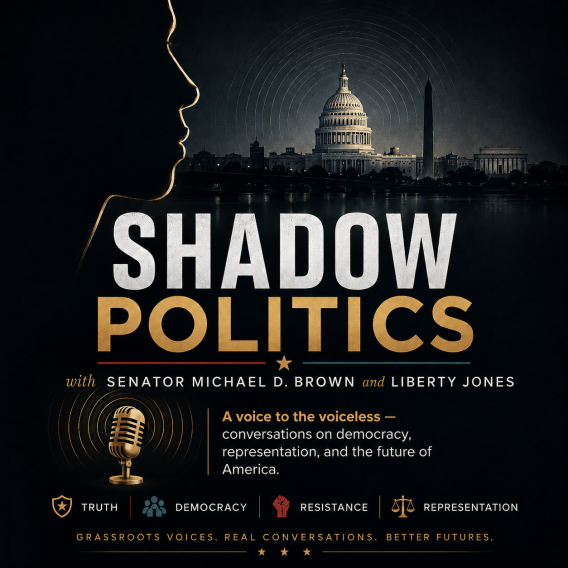

Shadow Politics with Senator Michael D. Brown and Co-host Liberty Jones
Political Debate Against the Other Side of the Isle and Ideological Crossroads
Guest, Noah Witherspoon - Floridian political activist of Turning Point USA
On Shadow Politics, an intense and polarizing discussion featuring host Senator Michael D. Brown, co-host Liberty Jones, debating conservative organizer Noah Witherspoon. The dialogue serves as a microcosm of the current American political divide, touching on fiscal policy, constitutional interpretation, and the moral foundations of leadership.
The conversation begins on a "homework assignment" given to Noah Witherspoon to justify conservative appeal to senior citizens. This quickly evolves into a heated debate over Donald Trump’s legacy, the validity of Critical Race Theory, and the legal nuances of birthright citizenship, highlighting a sharp contrast between institutional experience and emerging grassroots conservatism.
The Conservative Case for Seniors and Fiscal Rebuttals
Noah Witherspoon presented several arguments for why seniors should align with conservatism, focusing on economic security through the Tax Cuts and Jobs Act (TCJA) and the protection of Social Security. He highlighted the record-high VA budget of $488 billion projected for 2027 and the construction of over 450 miles of border wall as key successes. Senator Brown countered these points by arguing that the Republican party has historically sought to cut Social Security and that the current administration's focus on defense spending comes at the expense of essential social services like childcare.
Urban Governance and the "Beautification" of D.C.
A significant portion of the debate focused on the "Beautification Movement" in Washington, D.C. Liberty Jones questioned the ethics of spending 400 million on ball room renovations and 10 billion on D.C. aesthetics while cutting 120,000 households for elderly housing and 33,000 for people with disabilities. Noah defended these expenditures as necessary for the dignity of the nation's capital, while the Senator characterized private donations for these projects as "bribes" and criticized the incompetence of newly appointed judicial figures like Jeanine Pirro.
Social Theory and Academic Influence
The participants clashed over the role of Critical Race Theory (CRT) in academia. Noah characterized CRT as a "dangerous concept" that suggests racism is permanent within white society. In response, Liberty Jones, a sociology minor, argued that CRT is a structural analysis of systemic disparities, such as housing, rather than an attack on individuals. The Senator added that understanding the "prologue" of American history—including its darker chapters—is essential for future progress.
Faith, Values, and the MAGA Slogan
The dialogue concluded with a philosophical exploration of "Make America Great Again" and Christian values. The hosts argued that the MAGA slogan ignores historical periods of racial and gender-based oppression. Senator Brown challenged Noah to find "Christianity" in policies of retribution and military aggression, citing biblical passages on love and neighborliness. Noah maintained that Trump is a "builder" who is valiantly defending the country's foundations.
The interview underscores a profound disconnect between the "facts" as perceived by different political factions. While Noah Witherspoon represents a highly articulate and researched new generation of conservatives, Senator Brown and Liberty Jones emphasize historical context and institutional integrity. The debate remains unresolved, reflecting the broader national struggle to define the "true" American identity and the proper interpretation of its founding documents..
Shadow Politics

Shadow Politics is a grass roots talk show giving a voice to the voiceless. For more than 200 years the people of the Nation's Capital have ironically been excluded from the national political conversation. With no voting member of either house of Congress, Washingtonians have lacked the representation they need to be equal and to have their voices heard. Shadow Politics will provide a platform for them, as well as the millions of others nationwide who feel politically disenfranchised and disconnected, to be included in a national dialog.
We need to start a new conversation in America, one that is more inclusive and diverse and one that will lead our great nation forward to meet the challenges of the 21st century. At Shadow Politics, we hope to get this conversation started by bringing Americans together to talk about issues important to them. We look forward to having you be part of the discussion so call in and join the conversation. America is calling and we're listening… Shadow Politics is about America hearing what you have to say. It's your chance to talk to an elected official who has spent more than 30 years in Washington politics. We believe that if we start a dialog and others add their voices, we will create a chorus. Even if those other politicians in Washington don't hear you — Senator Brown will. He's on a mission to listen to what America has to say and use it to start a productive dialog to make our democracy stronger and more inclusive. If we are all part of the solution, we can solve any problem.
[00:00] Speaker 1: No taxation without representation. 200 years of exploitation in the capital of this nation. No, no, no, no. No representation (no, no, no, no) in the capital of this nation. 200 years of exploitation. Give the people their right to vote. Someone asked me, "Was it true, the voting rights of the district were long overdue."
[00:35] Speaker 2: That was Sweet Honey in the Rock with Give the People the Right to Vote. Hello, and welcome to Shadow Politics, an hour-long grassroots talk show, which is on, on, on a mission to make America think again. I'm your host, United States Senator Michael D. Brown, and along with my co-host Liberty Jones, we hope to make America learn and understand what's going on in this great country of ours so we can make important decisions, 'cause a vote is a terrible thing to waste. So listen, learn, and, uh, we're not gonna tell you who to vote for, we're not gonna tell you how to feel, we're just gonna put the information out there. Because what happens in the shadows is what makes the world go round. And tonight, we have a special guest with us, Noah Witherspoon. Noah is an organizer with, um, the group that, uh, Turning Point USA, which Charlie Kirk started, the late Charlie Kirk.
[01:32] Speaker 2: And, uh, he's been with us before, and he's back, and we're gonna talk about this new movement that's going on in colleges and high schools all across America and seems to be picking up steam. Let's find out what it's about and, and, uh, talk to Noah a little bit and, and find out where he's coming from. But before I introduce Noah, before we have him on the show, let me give a big shout-out to Nick Brown. It's his 31st birthday. This is my son, Nicholas. So happy birthday, son. Uh, have a great day. All right, Noah, you're on the show. Welcome. Welcome back. And, and let me tell you, Noah, you should take great pride in the fact that you are only the second high school student that we've ever had, uh, in, uh, um... I'm sorry. I'm getting a message from Liberty. Uh, you're only the second, uh, high school student that we've ever had on the show. The only other one we've had was a guy that was running for mayor, uh, a week after his 18th birthday, and we thought that was pretty cool.
[02:31] Speaker 2: But, uh, welcome back and, um, uh, do you wanna... If you wanna have an opening statement, say something. What do you-
[02:40] Speaker 3: Sure.
[02:40] Speaker 2: ... want to say, man?
[02:42] Speaker 3: Sure.
[02:42] Speaker 2: Go ahead.
[02:42] Speaker 3: Um, I, I recall that you gave me some homework, and I did it. Uh, I have-
[02:48] Speaker 2: Oh, no.
[02:48] Speaker 3: ... ten, yeah, mm-hmm, ten reasons why, uh, people should become a conservative, specifically seniors. Um, number one, economic security. Uh, seniors gain tax relief from the TCJI- TCJA, uh, which doubled standard deduction from $6,000 to $12,000 in singles. And number two, social security protection. Trump vowed to have no benefit cuts. Um, and even before Trump, uh, the Bush med- the Bush Medicare Part D added drug coverage too. So number three, national defense. The VA budget is the highest it's ever been. I know that you care about veterans, and I know that you care about the security of this country and their sanctity and our role in society. His budget is $488 billion as of 2027. Uh, and four, border security. Trump built 450 plus miles of border wall. He has the lowest crossings ever. And the Bush Secure Fence Act built 548 miles, taking a, a page out of George Bush's book. And number five, law and order.
[04:03] Speaker 3: Trump's policies cut murders 19% nationwide, and violent crime sharply decreased. Reagan, uh, I'm sure that you remember this, he had the highest, uh, crime crackdown ever, and he lowered, uh, crime in the United States by ridiculous amounts unheard of from any prior president. Number six-
[04:26] Speaker 2: Okay.
[04:26] Speaker 3: ... Energy independence.
[04:27] Speaker 2: No, let me stop, let me stop you right there, and you can give the rest of them.
[04:31] Speaker 3: Yeah.
[04:31] Speaker 2: But let's go over the ones-
[04:32] Speaker 3: Mm-hmm.
[04:32] Speaker 2: ... 'cause we'll lose track of them by the time we get to ten. Okay?
[04:35] Speaker 3: I know. I know. (laughs)
[04:36] Speaker 2: So first, first let's talk about, uh, defense. Okay? Uh, he wants, uh, Donald Trump just said he wants a trillion dollar defense budget.
[04:48] Speaker 3: Yes.
[04:48] Speaker 2: Okay?
[04:48] Speaker 3: $1.25 tr-
[04:49] Speaker 2: And he says he doesn't, he doesn't want to pay for daycare. So he wants to take the money from daycare and put it in defense. That's not a good trade-off as far as I'm concerned. I just want to say that. Social Security-
[05:01] Speaker 3: Okay.
[05:02] Speaker 2: ... the, the Republicans have always been the people that wanted to cut Social Security. They're the ones that have always talked about it. When I was at the Democratic National Committee, I was proud to say that I was head of the fund to save Social Security, because Ronald Reagan was trying to cut it in those days. So I'm not so sure I buy your argument on Social Security, although he did. He, he, he, he did make some, uh, m- promises, but he has not kept any of his campaign promises, so I don't know why we should... Well, the, the only one he's kept is border security. The rest, he's broken. The eco- gas prices are up. The economy is in the dumpster. He said he wouldn't start any new wars, and he's fighting with Venezuela, Iran, uh, wants to take Greenland, Cuba, and Canada. Uh, you know, and law and order, well, law and order is easy. You know who has the lowest crime rates, and you know who has the, the best law and order are totalitarian states.
[06:04] Speaker 2: Uh, there's not a lot of crime in, in Russia. There's not a lot of crime in China because if you commit a crime in China, they shoot you. So when you put ICE out on the street-... and you start being brutal about it, yeah the murder rates come down. Well, the murder rates came down because COVID ended and the economy started to get, started to recover. So, that's what I have to say about those. So, give me your last five. Go ahead.
[06:30] Speaker 3: Okay. Well, uh, just a quick rebuttal. Social Security, the Bush Medicare plan added drug coverage for seniors and- and other people. Uh, national defense, I know that you think that it's important that we have daycare and things like that, and other, uh-
[06:47] Speaker 2: Yeah, daycare for the children.
[06:48] Speaker 3: ... supplements for the children.
[06:48] Speaker 2: They- they-
[06:49] Speaker 3: Mm-hmm.
[06:49] Speaker 2: They still don't have children.
[06:50] Speaker 3: Yeah, well-
[06:51] Speaker 2: Go ahead.
[06:51] Speaker 3: Um, I don't think that we need hundreds of billions of dollars for that. And even if we did, then it's very, very important to know that without the type of security that our nation has, many of those children wouldn't be alive. Uh, on border security, you're right. On law and order, I think it's interesting that you say that, because, uh, all of those totalitarian governments, a lot of them, they don't have what it takes to stop, uh, structural corruption and structural crime. I think Donald Trump does.
[07:21] Speaker 3: But, um, energy independence-
[07:22] Speaker 2: Donald Trump is... Noah, Donald Trump is structural corruption. He's made $2 billion-
[07:29] Speaker 3: No, no, not Donald Trump.
[07:30] Speaker 2: He's made $2 billion on cryptocurrency. He violated the emollients, uh, uh, um, clause of the Constitution more times than any other president in the history of the United States. He- he- his government is very corrupt. But go ahead. Go ahead. Give me your, give me your next one. Oh, and by the way-
[07:50] Speaker 3: I mean-
[07:51] Speaker 2: ... since you like defense so much, let me give you the good news, Noah. You have to register for the draft in December, okay?
[07:58] Speaker 3: Uh-
[07:58] Speaker 2: And I hope you're ready to go over and die for Israel, because I'm not ready to see my son go. Go ahead.
[08:05] Speaker 3: (laughs) You know, I'm- I'm very aware of the draft, and my family has already procured a plan for that. But I've-
[08:11] Speaker 2: Yeah. I- I- I... Whoa, whoa, whoa. Wait a second. Procured a plan? You mean like Donald Trump? You got a bone spur, so you're gonna get out of your responsibility to the rest of us? You know, come on. Uh, uh-
[08:25] Speaker 3: No, no.
[08:25] Speaker 2: Yeah. Go ahead.
[08:27] Speaker 3: No. No.
[08:28] Speaker 2: Go on.
[08:28] Speaker 3: Donald Trump had a legitimate bone spur. So we-
[08:31] Speaker 2: A legitimate bone spur? Give me a break. His bone spur was $100 million his daddy had. That- that was his bone spur. Go ahead.
[08:39] Speaker 3: (laughs) Okay. Energy independence. Donald Trump has cut oil, um, oil prices by some of the highest that we've ever seen in the first half of his first year, and we've seen record-
[08:52] Speaker 2: Wait a second. Have you been to the gas pump? It's $6 a gallon in California.
[08:59] Speaker 3: Well-
[08:59] Speaker 2: How is that cutting gas prices? Go ahead. Go ahead.
[09:03] Speaker 3: Well, in, mm-hmm, in the first half of his first year, they were at record production and record lows. So, I think that we need to pay attention to the truth. And the truth is that Donald Trump is doing a great job. Um, he's anti-big government, personal freedom, traditional values, deregulation, energy independence, all of those great things. Those are things that he focuses on, and we must look at that.
[09:27] Speaker 2: No, no, no. Wait a second. No. You gotta stop. You can't, you can't just make stuff up, okay? This is what he's focused on. He's focused on tearing off half of the White House. He's talked... He's focused on painting the old executive office building. This is what's in the news today. He's focused on playing golf while 13 American brave soldiers died. You know, this is what he's focused on. I mean, this fantasy that you guys have that he's this great guy out doing these wonderful things just isn't true. The facts... You want to, you want to, uh, focus on the facts, and the facts are that this man is focused on very, uh, very few of what the national policy concerns should be. He just talks about them. Okay. Right now, after he reduced the price of oil in his first half of his first term, which I don't understand has, what has to do with anything, because we're not there anymore, he's going to open the Straits of Hormuz. The Straits of Hormuz were closed by him. He started a war.
[10:38] Speaker 2: They were open. They were open for-
[10:41] Speaker 3: No, not, not, not-
[10:42] Speaker 2: ... before he started this conflict.
[10:43] Speaker 3: ... not started by him, but look, we-
[10:45] Speaker 2: Who- who- who... It's not... This is why all our allies are coming to our aid, because he didn't start this mess. Do you know what the president of Spain said? And I'm gonna let you talk again. I'm going to point out that you're very brave to even come on and, and talk about this, but, but let me tell you what the president of France, uh, of Spain said. He said, "I'm not going to corrat- congratulate a guy that set the world on fire and then showed up with a bucket." And that's what's happened. He set the Middle East on fire, and now he's going in with the Navy and he's going to straighten it out. Well, it was all straightened out before he got there. Remember, in June, he obliterated, he obliterated... If there's anybody out there that doesn't understand what that word means, look it up in the dictionary. He obliterated their nuclear program. It didn't exist anymore. And then he attacked them several months later.
[11:38] Speaker 2: So-
[11:39] Speaker 3: Well-
[11:39] Speaker 2: That's what's going on in the world.
[11:42] Speaker 3: Well, to respond to your point, um, I think that it's important to remember that the president of France is the same person who's all cuddled up to Palestine. So, I wouldn't want to be covered as-
[11:53] Speaker 2: He was the president of Spain. He was the president of Spain.
[11:55] Speaker 3: Of Spain. Spain. Well, Spain and France. But, uh, the, the president of Spain recognized the, quote, State of Palestine, and so did France. I think it's disgusting that these, uh, you know, Europhiles are taking over what us Americans think, and I'm very sad that they're influencing you, Senator.
[12:13] Speaker 2: We recognize the State of Palestine. What are you talking about? We created the State of Palestine.... the United States, France and England created the state of Palestine after the Second World War 'cause we didn't want a bunch of homeless Jews coming into America. We're the people that started this all, all this crap in 1949 with the Palestine Mandate. So I'm trying-
[12:37] Speaker 4: Look, man-
[12:37] Speaker 2: Liberty Jones is with us and she probably wants to say something-
[12:40] Speaker 4: (laughs)
[12:40] Speaker 2: ... but I'm running my big mouth-
[12:42] Speaker 4: Yeah. Go ahead.
[12:42] Speaker 2: ... so she hasn't had a chance. Liberty, you wanna jump in here? (laughs)
[12:46] Speaker 4: I would love to. Hi.
[12:48] Speaker 2: There you are.
[12:49] Speaker 4: How, how are you guys doing? What an interesting-
[12:52] Speaker 2: Good.
[12:52] Speaker 4: ... conversation to be a part of, first of all. I have a question for you. (laughs) So I wanna summarize some of your points in this question, but first of all, you mentioned the elderly and disabled. First, I want to just make a statement that the commodity supplemental Food Program, which I'm sure you're aware of, provides critical nutrition assistance to elderly Americans, would be eliminated entirely by Trump's beautiful movement. Secondly, in relation to how he's helping or not helping the elderly, housing for elderly and housing with persons for disability has faced deep cuts. I actually have the numbers in front of me. 120,000 households for the elderly and three- 33,000 for people with disabilities. And these are major price cuts. Yes, maybe they were necessary. To which I ask you the question, do you think it's necessary that Donald Trump is spending $400 million to renovate the ballroom and $10 billion to fund the beautification movement of Washington, D.C.
[13:56] Speaker 4: when people's houses are being stripped from them? Okay. So I find it so interesting that you brought up all of those points about, you know, taxpayer dollars and cutting funding where you can, and then you made a massive jump to the ballroom. Your points are completely disjointed and that ballroom is funded by private donors. We need to understand the difference
[14:17] Speaker 2: No, no, no, no.
[14:17] Speaker 4: ... between-
[14:18] Speaker 2: No, let's put- let's point out that those are bribes.
[14:21] Speaker 4: Mm-hmm.
[14:21] Speaker 2: That's not funding. Those are bribes, okay?
[14:22] Speaker 4: No, no, that's, that's not bribes.
[14:24] Speaker 2: Yes, they are.
[14:25] Speaker 4: That seems to be clearly.
[14:26] Speaker 2: Look, when... Look.
[14:26] Speaker 4: No, they're not.
[14:27] Speaker 2: You know what? Now, I, now, uh, no offense, buddy. I think you're very smart and you're very strong but I've been in politics for 40 years and when you give somebody $10 million, you expect something for it. And if you don't understand that, you don't understand anything about business. Nobody gives the president of the United States millions of dollars without expecting a favor in return. And that's-
[14:48] Speaker 4: Also, can I-
[14:48] Speaker 2: ... just damned-
[14:49] Speaker 4: Can I just mention?
[14:51] Speaker 2: Go ahead. I'm sorry.
[14:51] Speaker 4: What about the e- uh, the FY 2026 federal budget that is funded through tax revenue, that $377 million were taken from to help renovate the White House? That's tax money.
[15:02] Speaker 2: You know, that... Well, if you're talking about the fiscal year bu- uh, budget, I know what you're talking about. Um, and those renovations to, to the White House are very, very necessary. Those are renovations to the White House and the ballroom are two different things. We don't really know where that money went and that's all up to the, uh, White House chief of staff to procure and we don't have any of those numbers publicly. But what I do know is that those actual donations were completely idle and if we are gonna be living in a pessimistic reality ran by democrats, folks, then I think that we should be looking at the actual facts, and the actual facts are that Donald Trump wants D.C. to look beautiful, as it should. It is the capital of our nation. We shouldn't have, you know, insane people roaming the, uh, streets and homeless people, uh, parading around and accosting random people. If that's what he wants D.C.
[15:55] Speaker 2: to look like- Tha- that doesn't happen in Washington
[15:57] Speaker 4: ... then very good.
[15:58] Speaker 2: It doesn't happen in Washington-
[15:59] Speaker 4: And also-
[15:59] Speaker 2: ... Noah, we live here. You know?
[16:02] Speaker 4: (laughs) Well-
[16:02] Speaker 2: It doesn't hap- Uh, uh, homeless people don't accost people in, in... I don't know what you do where you live, I know you live in one of the most expensive neighborhoods in America, but, but here, I leave my door open. In Washington, D.C., I've never locked my door. I lived there for, for 40 years. We don't have high crime. They make this stuff up. They make it up.
[16:26] Speaker 4: No, that's, that's not made up. That's not made up.
[16:28] Speaker 2: What, what do you mean it's not made up?
[16:28] Speaker 4: I mean-
[16:29] Speaker 2: Tell me how it's not made up, please. I live here-
[16:33] Speaker 4: It appears according-
[16:33] Speaker 2: ... and I'm telling you it's not happening.
[16:36] Speaker 4: Well, Mayor-
[16:37] Speaker 2: So I'm con-
[16:37] Speaker 4: Mayor Bowser is currently working with US, uh, U- US Attorney Jeanine Pirro and they're currently getting these criminals off of the street. It is generally-
[16:46] Speaker 2: Wait, wait.
[16:47] Speaker 4: ... and very well known- Pirro hasn't won one... Look, Pirro has not won a single case. She has not won a single case. She and Judge Judy are TV judges. This is the woman That's, uh, okay
[17:01] Speaker 2: ... that he's put in charge of the single most important judicial district in America and she is yet to win a single case. So I don't know, how is she-
[17:10] Speaker 4: Senator Brown-
[17:11] Speaker 2: Is she going out and arresting these people personally and dragging them in? 'Cause she's not winning in court. So your, your-
[17:18] Speaker 4: Senator Brown-
[17:18] Speaker 2: ... your fact that she is cleaning the streets of D.C. is wrong. She has not won a single case. Name a case she's won. See, I don't-
[17:27] Speaker 4: Senator Brown, that's a very nice spin, but I would like to give you Jeanine's record. She started one of the first, uh, domestic violence units in any district attorney's office in American history. She was the first woman to be elected a judge in, I think it was Westchester County in New York. Uh, she knows what she's talking about and she has been involved in law very intricately before she took up TV.
[17:52] Speaker 2: But she hasn't-
[17:53] Speaker 4: And that was mainly-
[17:53] Speaker 2: ... won a single case.
[17:54] Speaker 4: ... because she lost a race.
[17:56] Speaker 2: She hasn't won a single case.
[17:59] Speaker 4: Okay, I'm, I'm telling you-
[18:00] Speaker 2: I mean, in D.C. she has not won one case.
[18:03] Speaker 4: When-
[18:04] Speaker 2: So-
[18:04] Speaker 4: When she was DA, when she was DA, she won 100% of her cases. One hu- 100%.
[18:10] Speaker 2: But she hasn't won a case now. That's the point, Noah.
[18:14] Speaker 4: Do, you, know-
[18:15] Speaker 2: When you say... Well, look, when you say she's cleaning up the streets of D.C. and she's a judge, that would mean that she's putting criminals away, but she's not putting criminals away.She's doing a horrible job, just like Pete Hegseth, who's about to be fired, by the way.
[18:32] Speaker 3: Okay.
[18:32] Speaker 2: You heard it here first.
[18:33] Speaker 3: (laughs)
[18:33] Speaker 2: Uh, uh, uh, Kristi Noem, the Attorney General who was fired because she didn't do a good enough job covering up the Epstein files. So-
[18:44] Speaker 3: Okay. So-
[18:44] Speaker 2: This is, uh-
[18:45] Speaker 3: I, we don't know the reasons.
[18:46] Speaker 2: ... these people are not winning cases. And I've listened to Charlie Kirk, I've listened to a lot of his stuff this week, uh, and, and he puts out the same facts you're putting out, and they're not true. Of course, your doesn't anymore, unfortunately.
[19:01] Speaker 3: (laughs)
[19:01] Speaker 2: And let me just say, well, let me just say, uh, you know, I'm not trying to make light of that. What happened to him was a horrible thing that should never happen in America, and the guy was willing to listen. The reason you're on my show is because this guy was willing to listen. And I'm sorry if I'm not listening enough, but I can't have you g- on here saying things like, "She's cleaning up the streets of D.C." When I live here and there's nothing going on in D.C. that she needs to clean up. First of all, we have the lowest crime we've had in years, ever since the, eh, we had a blip up during the pandemic, but that's over. And she hasn't won a single case. And that's a... You wanna talk about the truth? The truth is, she hasn't won a single case.
[19:42] Speaker 2: So, uh-
[19:44] Speaker 3: Well, cases, cases are pending, all right? Plenty, plenty of cases are pending. She just announced an indictment the oth- the other day at a, um, at a-
[19:54] Speaker 2: Wasn't-
[19:54] Speaker 3: ... I think it was called-
[19:55] Speaker 2: ... said like that, Noah. Say, say she dreams of cleaning up the streets of Washington.
[19:59] Speaker 3: (laughs) No.
[19:59] Speaker 2: Or maybe she'll clean up the streets of Washington.
[20:02] Speaker 3: No.
[20:02] Speaker 2: Don't say she's doing it, 'cause she's not doing it. She's losing. She's lost every case.
[20:07] Speaker 3: But, yeah, well, no. She, she's, she's not losing anything. Honestly, I think that we must look at-
[20:12] Speaker 2: Whoa, whoa, whoa, whoa, whoa, whoa.
[20:13] Speaker 3: ... her record, and her record... Mm-hmm.
[20:15] Speaker 2: Her record in D.C. is all that counts. I don't care about her record elsewhere. She now has a new position she shouldn't have. Do you know that he-
[20:23] Speaker 3: No, but he-
[20:25] Speaker 2: Wait. Trump nominated-
[20:27] Speaker 3: ... attorney before-
[20:27] Speaker 2: ... a beauty contestant, he nominated-
[20:30] Speaker 3: Oh, God. I'm not gonna-
[20:31] Speaker 2: ... uh, uh, woman that had won a beauty contest to be the number one lawyer in Washington, D.C., and to prosecute cases. She took her first case and she blew it on the introduction to the case, and they threw the case out of court, and she no longer has a job. He's putting people that are willing to kiss his ass but are totally incompetent, like Pete Hegseth. What Pete's... You know, we've had people on this show, Noah, who have, who are, are, are admirals and generals, and, and, and, uh, you know. Hegseth was a PR guy in the Marine Corps, and he's running the Defense Department, which... And, and we need to move on here, 'cause this is the question I really wanna ask you. Where is the Christianity in anything you say? Would Jesus have turned the Defense Department into the War Department? Would he have said, "I'm gonna obliterate your civilization"? Would he be saying "fucking" in his, his, uh, social media contacts? I mean, come on, Noah.
[21:36] Speaker 2: There's not a-
[21:37] Speaker 3: Quo-
[21:37] Speaker 2: ... Christian thing about anything you people believe in. Not one Christian value. Name a Christian value-
[21:43] Speaker 3: You see, and-
[21:43] Speaker 2: ... that you believe in.
[21:46] Speaker 3: O- o- um, once again, Senator Brown, a very, very nice spin, a very worthy spin. But if we want to talk about Christianity, then we can talk about the Clinton age, we can talk about how y- y- you know, Carter was able to free all the-
[21:58] Speaker 2: What does that got to do with him?
[21:59] Speaker 3: ... Iranian victims.
[22:00] Speaker 2: What-
[22:00] Speaker 3: Uh, but, but they all claimed to be so-
[22:02] Speaker 2: Look, man-
[22:03] Speaker 3: ... extremely Christian. No.
[22:03] Speaker 2: ... I worked for a guy... Listen, I worked for a President of the United States, okay?
[22:08] Speaker 3: Mm-hmm.
[22:08] Speaker 2: That taught Sunday school until he was 99 years old. That's a good Christian. He built houses for the poor. He didn't play golf, okay? That's what he did when he left office, he built houses for the poor.
[22:20] Speaker 3: Yes, that, that's, that's all very worthy political, uh, stunts. But all that I have spoken on-
[22:26] Speaker 2: It's not a polit- Look, sir, we're gonna cut you off the show, okay? Because this man was not a political stunt. Habita- Hat- Habitat for Humanity is not a political stunt. Okay?
[22:38] Speaker 3: Look, look, I'm-
[22:38] Speaker 2: You need to wake up.
[22:40] Speaker 3: ... I'm... Mm-hmm.
[22:42] Speaker 2: Okay, go ahead. I'm sorry.
[22:43] Speaker 3: I'm very, very... Look, yeah, that, that's fine. I understand what you're saying, Senator Brown, and I completely sympathize with you. Christianity is very, very important. That is why Donald Trump has established the White House Faith Office.
[22:58] Speaker 2: He held the Bible upside down. The guy was asked whether he was an Old Testament or a New Testament person, and he said he was an e-books kind of guy. He doesn't even understand the Bible has two books.
[23:13] Speaker 3: That's a joke.
[23:13] Speaker 2: I was confir-... Wait, wait, Noah. I was confirmed when I was seven years old, and I understand, I understood at seven years old that there were two books to the Bible. This man has never opened a Bible in his entire life, but he wears a little cross and he has his, uh, press secretary wear a bigger cross, and all of a sudden he's a Christian. He's not a Christian. He's never done a Christian thing in his life. Chr- Jesus Christ did not say, "I am your retribution." He said, "I am your salvation. Come to me. I am your salvation." Do you wanna know what, what the Bible says about retaliation? It's, uh, Leviticus says, "You shall not take vengeance, nor, uh, grudges against any of your people, and you will love your neighbor as yourself." That's what the Bible says. It doesn't say, "I'm your retribution." It doesn't say, "I'm gonna get even." So let's call this what it is, okay? And what it is, is a, a bunch of people that are racist and misogynist, and this guy makes them feel good.
[24:26] Speaker 2: So, that's my opinion. Go ahead.
[24:29] Speaker 3: Well... Mm-hmm.
[24:33] Speaker 2: ... say, say whatever you want. I'm sorry, I'm being too aggressive here, but you're really pissing me off when you say Jimmy Carter built houses-
[24:39] Speaker 3: (laughs)
[24:39] Speaker 2: ... as a, as a gimmick. It wasn't a gimmick. You know what's a gimmick? Wearing a damn Make America Great hat, hat to a, a ceremony where they're bringing dead soldiers off a plane. That's what a gimmick is, a USA hat.
[24:54] Speaker 3: Look, uh, Senator Brown, I don't understand what is so incredibly wrong with the sentiment of Make America Great Again. It is a great country-
[25:05] Speaker 2: Because it's always been great, Noah.
[25:08] Speaker 3: And-
[25:08] Speaker 5: Can I tell you why?
[25:08] Speaker 2: You don't need to make it great again.
[25:09] Speaker 3: Nope.
[25:09] Speaker 2: I'm sorry, go ahead, Haley.
[25:10] Speaker 3: Go ahead.
[25:11] Speaker 5: I will tell you why America ... Make America Great Again is a problem to me. First of all, when was it great for somebody that wasn't white men? Are we talking about when it was great when we were fighting for our lives? Black people were ... Not we, but black people were fighting for their lives to be able to be recognized as citizens? Or are we talking about when they were slaves? Are we talking about 30 years ago when we had huge economic crisises? Are we talking about in the 1920s where we also had those? America was never fully great. It was great when people like him were on top for people like him, and he's trying to reiterate that sentiment.
[25:53] Speaker 5: And that's-
[25:54] Speaker 3: Okay. So-
[25:54] Speaker 5: ... and that's really unfortunate because you can tell me, you can tell me whatever the Republican media says, as Senator Brown will tell you whatever the Democratic media says. But we need to look at the history and we need to look at the numbers. And so saying America is ... America was great, let's do it again is racist and you need to recognize that.
[26:13] Speaker 3: (clears throat) Look, look, just, just like every political slogan, uh, that the Republicans come up with, the Democrats will find some way to call it racist. But I'm gonna tell you what Make America Great Again really means. All right? Make America Great Again means making America great again in different sections, right? America has been great in some aspects and not so great in others. America was great when we passed the Civil Rights Act. America was great when we had economic booms during the Industrial R- Revolution, right? After World War II, as Senator Brown will tell you. America was great when we were passing such incredible economic, uh, de- deregulatory measures back in the Reagan, uh, age. America has been great many times throughout history in many different forms and in many different ways.
[27:01] Speaker 3: Make some of those great again-
[27:01] Speaker 5: And what is Trump doing to pass civil rights acts nowadays?
[27:07] Speaker 3: I mean, well, we don't need another civil rights-
[27:08] Speaker 5: How is he working on the slogan then?
[27:12] Speaker 3: I mean, well, th- he's, he's working under this slogan by saying that Making America Great means it's centralized-
[27:18] Speaker 5: So it's a lot of talk, but not a lot of action.
[27:21] Speaker 3: But at the heart of some of those ... No, I'm, I'm telling you the action if you would let me finish. You're getting very worked up. Make America Great Again is a centralized version of all of those different forms of American greatne- of American greatness, and that is what he is trying to restore. That is his goal, that is his aim, and I think that he's doing a very worthy job.
[27:43] Speaker 2: Okay. Well, you're entitled to that opinion. But l- l- let me move on for a minute. You're right. We are getting worked up, and we're getting worked up because, uh, you're-
[27:52] Speaker 3: (laughs)
[27:53] Speaker 2: ... in our opinion, you know, you're, you're just not in touch with the facts. But let's get back to Christianity, okay? Uh, Make America Great Again, for the ... as far as that goes, has nothing to do with Christianity. Okay? And everything that I listened to in Charlie Kirk-
[28:10] Speaker 3: Mm-hmm.
[28:10] Speaker 2: ... and everything I hear you say, things about private ownership, things about the economy, things about women. Uh, Charlie, Charlie Kirk says that women ... if women want to, um, uh, uh, be satisfied, they need to get married and have children. Well, that's easy for a man to say, right? Let me tell you, I've been in a delivery room three times. It's no walk in the park. All right? So, so, you know, it's easy for a guy to say, "You know what? You should be barefoot and pregnant." Oh, oh, I know where I heard that. I heard that when America was great again. Be barefoot and pregnant. And that's what this guy is saying. He's saying that college is a scam. Now, how the hell would a guy that's never been to college know that college is a scam? How is it a scam? It's not a scam. It's not just about job training. It's about becoming a whole person, which unfortunately Charlie Kirk never did. But go ahead.
[29:10] Speaker 3: Well, I don't agree with Charlie Kirk on everything. I'll be the first to tell you I don't agree with him on everything. I agree with him on the vast majority of things like any other conservative. But what I will say is I don't believe that college is a scam, and I disagree with the mass majority of conservatives who do believe that. But what I do believe is a scam is the rabid Democrat media pumping our youth full of these ridiculous, horrible, uh, ideas and concepts within the land of academia. And that's why Donald Trump is combating them in such a forceful and noble and brave way.
[29:46] Speaker 2: Uh, oh, okay. Again, tell-
[29:47] Speaker 3: Which I'm happy to see him doing.
[29:48] Speaker 2: Give me, give me an idea that they're pushing then, in academia, that's a horrible idea on our youth. Give us, give us, give us that. A- and please make it more horrible than telling a college freshman woman that she should drop out and have a baby. But, but go ahead and tell me something that, that liberals are teaching our young men and women that, that, that's abhorrent to you and Donald Trump.
[30:17] Speaker 3: Mm-hmm. Well, critical race theory is one of the most dangerous concepts, I think.
[30:23] Speaker 2: Why?
[30:23] Speaker 3: Um-
[30:24] Speaker 2: Why, Noah? Because it'll make people think about what we did? You know, Charlie doesn't believe in reparations-
[30:31] Speaker 3: Come on. Come on.
[30:31] Speaker 2: ... but he believes in inheritances. Do you love this? This guy believes that, that people that made money that had nothing to do with you-... can give you all their money. But he believes that people from whom you are directly descended had no impact on you at all if you were born in the 20th century and you don't deserve reper- reparations. Why do White rich people deserve reparations and poor pe- Black people don't? I'd like to know that, really. That's what I mean.
[31:04] Speaker 3: Well, I contest-
[31:05] Speaker 2: He's not a Christian. Go ahead. Sorry.
[31:08] Speaker 3: Okay. I, I contest the fact that inheritance is a form of reparations and if you know about the foundation of the critical race theory, it was created by a Harvard law professor, Derrick Bell, who ordered that-
[31:21] Speaker 2: So what?
[31:21] Speaker 3: ... uh, that, that racism is permanent. I, and-
[31:25] Speaker 2: So what? Our whole po- our whole government was set up by a law professor. Our entire government. His name was Thomas Jefferson.
[31:35] Speaker 3: Yes, and-
[31:36] Speaker 2: You know? There's nothing wrong with taking a law professor.
[31:36] Speaker 3: Thomas Jefferson, I think, is different from Derrick Bell.
[31:41] Speaker 2: So critical race theory is, is a, it's a sensitivity tool. Okay? You need to understand where you came from. Past is prolaw. You know, it's carved right on the side of a building in the District of Columbia, which is the most important building in our democracy, the Archives. It says, "Past is prologue." And that's true. You cannot understand where you're going if you don't know where you've been. And where we've been, we've had a horrible track record on race. They hung people in the South. During, when, during my lifetime, Black people were hung in the South. During my lifetime. It's not ancient history.
[32:26] Speaker 2: So critical race theory-
[32:28] Speaker 3: No. I-
[32:28] Speaker 2: ... is, is ... And why should any idea, any idea at all ... If you can teac- if you can teach, should you be able to teach Christianity in school? A concept that's thousands of years old? Should you be able to teach that? But you can't teach something like critical race theory? I mean, w- w- w- w- how does that make sense?
[32:51] Speaker 3: I, I think that we have a difference of opinion on what critical race theory means. My view of critical race theory is a theory that argues that racism is permanent within the White section of society or the section of society that has been permanently, uh, in the oppressor's role. Uh, which they have not. It is simply factually inaccurate that White people have, you know, held the whip hand over the W- over the Black man forever. That's not how it's been.
[33:20] Speaker 2: Oh, my God, Noah. Read a book.
[33:23] Speaker 3: I mean, if we look at the history-
[33:24] Speaker 2: Read a book.
[33:24] Speaker 3: Okay.
[33:24] Speaker 5: Can I say something about this?
[33:25] Speaker 2: We- Yeah. Please, please.
[33:26] Speaker 5: I'm a sociology minor. I spent a lot of time learning about critical race theory. And first of all, it's not just one theory. It's a f- it's a tree. There's millions of branches, there's millions of leaves. And its proponents do not talk about the White man. It talks about the structure that we have in place, and it gives evidence on how it has done it wrong. If you want to identify as the White man being the structure, I completely agree with you.
[33:51] Speaker 5: But that's the fundamental-
[33:53] Speaker 3: I agree with you.
[33:53] Speaker 5: ... theory of critical race. It's evidence on things like housing disparity. That proves-
[34:01] Speaker 2: Oh, there's something Donald Trump would know about. He was convicted of d- uh, disc- discriminating against Black people.
[34:07] Speaker 5: Yeah.
[34:07] Speaker 2: This guy that's, uh, on a first year.
[34:09] Speaker 3: No. No. Okay. Yeah. No. He-
[34:11] Speaker 2: That, that didn't happen? You're gonna tell me that didn't happen, Noah? Do you want the case number?
[34:14] Speaker 3: That-
[34:16] Speaker 2: It happened.
[34:16] Speaker 3: That, that case was settled by Roy, Roy Cohn.
[34:18] Speaker 2: It happened. It was filed. How come it wasn't filed?
[34:18] Speaker 3: And it was settled. No. It, it was settled because it was packed into a bunch of lawsuits that the State Department launched against multiple real estate developers, and his real estate company was not in the wrong. It was settled for a reason. And we don't know that reason, but-
[34:35] Speaker 2: Why was it settled?
[34:35] Speaker 3: They, they do find for those stories.
[34:35] Speaker 2: Because he was right? The guy won't even-
[34:38] Speaker 3: No.
[34:39] Speaker 2: ... settle the things that he's wrong. Uh, uh, Noah, he lost over 60 election cases. He lost each and every one of them. 60 of them.
[34:48] Speaker 3: Well, I dispute that he lost them.
[34:49] Speaker 2: He understands that being ... Huh? What? He lost them.
[34:54] Speaker 3: I dispute that he lost the cases. Most of those cases were launched by independent actors. And if we actually looked at-
[35:00] Speaker 2: Whoa, whoa, whoa. What's an independent actor?
[35:01] Speaker 3: You know, Donald Trump has done a lot of winning in the courts.
[35:04] Speaker 2: He, they were thrown out of court because they're baseless. The man, for the first time in the history of the United States, a president of the United States went to intimidate the Supreme Court, sat there, and that case was thrown out. So it, who it ... If he's sitting in the courtroom, how is it settled by independent actors? It's not. You got ... Look. Noah, this man is the first person-
[35:27] Speaker 3: He can't sit in a courtroom now? Is, is that illegal?
[35:31] Speaker 2: No, it's not illegal. You know? Go watch The Godfather movies. They come, the mafia comes and they sit in the back of the courtroom, and all of a sudden, the witnesses don't say what they were gonna say. You know? And that's why he was there. He was there to intimidate those judges. It's never happened before. It's not the decorum, it's not the procedure in Washington. Okay? He did it.
[35:55] Speaker 3: Well, what, what do you wanna talk about, Steve?
[35:57] Speaker 2: But they threw his case out anyway. They threw his case out.
[35:59] Speaker 3: Well-
[36:01] Speaker 2: And, and you wanna know something? Liberty Jones has a very close friend who is, has birthright citizenship. So it's probably an issue that she cared about. And, uh, thank God they threw this jackass out of court, who wants to say it's not part of the Constitution. The Second Amendment is part of the Constitution, but birthright citizenship is not? The Second Amendment doesn't say anything about private gun ownership, but the second am- but, but, but birthright citizenship says anybody born in the United States, under any circumstances or for any reason ...And this guy is sitting in the White House saying, "Well, billionaires shouldn't be able to come over to Washington and shouldn't be able to come over to America and have their child just so they can be American citizens." And meanwhile, he's selling million, five million dollar gold cards. He's actually selling American citizenship. You know?
[37:05] Speaker 2: This is crazy, this stuff you guys are talking about and it pains me to talk to somebody like you because I see you're so damn smart. I see you're, y- you know, you know more about this. I'm shocked at how, how well, uh, educated you are on the facts. And I assume that you will do something great in your life. I hope that that'll be the case. And that's what troubles me, to see a, to see a young person who takes on all this misinformation. It's misinformation. You know, this man talks about fake news, this is fake news. You know, these things you're saying are fake news, you know? No, there's nothing wrong with him sitting in a court room. That wasn't the point. The point is no President has ever done it. Why do you sing?
[37:55] Speaker 2: Because it's appropriate-
[37:56] Speaker 3: Another-
[37:57] Speaker 2: ... or it's inappropriate?
[37:57] Speaker 3: Well, no. That's, I think that that's a good thing. Trump is making history in another great and bold way. And honestly, uh, on, on birthright citizenship, I would like to pose this question to Liberty. Liberty, what do you think that birthright citizenship means in the Constitution and the legal phrase? I took Law 101 in criminal justice so I just wanna hear it from you firsthand. Do you think that it's justified in the Con- in, in the Constitution?
[38:26] Speaker 2: Yeah. I mean, I'll let Liberty answer but I certainly think it is. Go ahead, Liberty.
[38:31] Speaker 5: Constitutional guarantees says, and I quote, "All persons born or naturalized in the United States are subject to jurisdiction thereof are citizens of the United States, and of the state wherein they reside." That's what it means to me.
[38:49] Speaker 3: Okay. So, you're aware within the, uh, historical time it was created and why it was created?
[38:59] Speaker 5: Um-
[38:59] Speaker 2: Look, you're going way... I'm gonna save you, Noah.
[39:02] Speaker 5: Yes. 1868, after the Civil War, to ensure equality.
[39:07] Speaker 3: Correct.
[39:07] Speaker 2: I'm gonna save you.
[39:07] Speaker 3: Equality between race and citizenry.
[39:08] Speaker 2: I'm gonna save you. I'm gonna, I'm gonna save you here, Noah. You're about to be hated by everybody in your movement.
[39:14] Speaker 3: (laughs)
[39:14] Speaker 2: Okay? Because the Second Amendment says, let me quote it to you, "A well-regulated militia," those are the first words. Every gun needs to be regulated, okay? And you, the Supreme Court, and all the people on your side say that that's not what it means. It means that, uh, every individual is allowed to have a gun because the end of the Amendment says, "Shall not be infringed." They don't understand the first three words, but they all understand the last three words. So, intent has nothing to do with anything.
[39:56] Speaker 2: These laws were all-
[39:57] Speaker 3: Oh, that's true. Yeah.
[39:58] Speaker 2: ... created, they were all created... Look, look, equal, you know, uh, all Equal Rights Laws, all the laws in America were created for, if they were created 100 years ago or they were ensigned in, were signed in the Constitution, you wanna talk about intent? The Constitution doesn't recognize women. The Constitution doesn't recognize Black people. You wanna talk about intent? What, wh- who cares what the intent is? The words are very clear. You have no idea what the intent was because you weren't there when they were making the legislation. Okay?
[40:36] Speaker 3: Senator Brown.
[40:36] Speaker 2: So it was to, it was to enfranchise Black people, yes. But who cares if, who cares? The words say-
[40:44] Speaker 3: Who cares? (overlapping conversation)
[40:45] Speaker 2: ... anybody born, anybody born, and you can't interpret, you can't go back and be, uh, anthropomorphic about this and say, "Well, the intent was not just anybody born in the United States."
[41:01] Speaker 3: Yep, I'm, I'm, I'm not saying that. And I like how you jumped in to save Liberty from this but you can't save her from this. Wong Kim Ark in 1898 limited the holding saying that, "A child of lawful permanent residents is citizen and does not extend to legal or illegal aliens or temporary visitors." That's from the Constitution Center. And if you wanna talk about-
[41:25] Speaker 2: Oh, uh, uh, uh, uh.
[41:25] Speaker 3: ... supporting arguments, then-
[41:26] Speaker 2: I'm, I'm, I'm not gonna save Liberty. You go tell that to the Supreme Court because it seem-
[41:31] Speaker 3: Okay. (laughs)
[41:31] Speaker 2: ... the Supreme Court just decided that you were wrong.
[41:34] Speaker 3: I would.
[41:35] Speaker 2: The Supreme Court just said that's not the case. The Supreme Court said what Liberty said holds. That's what they said. So-
[41:43] Speaker 3: You know what? I-
[41:44] Speaker 2: ... uh, I'm not a legal expert, but I think those guys know what they're talking about.
[41:49] Speaker 3: Well, yes.
[41:49] Speaker 2: You know?
[41:49] Speaker 3: And that's why I like to talk about activist judges. I actually wrote an article on this (overlapping conversation)
[41:54] Speaker 2: There's no such thing as an activist judge. Do you not understand? Wait, this is the problem is that you buy this stuff. There is no such thing as an activist judge. It is a judge's job, there, it is a judge's job to interpret the law. That's what they do. That's what their job is. That's what their responsibility is. And when they interpret them-
[42:17] Speaker 3: No, but you-
[42:17] Speaker 2: ... in a way that you don't like, you can't call them ineptus.
[42:22] Speaker 3: No, it's, it's just wrong. According to the-
[42:24] Speaker 2: It's wrong.
[42:25] Speaker 3: ... 1866 Civil Rights Act Precursor, Wong Kim Ark, according to the actual intent, according to-
[42:31] Speaker 2: Well, why didn't the Supreme Court-
[42:32] Speaker 3: (overlapping conversation)
[42:33] Speaker 2: Why, if y- look, look-
[42:33] Speaker 5: So, no.
[42:34] Speaker 2: ... I know you're... Why, why didn't the Supreme Court agree with you? I'm sorry, Liberty. Go ahead. I'm, I'm talking too much.
[42:42] Speaker 5: Me? Go ahead.So, my question to you, let's be objective about this, okay? 35 countries in the world use birthright citizenship. It's a pretty common thing nowadays. You know, most of these countries are North America, South America and Central America. They're not in where? Asia and Europe, which colonized the rest of the world, theoretically, okay? And this means that they migrated towards these countries. So, the South, the Global South, North America, we are countries that are melting pots because of our history of colonization. We are melting pots. Birthright citizenship allows for us to develop in the ways that historically we were made to. I don't understand what the problem with that is. I don't.
[43:33] Speaker 3: Here is the problem.
[43:34] Speaker 6: (laughs) .
[43:34] Speaker 3: It's just illegal. Monken Mark says it's illegal. The 1867 Pro-
[43:39] Speaker 5: What is illegal? It's in the Constitution.
[43:41] Speaker 3: Prohibition Act. No.
[43:41] Speaker 5: How is it illegal? How is it illegal?
[43:44] Speaker 3: It is- i- it is... No, it- it is a mangled-
[43:47] Speaker 5: What is illegal?
[43:47] Speaker 3: ... and manipulated... manipulated... It is a mangled and manipulated, e- eh,way to see the law-
[43:54] Speaker 6: (laughs) .
[43:54] Speaker 3: ... way to view the law if you believe that illegal... or children of illegal immigrants should be in this country. And if you wanna talk about 30-something countries, and we could talk about, you know, the fact that there are 193 UN member states and there are, like, 200, I think, 250 countries in the world. That's not even a majority of the countries. The majority of the countries in the world don't even agree with you. That is absolutely pathetic, and you're telling me that we should follow this rule? No. It's not true.
[44:22] Speaker 2: It's... It's in the Constitution, young man. We should follow the rule. And although you are a high school legal expert, the United States S- Supreme Court says you're wrong. So I tend to-
[44:34] Speaker 3: The United States Supreme Court (laughs) -
[44:35] Speaker 2: ... I'm sorry, Noah. I know you're very smart, but I... I... I'm on the side of liberty and the justices of the Supreme Court who say it's in the Constitution, so you can't have it. You can't call it unconstitutional. Okay? Let me tell you, I've worked for 18 years in the District of Columbia to make the people of the District of Columbia equal. And you know why they're not equal? Because in the Constitution in United States, it says that Congress has a power to rule the District of Columbia. Is that right? No. Is it democracy? No. Is there any reason for it? No. The only reason that it doesn't happen is it's in the Constitution. Once it's in the Constitution, pal, it's legal and you can't have it declared unconstitutional. There's no way you can have it declared unconstitutional. "It's in the Constitution." (laughs) You know? Come on, Noah.
[45:30] Speaker 2: We love you, buddy, but it's in the Constitution and there's nothing-
[45:34] Speaker 3: W- well-
[45:36] Speaker 2: ... wrong with it.
[45:36] Speaker 3: Well, w- well, there is-
[45:36] Speaker 2: There's nothing wrong with it.
[45:37] Speaker 5: It's the story of this country. This country-
[45:39] Speaker 2: Yes.
[45:39] Speaker 5: ... was built by immigrants. Literally-
[45:42] Speaker 3: (laughs) .
[45:42] Speaker 5: ... it was created, it was founded, it was founded... Christopher Columbus was not an American when he founded this country.
[45:49] Speaker 2: No, he was Italian.
[45:50] Speaker 3: Well, I... I-
[45:50] Speaker 2: I have to point that out 'cause my grandmother was Italian. No, that's right.
[45:54] Speaker 3: Oh, yeah.
[45:54] Speaker 2: He wasn't an American and none of the people that settled the country were Americans, and the person... the people that set up the government weren't Americans. The only Americans are Native Americans and, and the only true Americans, and the rest of us are immigrants. And let me just point out, they're not murderers and rapists that are coming across the border. It's your grandfather and my grandfather and your great-grandfather.
[46:20] Speaker 5: Yeah.
[46:20] Speaker 2: It's every, um, person that came to this country. People today come to this country for the same reason they've always come to this country, for a better life and for freedom and for justice, and Donald Trump is trying to change that.
[46:36] Speaker 3: Look, I believe... I- in God, I believe this.
[46:37] Speaker 5: Where are your grandparents from? Where is your family?
[46:41] Speaker 3: I-
[46:41] Speaker 5: Where are your great-paren- grand-grandparents from?
[46:45] Speaker 3: My great-grandparents are from the United States. I'm a fifth generation American.
[46:49] Speaker 5: Okay. So what about your great-great-grandparents? Where did they come from? Where was the sixth generation from?
[46:54] Speaker 3: I actually think they're from Nigeria.
[46:57] Speaker 5: Oh, my God, Noah.
[46:59] Speaker 2: Oh, my God.
[46:59] Speaker 6: Oh, my God.
[46:59] Speaker 5: Deport you right now. (laughs)
[47:01] Speaker 2: From Nigeria? Oh, th- those guys-
[47:04] Speaker 3: That's not what I'm saying, no. That's-
[47:04] Speaker 2: ... are rolling over in their grave right now.
[47:06] Speaker 5: (laughs)
[47:07] Speaker 2: Your sixth generation-
[47:08] Speaker 3: So we are... No.
[47:09] Speaker 2: Oh. Look, if- if they're waiting for you in heaven-
[47:12] Speaker 5: Ooh.
[47:12] Speaker 2: ... you got a lotta, you got alotta-
[47:14] Speaker 5: Oof.
[47:14] Speaker 2: ... you got a lotta 'xplainin' to do, boy. In Nigeria?
[47:17] Speaker 3: I mean, yes, sure. Look, th- this is... No. Th- this is, this is a very interesting argument, is that people think that illegal immigrants, you know, means that, uh, somebody who's come here illegally. If my-
[47:31] Speaker 2: Look, so your- your grandparents-
[47:33] Speaker 3: ... great-great-great grandparents, if I-
[47:33] Speaker 2: ... came here ill-
[47:34] Speaker 3: If I-
[47:34] Speaker 2: Hey, look, your fifth generation came here illegally. They didn't come through Ellis Island because Ellis Island didn't exist five generations ago. Okay
[47:42] Speaker 3: Yet they came through slavery and slaves were granted citizenship, which made them citizens, which made my great-grandparents-
[47:48] Speaker 5: Which... Wait, wait, wait, wait, wait. They were granted citizenship, uh, when?
[47:53] Speaker 3: ... after... They were granted citizenship-
[47:53] Speaker 5: Around 1868 when we granted-
[47:55] Speaker 6: No.
[47:55] Speaker 5: ... when... in the birthright constitutional act?
[47:58] Speaker 6: No.
[47:58] Speaker 5: Where they were actually not citizens? Which is the question you asked me?
[48:04] Speaker 2: I mean-
[48:04] Speaker 3: No, I'm, I'm, I'm telling you that they were granted citizenship through the US Constitution, which is completely legal. And then afterwards, any births that happened afterwards legally-
[48:13] Speaker 2: Yes, a- and that's what we're telling you, it's completely legal.
[48:17] Speaker 3: Pl- yes, completely legal in the specific scenario of slaves, which i- was created to address.
[48:23] Speaker 2: No, no, it's not specific.
[48:24] Speaker 3: And if you would like to hear about that, then you guys can listen to the specific-
[48:26] Speaker 2: It's not. Look, look, you can't have it both ways, Noah. You can't say-
[48:30] Speaker 3: No, I know, I'm, I'm-
[48:30] Speaker 2: ... that a constitutional amendment that gives you the right to have a gun, but specifies you can only have it if you're in the military-
[48:39] Speaker 3: I'm have... What?
[48:39] Speaker 2: That's the specificity of the Second Amendment. You can't say that that can be... that that applies to everybody.... and then say that you have to look at the specifics of, of a piece. It's not an amendment to the Constitution. It's actually in the constitution.
[48:54] Speaker 3: Yeah, you kind of do have to look at the specifics in law. That's what it is. I'm sure you, you know that better than anyone. And on top of this-
[48:59] Speaker 2: Oh, no, no, no, no, no, Noah. You don't look at the specifics in law.
[49:04] Speaker 3: ... No. For, it's true.
[49:05] Speaker 2: Be- you, it may be true, but you don't do, do it. The Supreme Court just said you're wrong. They looked at the specifics and they said you're wrong.
[49:12] Speaker 3: The Supreme Court, the Supreme Court is not the defining authority of the law. It is sorry, but that's just-
[49:19] Speaker 2: Yes, it is. Go, hey, Noah.
[49:21] Speaker 3: And if you know, no, no, no, no, I-
[49:21] Speaker 2: When you get into college, you're gonna understand there's three branches of government, and the top, the top law court in the judicial branch is the Supreme Court.
[49:32] Speaker 3: Oh, my God. Just, just listen, listen.
[49:34] Speaker 2: They are the court of ultimate, uh, uh, the, the place down to the last stand, the last place you can go to. They are in control of the entire court system. So-
[49:46] Speaker 3: The Supreme Court-
[49:46] Speaker 2: Uh, they are the end of all, all and beyond of the legal system.
[49:51] Speaker 3: The Supreme Court-
[49:53] Speaker 2: They are.
[49:54] Speaker 3: The Supreme Court has made missteps in the past. Like I said-
[49:57] Speaker 2: Of course, they have.
[49:58] Speaker 3: ... the defining of rights-
[49:59] Speaker 2: But not as many as ... Like what? Tell me, tell me.
[50:02] Speaker 3: Like, like, like Plessy v. Ferguson, which was very quickly overturned. If we wanna talk about how the Supreme Court is so final, then why did they overturn their own decisions?
[50:10] Speaker 2: That's because of poli-... Look, look, we're doing well. Let-
[50:12] Speaker 3: They're wrong here, they are wrong here, and they made a misstep here, just like they did in Plessy-
[50:17] Speaker 2: Why? Uh, do you, do you understand?
[50:18] Speaker 3: ... just like they did in Plessy and many other times.
[50:22] Speaker 2: Wait, wait a second. Noah, do you know how ridiculous it sounds for a m- m- person to sit on this show and say they took Introduction to Legal Theory 101, but they're, you're gonna tell us the Supreme Court is wrong and you're right?
[50:39] Speaker 3: (laughs)
[50:39] Speaker 2: That's crazy to me.
[50:41] Speaker 3: No. I'm, no. I'm, I'm not saying that I'm right. This isn't my theory. This is the theory of the United States. So let, so-
[50:48] Speaker 2: No, no, no, no.
[50:49] Speaker 3: Sorry.
[50:50] Speaker 2: This is a Charlie Kirk argument.
[50:51] Speaker 3: So, so let there be, oh my God, sorry, and the many appellate briefs that have came in. Look, we have to look at the simple facts.
[50:56] Speaker 2: But they lost.
[50:57] Speaker 3: The simple facts are all these appellate briefs were wrong.
[51:00] Speaker 2: They made mistakes, like everyone.
[51:00] Speaker 3: They lost, they lost, they lost.
[51:03] Speaker 2: They, they, they, they- Do you remember when Donald Trump, look, Donald Trump, the most horrible president in American history, stands up there and says, "I got more votes than anybody and I won, and that means I have the power." Well, I'm telling you, the Supreme Court just decided and they have the power. So you can't have it both ways, Noah
[51:23] Speaker 3: Okay. I'm-
[51:23] Speaker 2: When it goes your way-
[51:24] Speaker 3: I'm-
[51:24] Speaker 2: ... you can't say, "Oh, I believe in it." And when it doesn't, say, "No, I don't believe it." You know?
[51:30] Speaker 3: No. I've, I believe in the-
[51:32] Speaker 2: And that's a Charlie Kirk thing.
[51:34] Speaker 3: Okay. Well, I believe in the lasting effects of rulings, but clearly, the Supreme Court made a mistake here. It's just that simple. They made a mistake. They've made mistakes in the past.
[51:44] Speaker 2: How, how, how are you in a position to judge that?
[51:46] Speaker 3: They've done it multiple times.
[51:48] Speaker 2: How, how can you judge that?
[51:49] Speaker 3: I'm judging it. I'm, I'm judging it-
[51:51] Speaker 2: You don't have the e- you don't have the education to judge it.
[51:55] Speaker 3: Do you know who does?
[51:56] Speaker 2: You couldn't.
[51:56] Speaker 3: John Sauer.
[51:57] Speaker 2: Who?
[51:57] Speaker 3: Do you know who does? Janeane Pirro. All of these incredible lawyers who've worked-
[52:00] Speaker 2: Oh, come on. A TV, look, you told me that t- you had the nerve to say to me that Zelensky was a TV reality star, even though you worship a TV, uh, reality star.
[52:15] Speaker 3: (laughs)
[52:15] Speaker 2: And you're gonna tell me that Janeane Pirro, the judge who's gonna decide whether the dog that pooped on your lawn, you will, you, you get, uh, you get, uh, some kinda reparations or, or some damages because your neighbor's dog, uh, pooped on your lawn, that's the woman who's a legal authority? She's a joke. She's a joke like so many people in the Trump administration.
[52:41] Speaker 3: No, I'm, okay. Okay, well, I'm, I'm telling you that there, there have been a pageant of legal theorists like John Yoo, like David Addington, like John Sauer, who have disputed the 14th Amendment. And it's not just me. You-
[52:57] Speaker 2: But they're wrong.
[52:58] Speaker 3: Okay. Alright.
[52:58] Speaker 2: The Supreme Court decided they're wrong.
[53:01] Speaker 3: So-
[53:01] Speaker 2: So it doesn't matter.
[53:02] Speaker 3: So-
[53:02] Speaker 2: Do you know how many people have said that Donald Trump is totally unqualified? People with far more education and far more standing than the people that you're, you're bringing up now. People who are far more-
[53:16] Speaker 3: David Addington worked for a White House counsel.
[53:18] Speaker 2: People who've done amazing things. Former presidents, you know, have said he's horrible. But yet that, you don't accept. But you accept legal theories from people who really are not at the top of the legal profession, let me tell you. The three people-
[53:34] Speaker 3: That, that's not true. (laughs)
[53:34] Speaker 2: ... that you just named. Are you kidding me? Who are those people?
[53:38] Speaker 3: We, well, we don't-
[53:39] Speaker 2: Listeners, does any- Have you ever heard of any of them? No. Come on, man.
[53:44] Speaker 3: Wow. No, no, I-
[53:45] Speaker 2: You can't just make up an argument to fit your scenario. Um, look, we're, I wanna tell you something. We're almost out of time here. And you are the bravest young man I've ever met on the internet. Let me tell you. You come here and, and you know that Liberty Jones and I would just like to grab you and, and, and put you in a sack and take you somewhere and have you deprogrammed. But, so-
[54:10] Speaker 3: (laughs)
[54:10] Speaker 2: ... I'm so happy, I'm so proud of you for standing up to us. So we got two minutes left. You say something to end, to, to, to, you say something that we haven't let you say because you've been so polite and allowing, and allowing us to rant. So go ahead. You get the last few minutes.
[54:29] Speaker 3: Thanks so much. Well, you know, Donald Trump is somebody who knows about the foundation of this country, being one of the most successful builders in American history. Donald Trump is someone who defended this country in his first term, who is very valiantly defending his country in his second term, fighting in Iran, making sure that we are going to win this thing, and I'm very optimistic that we will. Donald Trump is somebody who knows the Constitution and is advised by incredible people. John Yoo, as I mentioned, the same person who came up with the, uh, the...Uh, McCain briefs and the same person who came up with the war briefs in the Bush administration, David Addington, another incredible legal scholar. All of them agree that Donald Trump is doing the correct thing in the courts. And Donald Trump also won the Trump immunities case, which I think is incredible and set the framework for hundreds of years of presidential, uh, action to come.
[55:29] Speaker 3: So, I think Donald Trump is defending this country in the courts. He is defending this country on the home front with the border. He is defending this country economically, making all of those beautiful deals, uh, and doing his best to preserve them as we fight this war in Iran and defending this country against terrorism abroad. Donald Trump is one of the best presidents, if not the br- the best president I think we've ever seen in modern American history, and we have to look at the bare facts and the bare facts show that. And that is why I support Donald Trump and I will continue to do my work down here, even in my small capacity to make America great again.
[56:07] Speaker 2: Well, that's great, and we appreciate you having a, you know, ha- having, uh, you on this show. Let me just correct a few things. Uh, the guy you talk about-
[56:17] Speaker 3: (laughs)
[56:17] Speaker 2: ... that, that worked on McCain briefs, do you remember who John McCain is? Donald Trump called him a loser.
[56:24] Speaker 3: I do.
[56:24] Speaker 2: He's a hero and Donald Trump called him a loser. Donald Trump, the draft dodger, called him a loser.
[56:32] Speaker 3: (laughs) .
[56:32] Speaker 2: This American hero, okay? So your, your friend worked for McCain, maybe he shouldn't be working for Trump, huh? And, and number two, the immunities case on- was the worst decision in American history-
[56:47] Speaker 3: (laughs)
[56:47] Speaker 2: ... to make the president of the United States immune from the legal system, that he can do whatever he wants and he can be above the law. Nobody's above the law in Ame- in America. That's the way it's supposed to act. But that's where we have to leave it. And maybe we'll have Noah back again, but first, Liberty and I have to rest a while because we're so worked up that, that we've had this crazy young guy on the show. And, you know, uh, the bottom line, Noah, is I think you're really great, but you need to get back to in touch with Christianity because Christianity is about love. Jesus Christ was about love. It's not about retribution. Jesus Christ is about people. He's not about money. Jesus Christ is about everything that Donald Trump is not, and that's where we have to leave it. Thank you, Noah Weatherspoon. Thank you, Liberty Jones, for not coming through the microphone and slapping me for taking up all the time.
[57:46] Speaker 2: Uh, I should have given you more time because you're smarter than I am. Uh, but we'll see you next week folks, and this goes out, and I hope you listen to this song. This goes out to Noah. It's called Unstoppable by Sia, because I believe you have the energy, Noah, to be unstoppable, and that's what scares me. We'll see you next week. Thanks.
[58:08] Speaker 1: No representation in the capital of this nation. Two hundred years of exploitation. Give the people their right to vote. Give the people their right to vote. Give the people their right to vote. Give the people their right to vote.


