Hollywood and Horsepower Show, June 4, 2026
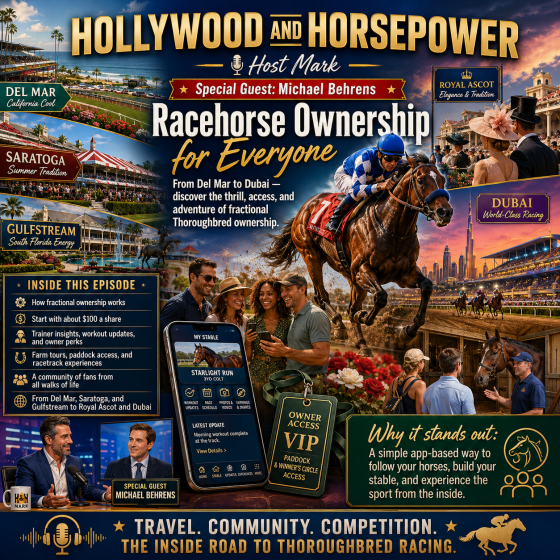

Hollywood And Horsepower Show with Mark Otto
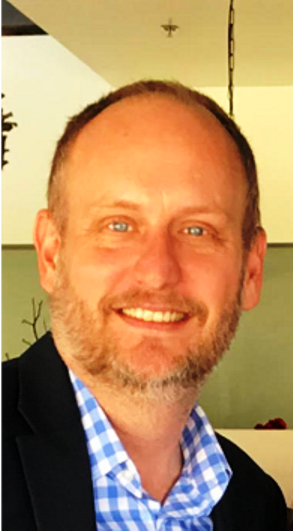
Guest: Michael Behrens, founder of My Racehorse the largest fractional racehorse ownership group.
Michael Behrens is the founder of MyRacehorse.com the first ever fully securities compliant micro-share racehorse ownership platform. Micro-shares allow racing fans to buy equity stakes in top thoroughbreds via a hyper fractional interest. A former marketing and advertising executive with Casper, one of the fastest growing direct to consumer brands ever, Michael turned his attention to thoroughbred ownership in 2017. As CEO of MyRacehorse his responsibilities include securities compliance, owner relations, track and industry partnerships and product development.
Title: Founder and CEO
Phone: 909-740-9175
Email: michael@myracehorse.com
Opening the Gates to Racehorse Ownership with Michael Behrens
Host Mark welcomes listeners to Hollywood and Horsepower and introduces guest Michael Behrens, an executive with MyRacehorse, a platform built around fractional racehorse ownership. The episode begins with a reminder of the show’s sponsor, Tony’s Steak and Seafood, and the charities the program supports, including No Fallen Heroes and Old Friends Equine. Mark frames the conversation around accessibility, explaining that MyRacehorse gives people at many income levels a way to experience ownership in Thoroughbred racing. Michael explains that MyRacehorse is more accurately described as a platform than a club, because it gives fans a structured way to buy small equity shares in racehorses.
From Racing Fan to Founder of a Platform
Michael shares that he grew up near San Diego and developed an early love for horse racing through trips to Del Mar. After life, family, and business took him away from the track for a time, he later had the opportunity to explore racehorse ownership after selling his digital marketing agency. He quickly discovered how expensive traditional ownership could be and began looking for a better way. Inspired by fractional ownership models in Japan and Australia, Michael helped create a system that would let fans buy into racehorses at a much lower cost. He explains that MyRacehorse now has about 100,000 owners across the globe, primarily in the United States and Australia.
How the MyRacehorse Model Works
Michael explains that fractional racehorse ownership requires real regulatory structure because dividing a horse into equity shares creates a security. MyRacehorse therefore operates under SEC and FINRA-related requirements while trying to keep the customer experience simple through its website and app. Users can browse available horses, review trainers, pedigrees, financial information, training costs, insurance details, workout videos, and offering documents before buying shares. Once someone purchases a share, the horse appears in that person’s ownership stable, and the owner begins receiving updates, videos, trainer insights, jockey content, and possible perks such as farm tours, paddock access, box seating, or winner’s circle opportunities.
Experiences Beyond the Racetrack
A major theme of the episode is that racehorse ownership is not just about watching a race. Michael describes the owner perks available through MyRacehorse, including farm visits, organized tours, training events, and large partner gatherings such as the Ocala event hosted with OBS. He also describes MyRacehorse lounges at tracks like Gulfstream, Santa Anita, and Del Mar, as well as international experiences tied to horses racing at places like Royal Ascot, Riyadh, and Dubai. Mark emphasizes that these experiences often include restaurants, local culture, travel, camaraderie, and traditions, making racehorse ownership part of a larger lifestyle and travel experience.
Community, Education, and the Racing Lifestyle
Michael explains that many MyRacehorse owners are not from racing families and are not industry insiders. They may have grown up watching the Kentucky Derby or visiting a track occasionally, but they did not know how to participate more deeply. MyRacehorse helps fill that gap through educational updates, owner content, trainer communication, analyst insights, and owner groups. Michael says the community itself often becomes one of the most educational parts of ownership, as people meet each other at tracks, share experiences, and sometimes go on to buy horses together, start stables, or even purchase farms. Mark connects this to the broader accessibility of horse racing, noting that racetracks often allow fans to interact with trainers, jockeys, owners, and horses in ways that are uncommon in other major sports.
Building a Stable and Choosing Horses
The final part of the conversation focuses on how MyRacehorse selects horses and trainers. Michael explains that bloodstock agents evaluate pedigrees, conformation, workouts, and auction value before horses are purchased. Depending on the situation, MyRacehorse may work with a trainer before buying a horse, or it may buy a horse and then match it to a trainer whose program fits that horse’s profile. Michael also explains that owners can diversify by purchasing shares in multiple horses instead of putting all their money into one horse. This allows members to experience different tracks, trainers, circuits, horse ages, and racing journeys. He closes by encouraging new owners to decide what matters most to them, involve family and friends, join the owner community, attend events, and give horse racing enough attention to fall in love with it.
Keywords: My Race Horse, My RaceHorse, MyRaceHorse
Hollywood and Horsepower Show
Through the relationships Mark Otto developed in Thoroughbred Horse Racing and Automotive Racing, during his global travels, the thing that most interested him was the story behind the story, with the famous people he was fortunate to meet. What was it that these people liked to do? How did they get into Hollywood or into Racing? These stories are fascinating! This is what encapsulates the “Hollywood and Horsepower Show”.
Bringing you along, we talk to so some of the most interesting people Mark met during his career. Don't be surprised if a few other guests stop by this show. This will be fun! It is where SNL meets The Tonight Show; a perfect mix of talk and comedy.
Speaker Identification
Speaker 1 – Intro Music / Theme Song. The opening lines appear to be a prerecorded musical theme for Hollywood and Horsepower.
Speaker 2 – Host Mark. The host introduces the show, sponsors, guest, charities, and guides the interview throughout.
Speaker 3 – Michael Behrens. The uploaded filename identifies the guest as Michael Behrens, and the transcript describes him as an executive with MyRacehorse.
Speaker 1 – Intro Music / Theme Song:
I’ve been down roads from Churchill to L.A.,
Met kings of speed and stars along the way.
They’ve got stories that the cameras never show.
Yeah, the truth behind the fame is what we know.
From the saddle to the silver screen glow,
Fast lanes and punch lines on a late-night show.
You think you’ve seen it all, but you don’t know the half
Till the curtain lifts and we all have a laugh.
It’s not just who they are, it’s how they came to be,
A little horsepower, a little mystery.
Hollywood and Horsepower, baby,
Take a ride where the legends laugh
And the engines never hide.
From the track to the spotlight,
Stories unwind.
Gather truths a little wild
And one of a kind.
Hollywood and Horsepower,
Where the real ones show every twist and turn.
It’s a tale you didn’t know,
So pour a drink, sit back, enjoy the show.
Where the fast and famous let it all go.
Speaker 2 – Host Mark:
Welcome to Hollywood and Horsepower, the show about the story behind the story.
We are brought to you today by Tony’s Steak and Seafood in Indianapolis, Cincinnati, Lexington, Kentucky, and Bowling Green, Kentucky. Tony’s, as Tony always says, has room at the table for one more. I tell everybody I send there that you have to understand Tony’s is an experience, not just going to dinner. Do yourself a favor. If you are in any place where he has a restaurant, make your reservations today.
We also want to remind everybody that we support two big charities on this show. One is No Fallen Heroes. If you can do a little or a lot, help them any way you can.
The other one is OldFriendsEquine.org. Old Friends is a Thoroughbred retirement home for retired racehorses in Lexington, Kentucky. Georgetown, actually, but it is right near Lexington. Do yourself a favor if you are anywhere in the area and check them out.
That kind of brings us into our guest today. We are joined today by a very special guest, Michael Behrens. Michael is the executive of MyRacehorse. MyRacehorse is a fractional ownership group, and I will let Michael explain more. The cool thing about this is that it is a way for anyone at any income level to get involved.
We are very honored to have Michael join us today. Michael, welcome to the show.
Speaker 3 – Michael Behrens:
Glad to be here. Thanks for having me.
Speaker 2 – Host Mark:
I am going to jump right into it, Michael. You guys have a really cool organization. You almost want to call it a club, but I know that is probably not the right term. I do not know how you guys describe it, but it is a really cool way for people to be part of horse racing without a huge spend.
Speaker 3 – Michael Behrens:
Yes, I think you described it pretty well. I think we call it more of a platform.
I will back up for a second, if I can, before I get too into it. I was always into horse racing. I grew up about 50 miles from San Diego, and we would go out. Senior year of high school, I started going. I went to San Diego State, and it is not too far from Del Mar. I spent some fun Saturdays with friends at the racetrack. I always really enjoyed it.
Speaker 2 – Host Mark:
My favorite track in the world.
Speaker 3 – Michael Behrens:
Yes. A Saturday in the summer at Del Mar, there is nothing like it. A lot of people debate Saratoga, the Spa in the summer, or Del Mar in the summer. But at 72 degrees, with the beach half a mile away or less, it is hard to beat it.
Anyway, life took over. I had three kids, and I was running an ad agency. We were a pretty large digital marketing agency in Pasadena, California. I did not get to go as often as I would have liked.
When the company sold, I had a little bit of liquidity and wanted to scratch that itch of getting involved in racehorse ownership. I loved it as a fan. I loved the experience, the competition, the trainers, the jockeys, and obviously the horses themselves. But I really wanted to see what the other side was like, and not just be a fan. I wanted to be the owner.
When I looked at the significance of the cost to get involved, that tagline, “the sport of kings,” really hit home. It was extremely expensive. The people I met with were amazing about sharing the risk and the expense of getting involved in horse racing, and I just thought there had to be a better way.
So we started putting our heads together on what we could do. We actually learned from the Japanese and Australian racing cultures, which are very significant around fractional ownership. I think something like 17% of all horses in Japan are actually owned by the fans through shares. I think one of every 200 people in Australia owns a racehorse.
These are cultures where racing is very vibrant, and they really embrace fractional ownership. I thought that sounded great. So we went on a journey to build a platform that would offer fractional ownership.
Fast forward seven years later, and now we have about 100,000 people across the globe, mainly in the U.S. and Australia, who own racehorses as a result of MyRacehorse.
Speaker 2 – Host Mark:
That is amazing. It is interesting to me, and I agree with you a thousand percent, that the experience is amazing. Del Mar is beyond fortunate. It is one of my favorite tracks in the world.
I had a similar background. My background came from marketing, product placement, ad agencies, and working with manufacturing representatives. I would go to Del Mar and Santa Anita mainly because I was out there for work, and I just fell in love with it.
But it is a little daunting. From someone on the outside, and I have always said this, it is kind of hard to figure out where to start. I was a little closer to it, and you were closer to it, but even for you and probably a lot of your partners and members, from the outside, it is daunting to figure out where to start.
I think that is one of the biggest things MyRacehorse has solved for a lot of people. It gives somebody a clear path and an easy way to get involved. It lets them feel the ownership side of it and also learn a little bit more about the sport from the inside.
Speaker 3 – Michael Behrens:
No doubt. I think you nailed it when you said, “Where do I start?”
I think most really interesting businesses over the last 10 years or so have done an amazing job of realizing that consumers do not have a lot of mindshare to do a bunch of investigation. Things can get really confusing when you are trying to describe new products.
So what they did was say, “We are going to make it really easy to try our products.” I remember being in San Francisco when Uber came out, and your first ride was free. Grubhub comes out, and it is like, “What do you mean I can order delivery through my phone?” Your first month of Grubhub delivery was free.
Netflix came out with DVD rentals and the subscription service, and your first month was free. I worked for Casper, which was one of the fastest-growing mattress companies of all time, and we gave you the mattress for 100 nights as a risk-free trial.
I think that is what great consumer brands do. They help consumers who are curious and interested by making it really easy to get involved.
Horse-race ownership never had that opportunity until MyRacehorse came around. Now our average share price is about $100. We are not talking about cheap horses or horses being trained by unestablished trainers. We are talking about some of the best pedigrees being trained by great horsemen like Bob Baffert and Todd Pletcher. We won the Preakness two years ago with the great D. Wayne Lukas.
We are surrounded by the best pedigrees and the best horsemen, and we are allowing consumers to come in for as little as $100 if that is how they want to get started.
Speaker 2 – Host Mark:
I do not think people realize what you can purchase for $100. When they hear $100 per share, I am sure a lot of listeners are thinking, “Yes, but how many shares do you have to buy?” You can buy one share. You can literally step off for $100.
To give an example, MyRacehorse has been a winner of the Kentucky Derby, Breeders’ Cup Classic, Preakness, and Pat Day. I realize some of our listeners may not recognize all these other races, but these are some of the largest Grade 1 races, which is the top level of horse racing and Thoroughbred racing.
That is pretty impressive. To your point, you are working with some of the best trainers in the industry. I know Bob personally, Bob and Jill Baffert, and I think Bob and Jill Baffert are some of the best horsemen in the industry. I realize some people might be arguing with me through the radio, but I am telling you from personal experience, and this is not anybody else’s two cents.
Being involved with Old Friends gives you a little bit of a view into how horses have been treated. I am not going to point to anybody negatively, but I will point to Bob. This is unsolicited. In fact, if anybody is screaming at their radio right now, it is probably Bob telling me to shut up. But his horses come in looking amazing. From Silver Charm, Game On Dude, Dan the Bluegrass Man when he was there, War Emblem, it is amazing to me how great they look even in retirement. To me, that is a testament going back to Bob and Jimmy Barnes. They just do a terrific job.
The reason I am doing this is not to give Bob a plug. It is to give you an idea of the level you can step into by being part of MyRacehorse. You are not running at some small track no one has ever heard of. You are at Santa Anita, Del Mar, Gulfstream. You are at the major tracks, and this gives people a real opportunity to get involved.
So walk us through this, Michael. Let’s say I am interested in becoming a fractional owner. How does that work? What does it really mean, and what do I get for my membership?
Speaker 3 – Michael Behrens:
I will take you through the full funnel, and we can dive a little deeper if a certain area deserves it.
When we first started out to do this, we said the only way it was going to work was if it was relatively simple. There is a complexity we are built on that made that statement of simplicity a little more challenging than you might first think.
The only way to do what we want to do, which is offer real fractional ownership of racehorses to people in the United States, was to be governed by the Securities Exchange Commission and FINRA. What happens when you take an asset like a horse, fractionalize it into hundreds or thousands of parts, and allow people to have a real equity interest? At that point, you have created a security.
This idea had been tossed around for a lot of years by a lot of really smart people who knew it was better to make racehorse ownership accessible to more people. But the challenge became the securities-compliance requirements.
We decided we were going to build this, but we were going to build it with a focus on simplicity. We were going to be regulated. We were going to do it legally and fairly, but at the same time, we were not going to make it too complicated.
We spent a good amount of time building the MyRacehorse app, which basically meets all the requirements that the Securities Exchange Commission, a broker-dealer, and FINRA need, but also makes it very easy for the user.
The user can download the MyRacehorse app or go to the MyRacehorse.com website. They can look to see what horses are available. They can get all the information about who is going to train the horse and why we bought the horse. They can look at all the financials and terms: how much we paid for the horse, how much is going into training, how much is going into care, how much the insurance policy was created at, and what the breeding on the horse was. If there are workout videos, you can watch the workout videos.
Everything you would expect if you were going to buy the whole horse is available to the users who want to get involved fractionally. If they find something they are looking for, we have the offering prospectus that is filed with the SEC available to be reviewed.
Then if you find something you like, you accept the terms and decide to purchase one, 10, 100 shares, whatever you want to purchase. You purchase there. It takes a minute or two on the app, and then that horse is added to your ownership stable.
Then you start receiving all the benefits, which are the content from the trainer, from the jockey, and all the perks that you get from owning a racehorse. Maybe that is box seating. Maybe that is a farm tour. Maybe that is paddock access or winner’s circle access, if you are lucky enough. All of that is delivered through the MyRacehorse app.
Speaker 2 – Host Mark:
That is something else to point out to our listeners. This is all done by app. It is not like you have to fill out a bunch of forms. It is not like you are trying to email or fax something in, or you are spending a half hour on the phone with somebody. You can literally do this from your phone while you are sitting on the beach.
Today, that is attractive. The other thing that is interesting is that having the app gives people access at their fingertips to immediate updates, communication, what the opportunities are, and what is coming up.
To that point, tell us a little bit about events and things MyRacehorse does with its members.
Speaker 3 – Michael Behrens:
One of the most enjoyable parts of owning a racehorse is getting to know the racehorse. That might be through the lens of the trainer, assistant trainer, groom, exercise rider, or hopefully getting out to the farm yourself and getting to meet your horse.
One of the things we do is create a section called Owner Perks. You buy a racehorse, and then you are basically entitled to the perks that a full owner would get. Of course, we have to share those experiences with 100, 1,000, or in some cases 5,000 people who are on the horse. You cannot just show up at the farm whenever you would like, or show up at the paddock and expect to get in without going through the proper processes.
But what we do on the app is, if you tell us, “I am going to be in this area, and we are having a tour to go see one of your horses,” or “We are having a morning to come see one of the horses at the farm,” you enter into the lottery. You are told several days beforehand if you are randomly selected. If you are selected, you meet a MyRacehorse staff member there. You get out to the farm, see your horse, take pictures, and ask the trainer questions, depending on how the day is constructed.
We try to throw as many of those perks as possible, and most of the time those are all free and included.
Once in a while, we try to do larger activities to make sure we can get as many people access as possible. For example, in Ocala, OBS, the Ocala Breeders’ Sales, is so kind and generous with its venue. It is where a lot of big horses are bought as two-year-olds down in Ocala, Florida.
They allow us every year to ship all of our horses in. The trainers come in, and we have a bunch of exercise riders coming in. They train, work out, meet, and talk to all the partners who come out there. This year we had over 750 people come out and hang out with their horses, meet their horses, and bring family and friends.
We had all the stalls open so people could go back there, pat the horses, take pictures, ask a bunch of questions, and learn their personalities. That is a big part of it. I wish we could allow everybody to go out every single day and see all the horses, but when you have shared ownership, you are going to have to have shared experiences.
I think we do a pretty darn good job of making as many experiences available to the partners as we can.
Speaker 2 – Host Mark:
I think that is a great point. You guys do a really good job. Another thing that is really impressive to me is that, as you know, I spend part of the year in South Florida, and you guys have your own pavilion, for lack of a better word, your section at Gulfstream. I think you guys have the best seats in the house. It is a big open-air pavilion with its own bar, its own entertainment, it is adjacent to food, and it is literally steps past the finish line.
Speaker 3 – Michael Behrens:
We do try to make the experiences. When you own a racehorse, it is an amazing accomplishment to get your horse to the races, and we want people to have the best possible time when that horse gets to the starting gate.
We work with different tracks and try to create what you are referring to as our Gulfstream lounge. We have had lounges at Santa Anita and Del Mar.
Speaking of racehorse ownership experiences, we have a horse with Wesley Ward right now that is actually shipping over to Royal Ascot to run at that meet. We have about 25 owners who are going for the entire week to tour farms, see some of the highlights of the U.K., and really have an immersive experience. They are going out for the whole week, and then it is going to end with our horse on Friday running in a handicap at Royal Ascot.
Speaker 2 – Host Mark:
For those listening who do not know horse racing, Royal Ascot is probably the most elegant race meet in horse racing, in my opinion. You can correct me if I am wrong, Michael, but to me this is where people dress in coats and tails and top hats. The Queen of England would attend. The King of England will attend. You are brought in by carriage. If you watch Downton Abbey, it makes you feel like you are part of that.
It is that type of elegant atmosphere. It is truly an experience. That is amazing that you guys have that level. Personally, that is a step above the Kentucky Derby to me.
Speaker 3 – Michael Behrens:
It is funny you say that. A lot of people tell us some of our international experiences are like that.
Last year, or the year before, Straight No Chaser, who wound up becoming the Eclipse champion for being the best sprinter, went over to Saudi and won in Riyadh a $2 million race. Then he went over to Dubai for that carnival, which is amazing.
We had a bunch of Americans come over. We spent the whole week there. We did all the tours you would want to do. We got to hang out with the trainer and watch the horse prepare every morning, and we had an amazing day at the races.
Our international experiences wind up being really fun. I think a lot of people do this because they expect, “I grew up not too far from Saratoga, Del Mar, or Keeneland, and I would love to be able to experience ownership as an owner.” I think they are very pleasantly surprised that these horses sometimes take you on a much bigger journey than you even imagined.
Speaker 2 – Host Mark:
That is a very good point. It is one of the things I have noticed, and I have met a lot of your members. Casually, because of what I do, I am always curious about people’s stories.
What is interesting to me is that your members come from all different walks of life. I have met everybody from mailmen to CEOs who are members. A lot of them really do not have a background in horse racing. It is an experience, an event, something where they feel camaraderie, or something they have a vested interest in with other people. Community, for lack of a better word.
It gives you a way to be at the upper level. I tell people this all the time. I have been involved in almost every sport there is, from NFL, NBA, Major League Baseball, F1, and NASCAR. Horse racing is probably one of the most accessible sports I have ever been involved in.
What I mean is that this takes it a step forward from being accessible in general. You can go stand at the rail at Gulfstream and possibly have a jockey, a Grade 1 trainer, or a Hall of Fame trainer walk next to you and start talking to you. Now you have gone to the next level, where you can experience ownership with a horse like Straight No Chaser, who has won on an international level and on a Breeders’ Cup level.
For those who are not aware, Dubai is extremely elegant, with world-class horse racing. I think the difference to me, and I did not grow up in horse racing, so I am not an expert, I am just giving you my two cents, and it is probably worth one. When you look at it, it is so interesting because you are on an international level.
A lot of races here sometimes have international horses come in, but a lot of it is three-year-olds in the U.S. or two-year-olds in the U.S. You go to Dubai or Royal Ascot, and you are competing with horses from all over the world.
In Dubai, these are horsemen. For people who do not realize it, the Thoroughbred breed kind of came from that region. The Darley Arabian stallion was shipped to England and bred with warmbloods, and that was part of the beginning of Thoroughbreds. When you think about it in that light, these people have been horse racing for hundreds of years. They know horses, so to go and compete on that level is amazing to me.
Speaker 3 – Michael Behrens:
You brought up a lot of really interesting points.
One thing you brought up, where I think sometimes maybe we get too much credit, is that horse racing is an unbelievably accessible sport. I think what we have done a good job of is curating that accessibility.
It is amazing how generous the jockeys and trainers are with their time, stopping and talking to fans and fractional owners. It is amazing how open the tracks have been to letting people get on the rail, hear the horses working out in the morning, or get access to the paddock, winner’s circle, or backside tours.
A lot of the tracks now are opening up backside tours. We work with Horse Country. We are a proud sponsor of Horse Country here in Lexington, and they have done an amazing job working with all the local farms to get tourists. I think close to 40,000 people a year come and visit the farms that are housing some of our most influential stallions and broodmares, from Justify to Into Mischief to Not This Time. They are all part of these Horse Country travels.
I think what has happened is that the sport itself is very accessible, but there has not been great marketing around that accessibility. There have not been great aggregators or curators of all that accessibility. When you think about somebody like us, our goal is to give you fractional ownership and then give you an amazing experience with it.
Our company is called Experiential Squared. We did this because we think owning something enriches the experience in a compounding way. I do think we benefit tremendously from a sport that actually is quite accessible, even though most people may not know about it.
Speaker 2 – Host Mark:
I would agree. That is something I always try to tell people. If you go to an NFL football game, it is not likely you are going to bump into a coach or a player. It is possible, but not as likely.
If you go to a Thoroughbred racetrack, it does not matter if it is Del Mar, Saratoga, Gulfstream, or Keeneland. There is a pretty good chance that somewhere during the day you are going to cross paths with an owner, a trainer, or a jockey. To your point, I have found them extremely accessible.
I am living proof of this. I came from outside the industry. I first got involved through a company I was working with in horse racing around 2010 or 2011. I have always said I was very fortunate to meet the right people at the right time. As I alluded to, I have gotten to know Bob Baffert and Terry Finley and a lot of people in this industry. Everyone has been so gracious, kind, and accommodating.
Bob I met through Old Friends. We were both supporters of Old Friends, and I met him through Michael Blowen. I got to know him as a person. He is a terrific guy.
Terry Finley and I met at Santa Anita standing in the area by the paddock and just started talking to each other. I had no idea who he was. It is amazing how people in this industry will just strike up a conversation with you.
That is something really exciting. I always tell people it is so much fun to spend an afternoon at a racetrack. There are all different levels. That is what I want to stress to people. Sometimes there is this image that it is a black-tie event and you have to be at a certain level to attend this stuff. There is everything from general admission, a hot dog and a beer on the apron, to suite seating upstairs, where you and some friends can have a catered dinner, and everything in between.
I always encourage people to experience it. If you are traveling, and we are big on this show about experiences, go to a local racetrack. Experience it. It is a great afternoon. It is fun and engaging. The people are kind and accommodating.
It is amazing to me, and I notice this more because I come from the outside, how accommodating and kind people are. Most people hanging around will take the time to talk to you and explain something.
That brings up the next question. How do you take a person who is interested in this for the experience, looking to be involved in something fun, and help them understand the sport? Do you guys have things that help people get initiated, so to speak?
Speaker 3 – Michael Behrens:
Yes. The majority of people who are part of ownership with MyRacehorse were not in the industry. They were not sons or daughters of trainers. They were not related to jockeys. They were not part of track families in terms of executives or people who work at tracks.
These are people who grew up enjoying the races, maybe on a Saturday or watching the Kentucky Derby. They always had a curiosity and wanted to be more participatory, but did not know where to start. I would say the vast majority of people are casual fans who have been interested and wanted to more deeply immerse themselves.
A big part of our responsibility is education. One of the things people have given us a lot of positive feedback on, and every year we survey all the partners and fractional owners on the platform in the U.S., U.K., Australia, and across the world, is the owner updates, the content, the feedback from our analysts, from the industry, and from trainers. How educational and exciting that is is super important.
We realize that it is a very important part of the journey. It is not only allowing them access to the horse, which is fun, but also access to the knowledge and insights that make this sport run.
On top of that, what I find to be probably the most educational component of fractional ownership with MyRacehorse is sometimes not us, but the community you become part of.
We have horses that have 2,000 or 3,000 owners. Authentic had 5,000 owners. Seize the Grey had 2,500 owners. What happens is these people start meeting each other through our owner community groups. They start meeting each other at the racetrack, and they start sharing their experiences. You develop a network and a cohort of people who share the passion as much as you do, and who are maybe at different parts of their journey in terms of what they have learned so far, what they have access to, or what they are interested in.
Collectively, you surround yourself with people who share the same passion and bring a bunch of different perspectives. We have had people meet through our partnerships and go on to buy their own horses in partnership together. We have had people go on to start their own stables. I know of a couple who bought their own farm and fell so much in love with it that now they are going to do some syndication with friends in their own journey.
It really is a combination. We know we have a responsibility to educate and share information, but you are also going to join a community, and you are going to find a ton of interesting people who can be quite accretive to your journey.
Speaker 2 – Host Mark:
That is something really cool, that you are part of a community and experiencing this with other people who have the same interest.
The other thing I think is really cool is that everywhere you guys have membership, which is nationwide or worldwide, you also have other experiences. You alluded to it. It could be anything from farm tours to Royal Ascot, where you are going to do some other things out there that culminate with the actual race.
I know a lot of people really like finding that cool restaurant, that cool home, or a place close to the racetrack. That is something I have always told people is really cool about horse racing. Horse racing to me is about food, camaraderie, and racing. It seems like everybody I talk to, if they start talking about Del Mar, or Saratoga, everybody has their favorites. It does not matter who you talk to. There is an absolute go-to every time they are there.
In Lexington, you go to the races and then go to Tony’s Steak and Seafood downtown for dinner. Or you go to the races and go to Malone’s. When I am in Gulfstream, we go to The Palm a lot. You go to different places around town. Steve Martorano has a great restaurant in Fort Lauderdale. Del Mar, I would always go, which is ironic because they are actually owners, to Gary West’s restaurant up in Carlsbad, West Steak and Seafood, and several places around Del Mar.
That is the other thing people really enjoy about this: it is such an experience. You have a great day at the races, then you go somewhere great for dinner. It is a true package.
Do you guys have things like that where you put together experience packages for your members?
Speaker 3 – Michael Behrens:
Yes. Like we talked about before, going to the races, especially if you have a horse in a big stakes race, is an accomplishment and something that should be celebrated.
When you go into a new track or a new community, it is not just about the racetrack. It is about the local culture and the local food. We try to take full advantage of that.
For instance, when we have been lucky enough to have a couple of horses in the Breeders’ Cup at Del Mar, the night before we rented out the Brigantine, a beautiful restaurant overlooking the beach. We rented out the whole restaurant. The entire patio was ours. Our trainers came out, and our partners came out. We spent a couple of hours celebrating.
We were at a really great local restaurant that a lot of people would only know if they lived there. We were experiencing that in this new environment, and people were coming from all over.
You would be amazed how far they will travel to come watch their horse, and they should. It is a very unique experience to be in a stakes race like that. It does not happen to that many people. We try to appreciate the fact that we know coming to support your horse is going to be about a lot more than just the race.
We were in Maryland for the Preakness, and we did a crab boil. We will go to Royal Ascot, and we will do tea. We will do morning workouts at Newmarket. We are always looking to combine local culture and the race itself, because that is a big part of it. You are going there for more than just the race. The race is obviously the pinnacle and the highlight, but I think the memories are made by the full experience. A lot of that is the food and local culture.
Speaker 2 – Host Mark:
I would agree. To your point, that is what people really enjoy. It is a complete experience. It is not just racing. It is experiencing other things, from local culture to a little bit more behind the scenes with the industry, from the farms or workouts and things.
One of the things I have always thought was really cool was how involved a lot of the people in horse racing are with other experiences, whether it is bourbon tasting, cigar bars, or something else. That seems to be growing, and I think you guys are doing a great job of that. The experience goes beyond just being at the racetrack.
For our listeners who do not know, when we talk about Del Mar and Saratoga, it is kind of an East and West thing. It is funny. One of the most interesting things to me is that the same thing that attracts people to Del Mar seems to attract people to Saratoga, in my opinion. This is just my two cents, but they generally have some sort of memory. They remember growing up going there with their dad, their granddad, their uncle, whatever. They have continued that, and then it expands because they have exposed people to it.
Saratoga, even though I would consider myself more of a Del Mar guy, has always been intriguing to me because I love listening to people tell their stories. You have people who have been coming there for 40 years, getting the same picnic table, camping out in town somewhere, staying in a hotel, staying in a campground, or renting an Airbnb. I can honestly tell you I have met people who do everything from car camp to rent a house on Lake George.
Again, every income level, every walk of life. This is not limited to certain people. It is open to everybody.
Del Mar, for people who do not know Del Mar, is really interesting to me. Del Mar was started by Bing Crosby. It was started because originally they were looking for someplace that was a little cooler than Arcadia. Arcadia is where Santa Anita is, up north of L.A., around Burbank and Hollywood. It gets very warm there at certain times of the year, and for the horses, that was challenging.
Bing recognized the need and found an area that was available. Ironically, there is something about that valley, and you grew up there, so you probably know it better than most. It is always cooler, to the point where that is part of the tagline, “Cool as Ever.” That came from the fact that it was always cooler than L.A.
There are pictures at Del Mar of Bing Crosby taking tickets on opening day. You have seen every celebrity you can think of walk through those gates. There are pictures everywhere of famous horses and famous people.
I really cannot encourage people enough. If you get the opportunity, it is an experience like no other. Every track has a unique thing. If you go to Gulfstream, you are blocks off the ocean. It is a beautiful facility, and the weather is almost always nice. You go to Saratoga, and I joke around that it is kind of like summer camp for adults. You go to Del Mar, and it is California. You can literally sit upstairs, and if you go up to the very top, you can see the ocean from the top seats. It is an amazing place.
The history is deep, the experience is fun, and there are so many things to do around every racetrack. That is another thing I always tell people. One of the things that is really cool about horse racing is that it takes you to some really cool places.
Being part of something like MyRacehorse really helps open the door to take you to cool places. There are not many places where there is a racetrack where it is not a desirable place to go, for a bunch of different reasons: local culture, restaurants, traditions. I just think that is really cool.
You have been around it a lot. You grew up on it. What are some of your best memories of Del Mar and Santa Anita?
Speaker 3 – Michael Behrens:
Before I share a couple of my personal experiences, listening to you talk reinforces so much of the original premise of why we wanted to start MyRacehorse.
It actually manifests itself in our logo. If you look at it, it is a silhouette of a horse head, and there is a road in the middle of it. The idea is that every Thoroughbred is going to take you on a unique journey. You do not know where it is going to take you, but every one of them has the ability to take you on something extremely memorable.
I have had probably 95% of all my experiences in Thoroughbred travel and communities as a result of these horses. I had actually never been to Saratoga before. I grew up near Del Mar and loved Del Mar. Everything you described about it is exactly right. Celebrity opening day, when I was going to school in San Diego, was the event. It was packed, impossible to get to, and on a Friday. Everybody was dressed up, and they all showed up to put their best foot forward. It was just one of the most electric Fridays, opening day at Del Mar.
You have the beach. My wife loves going there. We will get a little house close by the beach, walk on the beach in the morning, have breakfast at one of the local restaurants on the sand, spend the day at the beach, and then find a great place for dinner. It is great.
I had never been to Saratoga before. The most amazing thing about Saratoga is that I do not care who you run into, where you decide to eat, or where you decide to get gas. You are hearing people talk about the races. You are hearing your waitress give you tips on the four horse in the third race because she loves the way the horse has been working out, or she talked to her cousin, the exercise rider, and heard a great tip on a maiden.
You walk into the bakery, a gas station, or a movie theater, and they love horse racing. It is so unique. I have never seen anything like it.
Then you have these other smaller tracks I love so much. I had never been to Ellis Park here in Kentucky before starting MyRacehorse. This is an amazing family, fair-oriented, food-truck-vibe kind of place. I find it unbelievably delightful because I see little kids running around. The jockeys are so close that they stop after a race, sign autographs, and joke with the kids. You feel like you are a handshake away from the horses themselves, the way it is set up. The hospitality is incredible.
I find these local tracks to be so unique. Maybe they do not get all the rave reviews or the spotlight that the Saratogas, Del Mars, and Keenelands get.
Speaker 2 – Host Mark:
Another good job in Kentucky is Kentucky Downs.
Speaker 3 – Michael Behrens:
Yes.
Speaker 2 – Host Mark:
I think that is another one that a lot of people would not even know. For people who are not familiar with it, Kentucky Downs to me is one of the most unique tracks because it is not a perfect oval. The sprint to the finish line is uphill. It is a European turf track. It is one of the most unique places I have ever seen.
I apologize. I did not mean to interrupt you, but when you mentioned Ellis, I agree a thousand percent. There are so many hidden gems that you guys expose people to.
Speaker 3 – Michael Behrens:
We were just up at Indiana. We had also just done a collaboration with Sam Houston to try to bring fractional ownership to Texas in a more meaningful way.
You continue to get exposed to these local tracks. Every local track has a unique community, and the personalities are incredible. They are exciting and different. Across the board, it is a really fun adventure no matter where you wind up settling in.
That is one of the things we are very proud of at MyRacehorse. I do believe it is really hard to love owning horses if you only get to own one. What I mean by that is it is an amazing privilege to own a racehorse, no doubt. But the reality is that there are 17,000 horses born every year, and only one or two percent ever become stakes horses.
It is fun no matter what kind of achievements your horse has, but there is something really, really special about having one of the best horses in the world.
If you are able to put $100 in per racehorse, let’s say your budget is $1,000 or $2,000, that could be 20 horses in your stable. That could be 20 different racetracks you are going to, 20 different farms where your horses are stabled, 20 different trainers you are working with, and 20-plus different jockeys you have the privilege of getting to know.
It gives you the opportunity not only to enjoy owning a racehorse, but actually to take in the full totality of racehorse ownership. That takes a stable, and developing a stable in the traditional world, when the horses we are purchasing average about half a million dollars, is not something everybody can do.
But for $100, there is a high probability that people can add a couple of horses to their stable and experience all of what we are talking about today. You do need to have a little diversity and a little bit of a portfolio to be able to embrace all this.
Speaker 2 – Host Mark:
I agree 100%. Another thing you touched on that we should tell our listeners is that when we talk about these shares, and I think this probably goes without saying, but I am going to say it anyhow: if you have shares that start at $100 and your budget is $1,000, that does not mean you have to buy all $1,000 in one horse.
You could buy multiple shares in different horses to give yourself, as you put it, a stable. You can build your own stable, have parts of multiple horses, and have horses that race on different stages in different areas.
For people who are not familiar with horse racing, all horses do not race at all tracks. You could have horses that spend more of their time between Kentucky and New York, Kentucky and Florida, or New York and Florida. Having multiple horses in your stable gives you the opportunity to have something going, for lack of a better phrase, at all times.
Speaker 3 – Michael Behrens:
That is exactly right.
One of the things we do on the MyRacehorse website and app is clearly identify what circuit we think is going to become the home base. For the exact reasons you are saying, some people want to have something local. Some people want variety, so they want horses based in different areas. They may want horses of different ages.
A lot of people like to buy yearlings and watch them grow up. A yearling is a horse that is one year old. It has never had a saddle on. It has not gone through the breaking process. It is a very early horse, and you have no clue what it could be. It could be a superstar, or it might not be that fast. You really just never know. You are relying on conformation and pedigree, but you have not actually seen the horse become an athlete yet.
Some people like to buy two-year-olds. They have seen the horse work out. They have seen the horse breeze. They have a little more confidence that they can project what the horse is going to become.
Other people like to only buy horses of racing age after they have actually started. Then you know a little more about the quality of the horse. That is how we bought Authentic. We bought him after a win, and then he aspired to win one of the biggest races in the world, the Kentucky Derby. We were lucky enough to win it.
But Seize the Grey was a son of Arrogate that we bought as a yearling who had never had a saddle on before.
The website gives you the opportunity not only to experience these different areas, but also to look for different ages and different trainers. I find that trainers use such different approaches. I never would have guessed it. I would have assumed that the best trainers got there because they figured out a best-practices roadmap on how to maximize the athletic ability of a Thoroughbred athlete.
But it is incredible to me how bespoke and unique these trainers can be with their programs for individual horses, and how they differ from each other in terms of their training regimen. Getting the opportunity to see firsthand how different it can be is fascinating.
If you start to fall in love with racing, which is hard not to once you look behind the curtains, you start to really appreciate and get excited about the differences among the different stakeholders in the game.
Speaker 2 – Host Mark:
That kind of leads me to another question, because I agree. On the site, you guys have done an amazing job of putting together some of the most remarkable trainers and horses. How do you guys go about deciding what horse to buy or what horse to partner with?
Speaker 3 – Michael Behrens:
That is a great question.
In horse racing, there is an expertise called a bloodstock agent. Their job is to review pedigrees and conformation and help owners like myself and those we partner with decide what the best horses are to add to your stable.
We have a team of about four guys on the MyRacehorse staff in the U.S. and a couple of guys in Australia who basically go to all the sales. Most horses are purchased at public auction if you did not breed them.
You go to the sale and inspect all the different horses. If it is a two-year-old sale, you can actually watch them work out. If it is a yearling sale, you are looking more at walk, conformation, and pedigree.
Those bloodstock agents help you assign what value you think the horse is worth. Then it is a public auction. If something goes for what you think it is worth, you raise your hand, and when the hammer falls, that is your horse. If you think someone is overvaluing the horse, you pass and go to the next one.
It is a very exciting part of the whole journey. We attend almost every sale. We do not always walk away with horses. Sometimes our value equation and the horses available just do not add up. Other times it works out great, and we walk away with a handful of horses. But it is all run by the bloodstock agents and that team.
Speaker 2 – Host Mark:
Do you select the trainer first, or do you get the horse and then select the trainer?
Speaker 3 – Michael Behrens:
It depends.
Sometimes we will actually go with the trainer, and our bloodstock agents will say, “Trainer A, do you like this horse? Which ones do you like?” Sometimes it can be very advantageous to work with the trainer and find a trainer who is also on the same horse.
Not all trainers attend, and not all trainers are that participatory. Sometimes we buy a horse and think it is a perfect fit for a given trainer.
What we have learned over time, now that we have been doing this for eight years, is that each program is different. Some trainers seem to excel with one type of horse over another. Each stable side, MyRacehorse included, has decided that there are certain profiles of horses that we think match up really well with certain trainers.
That is what we are looking to do. If we did not buy it with the trainer, we are usually very intentional about buying a horse that meets a certain trainer.
A lot of times the trainers we select are predicated on the people and the partners on the platform and what they want. They vote with what they invest in and what they purchase. We are seeing a lot of people, because Straight No Chaser wins the Eclipse Award, wanting to go back to Dan Blacker. We are going to accommodate that. We are going to buy more horses for Dan Blacker.
Authentic or Seismic give you Bob Baffert, and we will go back there as well. A lot of times where we go is predicated on the partners raising their hands and saying, “This is where I want to buy more horses.”
Speaker 2 – Host Mark:
That makes sense. That is a very good point that a lot of people do not realize. There are different horses. When we talk about different types, there are horses that are turf horses and run on grass. There are horses that run on dirt. There are horses that run distance, and there are horses that are sprinters, meaning shorter races.
Another thing is that certain trainers, and this is getting less this way because they seem to be spreading out more, spend most of their time at certain tracks. They might be a better place to go for a certain horse.
It sounds like you have different trainers for different horses, depending on tracks and depending on the horse. That really gives people insight into how much thought you guys put into this.
We are up against the hour, and I hate to do this, but we are going to have to continue our conversation another time. I really appreciate you joining us.
For anybody who has been intrigued by this and wants more information, MyRacehorse.com is probably the best place to start, or download the MyRacehorse app. You can get weekly updates about your horse, real-time workout reports and updates, events, analysis, one-on-one contact with trainers, jockeys, and your other owners.
Michael, closing remarks. What would you tell somebody who is thinking about this and looking at something they want to get involved in to expand their travel and experiences? What is your suggestion to them, other than the obvious, which is to check out the website?
Speaker 3 – Michael Behrens:
I would say find out what is important to you. Talk about it with the friends and family you are going to share it with, because one of the best ways to enjoy racehorse ownership is to share it with family and friends.
It is incredible, the stories we hear about how much a fractional share of a horse brought a friend group or a family together and bonded them around the animals.
Figure out what is important. Is it location? Is it trying to get into big races? Is it having a young horse that you can watch mature and visit? Whatever it is, make sure you decide what is important to you and what you really want to start with. Then take your time and find what is right.
Then go all in. I think that is the most important part of it. Embrace it. Sign up for the MyRacehorse owner groups. Go for it. Meet people. Join the owner groups. Meet other owners and find out who they are. Ask about their experiences. Come to all the events you can possibly come to.
Listen to great content like this podcast and different newsletters that are out there to learn more about horse racing. Once you learn about it, you are just going to have a tough time not falling in love with it.
I think the biggest hurdle we face in horse racing is just getting people to give it a little bit of mindshare. Once you give it some mindshare, you find out why people like you and me are so passionate about it.
Speaker 2 – Host Mark:
Absolutely. We cannot encourage people enough. Take a moment and check it out at MyRacehorse.com.
Michael, thank you for joining us today. We really appreciate it.
We are brought to you by Tony’s Steak and Seafood. If you are in Lexington, check them out. If you are in Lexington, also check out OldFriendsEquine.org. They are a great organization. It is one of the only places you can get up close and personal with a racehorse, including Kentucky Derby winners and Breeders’ Cup winners. If you run into Michael Blowen, he will show you around.
Michael, thank you for joining us. We really appreciate it. This has been Hollywood and Horsepower, and we will see you guys again next week.