
Hollywood and Horsepower Show, July 30, 2026


Hollywood And Horsepower Show with Mark Otto
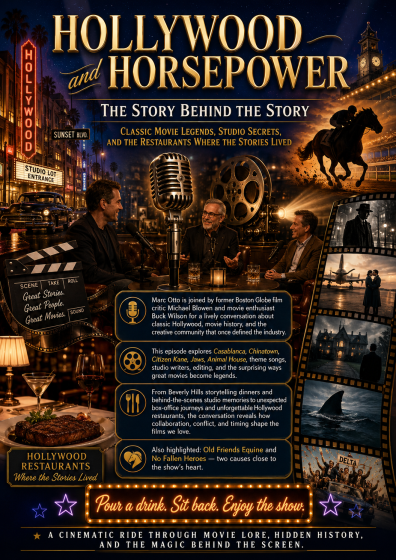
From Casablanca to the Cutting Room with guests Michael Blowen and Buck Wilson
From Casablanca to the Cutting Room: Hollywood Stories, Movie Legends, and the Restaurants That Remember
Summary
Hollywood's Vanishing Creative Community
Marc Otto welcomes former Boston Globe film critic Michael Blowen and movie enthusiast Buck Wilson for a wide-ranging conversation about classic cinema, studio culture, and the relationships that shaped Hollywood history. Blowen describes the old studio environment as a working community where writers, actors, directors, and critics could form genuine relationships and help one another. His memories of John Huston, Jack Nicholson, Julius J. Epstein, and the storytellers gathered at Epstein's Beverly Hills dinners reveal a Hollywood built as much on conversation and trust as on formal production. The guests contrast that atmosphere with a modern industry they see as more controlled, compartmentalized, and promotional. They also emphasize that conflict on a set was not necessarily a sign of failure, because strong films could emerge from arguments, creative tension, and competing ideas. Throughout the discussion, collaboration is presented as one of the essential forces behind enduring entertainment.
Why Casablanca Became an Evergreen
Casablanca becomes the central thread of the episode because it is the favorite movie of both Marc and Buck and is closely connected with Michael's friendship with screenwriter Julius J. Epstein. Michael explains that the screenplay was created through a collaborative studio process involving Julius and Philip Epstein, Howard Koch, Casey Robinson, and other contributors. He recalls that Epstein regarded it as simply another studio assignment and was surprised by its later cultural importance. The group discusses Harvard screenings, the film's gradual growth after its initial release, its memorable dialogue, its wartime themes, and the layered moral conflict beneath its romantic story. Marc also describes production documents and budget information that Michael shared with him, including cast and writer salaries and disputes over the film's moral implications. Their conversation presents Casablanca as a movie whose reputation grew because its writing, performances, music, editing, historical moment, and accidental creative discoveries all came together.
Movies That Found Their Audience Later
The guests explore how many famous movies were not immediate successes and only later became classics. Michael points to Casablanca, A Christmas Story, and Citizen Kane as films that developed audiences through rereleases, television, college traditions, or long-term critical appreciation. Marc describes his own delayed appreciation of Citizen Kane and compares the experience to learning to hear the complexity of the Beatles. Buck openly says he still does not like Citizen Kane, leading to a discussion of the intangible qualities that make a work connect with one viewer but not another. The episode also touches on Tommy Boy, Three Men and a Little Lady, Home Alone, Billy Jack, The Born Losers, and The Pope of Greenwich Village. Together, these examples show how timing, competition, distribution, cultural context, and personal perspective can matter as much as opening-weekend performance.
Deals, Theme Songs, and Unexpected Fortunes
The conversation moves behind the business side of entertainment through stories about contracts, percentages, music rights, and studio employment. Buck recounts how Sammy Cahn and Jule Styne created “Three Coins in the Fountain” with almost no information and later discovered that no one had secured the studio's ownership of the song. Michael tells how Alec Guinness accepted a percentage of Star Wars and later said the decision paid for his retirement. He also recalls Richard Brooks narrowly missing the chance to purchase lifetime rights to “Rock Around the Clock” for an additional $500. Marc adds the story of the Cheers theme song becoming an iconic last-minute replacement. These anecdotes reinforce the episode's recurring idea that small decisions, overlooked details, and unplanned substitutions can become some of the most important parts of entertainment history.
Restaurants as Places Where Stories Live
After Michael leaves, Marc and Buck connect Hollywood history with restaurants, travel, friendship, and personal memory. They discuss Musso & Frank Grill, The Brown Derby, The Palm, St. Elmo Steak House, Malone's, Win Schuler's, Eddie Merlot's, and Tony's Steak and Seafood as places tied to careers, family experiences, relationships, and memorable evenings. Buck recalls disliking formal restaurant outings as a child before learning to appreciate the Brown Derby, while Marc describes teaching his children the etiquette they absorbed from dining with adults. Buck tells the story of marrying Trina during a dinner in the wine cellar at St. Elmo, and Marc explains why The Palm Miami and Eddie Merlot's carry emotional significance for him. The discussion suggests that restaurants often serve as unofficial clubhouses where people decompress after work, exchange stories, form relationships, and preserve the social bonds of an industry.
The Invisible Art That Saves a Film
The episode closes with Buck's story about a deleted scene from Save the Tiger that Jack Lemmon considered some of his best acting. Although the scene was powerful on its own, it was removed because it interrupted the film's momentum, illustrating the discipline required to sacrifice strong material for the larger work. Marc expands the point by describing editing as an underappreciated art equal in importance to acting and cinematography. He notes that filmmakers such as Steven Spielberg, George Lucas, and Judd Apatow are valued for their ability to recognize useful pieces and assemble them into a coherent whole. The traditional phrase “cutting-room floor” becomes a reminder of the physical process by which film was once cut and spliced. The closing lesson is that audiences often experience only the finished harmony, while the choices, arguments, discarded scenes, and invisible craftsmanship behind it remain untold.
Guest, Michael Blowen
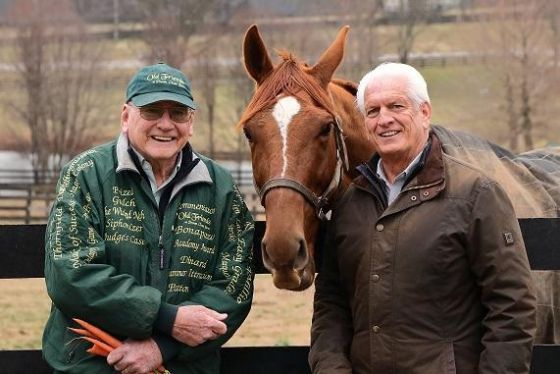
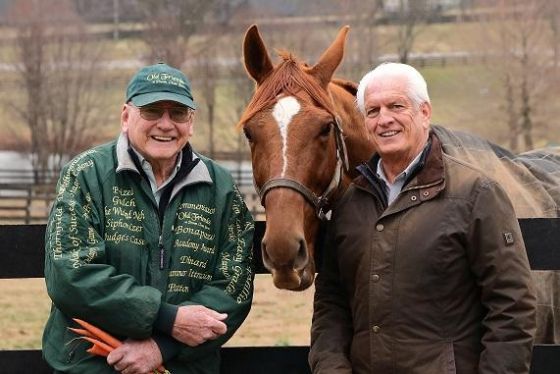
Michael Blowen is a former Boston Globe journalist and the founder of Old Friends Thoroughbred Retirement Farm, dedicated to the care of retired racehorses.
Early Life and Education
Michael Blowen began his career as an educator after earning a master’s degree from Emerson College in Boston, where he stayed on to teach for a period. He had a longstanding interest in writing, which led him to publish an article on Elia Kazan’s film adaptation of F. Scott Fitzgerald’s The Last Tycoon, catching the attention of a Boston Globe editor and launching his journalism career.
Career at the Boston Globe
Blowen joined the Boston Globe initially as a “second-string” critic and eventually became the newspaper’s top film reviewer. His work at the Globe spanned 24 years, during which he developed a reputation for insightful criticism and storytelling. A pivotal moment came in 1979 when an editor invited him to Suffolk Downs racetrack, sparking his lifelong passion for horses.
Transition to Horse Welfare
Blowen’s fascination with thoroughbreds led him to apprentice with trainer Carlos Figueroa at Suffolk Downs, where he learned the intricacies of horse care. Over time, he became increasingly concerned about the fate of retired racehorses, particularly after learning that many were sent to slaughter rather than proper retirement homes. This concern motivated him to take a more active role in horse aftercare.
Founding of Old Friends
After accepting a buyout from the Boston Globe in 2001, Blowen and his wife, Diane White, moved to Central Kentucky. He became operations director for the Thoroughbred Retirement Foundation before founding Old Friends Thoroughbred Retirement Farm in Georgetown, Kentucky, in 2003. The farm began as a small operation with a few paddocks and has grown into a multi-million-dollar facility housing over 100 retired racehorses, including notable champions like Silver Charm, Touch Gold, and Birdstone. Old Friends also operates a satellite location near Saratoga Springs, New York, and previously had an outpost near Kentucky Downs.
Achievements and Legacy
Blowen’s work has brought national attention to the aftercare of retired racehorses. He has personally overseen the rescue and rehabilitation of horses, including returning stallions from Japan and Italy, and has emphasized that all horses, regardless of fame, receive equal care. In 2023, marking the 20th anniversary of Old Friends, Blowen announced he would step down as president, passing leadership to John Nicholson, while continuing to engage with visitors and tours.
Personal Philosophy
Blowen often emphasizes the mutual benefit between humans and horses, noting that while the horses are cared for, they also enrich the lives of those who work with them. His dedication combines hands-on care, advocacy, and education, ensuring that Old Friends remains a sustainable and respected institution in the horse racing community.
Michael Blowen’s journey from Boston Globe journalist to champion of retired racehorses reflects a unique blend of storytelling, compassion, and entrepreneurial vision, leaving a lasting impact on both journalism and Dignified Racehorse Retirement in Aftercare.
Hollywood and Horsepower Show
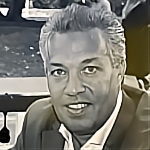
Through the relationships Mark Otto developed in Thoroughbred Horse Racing and Automotive Racing, during his global travels, the thing that most interested him was the story behind the story, with the famous people he was fortunate to meet. What was it that these people liked to do? How did they get into Hollywood or into Racing? These stories are fascinating! This is what encapsulates the “Hollywood and Horsepower Show”.
Bringing you along, we talk to so some of the most interesting people Mark met during his career. Don't be surprised if a few other guests stop by this show. This will be fun! It is where SNL meets The Tonight Show; a perfect mix of talk and comedy.
Speaker Identification
Speaker 1 - Host: Marc Otto. He identifies himself by name at the opening and closing and leads the interviews throughout the episode.
Speaker 2 - Guest: Michael Blowen. He is introduced as the founder of Old Friends Farm and a former film critic and entertainment writer for The Boston Globe. His surname appears in several garbled forms in the automated transcript, but the conversation consistently identifies him as Michael Blowen.
Speaker 3 - Guest: Buck Wilson. He is introduced by name as a close friend of Marc Otto and Michael Blowen and joins from San Carlos, Mexico.
Speaker 4 - Prerecorded Theme Vocalist / Announcer. This speaker performs the opening and closing theme material and is not identified by name in the transcript.
Speaker 4 - Prerecorded Theme Vocalist / Announcer:
I've been down roads from Churchill to L.A., met kings of speed and stars along the way. They've got stories that the cameras never show. Yeah, the truth behind the fame is what we know.
From the saddle to the silver screen, fast lanes and punch lines on a late-night show. You think you've seen it all, but you don't know the half until the curtain lifts and we all have a laugh.
It's not just who they are; it's how they came to be. A little horsepower, a little mystery. Hollywood and Horsepower, baby, take a ride, where the legends laugh and the engines never hide.
From the track to the spotlight, stories unwind. Gathered truths, a little wild and one of a kind. Hollywood and Horsepower, where the real ones show. Every twist and turn is a tale you didn't know.
So pour a drink, sit back, and enjoy the show, where the fast and famous let it all go.
Speaker 1 - Host Marc Otto:
Welcome to Hollywood and Horsepower, the show about the story behind the story.
We're brought to you today by Tony's Steak and Seafood in Lexington, Kentucky; Cincinnati, Ohio; Indianapolis, Indiana; and Bowling Green, Kentucky. Tony always says there's room at the table for one more. I always say dining at Tony's is not just dinner; it's an experience. You owe it to yourself to go if you're anywhere close to one of their restaurants. Take the time, make a reservation, and you'll thank us for introducing you to this gem of a restaurant.
I'm your host, Marc Otto. We are also big supporters on this network of two charities, one serving the human world and one serving the equine and animal world.
No Fallen Heroes was founded by fellow naval aviator Matt “Whiz” Buckley and his wife, Susie. Matt has done a phenomenal job helping veterans, first responders, and their families. They do not help only veterans and first responders; they help civilians and families as well. Their work helps people transition and is intended to reduce veteran suicide. We are losing far too many people every day, and Matt is doing a truly selfless job of trying to help them. He has testified before Congress and spent a great deal of his own money to make this possible. I would ask you to take a look at their organization. If you cannot do a lot, do a little. Every bit helps.
On the equine side, and also very much on the human side, we support Old Friends Farm at OldFriendsEquine.org. Old Friends was founded by a very close friend who is like family to me, Michael Blowen, and his wife, Diane White. They were columnists at The Boston Globe. Take some time, look it up, and read their story.
It is an amazing place. It is the only place where you can get face-to-face with a Kentucky Derby winner, a Breeders' Cup winner, or a horse you may have heard about or had the gift of watching somewhere. Now you can stand there and feed that horse carrots on a tour. It is a great way to spend an afternoon, and they hold events throughout the year around major racing events and other occasions.
Again, visit OldFriendsEquine.org. If you cannot do a lot, do what you can. Every dollar helps. We do not take a penny from either organization. We promote them on every show because their work is important to us.
We are joined today by the man himself, Michael Blowen, founder of Old Friends Farm and former entertainment writer and film critic for The Boston Globe. Michael, how are you doing today?
Speaker 2 - Guest Michael Blowen:
Very well, Marc. Thank you. I've been listening. You did a good show with Jill Baffert, and a really nice show with our new president, John Nicholson, about Old Friends. It has really been a pleasure.
Speaker 1 - Host Marc Otto:
I appreciate you always supporting the show and coming on. We have another guest today, a very close friend of mine and yours, Michael: Buck Wilson.
I tell everybody who asks that Buck is like having lunch with Hemingway. He knows a little bit about everything and a lot about many things. I always enjoy talking to him. Buck is joining us live today from San Carlos, Mexico, living the life everybody wishes they had, sitting by the sea and watching the palms sway. How are you doing, Buck?
Speaker 3 - Guest Buck Wilson:
I'm doing really well. It's good to hear from you guys.
Speaker 1 - Host Marc Otto:
Michael, I did not tell you Buck was coming on. It is kind of a surprise, but we all know one another. Today I wanted to talk about movies. We always go off on tangents, but Michael has several backgrounds, and one of them was as a movie critic for The Boston Globe.
For listeners who may not understand what that meant at the time, Michael was a critic in the pre-internet era. If you had a movie coming out, there were key newspapers in the United States where you needed a good review. In my mind, based on my experience around Hollywood, The Boston Globe, The New York Times, and the Los Angeles Times formed the three points of a triangle. If you did not get a good review in those three places, you had a problem.
At the time Michael was the entertainment writer, it was a major role and something everybody watched. I want to take Michael back there. I've had the gift of sitting at dinner with him and hearing his stories over the years, and that is what I want to do today.
On the other hand, Buck grew up in Southern California and is a walking encyclopedia of movies. I thought the three of us together could have a pretty good conversation. If you look up Michael's reviews, which can be found on FilmAffinity and in other places, they are still entertaining and applicable today. If you're looking for an older movie to watch, those reviews are a great place to start.
Michael, what is your favorite movie of all time? Not just one you reviewed. Everybody has a favorite. What is yours, and why?
Speaker 2 - Guest Michael Blowen:
My favorite movie is Chinatown. I did review it, and I think it is very close to being a perfect movie: the acting, the script, and the story. It is a complicated movie. I've probably seen it 15 times, and every time I watch it, I get something else out of it.
The movie grows as you get older. As we all get older, we see things differently, and I see the movie differently. The themes of political, moral, and social corruption that the movie examines are still apparent today. It is almost as though it were snapped out of Washington, D.C., transplanted, and given different names to protect the scoundrels.
It also led to a lot of personal things for me because I became friendly with John Huston, who was like my godfather. He would call people and tell them they should talk to me and not be afraid, because I would write down what they said accurately. That was all I wanted them to do.
The same thing happened with Jack Nicholson. Because of John's blessing, I became friends with Jack. If I needed help on a story, Jack could make a phone call for me in a second. Those relationships were very important, and both men, of course, are integral to my favorite movie.
Speaker 1 - Host Marc Otto:
Buck, what is your favorite movie?
Speaker 3 - Guest Buck Wilson:
My favorite movie of all time is one I put on every so often. It is almost like medicine. When things are not quite right, I put this movie on and it brings me back. It is Casablanca.
I did not see Casablanca until I was in my early twenties. I saw it in a college class about criticism, style, and writing. Bogart's character was the first antihero I can remember seeing. He is all swagger and smart remarks. Everything is cynical and cross-grained, and I love the way the entire movie comes together.
Speaker 1 - Host Marc Otto:
As both of you know, and as anybody who has been around me for more than three minutes knows, Casablanca is also my all-time favorite. On the wall behind me, courtesy of Michael, I have a framed budget from the movie. Everything about Casablanca has always fascinated me.
Michael was close to the movie's history because he was friends with Julius “Julie” Epstein. Julius and his twin brother, Philip, were two of the writers. Michael, how did Howard Koch become involved?
Speaker 2 - Guest Michael Blowen:
The script is very interesting because writing a movie screenplay is not the same as writing a novel or a short story. It is a group effort. These men worked at Warner Bros. They went to the studio every day, and writing was their job.
Sometimes Julius or his twin brother, Philip Epstein, would be called over to help another movie. A production might need a comic sequence or a new piece of dialogue, and they would work on it while they were still working on Casablanca.
Julius and Philip started working on the script, and then both went to Washington to protest the House Un-American Activities Committee and what was happening during the Red Scare in Hollywood. While they were gone, Howard Koch was brought in to work on the script. Casey Robinson was also called in. Everybody contributed different things, and the result was a real jigsaw puzzle.
I remember seeing a movie with Tom Conti, who played a professor connected with the University of Vermont. I cannot remember the title now, but I saw that it was written by Julius J. Epstein. I called the studio and said, “This man might be related to the person who wrote Casablanca. I'd like to find out.” They called back two days later and said, “It is the same man.”
I arranged an interview with Julie, and we became friends. We remained friends until his death. In fact, when he died, I was halfway through writing his biography.
Julie used to hold wonderful dinners at his home in Beverly Hills. Every time Diane and I went to California, we were fortunate enough to be invited. Old Hollywood would show up, including some of its great writers. Max Shulman would be there. Ernest Lehman, who wrote North by Northwest and Who's Afraid of Virginia Woolf?, would be there. They would begin telling stories and would not stop. Those dinners were among the highlights of my life. They were extraordinary.
Julie was employed by Warner Bros. His brother Philip went to Hollywood first, and then, about a year later, Julie followed. Julie had graduated from Penn State and had been a boxing champion there. He went to Hollywood around 1935 and began writing scripts, doctoring dialogue, and doing all the other work studio writers were asked to do.
He told me a funny story about one of the first movies for which he received full writing credit, No Time for Comedy with Jimmy Stewart. He was proud of himself and went down to the theater to see the title on the marquee. The marquee was so small that it could only fit part of the title. Instead of No Time for Comedy, it simply said, “No Comedy.”
Julie also told stories about Ronald Reagan living in the neighborhood and about the friends he had. Walter Shenson, who produced A Hard Day's Night, would come to those dinners. Sheldon Leonard, who produced major television shows such as I Spy and Make Room for Daddy, would be there. All these people would arrive, begin telling stories, and keep everyone laughing.
It showed what kind of community Hollywood once was. Unfortunately, because of modern technology and isolation, there is not as much of that social life anymore.
Speaker 1 - Host Marc Otto:
There definitely is not. Hollywood used to have a strong community and camaraderie. People worked together and looked after one another.
For listeners joining us, we are with former Boston Globe film critic Michael Blowen and our good friend Buck Wilson, talking about classic movies. Back then, and to some extent even now, Screen Actors Guild members had to work a certain amount to maintain their benefits. If somebody needed a job to keep those benefits, someone else would often figure out a way to put that person in a project. That does not happen as much anymore. The days when people watched out for one another have largely disappeared.
Speaker 2 - Guest Michael Blowen:
Marc, I just remembered one of the great things about those dinners. They occurred about every six months. At the first dinner we attended, there was an actress named Gloria Stuart, who had begun her career in the late 1920s.
She was auditioning for a movie, and by then she was well into her eighties. Every time we returned for another dinner, she would say, “I'm still auditioning for the movie.” Eventually, she got the role. It was the older Rose, the narrator in Titanic. The last time we saw her at Julie's house, she had been nominated for an Oscar.
You do not see that kind of thing as much anymore. Everything is so manufactured. In those days, you could go onto a movie set, stay for a couple of days, and write about what was truly happening. Today, so much of it feels prefab. You do not have that access. They look at you as another cog in a sales machine created to sell the product, so you never get the real feeling of the production.
Every movie set I visited, no matter how congenial people appeared to be, had arguments. The director would argue with an actor. An actor would argue with the cinematographer. The screenwriter would complain that people were changing a line. Out of all that confusion, a great movie would sometimes emerge. You do not get that flavor anymore. Maybe I am simply a cynical old person, but everything feels more prefab now.
Speaker 1 - Host Marc Otto:
I think you're right. A lot has changed, including editing. The one segment of the industry that I feel still maintains some of that old integrity is comedy.
Look at the people who came out of Second City and Saturday Night Live: Adam Sandler, David Spade, Dana Carvey, and others. They make a real effort to include their friends. Sandler fills his movies with comedians. He will find people on stand-up stages and put them in a movie, even in a cameo, just to help them get started. Dennis Miller also did a lot to help other comedians begin their careers.
That side of the business still has some community. The studio side feels much more compartmentalized than it used to.
Michael, I remember you telling stories about Jaws. The production challenges are legendary: the set, the budget, the calendar, and everything else. It became a blockbuster, but while they were making it, they must have had doubts.
Speaker 2 - Guest Michael Blowen:
Of course. None of them got along. Richard Dreyfuss and Robert Shaw hated each other. They did not want to be in the same scene. In addition to the technical problems, there was Robert Shaw's drinking.
Carl Gottlieb wrote a very interesting book about the making of Jaws. Those were the days when books chronicling the making of a movie could be accurate, and Carl did a great job. His book is still available and is well worth reading.
Speaker 1 - Host Marc Otto:
You were on the Jaws set for a little while, right?
Speaker 2 - Guest Michael Blowen:
A little bit. Very little. Carl Gottlieb is the person you want to read.
Speaker 1 - Host Marc Otto:
Were the stories accurate about how much of a debacle the production was?
Speaker 2 - Guest Michael Blowen:
I would not call it a debacle. Steven Spielberg had made only one other movie, and that was a television movie. He was a kid working with seasoned actors, an experienced cinematographer, and other people who had much more experience than he did. He did not yet know exactly how to do his job, so he was learning while he was in charge. That is a very difficult leadership position.
I think it was supposed to be a 55-day shoot, and it ended up taking more than twice that. Everything had to come together, and that is difficult even for a seasoned professional. Spielberg had so much talent and loved making movies so much that he persevered. When Jaws came out, it changed movie history.
The story, although I do not know whether it is true, is that once he wrapped and returned to Hollywood, he was not even sure he would have a career. Then the movie opened well, and that gave him tremendous momentum.
Speaker 1 - Host Marc Otto:
He must have been discouraged. You hear those stories about difficult productions. Caddyshack is another example. Harold Ramis said that if something could go wrong, it did. They chose a location without realizing it was under the flight path for the Fort Lauderdale airport, so they had terrible noise problems. They had problems on the set, and drugs and alcohol were rampant.
Ramis had just come off Animal House, which was relatively painless for him, and then went into a much bumpier production. Sometimes those troubled productions become some of the best movies.
Speaker 2 - Guest Michael Blowen:
That brings us back to Casablanca. Nobody had faith that Casablanca would become a hit, and it really was not a hit when it first came out. It dribbled into theaters.
One thing that helped bring it out of the shadows and into public awareness was Harvard's tradition of showing the movie during final exams. It became a favorite among students and turned into an annual event.
Nobody was more surprised by Casablanca's later appreciation than Julius Epstein. Julie thought it was amazing. When he wrote it, he regarded it as just another movie. He did not think about writing “Round up the usual suspects” or the other famous lines later attributed to him and his brother. To him, it was simply the next job.
Speaker 1 - Host Marc Otto:
My understanding is that Casablanca was part of a multipicture arrangement. Julie's focus was there, but he may not have devoted the same amount of time to it that he devoted to some other films that were not nearly as successful, such as Mr. Skeffington.
Speaker 2 - Guest Michael Blowen:
Mr. Skeffington came later. It was a gift. When Casablanca became a hit, Jack Warner wanted to reward Julius and Philip, so he gave them producing credentials on Mr. Skeffington.
They also wrote it, but they were named producers, which meant they had to deal with Bette Davis every day. Julie said, “I just wanted to go back to the office, sit down, and write anything.” Having to deal with her every day nearly gave him a heart attack.
Speaker 3 - Guest Buck Wilson:
Marc, your point is exactly right. These writers were hired employees. They might as well have been mechanics in an automobile factory, putting different pieces on different cars every day.
Here is an example. I watched The Big Sleep, the Howard Hawks movie written by William Faulkner and based on Raymond Chandler's mystery novel. There is an uncredited sequence involving racing and betting on horses as a metaphor for sex in a great scene between Humphrey Bogart and Lauren Bacall.
That scene was written by Julius and Philip Epstein. The studio called them in and said, “We need something here to juice this up. Give us something.” Out of the blue, they came up with a brilliant scene.
They all did that kind of work. Their offices were in the writers' building, and when someone was having trouble, that writer would go to another office and ask for help. Nine times out of ten, they received great help. People worked together. Going to Warner Bros. was like going to work in a factory.
Speaker 1 - Host Marc Otto:
For people joining us, we are with Michael Blowen, former film critic for The Boston Globe, and our good friend Buck Wilson. We are talking about old movies.
During the 1930s, 1940s, and even the 1950s, the major studios hired people under contract: actors, writers, and other creative workers. Lucille Ball began that way. People went to the studio every day, appeared in whatever production they were assigned to, and wrote whatever they were told to write. It was a regular job. The industry became more independent later.
Speaker 2 - Guest Michael Blowen:
That is true. The system had benefits and disadvantages because the studio heads controlled everything.
Speaker 1 - Host Marc Otto:
Laurel and Hardy are a good example. For a long time, they essentially belonged to the studio, and it was difficult for them to do what they wanted.
Speaker 2 - Guest Michael Blowen:
Julie could say what he wanted about Bette Davis, and I am sure she could be difficult. There are many stories about that. But the fact is that she stood up to Jack Warner over her salary and over being thrown into movies without any choice about her roles. She took him to court and won.
Speaker 3 - Guest Buck Wilson:
Michael, do you know the story about Sean Connery? When Connery began his career, the first thing he did, consistent with his personality, was hire a man whose only job was to track every dime Connery was supposed to receive.
I do not remember which movie it concerned, but Warner owed him approximately $15,000 that he had never received. He sued and won because he had someone tracking the money the entire time.
Do you know the Sammy Cahn story about Three Coins in the Fountain?
Speaker 2 - Guest Michael Blowen:
No. I'd love to hear it.
Speaker 3 - Guest Buck Wilson:
As far as songs, scores, and studio assignments were concerned, songwriters were contract players, too. The studio told Sammy Cahn and Jule Styne that it needed a song for a new movie called Three Coins in the Fountain.
Cahn asked, “Can I see the movie?”
The studio said, “No. You cannot see the movie. We have two cuts, and they are both away being mixed.”
He asked, “Can I see the script?”
They said, “No. The script is under wraps.”
Then they gave him the entire premise: “There are three girls. They go to Rome. There is a fountain. They throw coins in the fountain. There is romance. You understand. Now write us something excellent, and we would love to have it by tomorrow at noon.”
That was all the information they were given. They started writing, and Jule Styne came up with the tune. The bridge and the melody were almost mischievous, as though they were doing it partly out of a grudge over the assignment.
When they finished, they played “Three Coins in the Fountain” for the studio. The executives said, “That is perfect. It is exactly what we need. How quickly can we get it recorded?”
They answered that a full orchestra was already at the studio to record something else and that Frank Sinatra was there. If they orchestrated the song immediately, they could record it within the next two days. That is what happened.
The song was set to the film. The movie became a hit, and the song was also released as a successful single. At some point, everyone realized there was no copyright agreement covering the song. Sammy Cahn and Jule Styne owned it all.
The studio came back and said, “You cannot own 100 percent of this. It is part of our movie.” In the end, Cahn and Styne signed an agreement giving the studio 50 percent ownership while keeping the other 50 percent, because nobody had taken the time to establish the copyright arrangement before the recording.
Speaker 1 - Host Marc Otto:
It is funny how those situations turn out. So many actors took salaries when they should have taken percentages, or took percentages when they should have accepted salaries.
Speaker 2 - Guest Michael Blowen:
My favorite story about those kinds of deals involves Alec Guinness. He did not want to make Star Wars. He did not understand it and did not like science fiction, but he was not doing anything else. He said, “All right, I'll do it.” He was a professional actor, and it was a job, so he went out and played Obi-Wan Kenobi.
The producers offered him what I think was approximately $20,000 for a few days of work. His role expanded somewhat, but he chose to take a percentage instead. He told me this personally when his wonderful autobiography, Blessings in Disguise, was published.
He said that movie and that decision provided his retirement. He told me, “You could add up everything I made for every other movie, double it, and it still would not be as much as I made from Star Wars.”
Speaker 1 - Host Marc Otto:
That is incredible.
Speaker 2 - Guest Michael Blowen:
Another story involves Richard Brooks and Blackboard Jungle. Brooks wanted “Rock Around the Clock” as the opening-credit theme. The rights cost $500, and he had to scramble to find the money to pay Bill Haley and His Comets for the song.
Before they recorded it and put it into the film, someone told him, “If you can find another $500, you can have the lifetime rights to the entire song for $1,000.” Richard did not have the additional money, so he did not do it. There you go.
Speaker 1 - Host Marc Otto:
It is funny how those decisions become part of history. Theme songs used to be central to almost every television show.
James Burrows, whom we unfortunately lost this year, was an amazing man with a brilliant mind, responsible for work connected with The Mary Tyler Moore Show, Taxi, Cheers, Friends, Will & Grace, and many other programs.
He told the story that the Cheers theme song everybody knows was a last-minute replacement. He had another song he liked better. At the last minute, the composer told him, “I cannot let you use it because somebody else has already spoken for it.” Burrows was disappointed, but the composer said, “I have this other song,” and sent it to him. That other song is the one we cannot imagine Cheers without today.
The same kind of accident appears throughout Casablanca. Look at all its nuances, hidden messages, World War II references, famous one-liners, and lines that have been reused in other contexts. Several are ranked among the best movie lines of all time.
When people hear the phrase “the usual suspects,” they know exactly where it came from. “Play it again, Sam” is almost a cultural Mandela effect because that exact line is never said in the movie. “I'm shocked, shocked to find that gambling is going on in here” even turns up in political debates.
Speaker 3 - Guest Buck Wilson:
“I'm shocked!”
Speaker 1 - Host Marc Otto:
Exactly. There is a story that Michael Curtiz, while directing Casablanca, gave Bogart an extremely simple instruction for the scene where Rick stands at the top of the staircase and looks down at Ingrid Bergman as she walks out.
The direction was essentially, “Hold the cigarette, lower your eyes, look forward, and look bored.” When you watch it with that in mind, that is exactly what Bogart does. The moment hits hard because of the score, the edit, and the circumstances, but that tiny piece of direction works brilliantly.
Casablanca still holds up. It is still shown frequently, and it is difficult to find someone who does not know it. It won Academy Awards for Best Picture, Best Director, and Best Screenplay and received nominations for Humphrey Bogart, Claude Rains, cinematography, editing, and music. It is remarkable how many awards it received and how often it is still played.
Michael, did Casablanca open strongly? Was it an immediate hit, or did it grow over time?
Speaker 2 - Guest Michael Blowen:
It definitely grew over time. Julie said, “It was just another movie. Let's go on to the next one. No big deal.” Very slowly, it developed an audience.
I believe I wrote about Harvard students watching it during every exam period. That tradition gave the film a huge boost. It mostly caught on during its second run, not its first.
Speaker 1 - Host Marc Otto:
It is amazing how often a movie becomes an evergreen. Audiences either become educated about it or it gradually grows on them. Several comedies are like that. Today we think of them as blockbusters, but they did not open strongly and became classics later.
Speaker 2 - Guest Michael Blowen:
Opening weekend has become extremely important because advertising budgets and distribution decisions depend on it. If a movie does not open strongly, it can disappear.
Some films find their audiences much later, even through television. A Christmas Story became a cult favorite and is shown repeatedly for 24 hours during Christmas. When it first opened in Boston, it played in a soft-core porn theater because it was an independent production that could not get a conventional theater.
I went to see it on a Friday afternoon. That was one case where I was right about a movie. I thought it was fabulous. I had always been a fan of Jean Shepherd, whose writing it was based on, but the film did not really catch on until television because it could not find an audience in theaters.
Small independent films that did not perform well were quickly removed. They did not have the leverage major distributors had. A major distributor could tell a theater, “If you do not keep this picture for another week or two, we will not give you our next major release.” Independent producers were powerless against the corporate wisdom of the distributors.
Speaker 1 - Host Marc Otto:
Citizen Kane is another example. Did Citizen Kane open strongly?
Speaker 2 - Guest Michael Blowen:
No. William Randolph Hearst would not allow it to be advertised in his newspapers. They would not accept an ad for it. It became a real cause célèbre.
Speaker 1 - Host Marc Otto:
I love Citizen Kane. It is like the Beatles. People say, “I do not like it,” or, “I do not like the Beatles,” and I say, “Stop it. Paul McCartney is Mozart. You do not understand it yet, but you will. At some point, you will gain perspective.”
I feel the same way about Citizen Kane. If you do not get it now, you may get it later. There is a moment when it clicks. Something that did not seem like the thing suddenly becomes the thing, and nothing is bigger than the question, “What is Rosebud?”
Michael, was Citizen Kane Orson Welles's first big movie?
Speaker 2 - Guest Michael Blowen:
Yes. He was about 26 years old.
Speaker 1 - Host Marc Otto:
That is amazing. He put the film together so brilliantly. I enjoy movies with multiple layers.
My two children, Keith and Grace, are both smart. Grace is especially perceptive about movies. When we talk about a film, she notices things other people miss: background details, writing, sets, and supporting pieces. Citizen Kane rewards that kind of attention. It operates on many levels, from the cinematography to Joseph Cotten's performance and Orson Welles's work.
It is also an example of investors giving the people they hired complete artistic freedom. That is what Orson Welles received on Citizen Kane, and he never received it again. Many forces were against him, including William Randolph Hearst, who controlled a great deal of the media and political environment. Welles faced that pressure, persevered, and made a brilliant movie.
Speaker 3 - Guest Buck Wilson:
Gentlemen, I am going to say it. Whenever something creative works, whether it is a movie, a song, or a record, it often works because of intangibles. Sometimes it simply works, and nobody can fully explain why.
I cannot explain why, but I do not like Citizen Kane. I have watched it multiple times. I cannot put my finger on exactly what I dislike, but it simply is not my cup of tea.
Speaker 1 - Host Marc Otto:
I understand. I felt exactly the same way. Then one day, I watched it on an airplane out of boredom because it was the only title I recognized. Something clicked. Since then, I have probably watched it three times a year.
At some point, you may look at it and say, “Now I get it.” That happened to me with the Beatles. I know it is almost a cardinal sin to say I was not into them when I was younger, but they did not click for me then. Now I hear all the different rhythms, riffs, melodies, writing, and musicianship, and I understand their brilliance.
Citizen Kane was the same for me. Its history also interested me. It did not emerge smoothly, did not start strongly, and grew over time. It became an evergreen and a permanent part of cinema history.
Some movies do not open strongly because of what else is happening at the time. David Spade has said Tommy Boy did not open especially strongly. Another example is the Three Men series. Three Men and a Baby, with Tom Selleck, Ted Danson, and Steve Guttenberg, was an explosive blockbuster. When Three Men and a Little Lady was ready for release, the studio thought it was a slam dunk. Executives said there was very little competition except for a small movie called Home Alone, which they did not see as a problem. We know how that turned out.
Speaker 3 - Guest Buck Wilson:
I have a connection to Home Alone. The original was filmed at the house of a former boss, the infamous Bob Greeton, in Chicago.
Speaker 1 - Host Marc Otto:
A Nightmare on Bob Street.
Speaker 3 - Guest Buck Wilson:
His neighbors hated it.
Speaker 1 - Host Marc Otto:
Trust me, they hated it long before the movie was made. They simply did not have the joy of working with him the way we did.
Michael, what was your biggest surprise? What movie did you review favorably that took a long time to gain momentum?
Speaker 2 - Guest Michael Blowen:
I reviewed many movies favorably that did not do well at the box office. Conversely, I was one of the only people in America who disliked Animal House when I first saw it. I deeply regret that because I now think it is very funny.
At the time, I said, “This is the stupidest movie. None of it is funny. It is ridiculous. Who cares?” Diane, my wife, has never let me forget that in all our years of marriage.
Speaker 1 - Host Marc Otto:
You have to tell the story about the cast taking you to lunch.
Speaker 2 - Guest Michael Blowen:
The cast took me to lunch because they wanted to find out how they could become better at their jobs. It was hilarious. They threw rolls at me across the restaurant.
Speaker 1 - Host Marc Otto:
As I understand it, nearly the entire cast came.
Speaker 2 - Guest Michael Blowen:
Pretty much. John Belushi did not come, but John Landis was there, and Doug Kenney was there.
Speaker 3 - Guest Buck Wilson:
I saw Animal House in a theater with my father. Remember the year. I was very young, and I could not wait to get to college if that was what college was going to be like.
I am looking at the date now: 1978. I was 15 years old. When the movie ended, my father turned to me and said, “What was that?” He had no idea whether there had been a plot, what had happened, or why anyone liked it.
When I was in college, Animal House, Dr. Detroit, Eddie Murphy's Delirious, and movies from the whole National Lampoon and Saturday Night Live comedy crowd seemed to be playing 24 hours a day. You could not go anywhere without one of them being on. I could probably recite Caddyshack from memory because I have seen it so many times. Animal House is the same way.
Here is a piece of Animal House trivia. They wanted Dan Aykroyd to play D-Day alongside John Belushi. Aykroyd declined because he did not feel he could leave Lorne Michaels at Saturday Night Live. He looked around and saw that Belushi had left, Chevy Chase had left, and Bill Murray was gone or doing other work. He felt he could not simply walk away, so he stayed. That is why he was not in Animal House.
Speaker 2 - Guest Michael Blowen:
I probably would have loved it if he had been in it.
Speaker 1 - Host Marc Otto:
I would have, too, although I love the cast as it is. I am a huge Aykroyd fan. He is a brilliant mind, a brilliant actor, and one of the sharpest people in the business, especially on the comedy side. He is famous for saying, “Do not forget the business. It is called show business. Always take care of your business.” He is extremely smart and very funny.
Michael has a hard out and will need to say goodbye, but I have one question I always forget to ask. What is your favorite studio you ever worked with?
Speaker 2 - Guest Michael Blowen:
Probably Warner Bros.
Speaker 1 - Host Marc Otto:
I would say Warner Bros., too. Even in more recent history, going onto that lot feels like going back in time.
Speaker 2 - Guest Michael Blowen:
It was a great studio because you could walk around. You could pop into soundstages, and there was not security everywhere.
Speaker 1 - Host Marc Otto:
Once you were inside, it was like a city within a city. I used to call on them, too. It was amazing how easily you could walk around. It was very cool.
One more question, Michael. What is your favorite restaurant in Boston, and what is your favorite restaurant in Hollywood?
Speaker 2 - Guest Michael Blowen:
My favorite in Hollywood is obviously Musso & Frank Grill.
Speaker 1 - Host Marc Otto:
I have something from Musso & Frank framed on the wall behind me. When you and I were there during the Breeders' Cup, I kept the menu from that night and framed it.
For people who do not know the restaurant, more movie deals may have been put together at Musso & Frank than almost anywhere else in Hollywood. The Brown Derby receives a great deal of credit, but Musso & Frank deserves at least as much.
Speaker 2 - Guest Michael Blowen:
There were many good restaurants, but Buck made an important point. Peripheral things that appear minor or insignificant often become the most important things. Running into people and sharing ideas played an enormous role in Hollywood.
Sharing ideas certainly played a role in Casablanca. Some of the greatest lines in movie history came from people driving around, running into somebody, and suddenly getting an idea for a line. It did not all come from sitting in front of a typewriter.
Speaker 1 - Host Marc Otto:
I completely agree. The same applies to any kind of writing. Put a few writers in a room, whether they are working on comedy or a screenplay, and the material gets brighter and shinier. One person throws out an idea, somebody adds to it, and someone else adds to that. Collaboration is how you often create the best work.
I still like working that way. We share a group of friends who seem to have a third eye for humor. As the old line goes, we have jokes the night of the plane crash; we simply know we cannot say them out loud. That shared mind helps create material.
Michael, what is your favorite restaurant in Boston?
Speaker 2 - Guest Michael Blowen:
I'm still waiting for Tony's Steak and Seafood to open a branch in Boston. I would go there immediately.
Speaker 1 - Host Marc Otto:
Tony's is the place to go. We've had some great dinners there and will have more. We need to organize another get-together because I miss going there.
Speaker 2 - Guest Michael Blowen:
That would be great. I have to say goodbye. My tour is here, and we are going to look around and see our celebrities.
Speaker 1 - Host Marc Otto:
I cannot thank you enough, Michael. Buck and I will continue for a little while. We really appreciate you joining us.
That was Michael Blowen, former movie critic for The Boston Globe and founder of Old Friends Farm. Ladies and gentlemen, take a minute to visit OldFriendsEquine.org. Old Friends was founded by Michael and his wife, Diane White. They help retired racehorses, and, quite frankly, they help a lot of people. There has been as much healing for people as there has been for horses.
If you cannot do a lot, do a little. Do what you can. Every dollar helps. Michael, thank you again.
Buck, what movies did you see early that did not take off as strongly as you expected but stayed with you?
Speaker 3 - Guest Buck Wilson:
One we mentioned earlier is The Pope of Greenwich Village. I loved that movie when I saw it. I remember Michael did not love it.
Geraldine Page, the great veteran actress, plays the mother of a crooked police officer. She smokes like a chimney throughout the movie. She is never without a cigarette, she is always coughing, and her color looks bad.
What sold the performance is that Geraldine Page did not smoke. In those days, nobody thought to make herbal cigarettes or something similar for an actor who had to smoke constantly through multiple takes. They gave her real cigarettes. The cigarettes made her sick, and it looked great on film. I remember hearing that and thinking, “That is dedication.”
Putting Mickey Rourke and Eric Roberts side by side created immediate tension. In real life, you felt there was no possible way those two men liked each other, but in the story they were supposed to be close, with constant tension underneath. I thought the storyline and supporting characters were great. The score had an old-New-York feeling, with songs in the Sinatra tradition, including “Summer Wind.”
Speaker 1 - Host Marc Otto:
I absolutely loved that movie when I saw it.
The movie that comes to my mind is Billy Jack. I was in Southern California when it came out, so it went crazy there immediately, but it did not open everywhere as strongly as expected.
Tom Laughlin had made an earlier movie called The Born Losers, which introduced the Billy Jack character. The movie he ultimately wanted to make was fundamentally a political statement about the treatment of Native Americans. He had been trying to make that movie since the late 1950s.
The Born Losers turned Billy Jack into a continuing character, but that film centered on his confrontation with a biker gang. The next movie moved the character onto the reservation and became more of a national political statement about conflicting cultures. It was not understood everywhere, but it became big enough to produce multiple sequels. Movies take on lives of their own.
Back to Casablanca, which is both of our favorite movies. I looked up some famous quotes. I will give you a line, and you tell me who said it.
“Here's looking at you, kid.”
Speaker 3 - Guest Buck Wilson:
Rick. That is obvious.
Speaker 1 - Host Marc Otto:
“We'll always have Paris.”
Speaker 3 - Guest Buck Wilson:
Most of these are going to be Rick.
Speaker 1 - Host Marc Otto:
“Of all the gin joints in all the towns in all the world, she walks into mine.”
“Play it again, Sam,” although, as we said, that exact line is not in the movie.
“Louis, I think this is the beginning of a beautiful friendship.”
And the one we should have engraved on our headstones: “I'm shocked, shocked to find that gambling is going on in here!”
Speaker 3 - Guest Buck Wilson:
My favorite line is, “I came to Casablanca for the waters.”
Speaker 1 - Host Marc Otto:
Then Captain Renault says, “The waters? What waters? We're in the desert.”
Speaker 3 - Guest Buck Wilson:
And Rick answers, “I was misinformed.” That is the entire character in a nutshell.
Speaker 1 - Host Marc Otto:
For people joining us, I am with my good friend Buck Wilson. Michael Blowen, former film critic for The Boston Globe, was with us but had to leave at the top of the hour. We are talking about movies and movie history.
One thing I like in a movie, and that my daughter Grace also likes, is a multilayered story. Casablanca has the surface plot of refugees trying to escape wartime Europe through Casablanca and reach the Americas. Beneath that are messages about standing up against Germany.
The most famous example is the singing scene in Rick's cafe. The Germans begin singing, Victor Laszlo stands and asks the orchestra to play “La Marseillaise,” and, with Rick's approval, the musicians join in and drown out the Germans.
When you remember that the movie was released during World War II, it was a bold gesture. It was a punch in the nose to Germany, and it must have carried a certain amount of risk.
Years ago, Michael knew Casablanca was my favorite movie and shared his file on it with me. I have the movie's budget and some of its editing and production notes.
What stood out was that the disputes were not always about the things a modern audience might expect. They were not necessarily arguments over a particular word. There were concerns about the insinuation that Victor Laszlo's wife was having an affair with Rick. Questions of morality and etiquette created controversy.
Jack Warner objected to some of those elements. I have letters between the filmmakers and Warner arguing about what could and could not be included.
The budget also gives perspective. Casablanca was not an especially expensive movie. Humphrey Bogart received $36,000 and was the highest-paid cast member. Sydney Greenstreet received $7,500. Paul Henreid, who played Victor Laszlo, received $25,000. Ingrid Bergman, who played Laszlo's wife, also received $25,000. Claude Rains received $22,000, and the salaries went down from there. Some performers received very little.
Speaker 3 - Guest Buck Wilson:
Let me add two things. I just calculated the modern value of $36,000 in 1942. The country was emerging from the Depression and gearing up for the war economy. Unemployment was moving below two percent, which was considered a gold standard.
Even with that context, in comparative purchasing power, Bogart's $36,000 would be worth approximately $737,000 today.
Speaker 1 - Host Marc Otto:
That is fair. Another point is that I do not know Bogart's exact deal, and the budget does not mention it, but I do not believe the actors received royalties.
Speaker 3 - Guest Buck Wilson:
They received no royalties.
Speaker 1 - Host Marc Otto:
That is the other side of the number. As Michael said, sometimes people would have been better off taking a salary, and sometimes they would have been better off taking a percentage. Back then, they probably were not offered a percentage because they were studio employees.
The Epstein brothers received $15,000 apiece, which was good money for writers at that point. Howard Koch received approximately $4,200.
Speaker 3 - Guest Buck Wilson:
For perspective, the average hourly wage in 1942 was approximately 68 cents, and the average annual income was around $1,900. The writers and actors were paid well in relation to average workers, even though the overall budget seems small by modern standards.
Think about Henry Ford offering workers five dollars a day. At the time, that was a fortune. People were willing to put up with a lot for five dollars a day.
Speaker 1 - Host Marc Otto:
Henry Ford was not the easiest person to work for. The stories about him are endless. My father spent much of his working life around Detroit and told stories about Ford's factories: men being unable to leave the line for bathroom breaks, engineers being punished when designs did not meet expectations, and workers being made to leave their cars behind and walk home as a lesson.
You could not get away with those practices today, but he was notorious for that kind of behavior.
We are jumping around, but Lee Iacocca was my absolute business hero. Iacocca spoke about Henry Ford's quirks and described him as an absolute dictator.
Buck, you are one of the most well-traveled people I know. For sentimental reasons, I think I know your answer, but what is your favorite restaurant?
Speaker 3 - Guest Buck Wilson:
My absolute favorite is St. Elmo Steak House in Indianapolis, for obvious reasons. That is where my wife and I got married.
Speaker 1 - Host Marc Otto:
That is a great choice. We also had dinner at Musso & Frank during the Breeders' Cup one year.
Speaker 3 - Guest Buck Wilson:
Can I tell a story about the two of us?
Speaker 1 - Host Marc Otto:
Yes.
Speaker 3 - Guest Buck Wilson:
We were at The Palm in Nashville, Tennessee, while attending a trade show. I will not say which one, and I will not say which company we were working for. We had guests with us and ran up quite a tab.
It was a brilliant meal. We began with appetizers, a couple of bottles of wine, and cocktails. We were famous for over-ordering. We had more salad than we needed, but we ate it. We had more food than we needed, and we ate that, too.
At the end, I received the check. We were feeling pretty good about ourselves until I saw that it averaged a little more than $200 per person for four people. One of the guests heard the total and said, “Well, at least we didn't overdo it.”
Speaker 1 - Host Marc Otto:
It is important to keep things in perspective.
I have a story along the same line. My favorite restaurant is The Palm. I have always loved its history and the sense that the walls could talk. If I had to choose one location, The Palm Miami feels like home to me. I know people there, including Mumbles, Michael, and the rest of the team. They make you feel welcome.
Any time Marjia and I are in Miami, we go there for dinner. When my daughter Grace and I are there, we go as well.
There was a corner table in the back room beside a half wall. It was a perfect vantage point. You could see the main dining room but still had privacy. I requested that table every time I visited.
One day, Michael, the manager, said, “You do not have to ask anymore. When you make a reservation, we are putting you in the corner. That is your table.” To this day, when I make a reservation, that is where they put me.
Grace and I arrived one busy evening. Michael greeted us, said, “Your table is ready,” and waved us toward the corner. Grace looked at me and said, “Really? You and Sinatra both have a table at The Palm?”
I think that is true, although my table is in a better spot.
Speaker 3 - Guest Buck Wilson:
You can always count on Grace to bring you back to earth.
Speaker 1 - Host Marc Otto:
What restaurant do you remember from growing up in Southern California?
Speaker 3 - Guest Buck Wilson:
Because my father was my father, at least once a year we ended up at the Brown Derby.
As a child, hearing “We're going to the Brown Derby” made the life fall out of me. It meant I had to put on clothes I did not like, sit where I did not want to sit, and behave in ways I did not want to behave.
To borrow a line from Wally on Leave It to Beaver, when Beaver asks why they have to use good manners, Wally says, “Beaver, you don't think we're going out to dinner to have fun, do you?” That was exactly how I felt. I wanted to be left alone to eat the fruit from the table.
When I was around 12 or 13, however, something changed. We walked in, and the place seemed to transform. Suddenly I thought, “This is nice.” When I was in high school, if there was a girl I wanted to impress, I took her to the Brown Derby. I probably did that four or five times.
Speaker 1 - Host Marc Otto:
I have shot glasses from the original Brown Derby, not the later recreation, with the original logos. I also have glasses from Dean Martin's restaurant in Los Angeles, although I am drawing a blank on its name.
It is amazing how these places stay in your mind. You grew up much the way I did. My parents took me wherever they went, and I am thankful for that. I did the same with Keith and Grace. Any place we went, they went.
As much as it felt like a grind when we were children, we look back differently. Keith is now in his first real career job. He is traveling, attending dinners, and gaining perspective on business dinners and etiquette.
When your parents take you to what we would call a white-tablecloth restaurant, you learn more than which fork is the salad fork. You learn basic etiquette. We may not have learned it to our mothers' standards, but we learned enough to function.
We have all been out with people who clearly did not have that experience. I always told my children it was important to learn table manners so they would not embarrass themselves or the people with them. You need enough etiquette to function at a business dinner or even a good dinner with friends.
We touched on another story that we should tell. Buck is married to a brilliant woman, Trina. I have always looked up to Trina and admired your relationship. You did not begin your relationship at a restaurant, but you got married in one, and I have always thought it was a cool story.
As you have described me, I go to three restaurants for dinner, order four appetizers and two entrees, spill a drink, and then head to the next restaurant. Restaurants have always mattered to me, perhaps because of the social experience with friends and family. I still enjoy them even though I do not eat as much as I once did.
You and Trina were married at St. Elmo Steak House in Indianapolis, in the wine cellar. Is that correct?
Speaker 3 - Guest Buck Wilson:
Yes. We decided to marry in Indianapolis, close to Trina's family because that is where she is from. Her brother has multiple sclerosis, and we did not want to make him travel too far.
St. Elmo had always been our place when the two of us were in Indianapolis visiting family. They gave us the wine cellar and two dedicated waiters. There was no restriction on the menu. I selected a white wine and a red wine, and both kept coming. We essentially had a dinner party for 17 people in the wine cellar.
I do not offer this as advice, only as a matter of fact, but having a brother-in-law who is a preacher is convenient. We had a dinner party, and somewhere between the appetizer and the entree, my brother-in-law David asked, “Is now good?” I said, “Now is good.” We stood up and got married, then returned to dinner.
Speaker 1 - Host Marc Otto:
Jimmy and Jane had a wedding with a similar spirit. Jimmy told the story that their invitation essentially said, “We are going to get married at a farm outside Aspen. We are going to have a party, and at some point during the party we will exchange vows. The party will continue until it ends.”
Sometimes those are the greatest stories.
As we wrap up, it is amazing how memories attach themselves to places and times. Restaurants are central to many of my memories, which is one reason I talk about them so much on this program.
Marjia and I have been together a little more than a year. She is very important to me. She is a brilliant and amazing person, and I look up to her constantly. We first met at Eddie Merlot's, so that restaurant will always be special. The Palm will always be my favorite, but Eddie Merlot's holds a place in my heart because that was a night I will never forget.
I imagine St. Elmo holds the same kind of place for you. Certain people, places, and times become wrapped around food and restaurants.
That helps explain today's conversation. One thing I have always loved about Hollywood and horse racing is that after an event or a long workday, eight, ten, or twelve friends end up at a restaurant, sit around telling stories, and laugh all night. I do not know whether every industry is like that, but ours certainly is.
Do restaurants serve as those kinds of cornerstones for you?
Speaker 3 - Guest Buck Wilson:
Absolutely. In the business we were in, I can name places in Chicago, Boston, Orlando, and Miami. Wherever we were working, no matter how miserable the day had been, we knew where we were going for dinner.
How many times did we end up at Malone's in Lexington? The day might have been a mess, but we made it to Malone's. Tony's is another cornerstone. Musso & Frank, Dino's, and all those places become part of the memory.
Speaker 1 - Host Marc Otto:
There are childhood cornerstones, too. You mentioned the Brown Derby with your parents. One of mine was Win Schuler's in Marshall, Michigan. Grace works there today. It is a place I remember from growing up, much as you remember the Brown Derby. I probably did not enjoy it much at the time, but looking back brings up memories.
Today's conversation will be a very good memory for me.
We are at the bottom of the hour and have to wrap up. Buck, do you have one final piece of movie trivia?
Speaker 3 - Guest Buck Wilson:
The last story concerns Save the Tiger, for which Jack Lemmon won an Academy Award. He was up against Al Pacino and Jack Nicholson that year.
There is a scene from that movie that nobody has seen. At the beginning, Lemmon's character is at home and preparing to leave. For listeners who do not know the plot, he is a failing businessman in the garment industry. He had been successful, but by dubious means. His marriage is not doing much for him, and he is on the edge of a nervous breakdown.
In the deleted scene, he leaves home and visits his mistress, a young counterculture type, before returning to the main plot.
According to Jack Lemmon, that scene contained the best acting he had ever done. When he watched the dailies, he told the director that it was the scene he wanted submitted for Academy Award consideration.
The movie was completed, scored, and sent to him while he was in Europe with Billy Wilder. They watched it, and Lemmon said it was absolutely wonderful. Wilder paced with his pipe in his mouth, and Lemmon asked what was wrong.
Wilder said, “That scene with the mistress takes the character completely away from his journey at a 90-degree angle. It brings him back into the plot later, but it interrupts the momentum. It is a wonderful scene, but it destroys the movie's movement.”
They went back and forth about it, but Lemmon said that if Billy Wilder told him to jump off a cliff while making a movie, he would do it. He trusted him completely. If Wilder said the scene broke the movie's momentum, they would remove it. They took it out.
Lemmon still won the Academy Award, and the movie was nominated for Best Picture. That returns us to what we were saying about editing. It is often what you do not see. The way images are assembled and combined with the score is like creating a symphony.
Speaker 1 - Host Marc Otto:
Editing is underappreciated, especially by people outside the industry. Film is as much about editing as it is about the actors or what goes into the camera.
You hear the stories repeatedly. Filmmakers such as Steven Spielberg and George Lucas are known for their editing instincts. Judd Apatow is also known for editing. People send him material when they need someone to pull something useful from it. He has the touch to find pieces and put them together.
It is amazing how often scenes are built from what used to be called the cutting-room floor. Today, the process is digital, but the phrase comes from the time when film was physically cut and spliced back together. Editing has saved many movies.
We were joined today by Michael Blowen, former film critic for The Boston Globe, and my good friend Buck Wilson. We talked about movies, restaurants, and life.
Buck, I cannot thank you enough for joining us. This has been a lot of fun. We need to do it again soon, and we need to find a way to be in the same place for more than ten minutes.
Speaker 3 - Guest Buck Wilson:
That sounds good. I appreciate it very much.
Speaker 1 - Host Marc Otto:
We are brought to you today by Tony's Steak and Seafood in Indianapolis, Indiana; Cincinnati, Ohio; Lexington, Kentucky; and Bowling Green, Kentucky. Tony always says there's room at his table for one more. I always say dining at Tony's is an experience, not just dinner. If you're anywhere near one of their restaurants, make a reservation and take your friends. You'll thank us for it.
We also support charities that are near and dear to us, and we do not take a dime from either one.
No Fallen Heroes was founded by Matt “Whiz” Buckley and his lovely wife, Susie. They help veterans and first responders readjust to life. If you cannot do a lot, please do a little. No Fallen Heroes is an amazing organization, and I can tell you firsthand that Matt does not take a penny. In fact, he puts a great deal of his own money into it.
OldFriendsEquine.org was founded by our guest today, Michael Blowen, and his wife, Diane White. That organization does amazing work, and we could do an entire show on the stories surrounding Old Friends. Please take a look at both organizations.
Tony's Steak and Seafood and our promotional-products sponsor, Go Gaffney, have made today's program possible. Visit GoGaffney.com.
We appreciate everybody joining us today. This has been Hollywood and Horsepower. I'm Marc Otto. Buck Wilson was with us today. Thank you for taking the time, and we will see you next week.
Speaker 4 - Prerecorded Theme Vocalist / Announcer:
So stay a while. You're in the driver's seat, where the road and the rhythm finally meet. Stick around. You never know who's next, and trust me, they've got a story worth hearing.