
Hollywood and Horsepower Show, July 16, 2026

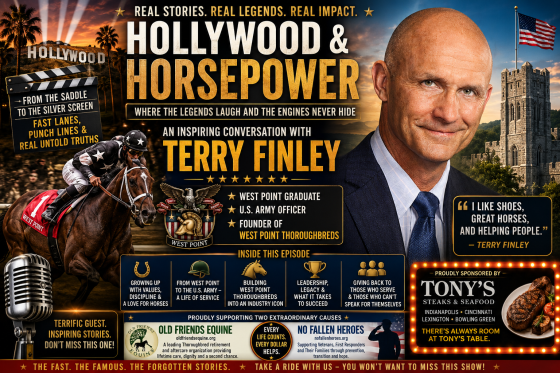

Hollywood And Horsepower Show with Mark Otto
Guest: Interview with Terry Finley - Owner and CEO of West Point Thoroughbreds
https://www.westpointtb.com/team/terry-finley/
Terry and his wife Debbie Finley established West Point Thoroughbreds in 1991. Terry, a former U.S. Army officer whose passion developed a passion for racing at a young age. His vision was to create a way for racing enthusiasts to enjoy the ownership experience without the enormous financial burden that typically comes with it. Since our first stakes winner, we've been committed to delivering unforgettable experiences to our partners both on and off the track. Over the years, we've had the privilege of racing some of the finest horses in the sport, including Kentucky Derby winner Always Dreaming, Grade 1 champion Flightline, and Eclipse Award nominees. We've celebrated victories in some of the sport's most prestigious races, from the Breeders' Cup to international events. But at the heart of our operation is the belief that every horse we race carries the hopes and dreams of our partners.
From West Point to the Winner's Circle: Terry Finley on Horses, Leadership, and Racing's Future
Summary
A Friendship Forged at the Racetrack
The episode opens with the program theme, sponsor recognition for Tony's Steak and Seafood, and appeals for Old Friends Equine and No Fallen Heroes. The host then welcomes Terry Finley, recalling that their friendship began when Finley complimented his shoes at Del Mar. Their lighthearted exchange establishes a personal tone before the discussion turns to Finley's background, career, and long involvement in Thoroughbred racing.
From Levittown to West Point
Finley describes growing up as the youngest of seven children outside Philadelphia, where his schoolteacher father introduced him to racing at Keystone and Liberty Bell. As a young person, he walked hots, rubbed horses, traveled with them, and became captivated by the racetrack. He later entered West Point after being inspired by an older football player who attended the Naval Academy, graduated in 1986, served in the Army, and maintained his connection to racing even while stationed in Germany and later at Fort Dix.
Building West Point Thoroughbreds
After leaving military service, Finley chose horse racing over a conventional corporate path and credits his wife, Debbie, for supporting the risk. He explains how an early partnership involving his father and brother showed him the excitement that shared ownership could create. Beginning with one horse at Philadelphia Park, he used small advertisements in BloodHorse and became an early adopter of the World Wide Web, eventually using technology to communicate directly with partners and update horse information.
The Human Side of Horse Racing
The conversation examines the many people whose work affects a racehorse, including trainers, jockeys, exercise riders, grooms, owners, and other barn personnel. Finley and the host emphasize that horses have distinct personalities and communicate in different ways, making judgment, feel, and experience essential. Stories involving Pat Day, Alysheba, Randy Romero, and other racing figures illustrate how trust between horse and rider can influence performance and how owners should give professionals room to make informed decisions.
Leadership, Loyalty, and the Long View
Finley argues that owners receive better results when they support trainers privately and publicly rather than constantly second-guessing them. Both speakers connect this philosophy to lessons learned from military service, family relationships, and business leadership. They describe effective leadership as listening, clearing obstacles, encouraging people to think creatively, and maintaining loyalty while still addressing performance problems when necessary.
An Evolution for Racing's Future
Looking ahead, Finley discusses the pressures facing horse racing and calls for evolution rather than revolution. He urges industry participants to move beyond personal attacks, collaborate respectfully, support aftercare and backstretch workers, welcome younger voices, and build both the fan base and wagering base. The discussion closes by considering lessons from Formula 1 and the PGA, particularly their use of media, events, sponsorship, and fan engagement, before the host directs listeners to West Point Thoroughbreds and again highlights the episode's sponsor and charities.
Hollywood and Horsepower Show
Through the relationships Mark Otto developed in Thoroughbred Horse Racing and Automotive Racing, during his global travels, the thing that most interested him was the story behind the story, with the famous people he was fortunate to meet. What was it that these people liked to do? How did they get into Hollywood or into Racing? These stories are fascinating! This is what encapsulates the “Hollywood and Horsepower Show”.
Bringing you along, we talk to so some of the most interesting people Mark met during his career. Don't be surprised if a few other guests stop by this show. This will be fun! It is where SNL meets The Tonight Show; a perfect mix of talk and comedy.
Speaker Identification
Speaker 1 - Host (Mark): The guest addresses the host as Mark during the interview. The transcript does not provide Mark's surname.
Speaker 2 - Terry Finley: Identified by the host as the founder of West Point Thoroughbreds, a West Point graduate, and a former Army officer.
Speaker 3 - Theme Song / Prerecorded Voice: The opening lyrical theme and brief closing promotional tag are presented as prerecorded program elements.
Speaker 3 - Theme Song / Prerecorded Voice
I've been down roads from Churchill to LA Met kings of speed and stars along the way. They got stories that the cameras never show Yeah, the truth behind the fame is what we know. From the saddle to the silver screen blow fast lanes and punch lines on a late night show. You think you've seen it all but you don't know the half till the curtain lifts and we all have a laugh. It's not just who they are, it's how they came to be a little horsepower. A little mystery, a Hollywood and Horsepower baby take a ride where the legends laugh and the engines. Never hide from the track to the spotlight stories unwind. Gather truths a little wild in one of a kind Hollywood and Horsepower where the real ones show. Every twist and turn is a tale you didn't know so pour a drink sit back. Enjoy the show where the fast and famous let it all go.
Speaker 1 - Host (Mark)
Terrific guest today somebody I consider a great friend and you know we've we've known each other for quite a while. We're brought to you today by Tony's Steak and Seafood in Indianapolis Cincinnati. Lexington and Bowling Green Tony always says there's always room in his table for one more. And I always say dining with Tony isn't just dinner. It's an experience. You owe it to yourself to go. We support two charities on this show that are near and dear to our hearts. We don't accept a penny from either one of them. We do this just because we believe in them.
Both on the human side and the animal side on the animal side. It's OldFriendsEquine.org. Michael Blowen and Michael and Diane Blowen were the founders of this farm entertainment writers from the Boston Globe. Went on to start a retirement home for. Thoroughbred and thoroughbred horses and they've just turned it into really the. Measure in aftercare that everybody else uses. It's just an amazing organization. They've added on John Nicholson as the CEO and president in the last couple of years. Most people probably know him from the horse park and from working some of the other.
Organizations wrong Kentucky. So it continues to evolve continues to grow and it's a is a terrific organization. The other one is No Fallen Heroes. No Fallen Heroes were started by friends. Matt with buckley a former Top Gun graduate Top Gun instructor naval aviator fellow aviator. Matt's a great guy is him and his wife susie started No Fallen Heroes to help veterans and first responders and their families. They really do. Great work. They do a terrific job of helping prevent suicide helping people transition.
We're losing weight to any veterans and it's just. Every life counts. We need to do everything we can to help these people and it's just a terrific work that those guys do. So. OldFriendsEquine.org No Fallen Heroes. Take a minute take a look and if you can't do a lot do what you can every dollar helps. We're joined today by a very special guest. Gentleman I consider to be a friend and a. Inspiration I look up to all the same time. She is. Speaking of veterans we're we're talking about a. West Point graduate a Army officer.
And. The founder of West Point Thoroughbreds, which kind of gives it away for anybody in the horse industry. Welcome by welcome Terry Finley terry. Welcome to the show. What.
Speaker 2 - Terry Finley
Mark it is so good to be on. I was so happy a couple weeks ago when you. Appeared in my text string and. Asked me to come on so let's go. Um, I can't thank you enough and it is truly an honor and I have to go back because.
Speaker 1 - Host (Mark)
You know you and I met in the most unique way. I don't know if you remember you probably do because you're you are one of the sharpest guys. I know but for our listeners. We I was standing at Del Mar I believe well Del Mar or Santa Anita. I think it was Del Mar I think it was Del Mar and you walked up and said I really like your shoes. And we started talking and I knew who you were. But it was I mean for me it was kind of like you have an elder come up and compliment your outfit. So, I mean.
Speaker 2 - Terry Finley
I do like shoes. I do like shoes. My wife has kind of got me off to kick a little bit. You know you get a little bit older and you know, it's like you see those. Older guys and they got sharp shoes. We were as old as we are now. Overall, Marshall. It's um, yeah, I'm still over in the shoes, but we still wear really good shoes. Try to I mean they're good investments, right? It's it's like when you go to the sales. You try to get the best possible horse you can. And when you go to the shoe store you go online you try to get the best possible shoe as well.
Speaker 1 - Host (Mark)
You're looking for a lot like I am you're looking for something unique. And that's what the what always it would always stands out and anybody who knows me knows that I. I like shoes as well. It was a common thread and an interesting way to meet and you've always been very gracious to me. Always giving me time and I can't thank you enough and I can't thank you enough for taking the time to do this today. So, yeah, you know everybody knows you for the obvious. I mean West Point Thoroughbreds is. Like an institution in the horse industry.
But I'd like to go back and kind of give people a little bit of a feel for you know your wife. Because I think. Most people, especially in the horse industry and even outside the horse industry today. Probably know you most is the face of West Point. But there's obviously a lot to Terry the. Happen before West Point. So yeah, you know, yeah, I was a little bit about growing up and you know how you became interested in horses.
Speaker 2 - Terry Finley
Yep, so my father was a school teacher. He had he taught for you know 36 37 years or so and seven kids. My what our my mother was a homemaker. And. That was the last of seven so wow. That provided me a chance to go to the races. A little bit more and to spend a little bit spend actually more than a little bit more time. With my father, you know, you could imagine what the first six had with a teacher salary back then they still don't make. Even closer what they should make. So back then it was even worse than it is now.
Speaker 1 - Host (Mark)
No, I was thinking the same thing else trying to figure out how he raised a family. Teacher salary that's pretty impressive.
Speaker 2 - Terry Finley
Well, who knows right even you know he did refereeing and. But I think a lot of his refereeing money went to the races because he always loved to go for the last two. At that time it was that Keystone and a Liberty Bell. And so you could go for the last two and the reason a lot of people went was because you got in free after the seventh race. So you could only bet the eighth and ninth races.
Speaker 1 - Host (Mark)
So, so where we're called where did you guys grow up?
Speaker 2 - Terry Finley
Right outside of Philadelphia a place called Levittown, Pennsylvania. Which is one of the first suburbs?
That was that came into being in the country. So. I just fell in love with the. With the racetrack and I ended up when I was a young kid. Ended up getting a chance to get around them and I worked I rubbed I walked hot. I rubbed horses. You know, I traveled all over the place with them and I worked for some really good guys. So. It kind of gave me a chance to see how enthralling and how captivating. This business was and. Still is in a lot of ways. It's still very. You know at its core. It's captivating and.
In my mind I always said like. If I ever got a shot to. Stay in the business or to be reintroduced to the business. I was going to take it. And so. That's what happened. I went to West Point. I graduated in. 1986.
Speaker 1 - Host (Mark)
So, and always a dream also did you aspire to go to West Point from a young age?
Speaker 2 - Terry Finley
Yeah, mark. I didn't I didn't my father was in the Navy in. World War II. But none of my brothers and sisters were associated with the military. What happened was I played football. I was a decent not even a good football player, but. Solid enough and there was a kid that was two years ahead of me. A kid by name of Brian Goodrow who's like six four. Like 240 and. You know was probably would have been not a walk on it a place like Penn State. But Penn State was looking at him and a couple other good schools.
But he ended up going to the Naval Academy. And I just thought that was the coolest thing and so in the back of my mind. I was like wow. What could I do?
To get to one of the academies and they were all um. They were all in play and I ended up getting into West Point. I didn't get into the Naval Academy, but um. So that took me. Right about. About this time in the summer of. 1982. Up to West Point for a summer, you know the first summer. It's called Beast Barracks. And that's the introduction that you have.
Speaker 1 - Host (Mark)
When you go to West Point as a plebe. So I was Navy some Navy was always plebe summer. So same thing.
Speaker 2 - Terry Finley
Yeah, plebe summer. Absolutely. Um. So. I just you know, I would go to the I go to the races with some friends. I always loved it. But of course as the years went by it got a little further and further away. And I always point out. We lived in Germany for the first for my first two years of service with my wife. And. We'd go to Frankfurt to either leave or to pick somebody up or to come back. And when you drove out of Frankfurt out of the airport there was an old racetrack. I don't know if it's even still there.
But it was really something because you know you'd go up there four or five times a year for. In one direction or the other. And I just remember like. Wow. And you're right back to your youth. Yeah. Exactly. I kept the dream alive. So. Anyway, we came back in. 1990. And we were getting ready to get out. I was going to go into.
Speaker 1 - Host (Mark)
Into the corporate world, which you know a lot of young officers right junior officers dude. That's an whole ecosystem a lot of big companies that. Loved to attract and um and train and retain young officers. And I had a job offer at Johnson & Johnson.
Speaker 2 - Terry Finley
A division of. How jane j called Ethicon and it just didn't work out, you know. We got extended because of the war at the beginning of the 90s. I didn't go to war, but I didn't train horses; I trained troops. I was a basic training. Company commander and um. Back to the side or we're still in germanage training. No, I was stateside. I was played. A place off four six new journey. Real famous and yeah. Yeah, so that basically gave me a chance to be in the area in the midland. And gave me a chance to get reintroduced to the racetrack and.
All of a sudden I was like, you know, I'm glad I didn't realize how dumb I was but I was like I had two kids. And I was like I want to give this a try see if I can work now at that time keep in mind.
Speaker 1 - Host (Mark)
That partnerships were starting to really accelerate in the industry you had Cot Campbell you had team valor you had centennial. So um. There were a couple local ones. I mean certainly not nearly as many as there are now. But they were starting to be more of a.
Speaker 2 - Terry Finley
And play more of a role in the industry in the early 90s and so we basically did a rough but. Yeah, and we're joined by Terry Finley for people just joining us West Point throw bread. For people that don't know or people that are outside of racing. You know explain a little bit about the difference between like a. Partnership or syndication and a like some of these club things. Because I think a lot of people don't understand the ownership side of it that well. Yeah, well. I mean, I think both entities. Let's start out.
Powder similar mark. Like both entities bringing people into the business which we absolutely we really need right? We sorely need so I have a lot of admiration. For the clubs in particular.
Speaker 1 - Host (Mark)
The my resource gang is it's really interesting. I remember my new there. And we actually had them as a guest on the show a few weeks ago mike barenth and I agree, you know, and high tide raises all boats. I'm just it does. Um. I think a lot of people don't realize that some people just own the whole horse.
Speaker 2 - Terry Finley
You know and then there's people that own a quarter and then there's people that own. Three hairs on their tail, but it still gives you an opportunity to get involved in it. And there's I guess there's a path for everyone. There is and um and that's been very positive. Um, you know, you. We kind of shudder to think. What racing would be like. Without the proliferation of. Of the partnerships. You know if we still relied on um on the. The one person owning only 50 horses instead of 50 people owning one horse.
But how did you come up with the idea?
How did you do? How did it hit you to say?
Go. Or the partnership side versus just doing it on your own. Well, I mean money had a big part. It's a big part to play that right but. I was just coming out of the Army but um. I think the biggest impact mark. Was the fact that my brother and my father when I was probably in the eighth or ninth grade. They got into a partnership. Um, that was just starting and okay. It was just a business man. Who loved the horses and it was really the precursor of the you know of the rapid acceleration.
But basically they ended up with a filly. Who won like three in a row, you know at a cheaper level?
I think she was a 10 000 hour claimer. But they just had a wonderful time with it and I could see I just remember.
Speaker 1 - Host (Mark)
The enthusiasm and the adrenaline rush that my brother and in particular my father. So. That kind of stuck in my mind. I love to horses. I saw what it did for my from my brother. Um and my father and.
Speaker 2 - Terry Finley
I didn't feel a. Gravitational pull to the corporate world. So I was like. What's the universe trying to tell me?
And I thought it was trying to tell me that I should take a shot. And so that's what I did that and I say any time I see I say I. I'll talk about my wife Debbie. She's my high school sweetheart. We've been together since the tenth grade and you know, you could imagine. Not every woman not every wife would have a husband come home. At. 26 years old with two kids and say I want to get into the horse racing business. I'm running I want to run a partnership after being in you know eight years in the military.
With a secure, you know housing and medical and everything else all covered but yeah, that's a big no.
Speaker 1 - Host (Mark)
Yeah, I give her an all the credit in the world. And that's what we did we started out with one horse and at Parx. At that time it was um it was Philadelphia Park and. And no idea what to do I just you know, I started to try to do some advertising and. All different kinds of things. I ran some small ads in the back of the BloodHorse if he.
Speaker 2 - Terry Finley
Right if you remember the BloodHorse had classified advertising. It's the racing form. And so that's where I did I basically um. I just. Stayed at it. It's not like you're gonna put it out on a social media or something at that time. That was your best avenue to get some exposure. Absolutely, absolutely and you talk about social media. It was funny the guy who did all my advertising in the BloodHorse. Was. A guy being a. A harry miller and harry miller was a Vietnam vet and. He took a little bit of a shine to me and um.
One day at like probably in 1993. He calls me and he says hey, terry. I was just at a meeting.
Speaker 1 - Host (Mark)
And they came up with this. Or they introduced this thing to me called the World Wide Web. And they asked me if I had any clients who might be interested in.
Speaker 2 - Terry Finley
In. Going down the path of looking at it and I brought your name up. And. Would you mind talking to them? And so that way that the very beginning of the internet. And a woman called me. And we started talking and like a couple months later we had a um. An internet site and I believe it was one of the first ones in the industry. In probably the middle. 1993 and so um. About a year later. We were able to update our horses. I used to have to fax. The updates we had six or seven horses then. I would have to fax them all to the BloodHorse.
And they would have to type in my updates. Well, we got this. An extension or whatever it was. And it turned out that we could do it ourselves and that was really the start of. Really getting me interested in technology.
Speaker 1 - Host (Mark)
And me seeing. How. Technology could really help a business like ours try to get a little bit of an edge and um. So that was uh. Almost 35 years ago. So today we celebrate 35 years. This year. That's amazing.
Speaker 2 - Terry Finley
And you know the it's impressive too that I did that's something I didn't realize is that you guys were. One of the cutting edge for using, you know, web and social media to promote it. Which today is just you know second nature to all of us. You don't think about it. But that's pretty impressive because I remember those days. I remember that sure when it first came out. It was a little cumbersome. Not the most user friendly. You know you had to kind of stumble through it a little bit, but it was still.
I remember at the time being. Just mesmerized with it and I was kind of like you. I was always taken by technology. You know, I'm not a Luddite, but you know, I'm I wasn't you know, I didn't grow up with it in schools. You know, I mean about the most advanced technology we had in school was typewriter. So I mean that came after so I didn't learn it like a lot of people do. But I remember forcing myself like I went and bought a laptop. And it is will show my ignorance especially at the time to get home.
Learning how to operate it and I couldn't remember how he told me. The sequence to turn it power it down. So I put it back in the car and drove back to the store with it open and running. The guys show me how to power it down. It's satisfying. I think about it.
Speaker 1 - Host (Mark)
Yes. Yeah. Technology has had a huge impact on our generation to say the least. Yeah, and it's um. And it definitely has helped our industry. I mean the horse industry has really adopted it. I think you know, it's interesting, you know, I had a conversation earlier this week. I'm sure you remember [Name unclear]. He hosted horse tales and I'm sure you've been on his show and you know, we're going past this year and.
Speaker 2 - Terry Finley
He was kind of one of my mentors, you know him like kind of Steve bick. There's a lot of guys I looked up to in this realm and. We talked about that a little bit that like, you know, Ursula's show. Came at a time when that was the only avenue to get your race results. That day. Like he would always show that was on am stations from five to seven and. Otherwise you had to wait till the next day when the newspapers came out. To get the race results. Yeah, so it's it's definitely changed to where now, you know, you get everything real time.
You can watch a race on your phone. You know, it's it is. It's really changed. It's been a game changer. So it's. You know, you guys are. Leading edge, you know, you and your wife and you did touch on a point that's really funny. I mean, it's like. It's crazy. So you guys obviously got married. While you were you still at the academy when you what's when you got married. No, no, I agree you got married after you graduated. We couldn't be we couldn't be married you weren't allowed to it. I'll you two back then. Okay. Yeah.
Yeah, so. In fact. There was one guy I remember. He must I think it went to mexico for christmas and.
Speaker 1 - Host (Mark)
And ended up getting married down there and he came back again. They he had the. They had to kick him out. You couldn't be. You couldn't be married. So I felt bad because it wasn't intentional. He did I don't you know. It's just not something that people talk about a lot. But. You know, the guy just made it tactical error. So, uh, no, we got married different world. I'm my dad was a detroit cop. My dad was Navy were war two like your dad. And then he was that he came back and was a detroit cop. I remember him telling me you had to get your commander's permission to get married as a policeman.
Speaker 2 - Terry Finley
Yes. Yep. It's crazy, right? It's so much different world but your point, you know, it's I like hearing those stories. Because it's amazing how many times you hear about, you know, sounds like a cliche, but like the power couple. It's like without that support. You know, there's no way not gonna have done what you did and there's. So many like that. I mean, I even experienced that myself. You know, I'm you know, I'm. Kind of a long-term relationship marjorie. She's. Absolute rock behind me and.
Same thing. I'm sure for you. I'm sure same thing. I'm sure you know, michael bawlin his stories. Very famous. I remember him saying, you know. When he went to diane and said he was gonna start old friends. He said I want to move to Kentucky and I'm sure you've heard this. I want to move to Kentucky and start a farm for retired racers. And she said let me think about it. She comes back to him and she said and there wasn't in boston. That a really good life. He was the entertainment writer for the boston globe. She was a syndicated columnist worldwide.
I mean, she was very accomplished most people don't realize how accomplished michael bawlin's wife was excellent writer.
Speaker 1 - Host (Mark)
And very well known columns worldwide. And she says to him I'll go with you but I'm one condition. And he says what's that and she said when I leave you don't come looking for me. Yeah. He looked at her and he said deal and. To this day he told that story a million times, but no the point is though. It's so critical to have that support. I mean is. One of these you learn in the military. I learned you learned is you know teamwork is everything. And that applies to your relationship as well. You've got to be a team or it just doesn't go.
Speaker 2 - Terry Finley
And my dad used to say there's nothing better. Than a good relationship and there's nothing worse than a band. Nope. So true show to your last words. That's the that's the piece behind West Point so you guys start West Point you and your wife. It's all to get one horse running at parts you starting to get some traction. How did you grow and where was your first?
Like where did you really feel like okay? This thing's gonna really go. Yeah. So. I'll I'll talk about that in a bigger picture. Um, I think. One of the things because you know a lot of people asked me that question. And. Mark and I tell them. Like I think that's probably been one of the things that's really helped us is. I just I've never felt comfortable in turn now. Let me explain that.
Speaker 1 - Host (Mark)
I've never felt comfortable in the sense that like you never truly arrive in this business. And the reason is because. You could. End up having. A really strong stable as good of a stable as you've ever had. And literally in a month. It. The situation could change as dramatically as you could ever imagine, you know, they get hurt. Trainers go on hot, uh, you know cold streaks. So I think when you ask that question, I always it always perks me up like when did you. Think that you arrived and.
I'm not I'm not trying to be cute here. I'm just saying like this business is structured in a way. That if you ever think you arrive, you're in big trouble. Like I haven't agreed with that.
Speaker 2 - Terry Finley
I would even expand on that. I think that applies to a lot of businesses. I've never I've never felt like that. You know, it's funny because people will and you'll you'll appreciate this people outside. Will always say things to you. And like, you know, oh, you're you know, you're doing really great. I never really feel that way and I'm sure I completely understand what you're saying and. For our listeners, I think you do it. Yeah, very good. Um, I think the other thing most people don't realize and you touched on it.
That's really key. What you do. Is so critical. There are so many pieces to it. You know, it's unlike any other sport in my mind. You know, you have a jockey. You have a horse. You have a trainer. You have an exercise rider. You have the track you have the distance this the surface the weather. Now all these and then just the overall health of all those people and animal. And if anything is locked. It's not going to click. And I there's several results through history where you know, they switched to trainer or switched to jockey.
Speaker 1 - Host (Mark)
Or switched to surface or a track and all of a sudden they're firing on all cylinders. And that is I've always said one thing that's always been impressive to me about this industry especially coming from the outside is. How um you have an athlete that you can't communicate with you have to figure out what you're thinking feeling. Without them telling you. I mean they tell you their own way not like they can walk up and say I'd really do better if you did this. Yeah. And they don't know I completely understand what you're saying.
Absolutely. They don't all tell you an exact good thing was so the so three different horses. Could tell you the exact same thing in three different ways. Thousand right and I think that might stop being around old friends. You have a yes is that. Will you can tell every thing they're feeling if it was a person you'd say they wear their feelings on their sleeve. And then you have horses that could be sick and don't even show signs. I mean we they've had horses their old friends that would be running a fever.
And it wouldn't be until somebody just kind of caught a little something to start checking deeper that it's like oh my gosh. There's something going on here, but they did not tip you off this something. You know, they wouldn't. They're yeah, they're absolutely right. They're their personalities are very different. Their personalities are very different in racing. I remember when war emblem came to old friends. He had a reputation that. He just would not do anything he didn't want to do. I can understand that's why he quit racing. They just couldn't get him to do anything.
And that was also why he quit breathing. They said when they would take him they even tried natural turning him out in a paddock with a mare and he would just lay down. He just literally refused to do anything he didn't want to do. So yeah, every one of them is different and you've got to figure that out as an older than a trainer. Yes. And that's. You know just like anything there are better surgeons. Well. Why is this surgeon better the other they went through the exact same training the head the exact same background? Well, there's an innate.
Talent that some people have and I think it applies to. To training resources now the difference is that. Much of their success is dependent on the horses that get off the van and walk into their barn.
Speaker 2 - Terry Finley
Every spring and summer I eat the two-year-olds so. I find. That's a fascinating part of the business. I do feel the plight of the modern date resource trainer is very. Very different than it was and I'll I'll offer you. Much. Much tougher. Especially with stats, you know stats are in the racing form everybody talks about stats. And it's really put most trainers very few trainers. Very few if any. Are in a position where they can look past their stats that are published every day and. That was never the case up until I'd say 20 years ago and so um.
It's a I think you're going to. And you know what's interesting about that is that. You see that in a lot of industries. And I've got a common phrase that I use is. You know, sometimes people overanalyze they get too focused on the numbers and I've actually made the comment. You know, you can get to a point where it's paralysis by analysis.
Speaker 1 - Host (Mark)
You. You can't make a decision because you're so consumed with the data that you know in some ways I think. People. Did better. I remember acting my dad one time and you anybody that knows me knows I mentioned stories in my dad. A lot of you is probably one of the wisest guys that I knew. And. I would always ask him I'd say, you know. He was one of those guys that seemed like they were 10 feet tall and bulletproof. And I want to say how come that was an adult, you know, I had a family and I'm sitting there.
I'm like. How come you always seem to know what to do?
You know, I was dealing with some. Challenging decision I had to make and. You looked at me says. Didn't know what to do. You're making a decision if that doesn't work you make another one. Yes. And there's something to be said for that, you know, there was a different approach. 20 years ago and I don't get me wrong that is very useful. But you kind of have to mix that with some common sense and experience too. Yeah, you do. Yeah, you do and. You talked about mark the number of hands.
Speaker 2 - Terry Finley
That touch. Anyone horse and it is a massive number of. Of people and hands that touch horses. Absolutely. I think. When people ask me and I kind of talk about. You know kind of the vision. That I've had uh and that my team has had. I talked I think about. Think about. Especially the trainer relationship that you know, we don't we don't fire trainers on a regular basis. Right and I know that there are some people and. Some owners that. Fire on a. Much more regular basis than the majority of other owners and that's their prerogative.
Right, I don't have any. That's their prerogative. They put their money up. They either earn their money or they inherited their money one of the other or combination.
Speaker 1 - Host (Mark)
And they buy horses and they can do with whatever they want with the asset. That is they're they're stable. But I think one thing people don't owners. It takes them a while. If they ever learn like. You're dealing with people you're dealing with trainers you're dealing with their staff. And if you basically don't have their backs. Right, you will not get as much out of your. Your horses as they were destined to get. And what do I mean by that? I mean like I want my guy thinking. Outside the box. I want my trainers.
To be thinking about taking shots and doing stuff that. You know, especially now that might cause some chatter on Twitter. Well, we don't care about Twitter. We care about our horses. And so you see where I'm going here like I think that's helped me. And I do think trainers appreciate it when they're not second guest.
Speaker 2 - Terry Finley
And they put a rider on they don't put Irad on. There's been a horse. We had a horse that was out nine months. Well, that's probably not a horse you put Irad on because he can read the racing form. Now he might not be a good example because he rides everything like it's it's the Kentucky Derby. But you get what I'm saying you might not ride a top rider you might use. I don't know. Jaime Rodriguez who's a gonna be a star. But we've had good luck with him, but he rides the hair off of every horse.
But those nuances, right. I tell him my personality. I think that's something that people don't don't give enough. Credit to. And that's something I heard another really famous trainers say one time is. One of the toughest things is matching the personalities. They're like, you know, look like you get a jockey. Energy exercise rider and the horse that kind of click. That's when things start happening. But you know, they're like, you know, you go down through. The racing form and look at horse after horse that you know their first four races.
Speaker 1 - Host (Mark)
Were kind of you know, not the best results. Maybe they were. Or maybe they were. Or whatever just not quite there and then all of a sudden they switched jockeys and all of a sudden boom is there. And I remember one time I had a. Lunch with Pat Day. I was fortunate enough that he threw old friends met him and I went and sat down and had lunch and. I was talking to him about it and I said, you know, what were some of the things you learned?
He says, you know, the biggest thing I learned. Was to let the horse tell me when it was time to go. He said money job. Wasn't to get him to the finish line and he said something really interesting. He said my job was to conserve energy. He said I guided him and conserved energy, but at the end of the day he goes the horse would tell me he was a very. Well-known it was Alysheba and he said. One time and I don't remember the race, but he said. I thought we were done, you know, we're coming up on the finish line. We were we're linked to that.
Of second place horse and he said, I'll be honest. I stood up in the stirrups. Something you never do and he said yeah all of a sudden he took off and he said I had to grab his mane.
Speaker 2 - Terry Finley
To keep from falling off the back and he said I look under my arm. And the horse closed we were going to get beat and the horse knew it and the horse took off to win the race. And he said so I learned the lesson that like I needed to tune into the horse. It would really understand that and it was amazing. I know Gary Stevens has said the same thing Mike Smith said the same thing. It is definitely. And the reason I bring this up because I think for a lot of our listeners and a lot of our listeners are in and on horse racing.
But for a lot of people I don't think they realize how much that has an effect on the results. Those personalities. Trainer personalities, you know, I've it does. I'm kind of like. On the edge of the industry. So I'm kind of floating around all over the place. And one of the things that's always stood out to me. And I remember this very clearly at like Belmont a few years ago was walking around the shed rose. And. Some barns are like very quiet very calm.
Speaker 1 - Host (Mark)
And in the next barn, it's like the horse is the restless the people are kind of yelling back and forth. You can just you could see a difference in the energy barn to barn. And you could also see a difference in the race results with those people. Yes, and it was really something that stood out to me. It's like it's like wow. Because I remember, you know, there was a conversation. I had something one time they're like, you know, that. There's this is different than any other sport. You know, there's there's spans for the horse. There's spans for the jockey there's spans for the owner.
There's spans for the track. Sometimes there's spans for that particular race. You know, there's guys that go to the gym dandy every year or go to the travers every year. So if you don't appeal to all those people you're leaving something you're missing some yeah you are. Yep, and I think sometimes people forget that we have a unique sport. Yeah, we do. When you're talking about Pat Day. You know, he's obviously friends with just about everybody in the business everybody has the utmost respect for me.
He tells the story very similar what you talked about he tells the story. He says. You know, he got off of a horse. One day and the owner came up to him and kind of a little bit of a belligerent with a little bit of an attitude. In a belligerent manner and he said I thought I told you to go to the lead at the start. And pat just took a deep breath. He said I wanted to stay with my horse. So, um, that's it. I wanted to stay with a horse if I went to the lead I wasn't going to be with him. I was gonna be by myself.
Speaker 2 - Terry Finley
But um, yeah, that's um. Lot of things, but that's what. You know, we just talked for a couple minutes about all the different things and just a small sliver. That's what keeps everybody. Our dreams alive were hoping for that big one and um. But you brought up something really poignant and I think you know, you gotta give yourself a little more credit because. You talked about giving people the latitude to take a shot may, you know, try something without the fear of criticism. And you know how much you're trying to appreciate that. I think anybody would appreciate that.
I don't care if it's no, you're right. You know working on the you know rake in the aisle to a guy that there's something to be said for. For making someone believe that you believe in them.
Speaker 1 - Host (Mark)
You know and there that is I don't know. I mean I. I can't speak for you, but I can speak for myself. I'm sure that's a lot of the strength that you gained from your wife. I mean, that's the one person that you know, you yeah if she believes in you. I know I've been like that with margins like sometimes she'll have more confidence than what I'm doing than I do. Totally and that they might not always. Clearly. Communicate that right and but they're always there for us so. Yeah, but it is you know the point is with anybody whether it's a partner or an employer or you know a business partner.
There's something to be said for that. Trust that confidence, you know, I mean, it's like and that's something that you know, I was right. I'm Italian and I mean for in Italians. It's like loyalty and trust is a big deal. You know, it's like if you don't have that you don't have anything. So I mean I put a lot of a lot in that so I mean yeah.
Speaker 2 - Terry Finley
What you're talking about is like. That's paramount and I do believe that breeds success because then people have the confidence. That if they're thinking something whether it's a trainer or a jockey or whatever whoever it is in the process. If they're thinking, you know, I really think if we. Did this it might help. They're gonna try it where if they're concerned about getting criticized and you touched on something with pat, you know, I'm. You remember the late Randy Romero randy was a good friend of mine.
And you know excellent docie great guy. And real really good friend. I mean I was very close to randy talked to him all the time. And he. Told me. Horror stories about guys. Trying to beat him up after races, you know throwing him around you know, he got a rubber most jockeys aren't very big people.
Speaker 1 - Host (Mark)
You know the owner comes down. He's mad. I told you to do this. I told you to do that. You know, it's like it could be you know, that's the other side. So if you take a guy who. Has them talent and you trust him and say look I believe in you. I really do I want you to you tell me what you think. What you think that's big that has a lot of power. Yeah, it is. Yeah, it does. Yeah, it does and uh. Yeah, no, you touch upon a great point mark human nature is human nature. All right, it doesn't matter where you're at in the world doesn't matter what you.
What industry you're in. When you know you have people who. Are have your back and have confidence in you and you're you're much more likely to perform. Look you might not have the talent and you might not make. Make great decisions and at a certain point you got a that has to be addressed. Right, but if they're on your team they're on your team. So that's what you're talking about. And I think that goes a long way. It's just you look and see. That's never talked about in our business. Like and you know you think about the just the vibe like.
You know. Every trainer and I don't care who you are chad brown just lost a group of horses from.
Speaker 2 - Terry Finley
You know he just lost and everybody from him to the guy who's got two horses like there's. Owners know that they basically. They make one phone call and the van is there in the next morning. So it's good. It's good. I just wish more owners. Would. Would own the fact that your trainers on your team your trainer is your field coach. And the more you take care of them and the more you support them both in private and in public the better it is and um. So, um, but look. I. It just takes all kinds and.
A lot of these things go out the window when you have a fast horse. Oh, right mark when you have a fat always now.
Speaker 1 - Host (Mark)
Do we do a certain extent?
No, you're absolutely correct. I mean it's kind of like anything else, you know. I used to have an old, you know, when I've always been sales and marketing and I remember. At an old sales manager that would always say like, you know, nothing a couple of good sales won't correct. You know, yeah. Amazing how positive results improve anything. So yeah, there is something to that. You're absolutely right. You've got to have the results along with it. But you know, I really believe sometimes that's how you get the results.
Is giving that person. The latitude and letting them know you support them. Sometimes that's where you pull a guy out and he does something great. I mean everybody knows. The seabed gift story and that's probably one of the most. Biggest, you know. Lessons of that was you know. The trainer wasn't he wasn't like a real high profile trainer at the start of that.
Speaker 2 - Terry Finley
The owner was considered kind of you know crazy. And. They put together one of the most winning teams there was. Jockey was kind of wild card. I mean, I think when they first started showing up people were laughing at him. And yeah, they were laughing when they were staring at seabed biscuits tail going down the track. You know, I mean, yeah. You know, I mean it's like there's something to be said for believing in somebody. There's something to be said just sometimes that gives them the ability to believe in themselves.
Yep. I'll give you a funny story about Seabiscuit. I give you a funny story so that you remember in Seabiscuit. They had the scenes they were like the nighttime scenes at Saratoga. Yeah. Is that where you bow? Well, yeah, when they're beautiful when he was trying to when he was trying when they were running on the track. You could see the lights on the track. The lights on the track. Yeah, what a beautiful scene anyway. I don't know how long they spent I think they spent like two weeks up here with the film crew and all the actors.
So, Tobey Maguire. Was the jock obviously of Seabiscuit. Well, it turns out that. Before I bought. My house at Saratoga, I bought my house in 2008.
Speaker 1 - Host (Mark)
That. The film company. They rented the house. From the previous owner for like two weeks and that house was occupied by Tobey Maguire. So. So told me has slept in my bed. Now we since changed the bed. Entirely but my wife always chuckled. She said I slept in the same bed. As Tobey Maguire. So I haven't seen it a long time. But it just um. As an aside. It's uh.
Speaker 2 - Terry Finley
You know, it's a funny thing, but that was a great movie really was. I don't know how to experience one of the money one with that. So, you know Gary Stevens was in there and played George wall. Oh, of course. Yeah and Popcorn Deelites was the horse that played. One of the horses that played Seabiscuit that was retired to old friends. Popcorn. Was. Actually according to Gary. I'm just reading the story Gary. I said popcorn was probably the one you saw most in the scenes. Because. Nothing phased it now. He said downside was it was so slow.
That they had to win or else the other horses to get him to win. Like they couldn't they kept shooting the scenes over because they couldn't get him. In. Without making it look obvious. So they kept trying to win the. Shoot right. Yeah. Yeah, but here. I want to the funny story that Gary told so you know when they showed the old looking footage. They created some of that. And they used like these old cameras that had these huge thick glass lenses. Well, one of the things dairies of those these old movie cameras when they were exposed to heat.
Sometimes would like explode basically the glass blow article. And I guess they were shooting one of the winter circle scenes. And.
Speaker 1 - Host (Mark)
They had the horse there and the whole crowd and the camera explodes from the heat. And everybody like you know ducks down hits the ground and he said the horse didn't blink. He did the horse was so kind of like just nothing phased him that he just stood there. So he said that was kind of why you saw him the most in all of the film. But yeah, no, it was uh, it's you know, it's interesting and that's another thing. I think it's kind of fun about this industry. It's interesting how many times?
Movies of all different kinds have involved horse racing more so years ago. But even some of the modern ones like secretariat the Seabiscuit. You know when they shot him at Saratoga and Belmont and Keeneland and Santa Anita and they used people. From the industry. I know when you look at the secretariat movie look up in the crowd, especially that last race. You know where or they portray winning the Belmont. I mean, there's a ton of people you recognize from the horse industry that they used as extras.
Oh, yeah, absolutely. Absolutely. It's not that I'm. Any company got their uh.
Speaker 2 - Terry Finley
Everybody got their tag card out of that deal. Yes, absolutely. So you guys are you know rolling along. I mean. What's next for West Point where you guys? Yeah, you know, you're guiding it. I know you know this key. That's continuing to be the same but there's always new things. Yeah, that could. I was thinking that we'd probably get to this question. Right and I think it's. You know we could probably do another show on that. Um, I think I'm 62. So I started. This is our 35th year and they're just numbers, right? I still really enjoy it. Um,.
I'm fascinated by the pursuit of. Trying to outwit and out hustle and outsmart. People with oh. With. The resources that dwarf us and I know we dwarf some people too. But it's it's all an ecosystem, right? But you know, you're not going to out money. There's several. Entities. That you simply cannot and will not and should not try to out money in this business. So what am I getting at?
I think the beautiful thing about a business is it really is about getting to the winter circle, right?
And we know that's a very difficult investment. And. If you only come in and look at the financial r o y and not the lifestyle r o y you're in trouble. Because you're probably going to lose unless you get very lucky and. You know the people that I know they've gotten very lucky. They've just taken their profits and try to do it again. So it's. It's a little bit of a vicious cycle like that, but it's an ambitious cycle that we all enjoy playing. But.
Speaker 1 - Host (Mark)
You may see the businesses is in there's there are parals. That are facing the business right now, you know, we basically I think are looked at as a relic of the past. By a decent portion. Of the population. And so. I. I do I think more and more about the business the industry and I know it's easy to say I think about the young people. I think about my. About my daughter who works in the company and. You know my. Grain kids and that number is going to be six in the middle of september. Oh, congratulations.
Thank you. The point being like. You know you basically I kind of I've I've I've asked the late between. You know looking at Twitter which I do like one time a week. And getting sucked into. Commenting about all the leadership failures. I guess the leadership failures. And. All the problems that people continuously to identify with while. Or on the other side saying like hey, how can I. Do my part. Right and how can I be part of an evolution and not a revolution because I think some people are.
Looking at a revolution. Revolutions do not work and cannot work in an industry like ours. It has to be an evolution. So. When you ask me what's next like I'm I understand I basically have been. Blessed and this industry has been very good to me very good to my family.
Speaker 2 - Terry Finley
We have 15 employees. They're they're all well compensated. Everybody gets to do what we love. And up that being said we. We definitely all believe that we owe it to the industry to give back. And so what does that mean that means you know taking care of the people the bat sharks workers. Being part of the progress of aftercare I get that um. And. Really growing our fan base and our betting base. And so how does that happen?
There's no magic wand and anybody that goes on. Online and starts to beat everybody up and pause everybody idiots and thinks that they're the smartest guy in the world. And that they can fix everything. Well, show me the beef tell show me where we're going and lay out a road map. And there are a couple guys that I've said exactly that too. I said that to their face. Lay out the road map if it makes sense and you truly believe it. And you've put your heart and soul right behind it. You're going to have plenty of followers because people love this business. They wanted to get better. They wanted to prosper.
So. I think we all just need to take a deep breath. And we all need to realize like listen, we're we're struggling. Just like a lot of other sports are struggling a lot of other industries are struggling. It's really about you know that leadership. I know about leadership. I think I went to a pretty good leadership school. Yeah, you're shifting day by day if you think you can write it to we listen and. And just call yourself a leader. Or a commissioner. Come on, man. Come on get with it like. So leadership is day by day. It's building spreed a core.
It's building unity. It's it's being respectful. It's you know. Really right putting your outlook on paper, but you have to support it. You just can't get mean spirited for somebody who has. An opposing view or a.
Speaker 1 - Host (Mark)
Slightly different view. So you see where I'm going here, right? It's like we're poli. And others like. When they talk about The Jockey Club. Well, look at the. Transformation of The Jockey Club and the board of stewards. I'm proud to be on the board of stewards of The Jockey Club. If you look at. When I. First became interested in the affairs of The Jockey Club. I was an early believer in HISA. Right, so that was probably 2015 so I've been following it for a while. And. The whole organization has changed.
In particular look at the. The demographic and the composition of the board of stewards for the first time in over 50 years. There's not a fix. That is at the helm. We have a. A great guy from opaloma. Everett Dobson who. Actually owns a pretty good basketball team who was. Able to raise the world championship. Trophy above his head in 2025 and you got Vinny Viola who's been able to raise the Stanley Cup twice and bought a. Franchise the Florida Panthers in. 2013 that was I think by and large looked at as the worst.
Professional sports. Entity or franchise in the whole world. In a span of 10 years they've won two front uh two Stanley cups so. For somebody to. Insinuate that. We don't have any leadership and we don't have any smarts. I get it like nobody's happy with the status of the business and how it's contracted and. How tough it is especially for trainers and jocks and.
Speaker 2 - Terry Finley
Owners on the smaller scale. I get that. But leadership is important here and if you have the voice and you have the pulpit like some people do in our industry. I just bring up leadership isn't just about saying. Everybody's an idiot and I'm a leader so follow me. No. Leadership is like day by day. Yeah, I mean I and I agree with you a thousand percent and it's it's funny. You know, I think a lot of people have the perception that leadership or. You know being in charge is like. Like you kind of said it's about you know parking orders or being mean.
You know, I. I've had leadership roles in most my career most people knows the sales and marketing and partnerships. Building, you know brands and things and. I always you know, I rose I was very fortunate that I met the right people to write times and I've I've. You know. Then hi is like, you know senior vice president with a couple of large companies 9,000 employees. But one of the things that my dad always taught me again one of my dad isms. He says, you know, God gave you two ears and one loss for a reason listen more speak less.
And he said the other thing that and this something that always stuck with me.
Speaker 1 - Host (Mark)
He said you treat everybody was respecting kindness and you listen to everyone because you never know. Where that idea is gonna come from and it might be the most unlikely guy. The guy sweeping the floor that says what do we do? Why don't we try this and you look at him and think. That's that's perfect. But you know, the other thing I always looked at was. And I'm getting to a point. I apologize. I'm wondering but I. One of the things I always looked at was I always looked at my role. Wasn't to push people around my role was to keep the debris off them so they could do their job.
And. To believe in them what we were talking about earlier to give them the confidence to do their job. I was really big within it and it's interesting. I've had people that have worked with me too for different companies. People that have become personal friends for over 20 years. I really take that is. My greatest accomplishment to be honest. Mm-hmm besides my kids. I feel the most proud of that somebody was willing. To. Follow me and go with me. You know the you get it remember these are people's families.
These are their well-being and they're willing to put the confidence in use. I felt like I owed it to put the confidence in them. And treat them. Give them everything I could so that they could succeed. My job was yeah with them. My job was quite the opposite. My job was to clear the path. And make it and that's something that I feel frustrated. With our industry it feels like there's too much in fighting it's like we need to pack more from the inside. You know, we'll do the downside. Yeah, so. So to your point, I'll say it like.
I think everybody should get to a point.
Speaker 2 - Terry Finley
Especially the guys that are very active on Twitter. Stop bringing up Stuart Janney like. Nobody's opinion is going to be. Changed on Stuart Janney. I know one thing. I'm not that I'm not a dumb guy. I've seen him at work and. I don't have any business with him. I don't I don't need to you know, he's he's um off of the board of stewards. He's not. Involved in The Jockey Club any longer. And I think he's done some very good things. I think he without high without Stuart Janney HISA. Is not in play now.
Do I understand that. There's some people have the ass that he's a quote unquote. He's a blue blood. He's a fibs. He's a he's a I get it. I get it. I'm not I'm not saying there's nothing there. Right. But. It's over. It's dumb what so I would hope that we could get to a point where we could put a bow on. Beaten up you know beating up the past.
Speaker 1 - Host (Mark)
Of The Jockey Club or the leadership failures of the past. Okay, and it kind of goes back to what we're talking about a little bit of respect and kindness goes a long way. You know, I mean sometimes you know rather than attacking someone online, which I hate that. It's like, you know, I mean if you don't have. You know, it's like your mother would tell you if you don't have something good to say don't say anything at all. And. You know. I think that you know this attacking and this infighting isn't good for anybody.
You know if you want to make a change get involved. Make a change, you know, dude. That's all the way even if it's at a small level. But don't just sit there and throw arrows at the people that are willing. To make an effort and try and make a change especially while you know, sometimes. Here's something that I and I know you got to go you're up against time and say but here's something that I will. Say from and I have so I came from outside the industry. I came to this industry from working was you know partnerships branding sports and marketing.
And it brought me into the industry. So I have a little bit of a different view. I work with a lot of other sports NASCAR F1 lot of other, you know vintage racing. I. I feel like. Horse racing draws attention sometimes to the negativity more than they do the positive. Because we're yeah always packing each other and for people outside the industry. That's what they hear. You know in that's what they see and it's got to stop.
Speaker 2 - Terry Finley
Well, I think that's yes, you're you're right the outside industry. But they'd also. I think just as. I. Just. As relevant is. That it silences. People who have something to say and want to be part of a. Of a path of. To progress meaning I agree. Yeah, you're just meaning like do you think like there's some good young. Younger owners in the business. There's several that I think have told. And spoken and given interviews. That man they just. You know, you're like I want to meet this guy. I want to talk. I want to you know put our heads together, but.
Unfortunately, I'm I'm afraid that there are plenty of others. That. Don't want to say something and have one of these. These guys kind of jump on them and I agree and then have a tourist. Anyway, we're talking about the same thing. It's like. We're not going. Anywhere close to where we need to be and where we want to go to if we don't talk. We don't collaborate.
Speaker 1 - Host (Mark)
And we don't be end of the day you got to work together goes back to what we started in the beginning. You know, yeah, what is the military based on what's most military training?
The teamwork and trusting your team. I can't trust your team when your own team's attacking. And at the end of the day the industry is a team. You know, I mean it isn't going to be somebody from the NFL or major league baseball or F1. PGA that comes in and says hey, I'll say I'll help you guys. It's going to you've got to. Do what you can do and you're just you have a great point. You know, if there's all this infighting and attacks. That's not going to encourage some younger person because they're gonna think I don't want to draw fire.
I don't feel like coming under attack for that. You know, I've got my life my own business my own responsibilities. Why should I like that often? Yeah, you know, I saw this firsthand. You know, I knew Michael Blowen their old friends. Way back. I mean from very early not the very beginning but very early. I gotta tell you people weren't vicious. I mean I saw it in the beginning now. He's like the fifth Beatle. But then yeah, I mean very well. I think I had people it's like if people run from him almost.
I mean and then they did tack him online and then you know, it criticized what they were doing and one thing. I will tell you and I think it's the lesson to be learned. With all of that and the people around him including myself would get probably more angry about it than he would. He always had a smile. He was always polite to everyone. He was always kind to everyone. Even the people that attacked him. Yes, and I saw that firsthand I saw people that were downright vicious that later kind of came around.
And they were he was very gracious to them. And I was it was kind of a lesson. I kind of thought you know what that's really how you should be. Yeah, that's hard to do that's hard to do. Yeah.
Speaker 2 - Terry Finley
That is the true measure of a gentleman and. Look we all. Get older and we all. Acquire wisdom more hopefully more wisdom. And. Isn't there certainly plenty of times that I were I look back and I regret how I acted and how I responded and how I. I you know just exactly what you just said, you know, because there have been times I probably would have been one of those guys. Boeing and I just say to young people just be a gentleman or be a general woman and. Part of this solution and. Yeah, listen things are.
Yeah, inevitably things are going to be better when more people go and listen I'm. It's. There are times where even the most optimistic. Of us, you know get you know frustrated and wonder. About this great industry we're in. But that being said there's there's a lot of talent in this industry and you look at the people. You know, I mean you brought up the series that. They came from Formula 1 like and that isn't embraced in a big way. That the gentleman we've been talking about Formula 1 for.
For years now how the Netflix show really transformed the viewership and everything. Well, the guy who put that together who engineered that transformation. Now goes on CNBC a week ago and says I want to do the same thing the horse racing. And. And some of the leading voices say do you want. Do you want me to tell you exactly what I think about this and you know what the inferences that they think is. Well, who knows maybe it is a bad idea, but I know one thing. Well, they've raised money.
Speaker 1 - Host (Mark)
They've got some other thing I can tell you is I've said this so again keep in mind. I'm coming from the outside. I truly believe. PGA and believe me. I work with all of them. Well, not just horse racing. PGA 401 and horse racing. Have a lot in common. They have downtime on the field. And I think that is something that as an industry. We should look at because I'm not I'm not trying to be negative in any way shape or corner criticize anybody. But I will say. Some of these others, you know, like F1 and PGA.
Are a little bit ahead of us and what they do. And how they embrace fans and how they attract sponsors and branding and we can learn from that. I don't mean that as a negative. I mean learn from it. Look at how they're doing things and try and emulate that. You can't it isn't the exact same thing, but there are similarities. And I think there are things that would transcend and that would makes it interesting one of those things from no one did. I'm very involved with F1 Miami is. They really engage people. I mean, it's like a week and a half.
Event leading up to the Formula 1 race and I totally wish it was not on the same weekend as Kentucky Derby. I mean, I was different weekend as it does for both sports. I'm not picking on either. What I wish it was different. We can but they do a big lead up and it's very interactive. It's very. You know engaging and the fans love it.
Speaker 2 - Terry Finley
Yeah, so I know you have we get we have the architect. We have the architect of the Formula 1 transformation. Who has a keen interest in our business and is speaking at The Jockey Club roundtable?
So.
Speaker 1 - Host (Mark)
I think that's a great starter. Yeah, that's pretty good. So that's really good. No, I mean, those are the things. And you know what those are the things that we need to promote. So that people know there are things going on. You know, I mean, it was always the negative you hear about the negative. You don't hear this much about these things. Yeah, so well listen, um, we've heard you're doing really great. And I look at the race. I'm really looking forward to it. We got to catch up. We got it sometime, you know when you're back home or in Lexington.
We got to go to tony's for dinner. I.
Speaker 2 - Terry Finley
Would love that, you know, there's a tony's in bowling green that I love. Yeah, that was. One right there. I love the life in ten. So yeah, so good. Great place and you know, he's he's a huge he's a huge supporter of the industry one of the first guys that got behind this show. Yes, I heard about yep.
Speaker 1 - Host (Mark)
So, well, I really appreciate it. Terry truly an honor to have you and for anybody who's interested in learning more. West Point Thoroughbreds. Is the place you want to go it's West Point tb.com. You take a look at them. They have an amazing organization. And they really do a terrific job and they can and you know, don't be intimidated by it. You know, they've got a there's a path for everyone to get in get into this and I tell people all the time. Horse racing is a great?
Engaging sport. It's very fun. It's it's something for everybody whether you want to have a hot dog or beer on the apron. And or if you want to get dressed up and take your partner spouse to you know, a suite or restaurant upstairs. There's something for everybody and I really encourage people in your travels if you don't live close to one. Take a look at any of them around the country and I guarantee it'll be one of the most engaging afternoons. You can have Terry. I can't thank you enough for joining us.
Give my best your family your lovely wife and look forward to seeing you soon.
Speaker 2 - Terry Finley
You got it. All right. Thanks so much. Hey. Thank you. I really appreciate it.
Speaker 1 - Host (Mark)
We've been brought to you by. Tony's steak and seafood. Bowling Green Kentucky a terrific place. Lexington, Kentucky Cincinnati and Indianapolis. You owe it to yourself to go tony's is truly an experience. It's not just dinner. We can't thank Terry enough for joining us today. We also asked you to support. The two charities that we support old friends equine dot org talked a lot of a horse racing on this one. Old friends is one of the places that some of the horses race go race horses go to after retirement.
The other one is No Fallen Heroes started by matt and Susie Buckley matt was a founder Top Gun pilot later, you know adversary instructor. Well, I was introducing as the real life gesture from the Top Gun. Get a chance take a look at both those organizations if you can't do a lot do a little every bit helps. We can't thank everybody enough for joining us today. We really appreciate it. This has been hollywood and horse power and we will see you guys again next week.
Speaker 3 - Closing Tag / Prerecorded Voice
Me. Stick around. You never know who's next. And trust me. They got a story worth hearing. You.