
Breaking the Silence, June 28, 2026

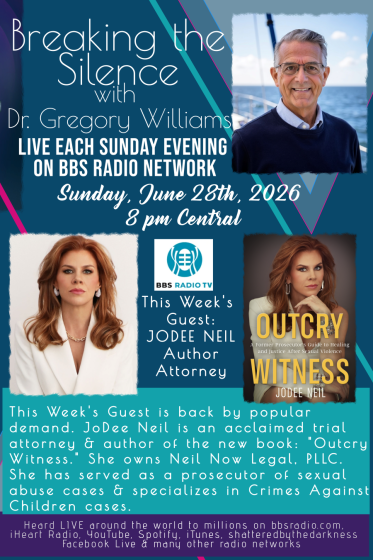
Breaking The Silence with Dr Gregory Williams
Outcry, Healing, and the Courage to Face What Fear Has Hidden
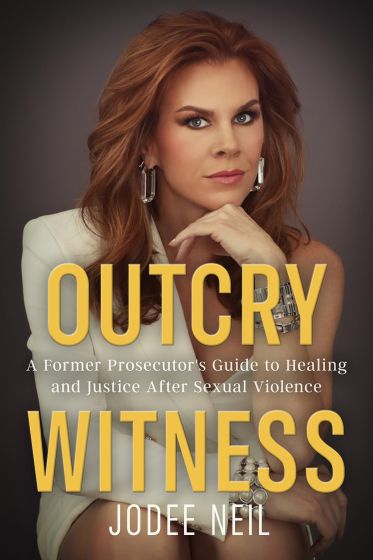
Guest, JoDee Neil, Owner of Neil Now Legal, Prosecutor, Attorney and Author of "Outcry Witness: A Former Prosecutor's Guide to Healing and Justice After Sexual Violence"
This week's guest is back by popular demand. JoDee Neil is an acclaimed trail attorney and author of the new book: "Outcry Witness." She owns Neil Now Legal, PLLC. She has served as a prosecutor of sexual abuse cases and specializes in Crimes Against Children cases.
Interested in our guest?
Visit their Website at: Civil Litigation Consultation | JoDee Neil for Texans
Don't forget to check out her book: "Outcry Witness: A Former Prosecutor's Guide to Healing and Justice After Sexual Violence" on Amazon
Opening From Houston With Gratitude and Hope
In this episode of Breaking the Silence, host Dr. Gregory Williams welcomes listeners from his home in Houston, Texas, and reflects on the city, the Texas Medical Center, the approaching Fourth of July weekend, and gratitude for military service members and veterans. He then introduces the evening’s guest, JoDee Neil, attorney, author, advocate, and returning guest. The episode centers on trauma, anxiety, disclosure, recovery, workplace harm, and JoDee’s book Outcry, Witness.
A Practical Game Plan for Anxiety and Triggers
Before bringing JoDee into the conversation, Dr. Williams shares a practical ten-step approach for dealing with anxiety when a traumatic trigger appears. He encourages listeners to recognize and name the trigger, breathe slowly, ground themselves through the five senses, challenge fearful thoughts, relax the body, replace fear with truth, take one small action, reduce outside stimulation, practice gratitude, and, for those who believe, turn to God in prayer. He explains that these steps can help move the brain out of panic and into a more rational, grounded state.
JoDee Neil on Becoming Unfrozen
JoDee responds by describing anxiety and trauma response as a kind of frozen state, where a person may feel unable to move, think clearly, or act. She affirms Dr. Williams’ grounding tools and adds that writing can also help people come out of that frozen condition. She speaks candidly about her own past reliance on pills and other numbing methods, explaining that many people try to avoid discomfort rather than face the pain underneath. For JoDee, healing required learning to feel, endure, and move through the truth rather than continually medicating it away.
Disclosure, Truth, and the Possibility of Joy
The conversation turns to disclosure, which JoDee defines as first admitting the truth to oneself and then saying it aloud to someone else. She explains that healing begins when a person recognizes that present pain may be connected to something that happened long ago, and that a joyful life requires facing that reality. Dr. Williams asks whether she once believed she was worthy of happiness, and JoDee says happiness felt distant and almost imaginary until she began accepting the truth and healing from it.
From Courthouse Healing to a Wider Calling
JoDee reflects on her career as a trial attorney, particularly her work with sexual abuse cases and crimes against children. She describes how helping others in court once made her feel whole and purposeful, but after writing Outcry, Witness, she no longer feels the same need to keep healing inside courthouses. Instead, she now sees a broader calling to bring her experience, communication skills, and trauma-informed understanding into businesses, schools, boards, leadership groups, and public speaking settings where she can reach more people at once.
Workplace Trauma, Retaliation, and Better Leadership
A major part of the interview focuses on how JoDee’s legal and survivor experience can help organizations. She discusses workplace sexual harassment, retaliation, human resources failures, and the need for better reporting protocols. JoDee says retaliation often causes additional harm and liability, and she argues that organizations should create clearer, safer processes before matters escalate into legal battles. She also discusses de-escalation, communication, chain of command, listening, smiling, reducing tension, and creating healthier workplace cultures that protect both people and organizations.
Facing Fear and Choosing Life
As the interview closes, JoDee describes her dream of speaking widely, including a future TED Talk, and says she wants people to hear her and decide that life is worth truly living. She encourages listeners who are trapped in despair, addiction, or avoidance to take the first step toward healing, saying that the fear of facing pain is often worse than the act of beginning. Dr. Williams and JoDee also discuss a possible future Houston event connected to their books and nonprofit fundraising. The episode ends with Dr. Williams reminding listeners that both he and JoDee have survived deep pain, that help begins with a first step, and that as long as there is breath, there is hope.
Guest, JoDee Neil

About JoDee Neil (From her website Jodeeneil.com)
Some people choose the law. Others are chosen by it. For me, becoming a lawyer was something I knew deep in my bones from the time I was five years old.
And from the moment I first argued into a courtroom, I knew this was where I belonged – using my voice to stand up for people who needed someone in their corner.
That sense of purpose remains with me to this day.
I grew up in Dallas, tagging along after my father, a board-certified family and criminal trial lawyer. He lived his life in and out of courtrooms, cowboy hat and boots on. By the time I was thirteen, I was already helping out around the office. I soon learned the rhythms of a legal practice, and what it meant to stand beside someone when the system towered over them.
My career began in the Collin County District Attorney’s Office, where the trial court became my second home. On my second day, I conducted a Voir Dire, and soon I was trying more cases than anyone else in my division. That pace and intensity showed me I was exactly where I was meant to be – not just “Wild Bill’s daughter,” but a powerful trial lawyer in my own right.
It wasn’t long before I was assigned to the Crimes Against Children Division. At 27, I was the youngest prosecutor handling those cases. The cases were heartbreaking, and the emotional toll was heavy. But I learned how to shoulder it without losing compassion, and that shaped the lawyer I am today.
After several years, I left Dallas and moved to Singapore. But without the courtroom, I was adrift. I found work with an NGO focused on child trafficking and continued work that I began while seving as an Assistant DA– my book, Outcry Witness. It would take me nearly twenty years to finish, but its seed took root during that period of loss and longing for meaningful legal work.
When I returned to Texas, now a mother of two young girls, my criminal trial experience still qualified me for serious felony defense appointments, but instead the civil firm where I worked assigned me to the opioid litigation where I represented counties against major pharmaceutical companies. That work became some of the most significant of my career, helping to bring billions of dollars in settlements into Texas.
Today, my practice looks different. I no longer measure my work in the number of trials I try or the settlements I secure. Instead, I focus on a niche that has always been at the heart of my calling: children. Whether it’s consulting on daycare and Montessori school cases, supporting families in conflict with CPS, or amplifying the voices of young people in systems that rarely hear them, my goal is the same as it was when I stood beside those survivors years ago – to make sure kids are seen, heard, and protected.
As a lawyer, I know the power of standing in a courtroom and telling a child, “You are brave. You are believed.”
My mission now is broader than individual cases. I believe that protecting children is the key to advancing humanity itself. A society that ignores its young cannot expect to thrive. Too often, parents, institutions, and even legal systems lose sight of that simple truth. My work is about bringing us back to it.
I started this journey in my father’s office, but after decades of trials, tears, victories, betrayals, and countless hours spent listening to the stories of children, I understand why I felt called so young. The law has always been about protecting the most vulnerable. That is the purpose I was given, and it is the purpose I carry forward.

Breaking the Silence
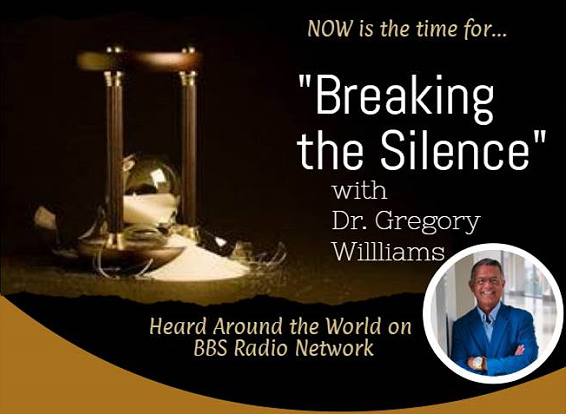

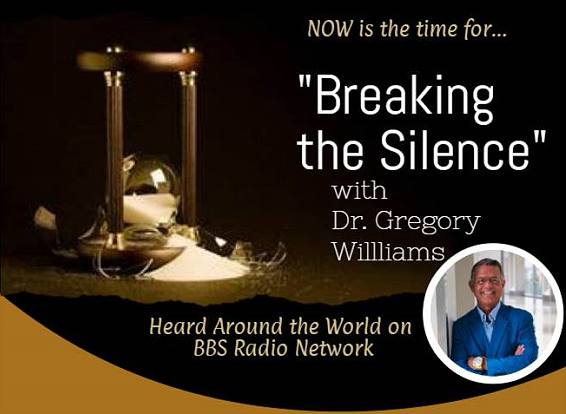
“Breaking the Silence with Dr. Gregory Williams”
Now is the time for you to step out of your own personal darkness and break the silence that has been hidden and closed up inside of you.
“Breaking the Silence with Dr. Gregory Williams” radio program will offer the listeners a Road Map to Hope each and every week with keys to discover within yourself that ray of light to make your day better and brighter. Dr. Williams will not only discuss his own personal journey of overcoming the darkness of years of horrific sexual child abuse in the hands of his father and his father’s friends, but Dr. Williams will also feature special guests that have their own personal stories of overcoming obstacles in their lives and becoming victors instead of victims.
“Breaking the Silence” will also feature information from the professional and medical field that will dive into the important research involving Adverse Childhood Experiences (ACEs) and how to build Resiliency in yourself and in your children. Along with this information will be special guests from greatest minds in the United States to share their expert research and thoughts on this very important subject that each person needs to be aware of.
Now is the time to invest a few minutes each week with some awesome information to give you steps to HOPE and keys to HAPPINESS and PEACE. NOW is the time to Break YOUR Silence and breakout into a NEW and BETTER YOU! Join us each week beginning August 13, 2019 for “Breaking the Silence with Dr. Gregory Williams”. You won’t want to miss a single program. Heard around the world on the best radio network on the airwaves, BSS Radio Network available on iTunes, Google Play, iHeart Radio, Facebook Radio, Spotify and over 100 other high quality digital radio stations.
Welcome to Breaking the Silence with Dr. Gregory Williams.
Dr. Williams is the author of the acclaimed book, Shattered by the Darkness, putting the
pieces back together after child abuse.
Dr. Williams is on the senior leadership team at Baylor College of Medicine in Houston,
Texas.
And Dr. Williams travels the United States speaking and training professionals, parents
and victims about the importance of dealing with abuse and personal trauma head on and
not being afraid to break the silence of your own personal pain.
Feel free to call in to tonight's show at 888-627-6008 and speak with Dr. Williams
and his guests live on air.
And now, your host, Dr. Williams.
Well, good evening.
I always think after the BBS does that introduction, I want to come out from behind some drapes
or something with applause and all that.
Good evening and welcome to my home here in Houston, Texas.
And I personally believe, and I think and I feel, I guess it doesn't matter what you
all think, that Houston is one of the best places in the country.
If not the world to live, I love this place.
I love the people.
I love the diversity.
I love the food.
Even though I can't eat much anymore, but I love just everything that Houston is.
And it's just a great place to be.
If you're ever close in this area, it's worth a drive to come on down to see us here in
Houston.
I'm here at the Texas Medical Center and you can just barely see it through with the sun
going down right over here.
But all the different hospitals were right there.
It was so funny.
I remember going down to Orlando, Florida and visiting my mom before she passed away.
She said, you moved to Houston and where do you live?
I said, I live at the Medical Center.
And she said, the Medical Center, what's that?
That's just a big hospital.
I said, well, mom, it's about 20 hospitals.
The Medical Center has more population in the Medical Center than the entire downtown
city of Dallas does.
And she said, so there's more than one hospital?
Oh my.
Yeah, and there's colleges and we're just growing and you can see when the sun gets
down a little bit more, there's construction sites there, there, there, and there you can
see all the different cranes taking and putting buildings on and building up.
But it's just a great place to be.
And we had the soccer world cup happening across the street here and starting to get
very exciting and very crampacked.
I got caught in that traffic the other night and you would have thought, wow, it took me
45 minutes to go about two blocks.
It was crazy.
Anyway, welcome to the program tonight.
I want you to know that here we are getting ready to go in the last Sunday night of the
month of June, 2026.
Can you believe that next weekend will be the 4th of July weekend and we will be celebrating
our 250th anniversary of our country.
And I tell you what, that's kind of special.
We have a country that everybody always complains about and maybe dams underneath their breath,
but I tell you what, there's not another country I'd prefer to live in.
Right here is the only place and I think it's interesting to watch all the soccer teams come
over from all the other corners of the world and say, wow, United States is something special.
And when you brought up here, live here, we take it for granted.
And I just want to say in advance as we celebrate 4th of July next Saturday, thank
you to all the veterans, everybody that's in the military serving that have given their
lives and the wives and the husbands and the spouses of those that are serving in the
military.
Thank you for your dedication so we can actually wake up in a country that's free.
A lot of people don't get that blessing.
So just welcome to the program tonight.
I'm rambling and I want to get to our guests tonight.
If you want to get involved tonight, hey, give us a call.
We don't get very many calls, but I know Jody would love to have you to call.
88627-6008.
We are having a little bit of difficulty with our Facebook on shattered by the darkness,
but that'll be coming up here shortly.
The people with BBS radio are diligently crawling inside of their computers, trying to get that
all fixed up for us, but that'll be coming up here shortly.
You can also, once that's up, comment on there and he said, it's already resolved.
Fantastic.
Or right here, 832-396-6525.
You can text that number.
That's my personal cell phone number 832-396-6525 and when or if we take a commercial break,
I think last time we got talk of so much that we just went right through the commercial
break, but if we take a commercial break, I'll check and see if there's any comments
that way.
Give a call.
You can be right on the program and your voice will be heard all the way around the
world tonight.
So that's just awesome.
I just want to talk real briefly and I'm going to kind of put it in turbo speed so
I can get through these points and not take up too much time because I really want to
give our brought back by popular demand, guests tonight, due diligence and as much time as
possible.
And I want to hear her comments after I share these and see what she thinks about this because
in her book, she has a lot of discussion about this.
You know, when you start feeling that anxiety start to coming on you and it starts creeping
and something's happening, you see somebody that reminds you of something.
There's a song on the radio that there's something that triggers that emotion inside
of you and your brain is going, oh my gosh, I'm not sure what's going to happen.
Your start setting in, the heart rate starts racing a little bit.
The pit start sweating whether you're using looming or not.
And you know, your heart, everything's just going out of kilter.
I think it's always important for us to have some type of game plan.
So if you want to jot these down real quick, if you're at home, just grab a piece of paper
or napkin or something and start jotting these down because you won't have time to
think about these because you're already being that mode, the anxiety and the tension
mode.
First of all, when that hits you, you need to understand and set back and look at it and
recognize what's going on.
Recognize that it's a trigger.
Recognize and don't panic, but you got to name it.
Really naming it.
Hey, wait, that smell reminds me of that moment in time.
That song reminds me, there's one song that if I hear on the radio, I almost have to pull
off the side of the road.
It's that traumatic for me.
But when you recognize it and name it, it automatically helps move your brain from that
reacting mode to a emotion into a rational mode.
Okay, I realize what that is.
I'm recognizing it.
I'm not going to let it take me over.
So number one, recognize it.
Okay, don't panic.
Name it.
Two.
I didn't believe in this, but I do now.
I wrote about it.
I think in my first book, but it really wasn't something I practiced a lot.
I did the tapping.
I did the grounding, but I never did the breathing.
Breathing is huge.
And if you can just do that breathing in through your nose for four seconds, hold it
for two and then expand.
Just let it all out.
Exhale for six seconds and do that five or six times just in that.
And you got to do through your nose.
You just inhale and for four seconds, hold that breath for two.
And then slowly exhale for six seconds.
Let all that air out of your lungs.
And what that's going to do is it that long exhale will signal your central nervous system,
that emotional system of your nerves inside of you that you're safe.
Just taking that.
Let's everything know inside your body.
I got this under control.
And though you may not, it helps trick the brain a little bit, trick the nervous system
a little bit.
And then I truly believe in the grounding yourself.
And that's a simple five, four, three, two, one.
You immediately, if you're outside, you look for five things and notice it and you pick
them out and say, I notice that one, I notice that, I notice that tree.
I notice that lake.
I notice that sidewalk.
And you see five different things and count them.
And then four, you touch four things.
Pick up a blade of grass.
You find a leaf.
You go to the water fountain, well, whatever you're at and whatever you're doing.
But you see five things, touch four things.
Here three things.
I hear the cars going by.
I hear the fountain running.
I hear, you know, whatever that's three things that you hear, two that you smell.
And then one that you taste.
And when you once you get your brain to go through that five, four, three, two, one,
everything starts to mellow out and then challenge your thoughts.
Number four, what evidence is based on truth in this fear, in this anxiety that you're
dealing with.
What evidence is there?
I have an attorney on tonight.
We're talking about evidence.
What evidence is it?
Or is it just because it would happen to be in the room at the same time?
Did that hurt you?
Did that song hurt?
Whatever.
And pick out the evidence.
And then are you predicting the future?
Because that song's on.
It's going to happen to me again.
Absolutely not.
That that's not even the case.
You could be even not even around people.
But you have that thought that something could happen.
And what's the most realistic outcome of this?
So start asking yourself questions.
And then five, start relaxing your body and literally relax your face muscles, your neck,
your shoulders, get your fingers, your arms and your legs and just start relaxing.
Tighten them up and let them loose.
Tighten it up and let it loose.
And when you do that, it starts relaxing everything too.
Replace all the fear with truth.
I've handled this kind of stuff before.
And it didn't get me.
I handled this.
I made it through it.
I don't have to solve this problem right now.
This isn't something that I need.
So you start going through that.
And those fears that you have, replacing it with truth.
Is this really going to hurt me or is it reminding me something that has?
And then seven, do one small thing.
Get up and move if you're sitting down.
Organize something.
Drink a glass of water.
Go forward laundry.
Take a walk.
Small actions.
That's different from what you're doing when you get the trigger.
Well, automatically start disrupting those anxious thoughts.
It literally tells your brain that's something else going on because your brain is reacting.
It's fighting for you.
It's like, whoa, I remember that.
That upset him.
That hurt him.
I'm going to do everything I can to make sure it doesn't anymore.
And there's a, there's that wall that goes up and the fear and the anxiety.
When you start doing these simple things, it starts rewiring that to where you have
control and you start calming back down.
And then you want to reduce all the stimulation that's around you.
Turn the TV down.
Put your cell phone down.
Turn off the internet.
Do everything to just being quiet for a while.
And then nine.
Practice gratitude.
I'm so glad I'm not where I was when this all happened the first time.
I'm glad I've come so far and come up with three things that you're blessed about today.
I am a huge believer in a gratitude journal and a gratitude thinking of writing and what
God has blessed you with.
And then 10, if you believe in a God, if you believe in the God, turn to him during these
times and surround all of these and soak all of this in prayer.
And that's my little game plan for dealing with anxiety.
How to how to attack that, how to offset it.
I want to bring in our guests tonight and TJ go ahead and bring her right next to me here.
And that's Jody Neal and you will recognize her from being on the program.
I think the very first Sunday of the month.
And she is the author of outcry, witness.
And she is a claimed trial attorney.
And in that she also owns Neil now legal.
And she has been a prosecutor of sexual abuse cases.
And she specializes in crimes against children.
And Jody, welcome to the program.
It's great to have you.
Thank you so much for having me back.
That was fantastic.
And you're up in the upper part of the state in the Dallas area.
Correct?
Yes, sir.
I'm up here up yonder for me.
Well, good to have you tonight.
Thank you so much for having me back.
And oh my goodness, just listening to you describe all of those grounding techniques.
That was really healing for me.
Oh, you have a section I believe if I'm wrong in the book on how do you deal with stuff.
What what's some of the things that really worked for you?
Work for your clients, work for the people that you advocate for because I think you
are the AAA of a person.
You're an attorney, you're an author and you're an advocate.
And you know, in all those, what's some of the things that you found was good advice
whether sitting next to you and you can hear their heart beating out of their chest?
You know, my I have been in the situation more times than I could ever even count.
And what you are describing are ways of becoming unfrozen because when you have the
anxiety as you describe it, what really happens is you're going into that state of freeze where
you really can't move and you just want to, you know, rock back and forth.
And you know, it's it's it's really pretty serious.
And I would say, you know, everything that you described is a very valid.
Way of snapping out of being frozen.
The only thing that I would add is if you can put pen to paper, that would help.
You know, if you're able to do that.
And I would also say, you know, it was during these states where I used to take a pill.
And I see now that it is so important to just to feel and to deal with it.
And it will pass.
And every time you beat it, you get better at it.
And, you know, there's it's definitely a journey.
But if you if you can, you know, start not taking any pills to deal with these moments,
that would be good.
You think a lot of people automatically will reach for the bottle will reach for,
you know, a drug or medication or something.
Oh, I got an in throw one in on my car.
But by that, it hadn't even had time to take effect.
But it's that mentality of that it could slow me down and help me.
I have lived it.
I have looked it.
You know, that was a major part of my coping and all the years between, you know,
the crime and the disclosure for me.
And I did not like feeling uncomfortable at all.
And I didn't want to think about anything that wasn't immediately in front of me.
You know, the case I was working on, the things I needed to do for my family, et cetera.
And so yeah, you know, I when I was in the opioid litigation, we learned that more
Americans have prescriptions for benzodiazepines than they did opioids by far.
And that's that's how we're coping with our traumas, I believe.
Did did you feel that if you could just numb it?
It would go away or you didn't want to unload the trunk of emotions because it was going to be
too painful and you just soon lock it and double lock it.
Yes and yes.
And on top of that, I wanted to be invisible.
I wanted to just make it all stop.
Wow.
Tell you what, you got this book, I'll cry witness.
And you have in there because I've read several chapters again tonight, just I like to hold
the book up so everybody can get online and you got over got a copy?
Yeah, I got one.
I got one.
We want to make sure we see we show everybody.
There's our legal scales beyond there.
My chest to Tibetan chest.
Here's my book.
There it is.
Hada.
Yes.
Get that book.
It's excellent.
And I think I love the chapter is toward the end about coping mechanisms.
Yeah.
And healing tools.
What's some of the things that before and after?
So if disclosure hasn't been done yet, disclosure meaning let's let's break this down to where I
can understand it.
You haven't told anybody about what's going on with you.
That's what you mean by disclosure, right?
Right.
You're frozen.
Yeah.
So you're just now starting to break out into the defrost.
Right.
You're learning to trust people.
Yeah.
Well, you know, you've you've you've decided that you concluded that problems that you're having in
your life are a byproduct of something that happened to you a long time ago.
And you are saying it to yourself first that you know, a plus b equals c.
And for me to have D, which is a joyful life where I am excited and happy to live and living
my purpose, I need to deal with this thing.
I need to first say it to myself.
I need to admit that this was real and that it happened to me.
And then I need to say it out loud to somebody else.
Did you think you was worthy of being happy or had you fallen down that rabbit hole so deep
that I deserve to be miserable?
How did you process that part?
So I mean, I, you know, I thought I was worthy of being happy, but it was so far removed from
anything that I considered to be a reality.
It was like almost like a make believe type type state of being like I could be happy for a
little while, but being happy as a person and being excited to live and feeling joy,
that was beyond me.
And it was accepting that that made me heal.
How is it because I may reopen it up my own closet.
I don't know if I want to, but how is it that you can find happiness when you're doing something
that you actually enjoy and maybe helping people, but then when you get home alone,
it's a different ball game.
It's a different world.
How do we learn how to heal the isolation if we're in that type of isolation?
Yeah, wow.
That was a really good question.
So what you're describing, I know that very well.
And that's those moments of beauty that you would have with another human being in your work,
right?
You know, you're witnessing their pain, their truth, you're holding space for them,
you're getting them through it.
And in those moments, you feel whole and like you're living your life's purpose.
And then you come home from work and you crash into the despair, the emptiness again.
And you know what's so interesting is since I wrote this book and finished it,
I don't feel like I need to do the first thing as much or maybe even at all.
Like I feel happy just being so full of hope and vision
for the future in all these different ways that I can, you know, advance humanity through my work
and my voice and my writing.
And I don't feel like I need to continue to heal in courthouses
in painful stories like I used to.
So the next chapter may not be with the marble pillars, judges and robes and
defendants and things of that order.
It may be a different world for you.
I think so.
I think the closest I'll get to the courthouse is the capital, the legislature.
I think I have done how to pretty good run at it and I think I'm done.
So how are you going to take what you talk about in your book
to the level of where now it's not what you chose for a livelihood.
Now you're doing something that has been chosen for you because you went through it
and now you're helping in a different way.
Yeah, yeah.
You know, the skill set that I learned from doing all of this work is,
I mean, you can't replicate it, right?
It's like, you know, it's like going to be an army ranger or something and,
you know, being the best at diffusing a bomb or whatever, you know, I mean,
and there's so many places for me to use the skill set, really taking it to the masses.
By getting out of the courthouse, you know, that's a tiny little world.
Yeah.
And you really can only help one in a million people in a courthouse, you know,
maybe one and a half a million people if you're, it's like a very small number.
And so by taking my healed state to businesses, to schools, to, you know,
boards, to see suites, I am going to be able to spread this piece that I feel in a lot of
different ways through a lot of different topics.
Okay. So if I was to ask you, okay, you wrote this book.
This is your first book, correct?
Yes, sir.
Okay.
And it's out now.
Everybody should buy it.
It is out.
And you want to use this as a stepping stone of being, hey, this is what I've learned in my years.
This is what I learned within me that happened to me, what to do and what not to do.
And now I want to help the masses.
So it's not a one on one consultation.
It's a, I want to, I want to speak.
I want to leave workshops.
I want to train.
I want to do business work.
I want to be in front of schools.
I want to do all of that so you can impact a lot of people at one time.
Yeah, that's exactly what I'm designing programs to do.
And, you know, there's, we, there are so many impactful moments that take place in everyday
human life that really come down to the same thing that my book is about.
And that is an issue that's taking place inside somebody that creates an inflection point
where a person needs to say something, say something to voice a concern, an issue, a safety measure,
endless examples, right?
And then how is that being received by someone else?
And so it really is the same concept.
It's how to use your voice in effective ways in workplaces and, you know,
boardroom schools, wherever you are, it all is the same.
And it's just this human communication of saying what you need to say and being heard by someone
who's capable of listening and how to make that a more palpable process for the rest of the world.
Yeah.
And do you, do you think that you going through the way that you went through
has given you an extra bullet in your emotional and intelligent gun of when people reach for the
medicine, reach for the bottle or whatever you go, hey, well, been there, done that?
Yeah.
This is what, so you think those negative experiences are going to help you
with people and what they need to do or what not to do?
Yeah, absolutely. I mean, having been in darkness, oh, you know what it looks like,
what the character of darkness is, what the signs are.
They're so, I mean, obviously tragedy is a spectrum, but there's a lot that I've experienced
that gives me the tools that I need to effectively diagnose and investigate and listen and remedy
issues that come up in places that are not courtye houses.
And, you know, if you've got a workplace, for example, and you have a ton of human resources
complaints and several EEOC complaints, and you come and talk to me and it turns out you're having
happy hours every Thursday night with your with your whole workforce. Well, okay, look,
that's a pretty compelling causal relationship there. You know, you get all these people drinking
alcohol, like, how about we just stop on the happy hours and maybe do a wide elephant gift
exchange, bring something laying around your house that your kid brought home or, you know,
let's have a little fun in a way that's not going to create a ton of liability and trigger,
you know, a bunch of people in a bar, you know, and WIs on the way home. I mean, yeah,
there are so many things that I have lived that have really equipped me to heal others.
Okay, great. Tell you what, we're going to take a short, short break, just for like a minute
in two seconds. On the other side of this, Jody, I want to find out we mentioned organizational
leadership, organizational dysfunction. What would you
do to be able to go into a business? What could you do for a Texas Children's Hospital or
Memorial Herrman across the street or a school down the road that has had issues?
What kind of expertise are you offering them from the business perspective, from the leadership
organizations perspective? And then after that, we talk about that, I want to find out if we look
at your life five years down the road, where do you want this book to have taken you and the
impact that it could have had on so many people? What do you want that to look like a few years
down the road? We're going to be right back 888627 6008, get on Facebook right now. Text me,
832-399-66525 or just give us a call, 888-627-6008. You won't want to miss the last half of
listening to Jody and her wisdom from this book. Outcry, witness. You want to make sure you order
during the commercial break. Grab that.
Get ready for a life-changing journey. From the best-selling author of Shattered by the Darkness
and when the dark clouds come, Dr. Gregory Williams is back with his highly anticipated third book
Embracing Your Scars, Learning How to Turn Life's Pain Into Life's Power and Purpose.
Have you ever wondered how to transform your struggles and the strength?
Do you want to stop hiding behind the pain, the heartache, and instead learn how to turn
those scars into the very fuel that propels you towards greatness? If you do, then this book is
for you in Embracing Your Scars. Dr. Williams shows you how to take the negative experiences
of your past and turn them into the very source of your future success. Don't miss out because
your transformation begins here. The book is available soon on Amazon, phones, and mobile,
and wherever great books are sold.
All righty. Welcome back to Tell You What? While you're buying Outcry, Witness,
by Jody Neal, I highly recommend that. Go ahead and do a double purchase of a book called The
Breaker by Micah in Diana Lersert. I love them. They're dear friends of mine and they just
liked our page here, our little podcast tonight, our radio broadcast tonight. And so they're listening.
Just want to let you know I love you guys. And buy that book too. Let's put both these books up
there on the top 10 list and just keep it there because it's impactful. It's not just a fiction
story. It's something that changes people's lives. And Jody, when you deal with this and you
try to put some kind of context, okay, your generation behind me, I'm almost, I got one foot in the
grave and the other one's on a great repeal. But when you look at the journey down the road
for you, how do you want that to progress? And when you walk into a room, what do you want people
to say about the person that's Jody Neal when they walk in? That person helped me with this. What
do you want the impact to be of this book and your journey in life? What a great question. I
I want to have a platform where I can speak to every soul on the planet and where they will say
of me. She made an argument that I that persuaded me that I wanted to really live.
You know, this is the woman who convinced me that life is worth really living. And because of that,
I quit alcohol. I quit pills. I, you know, got my faith right. I walked the straight and narrow.
I love my kids. I love my family. I vote. You know, I, I am the person I dreamed about being. And
it's because I saw her speak one day. That's great. Do you, do you go through this? Because
I hear I am, I think I need to send you a check for me, my therapist tonight. I love it. Would you
go off the stage after? And let's just pretend that tomorrow you're speaking in front of 5,000
people in Dallas and, and you just laid them out. When they all leave the room and you signed the
last book and you handed to them, do you go into dimness emotionally? Or does that give you a high
of thank you, God? I'm making an impact. I touched some people's lives. It was worth getting out of
bed this morning. Oh, yeah. No, I've always felt completely energized by groups of people.
Since I was a child, I actually have a recording. I'm going to send it to you. I'm four years old.
I'm singing Amazing Grace in church. You can actually hear the audience clapping and this really old
cassette recording that we digitized. But I have loved being on stage since I was a child. And
that's where I get energy. And I feel alive and in your hypothetical doctor, I would feel completely
like I was living like my dream. I would be so excited. I would not be able to sleep properly.
Yeah, I tell you, I get I'm more comfortable in front of people than I am one on one. One on one
with somebody that I don't know really makes me nervous. Like, okay, why you, why you want to get
close to me? What what what are you after? Everybody's ever got close to me has hurt me.
So I kind of put that you have trust issues? Or am I the only one in the room? Oh, yeah. No,
I was like, coffee with a lady the other day. And she was asking me all these questions. And I
was like, no, no, no, I like to ask the question. There you go. I didn't see this coming. Let me
let me ask the questions. No, I'm the same. I'm the same. You know, they're still it's a process
healing. Yeah. Yeah. When you are called, because you are offering that to businesses and organizations
and churches and every every type of group of people, and they say, Hey, what can you offer
us? What can you come in and train? What would that look like? And what's some of the things that would
be on that resume or CV in the fancy world that would say, Hey, this is what the three or four
things you're going to get out of spending some hours with me in a boardroom or in an auditorium?
Yeah, that's a that's a great organizational standpoint. Yeah, from an organizational standpoint,
you know, I'm I've had to learn a different language. Because you know, the courthouse
language is very direct. You know, you have to be very you have to learn the uncomfortable topics,
and you have to, you know, wrangle them. Corporate, though, I mean, you got to learn how to decompress,
deescalate, be more general, you know, you want to talk words like, retain talent, you know,
protect, you know, against turnover, find clarity, you know, all of these things that are like,
those aren't words we really use in the courtroom. So, you know, definitely clarity is something that
business owners want. And one of the programs I've designed is called communicating to win.
And that, you know, it has three different pillars of what I did before and when I was making
arguments in courtrooms. And, you know, I will give you from the courtroom to the boardroom.
That's what we're calling it. And then, and then a second win is chain of command for frontline
supervisors, you know, frontline workers. So in the DA's office, we use chain of command. And it has
always driven me a little bit baddie that the private sector doesn't use it because it's really
important, you know, in a hospital. I mean, you everything depends on the following the chain of
command. But in the private sector, I think that if there was more chain of command, they would have,
you know, less issues with turnover and whatnot. So that will turn around out there called trauma
informed sensitivity or wisdom or, you know, whatever. I hate terms like that because it ends up losing
the impact of what it really means. How important is it to understand that everybody that works
underneath the supervisor, they have issues, we all have issues, we're all carrying baggage.
Do you do you go into that with how to communicate, how to have those difficult conversations? Because
that's huge sometimes I have to have one this week with an employer. Yeah, you know, if that's
something that they want, absolutely. In fact, I would that's where I'm trying to go is into how
to create a protocol inside a workplace for reports of sexual harassment, sexual assault. There's a
lot of really bad stuff that can happen in a workplace. According to the CDC 38,910 American
women have experienced verbal sexual harassment only, just verbal. And so what happens after that
is retaliation. And that's what I really think we can avoid because that's a $14 billion per year
problem just in America. And that is when someone makes a report and then everyone just gangs up on
that person. And retaliation will hold up in court. You don't even really have to prove that the
sexual harassment happened. And the businesses are getting popped. And not only are the businesses
getting popped, but people are getting hurt. I mean, the what you and I have both been through
is bad, but workplace conflict is really bad too. And you know, and then there's like family court.
These are like the triad of horrors in America. And we really want to minimize the workplace
conflict because that's pretty avoidable, especially when it comes to retaliation. And so I would love
to help organizations really get their reporting protocol in order and an anti retaliation policy
and practice that will reduce trauma in the workplace and reduce plan of cervix in the courtroom.
Do you have wisdom? I'm sure you do in regards to de-escalation of a situation because I went to a
huge company on the other side of the country, not too long ago and talked to them about how to de-escalate
situations and get everything come back down. It's amazing I can do that with the company,
but sometimes I can't do it with my own life. But do you have wisdom and a program in that
arsenal of stuff that you take to organizations and businesses that didn't deal with that?
You know, honestly, a lot. There's some overlap with your intro to this episode and my program
for de-escalation. I mean, there's so much tension that can be diffused with just a smile. I mean,
that is my number one thing. I do it when I first walk into a courtroom, when I walk into a stage,
I smile. And it just takes tensions down by an order of magnitude and just little things like a
comfortable chair and setting aside time to listen and to really understand where this person's coming
from, to listen to the context, not just checking off boxes, you know, not, oh gosh, you know, we're
going to contact our lawyers who are going to tell us to darvo this person. You know,
we've got to come off that very nuclear technique of someone raises a concern or a report and we
just basically start rallying the troops to fire them. And in doing so, we create a lot of pain
for that person, create a lot of liability for the company. And things do not de-escalate whatsoever.
In fact, there ends up being a lot of vicarious turnover because of the retaliation and because
people see this person worked so hard and they were just disposed of like they were nothing.
You're going to do that to me. Well, I'm not safe here either. I need to get out of here.
So in your AAA of your, be introducing you, be an attorney, an author, an advocate, do you feel
that organizations from the top level, the people that are being managed by them, the leadership,
do you feel that they've really had their back, that they're advocating for them?
And how can you start building that trust of, hey, we're all on this team together.
I'm not out to get anybody. I just want you to do, I want to do whatever I can to make this
good for you also. How can we be advocates for people that carry some baggage?
Yeah. That's a good question. And in terms of going to, I don't know how to answer that question
based on evidence. On the one hand, you see companies that have employees who are consistently 40
year getting the gold watch retiring from the company. Now, on the other hand, you see companies
that have turnover that is mind-bloggling. And my feedback here, my inside baseball,
because I've done some employment, some play-of-side employment and some sort of white-collar type
stuff. And I think that the problem is coming from the lawyers a lot of times. They always do
the same thing. And that is double down, Darvo, deny, attack, reverse victim and offender.
And that's the defense. And that's always the defense. There's never any real creative solution
like, well, maybe we'll send you to a healing retreat and write you a check. And then we don't
have to do this whole thing and basically go to war. And so I would encourage companies to
consider options before deploying counsel. Sorry lawyers, not sorry though.
Yeah. Yeah. Down the road a few years, what's some of the things that you have in your dream
box that you would like to accomplish? Let's say by 2030 in the next four years.
Well, I would definitely want to get my TED talk going. Oh, okay. So I have been asking told and
you have to, and I push away from it. I'd like walking into a room and presenting where nobody's
ever heard me before. I'm afraid if I do a couple of TED talks or something like that, they're going to
go, I've heard this story before turn it and walk out. But tell me why that that impacts you.
Because I may need to change my point of view of that. Yeah, you know, my TED talk,
my TED talk draft is actually really similar to it sounds like your new book that's coming out.
It's about facing the fear. I want to do a TED talk because that is one more way to be immortal.
And, you know, I've got my first immortal, you know, assuming we make it for another million years,
you know, I feel pretty good about where I stand, but I want to keep feeling better.
And I want to just really zero in on the message of my soul, something that I want to be watched
a million times on YouTube. And that is timeless. Okay. That's good.
Maybe that's good. Okay. Besides the TED talk.
Oh, you know, I want to continue to be the best mother that I can be for my daughters. You know,
I want to, you know, take them to travel the world and to show them what's really going on out
there and to continue develop their empathy and help them achieve their dreams. I would love to
write another book. I would love to have all kinds of tools available on my website. And,
you know, I really, I really want to go for the Tony Robbins model.
Wow. Yeah. That's a big shoes. Of course, he's a big guy.
Keep that's huge because he does impact so many people.
Well, it wouldn't be the first time I feel big shoes.
So I'm never going to retire. I mean, you know, I'm, I'm never going to quit.
So I may as well just fill some big shoes. That's great. That's great. If somebody's listening tonight
and is locked in that moment in time when you talk about in your book of your days that you were
pretending everything was fine, but you were reaching for different stuff to get you through it.
What would be one of the things that you would say to them right now is we close out tonight of,
hey, this is what this is a couple of steps that you need to take
in your next few steps as soon as you can. I would say,
um, like it is so severe being in that despair. Not only are you afraid of the truth of what is
making you so sad, but you're afraid of even stopping the things that you're doing so that
you don't have to remember what's making you so sad. And what I would say is that the fear of it
is so much worse than taking the first step. And I mean by a lot, it's not just like,
oh, half a dozen, six, it's like, no, the fear of it. And it is so important for people to know
that all of the things that we do to medicate this pain so that we can keep it locked up only makes
it worse. Only makes it worse. I mean, I've, I've slightly dragged into the past couple years and
largely sober. And you know what, it is so much easier. Slaying a dragon when you have your wits
about you, your weapons are sharp. You know which direction you're going. You know, you can look
into that dragon's eyes and you know, I love lower the rings. You know, smog. I know, I know you,
you know, I'm gonna get you smog. You know, it is just so much easier when you are in fighting shape.
And what I want is for anyone who's listening to be inspired to just face the fear and take that
first step. Maybe that's calling your doctor and getting a prescription for Naltrexone. You know,
I think this stuff should be free at CVS because if you could just take a break long enough to kind
of pull yourself together a little bit, then that is a huge first step. And I wouldn't be here if
I hadn't done that. And I'm really open about it because I, I, we can't just pretend like there's
only one way to recover. Like it's just a bust. No, Naltrexone saved my life. And it's amazing.
It's amazing. I took it for two years. And you know, just, and then you can recover from that
other thing. And then from that other thing, almost everybody's a poly substance user.
And especially in Texas, where we can, we have access to so many things, right?
Right. You know, so just a little by little, you know, you're sharpening this weapon. You're,
you know, putting a baton in your leg, you know, strap, you're arming yourself with the
full armor of God, right? Yeah. And then, you know, really what's on the other side is so worth fighting
for. Like if I had known that I could heal, that I could feel like this, I think I would have done
it sooner. Yeah. Oh, yeah. I wouldn't wait 37 years. No way. But I hear through the grapevine,
it hadn't made the front page of the Houston Chronicle that you're coming possibly, we're
going to be working together on something possibly in Houston, towards the middle part of the,
a lot of part of the year. What do you have in mind if we can just kind of let people know, hey,
maybe want to check this out in a few months? What we looking at?
Sir, I think we're looking at, you know, a fundraiser with your new book and my book.
And for a nonprofit, right? Yeah, for a nonprofit. I think that's what we're looking at doing. And
I think my publisher's going to be there and there, you know, there may be a TV or parents
here or there. And I love Houston. I've met so many amazing trial lawyers in Houston. And
I mean, what's not to love except for the weather, the highways, the zoning.
I'm kidding. Now I love Houston. I love Texas. Okay. So if we get together in Houston and we do
the book signings and the fundraisers for a nonprofit that we choose,
could it be something where the public's all invited and they can get to hear your wisdom from the
stage and we can pass some time back and forth? Is that kind of what we're looking for?
I would love that. I would love that. Yep. I would love a stage and a microphone and Dr.
Williams and a bunch of people. Why just for a new light? Okay, I'll be the like man.
You're so fun. No, I'll share a stage with you any day. You can count on me.
Well, that'd be great. I'm looking forward to it. And I hope this comes to reality and whatever I
can do. I think we're talking about a theater down, down towards downtown and would love to do it and
can't wait to meet you in person. And thank you so much. Hold your book up one more time.
Thank you. Thank you. There's a book of the week to buy right now. Outcry witness. I bought it on
Kindle and had to immediately or you can buy this copy and have it on your bookshelf. But you
want to read it before you put it on your bookshelf. And it is a read that you're going to be referring
back to over and over and over again. Outcry witness by Jody Neal. If somebody wants to get in touch
with you Jody, what's the best way? Yeah, I would go through Jody Neal dot com. Jody Neal dot com.
I think I think I'm going to keep my law firm side up maybe for a little while longer. But
jodyneel.com is here to stay. And Jody Neal is J O D E E. Neil.
Yes.
Thank you so much for being with us. Hope to have you back. And hope we'll see you down here
in Houston and we will fill up the how about how about we'll fill up the NRG stadium. You want to do
that? I can do that. Let's do it. Okay, we'll do it. Let's do it. I'll call it.
To the barns. Hey, can we borrow the bar of the arena for a while? It's for a good cause.
Well, sure it is. Absolutely.
Love all our children.
That'd be awesome. We'll show the rodeo. The only the only game in town.
Yep. Yep. Thank you so much for being with us Jody.
Thank you for having me. You appreciate you. Come back again soon.
Thanks. You too.
As we do each and every week, I always like to end the program with the it's not the same old thing.
But I like to end it with never forgetting that you're you've just witnessed two people
that have been through hell.
And we still may be small like smoke, but it didn't kill us. We made it through it.
You can do it too. No matter what you've gone through, no matter what you're in,
no matter what you're going to face tomorrow, practice some of these things that Jody talked about,
get this game plan that we talked about, how to give her to that anxiety when you're triggered,
whatever it is, but never ever forget you got to take the first step to be able to get help.
But there's always there's always hope, no matter how hard how dark it gets outside
or how dark it gets inside. There's always hope. Never give up on that.
As long as there's breath, there's hope. Join us right here next week for another edition
of Breaking the Silence and just have an awesome and safe 4th of July upcoming week. God bless you.
Good night. We'll see you next week.
Thank you for listening to Breaking the Silence with Dr. Gregory Williams.
To contact Dr. Williams, dial 832-396-6525 or email him at
shatteredbythedarkness at gmail.com. And don't forget to join us each Sunday night
at 8 p.m. Central Time, 6 p.m. Pacific on VBS Radio Station One for the next episode of Breaking
the Silence.


