
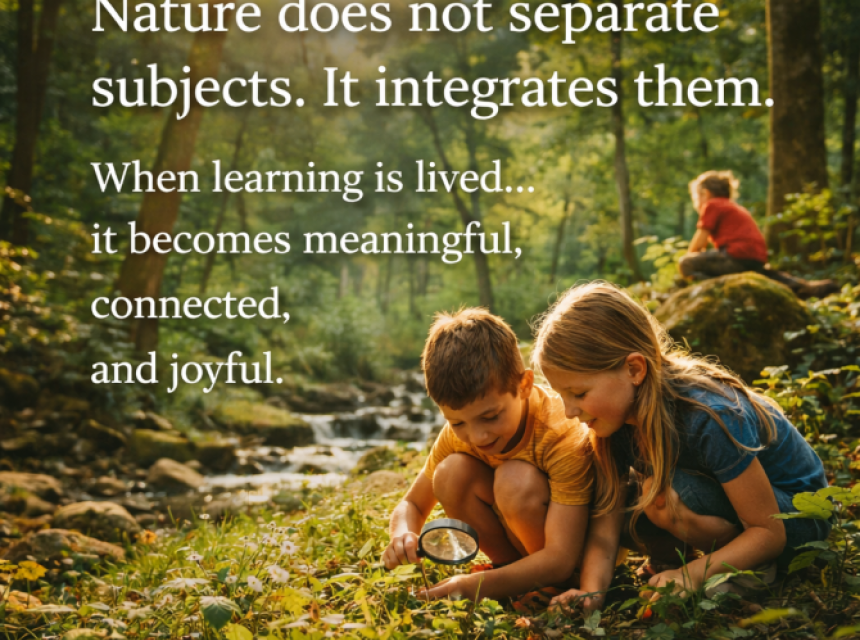
When we step outside, learning becomes real.
All Learning Reimagined
Returning to the original classroom
There is a simple yet powerful question we can ask ourselves: Where does learning feel most natural? For many, the answer is not inside four walls. It is outside. In nature. When we step into a natural environment, something shifts. The body softens. The mind quiets. Attention widens. Without being told, we begin to notice.
Patterns.
Movement.
Sound.
Life.
This experience is not accidental. It reflects a deeper truth explored through the Biophilia Hypothesis which is the understanding that individuals have an innate connection to the natural world. Not something we need to learn…but something we already know.
Learning That Is Lived, Not Delivered
Research shows that time in nature can:
- improve focus
- reduce stress
- enhance creativity
- support emotional balance
But beyond these benefits, nature offers something even more important as it makes learning real.
- When a child builds a shelter, they are learning structure, design, and resilience.
- When they observe a creek, they are learning flow, ecosystems, and interconnection.
- When they climb a tree, they are learning balance, risk, and trust in their body.
Nature does not divide learning into subjects, it integrates them.
A Remembering, not a New Idea
This way of learning is not new. In countries such as Denmark, Sweden, and Norway, forest schools are part of everyday life. Children spend extended time outdoors exploring, building, and discovering in all weather conditions. Similarly, approaches inspired by Rudolf Steiner emphasise rhythm, imagination, and connection to the natural environment. Learning follows the development of the individual, supported by meaningful, sensory experiences.
These approaches remind us of something ancient which is learning and life were never meant to be separate.
A Story - The Lesson Outside
A group of children sat inside, restless. The lesson was on measurement. Numbers on a page. Examples on a board. Attention drifted. The teacher paused and made a different choice. “Let’s take this outside,” she said.
The children stepped into the open air. “Measure something real.”
They spread out. One measured a tree trunk. Another paced the length of a garden bed. Two worked together to measure a shadow. Suddenly, the numbers meant something. They were no longer abstract, they were alive. What had felt difficult inside… became natural outside. All because the context changed even though the content was similar.
Shifting the Lens
When we begin to view nature as a teacher, the role of the educator or parent shifts. It is no longer about delivering information. It becomes about:
- creating environments
- inviting exploration
- holding space for discovery
The question becomes: How can I bring learning closer to life?
Practical Ways to Learn Through Nature
1. Take Learning Outside
Choose one familiar activity and shift the location.
- read under a tree
- complete maths using natural materials
- have discussions while walking
Small shifts in environment can create big shifts in engagement.
2. Nature Observation Practice
Invite stillness and awareness.
- Sit quietly for 5 to10 minutes
- Notice:
- sounds
- movement
- patterns
This builds attention, presence, and curiosity.
3. Learn Through Doing
Make learning tangible.
- measure a garden space
- build something useful
- observe plants, insects, or weather patterns
If it can be lived, it can be learned.
4. Create a Weekly Nature Rhythm
Choose one consistent outdoor time each week. Return to the same place and notice:
- changes in light
- seasonal shifts
- growth and movement
Nature teaches through rhythm and continuity.
5. The “Return to Nature” Invitation
This is not an activity. It is a remembering.
Step outside with no task.
- no phone
- no agenda
- simply notice
What draws your attention? What do you feel in your body?
6. The “One Shift” Practice
Choose one simple change this week:
- move learning outdoors
- use real materials instead of abstract examples
- walk while discussing ideas
Learning does not need to be complicated, just connected.
7. The “Same Place, Different Day” Practice
Visit the same outdoor space multiple times.
Notice:
- what changes
- what stays the same
- how you feel each time
This builds awareness of both environment and self.
Reflection for Educators and Parents
- When do individuals feel most calm and focused?
- What environments support that state?
- How can learning be brought closer to real life?
Nature has always been teaching. Quietly. Consistently. Without force. And when we return to it…learning becomes embodied, connected and meaningful. When was the last time you went outside to learn?
 To listen to an interesting podcast on Nature as Teacher go to https://bbsradio/alllearningreminaged.
Recorded on to the 27th March 2026. See below for ideas to promote nature as teacher in any educational settings. Enjoy!