
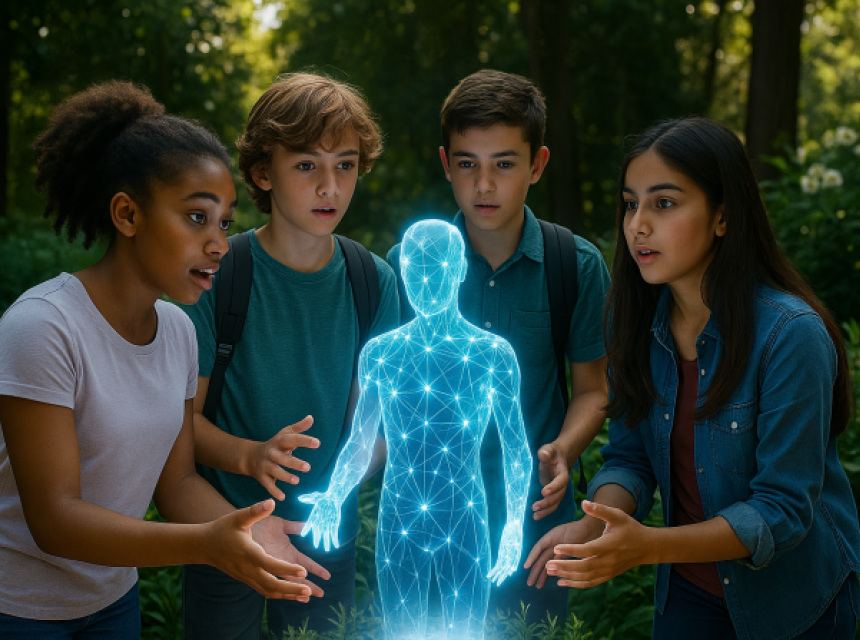
A Moment That Sparked Reflection
It began with a simple question in my classroom: “Who wrote this?”
A conversation about academic integrity and the use of AI in schoolwork quickly stirred strong emotions among my high school students. Some felt misunderstood. Others felt exposed. Many were unsure where the line between “help” and “cheating” actually sits.
Rather than pushing through the discomfort, we paused. We turned the moment into what real learning often is… a living inquiry. Together, we decided to explore a much bigger question:
What does it mean to be human in an age where machines can think, write, and create?
AI: The Great Disruptor and Mirror
Artificial Intelligence (or Technological Intelligence) has arrived in our classrooms, homes, and workplaces and not quietly, but as a powerful disruptor. It can summarize, design, translate, and even “imagine.” Yet beyond its capabilities, AI also acts as a mirror reflecting not just our intelligence, but our values, ethics, and awareness.
Used wisely, it can open doors to creativity, accessibility, and collaboration on a global scale. Used unconsciously, it can erode authenticity, amplify bias, and disconnect us from the very spark that makes us human… our hearts.
As educators, parents, and students, we now stand at a choice point: Will we allow technology to lead us, or will we lead with consciousness?
The Human Element
Technological Intelligence may write essays and paint pictures, but it cannot feel wonder. It cannot listen to silence and sense truth in it. It cannot wrestle with uncertainty, fall in love with an idea, or experience empathy.
That is the sacred terrain of the human spirit. In my opinion emotions run deep in mankind.
Education, at its heart, has never been just about knowledge but about awakening aliveness. When we mistake information for wisdom (mind vs heart), or convenience for connection, we lose something vital: the relationship between learning and meaning. I observe this daily in schools.
Integrity in the Age of Algorithms
The challenge of academic integrity is no longer about copying from books it’s about staying aligned with our own inner compass, our heart. Integrity is not a rule to follow; it’s an act of self-governance.
Beliefs shape thoughts.
Thoughts shape words.
Words shape actions.
Actions form habits.
Habits build character.
Character shapes destiny.
If we want integrity in education, we must nurture it in our beliefs first.
Do we truly value process over product?
Do we model curiosity, or only compliance?
Do our systems reward quick answers, or deep reflection?
Technology doesn’t remove these questions… it magnifies them.
The Balance: Co-creating with Consciousness
Contrary to a conspiracy theorist near you, Technological Intelligence is neither saviour nor villain. Like fire, it can cook our food or burn our house down. I feel the difference lies in consciousness and our intention.
When we approach it as a co-creative partner rather than a replacement for thought, AI becomes a catalyst for new forms of creativity and collaboration. The key is awareness: using technology to expand capacity, not to outsource identity.
Imagine classrooms where:
- AI supports language diversity and accessibility,
- students use digital tools to enhance personal voice, not erase it,
- and conversations about ethics and empathy are as central as grammar and equations.
This is the balance point where innovation meets integrity, and humanity stays at the centre of progress. It certainly doesn’t feel that way at the moment. In a conversation last week, a man who works in university I.T. department compared our currently reality to an ‘arms race…. Humans are scrambling to keep up’.
A Call to Reflection for Parents and Educators
So, what can we do about this? The answer for me is simple. We need to start intentionally ponder how we are using technology and the role it has in our lives. I urge you to pause for a moment and consider:
- What beliefs about technology are you modelling?
- How do your daily actions reflect what you truly value about learning?
- Are you helping young people develop discernment (the ability to choose consciously), and not react automatically?
Each thought, each word, each decision in a classroom or home shapes our collective consciousness in the natural unified field. (not in a hive mind – borg sense)
Technology may influence the tools we use, but humanity still writes the story.
Let’s guide our children to wield their creative ability through natural lore and know they are powerful creator beings.
“Technology may shape our tools,
but humanity shapes our world.
The future will be defined not by machines,
but by the quality of our choices,
the clarity of our hearts,
and the stories we dare to live.”
Listen to the 15st November 2025 podcast on All Learning Reimagined. See below for an inquiry project for into the role of Technological Intelligence.
Student Investigation Project
AI, Humanity, and the Future of Learning
(Educator Resource adaptable for classrooms or youth groups)
The Big Question
How can we use Artificial Intelligence (AI) to enhance human creativity, learning, and connection without losing what makes us uniquely human?
Why This Matters
AI is changing how we learn, create, and communicate. This project invites students to explore both the promise and the challenges of AI—and to form their own perspectives on how humanity and technology can evolve together.
Project Phases
1. Ignite Curiosity
- Reflect: “What’s my relationship with AI?”
- Discuss the pros and cons of AI in education.
- Create a shared mind map of hopes, fears, and questions.
Prompt: What kind of relationship do I want with technology?
2. Deep Exploration
Choose one inquiry question, such as:
- How is AI changing creativity and communication?
- What ethical challenges arise when humans and machines co-create?
- How might AI reshape education globally?
- How can students protect authenticity and integrity in a digital world?
Prompt: What truths or tensions are emerging as I explore this topic?
3. Co-Creation & Expression
Students choose how to express their findings:
podcast/video artwork article performance digital piece
Include:
- A creative or research-based output
- A reflection on what was discovered about humanity’s relationship with AI
Prompt: How did AI challenge or expand my understanding of creativity and integrity?
4. Sharing & Reflection
Host a “Humanity & AI Forum” or gallery walk for students to share insights.
Circle reflections:
- What did I learn about myself?
- What surprised or inspired me?
- How will I use technology moving forward?
Guiding Principles
- Integrity before convenience.
- Let technology serve humanity, not replace it.
- Your voice matters - use it.
- Always think for yourself.
- Collaborate with curiosity, not competition.
Closing Thought
Education’s next evolution won’t be measured by how fast we adopt technology,
but by how deeply we remember our humanity in the process.