
The Joyful Manifestation Show, August 21, 2026

The Joyful Manifestation Show with Sugandhii Iyer
Keeping the Signal Steady: Emotional Guidance, Continuity, and Conscious Manifestation
Summary
Continuity as a Manifestation Principle
The episode opens with an unexpected late start, which the host uses as a real-time example of continuity. She argues that maintaining continuity matters both in broadcasting and in manifestation because changing direction repeatedly sends mixed signals about what a person wants. In her framework, a desire can be released after it is formed, but the underlying intention should remain stable rather than reversing whenever circumstances become difficult. The host repeatedly returns to the idea that emotional reactions can interrupt this continuity. She encourages listeners to remain clear about the nature of the outcome they want even when temporary events are frustrating or disappointing.
Using the Emotional Guidance Scale
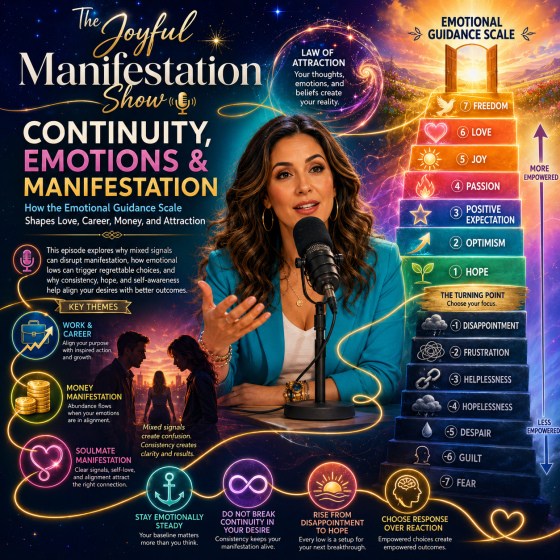
A central theme is the Emotional Guidance Scale, which the host describes as moving from joy, love, passion, and positive expectation down through contentment, boredom, pessimism, disappointment, worry, anger, guilt, despair, and powerlessness. She presents the scale as a way to notice where a person is emotionally before taking consequential action. The host's concern is not only the discomfort of negative emotions but also the choices people may make while deeply discouraged, helpless, or hopeless. She recommends doing a mental and emotional "spot check" before reacting. The broader lesson is to work upward toward relief, hope, optimism, and positive expectation before making major decisions.
A Relationship Example from Television
The host uses characters from The Bold and the Beautiful as an extended example of how emotional states can influence relationship choices. In the story as she recounts it, Steffi becomes deeply upset with Finn, throws away the symbol of their relationship, drinks during a flight, and later connects sexually with Carter while both are emotionally distressed. By the next day, changed circumstances leave both characters dealing with guilt and regret. The host interprets this sequence as an example of people moving to the bottom of the Emotional Guidance Scale and acting from hopelessness rather than from love or clarity. She explicitly distinguishes bonding through shared negativity from what she considers love based on joy, passion, and positive expectation.
Applying Continuity to Work and Money
The Money Manifestation section transfers the same ideas from relationships to jobs and careers. The host warns that a person who becomes despondent about work can break continuity by abruptly abandoning a goal, behaving badly in an interview, or deciding that a desired career no longer matters. She compares the universe to a cook preparing an order: if the order keeps changing, the original dish is abandoned and another must begin. Her practical suggestion is to identify what is still working in a current job, such as steady pay or regular hours, and use those observations to move emotionally toward relief and hope. From that more positive state, she says, a person can look for a better job without denying the value of what is already present.
Hope, Self-Control, and Reaction
The host repeatedly warns against giving up just before a desired result might arrive, using the image of a seedling that is about to break through the ground. She urges listeners not to let disappointment turn into hopelessness and then into an impulsive reversal of their intentions. In both career and relationship examples, she emphasizes self-control and awareness of what she calls provocations from the world. Recognizing that one has been emotionally provoked can create a space between the event and the reaction. In her view, that pause helps preserve both emotional stability and continuity of desire.
Law of Attraction and Conscious Choice
The final section connects the Emotional Guidance Scale, continuity, relationship dynamics, and the law of attraction. The host interprets Steffi and Carter's encounter as two people in similarly negative emotional states being drawn together and finding comfort in shared distress. She contrasts that with relationships formed from joy, positive expectations, appreciation, and passion. The episode closes by presenting emotional awareness as a way to reduce drama, avoid regret, and protect what the host calls one's good fortune. Across money, career, love, and manifestation, her central message is to notice emotional direction, avoid acting from the lowest states, and keep a stable intention while moving back toward hope and positive expectation.
The Joyful Manifestation Show


Support my show
$5.99/mo or $9.99/mo
Click HERE
SUBSCRIBE TO TALK SHOW
A Subscription is NOT REQUIRED to listen to my shows,
but it is greatly appreciated!
On The Joyful Manifestation Show with Iyer we talk about all things manifestation, covering topics and engaging our avid listening audience about the Joyful Manifestation process which includes:
a. Love, Sex, Soulmate Manifestation
b. Career, Profession, Business
c. Money
We will also be talking about manifestation, as it applies to:
a. Relationships
b. Happiness
c. Sex, sex energy
d. Present day meet up environments, night clubs
e. How to change our energy, change karma
f. Different lines of energy
g. Chakras, and what they do
h. Energy healing methods
i. How manifestation happens, is possible
Join me by calling into the show (888-627-6008) and let's manifest together!
Speaker Identification
Speaker 1 - Host
The transcript clearly contains one primary live speaker who identifies herself as the host of the Joyful Manifestation Show. The automated transcript renders her name inconsistently as "Sukhandi Ayur," "Sakarly Iyer," and "Sugandi Ayur," so the exact spelling of the host's name cannot be established confidently from the transcript alone. To avoid inventing an identity, the corrected transcript uses the consistent label "Speaker 1 - Host."
Music / Transition Audio
Several portions consist of music or transition audio that the speech-to-text system rendered as repetitive words or garbled fragments. These are marked as [Music break] and are not treated as separate speakers because no reliable spoken identity can be established from the transcript.
Speaker 1 - Host: Hi, this is [host name spelling requires verification] for the Joyful Manifestation Show. We are starting late today, and we really apologize for that. The regular person who takes care of the show is not available today, and hence you can sense the change in music. So, again, I really apologize for that, and I hope we've got the right show on the Joyful Manifestation Show.
The show must go on, right? That is one thing we've learned in show business: the show must go on. Whether it's a talk show or some other type of show, even if you're late or whatever it is, we are going to come and try to at least be there for you.
There's also that thing about continuity. We want to make sure that we get in some good energy week to week. So let's talk about continuity and the fact that, in our manifestation, we want to maintain continuity. Just like the show, even though it was getting late, we said, okay, maybe some people would listen, some people would wait to listen, and some people might drop off, but we still want to maintain continuity.
In manifestation, we also want to maintain continuity. We don't want to give mixed messages to the universe and say, "One week I want this, and another week I don't want this." We don't want to give mixed signals to the universe. We want to be stable about what we project to the universe. No matter what, we say, "Look, this is what we want. This is what we want. This is what we want." We don't change our minds and say, "One day we want this, and then we don't want this. Then we want it, then we don't want it."
We spoke at length last time about the Emotional Guidance Scale. We went to the high highs and then the mid-highs. In the high highs, we had love, passion, and joy - all of these very high emotions. In the mid-highs, we came down a little bit to positive expectations and so on. Then we came down to neutral, then lower and lower, until we reached the lowest levels: helplessness, hopelessness, and all of these negative feelings.
We also discussed an example from The Bold and the Beautiful. There may be some people listening today who follow The Bold and the Beautiful and some who don't. It is a show that has been around for donkey's years. A lot of viewers were very young when they started watching, and they're still watching and following the show through all its ups and downs.
Steffi is a character who is married to Finn, and they're supposed to be meeting in Monaco for a very romantic meeting. Finn's birth mother follows him there. She's supposed to be a psychopath, though she's trying to improve and wants to be part of the family. Finn tells her to go back because he knows Steffi wants nothing to do with her. But she doesn't go back. She ends up there, and Steffi has a fit, throws her wedding ring at Finn, and says, "I no longer want to be with you. This is done."
She went into a fight-or-flight mode. On the Emotional Guidance Scale, she reached the lowest level of emotion, where a person loses faith and becomes completely helpless and hopeless. She didn't see that there was anything left, so she threw the ring at him and went away.
The next time, it seems she drank all the way from Monaco to California. I think they live in California. She drank throughout the flight, reached her workplace, and was in a really bad mood. They're very rich - they're the Forresters. She reaches her workplace after drinking, and Carter comes in. He works there, and he is also in a bad mood because his wife has left him. There is a reason, but it has nothing to do with him. Carter is supposed to be a really nice guy. So he's also down in the dumps, and Steffi is down in the dumps.
After talking to each other about all their problems, while both are at the level of hopelessness and helplessness, they hook up. The next day, Carter's wife comes back and says, "I really apologize. I shouldn't have left. I shouldn't have given you my ring back." Finn comes back to Steffi and says he's sorry and promises to make sure it never happens again. He says he will protect her and keep his birth mother away from her.
Now you see what happened. There was no reason for Steffi and Carter to hook up at all. They had reached a place where they felt there was absolutely no hope. That's helplessness and hopelessness at the bottom of the Emotional Guidance Scale. When they felt there was nothing to hold on to, they sought comfort in each other. They spent the night together - not innocently.
In the morning, Steffi has a rush of emotions: "What did I do? This is a mistake." She goes back home, and Finn comes in. He promises that he will never let his birth mother near her again. But now it isn't Finn who is the guilty one. It's Steffi, and she says, "Look, I have something to tell you." She's even more down in the dumps.
Then Carter's wife comes back and says, "I was going to leave for Paris, but I couldn't leave you. So I'm back." From outer space, of course. They don't say that - that's me.
Here's the thing: the Emotional Guidance Scale is so clear. When somebody reaches the lowest level of the scale, they can do something they will regret later because they've reached that place of hopelessness and helplessness.
Now, me, myself, and I - it doesn't matter how hopeless or helpless I get - I wouldn't have done what Carter and Steffi did simply because they were in a place of complete dejection. Personally, I wouldn't, and I wouldn't recommend anybody do that. If you want to hook up with somebody or make love with somebody, do it when you're happy, not when you're at the lowest level of the Emotional Guidance Scale.
When you're feeling better and the next day comes around, what happened can turn out to be a big mistake and have a major impact on a relationship. So if you want to make love with somebody, you really want to be in a good mood and make sure you're in a good space, not mentally down in the dumps, because then there can be a lot of regret.
Having said that, we're back to the Emotional Guidance Scale. The point is to make sure we don't go too far down the scale and to try to remain at a higher emotional level. For example, the traffic over here is terrible, and I did say I'm disappointed with the traffic. But because of that, I can't just run away somewhere right now. Even though we're going to another city where the traffic is much better, what I'm saying is that you can't take actions solely based on your emotional reaction.
Let's go into work and career. We're going into Money Manifestation now.
Speaker 1 - Host: We're taking a couple of minutes for some music, and we will come back soon. So don't go away. Hold on tight.
[Music break]
Speaker 1 - Host: Welcome back. We are into Money Manifestation now. We were talking about the Emotional Guidance Scale and how people can go to the lowest level of the scale and do things they regret the next day. This continuity factor is really important.
If you want something, you continue to want it. Look at what happened with Steffi and Finn in The Bold and the Beautiful. Steffi was disappointed with her husband, but she wasn't just disappointed. If she had only been disappointed, she would have been at a higher level. Her negative feelings went far beyond plain disappointment and doubt. She went down to the lowest level of helplessness and hopelessness. Having gone there, she threw the ring, and when she threw the ring, she broke continuity.
Her wish had been to be with Finn. She wished for their marriage to work. But when she became upset with him, she threw the ring at him and broke continuity. She turned from wanting to be with Finn to not wanting to be with Finn. Her wish changed. She did a complete 180-degree turn, and all the time she was sitting with Carter, she kept saying, "I don't want to be with Finn. I don't trust him anymore. I no longer want to be with him."
There are two or three things here that I want to point out. She changed her mind, and there was a break in continuity. She turned 180 degrees and kept saying she no longer wanted to be with Finn. We'll continue this in the soulmate-manifestation part. For now, we're saying that when she changed her wish, she broke continuity.
Just like we said we don't want to break continuity with the show. Even though we started late, we're taking a stand and saying that we don't want to lose continuity with the show, and I will ensure that it's there somewhere for everybody to access.
Steffi breaks continuity and goes the other way. From wanting her husband so badly in Monaco, she now no longer wants her husband. She went from the highest levels of the Emotional Guidance Scale to the lowest levels. She did a 180-degree turn and started walking in the other direction: "I don't want to be with him. I don't trust him. I no longer want him." She was crying and in a very bad emotional state.
We'll continue this in the soulmate-manifestation part because we want to apply the same idea to work and career. Disappointment is a difficult emotion, but it is still not as low as helplessness and hopelessness. Disappointment is one thing, but when you come down to helplessness and then lose continuity and stop wishing for the kind of job or career you want, you can turn 180 degrees and start walking in the other direction, saying, "I no longer want this."
Imagine the universe is a big cook. You placed an order, and the universe is cooking your dish. Then you change your mind. What would happen? The dish gets abandoned. You might be charged - who knows? - or you may not be charged. We don't know. But the dish the universe started cooking gets abandoned. It's no longer of any use. Then maybe you order something else and say, "Now I want this. I don't want that."
If you have hope, positive expectations, passion, love, and joy, then you expect that you're going to get the job you want. At that time, you can maintain and retain continuity. You tell the universe, "This is what we want. This is what we want. This is what we want." We don't change our minds about it.
I'm not saying you have to wish continuously. Once you wish, you let it go. But you shouldn't keep changing the desire itself. We can't allow a drop to the bottom of the Emotional Guidance Scale to upset us so much that we lose continuity. We have to do a spot check and see what emotion we have regarding our career. If it is going lower and lower, make sure you come up again with some good thoughts because it can take you to a place where you lose continuity.
Maybe somebody reaches a place of complete despondency and helplessness, goes to an interview, gets asked some tough questions, throws the papers on the table, curses the interviewer or says something bad, and walks out. Then that's like a black mark. Feelings and emotions should not be allowed to take us to a place where we are completely despondent and helpless.
When we want something and maintain continuity, we tend to behave well. People put their best foot forward, give their best smiles, and stay on their best behavior. But when somebody reaches a place of helplessness, it can cause the person to act in a way like Steffi did. We must not go to a place where there is a break in the continuity of one's desire.
There are two problems. One, it can lead to behavior like Steffi's - and with work and career, you have to translate the example into that context. Two, it can confuse the universe. The universe starts cooking one dish, then stops that and starts cooking another, then stops that one too.
So this continuity of wishing and desire doesn't mean you have to keep wishing every minute. Once you wish, you let it go. But you cannot keep changing the desire and the wish all the time. Have continuity in the type, subject, and nature of the desire you want. This will ensure that the universe can bring to you what you desire.
This law-of-attraction idea can be applied to work, and it can be applied to soulmate manifestation. You can take Steffi's example and apply it to work: don't keep changing the desire. If somebody wants to be the best in his performance - maybe he's an artist and wants to be the best - he continues to wish for that. Again, I'm not saying he has to wish continuously, but the wish itself should be stable.
It shouldn't be, "One day I want it. Another day I don't care; give it to somebody else. I really don't care." Then another day, "I hate it. I no longer want it." Distaste and dislike come up. We don't want to go there. We want to maintain continuity in work.
As they say, just when the seedling is about to sprout and come out of the ground, that's when people lose hope. Hopelessness comes in, and one goes down, down, down the Emotional Guidance Scale just when the seedling is about to come out of the ground. That's what Louise Hay says. It might be in You Can Heal Your Life. Have you watched that movie? You Can Heal Your Life, What the Bleep Do We Know!?, and The Secret are three things you can watch.
Just when the seedling is about to sprout, people think it's no longer going to happen, and then they cancel their wish. Then the seedling doesn't come out of the ground. In The Bold and the Beautiful, it's a really good example of how people start a relationship and then lose hope. They change their desire because they reach the bottom rung of the Emotional Guidance Scale.
Apply that to work. People have a job and are climbing the ladder. Certain obstacles come through, and they start to lose hope in the company. They feel it is no longer suitable for them, and then they don't want to be there any longer. If you reach a place like this, try to climb up the Emotional Guidance Scale first. See what you can find that is good about the job.
Maybe there is steady pay. Perhaps they're not paying enough, but the pay is steady. You can put that point down on a piece of paper: steadiness of pay. The income comes regularly. Maybe it isn't much, but it comes regularly. Point one: steadiness of pay. Point two: regular hours. Maybe the work isn't great, but there are regular hours. It's not up and down all the time.
Try to see what's good about the job. Try to climb up the Emotional Guidance Scale and feel some relief. If you want to find another job, nobody is saying you have to be stuck in this one. But if you want another job, climb up the scale at least until you reach hope and positive expectations. Have hope that you will get another job because you've already established some good vibrations where steadiness of work and steadiness of pay are concerned.
Write those things down. You already have those good vibrations. Come out of hopelessness and climb to a place where you can say, "I can do really well because I have these things going for me." Then try to find another job. If you don't want to stay in the same job, find another job, but recognize the strong points you already have. Then you can find a job that incorporates additional benefits and climb up in your career.
Don't go down the Emotional Guidance Scale and stay there with your head in your hands, completely despondent and helpless, because there's no such thing as helplessness. We can always help ourselves.
With that, we will go into the next section, which is love, soulmate manifestation, love, and sex. We'll take a couple of minutes for some music. I'm hoping you're going to be there when I come back. Don't go away. Hold on tight.
[Music break]
Speaker 1 - Host: Hello, ladies and gentlemen. Hi, this is [host name spelling requires verification] for the Joyful Manifestation Show. Welcome back. Remember I said the regular person who takes care of my show is always there, but he's not here today - Thomas. That's why the show started late, and we really apologize for that.
Here is the Emotional Guidance Scale again. Last time it was grouped into the highs, the mid-highs, the neutral range, the lows, and the very, very low range. But now we're going point by point, number by number. For those who already know this scale, forgive me, because there are quite a few people who may not know it very well.
Number one, at the top, is joy, appreciation, empowerment, freedom, and love. Number two is passion. Number three is enthusiasm, eagerness, and happiness. Number four is positive expectation and belief - this is where you start to believe that something is going to happen. Number five is optimism. Number six is hopefulness. Number seven is contentment. Number eight is boredom. Imagine: at number seven you're content, and at number eight you're bored.
Number nine is pessimism. Number ten is frustration, irritation, and impatience. Number eleven is overwhelm. Number twelve is disappointment. For example, a person may be trying to get a job but finding it difficult to cope and feeling disappointed with what is available. Number thirteen is doubt: "Is this even going to happen?" Number fourteen is worry: "I don't think it's going to happen, and I'm worried about it." Number fifteen is blame: "This world is bad. The economy is bad. I blame everybody." Number sixteen is discouragement. Number seventeen is anger. Number eighteen is revenge. Number nineteen is hatred and rage. Number twenty is jealousy. Number twenty-one is insecurity, guilt, and unworthiness. Number twenty-two is fear, grief, depression, despair, and powerlessness.
When a person reaches numbers twenty-one and twenty-two - insecurity, guilt, unworthiness, fear, grief, depression, despair, and powerlessness - someone needs to start looking out. It's not just the emotions themselves. A person might say, "Okay, I can bear these emotions," but it's also about the actions a person can take from those emotions.
Look at the actions Steffi took: one, throwing the ring at Finn; two, drinking throughout the flight back to California; and three, going to her workplace instead of going home and being with the kids. She goes to her workplace, is very down in the dumps, hooks up with Carter, who is also down in the dumps, and they make out. I think they go all the way.
The next day, she is not in a better place. She's now feeling guilt and unworthiness, which is just above fear, grief, depression, despair, and powerlessness. What if Steffi had held back? What if she had simply consoled Carter, who was also crying on her shoulder? What if she had been the bigger person, held back, and not made love with Carter?
The next issue wouldn't be insecurity, guilt, and unworthiness. Now she's talking to Finn, and he's telling her, "You're such a good person. You're so committed to me." And she's thinking, "No, I'm not. I have something to be guilty about. I'm not that great person you think I am."
You see what I'm saying? The Emotional Guidance Scale is so useful in soulmate manifestation because we can watch our steps. The way people go up and down the scale is amazing - amazing in a negative way. We really want to get to at least number seven, contentment.
If you're going up the scale, number twelve is disappointment, number eleven is overwhelm, number ten is frustration, irritation, and impatience, number nine is pessimism, number eight is boredom, and number seven is contentment. From number seven onward, it starts to get better: contentment, hopefulness, optimism, positive expectation and belief, enthusiasm, eagerness and happiness, then passion, and finally joy, appreciation, empowerment, freedom, and love.
Now here's the main thing we want to address. Steffi drank throughout her flight. She didn't go home and try to get herself into a better place because she was in a very bad condition. She went to her workplace, sat there, and remained in a very bad mood. She was at the lowest levels of the Emotional Guidance Scale. This is where the law of attraction comes in as well: she attracts Carter.
He is facing the same issue in another way. His wife has left him. He thinks she's on a flight to Paris. She had given her wedding ring back to him because she can't have children, or something like that. She feels guilty about not being able to have children and believes leaving Carter is the best thing so that he can have children with somebody who can. She is allowing her guilt to guide her into leaving him, even though he tells her, "We'll find another way to have children."
She's feeling guilty. Guilt is at number twenty-one on the Emotional Guidance Scale, together with insecurity and unworthiness. She's feeling insecure, guilty about not being able to have children, and unworthy. She had been happy and in love, with joy, appreciation, empowerment, freedom, love, passion, enthusiasm, eagerness, happiness, and positive expectation. Then, when she finds out she cannot have children, she falls down the Emotional Guidance Scale to insecurity, guilt, and unworthiness.
Having fallen down the scale, she feels guided by those emotions. She gives her ring back to Carter. She doesn't throw it at him because she isn't angry with Carter. She's angry with herself and disappointed with herself. But it's worse than disappointment: it's guilt and a feeling of unworthiness because she cannot have children. She gives her wedding ring to Carter, he begs her to stay, and she leaves, saying she's going to Paris.
So Carter is also in a really bad condition when he enters the office. Now see the law of attraction playing here. Steffi did not have the intention of cheating. She was simply in a very bad place - drinking, crying, moping around, and unhappy with Finn. If Carter had not come in at that point, they wouldn't have made out. Maybe by the next day, Steffi would have been feeling better.
But Steffi's strong negative emotions drew something similar to her, and Carter walked in. Both were crying on each other's shoulders and supporting each other. When somebody is in a certain emotional place in life, the speaker says, they tend to draw toward people in a similar place. Steffi drew Carter, who was also facing something similar in a different way. They were drawn to each other, found comfort in their mutual negativity, and ended up having sex.
The next day, Carter feels guilty because his wife comes back and says, "I couldn't board the plane. I just couldn't take the flight. I missed you. I felt bad about what I did, and I'm back. I hope you forgive me." Steffi feels bad because Finn is promising the world to her and saying he will make sure his birth mother does not come near her.
I'm not judging whether Finn said something right or wrong. I'm just talking about what happened. Now Steffi is feeling a lot of guilt. Think about it: so many things are happening here, and people don't understand that their whole love life is being controlled, in a way, by the law of attraction. Steffi was putting out such strong negative vibrations that she drew Carter in while he was going through something similar.
Don't movies often show people comforting each other, and the next thing you know they're doing this and that and they think they're in love? That's not love, in my view. Love comes from joy. Love comes from passion, joy, and positive expectations. When people bond over something they have in common that is negative, I don't consider that real love. It's people bonding over negativity.
That's what happened. They bonded over something negative and ended up making a big mistake. It was not something that came from joy, positive expectations, celebration, and the other positive feelings at the top of the Emotional Guidance Scale.
Think about all the movies in which people bond while they're down in the dumps. For people who know the law of attraction, we can look at it with X-ray eyes and see what is happening. People are being drawn into negative spaces of drama because of the emotions and energies they are projecting.
Steffi's very strong negative emotions - helplessness and hopelessness - drew Carter in. They ended up making a huge mistake. The next day, instead of feeling better, Steffi feels worse. Now she feels guilt and feels unworthy of Finn. The day before, she was angry with Finn; now she feels unworthy of him.
So what happens to all the continuity we were talking about? People constantly change their wishes based on their reactions. Those are the provocations the world gives us. You have to watch out for the provocations the world gives. Steffi got provoked. Carter got provoked because he thought his wife was leaving.
This is where some amount of self-control would have helped. Being able to clearly see when one is being provoked is very important. Two main things are involved: first, retaining continuity in one's wishes; second, knowing when one is being provoked by the world.
Steffi needed to recognize that whatever happened in Monaco, including her mother-in-law coming there, was a provocation. If she had recognized, "Oh my God, this is going to provoke me to behave in a certain way," and understood that the whole situation was drama, she might have responded differently.
This world, consciousness, and energy are busy creating drama for people and bringing people together within it. People are constantly being provoked by this drama. If we can watch for the pattern - continuity, provocation, emotional reaction, movement down the Emotional Guidance Scale, further reaction, and further drama - we can avoid losing our good fortune.
Not being able to stay toward the top of the Emotional Guidance Scale can mean not being able to retain one's good fortune. All of these things are connected. If there is anything we really need to learn in life, it is these connections.
We will be meeting again next Friday at 7 p.m. [time zone unclear in the transcript]. Until then, I want to wish you a fantastic rest of the week and a fantastic rest of the day. This is [host name spelling requires verification], signing off for the Joyful Manifestation Show. Thank you.