
Hollywood and Horsepower Show, May 21, 2026

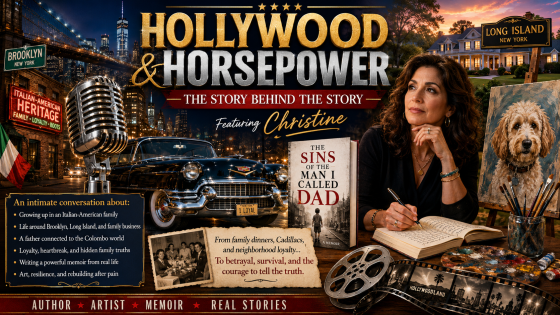

Hollywood And Horsepower Show with Mark Otto
Guest: Artist / Author - Christine Petrizzo, author of the book "The Sins of the Man I called Dad, My Father, The Mistress and the Mob"
Behind the Story: Christine’s Life, Family Legacy, Art, and The Sins of the Man I Called Dad
A Story Behind the Story
Hollywood and Horsepower opens with its promise to uncover the lives behind public reputations, then introduces Christine, an author and artist whose family story is connected to Italian American life, business, and organized crime. The host frames the interview as an opportunity to understand not merely a public name, but the childhood, family relationships, and personal experiences behind Christine’s book.
Growing Up in an Italian-American Family
Christine recalls growing up in East New York in a close Italian American family, surrounded by grandparents and extended relatives. She describes her father as a tough, frequently absent man whose trucking work, street connections, and increasingly prosperous lifestyle gradually made the children realize there was more to his life than they had initially understood. She and the host also reflect on anti-Italian prejudice and the contributions of Italian American families and businesses.
A Father Living Multiple Lives
As the conversation develops, Christine describes her father’s trucking and steel businesses, his connection to the Colombo family, and the wealth that eventually brought the family to a large home in Dix Hills. She says that despite the material comforts, his absences and long-term relationship with a mistress deeply affected her mother and daughters. The host and guest discuss the social codes and public perceptions connected to organized crime, while Christine keeps the emotional cost to her family at the center of her account.
Turning Pain Into a Book
Christine explains that she had long believed her family history could become a compelling story, especially after her mother’s death, her father’s choices, and the loyalty that she and her sisters showed him during difficult years. After an initial collaborative effort with her sisters did not work, she completed the manuscript herself with assistance and published The Sins of the Man I Called Dad. She describes the publication process as emotionally difficult but meaningful and says readers have responded strongly to the honesty of her life story.
Resilience, Motherhood, and Art
The interview also covers Christine’s divorce after her husband’s infidelity and her belief that he had modeled some of her father’s behaviors. She describes raising three young daughters through hardship and becoming stronger through those experiences. Christine then speaks warmly about her artistic gift, her dog portraits, her self-taught painting ability, her past wine-and-paint studio in New Jersey, and her hope to continue creating after moving to Florida.
Closing With Support and Appreciation
The host closes by encouraging listeners to obtain Christine’s book and find her art through her Instagram presence. The episode also repeats its sponsor acknowledgment for Tony’s Steak and Seafood and mentions Old Friends Equine and No Fallen Heroes as causes the host supports. Christine expresses gratitude for appearing on the program, and the host invites her to return while expressing hope that her book might one day become a film.
Hollywood and Horsepower Show


Through the relationships Mark Otto developed in Thoroughbred Horse Racing and Automotive Racing, during his global travels, the thing that most interested him was the story behind the story, with the famous people he was fortunate to meet. What was it that these people liked to do? How did they get into Hollywood or into Racing? These stories are fascinating! This is what encapsulates the “Hollywood and Horsepower Show”.
Bringing you along, we talk to so some of the most interesting people Mark met during his career. Don't be surprised if a few other guests stop by this show. This will be fun! It is where SNL meets The Tonight Show; a perfect mix of talk and comedy.
SPEAKER IDENTIFICATION
Speaker 1 – Host: The host introduces Hollywood and Horsepower, conducts the interview, identifies the sponsor and charitable organizations, and closes the program. The host’s name is not stated in the transcript.
Speaker 2 – Christine, Guest: The guest is introduced as an author and artist. Her surname is heard as “Pritziro” or a similar rendering; exact spelling requires verification.
SPEAKER 1 – HOST: Welcome to Hollywood and Horsepower. This is the show about the story behind the story.
We’re brought to you today by Tony’s Steak and Seafood. Tony’s is an experience, not just a restaurant, located in Indianapolis, Cincinnati, Lexington, and Bowling Green, Kentucky. You owe it to yourself to go. If you’re anywhere near there and you go anywhere else, you’re cheating your taste buds.
Tony’s is one of a kind. The meals are unmatched, the atmosphere is unmatched, and the staff and the owner are unmatched. They’re just terrific people. They make you feel special even if you’re not, and I can tell you that from personal experience.
We were there on Saturday night in Lexington, Kentucky. Unfortunately, we had to say goodbye to a really good friend, but it made it a lot nicer being able to catch up with some other friends and enjoy a meal at Tony’s. So if you’re anywhere near Lexington, Bowling Green, Cincinnati, or Indianapolis, stop at Tony’s. Tell them Hollywood and Horsepower sent you, and you’ll be thanking us when you do.
[INTRODUCING CHRISTINE]
SPEAKER 1 – HOST: We are joined today by a very special guest. She is very interesting: she’s an author, she is an artist, and she has done a lot of different things. We feel very fortunate to have her on the show with us.
Christine [surname requires verification] is with us today. I apologize for butchering her name. She didn’t shoot me. But I can’t thank you enough for joining us. We want to talk a little bit about your book and talk a little bit about life. I really thank you. Welcome to the show.
SPEAKER 2 – CHRISTINE: Thank you so much. Thanks for having me on. I’m very happy and flattered that you called me to be on your show.
SPEAKER 1 – HOST: I’m glad that you joined us. Before I go further, how do you pronounce your name properly? I don’t want to put your name down.
SPEAKER 2 – CHRISTINE: It’s Pritziro. [Spelling requires verification.]
SPEAKER 1 – HOST: Pritziro. Okay, just like it looks.
SPEAKER 2 – CHRISTINE: Yes.
SPEAKER 1 – HOST: I’m Italian myself, and sometimes it’s not what it looks like.
SPEAKER 2 – CHRISTINE: I know. A lot of the time, it’s very hard for me.
SPEAKER 1 – HOST: Believe me, I know. You and I talked a little bit before. We have some similarities in our backgrounds—kind of two different sides of the Italian world—but definitely some common ground there.
Your dad is very well-known by anybody who hasn’t been living under a rock. Thomas—Tommy—[introductory wording requires verification] was part of the Colombo family, a capo. Growing up, you had a really interesting childhood. I wanted to go back, even before the book, and talk a little bit about what that was like growing up. Where was home when you were really small?
[CHILDHOOD IN EAST NEW YORK]
SPEAKER 2 – CHRISTINE: We lived in East New York. My parents were born there. They weren’t born in Italy, but they were both Italian.
My mother had a very dysfunctional family, so she left school very young. She had to go to work and give the money to her father and his parents. There was a lot of alcoholism and things within the family. She met my father walking to work one day. She worked in a factory with her sisters, and at that time he worked for a garbage company. I think it was my grandfather’s route. They met on the street, started dating, and got married very young.
Then they started having children. My sister was born first. There were four daughters: Denise is the oldest. We had such a nice life with our grandparents. My grandparents were great. They loved us so much.
SPEAKER 1 – HOST: Were your grandparents born in Italy? Did they come over, or were they born here too?
SPEAKER 2 – CHRISTINE: Yes, they were born in Italy. I guess they came when they were a little older. I don’t really know exactly. Then they all lived in East New York—the whole family—so they had a little family there.
My father was a rough guy on the streets in East New York. He was a tough guy. He was a truck driver after that, and then there was a group in Brooklyn. I don’t know whether he started it, but they didn’t like who was moving into East New York, so there were riots and a lot of fighting going on in the streets.
At that time, I was a little kid, but I know the mayor asked my father, because he got arrested so many times, to leave Brooklyn. Then he would be okay. So that was it: we packed up and moved to Long Island.
I just remember, as a little kid, packing up. I hated to leave my grandparents, although they were over a lot. That is how my father started out on the streets in Brooklyn with all the local guys. They were young, maybe nineteen or twenty.
During the riots, we were never let out of the house. They would say, “You can’t go out.” We would ask why, and it was because they never knew what was going to happen. Maybe someone would come after the kids. We had to walk to school. That’s how it was in Brooklyn. Then we moved to Long Island when we were really young kids and started there in [location requires verification].
[ITALIAN-AMERICAN EXPERIENCE]
SPEAKER 1 – HOST: It’s funny, because I don’t think most people realize what it was like. I’ve always said every nationality, if you will, has had its day in the sun as far as being picked on or discriminated against. I don’t think people realize what Italians went through. Italians had a pretty rough go of it for a long time in New York.
SPEAKER 2 – CHRISTINE: They did. So did the Irish when they came, and Jewish people too. But the Italians had a hard time in the beginning.
SPEAKER 1 – HOST: That’s right. I don’t think a lot of people realize what went on. There was a time in New York when it was really dangerous to be Italian.
SPEAKER 2 – CHRISTINE: Right. I know.
SPEAKER 1 – HOST: As near as I can tell from what I’ve researched, my family came across from Italy through New York and kept going. They stayed there a little while, then moved on through Pennsylvania and into Michigan, around Detroit. Originally my dad grew up in northern Michigan, but later they came back to Detroit, where a lot of his uncles were, and that’s where he grew up.
I think a lot of people don’t realize how tough it was for people coming in. It wasn’t like they were exactly welcomed with open arms.
SPEAKER 2 – CHRISTINE: Right. Back in those days, it really wasn’t. It was hard for the Italians. Then they did such a great job with all the work they did. They were hard-working.
SPEAKER 1 – HOST: Think about it: the building, the small businesses. Even today, you go to Brooklyn, Bensonhurst, Howard Beach, Queens, and look at all the little shops, bakeries, delis, and restaurants. It’s amazing—multiple generations of all these things. I love going back there. I go back to New York several times a year, and I love walking around and looking at everything.
SPEAKER 2 – CHRISTINE: I know. Italians really do everything so specially—the cooking, the clothing, everything. The buildings, the steel industry: they were very hard-working people. People love Italians now, but back then maybe they didn’t. Italians made it better here when they came.
SPEAKER 1 – HOST: There’s no question. People just assume it was always like that, and I guess that’s what I was trying to get across: it wasn’t always that easy. Now people look at it and say, “There’s Little Italy.” Well, it wasn’t always like that.
I remember when I was young saying to my dad, who grew up in northern Michigan, “How come you never wanted to look up your original family and go back?” Our last name got changed; it isn’t what the Italian name was.
He said, “Let me explain something to you. Growing up in northern Michigan in the twenties, you didn’t want to be different. You just wanted to blend in.” He said it was bad enough that they had dark skin and jet-black hair.
SPEAKER 2 – CHRISTINE: Oh, come on. The Italians are beautiful. The men are handsome.
SPEAKER 1 – HOST: Yes, but you know what I’m saying. We stood out in a crowd.
SPEAKER 2 – CHRISTINE: I know. Then again, people think that if you’re Italian, right away you’re in the Mafia or you’re in the mob. But it’s not like that. Of course there is the Mafia, but it’s not all Italians. Today it is so much different.
[DISCOVERING THERE WAS MORE TO HER FATHER]
SPEAKER 1 – HOST: That brings me to the next thing I was going to ask. As you were growing up, did you start discovering that there might be more to your dad than what you realized?
SPEAKER 2 – CHRISTINE: I was a young one, and I would say, “He’s different.” Even when we were little and poor, we didn’t have too many friends. As we got older, I always asked why he was so different. He was always with these wise guys, and he was always out.
He was a truck driver, and he would come home with all these toys and everything. We would say, “Dad, it’s not our birthday.” He would say, “Oh, it fell off the back of the truck.” Everything fell off the back of the truck.
When I was little, I would picture a big truck driving in front of us on the road, the doors opening, and all these toys falling out. My father would pull over and pick them up. I didn’t know what to think when he said something “fell off the back of the truck” as a little kid.
SPEAKER 1 – HOST: The funny thing is, that actually was a phrase. They would say that to other guys too. I can remember guys saying, “I got you something.” “Where did you get it?” “It fell off the truck.”
SPEAKER 2 – CHRISTINE: Yes, I know. It was just a thing. After a while I would say, “All right, I guess it fell off the back of the truck.” We would get new bikes for no reason or whatever, and I guessed they fell off the back of the truck.
That’s how he was. He was rough and tough, always. When we moved to Long Island, it was the same thing as we got a little older. He was often not around because he was a truck driver and because of whatever he was involved in at the time. We didn’t really know, because he kept everything from us. We were little girls. He wanted boys, but he never got them. He had girls.
SPEAKER 1 – HOST: When did he get involved in businesses such as the steel company and the restaurants? Was that much later?
SPEAKER 2 – CHRISTINE: After the trucking. When we moved to Long Island, he started a trucking company, and then he started to build up.
SPEAKER 1 – HOST: He was not involved with the organization at that point?
SPEAKER 2 – CHRISTINE: Not that we knew. The trucking company was called JCLD, after us—the sisters. It was all our initials, JCLD. Then he started making more money.
We lived on Long Island, and he would come home with the big Eldorados. Later in life it was Bentleys, but at that point he would come home with the black Cadillac or the Lincoln Continental. My friends would say—we were little girls, maybe ten or twelve—they must have heard their parents say, “They’re in the mob.” The kids would say, “Your father’s in the Mafia.”
I didn’t know. I would ask my father, “Are you in the Mafia?” He would say, “Mafia? There’s no such thing as the Mafia. I work hard. I’m not a nine-to-five.” That was it.
He was not home a lot. It was hard for my poor mother. She didn’t drive. She always depended on neighbors to take her food shopping and things like that. When he came home, he was good when he came home, but it was not all the time. There were a lot of missing days and missing dads.
I guess he was always a womanizer. He always had girlfriends, besides whatever he was doing. He was involved with the mob, he was involved in his own business, and that was how it was back in the day. After a while, we all started to realize: he’s in the mob. But you didn’t ask. You just kept your mouth shut. That was it.
We always had such nice family dinners, and different people would come over—friends of his, “Uncle Ralphie,” Uncle This One. We always had a good time as younger kids.
[CADILLACS, NEIGHBORHOODS, AND FAMILY PROTECTION]
SPEAKER 1 – HOST: It is funny. In full transparency, I drive a Cadillac myself. Later in life, my dad always had a Cadillac. He worked at a Cadillac dealership after he retired, just for fun. I think there was something about Italians and Cadillacs.
SPEAKER 2 – CHRISTINE: I know, right?
SPEAKER 1 – HOST: It was like they felt, at that point, they had made it. I don’t know what it was, but it was more than a car.
SPEAKER 2 – CHRISTINE: Right. It really was. The Cadillac back then was a real Cadillac.
SPEAKER 1 – HOST: I remember, back in the mid-seventies, my dad would come home with different ones. Sometimes the neighbors would look and think, “That’s kind of interesting.”
When I was a kid in Detroit, we lived on a street that was mostly Italian. I remember everybody kept to themselves, but you couldn’t get away with anything. If you did something, your dad heard about it before you got home.
SPEAKER 2 – CHRISTINE: That’s right. They all knew each other. Somebody would call your dad: “Hey, your kid is down here. He skipped school. He went and did this.” You couldn’t get away with it.
SPEAKER 1 – HOST: The other thing I remember was there would always be an old man around. If you and some of your buddies were starting to get into trouble, he would literally tell you, “Don’t do that, man. That’s a felony. Get home.”
SPEAKER 2 – CHRISTINE: That’s good. You were boys, so it was different with the boys. They were always watching over you guys. With the girls, they were very protective.
SPEAKER 1 – HOST: My dad was really protective of my sisters. My sisters were much older than me. I was adopted later. I was talking to my oldest sister last night; she is about seventeen years older than me.
There is a funny story in our family that I’m sure you can relate to. My oldest sister was dating the man who later became her husband. My dad told him, “I want you to have her home by eleven.” They showed up a little later, around 11:15. Dad was sitting right by the back door in his bathrobe. They came through the back door. He told her, “Go to bed.” The boy stood there. My dad pulled out a revolver, laid it on the table, and said, “I’m pretty sure I told you eleven o’clock.”
SPEAKER 2 – CHRISTINE: Oh, my God.
SPEAKER 1 – HOST: He took off. It was the running joke in the family that he must have passed the test, because he came back.
SPEAKER 2 – CHRISTINE: Wow. I’m surprised he didn’t say, “All right, I’m not going back there anymore.”
SPEAKER 1 – HOST: But to your point, everybody was really protective of the girls. I have to be honest: I’m probably the same way with my daughter. I have a nineteen-year-old daughter and a twenty-two-year-old son. I’m protective of both of them, but I’m especially protective of my daughter.
SPEAKER 2 – CHRISTINE: Of course. My father was very protective of us. When guys came over when we were young, he would just give them a look, so they knew: “That’s my daughter.”
I remember my first boyfriend. I was young; we were just little kids. My father said, “Invite him over. We’re going to take him out for dinner.” The boy was always scared. My father took him for a little walk at my house and opened his jacket and showed him a gun or something. He said something to him, and the boy did not want to go out with me anymore. He was scared. Maybe I could have had a lot more boyfriends back then, because they were a little scared to be around my father.
SPEAKER 1 – HOST: You have to give your dad some credit on that one. If they get a little scare in them and they still come back, it’s probably a pretty good guy. If they don’t come back, maybe they had some bad ideas.
SPEAKER 2 – CHRISTINE: The ones that do come back have good intentions. We have to look at it that way.
SPEAKER 1 – HOST: Exactly. It’s a little bit of a test. If they meet us and they’re okay with it, chances are they didn’t have any bad ideas. If they meet us and shy away, it’s probably just as well.
[BUSINESS, STEEL, AND THE FAMILY’S CHANGING LIFE]
SPEAKER 1 – HOST: So, childhood in Brooklyn, then you are growing up and figuring out there is even more to Dad. How did that affect family life? He was busy a lot, of course, running businesses and other things.
SPEAKER 2 – CHRISTINE: He lived a lot of different lives, my father.
SPEAKER 1 – HOST: When did he get into the steel business?
SPEAKER 2 – CHRISTINE: After the trucking. I don’t know how he became involved, but then they started doing steel. I think he made his business as a steel business and progressed in the industry.
There are a lot of stories about him. People can look him up online and see what he really did. He was very involved in the unions and all that. His company delivered all the steel to the World Trade Center when it first went up. That’s how long ago he was in the business. Then, when it came down, he was involved in getting rid of the steel. He was older then, but he did that.
He was very big in his industry. He was involved in the Mafia and with the five families. They all worked together in the city with the unions, and they all made money with that at the time—in the seventies, eighties, and early nineties, I guess.
SPEAKER 1 – HOST: When the war started with the mob, that was kind of the end of an era.
SPEAKER 2 – CHRISTINE: Definitely.
SPEAKER 1 – HOST: With that war, with Giuliani, and with so many things that happened, so many people were killed or went away. That was when it all really came to a big halt. I’m not saying it’s over, but it is never like it was.
SPEAKER 2 – CHRISTINE: No, it’s never like it was. It’s different.
SPEAKER 1 – HOST: I’m not trying to romanticize it, but it did seem like there was a code and honor to it. They were not randomly doing things. There was a method to their madness. Then we got into the nineties after the war, and there were no rules anymore.
SPEAKER 2 – CHRISTINE: Everything changed. Before that, they had more of a system. Everybody was respected. That is the key right there: there was respect. There were lines you didn’t cross.
SPEAKER 1 – HOST: I’m not saying there weren’t guys who thought they were smarter than the system, but the system kind of weeded out those guys, if you know what I mean.
SPEAKER 2 – CHRISTINE: Right.
SPEAKER 1 – HOST: There were people, like John Gotti and some of the other guys, who did a lot of good in Howard Beach and Queens. They did a lot for people that people don’t know about.
SPEAKER 2 – CHRISTINE: Yes, they really did help people out. He was very well-respected. To this day in Howard Beach, you could stop somebody and mention his name, and they will say, “Oh, John was the best. He was the best.” He was a real man’s man. They loved him. He did a lot for the community, and he kept it safe. Whatever they did between each other, that was their own thing.
SPEAKER 1 – HOST: Exactly. If something happened there, it was between them. It wasn’t random acts against the public. If somebody was foolish enough to do something random, that usually ended really quickly.
SPEAKER 2 – CHRISTINE: Right. That is how it was.
SPEAKER 1 – HOST: It is hard to believe how long ago that was. I know you are friends with Angel, and I noticed that John Jr.’s daughter got married a couple of weekends ago. You look at the pictures, and it’s crazy how old everybody is. How old is John? He has to be close to fifty, right?
SPEAKER 2 – CHRISTINE: No, his birthday just passed. I think he was sixty-one.
SPEAKER 1 – HOST: Oh, wow.
SPEAKER 2 – CHRISTINE: They were a good family. But that is a good example of the two sides. They had their business, and then there was the side where they were out in public. In public, they definitely led a different life.
[FAMILY LIFE IN DIX HILLS]
SPEAKER 1 – HOST: You grew up with that. Then you went on to have your own family. You had daughters yourself.
SPEAKER 2 – CHRISTINE: Right. My father, when we moved to Dix Hills, was making a lot of money. He built this big, gorgeous house. It was like a Hollywood house. We all got new cars. We had a nice life, but he was never there, so it was hard for us. I felt sorry for my poor mother. It wasn’t easy, but we knew the lifestyle. Then you started to know. You didn’t ask any more questions; you just knew, and that was it.
It wasn’t easy. It was hard, because you didn’t really live a normal life. All the kids around the Persico family [name inferred from context; confirm if needed] and the other families—we all kind of stayed together. We were around the same age and were having kids. We lived that same lifestyle. We went to each other’s weddings and were around each other’s children. I don’t know how to explain it, but you all knew each other. We all knew what that lifestyle was like. It was easy being with each other, not that you sat around and talked about it. You did not ask questions. You just knew. It was simply the way life was.
SPEAKER 1 – HOST: In all fairness, I’m not making excuses for it, but it was a different time too. Even if a guy was not in the life and was a CEO of a company, he probably was not around much. I knew people whose fathers were very powerful CEOs, and they never saw their dads.
People had also gone through a period when their parents lived through the Depression, or they themselves touched that and saw what it was like. Your dad was born in 1933. It was kind of like they said, “We went through that, and we’re going to make sure we never go through it again.” They saw what it was like to go without, and they never wanted their families to go without. They went hard in the other direction.
SPEAKER 2 – CHRISTINE: That is true, but listen: my father did work hard. He was a workaholic. Aside from being connected with the Mafia, he also had his girlfriend—the mistress. We cannot forget about that.
[THE MISTRESS AND THE IMPACT ON THE FAMILY]
SPEAKER 1 – HOST: How did you figure that out?
SPEAKER 2 – CHRISTINE: We were really young; we were teenagers. We would go to a restaurant she had. We went there as a family a lot, so she was friendly with my mother. I did not really think she would ever be his type, because he liked those—people will read it in the book—redheaded, slim women. He liked those types of girls, with the big hair, the makeup, the tight dresses, and the big everything. He was always attracted to that.
I did not know why he was attracted to this woman. My grandfather was the one who said, “She has her claws in your father.” I said, “Grandpa, no. She is not his type.” He said, “Mark my words.”
After my grandfather passed away, I started to notice. We were young teenagers when it began, and it never stopped. She had a lot of control over him. As time goes on, you look back and say, “Oh, my God.” He was such a big guy in his industry and in the Colombo family, and one woman had a lot of control over him up until he passed away. That was amazing to all of us.
She kind of threw us under the bus. He loved us, but it goes very deep, and it is very emotional.
SPEAKER 1 – HOST: It was one woman for a long time.
SPEAKER 2 – CHRISTINE: One woman. I don’t know. She did something to him. You know what I’m talking about. With a lot of the guys you hear about in the life, it isn’t one woman; it’s any woman.
SPEAKER 1 – HOST: Right.
SPEAKER 2 – CHRISTINE: But this one had a hold on him, and I could never figure it out. She did. She controlled his money; she controlled a lot of things. I do not want to get into the whole thing, because it is in the book. That is what makes it really good.
SPEAKER 1 – HOST: We definitely want to encourage people to go out and get a copy of the book. It is worth the read. I’ve read parts of it. I need to sit down and go through the whole thing, which I will. But The Sins of the Man I Called Dad is a strong story.
[WHY CHRISTINE WROTE THE BOOK]
SPEAKER 1 – HOST: We are up to adult life now. What made you start thinking about writing the book? Was it something you always thought about?
SPEAKER 2 – CHRISTINE: I always wanted to. I always said, “My life story and my family’s story would be a great story.”
My mother passed away young. She was fifty-nine. She had cancer. What she went through with him and his mistress is another whole story, which is in the book. I do not want to give away the whole story.
A few years ago, my father was still alive, and my sisters and I felt that he never did the right thing for us. He lied all those years, saying, “I do this for you girls. You girls, you girls.” Meanwhile, it wasn’t for us. It was always for her, the mistress.
We decided we were going to write a book. We got a ghostwriter, sat down, and tried to write, but it did not work out. One sister wanted to say this; another wanted to say that. We stopped together, but I continued with my writing. I stopped for a long time, but then I said, “You know what? I’m going to continue this. I want to write this book.” That is what I did.
It took a long time. I do not know how to type, so I hired someone in the family—my son-in-law’s cousin. She is a doll, and she helped me. She would type, and I would read all my pages. We finally got it done.
Then my manuscript went to a really good company. They did a great job with the book: the Brooklyn Ghost Writer [name requires verification].
SPEAKER 1 – HOST: Yes, I heard you talking about that.
SPEAKER 2 – CHRISTINE: They were great. I had a great project manager. She actually emailed me last night that the book is back up on the top—I don’t know, number nineteen—in sales. It is doing well.
It really is a great story—my life story. It took about a full year for me to do it by myself. Then it took at least another six months to go through all the pages with the writers. It is a lot of work, and it was very emotional.
A lot of times I said, “I can’t go through with it. I just can’t.” There are things you do not want to say, and maybe you are uncertain. Family members can be happy or sad. There are mixed feelings with the book. But I did it. I had to do it.
The day it was published, I cried, because I said, “Oh, my God. It is out there. What am I going to do?” But everybody who reads it says, “I can’t put it down.” I have men I have never met who message me. One guy is like my biggest fan. He would text me, “I read another chapter. I do not want this book to end because it is so great.”
It is not really just a book. It is my story; it is my life. So I think it is great.
SPEAKER 1 – HOST: Those are the best stories.
SPEAKER 2 – CHRISTINE: Right, because it is a true story. It is all true. First of all, I never lie. It’s funny: my father always used to say—and he had the biggest lies—but he used to tell me all the time, “Never lie. Because you know why? You cannot remember your lie. You will never forget the truth, but you will forget your lies.” How he went through life, I do not know.
SPEAKER 1 – HOST: Maybe he did not like it, and he did not want to see you girls do the same thing.
SPEAKER 2 – CHRISTINE: Maybe. He believed his own lies. That is what happened. He believed his own lies.
SPEAKER 1 – HOST: It is true. You get to a certain point: you say the same thing enough times, and even you start believing it.
SPEAKER 2 – CHRISTINE: Yes. So I went through with it, and I think it is doing well. I really think it would be a great movie. I look at the cover of the book and say, “Oh, my God. He must be saying, ‘What did you do? How did you do this?’”
Sometimes I feel bad, and then I get mad and say, “You know what? You should have done the right thing.” When people read the book, they will realize he did not do the right thing for his family. We stuck by him. We were loyal. We did everything for him. During his prison time, we were always there for him.
He did not do the right thing for his children, his grandchildren, or his great-grandchildren. He did what he had to do for his mistress, and they will read about it. I figured I had to write it. My life story was a great story, and I think it would be an amazing movie.
SPEAKER 1 – HOST: Have you been approached about a screenplay or movie?
SPEAKER 2 – CHRISTINE: I would love to be. If somebody comes out and wants to try it, I would love that. I do not have the money to do anything, but the book is out there. I’m sure somebody will. Hollywood is always looking for stories.
SPEAKER 1 – HOST: It is a great story. It is real. People talk about writers like Hemingway and what made him great. I think what made him great was that he wrote about real life. He lived. Some things he created were fictional, obviously, but they were based around truth.
That is the same thing that makes your book so strong: it is real life. I think that is what people like. As you know as well as I do, there has always been fascination and curiosity around Italian life and the Mafia—what there is and what there isn’t. There have been so many stories about it that it is hard to determine what is fact or fiction. It gets exaggerated, obviously. Some stories are better than others, and I have even heard people from inside the life comment about certain portrayals that were pretty good. There is definitely curiosity and interest. I can easily see it becoming a movie.
SPEAKER 2 – CHRISTINE: That would be great. I would love to get it out there as a movie. My father was a big guy in the Colombo family. He was pretty big with them. He did what he had to do, I guess.
He loved his company, too. As I said, he was a workaholic. He loved his trucks, the bulldozers, and all the construction. He was so into construction. I look back and ask, “How did he live so many different lives?” It was really strange. I cannot do two things at the same time. I cannot imagine what his day was like—with his family, his work, the other life, and his girlfriend.
[ORGANIZED CRIME, BUSINESS, AND MICHAEL FRANZESE]
SPEAKER 1 – HOST: Some of the other guys associated with the Colombo family, such as Michael Franzese [spelling requires verification], were kind of the same way. Their lives evolved: they started out in one thing, went to another, then another.
Sometimes, especially in that world, it was opportunity, or sometimes something fell to you. Maybe somebody owed the group money and you ended up with a company you did not expect. Well, somebody had to run it. That would happen too.
I remember people telling me about one situation involving car dealerships.
SPEAKER 2 – CHRISTINE: Right. Are you talking about my brother and Michael?
SPEAKER 1 – HOST: I mean Michael Franzese.
SPEAKER 2 – CHRISTINE: Oh, Franzese.
SPEAKER 1 – HOST: There was a guy in the boroughs who owned a big car dealership and was a big gambler. He got to the point where he could not pay his gambling debt, and they took his dealership to pay the debt. They did not physically hurt him. They took the dealership and then gave him a job continuing to run the dealership.
SPEAKER 2 – CHRISTINE: I know the story. I have forgotten his name, but I know.
SPEAKER 1 – HOST: It shows where real events can differ from some television portrayals. They created a way for him to take care of the debt and keep going.
SPEAKER 2 – CHRISTINE: Right.
SPEAKER 1 – HOST: Sometimes they may not have planned to get into the car business, but a guy had a debt and they had to do something about it. All of a sudden, they were in the car business.
SPEAKER 2 – CHRISTINE: If he was a big earner, they were not going to get rid of him. They were going to have him keep earning money for them.
SPEAKER 1 – HOST: Exactly. He was more valuable with them, so they let him keep doing what he was doing. One guy said, “I know if I cut this guy off, he is going to go across town and start gambling with somebody else who is still connected to my book.” So he was better off finding a solution: “We will take the dealership, but you are going to work for us. You are still going to make money.”
SPEAKER 2 – CHRISTINE: That is like Michael Franzese. He made so much money with the gasoline thing that went on back then.
SPEAKER 1 – HOST: My gosh. To me, even to this day, that is one of the most brilliant things I have ever heard of.
SPEAKER 2 – CHRISTINE: I know. Whoever thought of that was unbelievable. He made millions a week. It was big money.
SPEAKER 1 – HOST: He made millions with a “B.”
SPEAKER 2 – CHRISTINE: Right. He is a very, very smart guy.
SPEAKER 1 – HOST: He is a very smart guy. He has a head for business.
SPEAKER 2 – CHRISTINE: Now he has the wine. He has so many different things—the books, the movies. He has done everything. Very smart man.
SPEAKER 1 – HOST: Did you know him when your dad was around?
SPEAKER 2 – CHRISTINE: I didn’t. My sister did, because I was more of the middle daughter. I got married young and had my kids. I was not really involved. But my sister, who married Michael [identity requires verification], knew him.
I did get in touch with Michael Franzese. I said, “I’m going to be writing a book. Did you know my father?” He said, “Yes, I know you.” He said he had the pleasure of meeting him a few times. They were not really close, but my sister knew Michael Franzese.
SPEAKER 1 – HOST: He seems like a really nice guy. I’ve always had a lot of respect for him.
SPEAKER 2 – CHRISTINE: Yes. He seems like a good guy. He is all over the place.
SPEAKER 1 – HOST: It is always interesting to me that you take a guy—and your dad was kind of like this—and no matter what they get into, they do well with it. Michael is kind of like that. As you were talking about, with the wine and the podcast, everything he touches seems to explode.
SPEAKER 2 – CHRISTINE: He knows how to do it. He knows how to put it all together. He definitely has a really good business mind. He loves his family too. That is why he left the mob when he could. When he got home from prison, he wanted to be with his family. He loved his wife and kids, and he has a lot of kids. I think he has about six.
SPEAKER 1 – HOST: I think the light bulb went on for him too. There are only two ways you get out of that, and neither one is good: you go to prison or to a grave.
SPEAKER 2 – CHRISTINE: That’s it: prison or a funeral. Those are the two options. I always used to say that to my father, but he would say, “Ah, there’s no such thing. What’s the Mafia?”
[THE COLOMBO WAR, LOSS, AND DIVORCE]
SPEAKER 2 – CHRISTINE: Even when the war started in 1992 and people were dying, I was really scared for my father. I didn’t think he was going to make it through.
I was at the hospital with my mother all the time. She got cancer and died in a very short time—seven weeks, and she was gone. It was really, really hard. The war was going on. It was very emotional. We went through a very hard time for a few years.
Then my husband cheated on me, and I had to go through a divorce. It was a lot of difficult years. To write the book was very emotional, because I had to bring up all these things again that I just wanted to bury.
SPEAKER 1 – HOST: You touched on your husband, and not to scratch at something painful, but was there common ground? Did you feel as if you married somebody similar to your father, personality-wise? Did you feel that way when it happened?
SPEAKER 2 – CHRISTINE: In the beginning, he was young—really young. But he wanted to be my father. He wanted to be just like him. I remember my mother telling my father, “Watch what you do in front of your son-in-law, because then they think they can do it too.”
That is really what happened. He thought, “It is okay for him. Why isn’t it right for me?” Then I had to go through a divorce with three young girls. It was really, really difficult. My father was there for me a little bit, but he had his life. I had to go through it.
Listen, you learn. That leads me to what I am today. I am a strong woman. I do what I have to do. I am an artist. I do my paintings, which God gave me as a gift.
[CHRISTINE’S ART AND PAINTING CLASSES]
SPEAKER 1 – HOST: That is a wonderful gift, and an amazing talent. I have seen some of your work. It is kind of funny: I have a little dog, a little Coton, and I’ve seen a couple of your pictures of a little dog that looks just like my dog. You do amazing work.
SPEAKER 2 – CHRISTINE: Thank you. I really appreciate that. I really get into it. I do portraits. People send me a picture of their dog, and then I paint the picture, and it comes out beautifully. I also do other paintings. I like to do paint classes and teach.
SPEAKER 1 – HOST: Do you do a lot of teaching?
SPEAKER 2 – CHRISTINE: I used to have a studio when I lived in New Jersey.
SPEAKER 1 – HOST: I remember that.
SPEAKER 2 – CHRISTINE: It was like a wine-and-paint studio. They would bring their wine and paint. It was great. Now I moved to Florida a few months ago. I am trying to do something here because it is my passion. I just love it. I really love it.
SPEAKER 1 – HOST: A wine-and-paint studio is not a bad idea. The more wine you drink, the better the painting looks.
SPEAKER 2 – CHRISTINE: Yes, you relax. I play great music. It is great. It really is. Everybody leaves with a painting they love. I taught myself how to paint. I never went to school for it. I taught myself.
SPEAKER 1 – HOST: How old were you when you started painting?
SPEAKER 2 – CHRISTINE: I was a little girl. My father was an artist; that is where I got it from. He never pursued it, but he definitely could draw. I got it from him.
When I was a little girl, I painted a whole mural on my wall—all these little lands and all these little characters. It was beautiful. I was always artistic. I did not go to school for it; I taught myself. Then I had to teach a class, so I taught myself how to teach a class. I am very proud of that.
SPEAKER 1 – HOST: That is very impressive. My daughter is very artistic and creative. She has done a lot of drawing and painting, and she is really creative in that way.
SPEAKER 2 – CHRISTINE: That is great. That is such a gift. It really is. I cannot even think of the word to use, but I am so thankful to have it.
SPEAKER 1 – HOST: You have some of your family down in Florida with you, right?
SPEAKER 2 – CHRISTINE: Yes. Two of my daughters moved down, with my little grandchildren. Some cousins are here, and my sister lives in the Keys.
[BOOK AND ART INFORMATION]
SPEAKER 1 – HOST: That is really great. We are coming up on the top of the show, Christine, and I cannot thank you enough.
Again, the book is out on Amazon. I encourage everybody to go look at it: The Sins of the Man I Called Dad, by Christine [surname requires verification]. You did a tremendous job. It is an amazing book. I encourage anybody to get it. You can get it on Kindle. Maybe at some point it will be available on audiobook. It is a terrific book.
I also encourage everybody to look up your artwork. Where can they find that?
SPEAKER 2 – CHRISTINE: They can look up Christine Paint Studio on Instagram, and they can see the paint classes and some of my artwork. They can see the dog paintings on there too. I thank you so much.
SPEAKER 1 – HOST: I thank you. I cannot thank you enough for doing this.
[CLOSING SPONSOR AND CHARITABLE MENTIONS]
SPEAKER 1 – HOST: Thanks for joining us. We’re brought to you today by Tony’s Steak and Seafood.
We have to take a minute and plug a couple of little things that we always care about. Old Friends Equine is a thoroughbred retirement farm in Lexington, Kentucky. They do the best work in the world, and I would argue that with anybody. I have nothing to gain, because they do not pay us. I do this because I think it is a good cause.
If you are in Kentucky, go to Tony’s for dinner and go to Old Friends for the afternoon.
No Fallen Heroes is connected with a good friend of ours, Matt [surname requires verification]. He helps first responders and veterans. He is a Top Gun pilot—the real deal, the real-life Jester, if you will. He was an adversary pilot at Top Gun school.
So take a minute and look at those two: No Fallen Heroes and Old Friends Equine. If you cannot do a lot, do what you can.
We appreciate everybody. Thank you for joining us. Thank you, Christine. It has been an honor to talk to you. I would love to have you on again, so please keep in touch. We are anxious to hear when the book becomes a movie.
SPEAKER 2 – CHRISTINE: I know. That would be great. You will be one of the first to know.
SPEAKER 1 – HOST: I would love to hear about it. Let’s keep in touch.
This has been Hollywood and Horsepower with Christine. We really appreciate you taking the time to join us. Go get her book, The Sins of the Man I Called Dad. You can find it on Amazon or anywhere else. I’m sure it is sitting on the shelf at your local bookstore.
Thanks for joining us, everybody. This is Hollywood and Horsepower. We’ll see you again next week.