
Hollywood and Horsepower Show, June 11, 2026


Hollywood And Horsepower Show with Mark Otto
Guest: Lawrence Hicks - He produces the social media program, Detroit Mob History
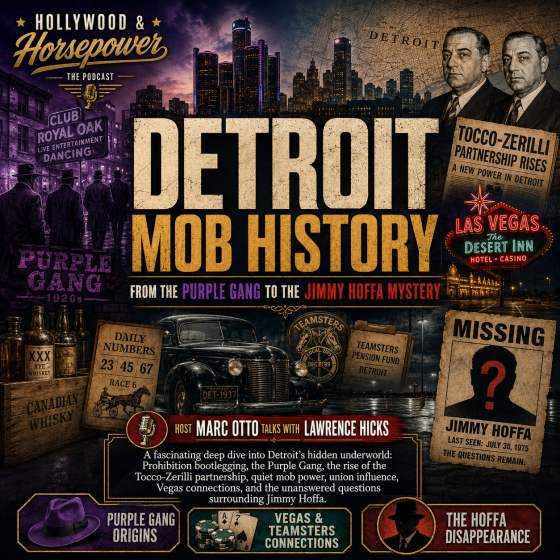
Detroit Mob History, the Purple Gang, and the Mystery of Jimmy Hoffa
The Story Behind Detroit Mob History
Marc Otto opens the episode by introducing Hollywood and Horsepower and welcoming Lawrence Hicks, creator of Detroit Mob History. Marc explains that his own interest in the subject is personal because his father served for 27 years as a Detroit vice cop and had interactions with figures connected to the era being discussed. Lawrence describes how he began exploring Detroit organized-crime history through the Purple Gang and now shares that history through Instagram, TikTok, and an upcoming website.
The Purple Gang and Detroit Bootlegging
Lawrence explains that the Purple Gang rose in the 1920s and 1930s as a dominant bootlegging force in Detroit during Prohibition. He describes figures connected to the group, including the Bernstein brothers and Fleisher brothers, and emphasizes their reputation for aggression and ruthlessness. Marc adds context for listeners by explaining bootlegging as the illegal alcohol business during Prohibition and notes that the Purple Gang was known for making people disappear if they got in the way.
The Rise of the Tocco-Zerilli Partnership
The discussion moves from the collapse of the Purple Gang to the rise of the Italian families, especially William “Black Bill” Tocco and Joseph “Joe Uno” Zerilli. Lawrence describes how the Purple Gang’s internal distrust and violence created space for the Tocco-Zerilli partnership and the Detroit Partnership family. He also explains that Detroit’s crime family became known for staying quiet, low-profile, and business-minded, even requiring education and business acumen among made members.
Unions, Teamsters, Vegas, and Jimmy Hoffa
Marc and Lawrence discuss how the Detroit family became connected to unions, the Teamsters, Las Vegas casino funding, and Jimmy Hoffa. Lawrence explains that Hoffa’s access to Teamsters pension funds allegedly helped finance Las Vegas casino investments when banks were not interested in backing the projects. They also discuss tensions involving Hoffa, Frank Fitzsimmons, Tony Provenzano, and Detroit approval, leading into the mystery of Hoffa’s disappearance in 1975.
The Hoffa Disappearance and Detroit’s Low Profile
The episode explores several theories surrounding Jimmy Hoffa’s disappearance, including Marc’s story about his father being asked to have lunch with Tony Giacalone after Hoffa vanished. Marc says his father believed Hoffa and the car may have ended up at a steel plant, while Lawrence notes that only those involved truly know what happened. Both emphasize that, despite the heat from the Hoffa case, Detroit’s organized-crime family managed to fade back into the background and return to a lower profile.
Modern Detroit Mob History and Preserving the Past
The later discussion covers the 1980s and beyond, including Tony Zerilli’s decline in power, Jack Tocco’s leadership, RICO pressure, family friction, and the continuing low-profile nature of the Detroit family. Lawrence says he wants to focus next on the Purple Gang, the 1920s and 1930s, the Detroit Partnership, and the Crosstown Mob War involving Chester “Big Chet” LaMare. The episode closes with Lawrence promoting Detroit Mob History’s social platforms and merchandise plans, while Marc thanks him and highlights Tony’s Steak and Seafood, Old Friends Equine, and No Fallen Heroes.
Hollywood and Horsepower Show
Through the relationships Mark Otto developed in Thoroughbred Horse Racing and Automotive Racing, during his global travels, the thing that most interested him was the story behind the story, with the famous people he was fortunate to meet. What was it that these people liked to do? How did they get into Hollywood or into Racing? These stories are fascinating! This is what encapsulates the “Hollywood and Horsepower Show”.
Bringing you along, we talk to so some of the most interesting people Mark met during his career. Don't be surprised if a few other guests stop by this show. This will be fun! It is where SNL meets The Tonight Show; a perfect mix of talk and comedy.
Speaker Identification
Speaker 1 - Intro / Outro Song Voice
Identified by the opening and closing show-theme lyrics about Hollywood, horsepower, legends, stories, and the road.
Speaker 2 - Marc Otto, Host
Identified by his opening line, “I’m your host, Marc Otto,” and by his role guiding the interview and sponsor mentions.
Speaker 3 - Lawrence Hicks, Guest / Creator of Detroit Mob History
Identified by the host’s introduction and by his discussion of Detroit Mob History, the Purple Gang, Detroit organized-crime history, Jimmy Hoffa, and related figures.
Speaker 1 - Intro Song Voice:
I’ve been down roads from Churchill to L.A., met kings of speed and stars along the way. They’ve got stories that the cameras never show. Yeah, the truth behind the fame is what we know.
From the saddle to the silver screen, from fast lanes to punch lines on a late-night show, you think you’ve seen it all, but you don’t know the half, until the curtain lifts and we all have a laugh.
It’s not just who they are. It’s how they came to be. A little horsepower, a little mystery. Hollywood and Horsepower, baby, take a ride, where the legends laugh and the engines never hide.
From the track to the spotlight, stories unwind. Gather truths a little wild and one of a kind. Hollywood and Horsepower, where the real ones show. Every twist and turn is a tale you didn’t know. So pour a drink, sit back, and enjoy the show, where the fast and famous let it all go.
Speaker 2 - Marc Otto, Host:
Welcome to Hollywood and Horsepower, the show about the story behind the story. I’m your host, Marc Otto, and we are brought to you today by Tony’s Steak and Seafood in Indiana, Ohio, and Kentucky.
Take your chance, look at their website, and get your friends, your family, or anybody close to you a gift card. If you’re traveling, you would be cheating yourself not to go there. It’s not just dinner. It’s an experience. As Tony says, there’s always room at the table for one more.
We are joined today by a very special guest. He hosts a program called Detroit Mob History. I have always been interested in this because I have not really talked about it a lot, but my dad was a Detroit vice cop for 27 years with the Detroit Police Department. He was in vice, and I’m Italian, so I know it was a very interesting time. He was in there from somewhere around 1941 until 1969, so he retired early. He had a lot of interactions with some people we will talk about today.
We are joined today by Lawrence Hicks. Lawrence, welcome to the show.
Speaker 3 - Lawrence Hicks, Guest:
Thank you. Thank you. Thank you.
Speaker 2 - Marc Otto, Host:
Thank you. I appreciate you taking the time to join us today. I have always been interested in following what you do because you have a gift for finding pieces of history that I do not think most people knew about. Or, if they had heard things about it, maybe they had heard them incorrectly, or they had only heard pieces of the story.
I know I have learned a lot since watching your program. It is called Detroit Mob History. How many different platforms are you on?
Speaker 3 - Lawrence Hicks, Guest:
I’m on Instagram and TikTok.
Speaker 2 - Marc Otto, Host:
I encourage everybody to go and check it out. Check out your TikTok page. You have great content. It is really interesting, and that is some of what we want to talk about today.
I think people do not always realize that there even is, or was, a Mafia in Detroit, or how influential it was. One of the things you have spoken about is that, going back, Detroit was actually influential. Give us a little history. Where did it kind of start? You know a lot about it, and I do not want to misrepresent it.
Speaker 3 - Lawrence Hicks, Guest:
The way I got into the whole backstory of the Mafia in Detroit was with the Purple Gang. The Purple Gang started in the early 1920s and went into the 1930s. They were really the brand for bootlegging in Detroit.
You had the Bernstein brothers, the Fleisher brothers, and a couple of other guys. They pretty much ran the bootlegging in Detroit.
Speaker 2 - Marc Otto, Host:
For people who do not understand, bootlegging was basically the illegal alcohol business. We are talking about a time when there was Prohibition and there was no alcohol being sold in Michigan. Well, most of the country, right? Not just Michigan.
Speaker 3 - Lawrence Hicks, Guest:
Exactly. You had Abe Bernstein, who was the leader of the Purple Gang, and his brother Ray Bernstein. He pretty much coordinated all of the blind pigs in the city of Detroit. They were really assertive, very aggressive, and ruthless.
Speaker 2 - Marc Otto, Host:
That was what I had heard. The Purple Gang, for anybody who did not know, was really strong in Detroit at one time. They pretty much ran anything, and if you got in their way, you had a tendency to disappear. They might find you, but you disappeared.
How did that evolve? It goes from there, and then later it becomes another family. What was that family after that?
Speaker 3 - Lawrence Hicks, Guest:
After the Purple Gang, the Purple Gang pretty much imploded. They had a lot of trouble trusting each other. A couple of them went to jail. Ray Bernstein went to jail, and on the come-up were the Italian gangs. You had William “Black Bill” Tocco and his first cousin, Joseph “Joe Uno” Zerilli.
Speaker 2 - Marc Otto, Host:
You cut out there for a minute. Sorry about that.
Speaker 3 - Lawrence Hicks, Guest:
Right after the Purple Gang imploded and started shooting with each other, the gang kind of blew itself apart. Then you had William “Black Bill” Tocco and Joseph “Joe Uno” Zerilli coming up. They started to form a partnership, and they pretty much coordinated what became the Detroit Partnership family.
Speaker 2 - Marc Otto, Host:
They were not part of the Purple Gang, though?
Speaker 3 - Lawrence Hicks, Guest:
Exactly.
Speaker 2 - Marc Otto, Host:
What year was that? Because there was a time when they kind of formed the old Cosa Nostra in New York. Was that around 1937? I might be wrong on the year. I think 1935 was when the Commission happened in New York.
Speaker 3 - Lawrence Hicks, Guest:
I’m not sure on the year. It could be 1937.
Speaker 2 - Marc Otto, Host:
So were the Tocco family already part of the Commission?
Speaker 3 - Lawrence Hicks, Guest:
Yes. Joseph “Joe Uno” Zerilli was the godfather. A really interesting fact is that he was the longest-serving don in the country for almost 40 years.
Speaker 2 - Marc Otto, Host:
Wow. Who was that?
Speaker 3 - Lawrence Hicks, Guest:
That was Joseph Zerilli.
Speaker 2 - Marc Otto, Host:
I heard my dad talk a lot about Joseph Zerilli. He actually was kind of friendly with him. I do not know the details, but they kind of worked back and forth, if you will. I think it was a little different back then. There was kind of a give-and-take between the family and the police department.
That is pretty interesting. These guys come in and pick up the pieces after the Purple Gang falls apart. How did they start building?
Speaker 3 - Lawrence Hicks, Guest:
Once they formed a partnership, there was the Licavoli group, Peter “Horseface” Licavoli, the Corrado family, and others. They started to control the bootlegging after the Purple Gang. They already had things set in place because they had worked with the Purple Gang as well.
Speaker 2 - Marc Otto, Host:
There was already a connection between the two, and they just kind of assumed a lot of their business.
Speaker 3 - Lawrence Hicks, Guest:
Yes.
Speaker 2 - Marc Otto, Host:
It evolves from there. From my understanding, they are developing their family, growing, and getting more involved in different things. Chicago even took some lessons from them.
Speaker 3 - Lawrence Hicks, Guest:
Yes, because the Detroit Mafia family was really good at being under the radar. That is what they were known for. That is one of the main reasons why no one really knows there was a Mafia in Detroit, because of how they executed, not being on the news or on the radio. They were really in the underworld, literally.
Speaker 2 - Marc Otto, Host:
They were pretty quiet, not real flashy like some of the other families around the country.
Speaker 3 - Lawrence Hicks, Guest:
Yes. Also, a really important thing about the Detroit crime family, the Tocco-Zerilli crime family, is that you also had to be college educated. You had to have some type of business acumen even to be a made person.
Speaker 2 - Marc Otto, Host:
Wow. That is definitely rare. That is not something a lot of the other families required, is it?
Speaker 3 - Lawrence Hicks, Guest:
No, not at all. They were very, very smart. Like I said, Joseph Zerilli was the longest-serving don in the country. His son was Tony Zerilli. William “Black Bill” Tocco’s son was Giacomo “Jack” Tocco. They essentially learned from the best of the best.
Speaker 2 - Marc Otto, Host:
That makes sense. You mentioned Tony Jack. How did he come in?
Speaker 3 - Lawrence Hicks, Guest:
Tony Giacalone and his brother, Billy Giacalone, came through their father, who worked at Eastern Market. I do not know if their father was in the mob, per se, but the Tocco and Zerilli people took note of his sons. Tony Giacalone ended up driving for Tocco and Zerilli for about a decade or so.
Speaker 2 - Marc Otto, Host:
That is pretty interesting. At what point did they take over? I am assuming they were capos at that time. Were they there until Joe Zerilli passed away, and then they took over? Or did they take over before he passed?
Speaker 3 - Lawrence Hicks, Guest:
Once Joe Zerilli passed away, his son Tony Zerilli was supposed to be the person running the family. But he ended up getting caught in a gambling-tax case. The feds bugged the phone, and they also bugged a light somewhere near Eastern Market. They caught Zerilli on tape speaking about the family, speaking with his nephew, Nove Tocco, and talking about the family and everything else.
Long story short, Tony Zerilli ended up not getting the place, and Giacomo “Jack” Tocco ended up being the person who was running the mob family.
Speaker 2 - Marc Otto, Host:
Wow. That is interesting. They had actually put a microphone on a streetlight or a street post and caught him on the sidewalk talking, and they bugged his car as well?
Speaker 3 - Lawrence Hicks, Guest:
Exactly.
Speaker 2 - Marc Otto, Host:
It is amazing that they had that technology at that time. We are talking late 1950s or 1960s?
Speaker 3 - Lawrence Hicks, Guest:
Yes, late 1950s or 1960s.
Speaker 2 - Marc Otto, Host:
They actually put something in his car that transmitted the information.
Speaker 3 - Lawrence Hicks, Guest:
Yes.
Speaker 2 - Marc Otto, Host:
So he ended up not getting the position because it was a bad look for the family. They were known for Detroit not even being negative, or not being in the limelight.
Speaker 3 - Lawrence Hicks, Guest:
Exactly. That put him into the limelight in a way they did not want.
Speaker 2 - Marc Otto, Host:
I am sure that was not very welcome. That kind of knocked him down, and then Jack Tocco took over and was the leader for the family until he passed away.
For people who do not understand, we are talking with Lawrence Hicks, who is the founder of Detroit Mob History. You can find him on TikTok and Instagram. He has done a fabulous job of really bringing out the history of the Detroit families. It is interesting because I do not think a lot of people are aware of this. A lot of people probably did not even realize that there was an organized family, and even the ones who did probably did not know that it was always kind of quiet.
In an odd way, they kind of lived in plain sight. They lived in neighborhoods around the city, did they not?
Speaker 3 - Lawrence Hicks, Guest:
Yes. The leaders were kind of in one area, but a lot of the capos and made men were all over the place. That is what Tony Giacalone was really known for. He was almost the face of the Zerilli-Tocco family.
Speaker 2 - Marc Otto, Host:
So that makes sense. That is how the Giacalones got into it. Basically, when Zerilli got charged, that cast a little bit of light they did not really want.
By that time, they were probably starting to get involved with unions and different things.
Speaker 3 - Lawrence Hicks, Guest:
Yes. That is where Jimmy Hoffa comes into play. Jimmy Hoffa had a connection with the Mafia family, using pension funds from the Teamsters to build Vegas.
Speaker 2 - Marc Otto, Host:
Really?
Speaker 3 - Lawrence Hicks, Guest:
He was using the Teamsters pension funds to invest in Las Vegas.
Speaker 2 - Marc Otto, Host:
So that was a lot of money that they used to build things and do things in Vegas.
Speaker 3 - Lawrence Hicks, Guest:
Exactly, because the banks were not really looking to invest in Vegas. It was prime real estate for the Mafia. Across the country, they used the pension funds, and they used Jimmy Hoffa to get the Teamsters pension funds to fund Las Vegas casinos.
Speaker 2 - Marc Otto, Host:
Basically, they gave them loans, and then they would pay it back once they got the casinos going.
Speaker 3 - Lawrence Hicks, Guest:
Yes.
Speaker 2 - Marc Otto, Host:
Obviously, he got a little something as a finder’s fee. Was it Bugsy Siegel who started all that? Who was it?
Speaker 3 - Lawrence Hicks, Guest:
You had a couple of families. You had the New Jersey family, including Tony Provenzano, who actually got into a fight with Jimmy Hoffa. They already had tension with each other before things really spilled over and before Jimmy obviously died. You also had Meyer Lansky and Chicago.
Jimmy Hoffa ended up creating a lot of conflict because Frank Fitzsimmons took over after Jimmy Hoffa went to jail, and Jimmy Hoffa wanted his position back. That is where he kind of went on the rampage. Allegedly, Jimmy Hoffa set up a bomb in Frank Fitzsimmons’ son’s car at a restaurant in Corktown. Luckily, Fitzsimmons’ son was not inside the car, but they say Jimmy Hoffa actually had the bomb put in his car. It blew up, and that is what really tipped Hoffa over toward being killed.
Speaker 2 - Marc Otto, Host:
So it was really a dispute between him and guys out in New Jersey.
Speaker 3 - Lawrence Hicks, Guest:
Yes, but they had to get approval by the family in Detroit.
Speaker 2 - Marc Otto, Host:
The Commission in Detroit. That is pretty amazing.
Going back, the Purple Gang rolls into the Giacalones and Zerillis. Zerilli and Giacalone are growing and building the organization. Obviously, Prohibition comes to an end. How did they evolve at that point? Was it the numbers racket or other types of gambling? Michigan was never really, people probably do not remember this, but the lottery was not even around back then. They had what they called a numbers game that was basically run under the counter at a lot of bars, stores, and things.
Speaker 3 - Lawrence Hicks, Guest:
Yes. I know they controlled the numbers racket. I also know that the Giacalones, Tony Giacalone and Billy Giacalone, were involved. They got money from the numbers racket, Vegas, and other things. They invested pretty heavily in Vegas.
Speaker 2 - Marc Otto, Host:
Yes. Bugsy Siegel and Meyer Lansky brought Vegas back in about 1940 and started building around 1945 and into the 1950s, building the Strip. There was a lot going on there. There was a lot of construction and growth. Detroit was involved up into that point in time, then?
Speaker 3 - Lawrence Hicks, Guest:
Yes. Vegas was a big part of Mafia families across America.
Speaker 2 - Marc Otto, Host:
I am sure a lot of people did not even know that because Detroit did a really good job of flying under the radar. I think everybody knew that some of the New York families were involved, and the Chicago Outfit, but when you go back and read, they do not even mention Detroit. It is interesting because it sounds like Detroit really was one of the bigger fundraisers, pulling a lot of money from Hoffa and the Teamsters to help fund a lot of the projects.
Speaker 3 - Lawrence Hicks, Guest:
Yes. They also had clubs and stuff like that, but it was predominantly the numbers racket and Vegas.
Speaker 2 - Marc Otto, Host:
It is funny. My dad was a Detroit vice cop, and he hated the lottery. The day he died in 2004, he still did not like it. He said, “When Giacalone did numbers, guys went to prison. When the state does numbers, it is called the lottery.” It just bothered him. But I know that was a big business.
I remember him talking about it. It would be at almost every bar, party store, or club. You could walk in, and as long as they knew you or you knew the right thing to say, the guy would pull out the book and you would pick numbers.
Did you ever figure out where Detroit’s numbers were chosen from? Did you ever hear anybody talk about it?
Speaker 3 - Lawrence Hicks, Guest:
No, that I do not know.
Speaker 2 - Marc Otto, Host:
In New York, the story was that Belmont Park was a big racetrack. They used Belmont a lot. In fact, John Gotti, up into the 1980s, would go to Belmont for meetings because there were no microphones. He had figured out that his club, the Bergin Hunt and Fish Club, the Ravenite Social Club, and even some of the outside traffic lights or streetlights had been bugged. He knew there were cameras all over him. So he would go to Belmont and pick random places, never the same place twice, so they could not set it up, and he would have a lot of his meetings.
From what I have been told, and this is Jim’s hearsay, but it tracks, the numbers for the day were the last three digits of the attendance at Belmont Park. I can remember this back in the 1980s. If you were in New York and watched the evening news, they would always give the attendance for Belmont Park. I remember thinking, “Why is that a big deal?” The guy would even repeat it sometimes. He would say, “Belmont Park, such-and-such horse won, and the attendance today was 937. That is 937.” He was announcing the winning numbers.
It was funny because, listening to it then, I was thinking, “What the heck is he doing?” Now it makes sense. I was always curious how other cities did it, or if they all went off that. I know New York always seemed like the head office, if you will.
Coming into the 1970s, things are starting to fracture a little bit, right? Charges are being brought. Hoffa disappears. That brought a lot of heat.
Speaker 3 - Lawrence Hicks, Guest:
Yes, 1975.
Speaker 2 - Marc Otto, Host:
What were they doing at that point? Were they still feeding Vegas on expansion? The numbers had to be big, and I do not know what year the lottery started, but it had to be right in there.
Speaker 3 - Lawrence Hicks, Guest:
I know they also owned Hazel Park Raceway, the horse track. They were getting money from that as well. After the 1970s, I know there was another rebuilding phase. Like I said, Tony Zerilli ended up getting caught with the gambling-tax case, so they really had to figure out how to get back.
Speaker 2 - Marc Otto, Host:
Tony Jack got some light on him at that point, too, when Hoffa came up missing, because he was supposed to be the one who was going to meet him.
Speaker 3 - Lawrence Hicks, Guest:
Yes, he was supposed to be. It is funny. He was at the Oakland Sportsmen’s Club, and he never talked to anyone at all. But on the day Jimmy Hoffa went missing, on July 30, he was just outside talking to everybody, smiling and everything else. It was completely out of his character.
Speaker 2 - Marc Otto, Host:
He had to make sure he had an alibi. He had to make sure somebody knew where he was and that he was not there.
Speaker 3 - Lawrence Hicks, Guest:
Yes. They did a really great job. You could almost say they put out a disinformation campaign during the whole time, because everybody was trying to figure out what was going on. Even from other families, you hear people from New York, like Michael Franzese, saying he knows, and people from Jersey saying Jimmy Hoffa would be there. It is incredible that, to this day, no one has even found Jimmy Hoffa.
Speaker 2 - Marc Otto, Host:
I have heard Franzese say he had heard a story, but he was not even sure it was accurate. It does seem like it probably was intentional, that they purposely dropped a bunch of different rumors to confuse everybody.
Speaker 3 - Lawrence Hicks, Guest:
Yes. Even to this day, you hear different theories.
Speaker 2 - Marc Otto, Host:
There are a million different theories. I was telling you my dad retired from Detroit PD vice in 1968 or 1969. He got called in 1975 because he knew Giacalone personally, and he was asked by someone in the upper echelon in Detroit to go have lunch with him. He did.
I heard him tell the story to my mother. She asked how it went, and he said, “We walked in, sat down, and I told him, ‘I think you know why I’m here.’” Giacalone said, “Chief, we’ve been friends for a long time. I can’t talk to you about this.” My dad said, “Fair enough.” He said they had lunch, he asked him about the family and the kids, paid the bill, and left.
His theory was always that Hoffa and the car ended up going into a steel plant and into the melting pot. But he said it was just a theory, because nobody saw the car leaving the restaurant. He figured there was a truck or something involved that got it out of there, because nobody ever saw it leave.
Speaker 3 - Lawrence Hicks, Guest:
Yes. They pretty much assume Hoffa was most likely killed inside the car, and whatever happened to the body, only they know.
Speaker 2 - Marc Otto, Host:
The car was never found either, was it?
Speaker 3 - Lawrence Hicks, Guest:
I do not think so.
Speaker 2 - Marc Otto, Host:
That was a pivotal chapter.
We are talking with Lawrence Hicks of Detroit Mob History. Hollywood and Horsepower is brought to you today by Tony’s Steak and Seafood in Indianapolis, Ohio, and Kentucky. You can find them online. It is one of the best restaurants I have ever been to, and I have been to a lot of them.
We also support two charities on this show: OldFriendsEquine.org in Georgetown, Kentucky, where a lot of retired racehorses end up, and No Fallen Heroes, which helps first responders and veterans dealing with PTSD, suicide prevention, and a lot of other things. If you cannot do a lot, do a little. Every bit helps both of those organizations. We help both animals and people here, and we want to support both Old Friends and No Fallen Heroes.
Lawrence, we are up to 1975. Hoffa has come up missing, and there is a little bit of unwanted attention on the family. How are they evolving at this point? How did they shift? What is ironic is that the story lingered for a little bit, but it did not throw the family out into the limelight for long. They were pretty good about getting back undercover. I do not think that, by the end of the 1970s, anybody thought about it very much. I think everybody kind of wrote it off as some sort of dispute between Hoffa and the Italian families.
Speaker 3 - Lawrence Hicks, Guest:
Yes. I do know that I saw or read a story that Isiah Thomas got caught up with the Mafia as well, maybe with gambling or something like that.
It appears that they started to focus more on their businesses than everything else because, with the whole Hoffa thing, they were catching heat. They were focusing on legitimacy and making sure they did not catch any more heat from the feds.
Speaker 2 - Marc Otto, Host:
There are several people like Isiah, and I do not know if this is what happened to him. I do not know him other than by reputation. But Michael Franzese has told this story himself online. A lot of times, what would happen, and I have heard this from several people, is that a lot of athletes are pretty big gamblers. They like to bet.
Speaker 3 - Lawrence Hicks, Guest:
Oh, yes.
Speaker 2 - Marc Otto, Host:
It could be anything. It might have nothing to do with their sport. They might bet horses, boxing, or anything. What they say would happen is that the athlete would get in over his head. Then he would go across town and start working with another bookie, not realizing that guy was connected to the same organization. Michael said he would get a call from that guy saying, “This guy is trying to place a bet.” Michael said he would tell them, “Let him.” They would intentionally feed him rope until he was in a real spot. Sometimes they could owe several hundred thousand dollars.
Then they would have a sit-down with him and say, “All right, here is the thing. You have a big debt to pay. Can you pay the debt? No. We are not going to hurt you. We do not want to take your stuff, but we need Saturday’s game to be this.” It could be a big win or a little bit of a loss. That was the story. They would lean on these guys and make them feel like, “Now you are playing for us a little bit so your debt gets paid.” What options did the guy have?
Speaker 3 - Lawrence Hicks, Guest:
Once the mob gets its hands on you, it is kind of tough to get out.
Speaker 2 - Marc Otto, Host:
Michael Franzese has talked about this a lot. He says it really was about the money at the end of the day. They just wanted the money. As long as they could figure out a way to come up with it, that was the point. He said a couple of car dealers got into him, and he ended up owning the car dealership while the guy who used to own it worked at the dealership. It was, “Here is the deal. I am going to take the dealership. You are going to run it, you get a good job, and we get your debt paid.”
It really was a business transaction. I am sure that if you had no value, you had no value, and who knows what happened then.
So it evolves into the 1980s. As anybody knows at this point, the 1980s did not bring a lot of good times for any of the organized families. I am sure Detroit shared that as well. New York was under a lot of heat. That was when they broke up families out there. John Gotti goes down. Paul Castellano dies. How did Detroit evolve?
Speaker 3 - Lawrence Hicks, Guest:
With Tony Zerilli getting caught on those things, Jack Tocco became the boss. He was the boss. Now the boss of the family, allegedly, is Billy Giacalone’s son, Jackie “the Kid” Giacalone.
Speaker 2 - Marc Otto, Host:
Would he be Tony Jack’s nephew?
Speaker 3 - Lawrence Hicks, Guest:
Yes. Jack Tocco got caught on a RICO case, and the judge sentenced him to a year or two, something like that. I do not even think he really served much. Usually, you get 20 or 30 years, and he did not even get that.
Tony Zerilli’s case really put a chink in his reputation with the family, and that caused friction. Everybody was intermarried, too, so it really caused a feud. That is how the Tocco family feud started to happen in the mid-1980s into the 1990s.
Speaker 2 - Marc Otto, Host:
Did they split up at that point?
Speaker 3 - Lawrence Hicks, Guest:
They did not split up, but Tony Zerilli pretty much lost his power in the family.
Speaker 2 - Marc Otto, Host:
Did he have kids who were in?
Speaker 3 - Lawrence Hicks, Guest:
Nove Tocco really dives into the whole history because he was the nephew of Tony Zerilli, who was supposed to be the leader of the Mafia family. Due to the case Tony caught, he pretty much lost his stripe in the family. Nove Tocco has firsthand experience with the family, and he really dives into it.
Speaker 2 - Marc Otto, Host:
It is kind of funny. You meet these people, and I have met several. I know a lot of people who grew up in it. Their dad was pretty well known. Christian Cipollini wrote a book about her dad. It is a great book if anybody has not seen it. The name of her book is The Sins of the Man I Called Dad. Christian was a guest on the show.
She talks about how, at first, you did not really know. You just thought your dad was in business, and he did not really talk about it at home. I think that is kind of how those guys were. You wonder sometimes how much the kids actually knew. I have friends who grew up out in Howard Beach and Queens, and their dads were involved. They do not even know for sure how deep. Dad never talked about it at home.
I had some of that with my dad. My dad knew the Zerillis and the Giacalones. If he saw those guys, he would always talk to them outside. It was not like it was secret, but he just did not talk about it. That was something Christian said, too. Later, when they got older, like in high school, they started putting stuff together. But when they were younger, they did not really know. It is not like they come home and talk about work. It is kind of a different world.
Did one of them write a book?
Speaker 3 - Lawrence Hicks, Guest:
I think Nove Tocco wrote a book. He and Scott Burnstein do a good job of diving into the origins of it and how Joseph Zerilli’s reputation looked. He was a really respectable man.
Speaker 2 - Marc Otto, Host:
That is one thing I do not think people realize was different from some of the other cities. I am not saying good or bad, but Detroit was different. The people at the top of the family probably had neighbors who did not even realize it. They were just businessmen. Maybe they had a store, restaurant, or club, and that is just what they did, but they were involved in these other things.
Whereas in some other cities, it was pretty obvious who was who. If you look at Paul Castellano and some of those guys, I think everybody kind of knew who he was. He was even quiet. I know that was some of the rub between him and Gotti, how out in public Gotti was. Castellano was a very private guy. His house was huge, but in everyday life he was not going crazy.
It definitely changed, and it is kind of interesting that Detroit really never did change. They always had that quiet, undercover underbelly. You did not see it out in the open. You still do not today. I think a lot of people do not realize there is still an active family today, right?
Speaker 3 - Lawrence Hicks, Guest:
Yes, definitely. It is hard to say what the family is in because you do not really hear their names in the papers. You do not see their names in social media or the movies. It is so low-key. It has gone back to the days of keeping really low-key.
There are still members from both families, like Zerilli and Tocco, and the Giacalones. Jackie “the Kid” Giacalone, Billy Jack Giacalone’s son, is the person who is running the family right now. I do not know who is under him or what is going on with that, but I do know he is running the family, and he keeps a super low profile. I think the only picture you can probably find is from when he caught a case around 2015, or something like that.
They are active today, but they are low-profile.
Speaker 2 - Marc Otto, Host:
What is next? Where are you focused now?
Speaker 3 - Lawrence Hicks, Guest:
I want to get back to really focusing on the Purple Gang, because I really want to go back to the 1920s and 1930s. That is the era that I think a lot of Detroiters especially would love to know more about. The facts and interesting history about the Purple Gang, the creation of the Detroit Partnership, and the Crosstown Mob War. That was the war between the Tocco-Zerilli group and Chester “Big Chet” LaMare.
I want to go back to the 1920s and 1930s and stay around that era. I am also putting out hats and merchandise for the Detroit Mob History channel.
Speaker 2 - Marc Otto, Host:
That is cool. Tell us about that story with Big Chet. That was a blow-up, too, was it not?
Speaker 3 - Lawrence Hicks, Guest:
Yes, the Crosstown Mob War. Big Chet LaMare was the boss in Hamtramck. He was a don, but he was more out in the open, kind of like Gotti, using his role and force. He was not quite as quick on the trigger as the Purple Gang, but he was definitely aggressive. He got into a feud with the Tocco-Zerilli group.
Crazy enough, the person who ended up turning on Big Chet LaMare was actually his wife. Tocco and Zerilli pretty much came up with a plan to get his wife to kill him.
Speaker 2 - Marc Otto, Host:
Wow.
Speaker 3 - Lawrence Hicks, Guest:
Also through Angelo Meli, who was like the underboss for Chester LaMare, he ended up going with Tocco and Zerilli as well.
Speaker 2 - Marc Otto, Host:
That further helped fragment the Purple Gang and opened the door for Zerilli and the crew to step in.
Speaker 3 - Lawrence Hicks, Guest:
Yes. I did a little bit more research to try to figure out if the Purple Gang was going against Zerilli and the Tocco family, and I found out that the Purple Gang actually kind of merged with Tocco and Zerilli because they knew if they did not, they were probably going to be taken over.
Ray Bernstein ended up going to jail for life for murder, and he was out of the forefront. So they kind of merged with the Tocco-Zerilli group. Also, Lenny Schultz was part of the Tocco-Zerilli group, and he was also with Jimmy Hoffa. They used him because he had information about trucking.
Speaker 2 - Marc Otto, Host:
Wow, really? Where do you find a lot of your information?
Speaker 3 - Lawrence Hicks, Guest:
I go to YouTube and Google. Honestly, a lot of the information I get from YouTube. The main person I really listen to is Scott Burnstein. He is excellent. He has written multiple books.
Speaker 2 - Marc Otto, Host:
He has some family that was in the Purple Gang, correct? Was that the connection, that he started out researching some history because he had a family connection to it?
Speaker 3 - Lawrence Hicks, Guest:
Yes, to the Purple Gang. He also has a lot of information about the Tocco-Zerilli family as well.
Speaker 2 - Marc Otto, Host:
That is really interesting. I cannot thank you enough for joining us. I really enjoyed talking to you. Do you have a website up? I knew you were talking about being close to getting merchandise launched. Where can people find you?
Speaker 3 - Lawrence Hicks, Guest:
You can find me at the Detroit Mob History website. The website is going to be finished by the end of next week. My profile on Instagram and TikTok is Detroit Mob History, all the same. We are going to be dropping merchandise by the end of next week, and the website will be up and running.
Speaker 2 - Marc Otto, Host:
You have a great logo. It should be cool-looking merchandise. You definitely have a really cool look. Are you doing just logo-type merchandise, or are you creating other things to go with it?
Speaker 3 - Lawrence Hicks, Guest:
I am also going to create a line for the Purple Gang.
Speaker 2 - Marc Otto, Host:
That is pretty cool.
Speaker 3 - Lawrence Hicks, Guest:
Yes, but it is going to be under the theme of Detroit Mob History.
Speaker 2 - Marc Otto, Host:
People can go there to find that stuff. I really cannot thank you enough for joining us. It has been great talking to you. You have a wealth of information, and we will definitely be following to watch where you take this next. I like following your channel.
I was going to ask you, and I did not know if it was a person, but some of your videos have a narrator. Who is that? Some of it is you, and some of it is somebody else.
Speaker 3 - Lawrence Hicks, Guest:
I go on YouTube and find videos. I type in Detroit Mob History, and there is this guy named Allen Gunner. I do not know if he was in the Tocco-Zerilli family, but I think he was a person who was close to the family.
Speaker 2 - Marc Otto, Host:
Got you. He seems to have a lot of information.
Speaker 3 - Lawrence Hicks, Guest:
Yes.
Speaker 2 - Marc Otto, Host:
Have you ever sat down and talked with him?
Speaker 3 - Lawrence Hicks, Guest:
No, I have not. I do not even know if he is on Instagram or TikTok. I would have to check.
Speaker 2 - Marc Otto, Host:
Have you ever had the chance to meet any of the Giacalones or Zerillis?
Speaker 3 - Lawrence Hicks, Guest:
No, I have not.
Speaker 2 - Marc Otto, Host:
It is definitely a big part of Detroit history. It is definitely a big part of Italian family history. We enjoy your channel. We enjoy watching the content you come up with. Keep up the good work, and we will definitely check back with you and have you on again for updates.
We will be looking for your book when it comes out.
Speaker 3 - Lawrence Hicks, Guest:
Yes, for sure. Thank you. Thank you. Thank you.
Speaker 2 - Marc Otto, Host:
Thank you so much for joining us, Lawrence. That has been Lawrence Hicks with Detroit Mob History.
We are brought to you today by Tony’s Steak and Seafood in Indiana, Ohio, Lexington, and Bowling Green. If you are looking for a place to take your family, or if you are looking for a gift to give your friends, you cannot go wrong with Tony’s Steak and Seafood. It is not just dinner. It is an experience.
We support, on this channel, and we do not get a dime for doing it, OldFriendsEquine.org. I do not want anybody to think we are charging these people. Old Friends is the largest thoroughbred retirement facility in the world. If you are ever curious about racehorses, we talked a little bit about it today and the connection they have to the Italian world. If you ever want to meet a horse up front, maybe a Kentucky Derby winner, that is the place to go. They are in Georgetown, Kentucky. They are open to the public. They do tours every day, and you will really enjoy yourself. The founders are Michael and Diane Blowen. They were both writers for The Boston Globe, very interesting people and good friends. If you have any interest in that, you can check them out at OldFriendsEquine.org.
The other charity we support is No Fallen Heroes. No Fallen Heroes is a charity started by another naval aviator, Matt “Whiz” Buckley. Matt is a friend of the show and a great guy. He really tries to do everything he can to help veterans and first responders. Take a minute and look at his website. All you have to do is search No Fallen Heroes, and it will pop up. Take a minute and look at what he does. He donates everything he does to help the charity, and he does a lot to help veterans. He has helped some of the most famous veterans, like Marcus Luttrell, the SEAL they made the movie about. He is a really great guy.
Thank you, everyone, for joining us. If you are in New York, check out King of Burros. If you are in Miami, you have to go to The Palm in Bal Harbour. We hope you tune in again next week to hear us on Hollywood and Horsepower. Thanks for joining us.
Speaker 1 - Outro Song Voice:
So stay a while. You are in the driver’s seat, where the road and the rhythm finally meet. Stick around. You never know who is next, and trust me, they have a story worth hearing.


