Hollywood and Horsepower Show, August 20, 2026

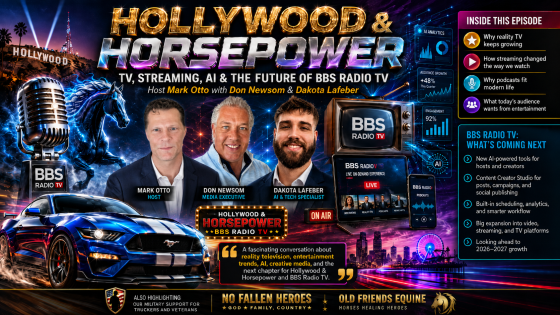

Hollywood And Horsepower Show with Mark Otto
Guests are Donald Newsom & DaKota LaFeber, BBS Management
From Reality Television to AI-Powered Broadcasting: The Future of Media, Streaming, and BBS Radio TV
Summary
Reality Television as Escape and Human Storytelling
Mark Otto opens the episode by explaining that conversations with Margie inspired him to examine the growth of reality television. He contrasts today's reality-driven media environment with the older era of sitcoms, dramas, news, talk shows, and late-night programs. Baylen Out Loud becomes the principal example of a reality series that follows a person's genuine daily challenges rather than functioning solely as sensational entertainment. Mark and Donald Newsom agree that these programs can let viewers temporarily leave their own concerns and enter another person's world. They also argue that audiences are increasingly drawn to personal stories, unpredictability, and programming that feels less polished and more authentic.
Entertainment, Creativity, and the Expanding Need to Connect
Donald describes entertainment and the arts as psychologically important because they help people unwind, imagine, and create. He predicts that podcasts and specialized media channels will multiply until nearly every person or company can operate a communications outlet. Donald calls the coming period an "era of the loud," in which radio, television, satellite, wireless, podcast, and online signals make humanity increasingly visible and connected. He also shares his belief that this communications expansion may accompany public discussion of nonhuman intelligence and future contact. Mark connects that broad idea to the practical reality that viewers have moved from a few scheduled television channels to hundreds of on-demand choices.
BBS Radio TV's Plan for a Broader Media Platform
Donald says BBS Radio TV is preparing new systems, servers, websites, code, AI integration, and a Content Creator Studio. The goal is to let hosts, guests, musicians, writers, and users create, aggregate, distribute, and monetize their work in one community-centered environment. He envisions people building talk shows, businesses, educational libraries, and specialized media niches without needing the infrastructure of a traditional broadcasting company. Donald says the network is carefully removing bugs before releasing the tools and expects the technology to place more creative and distribution control directly into the hands of users. He also discusses plans for customized channels on major digital television and streaming systems.
The Content Creator Studio and Integrated AI Assistance
DaKota LaFeber explains that the Content Creator Studio will organize host profiles, guest information, shows, episodes, posts, campaigns, calendars, and analytics. Users will be able to connect Facebook, X, YouTube, Instagram, and other platforms, then schedule and distribute posts with far less manual work. An integrated AI assistant is intended to help people who are not technically experienced by responding to natural-language instructions. A host could ask the assistant to summarize episodes, draft posts, build a campaign, propose timing, identify compliance issues, schedule material, and publish it across platforms. DaKota says the purpose is to keep creators from having to move among numerous unrelated services and AI tools.
DaKota's Path from Healthcare to Cybersecurity and AI
DaKota describes growing up in Indiana and the Kentucky-Ohio-West Virginia tri-state region before beginning college with plans to enter respiratory therapy. His direction changed after watching his younger brother experiment with ethical-hacking tools and introducing him to Kali Linux. DaKota later studied cybersecurity, participated in national competitions, and developed interests in red teaming, ethical hacking, and digital forensics. Work with an experienced mentor gave him real-world exposure that he says differed significantly from classroom exercises. As AI expanded, he began combining it with cybersecurity and digital-forensics work, eventually moving into AI engineering and development for BBS Radio TV.
From Early Studio Chaos to the Network's Television Future
Donald recalls the complicated early years of remotely engineered broadcasting, when board operators had to manage numerous buttons, phone lines, guests, stations, and streams simultaneously. He says reality-television producers once proposed filming BBS Radio TV, but internal resistance prevented the project from moving forward. The conversation moves through memories of Howard Stern, American Chopper, Johnny Carson, Jackie Gleason, Don Rickles, John Wayne, Clint Eastwood, Tom Selleck, Jerry Seinfeld, and Mr. Ed as examples of media personalities or formats tied to particular moments in entertainment history. Mark and Donald agree that future programs should embrace remote production, authenticity, humor, and the occasional imperfection. They close by emphasizing mutual respect, a strong community of hosts and technicians, and plans to move Hollywood and Horsepower and other BBS programs into video and streaming television during 2026 and 2027.
Hollywood and Horsepower Show

Through the relationships Mark Otto developed in Thoroughbred Horse Racing and Automotive Racing, during his global travels, the thing that most interested him was the story behind the story, with the famous people he was fortunate to meet. What was it that these people liked to do? How did they get into Hollywood or into Racing? These stories are fascinating! This is what encapsulates the “Hollywood and Horsepower Show”.
Bringing you along, we talk to so some of the most interesting people Mark met during his career. Don't be surprised if a few other guests stop by this show. This will be fun! It is where SNL meets The Tonight Show; a perfect mix of talk and comedy.
Speaker Identification
Speaker 1 - Mark Otto, Host. Mark identifies himself at the beginning of the program, introduces the sponsor, charities, episode topic, and guests, and conducts the interview.
Speaker 2 - Donald Newsom, Guest / Head of BBS Radio TV. Mark introduces Donald as the head of BBS Radio TV. Donald discusses entertainment trends, the network's history and expansion plans, streaming channels, and the early years of BBS Radio TV.
Speaker 3 - DaKota LaFeber, Guest / BBS Radio TV AI and Technical Team Member. Mark introduces DaKota as the network's AI specialist. DaKota explains the Content Creator Studio, social-media automation, integrated AI assistance, Roku development, cybersecurity, digital forensics, and his technical background.
Speaker 4 - Prerecorded Theme Vocalist. This label is used for the opening and closing theme-song material.
Speaker 4 - Prerecorded Theme Vocalist: I've been down roads from Churchill to L.A., met kings of speed and stars along the way. They've got stories that the cameras never show. Yeah, the truth behind the fame is what we know.
From the saddle to the silver screen, fast lanes and punch lines on a late-night show. You think you've seen it all, but you don't know the half until the curtain lifts and we all have a laugh.
It's not just who they are; it's how they came to be. A little horsepower, a little mystery. Hollywood and Horsepower, baby, take a ride, where the legends laugh and the engines never hide.
From the track to the spotlight, stories unwind, candid truths a little wild and one of a kind. Hollywood and Horsepower, where the real ones show every twist and turn in a tale you didn't know. So pour a drink, sit back, and enjoy the show, where the fast and famous let it all go.
Speaker 1 - Mark Otto: Welcome to the Hollywood and Horsepower show. I'm your host, Mark Otto.
We're brought to you today by Tony's Steak and Seafood in Lexington, Kentucky; Bowling Green, Kentucky; Cincinnati, Ohio; and Indianapolis, Indiana. Tony always says there is room at his table for one more. I always say dining at Tony's is an experience, not just dinner. You owe it to yourself to go.
We support two charities on this show, both 501(c)(3) organizations. The first is No Fallen Heroes, founded by fellow aviator Matt "Wiz" Buckley. Matt is a Top Gun graduate and naval aviator. He and his wife, Susie, started No Fallen Heroes to help first responders, veterans, and their families readjust to civilian life.
We are losing far too many veterans and first responders to suicide today, and that is the primary focus of No Fallen Heroes: helping people transition successfully. We do not take a dime on this show for promoting these organizations. We do it because we believe in them. Take a moment and visit nofallenheroes.org. If you cannot do a lot, do a little. Every bit helps.
On the animal side, we support Old Friends Equine at oldfriendsequine.org. Old Friends was founded by entertainment writer Michael Blowen and his wife, Diane. They saw a need for retired thoroughbreds to have a home after their racing careers were over, and they took it upon themselves to make that possible.
Fifteen or twenty years later, they are home to close to 500 horses on multiple farms in Kentucky, New York, and Japan. They do a fabulous job on both the human and equine sides. If you are anywhere near the Lexington, Kentucky, area, check them out at oldfriendsequine.org.
Today's show is going to be a little different. We are going to talk about television, its history, where it is going, and a great deal about our network.
Today's show is dedicated to none other than the light in my life, Margie. She will understand why, because she inspired this episode. In talking with her about the things that interest her, I began thinking about the subject. I consider her one of the smartest people I know, and I always listen to what she says.
We are going to discuss some trends in television, which will lead us into the next steps for Hollywood and Horsepower, probably in 2027. We are joined today by my boss, basically, Donald Newsom, the head of BBS Radio TV, and DaKota LaFeber, our AI specialist, who handles a great deal behind the scenes here at BBS. Don and DaKota, welcome to the show.
Speaker 2 - Donald Newsom: It is a pleasure to be here. I'm Don, and for today my co-host is DaKota.
Speaker 3 - DaKota LaFeber: How is it going? Thanks for having me.
Speaker 1 - Mark Otto: DaKota, thanks for joining us. Don, I really appreciate both of you taking the time.
Don and I have talked about this a little, and we are going to get into where the network is going. One of the things that sparked this episode was my conversation with Margie. As I said, I consider her one of the smartest people I know. She probably understands human nature better than I do.
It interests me how much reality television has grown in popularity, and I do not mean that negatively. One of her favorite shows, for example, is Baylen Out Loud. She also watches programs such as 90 Day Fiance. They can be captivating.
It makes you step back and ask, "How did we get here?" We went from sitcoms, dramas, news programs, talk shows, and late-night shows to having entire networks devoted to reality television. It continues to grow and captivate interest. Much like this show, people seem hungry for information, talk, and lifestyle content.
What are your thoughts on that, Don? You are the veteran in the network world.
Speaker 2 - Donald Newsom: Forgive me. I was trying to set something up with DaKota. Can you repeat the question?
Speaker 1 - Mark Otto: Of course. We were getting a few things ready so DaKota could explain them later.
Margie, the light and love of my life, inspired this show. She closely follows a number of reality programs. That is not unusual, but I did not know much about them. By watching what she watches, following the storylines, and then doing a little research, I became interested.
The program that stood out most was Baylen Out Loud. It follows a young woman with Tourette syndrome. She began posting TikTok videos in 2020 and became widely known on the platform. TLC acquired the rights to a series in 2024. She later became engaged to a young man named Colin Dooley. The show premiered on TLC in 2025 and, from what I understand, is now in its second season and is one of the network's growing, highly rated programs.
What interests me is the following these reality shows build compared with what I would call traditional television: sitcoms, dramas, news, talk shows, and late-night programming. What is driving the hunger for reality television?
Speaker 2 - Donald Newsom: It is a tried-and-true thing throughout history. We know that bread and circuses entertain the people. The more economic strife and worldwide instability there is, the more entertainment people want. I want it too.
Speaker 1 - Mark Otto: That makes sense. Some shows are a little tabloid-oriented or sensational, but others simply let you follow a family's life and journey. They are not necessarily exploitative; they are telling a story.
To your point, the shows offer an escape. For 30 minutes or an hour, you do not have to think about your own world. You can immerse yourself in somebody else's life. Perhaps it looks like a better world than yours, or perhaps it is simply different.
Speaker 2 - Donald Newsom: That is one reason AI and virtual worlds are going to take off. Technology and creativity are crowding us toward them, and everything is leading in that direction.
I expect more of it because I see greater divisions in our economic situation. There are going to be many more poor people and many more ultra-rich people. The distance between them is becoming so great that a lot of people feel as though they live in a kind of dystopia. They cannot believe things are the way they are.
Entertainment is a valuable art. It brings forward people whom, in the past, we might never have imagined building a program around. Who would have thought of putting a woman with Tourette syndrome at the center of her own program and having so many people watch it?
Ironically, it does not come across as sensational to me. It feels genuine. People settle in and see how someone with different health issues or life circumstances negotiates the world. It is revealing and entertaining. I love that.
Mark, you and I spoke about this the other day. I can hardly unwind anymore unless I watch an hour of television before bed. I have become used to relaxing into somebody else's world so I can take my mind off my own. I would not want to be without it.
Speaker 1 - Mark Otto: We are on the same wavelength. By the end of the day, after meetings, calls, and everything else, you want to disconnect for a while.
I tend to gravitate toward older television, even television from before my time. I will watch Leave It to Beaver, The Love Boat, Cheers, and other programs that were big in their day.
I was talking with Margie about why I enjoy them. First, they take you to a time and place in your childhood or life that holds good memories. Second, a program such as The Love Boat is an escape and a trip down memory lane with all the celebrities who appeared on it. It lets your mind unplug and focus on something else.
Speaker 2 - Donald Newsom: That is important. Entertainment and the arts have a profound and powerful impact on our psyches. They release imagination and creativity.
Whether we are gamers, binge-watchers, or podcast listeners, entertainment gives us time to unwind and may help us find the creativity we are looking for. I love the arts.
I think the media world is going to change dramatically. You and I spoke about this. There will be more and more channels, and more people will want podcasts. Every company may have a podcast. Every person may have one, just as people once imagined everyone might have a personal cryptocurrency or money unit that could be exchanged virtually.
We are moving into an era when communication will be loud and over the top. There will be a tremendous amount of it.
I read about an interview that was allegedly scrubbed. The person or entity involved was unidentified; some even suggested it might have been nonhuman. Whatever it was, the message was that humanity was entering what it called "the era of the loud."
According to that account, the next hundred years would be a period in which humanity became extraordinarily loud. Communications, radio signals, television signals, satellite signals, and wireless signals would become so strong and numerous that everybody, or whatever is out there, would take notice. Humanity would be entering a very loud phase of its growth.
I believe we are moving toward a time when we will inevitably have open contact with other species because, in my view, they are out there and are going to know we are here. I do not think that can be avoided.
I think that is part of what is culminating as we follow Senate hearings and disclosure discussions. We are entering a time when everybody wants to be entertained, talk, be heard, and connect, and now we have the ability to do it.
Speaker 1 - Mark Otto: We went from an era when a local market might have had three, four, or perhaps five channels to a world with hundreds of channels, streaming services, and podcasts. People are hungry for content and want more of it.
That is another factor driving reality television. Dana Carvey has a comedy bit in which Paul McCartney calls John Lennon and tries to explain who the Kardashians are. It is funny, but it is also surprisingly accurate. Who would have thought somebody could create an empire from a reality show about a family?
Love them or hate them, you have to give them credit. They are marketing geniuses. They have done a phenomenal job building multiple brands and businesses.
That is what interests me. I recently read that more than 2,000 individual reality shows are currently available across various platforms, and I suspect that number may be low. They range from mainstream and terrestrial networks to streaming platforms.
We nearly had a reality program of our own, which is where I was leading. Hollywood and Horsepower is expected to be on television next year. That connects directly to the changes at BBS and the direction in which the network is moving. Tell us where we are headed.
Speaker 2 - Donald Newsom: Great question. I always love that question. We are heading into the deep end.
We may be in the last lane right now, but when I look ahead and behind me, I do not see anyone. Eventually, I will start believing we are in first place. That always works for me.
To be honest, Mark, we are heading into a time of BBS. I believe BBS is going to become a household name, like BBC, NBC, or ABC. We are going to begin proving that this year.
We have new systems, servers, websites, code, AI integration, a Content Creator Studio, and much more. The platform will allow guests, hosts, musicians, article writers, and users to tailor their own media worlds to their needs.
They will be able to create, aggregate, distribute, and monetize content in a community setting, with the help and tools they could dream of and more. They will be able to shape their worlds. We have the tools and the people. The work has been done, and now we are integrating it and preparing to release it.
Much of it could arrive within a week or two, although there is always one more thing to do. Technically, we could release a great deal now, but some bugs would remain. We are perfectionists in that way. We want to iron out every bug we see before releasing the systems.
More and more people are going to look around and say, "I can have my own talk show. I can become known. I can build my business, sell my services or products, represent myself, and tell the world what I know."
Someone may want to assemble a compendium of lost information and preserve it for future generations in an accessible library. People will see how easy that can be. The tools will be relatively inexpensive and straightforward. Smart users will establish a niche and become who they want to be through media.
That is where DaKota comes in. I am going to let him explain more about where we are heading.
He has done very few interviews. We keep him boxed up. We put him in a little cage, and when he finishes coding, we close the cage again. We feed him every now and then, let him out to code, and then send him back. This is a little new for him.
We have weekly meetings and plan to have an open-forum podcast with DaKota. He will be able to train people to use our content-creation system, which is part of our sister site. I will let him take over and explain it.
Mark, thank you for allowing us on your program. It is always a pleasure.
Speaker 1 - Mark Otto: I appreciate both of you taking the time. I cannot thank you enough for the help. As the network grows, I feel honored to be part of it.
Speaker 2 - Donald Newsom: You are one of the best parts of it for me, Mark. You have a heart of gold. I love it when we talk. I love our conversations, your questions, and the way you think.
I am a nostalgic person, and I feel what you are doing. Your program has always sat well with us. It is a sincere pleasure having you on the network.
Speaker 1 - Mark Otto: Thank you. That is an honor. We would not be here without you. I always tell people I do the easy part. I show up and talk. You do the heavy lifting, make everything look good, make sure the production happens without a hitch, and get the program where it is supposed to go.
Speaker 2 - Donald Newsom: Thank you. Soon, those tools will be in your hands, and it will be as easy as flipping a switch. You will press a button, and it will be done.
Speaker 1 - Mark Otto: That includes Roku and the other television systems, correct?
Speaker 2 - Donald Newsom: Correct. We will have fully functional channels on the major digital television systems, customized for us and developed by us.
Speaker 1 - Mark Otto: That is what is driving so much of this. I talk to many people who consume most of their media on a phone, tablet, or laptop. They may stream it through a smart television, but I meet very few people who still rely on broadcast networks or traditional cable.
Streaming is where perhaps 90 percent of the people I speak with get their entertainment. I believe that is where everything is going, for the same reason podcasts are popular.
Someone at one of the networks to which BBS distributes our program told me that the company is moving more toward talk content. People build their own music playlists now. They are not necessarily tuning into a music channel. They are choosing talk content.
They also like the podcast format because they can listen in the car, pause when they get out, resume at the gym, and pick up again when they go home.
That connects to where we began the show, with reality programming and streaming. People value the freedom to watch or listen whenever they have an hour or even half an hour.
I see that with Margie, to whom this show is dedicated. She is the nucleus of the episode. Whenever she has time, she sits down and watches that week's episode of whichever program she follows.
That is very different from when we were children. If you wanted to see a program, you had to be in front of the television at the moment it aired. Otherwise, you might not see it again for six or eight months, until it returned in reruns. Roku and other streaming platforms are clearly the future of entertainment.
Speaker 2 - Donald Newsom: They are, whether the future belongs to those exact companies or to services that resemble them.
I sometimes say we are entering a religiously spiritual era. By that, I mean we all want to connect. It is becoming easier and easier to connect with other people. We come here to connect with one another, and the tools and systems now make that very easy. There is going to be much more of it.
We are only at the beginning. The internet started coming into being for the public in the 1990s. Look where we are roughly 25 years later. In the next 25 years, communication will become something we may not yet be able to visualize.
To bring it full circle, here is DaKota. Mark, thank you for letting me join your program.
Speaker 1 - Mark Otto: Don, I appreciate it.
For people just joining us, this is the Hollywood and Horsepower show. We have been joined by Donald Newsom and DaKota LaFeber. DaKota is our AI expert here at BBS Radio TV. DaKota, tell us what is new and what is coming.
Speaker 3 - DaKota LaFeber: A major project I have been developing is called the Content Creator Studio. It will be connected to our sister site, which people can view now at BBSRadioTV.com. That site will also undergo many changes in the coming month.
The Content Creator Studio will function somewhat like the creator systems used by YouTube, Instagram, TikTok, and X. When hosts log in, their information will already be there. Guest information from previous shows will be available. Their shows and episodes will also be organized in one place.
Users will be able to create posts inside the platform. They will also be able to create campaigns for those posts and select the dates and times when the material should go out.
They can connect social-media platforms such as Facebook, X, YouTube, and Instagram. With one click, posts can be sent or uploaded automatically to those platforms.
A calendar will be integrated into the platform so users can visualize and schedule campaigns, posts, live shows, and previous shows. All of that will appear on the calendar.
Another major feature I am fine-tuning is the analytics tab. It will provide an overview of analytics across social-media platforms so users do not have to visit many separate sites. The system will bring the information together in one place.
One problem we have been trying to solve is accessibility for people who are not technologically experienced but still want to distribute their content. I thought, why not integrate our own AI assistant into the Content Creator Studio?
Instead of manually moving through tabs, scheduling campaigns, adding items to a calendar, creating posts, or searching for information about a show from last year, a user could simply ask the assistant.
For example, the user might say, "Summarize this week's episodes and draft posts for the three strongest." The user could also say, "Build a campaign for next week's show across all platforms and propose the timing," or ask, "Which drafts are blocked by compliance flags, and why?"
The assistant would analyze the information and data associated with the user's Content Creator Studio account and guide the user through the process.
A user could say, "Create a post for next week's show, add it to the calendar, and upload it to the social-media platforms on this date." The assistant could do that. A person would not have to be highly technical, as long as that person knew how to communicate with the assistant.
Speaker 1 - Mark Otto: That is amazing. The network has come so far. Hollywood and Horsepower is in its third year, and even during my time with BBS, it is remarkable how much the platform has evolved.
I want to ask something that takes us back to my conversation with Don. You are younger than Don and me. What interests you about reality television? What do you gravitate toward when you want to watch something?
Speaker 3 - DaKota LaFeber: To be honest, Mark, I am not a major fan of reality television.
Speaker 1 - Mark Otto: That is fair. Let me ask it differently. What do you like to watch or stream? Are you a TikTok or YouTube person?
Speaker 3 - DaKota LaFeber: I like older shows, but lately I am most interested in news and what is happening around us. I am not as interested in the political arguments themselves as I am in what politics is becoming.
Speaker 1 - Mark Otto: Everybody has different interests. Working with Don, I can see that he follows everything closely. He is one of the most knowledgeable people I know about politics, government, and related subjects. He has probably forgotten more than I know.
Speaker 3 - DaKota LaFeber: Before coming on, I looked at your profile and learned more about you and the show. I mentioned to Don that my younger brother started a car-enthusiast company about four years ago called Official Wind Therapy, based in Chico, California.
What he does relates directly to what you were saying about people streaming and creating content on their phones. That is precisely what he does. Some of his work is so polished that you cannot tell whether it came from a professional production camera or an iPhone.
Speaker 1 - Mark Otto: There is no question. I have seen video shot on an iPhone that looks better than footage produced on professional cameras ten years ago.
Speaker 3 - DaKota LaFeber: Exactly. I find that extremely interesting.
I also tell people that AI is already part of their lives, whether they want it to be or not. That is the direction in which the future is moving.
I watch podcasts about the future of AI and videos featuring interviews with people sometimes called the godfathers of AI.
Speaker 1 - Mark Otto: AI is amazing. I have reached the point where I use it regularly. I have created campaigns and presentations with it.
Work that once took hours or sometimes days to research and assemble can now begin with a set of bullet points. An AI system can create a PowerPoint presentation that may not be 100 percent finished, but it can be 90 percent of the way there. Then you can refine it.
The quality of work you can create is remarkable. As with anything else, you get out of it what you put into it. There is a learning curve in understanding how to guide it and where to direct it. AI is also entering entertainment and every other form of media.
Speaker 3 - DaKota LaFeber: One thing many people do not understand is that AI models are prepared and trained to perform particular kinds of work.
I like to say AI is like a child who knows everything but understands nothing. It has to be guided. Some models are specifically trained for certain tasks.
You cannot necessarily go to a general AI system and expect it to be 100 percent correct when it writes a specialized document. Other models may be trained specifically for that type of document.
Bringing this back to BBS Radio TV, users will not have to bounce among many different AI platforms to create campaigns, bulletins, or media. The tools will already be integrated into the site. A user can say, "Create this for me and distribute it," without moving back and forth among different services.
Speaker 1 - Mark Otto: That is amazing. Don also talked about our Roku channel and other streaming channels. When do you think those will go live?
Speaker 3 - DaKota LaFeber: I have been studying the Roku setup, and it is not as complicated as it may seem. I think we can have something ready to build on within the next few months, although it is difficult to give an exact date because we have so many projects underway.
The Roku rollout itself does not appear to be especially difficult.
Speaker 1 - Mark Otto: It is remarkable. Our show is scheduled to move into video in 2027, so we are moving in that direction and following the network.
Speaker 3 - DaKota LaFeber: One thing I have learned is that launching a channel can be extremely expensive or relatively inexpensive, depending on how it is done.
Some services offer to package a station and roll it out on Roku for around $34,000. On Roku's developer platform, however, the information indicates that if you have the tools and technical ability to create the app, there may be no charge simply to place it on the network.
Speaker 1 - Mark Otto: That is the strength of BBS. Don, Doug, DaKota, and the entire team have done an amazing job building the necessary tools.
Even looking at how far things have come during my time here, the pages, data, and systems are phenomenal, and I know we are only scratching the surface of what is coming.
The next six to twelve months will be exciting. I am looking forward to the growth of the show and the changes ahead.
DaKota, tell me about your background. Have you always worked in AI?
Speaker 3 - DaKota LaFeber: No, definitely not. I was born and raised in Indianapolis, Indiana, and I spent much of my childhood in the tri-state area of Kentucky, Ohio, and West Virginia.
My grandparents lived in South Point, Ohio, and Ironton, Ohio. My mother lived in Ashland, Kentucky, about two hours north of Lexington. I also lived in Lexington. It is a great state.
For much of my early working life, I worked in construction. When I was around 20, I started college and became interested in healthcare. I planned to enter respiratory therapy. This was about a year after the COVID-19 outbreak, when the projected demand and pay growth for that field were much higher than they are now.
I was very interested in healthcare and was only a few months away from graduating with an associate degree in respiratory therapy. Then I saw my younger brother doing what looked like hacking on a laptop, and I found it fascinating.
He had me download Kali Linux, a Linux-based operating-system distribution that ethical hackers use for education, testing, and security work.
I remember opening a terminal, looking at the command-line tools, and thinking, "This looks crazy and incredibly interesting. I may never know how to use it, but I love looking at it."
As time passed, I learned that cybersecurity was something I could study in college. In 2023, I began a cybersecurity program.
I was especially interested in red teaming and ethical hacking. I was invited to Washington, D.C., after competing in the National Cyber League and the United States Cyber Challenge.
That is where I met my mentor, Alex Krepelka, who leads a cyber defense operations center and is now one of my best friends. He was deeply involved in digital forensics. I was more interested in hacking, but I was able to work beside him on projects and gain real-world experience from a cybersecurity veteran.
For students, there can be a huge difference between doing exercises in school and working with a mentor who has practiced the work in real situations. That experience opened my eyes and gave me a strong interest in digital forensics.
I worked in that area for several years. During that time, AI became part of my life. The deeper I went into AI, the more my work shifted toward AI engineering and the development of cybersecurity and digital-forensics tools that use AI.
I cannot say I am more interested in one field than the other. Cybersecurity, digital forensics, and AI have all become part of my life.
Speaker 1 - Mark Otto: That is amazing. I am thankful to have you on the BBS team. You have joined a great group, and the experience will help both the network and your career.
I appreciate you taking the time today. It has been terrific speaking with you. Listeners have learned more about the next steps, even if some details remain intentionally broad.
The main point is that people will see many changes at BBS over the next six to twelve months. Hollywood and Horsepower will move onto several streaming platforms and into video. The network continues to grow, and it is amazing to see what it has become during the relatively short time I have been involved.
I can only imagine what that growth feels like to everybody who has been there much longer.
Speaker 3 - DaKota LaFeber: It was great talking with you and meeting you, Mark. I am going to pass you back to Don.
Speaker 1 - Mark Otto: I appreciate it. Thank you so much. Have a good day.
Speaker 2 - Donald Newsom: Thank you for having DaKota on. This was something of a debut interview for him.
Speaker 1 - Mark Otto: He did it right.
Speaker 2 - Donald Newsom: I like throwing people into the deep end.
When I started, remotely engineered studios did not exist. The system was difficult because a board operator might have to press eight or nine buttons to make everything happen the way I had designed it.
I would throw board operators into the room without teaching them nearly enough. It was comical. That would have been the perfect time for a reality television program.
If I had videotaped the laughter, fun, craziness, and confusion from those early years, it would have been a wonderful historical record. It could have become its own sitcom.
Award-winning writers, producers, and reality-program creators approached us more than once. One group said, "We will set up seven cameras and position them here and here." They had mapped everything out. I do not even know how they learned so much about the operation.
They proposed recording only ten or fifteen minutes per day, with cameras available as events unfolded, to create a reality program based around BBS Radio TV.
Some people in the studio were adamantly opposed. They said they would quit rather than have cameras around them all the time. We did not move forward.
It saddens me a little today because the program would have been hilarious.
Howard Stern comes to mind when we talk about radio moving onto television. Love him or hate him, he was one of the first major radio personalities to put his program on television.
Howard Stern himself used to call one of our shows almost every Friday, using strange voices and making fun of the host. It went on for perhaps a year or a year and a half before we realized who it was. I later spoke with him off the air, and he more or less acknowledged it. I shut it down because I did not initially understand what was happening.
He did open a doorway for radio programs moving into television.
Speaker 1 - Mark Otto: I was thinking of something more like the motorcycle father and son who worked together at Orange County Choppers.
Speaker 2 - Donald Newsom: American Chopper. I always thought that was funny. A man built a business, his family worked in it, and they put the whole thing on reality television.
I loved it because I was into motorcycles at the time and owned a few myself. That was around the period when I wanted to develop a reality program around BBS Radio TV, but I could not win the support of the rest of the hands-on administration.
I might win them over one day, although the operation is much more refined now. Much of the early craziness is gone, and there is far more efficiency. People know their responsibilities and understand what they are doing.
When we first started, however, there were moments when I wanted to get on my knees and cry. Everything would go wrong at once. I saw every board operator and studio administrator experience that same feeling.
I would tell them, "Ignore everything for a moment and get centered."
The stream might stop, the station might drop, the guest might disconnect, and all the systems might fail. Then 14 to 20 phone lines, depending on the studio setup, could ring at once. You could not believe it. You did not know where to begin fixing things. It was traumatic.
Speaker 1 - Mark Otto: It is easy to feel like a deer in the headlights. One thing I learned early, and still tell myself, is, "Work the problem. Do not let the problem work you." Handle one problem at a time.
As a pilot, one of the first things you learn in an emergency is: aviate, navigate, then communicate. Fly the airplane first.
Problems are similar. Work the immediate problem first. My dad used to tell me, "You will have plenty of time to panic after you get this figured out. Do not panic while you are figuring it out."
There is something to that.
Don, I cannot thank you enough for joining me. I really appreciate it. It is an honor to be part of the network. As I told DaKota, it amazes me how much BBS has grown during my time here. I can only imagine what it looks like from your perspective.
Speaker 2 - Donald Newsom: You have seen nothing yet.
This year, we are planting seeds that will allow us to market ourselves fully and heavily next year. By the end of this year, those seeds should be fully grown. Next year will be fun.
We are all excited. It is wonderful that Hollywood and Horsepower is already in its third year. You have a great show, and I look forward to its television phase.
Your original concept was something like two friends sitting side by side, perhaps near a fireplace, reminiscing about the old days, talking about good memories and what it felt like to be there, and drawing out the full life stories of your guests. I think that is fabulous.
Speaker 1 - Mark Otto: I have had many inspirations. One of the biggest was Johnny Carson. I always looked up to him. What a brilliant man. He was the godfather of late-night comedy, and he was prolific and calm. Even when something bombed, he could be at his best.
Speaker 2 - Donald Newsom: He handled a bad moment better than most people handle a good one.
Speaker 1 - Mark Otto: He did. That taught me not to be so tightly wound that you appear unable to handle it when something goes wrong.
I will never be another Johnny Carson. Nobody compares to him, and I would not even try.
Speaker 2 - Donald Newsom: Bless him. He was smart enough not to try to be somebody else, and that was part of why he succeeded.
There will not be another Johnny Carson. Part of his success belonged to a particular time and place. The Hollywood in which he worked does not exist anymore.
It is like saying there will not be another Jackie Gleason. He fit his moment. The same is true of Don Rickles, John Wayne, and Clint Eastwood.
Speaker 1 - Mark Otto: Tom Selleck belongs in that group too. He is an absolute legend. When he finally stops working, which may not be far off, it will mark the end of an amazing career.
Speaker 2 - Donald Newsom: You cannot replicate those people because the conditions that produced them no longer exist.
Speaker 1 - Mark Otto: Exactly. Tom Selleck moved from Magnum, P.I. to westerns and then Blue Bloods. Many actors around him were typecast and did not accomplish as much after Magnum, P.I. The actor who played Magnum evolved the most.
I love those kinds of stories, and I want to do more of them.
Today's discussion of reality television was sparked by Margie, the person I admire most. I watch what she does because there is no mind I try harder to understand.
Speaker 2 - Donald Newsom: You are going to be doing your own reality television program. Hollywood and Horsepower is real.
Speaker 1 - Mark Otto: It amazes me how these shows captivate people.
Do you ride horses, Don?
Speaker 2 - Donald Newsom: No. I stand near them.
I was thinking about Jerry Seinfeld's Comedians in Cars Getting Coffee. Perhaps you could do something like that in a race car.
Speaker 1 - Mark Otto: We could use the red race car or the white one. We might put a camera on a horse and walk around the barn.
That connects to something we have discussed often. We want to do more remote shows.
Speaker 2 - Donald Newsom: Those are easy to do. The technology is simple now.
Here is another point: if there is a small stumble, roll with it. People often appreciate a show more when it is not absolutely perfect.
Speaker 1 - Mark Otto: That is true. Sometimes polish can almost become a defect.
That may be another attraction of reality television. It feels real. If something goes wrong during the show, the audience sees it.
With Baylen Out Loud, for example, when Baylen experiences a tic, viewers do not know exactly what will happen. That unpredictability is part of why people watch.
Speaker 2 - Donald Newsom: That is why people will watch Hollywood and Horsepower on television: to see what goes wrong.
Speaker 1 - Mark Otto: They will wonder whether I am going to fall off the horse. We will have to make my little dog, Parker, part of it.
Speaker 2 - Donald Newsom: You could also have a talking horse, like Mr. Ed.
Speaker 1 - Mark Otto: That would be hilarious.
Speaker 2 - Donald Newsom: One of the funniest bits I remember was Chevy Chase doing an interview with Mr. Ed on Saturday Night Live. It was near the end of the horse's life, and the sketch was an absolute riot.
Lorne later discussed how they created it because Chevy did not do many voices, but he could imitate Mr. Ed. They showed the back of the horse's head, used Chevy's voice, and cut to Chevy sitting across from the horse asking questions. It was hilarious.
Speaker 1 - Mark Otto: We are at the top of the hour, so I have to wrap up. I cannot thank you enough for joining us today. We are excited about the next phase of this show, the network, and everything the team is building. Thank you for everything you have done for me and the program.
Speaker 2 - Donald Newsom: It is a pleasure. I love doing this, and I love doing it with you.
It takes a powerful community of personalities to develop a good media company. Hats off to the hosts on our network, because they are a powerful community of personalities. That makes the work flavorful and rewarding.
We are going full speed ahead. This year, we have something to prove, and we are going to prove it. We look forward to doing it with you.
Speaker 1 - Mark Otto: I agree completely. It takes a community to make this and the other shows successful. It is not only the host; it is everybody.
You have the technology and understand where to go next, how to drive the work, and how to develop it. Success also comes down to mutual respect. Like any successful relationship, it revolves around respect.
I respect what you do, and you respect what the hosts do. That is what makes the relationship successful.
Speaker 2 - Donald Newsom: It is a marriage.
Speaker 1 - Mark Otto: It really is. Like any successful marriage, it works when there is respect and admiration.
Speaker 2 - Donald Newsom: Or a big diamond ring.
Speaker 1 - Mark Otto: That too.
You have to look at the people in your life with respect and admiration. I respect you and the BBS team, and I respect and admire Margie, the person to whom this show is dedicated and the light of my life.
Don, I cannot thank you enough for doing this.
This has been the Hollywood and Horsepower show on BBS Radio TV. Stay tuned for what is coming next. We have a great deal coming in 2026 and 2027.
You are going to see this show move into video and television. You will see many other programs on the network do the same. We are excited to take you along with us.
Thank you for joining us. Our guests were Donald Newsom and DaKota LaFeber of BBS Radio TV. We will see you again next week.
Speaker 4 - Prerecorded Theme Vocalist: You are in the driver's seat. Stick around. You never know who is next, and trust me, they have a story worth hearing.