Bible News Prophecy, August 22, 2026

Bible News Prophecy with Dr Bob Thiel
Who Gave the World the Bible?
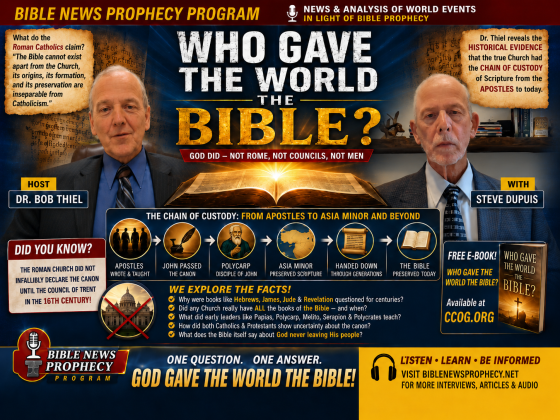
Did the Roman Catholic Church give the world the Bible as they claim? From a book titled “The Bible is a Catholic Book” by Jimmy Akin the inside flap has this written: “In The Bible Is a Catholic Book, Jimmy shows how the Bible cannot exist apart from the Church. In its origins and its formulation, in the truths it contains, in its careful preservation over the centuries and in the prayerful study and elucidation of its mysteries, Scripture is inseparable from Catholicism. This is fitting, since both come from God for our salvation.” Catholic Bible 101 claims, "the Church gave the world the Bible. The Bible does not exist apart from the church."
Is that accurate? Are the truths of the Bible inseparable from Roman Catholicism? Is it true that the Bible cannot possibly exist apart from the Roman Catholic Church? The Roman Catholic Church did not formally accept its canon of the Bible until the 1546 Council of Trent.
And the Greek/Eastern Orthodox? They did not finalize their canon until 1672 at the Synod of Jerusalem.
Would God have left His true church without His word for centuries?
What about a Protestant church? Did one of the Protestant churches give the world the Bible? The Protestant churches were born from the Roman Catholic Church, so they came later in time. If the Roman Catholic Church didn’t bring the world the Bible, then humanity was without the word of God for even more centuries.
One thing is certain – the instant one of the books of the Bible was written, someone had it; even if it was only the author. So, was there a church that had a continuous chain of custody of the scriptures? If so, what church was it? Is there historical proof that one group had a continuous chain of custody of the books of the Bible the instant they were written – not centuries later?
The fact is that the Greco-Roman Catholic and Protestant churches did NOT accept the validity of several books of the New Testament. Yet, from the beginning the Church of God did and has maintained the chain of custody since the Apostle John handed down the books and the knowledge of the canon to Polycarp of Smyrna, who passed this on to others.
And most importantly: Who Really Did Give the World the Bible?
Click here https://cogwriter.com/BibleCanon.pdf for a free eBook of a comprehensive study guide to Who Gave the World the Bible.
Watch this video as Dr. Thiel shines the light of Biblical truth and historical proof on the possessors of the chain of custody of the Holy Scriptures.
Read the full article to this video titled “Although the Roman Catholic Church claims it gave the world the Bible, God did, and the Church of God had the chain of custody” at URL https://www.cogwriter.com/news/church-history/although-the-roman-catholic-church-claims-it-gave-the-world-the-bible-god-did-and-the-church-of-god-had-the-chain-of-custody/
From Apostles to Canon: Who Preserved the Books of the Bible?
Summary
The Question of Biblical Origins
The episode begins with a direct question about who gave the world the Bible. Dr. Bob Thiel answers that God did and then contrasts that position with Roman Catholic claims about the Church's role in the Bible's origin, formation, and preservation. He cites a Catholic book and Catholic-oriented sources as examples of the position that the Bible cannot be separated from the institutional Church. The discussion then focuses on the formation of the biblical canon and the timing of formal Catholic declarations about which books belong in Scripture. Throughout the episode, these claims are presented as part of Dr. Thiel's argument rather than as independently established historical conclusions.
Catholic Claims and Canon Disputes
Dr. Thiel discusses Catholic material concerning the recognition of the biblical canon and points to historical uncertainty over books such as Hebrews, James, 2 Peter, 2 John, Jude, and Revelation. He argues that this uncertainty undermines the claim that the Roman Church uniquely preserved a continuously known canon from the beginning. He also refers to the Council of Trent and says the Catholic Church did not make an infallible declaration concerning the canon until the 16th century. He contrasts that timeline with biblical passages he interprets as implying that true Christians would have known and possessed the Scriptures. His central contention is that inspiration came from God and was not created by later church councils.
Apostolic Custody in Asia Minor
A major part of the episode centers on the idea of a "chain of custody" for the biblical books. Dr. Thiel argues that the apostles and their recipients possessed the inspired writings from the time they were written, with the Apostle John eventually having access to the full collection. He emphasizes John's residence in Asia Minor and says many New Testament books were written to or from people connected with that region. He then links John with Polycarp and presents this relationship as evidence that knowledge of the canon continued in Asia Minor. The argument is that a continuous community, rather than later councils, preserved awareness of the inspired books.
Early Church Figures and Scripture
Dr. Thiel names several early Christian figures in support of his chain-of-custody position, including Papias of Hierapolis, Polycarp, Melito of Sardis, Polycrates of Ephesus, Serapion of Antioch, and Lucian. He says these figures demonstrate familiarity with sacred Scripture and, in some cases, concern about distinguishing accepted writings from disputed or noncanonical texts. Polycarp's letter to the Philippians is presented as especially important because Dr. Thiel argues that it quotes from or alludes to all 27 New Testament books. Melito's investigation of the Old Testament canon is used to support a canon that excludes the Apocrypha. Serapion's rejection of the Gospel of Peter is presented as another example of an early community making distinctions among writings.
Later Catholic and Protestant Questions
The episode moves from the early centuries to later Catholic and Protestant history. Dr. Thiel refers to disputes over several New Testament books, Jerome's work on a Latin Bible, the inclusion of the Apocrypha, and later Catholic declarations about the canon. He also discusses Protestant figures such as Zwingli and Martin Luther, arguing that some Reformers continued to question books such as Revelation, Hebrews, James, and Jude. The 1611 King James Version is mentioned as having included the Apocrypha as an appendix. Dr. Thiel uses these later disagreements to reinforce his claim that both Roman Catholic and Protestant traditions experienced uncertainty that, in his view, did not characterize the Church of God tradition he represents.
The Episode's Final Claim
In the closing portion, Dr. Thiel rejects the idea that no Christian community knew the biblical canon until centuries after the apostles. He argues instead that the true Church would have known the Scriptures, preserved them, and maintained a historical chain of custody from the apostles onward. He says later scholarly assumptions often treat Greco-Roman Christianity as representative of Christianity as a whole, while his interpretation emphasizes a smaller "little flock" described in Luke 12:32. When the host repeats the opening question, Dr. Thiel again answers that God gave the world the Bible. The episode ends by directing listeners to additional interviews, written material, and audio content on the program's website.
Bible News Prophecy
Bible News Prophecy
The Bible News Prophecy program broadcasts news and information in the light of the Bible and its prophecies. This includes proclaiming the good news of Jesus Christ and the gospel of the coming Kingdom of God to the world as a witness (Matthew 24:14), teaching all things that Jesus commanded (Matthew 28:19-20), providing prophetic warnings of God’s impending judgments, contending for the faith once for all delivered to the saints (Jude 3), assisting in the calling of the full number of those to be reached before Jesus returns (Romans 11:25-26), explaining mysteries of God's merciful (James 2:13) and loving plan (e.g. Romans 16:25-27), helping people better understand the Bible (Acts 8:30-31, Romans 10:14-15), explaining God’s loving plan of salvation (Psalm 68:30, John 3:16-17, Luke 3:6, Romans 11), encouraging people to live the way of Philadelphian (Hebrews 13:1) and agape love (1 Corinthians 13), and calling for personal (Acts 2:38) and national repentance (2 Chronicles 7:13-15).
The Bible News Prophecy program teaches the fact of God's existence, the fact of Jesus being Savior, and the certainty of biblical truths. The program discusses what the future holds for humanity in the light of Bible prophecy. The Bible News Prophecy program analyzes news and world events by the light of the word of God and also explains matters that will happen in the future, based on Bible prophecy.
The Bible News Prophecy program is sponsored by the Continuing Church of God.
Jesus said His true Church would be a "little flock" and be around until He returns
The Continuing Church of God is a "little flock" that traces its history from the Book of Acts, throughout the ages, and into the 21st Century.
We trace our unbroken history to the start of the New Testament church in the Book of Acts. We are a pacifist church that teaches original Christianity as taught and practiced by Jesus Christ, the original Apostles, their early faithful followers, and others faithful to original Christianity throughout history. We have supporters and congregations around the world. We have free literature online available in over 1500 languages at ccog.org. We have churches in multiple countries (see Congregations of the Continuing Church of God ) and over 10,000 congregants around the world.
Our primary English speaking radio presenters for the Bible News Prophecy program on numerous AM/FM stations as well as shortwave stations are Steve Dupuie and Dr. Bob Thiel as well as James Martenet. The Bible News Prophecy program is also available online at biblenewsprophecy.net.
Dr. Thiel has a Th.D. in early Christianity (more on him can be found in the article available at: https://www.cogwriter.com/cogwriter.htm).
Dr. Thiel writes daily news and prophecy articles which are available at https://www.cogwriter.com/
The YouTube channel link is: Bible News Prophecy channel.
Speaker Identification
Speaker 1 - Steve Dupuis - Host / Interviewer. The opening identifies the speaker as Steve Dupuis and the closing identifies the program presenter with a slightly different surname rendering, "Steve Dupuy." The exact surname spelling should be verified.
Speaker 2 - Dr. Bob Thiel - Guest / Commentator. The raw transcript renders the surname as "Teal," but the contextual reading strongly indicates "Thiel." This correction should be verified if publication requires source-level certainty.
Speaker 1 - Steve Dupuis: Friends, this is Steve Dupuis for the Bible News Prophecy program with Dr. Bob Thiel, bringing you news and analysis of world events in light of Bible prophecy. Dr. Thiel, who gave the world the Bible?
Speaker 2 - Dr. Bob Thiel: God did.
Speaker 1 - Steve Dupuis: What do the Roman Catholics claim?
Speaker 2 - Dr. Bob Thiel: Well, I bought a book by a guy named Jimmy Akin titled The Bible Is a Catholic Book. He claims the Bible cannot exist apart from the Church, and that its origins, its formation, and its careful preservation over the centuries are inseparable from Catholicism. He says Catholics can sometimes get intimidated by the Bible, especially by scriptural challenges from Protestants, and he says, "We are the original Bible Christians." Well, that is what he says.
I went to Catholic Bible 101 and asked where the Bible comes from. The answer given was that the Church gave the world the Bible, that the Bible does not exist apart from the Church, and that the New Testament was not finalized in its present form until Pope Damasus I and the Council of Rome in 382 proposed the current canon of Scripture of 73 books. So that was that response.
Then I went to the Roman Catholic EWTN website. They had a question from a guy named Bill that, in substance, asked: If the Roman Catholic Church gave the world the Bible and is infallible, then why did Rome reject or question the inspiration of James and Hebrews and later accept them? If the Catholic Church really is illuminated by the Holy Spirit so men can trust her as God's organization, why was she so wrong about something so simple?
The answer was from a priest by the name of John Eckert. He said the recognition of the canon of Scripture was not accomplished in an instant, and that the Church was not wrong in such a matter because she never infallibly declared a wrong canon.
Well, the fact is that the Church of Rome admits there was uncertainty about various books. The old Catholic Encyclopedia discussed questions about the Epistle to the Hebrews, James, 2 Peter, 2 John, Jude, and the Apocalypse - the Book of Revelation. They admit there was uncertainty. Why? Unlike the Church of God, they did not have the chain of custody.
Now, the New Catholic Encyclopedia specifically claims they did not infallibly declare the canon until the Council of Trent in the 16th century. Although most Protestants do not accept that particular canon, their scholars tend to agree that the canon of Scripture was not known for a long time.
But in Hebrews 13:5, God promises He will never leave or forsake us. Well, if we did not know what the New Testament was for two or three hundred years, or 1,500 years, it kind of sounds like God would have forsaken us.
Look, in 2 Timothy 3, the Apostle Paul wrote Timothy and said that you could become complete from the Scriptures. So if you did not know what they were, it does not make sense that true Christians did not know what they were.
There are some Protestant scholars who get parts of this right. Dr. Krueger wrote, in substance, "After all, aren't God's books still God's books apart from anybody using them or recognizing them?" Well, yes. It is correct to conclude that a council of men did not change the books inspired by God. Those that God inspired were always inspired, despite the fact that various Roman Catholics and Protestants, for that matter, were confused about them.
The instant one of the books of the Bible was written, someone had to have possession of it. Did any one person or group of people ever have possession of all of the books of the Bible? If so, when did they possess them?
Well, the writers had the books from the beginning, and the recipients had them when they received them. I will go over this more in a moment. The disciples and apostles collected them, and the last apostle to die and the last one to write books of the Bible, the Apostle John, had them. He lived in Asia Minor.
Of the 27 books of the New Testament, between 14 and 20 were written to people in Asia Minor or by people associated with Asia Minor. According to historical records, Polycarp was a disciple of John, and he learned from John and the apostles. According to a document known in the transcript as the "Paris Fragment," the Apostle John passed the canon to Polycarp, which we would have believed happened anyway because he knew him.
So we believe this is evidence that the canon of Scripture was known from the beginning in Asia Minor. A Protestant scholar by the name of James Moffatt wrote, in substance, "Was not the apostolic canon of Scripture first formed in Asia Minor?" We say yes. It was the Church of God that was prominent, even predominant, in Asia Minor until the early third century and had the chain of custody.
We have a free e-book available at ccog.org titled Who Gave the World the Bible? At ccog.org, you can find the literature and a chart of the chain of custody. On one side, you have the Church of God chain of custody; on the other side, the record of Roman Catholics and Protestants.
For most of the original points, we all agree. So let me go through many of those original points. God inspired various ones to write books of the Bible. Paul wrote Timothy to bring Mark and the parchments. Peter had Paul's writings, as referenced in 2 Peter. We believe John received Paul's writings from Peter. Peter and Paul were killed. After John was on the Isle of Patmos, he moved back to Ephesus.
One thing we teach that Greco-Roman Catholics and Protestants do not teach is Isaiah 8:16. We believe John fulfilled that passage about sealing the testimony among the disciples. John was the last of the original apostles and the last one to write a book of the Bible, so he had them all.
We believe he passed what he knew to Polycarp. Others accept that he passed at least some of this to Polycarp.
Now let us go to additional points that, in our view, show that we had the chain of custody. One of our people in Asia Minor, Papias of Hierapolis, accepted the Book of Revelation. He was writing around A.D. 120.
Polycarp wrote a letter to the Philippians around A.D. 135. I had this published, by the way, in a theological journal, where I argued that he quotes from or alludes to all 27 books of the New Testament. Greco-Roman Catholics and Protestants say he alludes to most of them. I say it was all of them.
Polycarp also wrote that the Philippians were well versed in the sacred Scriptures. Well, how could they be well versed in the sacred Scriptures if they did not know what they were?
Another Church of God leader in Asia Minor by the name of Melito of Sardis wanted to verify that we had the true Old Testament canon. So he went down and checked that out. That writing is accepted by the Greco-Roman Catholics. But they accept books that are not in our Bibles. Church of God Bibles and Protestant Bibles do not include what is called the Apocrypha in the Old Testament. Melito did not include that. They all call him a saint. He is one of our people.
Also in Asia Minor, we have Polycrates of Ephesus. He told Victor, the Bishop of Rome, that he had gone through every sacred Scripture. Well, how could he go through every sacred Scripture if he did not know what they were?
Also close to Asia Minor, you have a man by the name of Serapion of Antioch, who we consider one of our people. He said the Scriptures were handed down to him. That is what we say: they were handed from John to Polycarp, and Polycarp and others passed them on. That is how they were handed down to people such as Serapion.
Serapion also visited a church where they were using something called the Gospel of Peter, which the Church of God was not using, but some of the Greco-Roman Catholics were. That was around A.D. 209.
Furthermore, there was a church - actually, a school - in Alexandria. According to Origen, in the third century they regarded Hebrews, 2 Peter, 2 John, 3 John, James, and Jude as contested writings.
Around the year A.D. 250, the raw transcript appears to refer to North Africa and Cyprian of Carthage in connection with an early Latin Bible. The precise wording is unclear. Speaker 2's stated point is that this Bible did not include Hebrews, 2 Peter, James, or Jude.
While there was a school in Alexandria, there was also one in Antioch, associated with one of our people, Lucian. He used the Hebrew Masoretic Text and what we call the traditional text for the New Testament, the Textus Receptus. Again, those are the books and textual tradition we would use.
According to Eusebius, the Greco-Romans in the fourth century were still unsure about Hebrews, James, Jude, 2 Peter, 2 John, 3 John, and Revelation. In something the transcript identifies as Canon 85 of the Apostolic Constitutions, they included two epistles of Clement as sacred books. Those are not in the New Testament, by the way.
In the late fourth century, Jerome wrote that the Nazarene Christians used the Old and New Testaments. The Pope wanted him to put together the Bible, so he consulted with the Nazarene Christians - our people, as we understand them - to know what the books of the Bible were. He did not want these extra books in the Old Testament, but the Pope told him he had to put them in anyway. I have writings from Jerome where he objected, by the way. You can read them in our free e-book at ccog.org.
While our people continued with what we regard as the original canon, Augustine of Hippo said Hebrews was still disputed. In A.D. 405, Pope Innocent I left Hebrews out. In 405, Jerome finally completed his Bible and, after pressure, included the Apocrypha.
But our people kept working with the Bible, translating the New Testament into different languages, and we had the books. There were edicts against our people in the 12th and 15th centuries, and supporters of Rome took the books from us.
Now, what about the Protestants? In the 16th century, one of their reformers, a man by the name of Zwingli, did not accept the Book of Revelation as Scripture. In 1546, Martin Luther still doubted the inclusion of Hebrews, James, Jude, and Revelation in the Bible. For example, Martin Luther said you are saved by faith alone, while James says otherwise, and he did not want to use that book.
But what about the Roman Catholics? In 1546, they declared the fixed canon as a dogma of their church and said it could not be changed. That was 1546, approximately 1,450 years after the last book of the New Testament was written.
In 1611, the King James Version of the Bible was published with the Apocrypha included as an appendix.
In 1672, [the wording in the source transcript is too garbled to reconstruct confidently]. Protestants used the Masoretic Text for the Old Testament, whereas the Greco-Romans used the Septuagint. We used the Textus Receptus for the New Testament as the best source. Protestants sometimes use it and sometimes use something else.
The reality is that the view of agnostic scholars, Greco-Roman Catholics, and Protestants is that nobody knew what the books of the Bible were. But we do not agree. We think the Bible itself points to the fact that the true Church would know what the books of the Bible were, and that we have had the chain of custody throughout. We believe history supports our view.
You know, even though Jesus said His Church would be a "little flock" in Luke 12:32, most scholars ignore that. They assume the Greco-Roman Catholics represent Christianity as a whole, so they have taken the Greco-Roman view of the councils as fact.
Speaker 1 - Steve Dupuis: I want to circle back to my original question, Dr. Thiel. Who gave the world the Bible?
Speaker 2 - Dr. Bob Thiel: God gave the world the Bible. [The next short phrase involving Jerome and Roman Catholics is garbled in the source transcript and cannot be reconstructed confidently.] They basically got it from us, and we got it from the apostles, who were inspired by the Holy Spirit.
Hopefully, the facts of history will help people realize which church had the chain of custody, because they did not know what the books were, and we did.
Speaker 1 - Steve Dupuis: Thank you, Dr. Thiel. For more interviews with Dr. Thiel, in addition to written and audio articles, visit our website at biblenewsprophecy.net. This is Steve Dupuis for the Bible News Prophecy program.