
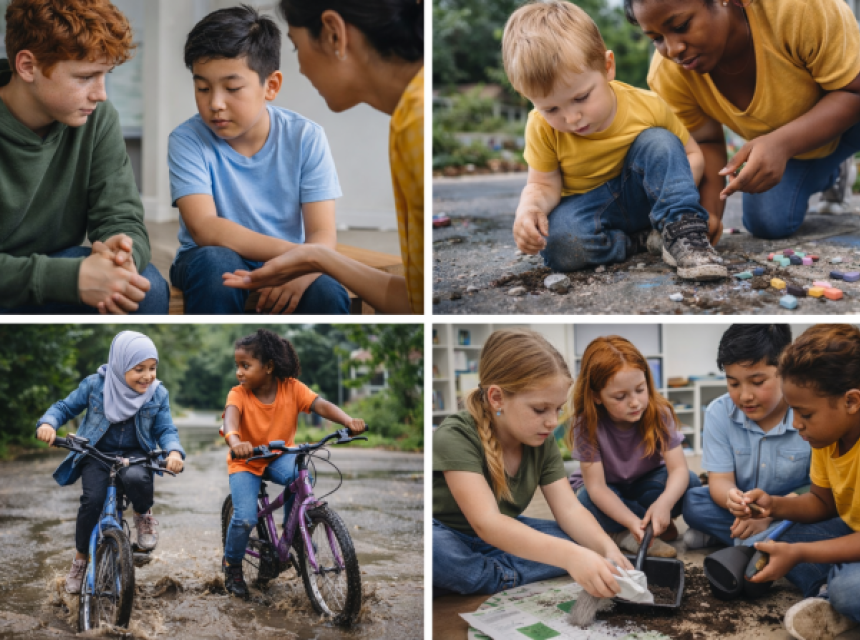
Why connection comes before content
In many education systems, learning is often treated as the transfer of information. A teacher delivers knowledge, and the learner is expected to absorb it. Yet anyone who has spent time with children or young people knows that learning is rarely this simple.
Before a word is spoken or a lesson begins, something else is already happening. Learners are sensing the emotional atmosphere of the space. They notice tone of voice, facial expressions, body language, and the quality of attention being offered to them.
In other words, learning begins in relationship.
Educational thinkers have long recognised that knowledge is constructed through interaction. Learning does not simply move from one mind to another; it emerges through dialogue, trust, curiosity, and shared experience. When learners feel seen, respected, and safe, their minds naturally open to exploration and growth.
This is where relational literacy becomes essential.
Relational literacy is the ability to be aware of ourselves and others in a learning environment. It includes listening, empathy, emotional awareness, and the capacity to respond rather than react. It asks educators, parents, and mentors to recognise that who we are in the room matters just as much as what we teach.
Children are especially perceptive in this way. They quickly sense authenticity, care, and presence. They can also sense tension, impatience, or disconnection. Educator Rita Pierson expressed this insight powerfully in her well-known talk when she said:
“Kids don’t learn from people they don’t like.”
Her message was not about popularity or entertainment. It was about the importance of relationship. When learners feel respected and valued by the person guiding them, trust grows. And trust creates the conditions where learning can flourish.
This does not mean every moment must be perfect or every relationship effortless. Rather, it invites adults to cultivate awareness. A child who feels disliked or judged may close down, while a child who feels understood is far more likely to engage.
When we begin to view learning as a relational field, the focus shifts. Instead of asking only “What am I teaching?” we begin to ask:
- What is the emotional tone of this space?
- Do learners feel safe and valued here?
- How am I showing that each individual matters?
These questions remind us that education is not only cognitive. It is deeply human.
When connection comes first, learning becomes more than the acquisition of knowledge. It becomes an experience of trust, curiosity, and shared discovery.
And in that kind of environment, both learners and educators grow together.
To listen to an interesting podcast on Relational Learning go to https://bbsradio/alllearningreminaged.
Recorded on to the 7th March 2026. See below for ideas to promote relational literacy use in any educational settings. Enjoy!
A Story: The Shift
There was a boy in a classroom who had gained a reputation. He called out during lessons. He struggled to sit still. Instructions were often followed by frustration. Each day the pattern repeated.
“Stop that.”
“Sit still.”
“Why are you always disrupting?”
The more the corrections came, the more the behaviour seemed to grow.
One morning, a different teacher stepped into the room. She noticed the same restlessness. The same fidgeting. The same wandering attention however, she began with curiosity and did not correct him. She walked quietly over and knelt beside him.
“I can see your body has a lot of energy today,” she said softly. “Do you need to move for a moment?”
The boy looked up, surprised. No one had asked him that before. She offered him a simple choice.
“You can stand at the back of the room for a minute, or you can help me hand out these books.”
He chose to help. As he moved around the room, something subtle shifted. It was clear he was no longer the problem and emerging as part of the process.
Later that day he joined the lesson more calmly than usual. Nothing dramatic had happened. The content had not changed. But the relationship had and when the relationship shifted, the learning field shifted with it.
Building Relational Literacy in Practice
Simple ways to strengthen connection in learning environments
Relational literacy grows through small, consistent practices. It is less about techniques and more about awareness of how we show up with others.
Below are several ways educators and parents can strengthen the relational field in everyday learning settings.
1. Begin with Connection
Before moving into tasks or content, take a few moments to acknowledge the individuals in the space.
A simple greeting, eye contact, or short conversation can make a significant difference.
Examples:
- “How are you arriving today?”
- “What has been on your mind this morning?”
- “Is there something you’re excited about today?”
These moments signal to learners that they are seen as individuals, not simply as students completing work.
2. Notice the Emotional Climate
Learning environments carry an emotional tone that everyone can feel.
Pause occasionally and ask yourself:
- Does the space feel calm or tense?
- Are learners relaxed or guarded?
- Is there openness to participation?
Small shifts in tone like slowing down, softening voice, allowing a pause, can transform the atmosphere of a room.
3. Respond Rather Than React
When challenges arise, a brief pause can help shift the interaction.
Instead of reacting immediately, try noticing what might be beneath the behaviour.
Questions to consider:
- What might this learner be experiencing right now?
- Is this frustration, fatigue, confusion, or a need for movement?
- What response might support them rather than escalate the moment?
This shift models emotional awareness and helps learners feel understood rather than judged.
4. Practice Reflective Listening
Sometimes learners simply need to feel heard.
If a child expresses frustration, reflect what you hear before offering solutions.
For example:
- “It sounds like this part is feeling difficult.”
- “I can see that you’re frustrated with this problem.”
When individuals feel acknowledged, they are more open to continuing the learning process.
5. Create Space for Voice
Relational learning thrives when individuals feel their perspectives matter.
Invite learners to share ideas, ask questions, and contribute to discussions.
You might ask:
- “What do you think about this?”
- “How would you approach this problem?”
- “Does anyone see it a different way?”
This reinforces that learning is a shared process rather than a one-way exchange.
6. Strengthen the Sense of Belonging
People learn more effectively when they feel they belong.
Simple practices can reinforce this:
- collaborative problem-solving
- group reflection circles
- acknowledging each learner’s strengths
When individuals feel that they are valued members of the learning community, participation increases naturally.
7. Reflect on the Relational Field
At the end of a learning session, educators and parents may find it helpful to ask themselves:
- Did the individuals in this space feel seen and respected?
- Did I respond with awareness and patience?
- What strengthened the sense of connection today?
These reflections help develop relational literacy over time.
8. Know Your Communication Style
Another important aspect of relational literacy is understanding that people often process information in different ways. When we recognise these preferences, communication becomes clearer and more respectful.
Many communication frameworks describe four broad tendencies. While individuals may express more than one style, most people lean toward one or two.
Visionary — “Why does this matter?”
These individuals tend to think in big pictures and possibilities. They are motivated by meaning and purpose.
They often want to understand:
- Why are we learning this?
- How does this connect to the larger vision?
- What difference could this make?
When speaking with visionary thinkers, begin with the purpose or intention before moving into the details.
Relational — “Who is involved?”
Relational communicators are attuned to people and connection. They often sense the emotional atmosphere in a space and value collaboration.
They may ask:
- Who will this help?
- How will this affect others?
- How can we work together on this?
With relational communicators, building trust and connection first helps create openness to learning.
Detail-Oriented — “How does this work?”
Some individuals prefer step-by-step clarity. They want to understand the process and structure behind a task.
They often appreciate:
- clear instructions
- logical sequencing
- time to work carefully through details
When working with detail-oriented learners, providing organised guidance and allowing time for precision supports their strengths.
Fact-Focused — “What is the key point?”
Fact-driven communicators tend to value efficiency and clarity. They often prefer information presented directly and concisely.
They may ask:
- What do I need to know?
- What is the outcome?
- What is the quickest way to understand this?
With these learners, keeping communication focused and purposeful helps maintain engagement.
Why This Matters in Learning
In many classrooms and learning environments, information is presented in only one style. Yet when communication acknowledges multiple preferences, more learners feel understood. For example:
- Begin with why the learning matters.
- Explain who it may benefit or involve.
- Show how it can be done.
- Clarify what the key outcome is.
By weaving these perspectives together, educators and parents create a learning environment that speaks to a wider range of individuals. Recognising communication styles also encourages self-awareness. When learners begin to understand how they prefer to receive and share information, they can communicate more effectively with others. This awareness strengthens the relational field and deepens relational literacy, helping learning become not just an exchange of information, but a process of understanding each other more fully.
A Final Thought
Learning is not isolated as it grows in the space between people through trust, attention, and genuine care. When we strengthen the relational field, we do more than improve learning outcomes. We create environments where individuals feel safe to explore, express themselves, and discover what they are capable of becoming. And in that kind of space, learning becomes something far richer than the transfer of information. It becomes a shared human experience.