All Learning Reimagined Podcast
Throughout human history, the circle has been one of our most universal learning spaces. From Aboriginal Australian yarning circles to Native American talking circles, from African palavers to Celtic gatherings, people have long understood that when we sit in a circle, something shifts. We see one another. We listen differently. We speak with more intention. We remember that learning, connection, and community were never meant to be linear or hierarchical they were meant to be relational.
In traditional societies, circles were used to share stories, pass on cultural knowledge, settle disagreements, plan seasonal responsibilities, and teach younger generations how to live well with one another and with the land. The geometry itself carries meaning: no one is at the “front,” no one is hidden, and everyone holds equal space.
Circles help us return to an ancient wisdom that modern education often forgets: every voice matters, and learning is strongest when it is shared.
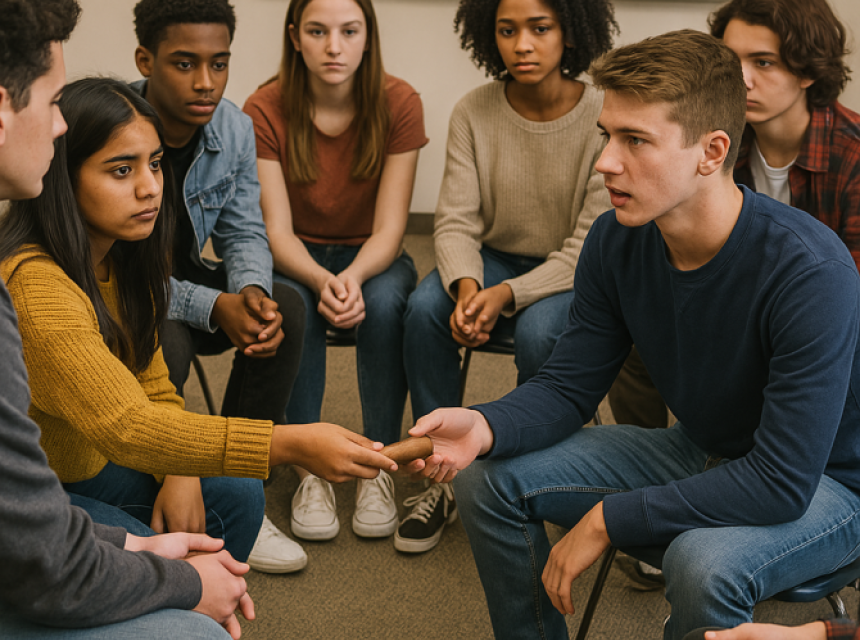
In today’s classrooms whether early childhood, primary, or secondary, the circle remains a powerful tool. It creates safety. It softens conflict. It strengthens community. It encourages young people to practice listening, empathy, and collective decision-making. Most importantly, it reminds students that leadership does not come from authority or position; it arises from responsibility, contribution, and presence.
A circle can be formal or informal. It can be a five-minute check-in or a full restorative process. It can be used to explore a story, solve a problem, celebrate a milestone, or make a choice that belongs to the whole group. When educators bring circles into their practice, they create spaces where students experience themselves not simply as individuals completing tasks, but as members of a community navigating life together.
In a world where young people face increasing division, noise, and uncertainty, the circle offers a simple and profound alternative:
-
a place to breathe
-
to be heard
-
and to hear others
-
A place to grow relational skills (empathy, perspective-taking, responsibility, collaboration) that will shape not only their schooling years but their lives.
The power of the circle lies not in the furniture itself, but in what it invites us to remember:
We learn best when we belong. We thrive when we feel seen. And we transform when we listen—to others, to the world around us, and to ourselves.
If this topic resonates, listen to the 22nd November 2025 podcast on All Learning Reimagined. See below for resources and ideas to introduce circles in educational settings. Scroll down on this page for all archived shows and past articles and resources.
Classroom Activities to Get Started
Here are simple, practical circle-based activities for teachers at any year level. Each requires minimal preparation and supports connection, communication, and emotional intelligence.
1. Feelings Check-In Circle
All ages (5–18)
Purpose: Build emotional literacy and a safe classroom culture.
How it works:
- Students sit in a circle.
- A talking object (stone, shell, soft toy) is passed around.
- Each student shares one word or sentence describing how they feel today.
- No discussion—just listening.
Variations:
- Older students can add a “why” if they choose.
- Younger students can use picture cards or facial expression cards.
2. Appreciation Circle
All ages
Purpose: Strengthen relationships and belonging.
How it works:
- Students take turns sharing something they appreciate about the class, learning, or a peer (not naming individuals for younger grades unless appropriate).
Optional:
- Close with a class “thank you” breath or gesture.
3. Conflict Resolution / Restorative Circle
Primary & Secondary
Purpose: Repair relationships and restore harmony.
Steps:
- Restate the purpose (to understand, not to blame).
- The person harmed speaks first, holding the talking object.
- Others respond when they receive the object.
- Students share how the situation affected them.
- As a group, propose solutions or agreements.
- Close with a positive statement or gratitude.
4. Decision-Making Circle
Upper Primary & Secondary
Purpose: Promote agency and collective ownership.
Suggested flow:
- Present the question (e.g., “What project should we do next?”).
- Idea round: each student offers an idea.
- Clarifying round: questions only.
- Impact round: pros/cons.
- Choice round: hands, tokens, or consensus.
5. Story Circle
Early Childhood to Lower Secondary
Purpose: Build oral language, creativity, and listening.
How it works:
- One student starts a story with a single sentence.
- Each person adds a sentence as the talking object moves around the circle.
- Encourage imaginative, playful contributions.
6. Strengths Circle
Years 3–12
Purpose: Promote positive identity and peer recognition.
How it works:
- Students share a strength they see in themselves or in the class.
- Optional extension: peers can (respectfully) share a strength they notice in someone else.
7. Problem-Solving Circle
Years 4–12
Purpose: Develop collective reasoning.
Steps:
- Present a problem (environmental, social, classroom-based).
- Students brainstorm all possible solutions (no judgement).
- Circle evaluates the ideas.
- Choose one to try as a group.
8. Calm & Mindful Circle
All ages
Purpose: Reset energy, reduce stress, increase focus.
Ideas:
- One-minute silence
- Guided breathing
- Each student shares one thing they’re grateful for
- Nature sound visualization
9. Inquiry & Thinking Circle (Socratic Circle)
Years 5–12
Purpose: Deepen thinking, questioning, and respectful debate.
How it works:
- Provide a short reading, image, or video.
- Students sit in a circle and ask open-ended questions.
- Teacher facilitates gently, avoiding leading questions.
- Encourage students to build on one another’s ideas.
10. Class Agreements Circle
All ages
Purpose: Create shared expectations and community norms.
Steps:
- Ask: “What helps us learn well together?”
- Students propose agreements.
- The group chooses 5–7.
- Display them as “Our Circle Agreements.”